




Abstract
In this study, low-density polyethylene (LDPE) and polyaniline (PANI) were used as a modifying agent for bitumen of grade 60/70. A composite material was synthesized by mixing LDPE, toluene, and PANI powder in bitumen to investigate structural, mechanical, and dielectric properties. Four samples with varying content of LDPE/PANI were prepared. The structural property was analyzed by using X-ray diffraction. From the results, it has been analyzed that LDPE introduces crystallinity into the structure to some extent. Mechanical properties were analyzed by using penetration by grade, softening point, fire and flash point, and ductility. It was observed that incorporation of LDPE/PANI enhances the stiffness of samples which causes a reduction in penetration and ductility values. The softening point increases from 54°C to 69°C as LDPE/PANI content increases from 0 to 8% respectively. Similarly, fire and flash point increase from 240°C to 342°C and 235°C to 342 as LDPE/PANI content increases. Dielectric properties were investigated using dielectric constant, dielectric loss, and tangent loss. Results revealed that dielectric properties were also affected with the incorporation of LDPE/PANI content. High dielectric constant and high losses were observed as we increased the content of LDPE/PANI.
Introduction
Bitumen is a highly viscous, dense black sticky petroleum-based hydrocarbon. Its chemical composition and structure are complicated and depend on the method of extraction. 1 It is usually extracted through distillation of crude oil and has a general formula CnH2n + 2 where n is the number of carbon atoms in hydrocarbon chains. It is extracted through distillation of crude oil. It possesses adhesive properties and has a wide range of applications mainly in road construction and waterproofing. 2 Based on hardness and consistency, bitumen is categorized into 30/40, 40/50, 60/70, and 80/100 grades. Despite its wide range of applications material possesses some limitations also. 3
One of the important features of this material is to hold the aggregate and act as a binder in pavement of roads. However, at elevated high temperatures, its binding ability is affected. 4 Thus, the expansion of bitumen at high temperatures occurs and causes thermal cracking in roads. Also, infiltration of water causes softening of binder which damages the overall structure. In addition to that, limited dielectric literature is available on this material. This paper aims to address these limitations through bitumen modification.
Currently, various methods are being employed to modify bitumen including physical, chemical, and biological methods. 5 The Physical method is considered to be the most common, easy and inexpensive in nature. This paper aims to study the interaction of low-density polyethylene (LDPE) and polyaniline (PANI) with neat bitumen to explore their modified mechanical and dielectric properties.
Literature review
Ali Akbar et al. investigated the effect of rubber on properties of neat bitumen. Rubbers acted as a good modifier as it improves the properties of bitumen. The incorporation of rubbers into neat bitumen resulted in enhancement of the softening point and lowering of penetration by grade values. Lower values of penetration by grade indicate an increase in stiffness of samples. Polybutadiene rubber (PBR) made a sustained phase mixture in a binder. It was mainly due to the higher compatibility of rubber with neat bitumen. The increased amount of rubber increases the temperature susceptibility of polymer-modified bitumen. This improved its performance at higher temperatures. 6 Kashif et al. investigated the effect of waste plastic including gas pipes and plastic bottles on neat bitumen. Five samples with various contents of plastic were made and subject to multiple tests to check their suitability in the pavement industry. It has been observed as the content of plastic increased; there was a significant drop in penetration and ductility values. However, softening point rose with the increasing content of plastic. The author observed that the service life of roads could be enhanced with the incorporation of degraded plastic in neat bitumen. 7 Abbas al-hadabi et al. used nano carbon to alter the properties of neat bitumen. Various tests include penetration, softening, ductility, marshal stability, and indirect tensile strength (ITS) been carried out to check out its potential in the bituminous industry. Results showed an increase in marshal stability and ITS. Increase in marshal stability indicates an increase in strength of material as marshal stability defines the maximum load a specimen can withstand before failure. Both-marshal stability and indirect tensile strength- are indicators of strength against temperature, cracking and rutting. A decrease in penetration and ductility was observed after the incorporation of nano carbon in bitumen. 1% is found to be the optimal value for nano carbon. 8 N.H. daniel et al. improved the properties of neat bitumen by using latex. It was observed incorporation of latex in 60/70 grade bitumen led to an increase in stiffness of material which affects the viscosity and penetration test of bitumen. Viscosity increases as the amount of the latex increased in the samples. The author also observed that the samples ability to hold aggregate at high temperature also increases with an increase in latex. 9 Malik shoeb ahmad et al. modified the properties of neat bitumen of grade 60/70 by incorporating polyethylene terephthalate (PET). A result indicates that PET modified sample showed better performance as compared to non modified bitumen sample. PET improved the engineering properties including penetration, softening, fire, flash, and ductility values. Various samples were prepared by adding PET ranging from 2 to 14%. Addition of PET ranging from 10 to 14% (by weight of bitumen) showed promising results. 10 S. Sadeghpour et al. utilized styrene-butadiene-styrene (linear and branched) and organophilic montmorillonite (OMMT) to modify bitumen properties. The Structure of samples was characterized by using XRD technique. A superior exfoliated structure is formed after the incorporation of nano clay OMMT in SBS modified bitumen. Physical tests were performed to evaluate the performance of nano clay and SBS modified samples. Presence of nano clay significantly altered the properties of SBS modified bitumen. 11 Feng chen et al. performed dielectric measurements on neat bitumen and wax modified bitumen in a frequency range of 10−2-106 Hz. It was found that the dielectric constant is highly dependent on frequency and temperature. At low frequencies, high value of the dielectric constant was observed. However, as frequency increases, dipolar polarization cannot align with the rapidly oscillating field and results in a decrease in the value of the dielectric constant. At higher frequencies, the dielectric constant showed no change in value. The author also calculated dielectric loss and tangent loss. 12
This study focuses on improving the mechanical and dielectric properties of neat bitumen through physical modification. For that purpose, low density polyethylene (LDPE) and polyaniline (PANI) were incorporated to alter the properties of neat bitumen.
Problem statement
Rutting is one of the limitations of bitumen. At higher temperatures, the binder melts and expands which causes thermal cracking. This problem is dominant in warmer regions. Various polymers have been incorporated into neat bitumen for this purpose. However, incorporation of such polymers limits to improve only mechanical properties. This study aims to improve mechanical as well as dielectric properties by using an insulating and conducting polymer.
Materials and experimental procedure
Materials
Physical properties of bitumen of grade 60/70.

Experimental procedure
Synthesis of PANI
The chemical oxidative polymerization technique is one of the widely used techniques for the preparation of polyaniline. For this purpose, initially, 10 ml of aniline monomer in 10 ml de-ionized water was taken into beaker 1 and put on a magnetic stirrer for homogeneous mixing. 1 M HCl solution (5 ml) was added dropwise into beaker 1 with the help of a dropping funnel. 12.25 g of APS was added in 10 ml of de-ionized water in a beaker 2 and kept on stirring until it was completely dissolved in de-ionized water. A mixture of beaker 2 was then slowly added into beaker 1 to initiate the process of polymerization. The solution was kept on stirring for almost 3 h and then left for 24 h. After 24 h, the solution was filtered and then dried in the furnace at 70°C to obtain fine powder.
Synthesis of LDPE/PANI bitumen composites
Four LDPE/PANI modified bitumen samples were prepared while keeping LDPE/PANI ratio at 1:1. To get better dispersion and homogenous mixing, LDPE was initially dissolved in toluene through the process of reflux heating.
To obtain polymer modified bitumen samples, a high shear mixer with an rpm of 3000 was used for almost 2 h. Temperature was maintained at 160°C. In a typical procedure, bitumen was initially heated until it converted into liquid form. LDPE dissolved in toluene was then slowly added into neat bitumen. Meanwhile, PANI powder was also added and allowed vigorous mixing (3000 rpm) at 160°C for 2 h to get final polymer modified samples (PMB). Four samples with increasing content of LDPE/PANI (2%, 4%, 6%, and 8% by weight) were prepared and named PMB2, PMB4, PMB6, and PMB8 respectively.
Various tests were conducted to explore the structural, mechanical, and dielectric nature of polymer modified bitumen samples.
Results and discussions
X-ray diffraction
Figure 1 shows the x-ray diffraction of bitumen, pure PANI, LDPE and composites respectively. Since bitumen consists of complex hydrocarbons, it mainly shows amorphous nature.
13
Bitumen complex structure hinders efficient packing into crystalline lattices. PANI also exhibits an amorphous nature.
14
A broad peak is observed at 2θ values between 18 and 24°. LDPE shows semi-crystalline nature. Two major peaks were observed at 2θ = 21.43° and 2θ = 23.82° corresponding to (110) and (200) planes respectively.
15
The peak observed at 2θ = 21.43° was found to be the strongest peak and reflects the orthorhombic structure of polyethylene. These two peaks gave primary reflections which were observed in XRD analysis. Rest of the structure shows amorphous regions, due to the higher degree of branching present in LDPE as shown in Figure 1(c). Broader peaks observed at lower angles and two major peaks of LDPE were observed in all composites which confirm the successful synthesis of polymer modified samples. The intensity of peaks increased with the increasing content of polymers as shown in Figure 1(d)-(g). XRD analysis of (a) Bitumen (b) PANI (c) LDPE (d) PMB2 (e) PMB4 (f) PMB6 (g) PMB8.
Mechanical properties
Penetration by grade
This test basically evaluates the hardness or consistency of materials with the help of a penetrometer apparatus. 16 The hardness or softness of the material can be evaluated by measuring the penetration of the needle in material in millimeters up to 5 s and at 25°C. The greater the penetration of the needle, the softer will be the material and vice versa. A needle of 1 mm in diameter and 50 mm in length was used to match the standard values.
From Figure 2, it is clear that penetration decreases significantly from 69 to 18 as we increase LDPE/PANI content from 0 to 8% respectively. LDPE is a thermoplastic polymer with long branched chains that may affect bitumen, causing a more rigid and complex structure and making the material harder. Moreover, PANI also possesses high rigidity and might act as filler within a bitumen matrix that limits bitumen flow ability and cause an increase in stiffness of material. The lower values of penetration indicate greater resistance to deformation under high temperature and load. The significant reduction in penetration values with increasing LDPE/PANI content highlights a clear trend of increased stiffness and structural rigidity in the bitumen matrix. This behavior aligns with findings from polymer and filler modified bitumen in the past studies.
17
Effect of LDPE/PANI content on penetration by grade.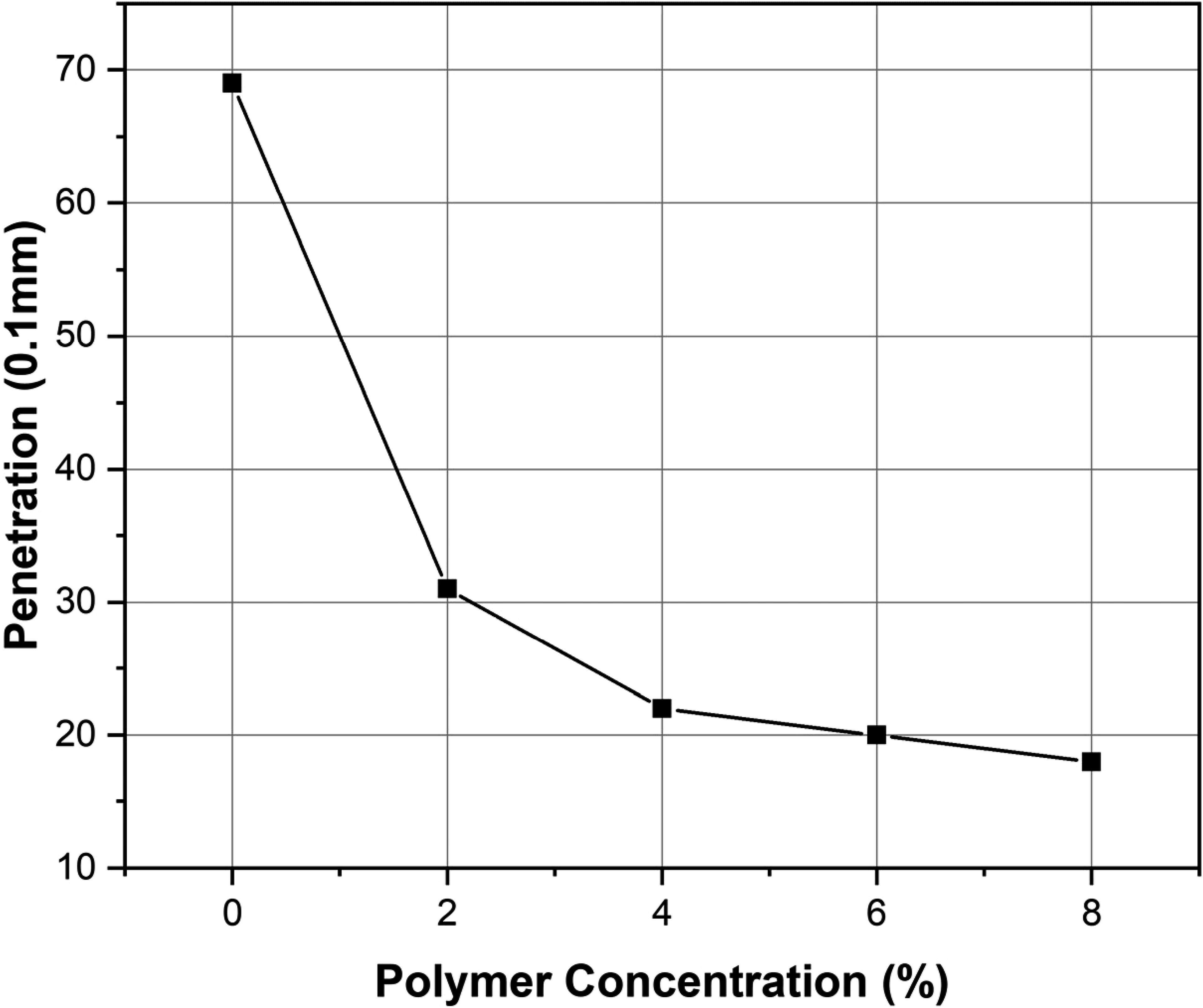
Softening Point
The softening point is defined as the temperature at which phase change occurs in bitumen or bitumen attains particular degree of softening. The test occurs under specific conditions. The greater the softening point, the greater will be the temperature bearing ability of the material or less temperature susceptibility of the material and vice versa. 18
From Figure 3, it is evident that with the increasing content of LDPE/PANI, the softening point increases significantly. Value increased from 54° to 69° as increase in polymers content from 0 to 8% respectively. From previous penetration test, it is evident that the incorporation of LDPE/PANI results in an increase in the stiffness of the material. This increased stiffness could be the reason for the increased softening point of the material as more energy is now required to soften the material. Moreover, from XRD results it is clear that LDPE introduces semi crystalline phase in bitumen. To break this structure more heat energy will be required which can contribute to increasing the values of the softening point. The significant increase in softening point with increasing LDPE/PANI content highlights an enhance thermal resistance and structural stability of modified bitumen. This increasing trend in the softening point is quite similar with the findings of styrene butadiene styrene (SBS) modified bitumen conducted in the past.
19
Effect of LDPE/PANI content on softening point.
Fire and flash points
Fire point is defined as the minimum temperature at which vapors of liquid or material catch fire and continue burning for at least 5 s even after the ignition source is removed. While flash point indicates how easily a chemical or material burns if exposed to a flame or temperature. It defines the safety of materials. Materials will get easily ignited if their flash point is low.
From Figure 4(a) it is clear that fire point values increase with the increasing content of LDPE/PANI. As discussed earlier, the incorporation of LDPE/PANI leads to an increase in softening point which means bitumen can stay solid at elevated temperature thus decreasing the likelihood of the formation of volatile gas that can be ignite. Moreover, at elevated temperatures, LDPE is relatively less volatile than bitumen. The incorporation of LDPE in bitumen may reduce the release of volatile vapors which may easily be ignited. Thus fire point increases significantly. Similarly, flash point also increases with the increasing content of polymers. As the thermal decomposition of LDPE usually occurs above 300°C, it doesn’t break down into volatile vapors or components at lower temperatures. Thus flash point increases with increasing content of polymers. Effect of LDPE/PANI content on (a) fire and (b) flash point.
Ductility
Ductility is defined as the material’s elasticity and its stretching ability before breaking. The ductility of bitumen samples is measured by the distance in centimeters (cm) to which samples elongate before breaking at a specific temperature and speed. The higher the ductility more will be the flexibility of bitumen samples to tolerate deformation.
From Figure 5, it is clear that ductility decreases drastically as we increase the content of LDPE/PANI. The incorporation of LDPE/PANI makes a polymer network that enhances the overall strength of the bitumen structure. Although this polymer network improved some properties including thermal stability, durability, and safety, it also affected the material elongation ability. Also, incorporation of LDPE introduces a crystalline phase in samples; this crystalline structure hinders the stretching ability of material thereby reducing samples ductility. In systems where polymers are combined with fillers or other polymer, a compounded reduction in ductility is frequently observed. Similar trends have been observed in SBS-carbon black modified bitumen study.
20
Effect of polymer content on ductility.
Dielectric properties
Dielectric constant
Figure 6 shows the dielectric constant versus frequency for bitumen and composites PMB2, PMB4, PMB6, and PMB8 respectively. The dielectric constant was calculated using the following equation
21
; Effect of LDPE/PANI on the dielectric constant.

From Figure 6, it is clear that the dielectric constant decreases with increasing frequency as it is a common behavior in materials. 22 This decrease in dielectric constant is largely due to dipolar relaxation and interfacial polarization. At lower frequencies, interfacial polarization plays a vital role as charge carriers have enough time to gather at interfaces. However, these charge carriers don’t have sufficient time to gather and redistribute at interfaces as the frequency increases. This leads to an overall reduction in dielectric constant at higher frequencies.
The Incorporation of LDPE/PANI improved dielectric constant values. With the increasing content of LDPE/PANI, the dielectric constant value also increases. This is largely due to the conducting nature of PANI. PANI has a high dielectric constant because of its ability to polarize under an applied electric field. The incorporation of PANI generates more charge carriers that enhance the overall polarization of samples. This increase in polarization caused higher values of the dielectric constant.
Dielectric loss
The complex dielectric loss occurs in the samples due to defects, pores, and heterogeneity in the structure of the samples. This loss causes heat dissipation in the samples. Figure 7 shows the dielectric loss of bitumen and polymer modified composites. It is observed with the increase in frequency values the dielectric loss decreases while at high frequencies dielectric loss becomes almost constant. Dielectric loss increases with the increased content of LDPE/PANI as the polymers introduce more heterogeneity in the structure. Moreover, the conducting nature of PANI introduces more charge carriers in samples. When an electric field is applied these charge carriers lead to larger energy dissipation in heat form. Thus dielectric loss increases. Effect of LDPE/PANI on dielectric loss.
Tangent loss
Tanδ is called loss tangent and it is frequency dependent. For an alternating field of a given frequency, when it is applied on a dielectric it will take some time to polarize the dielectric material. This time difference can be represented by a phase term δ, called loss angle and Tanδ is called dielectric loss tangent. It is calculated by following equation
23
;
It is observed for all the samples, bitumen and LDPE/PANI bitumen composites that tangent loss decreases continuously as the frequency of the alternating fields increases as shown in Figure 8. Effect of LDPE/PANI on Tangent loss.
Due to the conductive losses from PANI and heterogeneity in samples, tangent loss also increases with increasing content of PANI/LDPE. The heterogeneity of samples introduces more interfaces between bitumen, LDPE, and PANI. The interaction occurring at interfaces might cause additional energy loss which leads to an overall increase in tangent loss.
Conclusion
In this study low-density polyethylene (LDPE) and Polyaniline (PANI) were used as modifying agents for neat bitumen. The effect of the concentration of LDPE/PANI on bitumen has been studied intensively. Structural, mechanical, and dielectric properties were investigated. It has been observed that the properties of neat bitumen can be modified by the incorporation of LDPE/PANI in samples. XRD results revealed that LDPE introduced crystallinity in samples to some extent leading to an enhanced structural order. A decrease in penetration indicates sample became harder and less susceptible to deformation. An increase in softening point suggests the improved thermal stability of samples making it suitable for those areas where higher thermal stability is required. While fire and flash point indicates improved resistance to ignition. Thus these samples are suitable for fire resistant coatings also. However, the incorporation of LDPE/PANI affects the stretching ability of samples and causes a reduction in ductility. Dielectric properties are also affected by the addition of LDPE/PANI content. Increased values of dielectric constant and dielectric loss make these samples suitable for capacitors and insulating layer applications. Moreover, improved thermal stability and hardness with reduced ductility make these samples also suitable for waterproofing membranes.
Footnotes

Funding
The authors received no financial support for the research, authorship, and/or publication of this article.
Declaration of conflicting interests
The authors declared no potential conflicts of interest with respect to the research, authorship, and/or publication of this article.