



Abstract
The underlying investigation reports the effects of the magnetohydrodynamics (MHD) and non-linear slip coefficients on the coating thickness of the web/substrate during the blade coating process. Two dimensional analysis of the blade coating process is performed using non-Newtonian nanofluid model with the help of basic equations of fluid dynamics are performed. Firstly, the system of equations of motion (EOM) is transformed into the non-dimensional form by using the scaling factors. Secondly, the modeled equations are further simplified with the help of lubrication approximation theory (LAT). The resulting boundary value problem is transformed into stream function to eliminate the pressure gradient from the flow equation and then numerically tackled with the Matlab built-in function bvp4c with the method of false position (Regula-Falsi Method). A comparative study of numerical data with results simulated by artificial neural networks (ANN) found that results are in excellent agreement. The impact of sundry parameters on physical quantities is examined through graphical representation. Results indicate that the influence of magnetohydrodynamics (MHD), nanoparticle and slip effects cannot be ignored during the blade coating flow, as a significant impact of these parameters is observed on velocity, temperature, pressure, coating thickness, blade load, and streamlines.
Keywords
Introduction
Blade coating process gained an ample importance in coating technological because of its vast application in the electronics industry, paint industry and coating a thin layer on the stores information device. In the process of polymer processing, metals and synthetic materials are frequently coated with nitrocellulose, silicone, epoxy, acrylic, phenolic, silicone, and polyvinyl chloride, among other compounds. Coating materials used in design and construction is accomplished through a variety of ways.1–5
In the beginning the coating process was explained by Landau and Levich, 6 who performed a mathematical analysis of dip-coating process of a liquid film. Greener and Middleman 7 discussed the process of blade-coating of a viscoelastic fluid under the usual lubrication approximation theory (LAT) and found the solution with the help of perturbation method. They observed that a small increment in coating thickness reduces the pressure. Hsu et al. 8 analyzed the blade coating process both theoretically and experimentally of viscous and viscoelastic liquids. They solved the equations by means of perturbation method and finite element method and compared the results. Sullivan and Middleman 9 examined both theoretically and experimentally coating of viscous and viscoelastic liquids. Sullivan et al. 10 demonstrated the blade coating mechanism using viscous and non-Newtonian fluids using finite element algorithm. The primary investigation on the blade coating process using Newtonian and power law fluid was explained in the middleman 11 book and Ruschak 12 paper. Different researchers done a lot of worked on the blade coating process theoretically as well as experimentally using different fluid models to see the impact of the material parameters on the pressure, coating thickness in their articles.13–18 Ross et al. 19 suggested an asymptotic solution for the power law fluid model in their research of the blade coating process, comparing their results to those proposed by Hwang. 20
Sajid et al.21,22 presented their study on the blade coating using Newtonian and non-Newtonian fluid models for both planer and exponential coater. They find the solutions of their problems both analytically and numerically using perturbation and numerical method like shooting algorithm. They have discussed the impact of the slip condition and magnetohydrodynamics (MHD) on the coating thickness and blade load in detailed. The process of blade coating using Oldroyd 4-constant model discussed numerically using shooting method by Shahzad et al. 23 The impact of slip condition and MHD using Newtonian fluid under the LAT approximation for the case of flexible blade coater was discussed analytically by Wang et al. 24 Mughees et al. 25 presented the heat transfer analysis using couple stress model to elaborate the viscous dissipation effects on the blade coating mechanism. Mitsoulis 26 examined blade over roll coating process using Boger fluid. Kanwal et al. 27 investigated blade coating phenomena using micropolar. They discussed the effects of the coupling and microrotation parameters on the mechanical quantities of the blade coating process. Numerous scholars have looked analytically and numerically at studies on the blade coating process using various non-Newtonian fluid models under the premise of Lubrication Approximation Theory (LAT). Their investigations’ primary goal was to comprehend how material characteristics affected the crucial elements of the blade coating process.28–30 Abbas and Khaliq 31 used the Jeffery fluid model to see the impact of the material parameter on the mechanical quantities. Another paper Abbas et al. 32 Discussed the blade coating mechanism using Sutterby fluid under the isothermal condition. Khaliq and Abbas,33,34 demonstrated isothermal and non-isothermal blade coating process using viscous fluid with temperature variable properties and simplified Phan‐Thien‐Tanner fluid model. More recently, a thorough analysis of nonisothermal blade coating with a non-Newtonian nanofluid that includes magnetic, thermophoresis, Brownian slip, and MHD effects is given by Javed et al.35,36
The fluid composed of the small nano particles and liquid has its significant characteristics in different fields of science. It has unique rheological properties which differentiate it from the ordinary fluids. In the coating industries different types of fluid were used to protect the material and increase it life and efficiency. The application of nanomaterial over the material has better impact rather than the ordinary fluid. It is another important factor that for higher concentration nano fluids behave like the non-Newtonian fluids which more beneficial for the coating process. The study of hybrid nanofluids with magnetohydrodynamic (MHD) effects for various physical phenomena and different non-Newtonian models is presented in these articles.37–40 In these studies authors used ANNs to predict the fluid behavior and heat transfer rate. An experimental study is done by Gupta et al. 41 They used nano-fluid as a coating material to the pipe and found that it is more efficient for the heat transfer enhancement. Esmaeilzadeh et al. 42 CuO/TiO2 nano particles for the coating purpose. These studies explain the growing interest and potential of blade coating nano-fluids in various fields, including thermal management, surface engineering, and functional coatings.
The purposes of the current investigation are to explore the effects of MHD and slip using non-Newtonian fluid on the velocity of the molten polymer sheet, pressure, blade load, and final sheet thickness. The structure of the current study is as follows. The literature survey discussed first, followed by the prsentation of the mathematical equations and flow configuration. Next, the numerical findings and discussions are provided. Finally, the study concludes with the succinct summary.
Flow geometry
Two dimensional analysis of the blade coating mechanics is demonstrated in Figure 1. In this analysis, we consider that substrate having length L moving along the positive x-axis with uniform velocity U and the rigid blade is fixed at height Diagram of a blade coating process and its variables.
Mathematical formulation
In order to investigate the impact of the slip, MHD, heat transfer and nanofluid in the blade coating process, we use the basic equations of fluid dynamics for incompressible are demonstrated as




In equation (2)

In equation (2)
The Maxwell equation incorporating with Ohm’s law can be written as;

The associated boundary conditions on the polymer velocity, temperature and nanoparticle volume fraction for the blade coating analysis are defined in the following manner.




The velocity field for two-dimensional flow is provided as

The components form of equations (1)–(5), using equation (11)








To made flow equations and boundary conditions in dimensionless form, introducing the normalized variables and parameters as.

We can represent equations (13)–(20) in the following manner by utilizing dimensionless variables:




In the coating process the flow is creeping type in which the Reynolds number is very small and the gap between the web/substrate and blade is







To find the value of

Using the value of

It is evident from equation (31), that pressure is only a function x, to eliminate pressure gradient from equation (38), we differentiate equation (38) with regard to


Converting equations (32), (38), and (39) and boundary conditions into stream function with the help of equation (40), we get



Equation (48) is fourth order differential, we have used the volumetric flow rate formula to find two more extra boundary conditions which are needed as follows.

The following condition on the pressure at inlet

Pressure is computed numerically using the following relation

The blade load is computed as follows:

The unknown parameter
Result and discussion
This section includes the discussion of the results that were obtained numerically for viscoelastic parameters (
Velocity profiles
Figure 2(a) and (b) demonstrated the influence of the MHD and slip parameters on the molten polymer velocity with fixed values of the other parameters. Figure 2(a) and (b) show that velocity of the molten polymer enhancing near the substrate/web and reducing near the blade with increasing both MHD and slip parameters values. This enhancement in velocity profile indicates that the magnetic field effectively accelerates the flow of the polymer. This mechanism can be particularly beneficial in the blade coating process, as a higher velocity implies a faster coating process. Consequently, utilizing a magnetic field can significantly improve the efficiency and quality of the coating operation. The increase in slip coefficient produces less resistance and greater relative motion between the molten polymer and the substrate. This reduction in friction allows the polymer to flow more freely and rapidly near to the surface. The reduced friction at the interface can minimize damage on the coating equipment which extends its operational lifespan and reducing maintenance costs. (a,b) Effects of MHD (M) and slip parameter (η) on the velocity profiles.
Temperature profiles
The effect of the magnetic field, slip coefficient and Brinkman number on the temperature (left panel) and concentration (right panel) profiles is presented in Figure 3(a)–(d). It seen Figure 3(a) that Magnetic field intercept the fluid motion and in result random motion of the particles of molten polymer increase which leads to increase the kinetic energy, subsequently thermal energy gets increase which enhance the temperature of the molten polymer. Increasing the slip coefficient reduces the friction at the substrate which results in an increase in velocity near the substrate. The increase of velocity near the substrate increases the temperature of the polymer due to viscous dissipation shown in Figure 3(c). In Figure 3(e) the influence of the Brinkman number (Br) on the temperature profiles of the molten polymer is analyzed for plane coater. The results indicate that as the value of Br increases, the temperature of the molten polymer increases. In Figure 3(b), the impact of the magnetic parameter on the concentration of nanoparticles within the molten polymer is analyzed. The results indicate that the increase of magnetic field strength reduces the concentration of nanoparticles in the molten polymer for plane coater. Similarly, Slip coefficient and Brinkman number follow the same trend as the magnetic field, this trend are presented in Figure 3(d and f). By adjusting the Brinkman number, we can control the heat and concentration to optimize the industrial processes. (a-f) Effects of MHD, slip parameter and Brinkman number on the temperature (left panel) and concentration (right panel).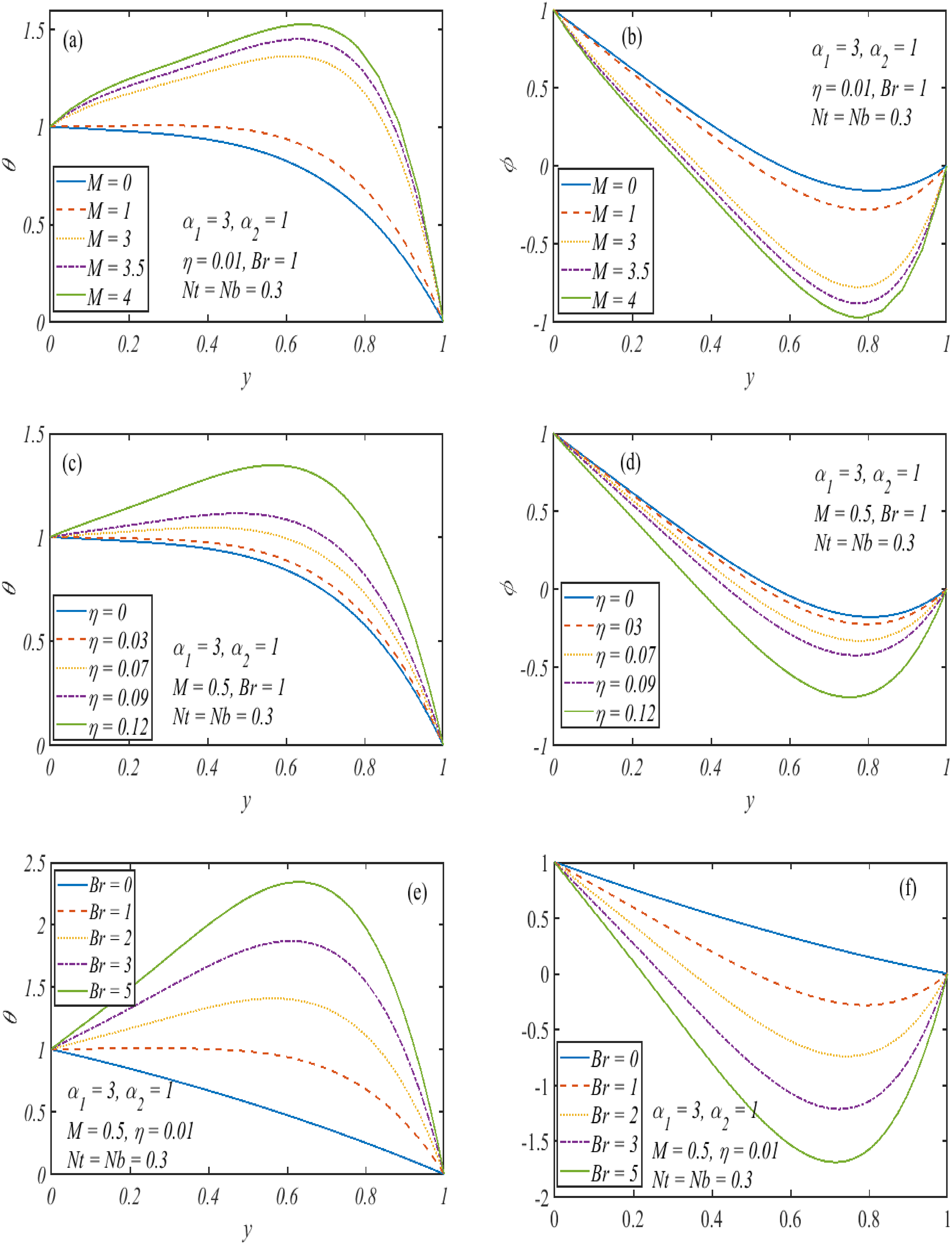
Pressure distribution
In Figure 4(a–d) the effects of the magnetic field, slip coefficient (a-d) Effects of MHD, slip parameter, 
Shows the variation in thickness (h1) and load (∏) for different values of the MHD parameter M.
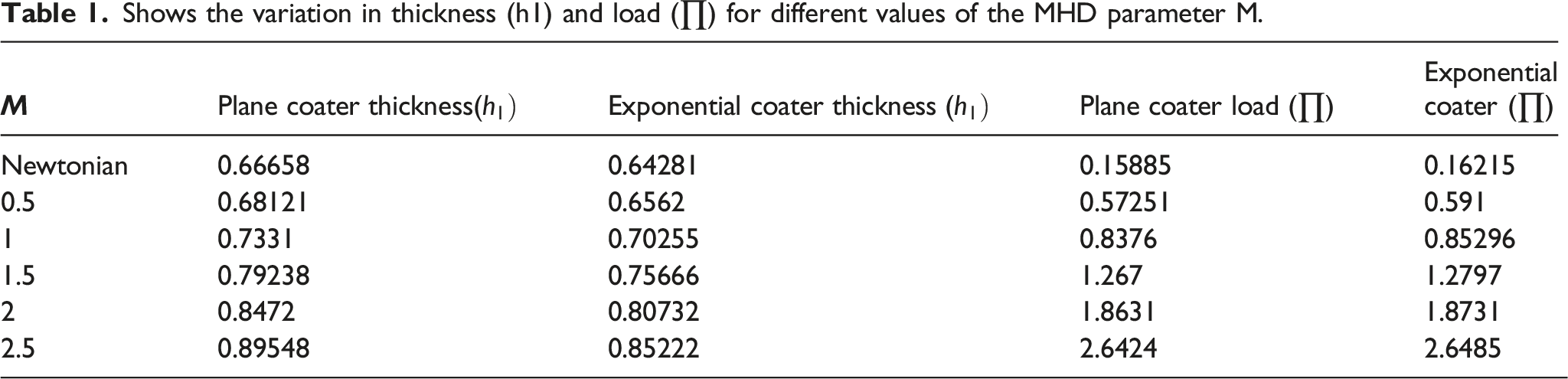
Shows the variation of the thickness (

Table 2 reveals that as the slip parameter (
Artificial neural networks (ANNs)
Different scenarios for artificial neural networks (ANN) analysis.


(a, b) ANN based Result and numerical reference results of NIS-BCP.
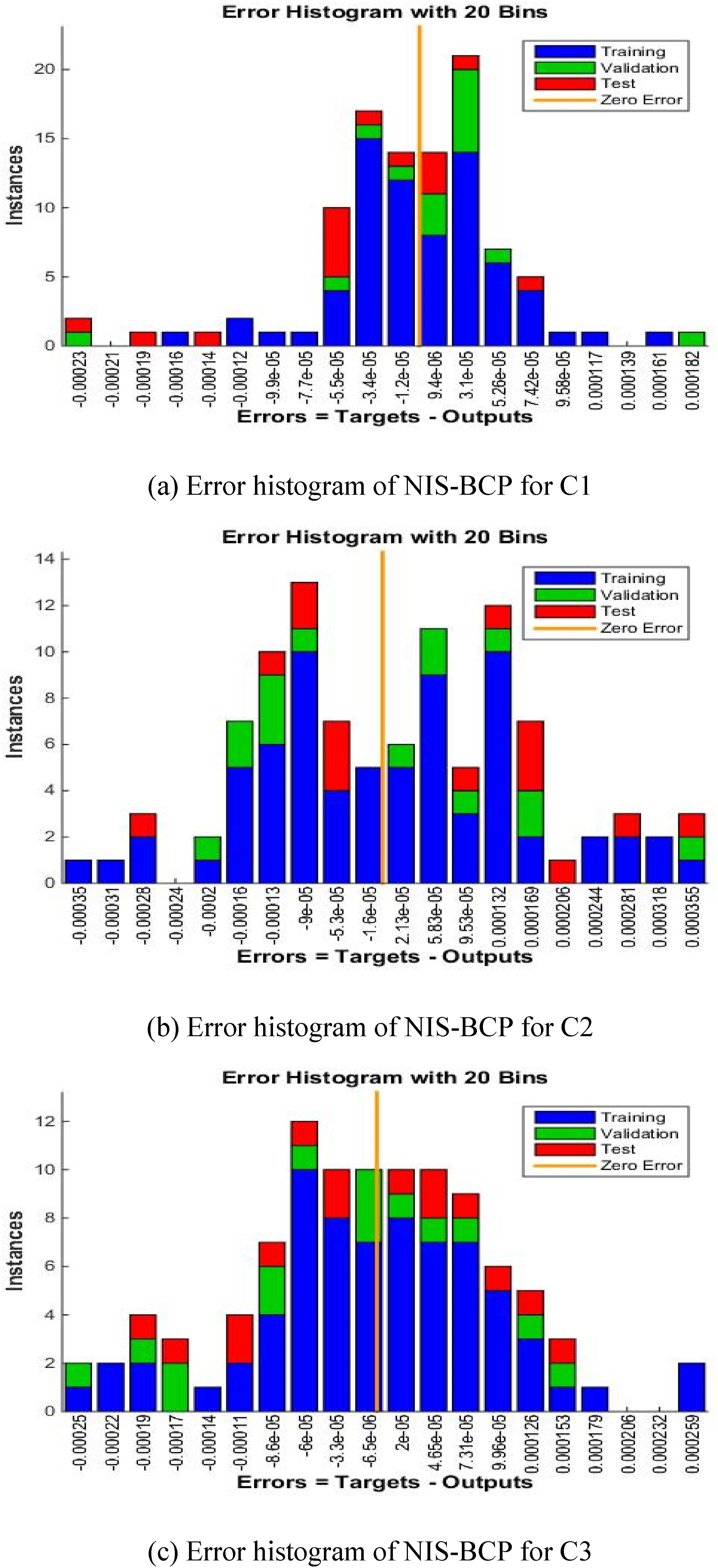
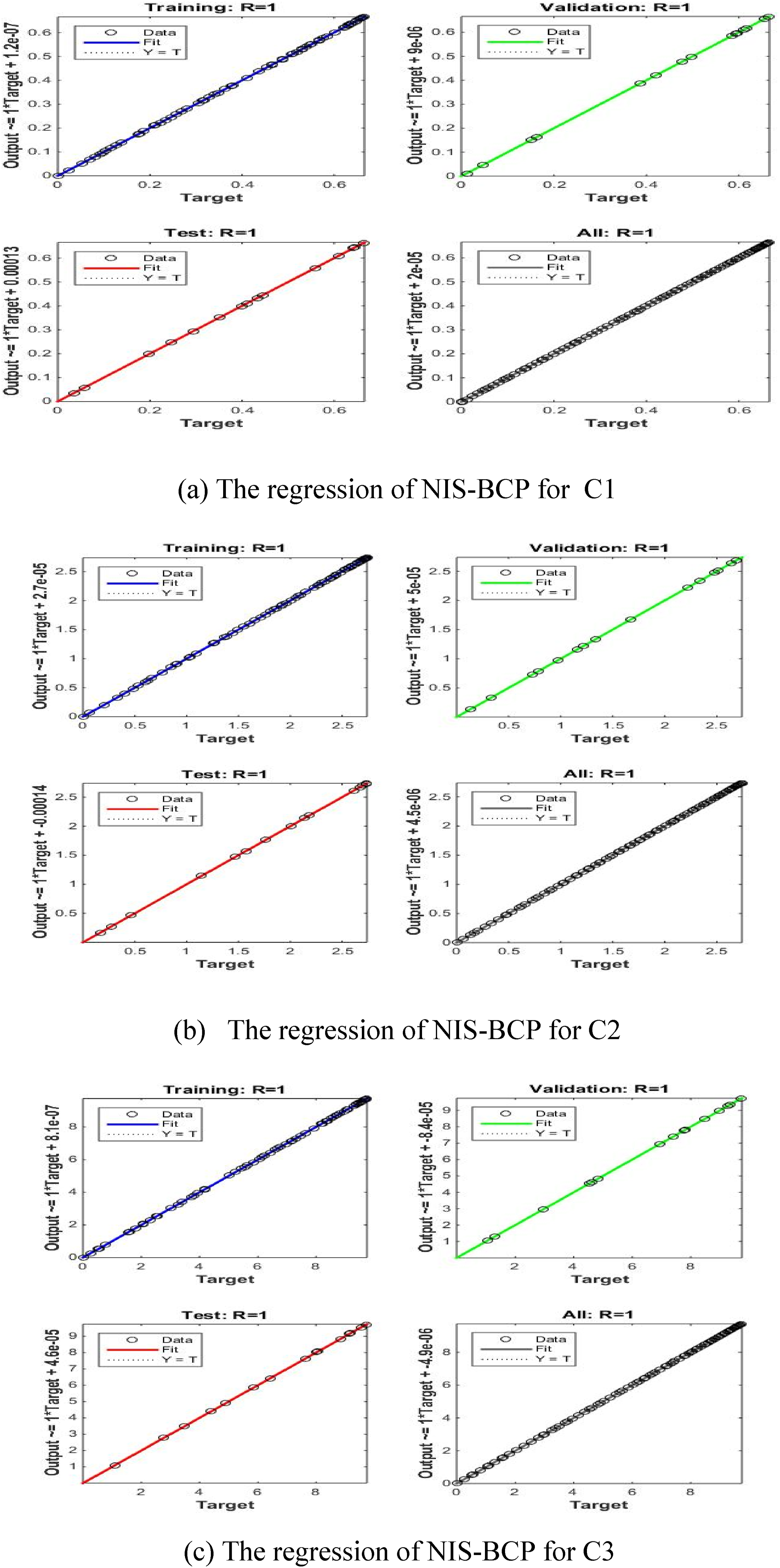
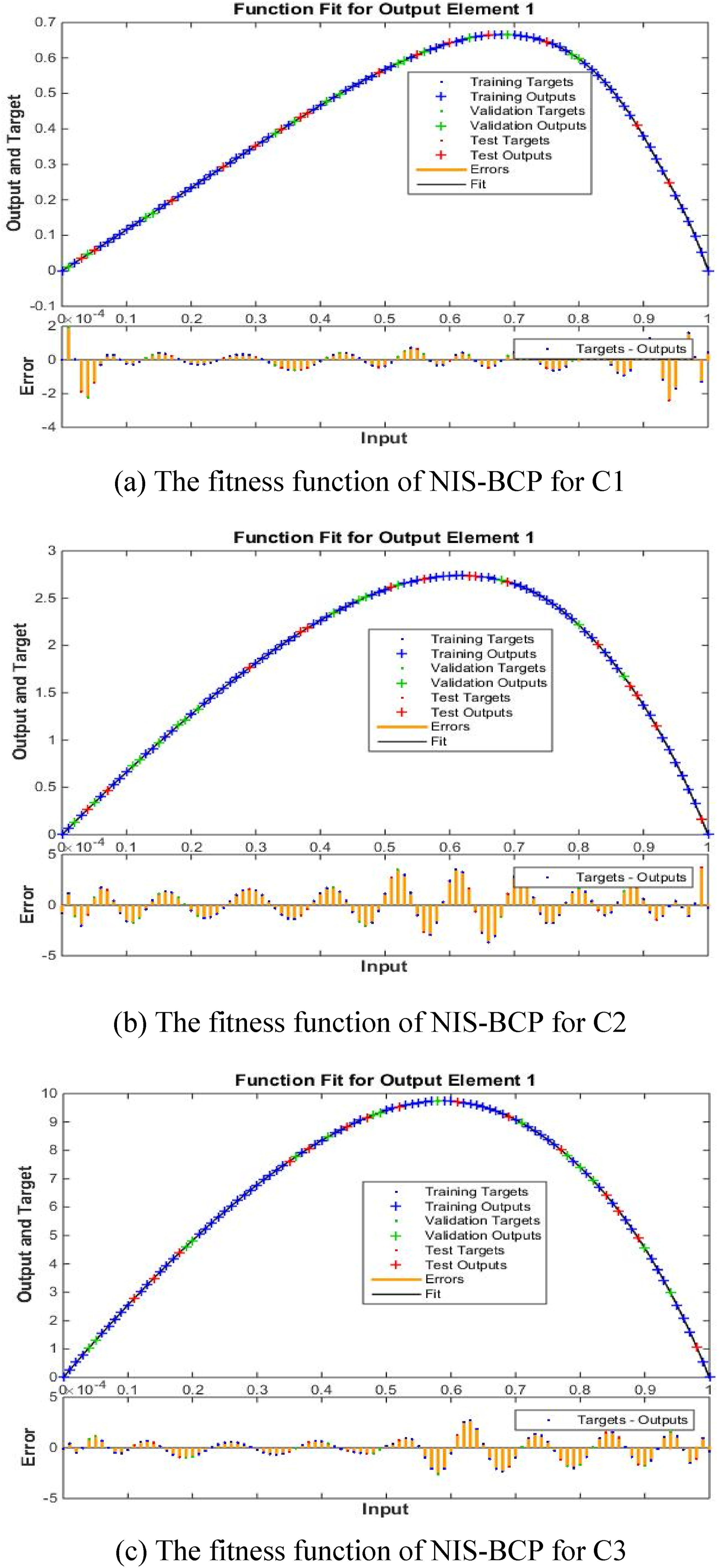
Mean square error (MSE) measure, Gradient, Mu, and validation, the performance of the EHs, fitting curve, and performance of the Regression for different values of MHD parameter (M) are shown in Figures 5–9. In Figure 5(a) and (b) comparison of pressure data obtained by shooting method and through AI simulation is given. The agreement was found excellent which can be seen in error analysis graph. In Figure 6(a-c) mean square error, Gradient, Mu, and validation are plotted for senior 1 case 1-3. The best validation performance for scenario 1, case 1 is (a-c). MSE, Gradient, Mu, and validation for NIS-BCP for NIS-BCP (S1). (a-c) Error histogram for NIS-BCP (S1). (a-c) Regression analysis for NIS-BCP (S1). (a-c) Fitness function for NIS-BCP (S1).
The effect of MHD on the pressure gradient is presented in Figure 10 (left panel). This figure demonstrated the pressure gradient increases near the inlet region of web and decreases in the nip region and outlet regions with increasing the MHD parameter values. The impacts of the Oldroyd 8-constant parameter Effects of MHD on pressure gradient (left panel), while effects of 
Concluding remarks
In the current investigation we have demonstrated the influence of the MHD and slip effects and material parameters of the Oldroyd 8-constant model on the velocity, pressure temperature, coating thickness and blade load with the help of various graphs and tables. We have made comparison our numerical finding, which obtain through bvp4c method with the AI simulated results and found that results are in excellent agreement. The main key feature of our current study is listed below. • By increasing the values of the magnetic field, slip parameter and • The temperature of the molten polymer increases with increasing the value of the Brinkman number (Br). • The concentration of nanoparticles in the molten polymer reduces with increasing the values of the magnetic field, slip coefficient and Brinkman number. • When the value of the slip parameter ( • For MHD parameter value M = 2.5, the coating thickness increased 34.33946% (for plane coater), 32.5773% (for exponential coater) and blade load also increased by 1563.456% (for plane coater), 1533.364% increase (for exponential coater), respectively, compared to the Newtonian fluid
11
.
Footnotes
Acknowledgments
Dr Ahmed S. Sowayan would like to special thanks and acknowledgment to Al Imam Mohammad Ibn Saud Islamic University (IMSIU) Riyadh, Saudi Arabia.
Declaration of conflicting interests
The author(s) declared no potential conflicts of interest with respect to the research, authorship, and/or publication of this article.
Funding
The author(s) received no financial support for the research, authorship, and/or publication of this article.

Data availability statement
Data sharing not applicable to this article as no datasets were generated or analyzed during the current study.