



Abstract
The main objective of the present study was to investigate the influence of graphene nanoplatelets (GnPs), Titanium dioxide (TiO2), and its hybrid filler on the mechanical, thermal, and morphological characteristics of polypropylene (PP) based hybrid composites for structural applications. The PP-based hybrid composites were prepared using a twin-screw extruder for different filler compositions and then molded into tensile specimens with a mini-jet injection molding setup. Tensile, thermal, and morphological analyses were performed to determine the hybrid capability of the PP-based composites. The results showed that the values of tensile modulus and tensile yield strength show significant improvement at about ∼24% and ∼17%, while the values of elongation at break show a slightly decreasing trend for the hybrid composites compared to PP composites. The thermal stability analysis shows that the higher the hybrid filler content, the higher the temperature. Further, the SEM micrographs for the hybrid fillers show good dispersion onto the PP matrix, which may increase the interfacial adhesion between PP and fillers, thus enhancing the mechanical and thermal properties of PP-based hybrid composites.
Introduction
Over the last few decades, many more advancements have been recorded and researched in the domain of engineering materials in terms of their high-end application. The continuous development in the field of engineering materials has compelled researchers to shift their focus toward polymeric hybrid composites due to many recent advancements in the domain. 1 The academic, scientific community and manufacturing sectors have awakened great interest due to their excellent performance and characteristics, such as lightweight, appreciable mechanical properties, wear resistance characteristics, processing ease, and, most importantly, cost-effectiveness. Their significant improvement in mechanical, electrical, and thermal behavior has kept the barriers to utilization aside. 2 For high-end technological applications, the polymers are reinforced with organic or inorganic fillers to develop composites that enhance the physical, mechanical, thermal, and other properties of polymeric composites.3–5
The enhanced properties of the polymer composites are basically influenced by the size of the filler particles, their dispersion, and the concentration of filler loadings. 5 If the dispersion of fillers is uniform in the composite, it exhibits an appreciable and unmatched physical property that cannot be achieved easily from an individual component.6–8 Therefore, the researchers have recommended incorporating organic or inorganic fillers with polymeric materials4,9 due to the potential for high-end applications. In recent years, a polymer matrix, Polypropylene (PP), has attracted remarkable attention in the scientific and research community. PP is the most widely identified general type of thermoplastic resin that has gained multi-dimensional application exposure in various disciplines such as construction, electrical wirings, automotive parts, textile, etc., due to added advantages in terms of their ease of processing, cost-effectiveness, decent thermal and mechanical behavior, and higher recyclability.2,10,11 However, pure PP is limited to some extent due to some associated shortcomings, such as lower impact toughness, lower stiffness, and higher mold shrinkage. 12 Such shortcomings of PP material can be overcome by incorporating organic/inorganic fillers such as talcum powder, 13 mica, nano silica, 14 calcium carbonate (CaCO3), 15 zirconium dioxide (ZnO2), 16 glass fibre, 17 wood dust, 18 metallic powders,19,20 carbon fibres, 21 carbon nanotube (CNT) 22 as well as graphite-like carbon nitride and functionalized layered double hydroxide 23 can be utilized to enhance the physical and mechanical characteristics and performance of PP reinforced nanocomposites that improves the productivity of composites and reduces the cost of production. Polypropylene (PP) possesses exceptional properties, making it widely utilized in various technical applications due to its affordability and high tensile strength. PP can be transformed into various forms, with PP fibres finding extensive use in upholstery, floor coverings, geotextiles, automotive textiles, and apparel, among other applications. 24
The literature shows that many studies have already been carried out to estimate the mechanical performance and characteristics of individual filler-reinforced PP-based nanocomposites.25,26 Nowadays, the utilization of nanomaterials is a very promising research domain capable of enhancing the mechanical and thermal characteristics of composite materials. 27 Graphene nanoplatelets (GnPs) are one such nanofiller that provide enough stability and strength due to their two-dimensional hexagonal lattice structure. 28 GnPs exhibit great and promising characteristics as a reinforcing agent due to their low density, low cost, and exceptional morphological characteristics. 29 Extensive studies have been conducted on GnPs as reinforcing filler agents.12,30–32 The honeycomb structure of graphene possesses unique properties and has attracted researchers since its discovery. High versatility and relatively larger specific surface area made it suitable for sensing applications.33,34 Further, graphenes are nowadays being incorporated into many high-end applications such as explosive detection through sensors, electronic gadgets, thermal and electrical conductors, manufacturing of transistors operating in high frequencies, low-cost display screen manufacturing and so on. Further, PP/GnPs composite finds potential applications in automotive parts (e.g., bumpers, interior components), electronics (e.g., casings, printed circuit boards), packaging (e.g., films, containers), and aerospace industries.
Even a small amount of GnPs can significantly enhance the physical and mechanical,35,36 electrical,37,38 and thermal properties39,40 of the nanocomposite. Also, it is worth noting that the selection of micro/nano-filler with specific dimensions is an essential parameter to be considered in order to maximize the performance characteristics of the composite system. 41 In this context, Shang et al. and co-workers 36 reported the mechanical behavior of nanocomposite developed using graphene reinforcement in poly(vinyl alcohol) that comprises 0-3% of weight fraction and observed to possess the significantly highest value of tensile strength. A similar study on the tensile behavior of GnPs-reinforced PP nanocomposites was investigated by Ali et al. 39 A remarkable improvement in tensile behavior was achieved due to the addition of GnPs in the composite. Sutar et al. 40 reported the study of mechanical behavior for two types of smaller-size GnPs (25 µm) under the loading rate of 1, 2, 3, 4, and 5 wt.%. and found that significant improvement of tensile strength was recorded and was seen that the decreasing thickness of GnPs decreases the impact strength but increases the tensile behavior of the composite. Further, Jun et al. 42 reported a study on tensile behavior for reinforcing the large-size GnPs (150 µm) in the PP matrix. The study reveals the limited enhancements of mechanical properties.
Similarly, nanocrystalline inorganic filler material such as Titanium dioxide (TiO2) possesses numerous remarkable active properties comprising high chemical and thermal durability, non-toxicity, high photocatalytic activity, and, most importantly, lower cost.43,44 Titanium dioxide (TiO2) finds extensive applications due to its potent oxidizing power of photogenerated holes, chemical inertness, non-toxicity, affordability, high refractive index, and favourable surface properties. It serves as a white pigment in paints, plastics, paper, and cosmetics, representing major end-use sectors. TiO2 is also utilized to opacify plastic materials and enhance photo durability. The important key requirements for TiO2 include good dispersibility in polymer systems, a blue undertone, and excellent heat stability. In recent years, the consumption of TiO2 has surged across various minor end-use sectors, such as photocatalysts, catalyst support or promoters, gas sensors, and electric and electrochromic devices. Similarly, the PP/TiO2 composites are potentially utilized in outdoor applications (e.g., outdoor furniture, automotive exterior parts), healthcare products (e.g., medical devices, packaging), food packaging, construction materials, and environmental applications.
From the literature study, various works have been reported in TiO2 as a filler content. In this regard, Rusu and Rusu 45 reported the enhanced tensile behavior of two series of Nylon 6/2 nanocomposite. In this way, the improved mechanical tensile behavior was studied and reported by Esthappan et al. 3 In this study, the nano TiO2 was prepared using the wet synthesis method, and TiO2/PP composite samples were prepared by the melt mixing method. Further, Aydemir et al. 46 reported an investigation on the effects of TiO2 loading rate in TiO2/PP nanocomposite. Various mechanical and thermal studies were reported in the article, which suggests improved mechanical properties. In this way, Daneshpayeh et al. 44 used response surface methodology (RSM) to investigate the mechanical tensile behavior of a PP/LLDPE/TiO2 ternary nanocomposite. The Box-Behnken approach was used to design the tests. The analysis discovered that the LLDPE content has a substantial impact on the enhanced mechanical tensile properties of the aforementioned nanocomposite. In exploring the new functional opportunities of utilizing polymer materials instead of traditional materials, nanocomposites open up a new horizon with multidimensional opportunities. As a reinforcing agent, the size of nanoparticles of TiO2 plays a vital role in enhancing the mechanical behavior and characteristics of the composite. In this regard, Enesca et al. 47 reported the influence of TiO2 filler on the mechanical characteristics of polymeric nanocomposite materials in their investigation. The findings provide a strong direction on the relationships between the structural features of TiO2 nanocomposites with polymeric matrix and their mechanical properties. As a result, several researchers have used a variety of ways to obtain the required performance of polymer composites. They observed that introducing two or more distinct fillers simultaneously into the polymer matrix increased the performance of polymer composites by making use of the unique properties of two or more fillers.47–50
There is a lack of study found in the literature on PP-based hybrid composites for analyzing their mechanical performance. Some significant work was identified in this way. Bensalah et al. 51 reported the graphite/clay-reinforced PP nanocomposite. The investigation results in the excellent mechanical behavior of hybrid composite compared to the neat PP polymer matrix. Also, improved thermal stability was achieved for hybrid composite. Adewale et al. 52 also looked at how adding coir fibre to the PP matrix improves its mechanical qualities. The results showed that the addition of coir fibres improves the tensile modulus and tensile strength of the prepared composite.
Thus, numerous studies have explored different directions to enhance the performance of polymeric composites. However, to our knowledge, research specifically focusing on the reinforcement of PP-based hybrid composites with GnPs and TiO2 hybrid fillers has been lacking. Furthermore, past literature commonly advocates for an equal weight percentage, typically in 1:1 wt. ratio when mixing the two fillers to develop the hybrid polymeric composite. This study introduces a novel method for hybrid composite fabrication, extensively discussed in the following sections. This approach holds promise for a range of applications, including automotive interior and exterior components, healthcare products like medical equipment, food packaging, and construction materials. Additionally, it may prove beneficial in fields requiring superior thermal and electrical properties.
The primary objective of the present study is to explore the influence of incorporating TiO2 filler into the PP/GnPs composite system. The research emphasizes a novel approach to hybridization by increasing the TiO2 weight percentage while decreasing the GnPs weight percentage. Furthermore, the investigation examines the mechanical and thermal characteristics of the resulting hybrid composite. Thermal analysis conducted through TGA, coupled with FTIR and XRD assessments, elucidated the thermal and structural behavior, including associated functional groups within the hybrid composite system. Additionally, SEM observations of the fractured surfaces of the prepared PP/GnPs/TiO2 hybrid composites contribute to the morphological study of the fractured samples.
Experimental procedure
Materials procurement
In the present work, polypropylene (PP) homopolymer (M103) was procured from Haldia Petrochemicals Ltd. (India) with a density of 900 kg.m−3 and melt flow index (MFI) of 3 g/10 min as per ASTM D1238, was utilized as a matrix material. One of the fillers is graphene nanoplatelets (GnPs), which are supplied by Alfa Aesar and have a surface area of 500 m2/g with the average graphene flake thickness within the structure of GnPs filler particles was 8-10 nm. The other filler used in this study is titanium dioxide (TiO2), which was made available from Dupont (India) under the brand name Dupont-R902, having a density of 4197 kg.m−3 with a mean particle size range of 1.5-1.9 µm. Furthermore, Sigma-Aldrich (India) supplied maleic anhydride grafted polypropylene (MAPP) with a density of 934 kg.m−3 at 25°C, which was employed as a compatibilizer in the hybrid composite that has the 2 wt.% maleic anhydrides.
Methods and sample preparation
A Haake twin screw micro extruder was utilized to process the matrix and filler components, which are precisely weighed according to the intended proportions (Thermo Haake). For hybrid composition preparation, the weighing of the fillers is significant. Materials are dried in an MCP, HEK, Germany-made vacuum oven at 60°C for 6 hours before the extrusion process to remove the moisture contents. In this study, an alternative approach was employed to incorporate fillers into the polymer matrix phase. Maintaining a constant ratio based on the hopper capacity of the twin-screw extruder, 92 wt.% of PP and 2 wt.% of MAPP were retained, while adjustments were made to the remaining 6 wt.% of the total batch capacity for hybrid composite preparation by reinforcing GnPs and TiO2 as fillers. Initially, 5 wt.% of GnPs were combined with 1 wt.% of TiO2. Subsequently, a gradual reduction in GnP contents was accompanied by a proportional increase in TiO2 content during the preparation of the hybrid polymer composites.
In order to melt the polymer with the compatibilizer during this mixing process, PP and MAPP are first put into an extruder and run for two minutes. Then, a certain quantity of GnPs and TiO2 powder was added to the extruder, and it was mixed for 3 minutes at 60 rpm with temperatures ranging from 190 to 230°C. After that, to prepare the tensile samples, the extruded melt was injected into a Haake mini-injection moulding device supplied by Mini Jet, Thermo Electron Corp., at a pressure of 450 bar and an injection time of 6 sec. The detailed flow diagram for the composite sample preparation in different stages have been delineated in Figure 1. Flow diagram of the hybrid composite preparation in different stages.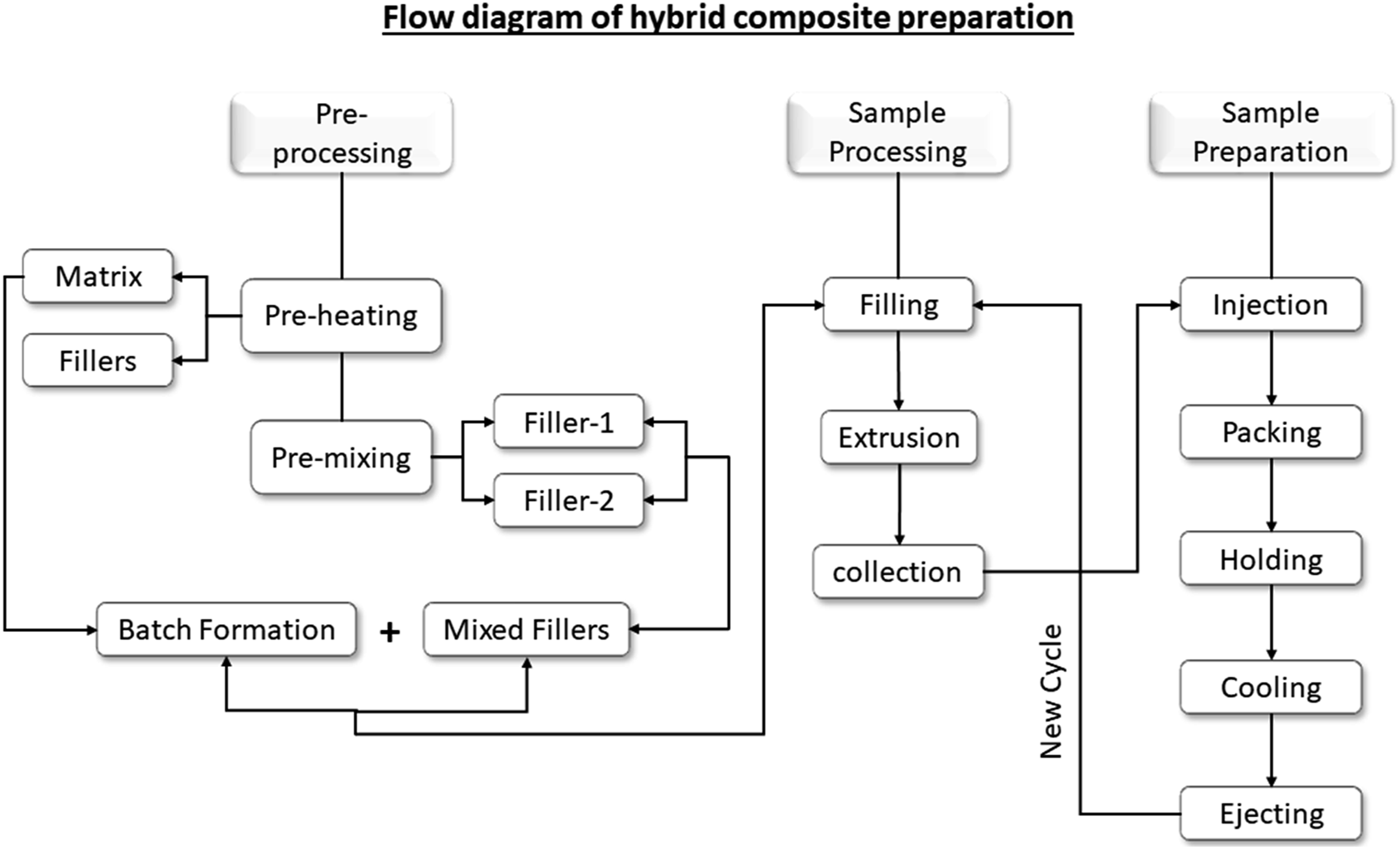
Characterization techniques
Tensile properties like tensile modulus, tensile strength, and elongation at break were studied at room temperature using a Universal Tensile Testing Machine (Instron Ltd, UK) with a load capacity of 30 kN. However, the crosshead speed is a function of the material’s rigidity, shape, and thickness. Generally, softer materials are pulled faster during testing. ASTM D638-14 allows 5, 50 and 500 mm/min and recommends the slowest according to the time to reach the extension to break (< 5 mins). According to the thickness, size and rigidity of the composite samples, the slowest cross-head speed was maintained at 5 mm/min. This kept the extension-to-break under 5 minutes of the samples. Further, the average value of five samples was used to evaluate the tensile behavior of the produced composite system. The fracture mode of the prepared tensile samples was further studied by analyzing the fracture surface morphologies.
The fractured tensile samples underwent surface morphological studies using a Jeol, JSM-6390LV, Japan scanning electron microscope (SEM). Fractured samples were coated with a gold-palladium layer to avoid the accumulation of electrical discharge during SEM analysis.
The Izod impact test was carried out for the pure PP and its PP/GnPs/TiO2 hybrid composite at room temperature using an Izod impact testing machine (Fuel Instruments and Engineers Pvt. Ltd., model: IT 1.4) with an energy range of 0.0 to 1.4 Joule (J). The Impact test was performed under notched and unnotched conditions according to the ASTM D256 and D4812, respectively. A total of five samples for each condition were tested to analyze the impact strength of the PP and its hybrid composite.
The X-ray Diffraction (XRD) measurements was carried out to investigate the structural properties and identify phases of the pure PP, and its hybrid composite of PP-GnPs-TiO2 using a Rigaku smart lab, 9 kV diffractometer with Cu-Kα radiation (λ = 1.5418 Å). The XRD measurements were conducted within the 2θ range of 10 to 80° at room temperature by employing an incidence angle of 0.05.
The Fourier Transform Infrared (FTIR) technique was used to better understand the functional groups present in the prepared PP-GnPs-TiO2 composites. A Perkin Elmer 100 spectrometer with an attached ATR sampling accessory facilitates the spectral analysis which has undergone for the spectra recorded at a resolution of 4 cm⁻1. Various samples of the prepared pure PP and its hybrid composite samples were scanned 32 times in a row at wavenumbers ranging from 4000 to 400 cm⁻1.
Thermogravimetric analysis (TGA), Shimadzu, DTG-60, Japan, was used to determine the thermal behavior of PP-based hybrid composites. Specimens weighing about 5 mg were heated at a rate of 10 °C/minute from 25 °C to 600 °C. The experiment was conducted in a nitrogen gas environment, and temperature and weight changes were tracked and recorded.
Further, the differential scanning calorimetry (DSC) analysis was carried out using the Discovery DSC 25 instrument (Waters, USA). Initially, the specimens were heated up to 240 °C and were maintained at this temperature for 1 minute to eliminate any prior thermal effects. Subsequently, the samples were cooled to reach ambient room temperature. Both heating and cooling procedures were conducted under a nitrogen (N2) atmosphere, with a heating/cooling rate of 10 °C/min. The second heating cycle was chosen for analysis. DSC analysis provided data on the nanocomposite’s melting (Tm) and crystallization (Tc) temperatures, as well as melt enthalpy (ΔHm) and percentage of crystallinity. The degree of crystallinity (Xc) was determined using equation (1).

Results and discussions
Tensile characteristics
Influence of GnPs, TiO2 and hybrid fillers on tensile modulus
Figure 2 delineates the tensile properties of the prepared composite system as the result of the distribution and orientation of filler and hybrid filler reinforcement in the matrix phase. Figure 2(a) depicts the relationship between tensile modulus and the wt.% of GnPs reinforcement in PP composites. The effect of raising the wt.% on the GnPs/PP composite is clearly visible. Figure 2(a) depicts the continuous increase of tensile modulus as the wt. % of GnPs fillers is increased from 1 to 4 wt.%. The considerable rise in the tensile modulus of the produced composite at a constant strain rate of 5 mm/min is due to the arrangement and orientation of the macromolecular chains of the polymer matrix, which occurs along the loading direction of the specimens. Hence, the GnPs reinforcement in the PP composite system plays a stiffening role up to a certain wt.%. In the present case, it can be seen that the 4 wt.% of GnPs reinforcements in the PP composite increases the tensile modulus by ∼ 19% more than that of the tensile modulus of unfilled PP polymer matrix. The decrease in tensile modulus with GnPs filler contents higher than 4 wt.% is attributed to the filler agglomeration at higher loadings. The above-mentioned observations can be further supported by the similar findings of increased modulus for epoxy/GnPs composite system due to the addition of varying GnPs fillers reported by Anwar et al.
55
Maximum tensile load-bearing capacity and tensile modulus both followed a similar improving pattern. The current findings concur with those of numerous researchers.40,56 The increased stiffness, which enhances the adhesion and filler particle interactions between GnPs particles and the PP matrix, is responsible for the increased tensile modulus. Effect of hybrid fillers on tensile modulus for (a) PP/GnPs composite, (b) PP/TiO2 composite, and (c) PP/GnPs/TiO2 hybrid composite.
A similar study on varying wt. % of TiO2 in PP composite has also been analyzed in the present work, as shown in Figure 2(b). The uniform dispersion and distribution of filler particles over the matrix phase influence the ultimate physicochemical properties of composite materials. This helps in generating a conductive pathway for an efficient and improved energy dissipation during tensile testing. This reduces the possibility of crack growth during the composite failure and ultimately increases the strength of the composite system. 17 Figure 2(b) demonstrates the effect of TiO2 filler addition in PP composite for analyzing the tensile modulus of the prepared composite. The reinforcement of varying filler loadings of TiO2 weight fraction from 1-3 wt.% results in a noticeable improvement in tensile modulus. The maximum increase of tensile modulus is found to be ∼11% under 3 wt.% of TiO2 filler loadings than that of the unfilled PP matrix. Further, the increase of filler loadings of more than 3 wt.% results in a decreasing trend of tensile modulus. Because there are more possibilities for inter-particle interactions in the higher filler loading region, the tensile modulus of the PP/TiO2 composite system is falling in that region. 3
Further, the comparative study for hybrid fillers (GnPs:TiO2) reinforced PP-based hybrid composite was carried out. Figure 2(c) demonstrates that the overall tensile modulus of the hybrid composite was found to be higher than the pure PP matrix, describing the facts of filler rigidity and the good dispersion of filler particles over the matrix phase. At 5:1 wt.% of GnPs:TiO2 loading, a significant increase in tensile modulus was observed. Further, almost linear trend was identified at 4:2 and 3:3 wt.% of hybrid filler loadings. The gradual decrease of GnPs and increase of TiO2 wt.% further outlined a decreasing trend at higher TiO2 loading. However, individually up to 2:4 wt.% of GnPs:TiO2 filler loading, the significant increase of ∼24%, ∼16.32%, and ∼15.74% than neat PP were observed in the developed hybrid composite.
Influence of GnPs, TiO2, and hybrid fillers on tensile strength of PP composite
The present work also contains the effect on the tensile strength of inorganic filler reinforcement in PP composite. Figure 3 delineates the tensile strength characteristics of the prepared composite samples depending upon the reinforcement of GnPs filler with a gradual increase of wt.%. A significant increase can be noticed in the range of 1-3 wt.% of GnPs reinforcement, as shown in figure 3(a). Compared to the unfilled PP, ∼6% and ∼14% increases in tensile strength were recorded under the minimum of 1 wt. % and the maximum of 3 wt.% of GnPs fillers. Further addition of GnPs leads to agglomeration due to inhomogeneous filler distribution over the matrix phase. Effect of hybrid fillers on tensile strength for (a) PP/GnPs composite, (b) PP/TiO2 composite, and (c) PP/GnPs/TiO2 hybrid composite.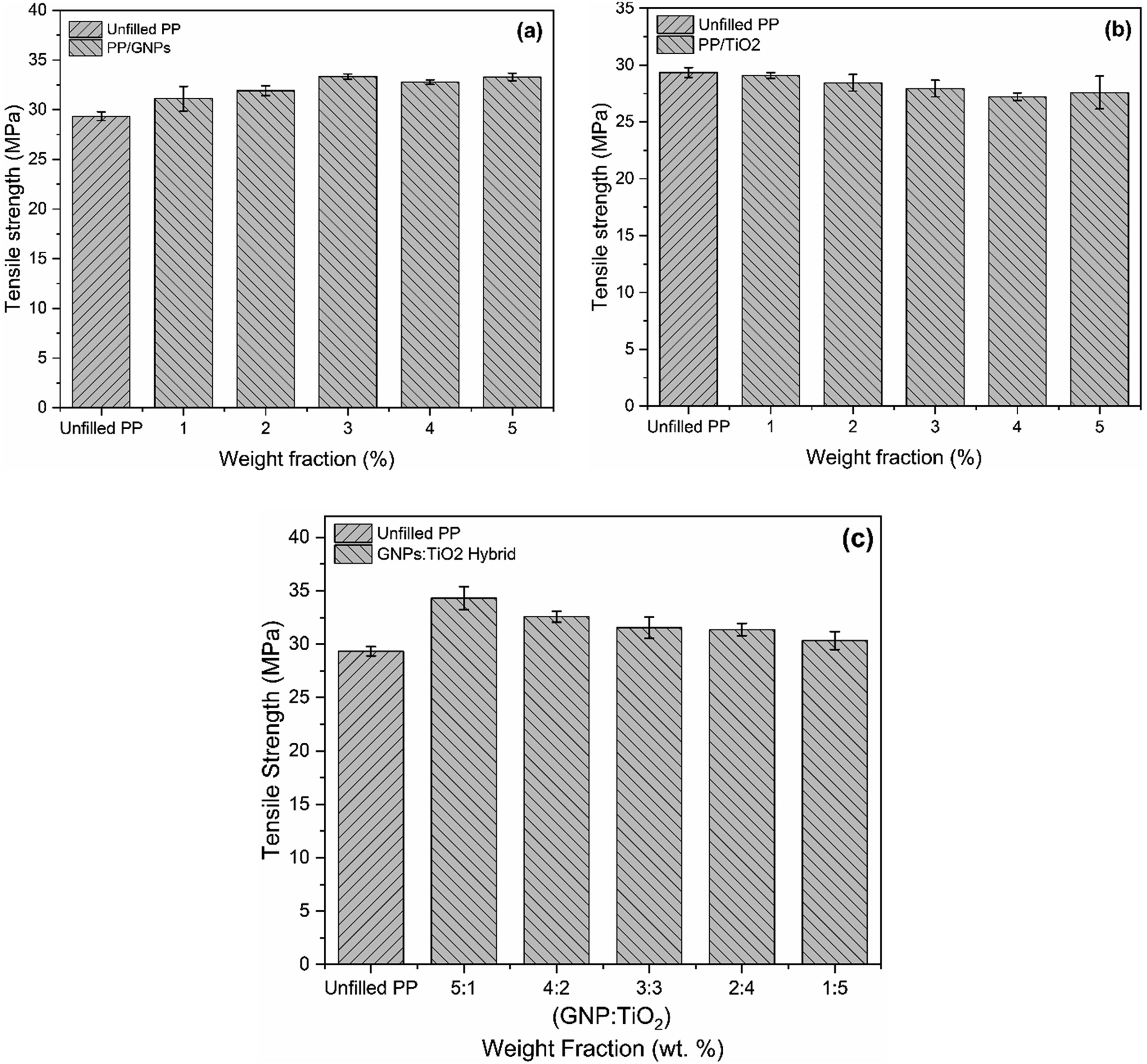
On the other hand, a decreasing trend was found in the case of TiO2 reinforcement in PP composite. Figure 3(b) demonstrates the tensile strength characteristic of the PP/TiO2 composite system by reinforcing the varying TiO2 wt.%. A significant decrease was observed up to the reinforcement of 4 wt.% of TiO2. Compared to the neat PP composite, it shows a slight decrease of ∼1% reduction in tensile strength. This reduction in tensile strength is maximum observed at 4 wt.% of TiO2 reinforcement, which is ∼7% reduction of tensile strength than pure PP composite.
However, the tensile strength of the composite composed of the inorganic fillers closely depends upon the distribution and proper dispersion of fillers, interfacial interactions, and the interfacial adhesion of fillers with the matrix material. In the PP/GnPs composite system, the increasing trend of tensile strength possesses appreciable adhesion, dispersion, and good interfacial interactions of GnPs fillers to the PP matrix, which specifies the easy and efficient stress transfer from filler to the matrix phase, causing the certain increases in the strength of the composite. Also, the poor interfacial interactions lead to a significant decrease in tensile strength characteristics of the prepared composite system.8,57 Therefore, in the present work, the PP/GnPs composite was found to have a better interfacial and good dispersion than the PP/TiO2 composite.
Further, investigating the hybrid PP composite with inorganic fillers (GnPs:TiO2) reinforcement gives an appreciable tensile strength characteristic of the hybrid composite system. Figure 3(c) demonstrates the effect of tensile strength characteristics on reinforcing the TiO2 fillers by replacing GnPs filler. An increasing trend can be seen in Figure 3(c), which concludes the significant increase in tensile strength in the case of GnPs:TiO2 reinforcement in the hybrid system. The reinforcement of 5:1 (GnPs:TiO2) produces a significant increase in tensile strength of ∼17% compared to unfilled PP matrix. This improved tensile strength characteristics is due to the good interfacial interactions among the filler particles and the PP matrix which leads to a more efficient stress transfer phenomena from fillers to matrix phase during axial loading. Further, a decreasing trend in the PP/GnPs/TiO2 composite were identified. However, the individual effect of the PP/GnPs/TiO2 hybrid composite was found to be higher the unfilled PP matrix.
Influence of GnPs, TiO2, and hybrid fillers on elongation at break of PP composite
Elongation at break is an essential characteristic in order to comprehend the ductile behavior (tensile fracture toughness) of materials. Figure 4 shows the influence and dependency of elongation at break as a function of varying wt.% of GnPs filler loading. From Figure 4(A), it can be clearly observed that a decreasing trend in the elongation at break was observed. In 2-4 wt.% of the GnPs filler reinforcement, an almost linear trend was obtained. Further, at 5 wt.% of GnPs addition indicated a slight increase in the elongation at break characteristics. The higher wt.% of GnPs addition i.e., at 5 wt.% of filler addition, enhances the toughening effects due to the large specific surface area covered by maximum filler contents under the same adhesion state. Effect of hybrid fillers on elongation at break for (a) PP/GnPs composite, (b) PP/TiO2 composite, and (c) PP/GnPs/TiO2 hybrid composite.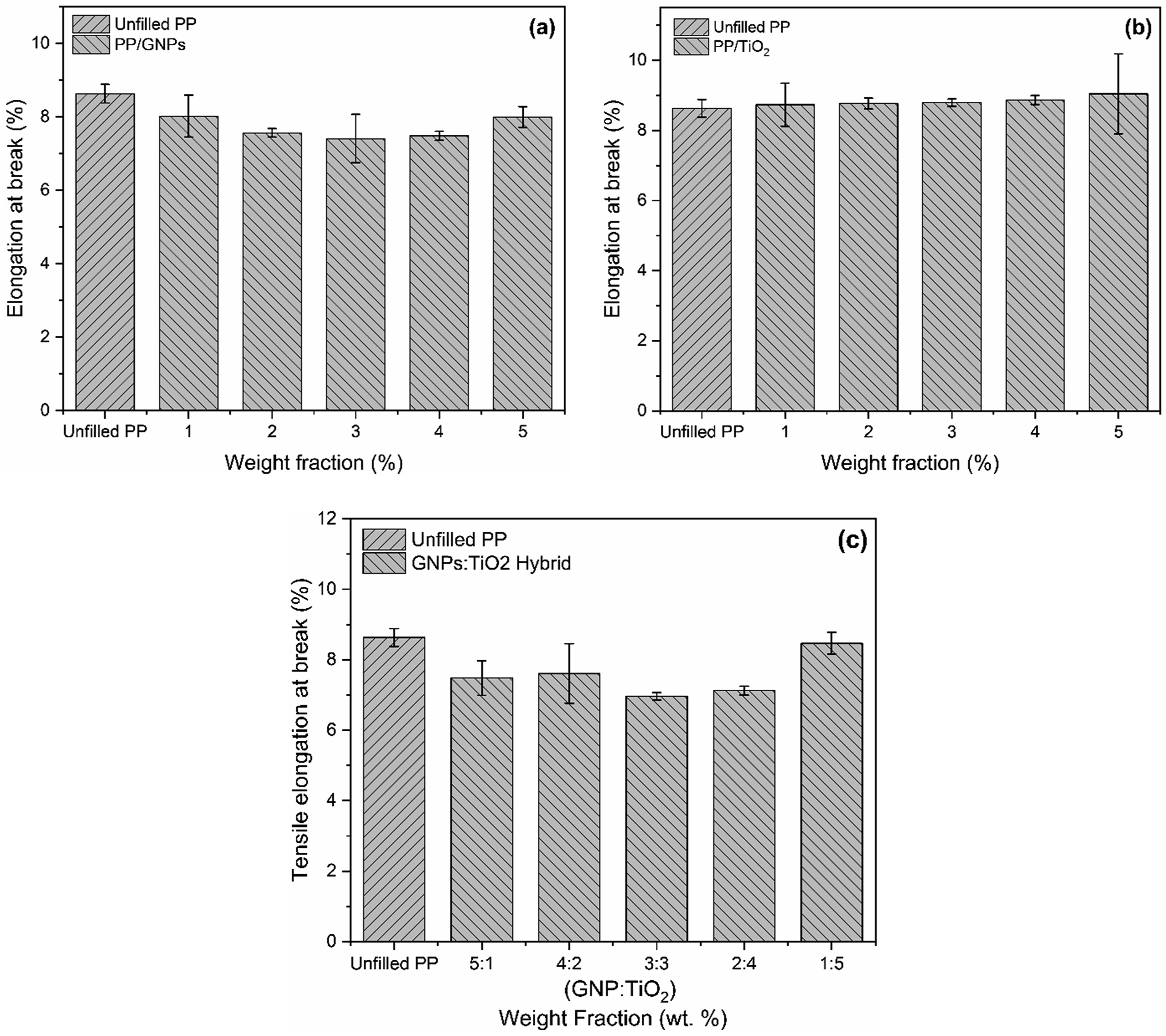
Similarly, Figure 4(b) demonstrates a slight improvement in elongation at break for TiO2 filled PP composite. Further, the continuous increasing trend in elongation at break were noticed. At maximum 5 wt.% of TiO2 filler addition, the elongation at the break was found to be increased by ∼5% more than that of the unfilled PP.
Further, in case of hybrid filler reinforcement, the elongation at break drops significantly on reinforcing the filler loadings of TiO2 by replacing the GnPs fillers. Figure 4(c) demonstrates the decreasing trend in elongation at break. The utilization of rigid particle fillers in polymer generally decreases the elongation at break, and the increases are attributed to the good interfacial adhesion and breakdown of agglomerated fillers in the polymer matrix.58,59
This is also important to note that the reinforcement of a filler content is also responsible for converting the ductile behavior of PP into a brittle behavior by changing the failure mode. Having a significant filler agglomeration leads to the development of inadequate homogeneity that increases the rigidity of particle filler, resulting in a decrease in the deformability of PP composite. Under the condition of external loading, the composite starts deforming under the action of inhomogeneity of the local stress distribution. 58
Impact test analysis
The success of antistatic materials in real-world applications depends heavily on their mechanical properties.
60
The impact strength of pure PP and its hybrid composite of PP-GnPs-TIO2 with varying hybrid filler loadings is delineated in Figure 5(a) and Figure 5(b) for both notched and un-notched composite samples. Impact property of PP and its Hybrid condition for (a) un-notched samples, (b) notched samples.
Under the un-notched condition, a continuous decreasing trend were observed. The pure PP polymer matrix was found to have the maximum impact strength of ∼ 95 ± 1.825 J/m and ∼17 ± 0.234 J/m under both un-notched and notched conditions respectively. In both the conditions, the gradual decrease of GnPs and gradual increase of TiO2 influence the impact strength of the hybrid composite system. Under notched condition, the maximum impact strength was found to be ∼18 ± 0.115 J/m at 5:1 wt.% of GnPs:TiO2 hybrid filler loadings. Further, a continuous reduction in impact strength at hybrid filler loadings was identified. In both cases, the decreasing trend in impact strength may be mainly due to the restrictions in molecular mobility 61 due to higher amount (as GnPs filler particles have lower density) of GnPs filler contents that causes the enhancements of brittle behavior of the composite samples, which also possibly causes the agglomeration of excessive filler particles.
In both the cases, the clear observation also states that the decreasing wt.% of GnPs fillers decreases the impact strength of the composite samples, which significantly demonstrates the decreased toughening ability of GnPs. At maximum wt.% of GnPs addition indicated higher impact strength. This is because, the higher contents of GnPs particles act as a nucleating agent for PP matrix. to produce FTIR spectrum determination of pure PP and PP-GnP-TiO2 hybrid composite.
Such decrease in impact strength with gradual decrease in GnPs contents and increase in TiO2 filler contents is evident due to decreased elasticity of the material caused by filler inclusion. 63 This reduction in material’s elasticity diminishes the deformability of the matrix, consequently reducing ductility and leading to the formation of a weaker structure in the composite system. Moreover, as the filler concentration increases, the ability of polymer matrix to absorb energy diminishes, thereby lowering toughness and resulting in a decrease in impact strength. 24
FTIR spectrum analysis
Figure 6 shows the FTIR spectral plot of PP and its hybrid composites reinforced with different wt.% of GnPs and TiO2. The FTIR spectral analysis confirms the presence of GnPs and TiO2 filler contents into the PP polymer matrix phase. The characteristic peaks of PP and its hybrid composites were found to be developed at the spectral range of 3151-3036 cm−1, and at wave number 1655, 1574, 1365, 1172, 1041, 1010, 729, 691 cm−1 24. The spectral peak developed at 1655 cm−1 is attributed to the thermo-oxidative degradation and denotes the presence of carbonyl groups -C = O. 53
The spectral peaks at 3036, 1574, and 1365 cm−1 were found to be marginally shifted due to the reinforcement of GnPs and TiO2 hybrid fillers. From Figure 5, it can be clearly seen that the peak intensity decreases as the wt.% of the TiO2 increases. The spectral peak developed at 1365 cm−1 exhibits the presence of CH3. 64 A band in the low spectral range (between 3036, 1574, and 1365 cm⁻1) were identified at the gradual incorporation of TiO2 filler contents, which is associated with the reduction of thermo-oxidative degradation. 53 The FTIR spectra firmly indicate the presence of peaks at lower wavenumber at 1041, 1010, 729, and 691, cm−1. The peak intensity at these spectra seemed to be changed on increasing the TiO2 wt.%. The peaks identified between the spectral range of 691 to 729 cm−1. These spectral bands are attributed to the Ti-O-Ti vibration. 65 A similar band identification was also reported by Salhi et al. 64 Several peaks related to TiO2 were observed in all the samples of the PP-GnP-TiO2 hybrid composites. 46 Further, in order to confirm the presence of GnPs and TiO2 filler particles in the PP matrix, the hybrid composite samples were also jointly verified by XRD test results.
XRD pattern analysis
Figure 7 demonstrates the XRD pattern analysis of pure PP and its hybrid composite with reinforcements of GnPs and TiO2 at different weight percentages. For a semi crystalline structure like polypropylene (PP), the crystalline behavior, including crystal type and their crystallinity, significantly influence the mechanical their behavior.
66
For pure the characteristic peaks were found to be occurred at the 2θ value of around 14.7°, 17.4°, 19.1°, 21.7°, and 26.03°, representing the crystal planes (110), (040), (130), (041), and (060), respectively.42,60,62 These characteristics peak of pure PP in the alpha-crystal form of PP are very weak.
67
Such behavior of PP has also been reported previously attributed to the highly oriented lamellar structure in terms of its crystalline morphology.
68
Further, compared to the pure PP, a novel peak emerges around 2θ = 16.2°, corresponding to the (300) plane of the β crystal form.
42
X-ray diffraction pattern of pure PP and PP-GnP-TiO2 hybrid composites.
This suggests that the presence of GnPs filler contents in PP/GnPs/TiO2 composites alters the crystal structure of PP, and GnPs serving as a heterogeneous nucleating agent favoring the formation of the β crystal form, thereby improving the impact strength and toughness of the nanocomposites. 62 At GnPs addition, the sharp peaks developed at 17.4° is quite different from the peak developed for pure PP. This also suggests the behavior of GnPs as a nucleating agent for pure PP. 69 Also, compared to the pure PP, no distinctive changes on the peaks were identified except for an additional peak developed at the 2θ values of 25.28° (d = 3.5200 Å) and 36.07° (d = 24,310 Å) with the crystal plane position at (101), and (103) of the rutile crystal phase of TiO2 respectively as per the JCPDS card 21-1276. This confirms the incorporation of TiO2 in to the PP polymer matrix phase. Further, no characteristics change in the peak intensity or width of the PP signals were identified, suggesting that the loading of the increased wt.% of TiO2 had no effect on the crystalline structure of the polymer matrix. the present study also possess a good agreement with the previous literature. 70
Thermogravimteric analysis
Thermal stability is an essential factor that must be considered from a high-end application standpoint in various sectors due to changes in the material’s viscosity and viscoelastic behavior.
46
In the current work, the TGA was carried out to examine the influence of hybrid filler content on thermal stability. Thermal stability is one of the important parameters for hybrid polymeric composites to determine the temperature behavior of polymeric composites, and the results may be the limiting factor in deciding on end-use applications.
71
Figure 8 depicts the percentage weight loss of pure PP and the hybridized effect of PP-based hybrid composite reinforced with varying wt.% of hybrid fillers (GnPs:TiO2) as a function of temperature under the nitrogen gas environment. Table 1 lists the temperatures at which deterioration begins and the highest degradation temperatures acquired from thermogravimetric test data. Figure 8 clearly shows that heat deterioration of neat PP and hybrid composites is a one-step process. Table 1 further shows that the loading of hybrid fillers comprising GnPs and TiO2 improves the thermal stability of the PP polymer matrix. The loading of GnPs and TiO2 to the PP matrix improves the onset and maximum degradation temperatures. The improved thermal stability of PP-based hybrid composites might be attributed to high interfacial adhesion among the GnPs, TiO2, and the PP matrix phase. TGA of unfilled PP and different hybrid filler compositions with 2 wt.% MAPP. TGA of unfilled PP and different hybrid composites.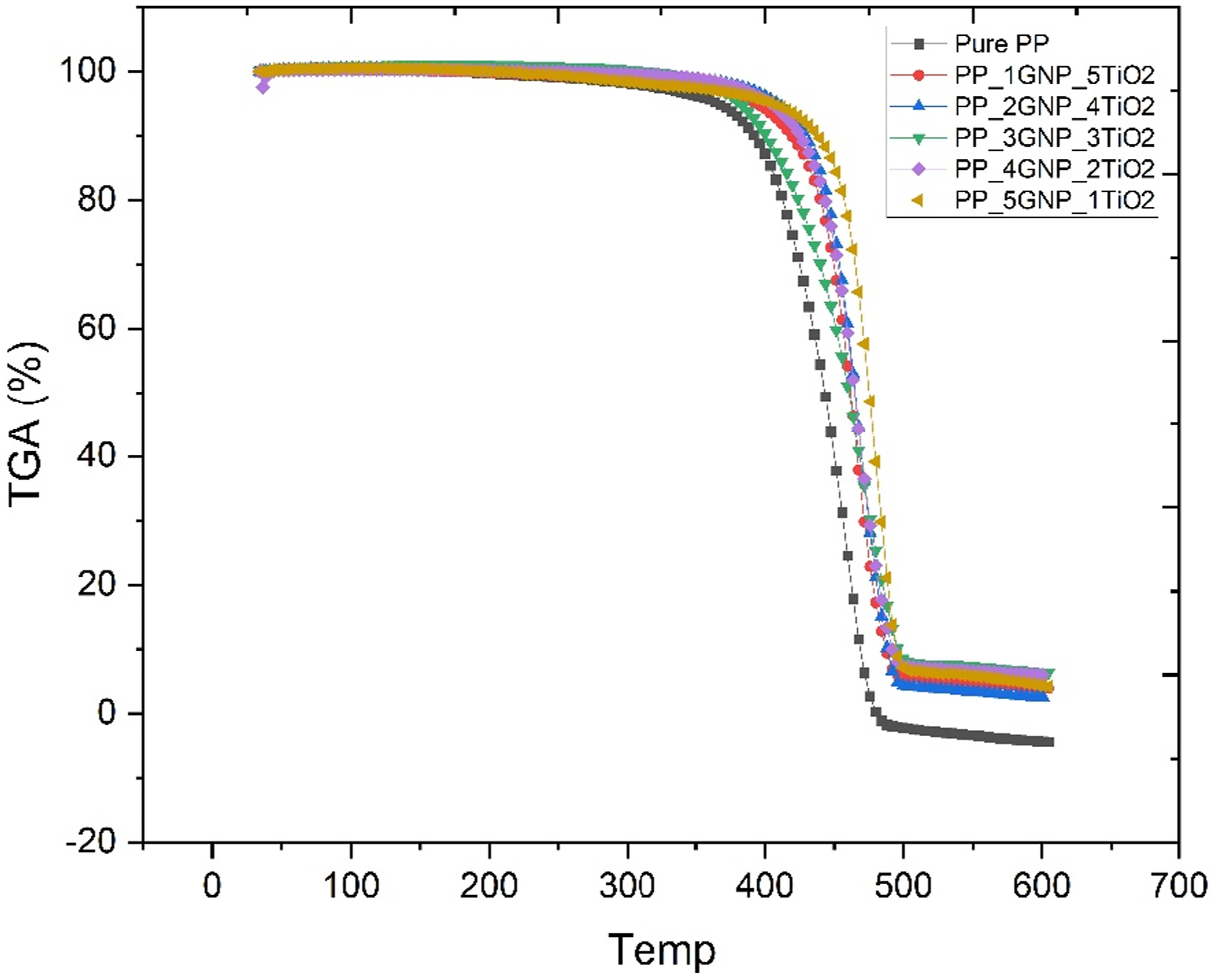

Differential scanning calorimetry (DSC)
Figure 9. demonstrates the melting and crystallization properties that were studied by conducting the DSC experiments on developed pure PP and PP/GnPs/TiO2 hybrid composites. The DSC traces show the effect of GnPs and TiO2 filler contents at varying wt.% in decreasing and increasing manner. The findings from the DSC thermogram examination are presented in Table 2. DSC thermograms of the developed PP/GnPs/TiO2 hybrid composite for (a) the heating cycle and (b) the cooling cycle. Melting and crystallization characteristics of the developed hybrid composite.

From the DSC traces, as shown in Figure 9, it can be clearly observed that the GnPs loading produces significant influences on crystallization temperature. At higher wt. % of GnPs (at 5:1 wt.%) loading in PP/GnPs/TIO2 hybrid composite, an increase in crystallization temperature was noted, and the gradual decrease in GnPs wt.% decreases the crystallization temperature, 72 indicating that PP crystallizes at elevated temperatures in the presence of GNPs. This phenomenon could be attributed to the GNP particle surfaces acting as nucleation sites for PP crystallization.73,74
Further, no effective difference in the melting temperature of PP/GnPs/TiO2 hybrid composites was observed. However, the findings indicate that the increasing wt.% of TiO2 contents by replacing the GnPs contents accelerates the degree of crystallinity of polymer resins. As TiO2 acts as a heterogeneous nucleation agent, it is deemed significant in enhancing thermal properties. These outcomes align with prior research findings.53,75 Increased PP crystallinity implies a reduced proportion of the amorphous phase, consequently leading to composite materials with dynamic mechanical properties that are less influenced by the glass transition. This results in a higher rubber modulus due to the presence of more crystals, as evidenced by the values provided in Table 2. However, although the variations in crystallinity rates are relatively small, the incorporation of inorganic filler aids in enhancing the thermal stability of the composites. The DSC traces clearly indicate that the sample PP_3GnPs_3TiO2 shows the highest enthalpy of fusion and the highest degree of crystallinity. This suggests that preparing the hybrid composite with hybrid fillers is most significant and suitable when the hybrid fillers are mixed or incorporated in equal weight percentages in the polymer matrix.
Fractured surface morphological observations
It is widely believed that the quality of hybrid filler dispersion into the polymer composite directly relates to the mechanical properties of polymer composites.17,30 Hence, to evaluate the fracture surface and investigate the degree of dispersion of filler materials, the fractured samples were produced using scanning electron microscopy (SEM). Figure 10(a-f) depicts SEM micrographs against the fractured surface of the prepared specimens filled with various hybrid filler compositions (GnPs and TiO2) and pure PP matrix to examine the interfacial structure morphology. Pure and unfilled PP matrix showing the smooth surface morphology indicating no additional filler reinforcement (see Figure 10(a)). From Figure 10(b), a smooth and tongue-like pattern of the hybrid composite surface indicates the layer-wise structure of GnPs particles distributed uniformly over the entire PP matrix phase, and the white dotted particles present over the layer of GnPs indicate the presence of TiO2 particles in the hybrid composite. Such uniform distribution also demonstrates the uniform dispersion of GnPs and TiO2 fillers in the specimen, which improves the interfacial adhesion of hybrid fillers with the PP matrix phase. This improved interfacial adhesion and uniform distribution of hybrid fillers demonstrate the improved mechanical characteristics of PP-based hybrid polymer composite. Further, at 4 wt.% GnPs and 2 wt.% TiO2 hybrid fillers combination shows the wrapping-shaped pattern ( see Figure 10(C)) and cave-like structure with small voids, suggesting the brittle fracture due to reinforcements of the hybrid fillers. In such cases, the samples experience higher tensile resistance and higher strain, which is also attributed to the good amount of the TiO2 mixing by replacing the GnPs particles. Further, in a subsequent study of fracture surface morphology, the river-like rough surface morphology can be clearly identified in Figure 10(d). The scaly structure with surface peel-out and micro-voids is responsible for the lower tensile properties of the hybrid composite. Also, the increasing wt.% of TiO2 further potentially increases the chance of agglomeration of the fillers. The higher loading of TiO2 seems to be potentially agglomerated, which can be clearly seen in Figure 10(e). The stacked surface with the gully-like fractured structure of the prepared hybrid composite exhibits the brittleness characteristics of the composite system. The presence of the excess amount of TiO2 particles, as shown in Figure 10(e) and (f), leads to the formation of micro-voids due to the delocalized action of TiO2 agglomerates under tensile action, which potentially acts as the crack initiation and crack propagation zones that further, leads to the premature failure of the composites. SEM micrographs with varying wt.% of hybrid filler along with 2 wt.% MAPP showing the composite compositions of (a) Unfilled PP; (b) 5 wt.% GnPs and 1 wt.% TiO2. (c) 4 wt.% GnPs and 2 wt.% TiO2 (d) 3 wt.% GnPs and 3 wt.% TiO2; (e) 2 wt.% GnPs and 4 wt.% TiO2; (f) 1 wt.% GnPs and 5 wt.% TiO2.
Conclusion
The mechanical tensile characteristics, such as tensile modulus, strength, and strain at break, were evaluated and analyzed in the present study. The study was carried out for five types of composite viz. GnPs-filled PP composite, TiO2-filled PP composite, and TiO2:GnPs-filled hybrid composite. Based on this study, the following results can be concluded as follows: • In the study of tensile modulus, a significant increasing trend for PP-based composites was observed. The addition of 1 - 4 wt.% of GnPs filler in the PP composite shows an increase, and then agglomeration starts. Similarly, a significant outcome was seen in the case of TiO2-filled PP composite for up to 3 wt.% of TiO2 addition. In PP/GnPs composite, the tensile modulus was found to be increased by ∼19% at 4 wt.% of GnPs loading. In the case of the PP/TiO2 composite, at 3 wt.%, the tensile modulus was found to be increased by ∼11%. Similarly, for GnPs:TiO2 filler addition, the same is found to be significantly increased by ∼24% at 5:1 wt.% of hybrid filler reinforcement, and further, the decreasing trend was identified. • Similarly, an increasing trend was seen in the tensile strength characteristics of the PP/GnPs composite. At 3 wt.%, an improvement of ∼14% was observed than unfilled PP. In the case of the PP/TiO2 composite, a continuous decrease in tensile strength was observed. further, for the hybrid composite system, the tensile strength was found to be increased by ∼17% at 5:1 wt.% of GnPs:TiO2 filler loadings. Further, a decreasing trend was observed for higher TiO2 loading in a hybrid system. • Furthermore, at 2 wt.% GnPs addition in PP/GnPs composite, the reduction in elongation at break was observed, and at higher loading of GnPs, i.e., at 4 wt.% of GnPs, a rising trend was seen. Further, in the PP/TiO2 composite, a slight improvement in elongation at break was identified. Further, the continuous increasing trend in elongation at break was noticed. At a maximum of 5 wt.% of TiO2 filler addition, the elongation at the break was found to be increased by ∼5% more than that of the unfilled PP. Also, for the hybrid composite system, a continuous decreasing trend was observed. at, 3:3 wt.% of GnPs:TiO2 filler addition, the minimum elongation of the break was observed, and then an increasing trend was seen. • Further, the impact strength of the prepared hybrid composites under un-notched conditions was found to be in decreasing trend due to increased wt.% of TiO2 loading and gradual decrease in GnPs contents. Also, under notched conditions, for higher GnPs contents, i.e., at 5:1 wt.% of GnPs:TiO2 hybrid filler addition, the impact strength was found to be maximum, and then a continuous decreasing trend was observed. • The thermal study exhibited a significant improvement in the thermal stability of the hybrid composites, which is evident from the thermogravimetry analysis. This may be due to the inherent higher thermal properties of TiO2.
Therefore, this study establishes a foundation for future research endeavours aimed at developing hybrid composites. The present study also suggests a pathway for a novel method of sample preparation by necessary filler modification to investigate further the essential mechanical, thermal, and tribological performance, scratch resistance properties, thermal and electrical conductivity, as well as the morphological studies crucial for potential end-use applications.
Footnotes
Acknowledgments
The authors extend their appreciation and thanks to King Saud University for funding this work through the Researchers Supporting Project number (RSPD2024R711), King Saud University, Riyadh, Saudi Arabia. The authors gratefully acknowledge the invaluable support from the Central Instrumentation Facility (CIF) at Birla Institute of Technology, Mesra, Ranchi, India. Their assistance has been instrumental in facilitating the FTIR, XRD, TGA and SEM analysis work conducted in this research. Additionally, the scholars sincerely thank Birla Institute of Technology, Mesra, Ranchi, India, for awarding an Institute Research Fellowship (IRF). This fellowship has played a crucial role in supporting and advancing the scholarly endeavors of the researchers involved in this study.
Authors contribution
Declaration of Conflicting Interests
The author(s) declared no potential conflicts of interest with respect to the research, authorship, and/or publication of this article.
Funding
The author(s) disclosed receipt of the following financial support for the research, authorship, and/or publication of this article: The authors extend their appreciation to King Saud University for funding this work through Researchers Supporting Project number (RSPD2024R711).
Correction (June 2024):
Article updated to revise “Future University” with “Future University in Egypt” from author Ahmed Farouk Deifalla's affiliation.

Data availability statement
Data sharing not applicable to this article as no datasets were generated or analyzed during the current study.