



Abstract
Graphene nanoplatelets (GNPs) are two-dimensional carbon structure materials with single or multilayers graphite plane which possesses attractive characteristics including high electrical conductivity, high modulus, high strength, high thermal conductivity and high specific surface area. In this study, the GNPs were modified by maleic anhydride (MA) and vinyltrimethoxysilane (VTMOS), and then reinforced carboxy NBR (XNBR) to prepare GNPs/nitrile rubber (XNBR) nanocomposites. The modified GNPs were characterized by Fourier Transform Infrared Spectrometry (FT-IR), Raman spectroscopy. The properties of GNPs/XNBR nanocomposite such as thermogravimetric analysis (TGA), thermal conductivity and mechanical properties were investigated. The experimental results show that the successful modification of GNPs can improve the properties of the nanocomposites.
Keywords
Introduction
Nitrile-butadiene rubber (NBR), or oil-resistant rubber, is often used to produce oil seals, bonding pads, oil-resistant soft hoses, printing rollers, industrial rollers, bonding agents, etc. It is oil and wear resistant and resilient. In addition, it is resistant to permanent deformation under compression and demonstrates excellent air tightness and temperature tolerance (-30°C–120°C). However, NBR is vulnerable to aging. NBR is a small-quantity, large-variety, and multipurpose product. It is an essential product in the rubber industry and exhibits considerable potential for improvement. Carboxylated nitrile rubber (XNBR) is synthesized through the terpolymerization of carboxylated monomer to butadiene and acrylonitrile. This process greatly enhances the strength, wear resistance, oil resistance, adhesiveness, and aging resistance of the rubber. XNBR is suitable for applications that demand superior oil resistance, strength, and wear resistance. It is widely applied in the manufacturing of rubber rollers, sealing rings and tapes, and rubber adhesives 1 .
Graphene nanoplatelets (GNPs) are platelet-liked graphite nanocrystals with multigraphene layers. In general, a high contact area between polymer and nanofiller maximizes stress transfer from the polymer matrix to nanofillers. Therefore, GNPs can be expected to exhibit better reinforcement than CNTs in polymer composites, due to their ultrahigh aspect ratio (600–10,000)2–6 and higher surface constant area. The GNPs planar structure provides a 2D path for phonon transport, and the ultrahigh surface area allows a large surface contact area with polymer resulting in the enhancement of the composite thermal conductivity7–9. However, the large surface area between GNPs which is GNP planar nanosheets results in large Van der Waals forces and strong π–π interactions10–12. Thus, the performance of graphene based polymer composites is limited by the aggregation and stacking of GNP sheets. Since the physicochemical properties of aggregated GNPs are similar to those of graphite with its relatively low-specific surface area, the performances of GNPs will suffer significantly from reduced performance. This is an important issue if GNPs potential as a polymer composite reinforcing material is realized13–14.
The contact interface between carbon materials and substrates can be improved by effectively modifying the carbon nanomaterials, reinforcing their covalent bond. Subsequently, the physical and electrical properties of composite materials can be greatly improved by uniformly distributing carbon materials on the bonding surface of the substrate and forming a carbon network.
Three methods are currently available for the preparation of GNPs/rubber composites: emulsion blending, solution blending, and mechanical blending. Using emulsion blending method to prepare carbon nanomaterial/elastomer composite is adding carbon nanomaterials into rubber emulsion. The mixture is mixed evenly and then demulsified, dried, and vulcanized to obtain the carbon nanomaterial/elastomer composite. Graphene oxide (GO) or modified GNPs can stably disperse in water. Schopp et al. 15 introduced an emulsion blending technique with highly effective functionalized graphene (FG) dispersion in styrene-butadiene rubber (SBR) to improve the mechanical properties, electrical conductivity, and gas barrier resistance of FG/SBR composite.
Zhan et al. 16 using emulsion blending to prepare a graphene (GE)/natural rubber (NR) composite. Graphene oxide was dispersed in NRL using an ultrasonic field and was then reduced in situ, followed by latex coagulation to obtain the NR/GE masterbatch. The results show that the process produces a much better dispersion and exfoliation of GE in the matrix and contributes to an increase in the tensile strength compared to conventional direct mixing. Compared to pure rubber, the tensile strength and tear strength for NR/(2 wt.–%)GE composites were increased by ∼47 and 50%, respectively. With increasing GE content, the maximum torque, crosslink density, elastic modulus, and thermal conductivity of NR/GE composites were found to increase.
Preparation of graphene/elastomer composite by solution blending is first dissolve rubber in a solvent, then adding graphene into the rubber solution. Following mixed evenly, and dried. Finally, the solution vulcanized to obtain the graphene/elastomer composite. Compared with emulsion blending method, the solution blending achieves a more uniform graphene dispersion. However, this method requires a significant amount of organic solvent and unfriendly to the environment.
Xiong et al. 17 prepare reduced graphene oxide (RGO) and hydroxylated styrene–butadiene–styrene tri-block copolymer (HO-SBS) by solution blending method. The addition of RGO improved the thermal stability of the RGO/HO-SBS nanocomposites while slightly lowered the mechanical property. Moreover, RGO gave the nanocomposites a maximum electrical conductivity up to 1.3 S/m.
Graphene platelets (GnPs) of ∼3 nm in thickness were selected to solution blending added in a commonly used elastomer – styrene-butadiene rubber (SBR) and investigated by Araby et al. 18 . A percolation threshold of electrical conductivity was observed at 5.3 vol% of GnPs, and the SBR thermal conductivity enhanced three times at 24 vol%. Tensile strength, Young's modulus and tear strength were improved by 413%, 782% and 709%, respectively.
Preparation of carbon nanomaterial/elastomer composite by mechanical blending method, is using a twin-roller or a banbury mixer, then vulcanized under specific temperature and pressure to obtain the carbon nanomaterial/elastomer nanocomposite. Mechanical blending method does not require the use of solvents and is suitable for polar and non-polar rubber elastomers. However, a uniform dispersion is more difficult to achieve with mechanical blending than the other two preceding methods because large specific surface area and surface energy in the carbon nanomaterial, especially graphene may cause the viscosity increase of rubber elastomer and result in the carbon nanomaterial difficult uniform dispersing into rubber matrix. Araby et al. 19 investigated the composites’ structure and properties, and compared the 3-phase composites with elastomer/graphene platelet (2-phase) composites. MWCNTs may bridge graphene platelets (GnPs) and promote their dispersion in the matrix, which would provide more interface area between the matrix and the fillers. MWCNTs worked supplementally to GnPs by forming conductive networks, where MWCNTs acted as long nanocables to transport electrons and stress while GnPs served as interconnection sites between the tubes forming local conductive paths. This produced a percolation threshold of electrical conductivity at 2.3 vol% for 3-phase composites, 88% lower than that of 2-phase composites. At 26.7 vol% of total filler content (MWCNTs + GnPs), tensile strength, Young's modulus and tear strength showed respectively 303%, 115%, 155% further improvements over those of 2-phase composites.
Hernandez et al. 20 investigate the Natural rubber (NR) and functionalized graphene sheets (FGSs) nanocomposites were prepared by conventional two-roll mill mixing. The morphology and structure of the FGS was characterized confirming the successful exfoliation of the FGS. The strong rubber-to-filler interactions accelerate the cross-linking reaction, increase the electrical conductivity and cause an important enhancement on the mechanical behavior of the NR nanocomposites. The nanofiller does not affect the molecular dynamics of NR, while the presence of vulcanizing additives slowdowns the segmental motions and decreases slightly the time scale of the global chain dynamics in NR/FGS nanocomposites.
In this study, the GNPs modified with maleic anhydride (MA) and vinyltrimethoxysilane (VTMOS), respectively, were uniformly dispersed in XNBR and prepared the GNPs/XNBR nanocomposites. The modified GNPs were characterized by Fourier Transform Infrared Spectrometry (FT-IR), Raman spectroscopy. Furthermore, the properties of GNPs/XNBR nanocomposite such as thermogravimetric analysis (TGA), thermal conductivity and mechanical properties were also investigated. A schematic of this study is shown in

The schematic illustration of this study
Materials
The maleic anhydride (MA, C4H2O3) and vinyltrimethoxysilane (VTMOS, CH2=CHSi (OCH3)3) were supplied by Dow Corning Corporation and used to modify carbon nanomaterials, respectively. Graphene nanoplatelets, GNPs (SWB30) with a thickness of 5–25 nm are obtained from Enerage Inc. Taiwan. The Carboxylated nitrile rubber (XNBR) latex were supplied by NANTEX Industry Co., Ltd. Taiwan. (NANCARNBR 672, solid content was 43.5 wt%).
Preparation of GNPs/XNBR Nanocomposites
The GNPs/XNBR nanocomposite mixture formulas shown in
Basic recipe of CB/MWCNT/Graphene/XNBR composites

Basic recipe of CB/MWCNT/Graphene/XNBR composites
Characterization of GNPs
The main structure of the unmodified GNPs was benzene rings. There is an absorption peaks with obvious double-bonded (C=C) benzene rings were observed between 1600 and 1475 cm−1. The Fourier Transform Infrared Spectroscopy (FT-IR) results illustrated in
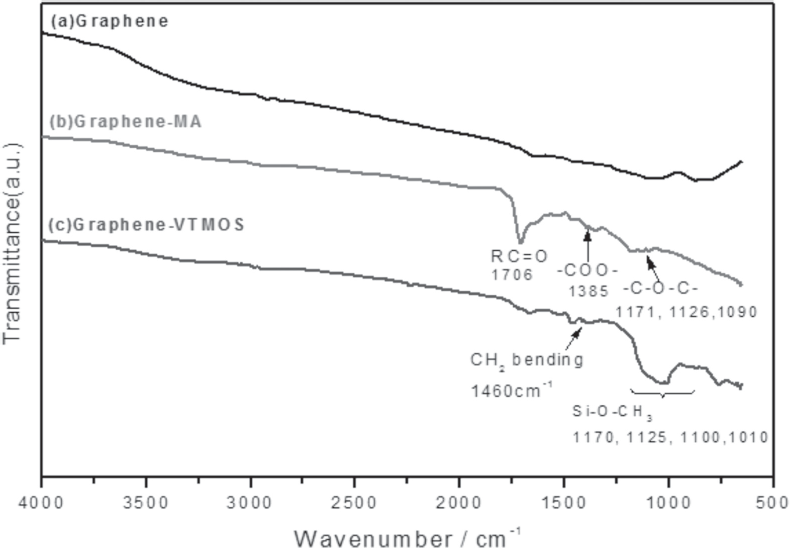
FT-IR spectra of GNPs. (a) unmodified GNPs; (b) GNPs-MA; (c) GNPs-VTMOS
The Raman spectra of classic GNPs (

The Raman spectra of classic GNPs
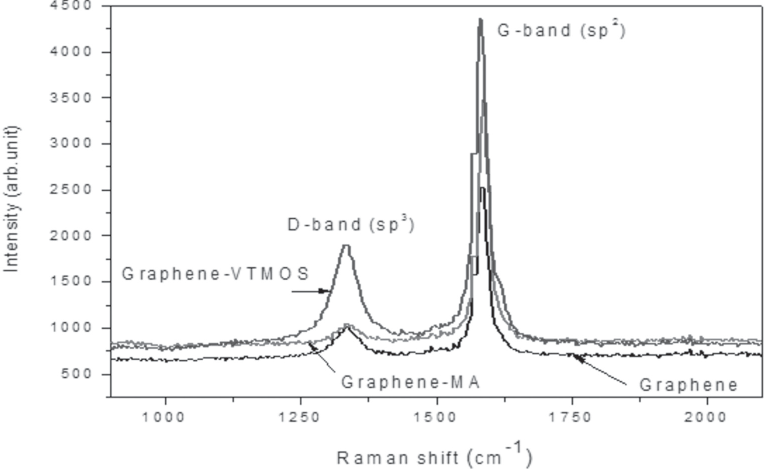
The Raman spectrum of the pristine and modified GNPs
Raman spectra analyses results of GNPs
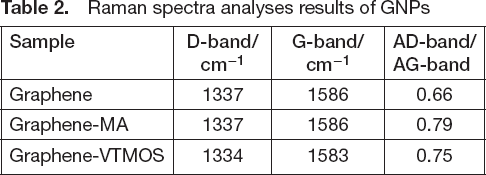
The preceding data show that the D/G area ratios of the modified GNPs were higher greater than those of the original GNPs, indicating that the modifiers were successfully grafted on the surface of the GNPs.
Thermogravimetric Analysis (TGA)
MA and VTMOS were added to the GNPs to prepare GNP-MA and GNP-VTMOS, respectively. The thermogravimetric curves of the pristine and modified GNPs are illustrated in
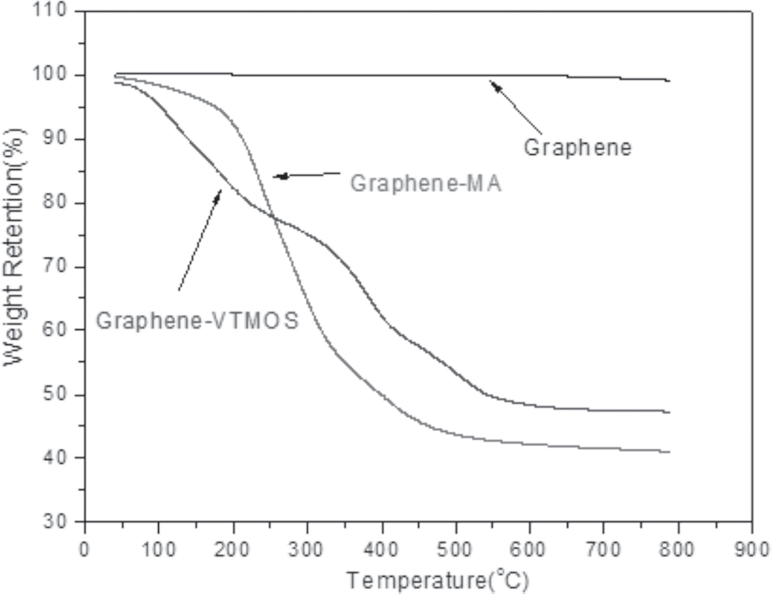
The TGA curve of the pristine and modified GNPs
Thermal Conductivity Coefficient of GNPs/XNBR

The thermal conductivity of the GNPs-MA/XNBR nanocomposites
Mechanical Properties of GNPs/XNBR
The performance of the GNPs/XNBR nanocomposite was primarily evaluated by GNPs dispersion and the interfacial effects between GNPs and XNBR. The mechanical properties of the GNPs/XNBR nanocomposites are illustrated in

The tensile strength and elongation of the GNPs-MA/XNBR nanocomposites

T.S: tensile strength; E: elongation; Tear Die-C: tear strength
The experimental results of mechanical properties were compared with those proposed by Bai et al. 21 . They added graphene oxide (GO) to reinforce XNBR. The tensile strengths of their GO/XNBR composite prepared with 0 vol% (pure XNBR), 0.22 vol% (approx. 0.5 phr), 0.44 vol% (approx. 1 phr), and 1.3 vol% (approx. 3 phr) of GO were 14.8, 21.7, 22.4, and 10.3 MPa, respectively. The reinforced behavior of GO/XNBR composite can be significantly reinforced with a small concentration of GO. However, an excessive concentration of GO can cause aggregation, hindering the mechanical properties of the GO/XNBR nanocomposites.
In this study, the GNPs was successful to modified with maleic anhydride (MA) and vinyltrimethoxysilane (VTMOS), respectively, and uniformly dispersed in XNBR to prepared the GNPs/XNBR nanocomposites.
The experimental results showed that the identification of GNPs via FT-IR and Raman spectra have obvious characterization. The tensile strength of GNPs/XNBR nanocomposites have optimal characteristics with reinforcement through modified GNPs addition. However, the tear strength decreased drastically when the GNPs-MA adding into XNBR because of nonuniform dispersion and void in the nanocomposite.

The Die-C of tear strength of the GNPs-MA/XNBR nanocomposites
Footnotes
Acknowledgment
The authors would like to thank the Ministry of Science and Technology of Taiwan (National Science Council of Taiwan), for financially supporting this research under a Contract No. MOST 105-2221-E-157-004, MOST 105-2623-E-269-001–D and MOST 105-2221-E-241-001-MY3.