




Abstract
The paper investigates the effect of bulk and surface modification on the adhesive and tribological properties of ultra-high molecular weight polyethylene (UHMWPE) and shows that bulk modification with nano- and micro-sized modifiers (montmorillonite, shungite, exfoliated graphite) mainly reduces the friction coefficient but leads to a decrease in the wear resistance of the corresponding composites. It is found that gas-phase surface fluorination provides an increase in the wear resistance of experimental samples in all cases due to a combination of nanotexturing and chemomorphological transformations of the surface layers of the modified polymers. The significant dependence of the nanotexture on the technique and mode of modification is demonstrated using the original approaches to the quantitative characterization of the experimental samples’ surfaces’ scanning electron microscopy-images (formed with the scanning electron microscope). It is shown that the surface fluorination not only makes possible to significantly compensate for the increase of the friction coefficient of bulk-modified UHMWPE in comparison with the original one but also provides a nonlinear multiplicative increase in the wear resistance.
Introduction
One of the main tasks of applied materials science is to improve the operational characteristics of materials widely used in various spheres of economic activity.1–4 There has been a steady trend towards replacing metal and ceramic materials with polymer-based composites.5–9 The reasons for the above trend include the combination of the relative ease of mechanical processing of polymers with the possibility of obtaining the widest range of certain functional properties that can be given to these materials by the techniques of bulk or surface modification.10–13 The bulk modification is usually understood as filling the materials (in most cases) with solid-phase and (less often) liquid-phase impurities at the manufacturing stage.14–17 At the same time the bulk modification is often accompanied by a deterioration of the so-called « surface » properties of the initial polymer matrix18–20 as the release of impurity fragments on the surface significantly distorts its original texture and chemical composition. The surface modification methods are usually used to compensate that negative effects in some cases accompanied by various procedures of special mechanical, thermal, electro - and/or chemo - activation.21–24 One of the most studied and widely used surface modification methods is the gas-phase treatment of the material’s surface with the modifying mixtures based on chemically inactive gases.25–28 The fluorine, the sulfur anhydride, the atomic oxygen etc. can be active reagents in such mixtures.28–31 Although the results of gas-phase modification of various polymer matrices by various gas-phase modifiers were obtained earlier, the need for practical application of bulk composites with the necessary set of physics-chemical and, as a result, operational properties requires studying the features of surface modification of such materials.32–35 For example, it was found that solid-phase components implanted in a polymer binder can be characterized by the degree of modification, 36 which is many times higher than one for the initial polymer. Thus, the corresponding composites after fluorination may not acquire positive properties at all since the main part of the fluorine supplied is chemically absorbed by relatively compact placed zones of impurities partially protruding to the surface. This paper is devoted to the study of the synergistic effects observed during sequential bulk (with the shungite, exfoliated graphite or montmorillonite) and surface (by the gas-phase fluorination) modification of ultrahigh molecular weight polyethylene (UHMWPE).
Material and methods
The main objects of our research are ultra-high molecular weight polyethylene (UHMWPE; JSC “TNHK”) and composite materials based on it that were synthesized by N.N. Semenov Institute of Chemical Physics of the Russian Academy of Sciences (Russia). The bulk modification of the UHMWPE was carried out in accordance with the methodology
37
using fillers of various chemical nature with a mass content of: shungite – 4.2 mass %; exfoliated graphite – 5.0 mass % and organomodified montmorillonite – 8.3 mass %. The surface modification of the experimental samples was performed by the gas-phase fluorination
38
with a gas mixture of 15%F2/0.5%О2/82.5% for 180 minutes in a preevacuated stainless-steel reactor (Figure 1). The experimental samples fluorination setup scheme:1-air extractor; 2-a cylinder with a modifier; 3-corrosion-resistant pressure gauges; 4,5- stainless steel needle valves; 6-cylinder valves; 7-a cylinder with helium; 8-a corrosion-resistant manovacuummeter; 9-a stainless steel reactor; 10– a shut-off valve; 11 - a chemical absorber; 12-a vacuum pump; 13 – housing; 14 – lid; 15 – sealing ring; 16 – fitting; 17 – holes for bolted connection; 18 – wire bracket; 19 – samples of UHMWPE composites; 20 - gas mixture flow distributor.
The following elements were used as the main components of the experimental setup for gas-phase fluorination of the polymers (Figure 1): supply and exhaust ventilation with a recuperator (1); gas cylinders for F2/He (2), He and O2 (7); gas manometers (3); - needle stainless steel valves (4,5); diaphragm valves (6, 10); corrosion-resistant manometer (8); stainless steel reactors with 0.3, 0.5 and 1 L volumes (9); chemical absorber (GOST 6755–88) (11); vacuum pump (12). There were also used the reactor thermal stabilization system with a temperature range from 15 to 95°C, the wire bracket for samples placing and chemically resistant rubbers made sealing gaskets and rings. The stainless steel reactor (9) consists of a housing 13 and a lid 14, connected by bolts in holes 17. The sealing ring 15 provides multiple installation/disassembly of the reactor without loss of tightness. Connection to the gas system and the evacuation site was carried out through a fitting 16 with a threaded connection M10 × 1 mm. The samples of UHMWPE composites (19) were placed on a support bracket at a distance of 3–5 mm from each other in order to avoid contact of the samples during the gasphase processing. A cylindrical gas mixture flow metal distributor (20) was used for a qualitative and uniform modification process over the entire sample’s area. In the absence of a gas distributor in the reactor the initial stage of the modification process proceeds mainly along the upper sections of the composite samples which leads to uneven pro-cessing or destruction of their surfaces. Due to the geometry and the shape of the gas flow distributor the modifying mixture entered the UHMWPE composites through the holes in its lower part. Thereby the likelihood of local negative effects on polymers is reduced and the modification process covers the entire area of the samples.
The gas-phase fluorination process was carried out in three stages: the sample prepa-ration of UHMWPE (wiping composites with ethylalcohol or other solvent taking into account the nature of the ingredients (fillers) included in the polymers to remove possible contaminants and degassing of polymers by vacuuming), the gas-phase fluorination and the reaction products removing from the reactor by it’s vacuuming and using chemical absorbers.
The polymers gas-phase modification leads to the transformation of the polymer chain from hydrogen-carbon to fluorohydrogen-carbon structure depending on the technological mode of the modification (fluorination or oxyfluorination). It is illustrated by the example of a low-molecular-weight analogue of UHMWPE - low-density polyethylene (LDPE) (Figure 2). The presence of oxygen in the gas mixture leads to the formation of oxygen-containing groups of various types (–COF and –COOH, etc.) (Figure 2). The elemental scheme of fuorination and oxyfluorination of LDPE.
28
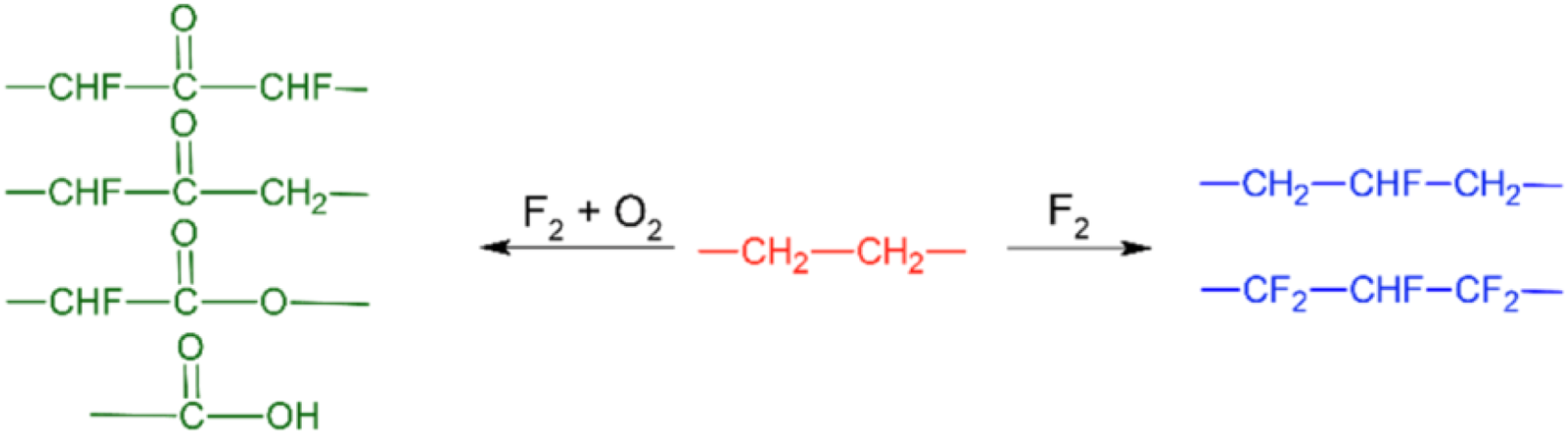
The ultimate result of gas-phase fluorination is the poly-tetra-fluoro-ethylene surface coat production which practically does not occur in the polymer’s bulk due to the decrease of fluorine permeability for the just modified layers.
The reaction of fluorine with polyethylene proceeds by a chain free radical mechanism which is described by the following scheme:



The fluorine - polymer interaction includes the substitution of hydrogen atoms in the polymer chain for fluorine ones, the fluorine integration by double carbon bonds (if any) and the possible (local) destruction of the polymer chain as a consequence of high local heat release.
The creation of a fluorine-containing layer in UHMWPE is confirmed by XPS spectroscopy
39
(Figure 3). Fitted C1s XPS spectra of initial and treated with 10%F2– + 90% He mixture UHMWPE samples (treatment duration was equal to 2 and 90 min) and assignment of the XPS C1s components.
39

Thus, the surface modification can be represented as the integrated coat creation with the thickness, degree and chemical “design” defined by used gas-phase processing technique.
The UHMWPE surface and bulk modification quality control was carried out by the scanning electron microscopy (SEM)40–43 on an auto-emission scanning electron microscope JSM 7500-F (“JEOL”, Japan). The subsequent verification of the results was made with the IR-Fourier spectroscopy44–47 using the SimexFT-801 IR-spectrometer (Russia). The wear resistance of the composite materials based on UHMWPE was determined in the “dry friction” mode on a universal friction machine MTU-01 (Russia) (the clamping force and the rotation speed of the steel indenter (with an average roughness of ∼1.7 microns) were 70 ± 5 N and ∼200 rpm, respectively) (Figure 4). The experimental samples wear resistance setup and the photos of the initial and the bulk modified with organo-modified montmorillonite (8.3 mass %) UHMWPE after the wear resistance experiments.
Results and discussion
The chemically different fillers supplementation to the UHMWPE matrix leads not only to a volumetric restructuring of one but also to textural and morphological transformations of the corresponding surface and near-surface layers (Figure 5(a)–(d)). The surface gas-phase fluorination of polymers and related composite materials is accompanied by the changes in the mode structure of their nanotextures (Figure 5(e)–(h)). The SEM-images of the UHMWPE based experimental samples nanotextures before (a, b, c, d) and after (e, f, g, h) the fluorination procedures: without fillers – (a, e) and bulk – modified with: the shungite (4.2 wt.%) – (b, f); the exfoliated graphite (5.0 wt.%) – (c, g) and the organomodified montmorillonite (8.3 wt.%) - (d, h).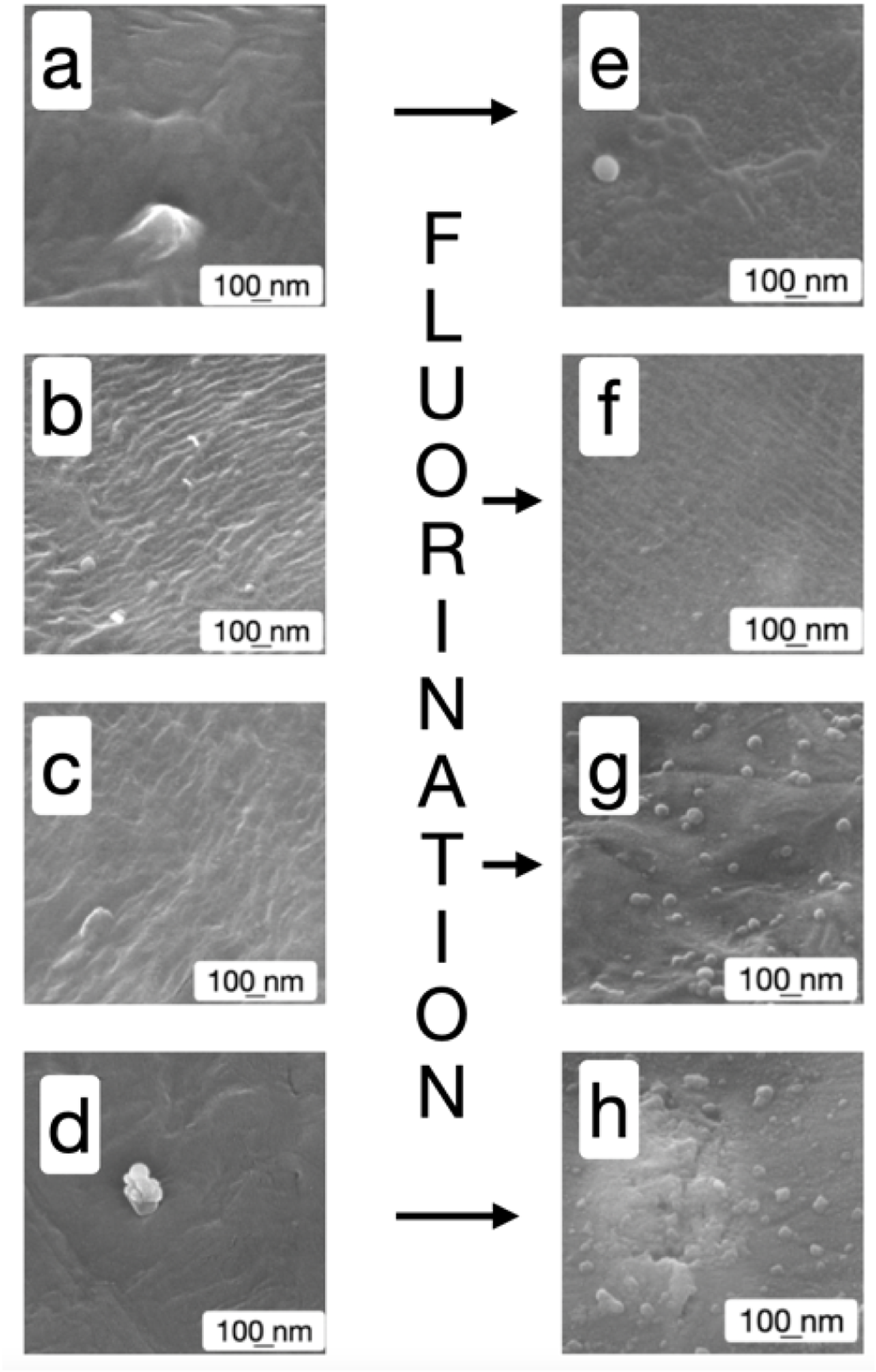
Composition of the surface layer of the initial and fluorinated UHMWPE composites.

The + symbol denotes that the element is present in less than 1 wt %. 37

EDS-analysis of fluorinated UHMWPE composites with the organomodified montmorillonite (A) and shungite (B). C-carbon; O-oxygen; F-fluorine; Si-silicon; Ca-calcium.
The nanotextures visualized with scanning electron microscopy can be imagined as the superposition of two-dimensional periodic lattices with multiple spatial periods.48,49 The SEM-images pixels brightness amplitudes form the morphological spectra that quantitatively characterize the relief of the surface of the experimental samples on a submicro scale (Figure 7(a)–(d)). The morphological spectra of UHMWPE based composite materials’ nanotextures before (a, b, c, d) and after (e, f, g, h) the fluorination: initial – (a) and bulk modified with the shungite (4.2 wt.%) – (b), the exfoliated graphite (5.0 wt. %) – (c) and the organomodified montmorillonite (8.3 wt.%) – (d).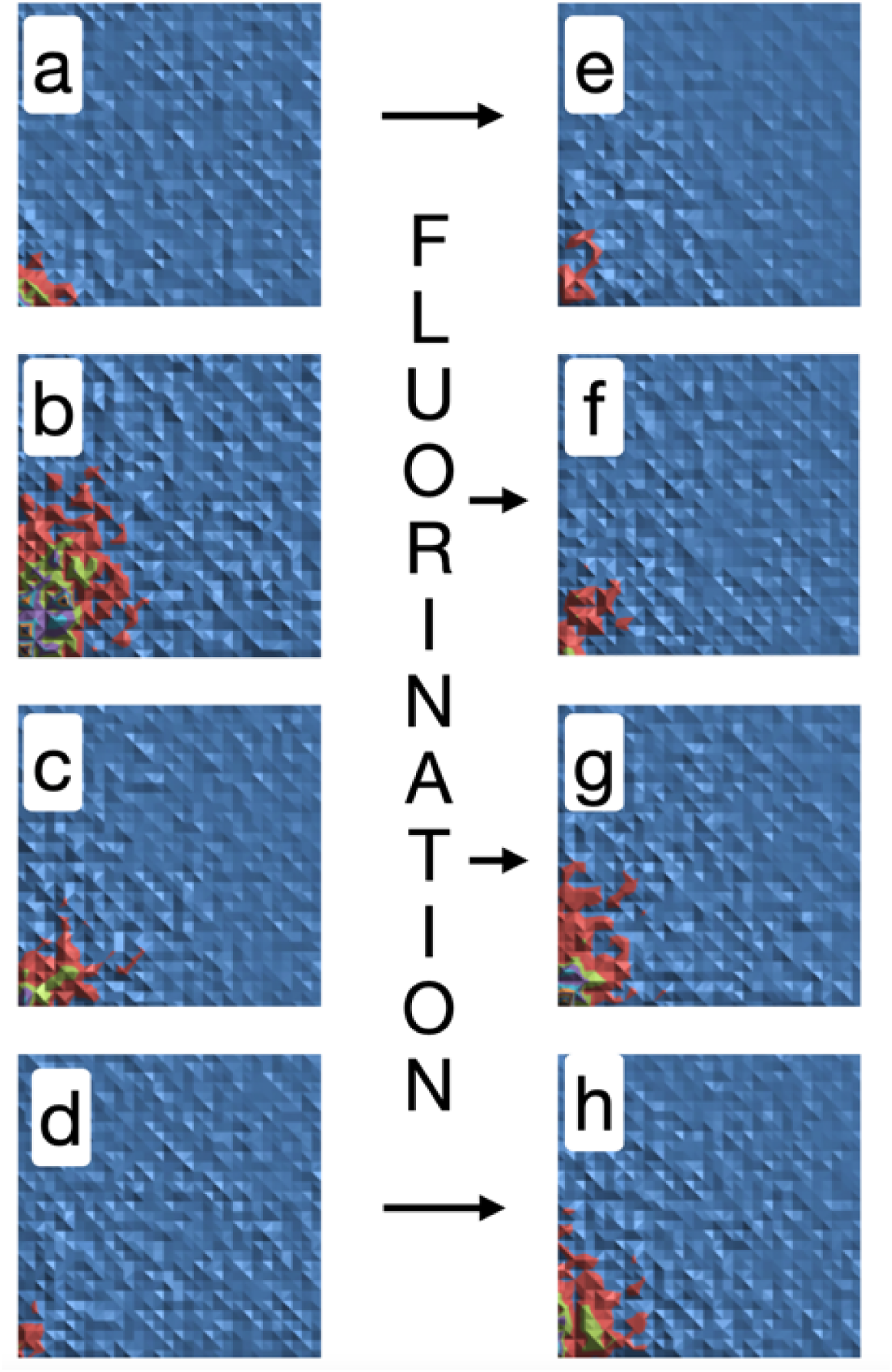
The characteristic size of the morphological spectrum of the localization areaof nanotexture of sample surface can both increase and decrease after the bulk modification depending on the type of the filler. At the same time, the fluorination is also able to provide both an increase and a decrease in the corresponding localization radius. Thus, a structure-morphology synergetic effect is observed (Figure 7(e)–(h)). The essence of the effect is the dependence of the initial polymer nanotexture mode composition on the sequence and the nature of bulk and surface modifications. Hypothetically, there are four possible main variants of textural-morphological transformations (three of which there were observed in our experiment): - the radius of the morphological spectrum localization area increases both after bulk and after surface modification (observed after bulk modification of UHMWPE with exfoliated graphite and fluorination); - the radius increases after bulk modification and decreases after fluorination (observed during bulk modification with the shungite); - the radius decreases as a result of bulk modification and increases after fluorination (observed under the bulk modification with the montmorillonite) and - the radius decreases after each type of modification (this situation was not observed in the framework of the experiments were set).
Since the influence of the radius of the morphological spectrum localization area on the functional characteristics of the material may be not obvious, it was necessary to assess the positivity of the observed phenomenon in relation to the improvement of the operational characteristics of the modified polymer matrix.
The effectiveness of UHMWPE bulk modification with the fillers of various nature is confirmed by the data of IR-Fourier spectroscopy. The absorption band of the Si-O, Al–O–Si and Si–O–Si functional groups appears (∼1040 cm−1) for UHMWPE bulk composite with the organomodified montmorillonite (8.3 mass %). 50 The bulk modification of the UHMWPE with the shungite leads to the appearance.
The fluorination of UHMWPE and corresponding composites leads to the formation of a more « developed » and more “rigid” surface with “hill-valley” type structure. It is explained by the difference of the fluorination kinetics for amorphous and crystalline UHMWPE-composites regions and by the changes in the chemical structure of the surface and near-surface layers during the transformation of functional groups from CH2 to CFH and CF2 (Figure 9). IR spectra of fluorinated UHMWPE and composites based on it: initial - (1) and bulk modified: shungite (4.2 wt. %) - (2), exfoliated graphite (2.9 wt. %) - (3) and organomodified montmorillonite (8.3 wt. %) - (4).
The chemical-morphological transformation of UHMWPE as a result of sequential bulk and surface modifications provides the possibility of controlling the free surface energy of the formed materials and, as a result, their wear resistance, as well as other tribological and adhesive characteristics, studied in.
51
A clear increase in wear resistance as a result of fluorination was observed for all experimental samples (Figure 10). The effect of fluorination on the wear of UHMWPE and composites based on it.
The functional manifestation of the synergistic effect of bulk and surface modification is well observed in the study of the wear resistance of UHMWPE/shungite composites (4.2 wt.%). The fluorination of UHMWPE reduces its wear by three times, bulk modification of UHMWPE with shungite also reduces wear by three times (from 6 to 2 × 10⁻⁴ g/h), the linear effect from the successive application of fluorination and bulk modification should lead to a decrease in the degree of composite wear by 9 times, but there is a decrease in wear to ∼ 0.5 × 10⁴ g/h (Figure 8), i.e. by ∼ 12 times. Specific manifestation of the same functional-synergistic effect is compensation for the increase in the degree of the composites wear obtained as a result of bulk modification due to fluorination (for example, wear is first increased by ∼ 6.5 times as a result of bulk modification with organomodified montmorillonite, and then decreases by ∼ 4.2 times due to fluorination). The discussed effect is hardly observed in the case of bulk modification of UHMWPE with exfoliated graphite with a mass fraction of 5.0%. The IR-spectra of UHMWPE and corresponding composites: initial - (1) and bulk modified with: the shungite (4.2 mass%) – (2), the exfoliated graphite (2.9 mass%) – (3) and organomodified montmorillonite (8.3 mass%) – (4).
Apparently, this is due to the combination of the chemical composition and morphological characteristics of this filler, with the fluorination degree significantly exceeding the fluorination degree of the considered polymer matrix.
Conclusions
As a result of studying the effect of bulk and surface modification on the structure and properties of the polymer matrix of ultrahigh molecular weight polyethylene (UHMWPE), it was found that the combined use of fluorination and bulk filling with shungite, exfoliated graphite or montmorillonite leads to clearly nonlinear changes in both the structure and a set of properties of the initial polymer. When testing the formed composites for wear resistance, it was shown that the most obvious manifestation of the functional-synergistic effect is a nonlinear increase in the wear resistance of samples based on UHMWPE, bulk modified with shungite the same time, it was shown by scanning electron microscopy (SEM) that the nanotextures of all samples changed significantly and in different directions as a result of both, bulk and surface, modification. Thus, the possibility was established to effectively control the wear resistance of composites based on ultrahigh molecular weight compounds by selecting combinations and conditions for the implementation of bulk and surface modification.
Footnotes
Declaration of conflicting interests
The author(s) declared no potential conflicts of interest with respect to the research, authorship, and/or publication of this article.
Funding
The author(s) disclosed receipt of the following financial support for the research, authorship, and/or publication of this article: The reported study was funded by Moscow Polytechnic University (Grant named after V.E. Fortov).
