




Abstract
In this study, the effects of gamma irradiation on the tribological behaviors of high-density polyethylene (HDPE)-filled ultrahigh-molecular-weight polyethylene (UHMWPE) composites were investigated. The tribological changes were evaluated by friction and wear tests as well as scanning electron microscopic analysis of the worn surfaces. It was found that the irradiation induced the degradation of UHMWPE molecular chains and the interfacial cross-linking was formed. The addition of HDPE significantly increased the wear resistance of UHMWPE composites. Friction and wear tests indicated that HDPE improved the tribological properties of the materials before and after irradiation. HDPE and irradiation exhibited a good synergistic effect for improving the wear resistant and tribological properties of UHMWPE material.
Introduction
It has been known that the blending of dissimilar polymers offers an attractive opportunity for the development of novel materials with useful combinations of properties. 1 –3 Blending, in contrast, is the simplest method to modify the polymers, that is, both flat sheet and hollow fiber, and thus is widely used in the industry. However, by directly blending hydrophilic polymer, the vast majority of these polymer pairs is thermodynamically immiscible and, when blended, usually displays poor properties, owing to their unstable morphology and poor adhesion between the phases. Such problems have been overcome by the introduction of a proper compatibilizer to modify the interfacial condition. The process is often called compatibilization. A compatibilization strategy frequently proposed is the addition of a premade block copolymer composed of the blocks, which are miscible with the component polymers or the component polymers themselves. 4 –6
Ultrahigh-molecular-weight polyethylene (UHMWPE), which exhibits a very low friction coefficient against steel, is widely used in biomedical and technical applications because of its high wear resistance and high impact strength. Nevertheless, UHMWPE is a viscoelastic material. Its performance is affected by inherent weaknesses, such as high creep when compared with metal and bone. 7 High-density polyethylene (HDPE), which exhibits a better creep resistance but a lower wear resistance, can be blended with UHMWPE to improve the creep resistance. UHMWPE has been widely used as a bearing material for artificial joint replacement over 40 years. To improve the blood compatibility of biomedical materials, many studies have focused on the development of new materials and the modification of conventional materials. 8 –11 The radiation chemistry investigations were also extended to the polymer/drug interactions with interesting results pertaining to the nature and the role of polymer interaction. It is usually cross-linked by gamma rays irradiation before its implantation into human body. 12,13
In this study, gamma irradiation of UHMWPE is used to improve the tribological behaviors of HDPE-filled composites, and the friction and wear mechanism is investigated.
Experimental
Materials
The HDPE used with an average granule diameter of 3 mm was DMD 7006A provided by QPC (Shandong, China).
The raw material of UHMWPE used in this study was in the form of a powder SLL-5020, provided by Shanghai Research Institute of Chemical Industry (Shanghai, China) with a viscosity average molecular weight of 5 × 10⁶.
Gamma irradiation
UHMWPE was irradiated by using 60Co as irradiation source (Gammacell, Nordion Inc., Canada). Irradiation was performed in the presence of air at 50, 100 and 150 kGy dose and an irradiation temperature of 25°C.
Specimen preparation
The UHMWPE/HDPE blends were produced by mixing 20 wt% HDPE granules and 80 wt% UHMWPE powder in a HAKKE laboratory kneader at a temperature of 210°C. The rotational speed was 10 r/min for 5 min, and then the speed was increased to 45 r/min for 10 min. In the next step, the blend was compression-molded in the same mold as the UHMWPE samples at a temperature of 180°C and a pressure of 10 MPa. After 20 min, it was cooled naturally under the same pressure.
Hardness
The Rockwell Hardness (HRM) hardness was measured at a load between 0.098 and 19.6 N using a microhardness tester (HM-221, Mitutoyo Corp., Kanagawa, Japan). The load was applied for 30s.
Friction and wear properties
Friction and wear tests were conducted at a velocity of 0.42 m/s for 1 h under loads of 50, 100, 150, 200 and 250 N with a MM-200 block on ring wear tester. Samples were 25 × 7 × 6 mm3 blocks, and the composition of the metallic ring was AISI 1045 steel, quenched and hardened to a hardness of 40–45 HRC. The metallic ring and the block specimen were finished with 600 grade silicon carbide paper that provided a surface roughness of Ra = 0.10–0.15 and 0.4–0.6 μm, respectively.
Results and discussions
The hardness
Figure 1(a) shows the hardness that varies with the HDPE content for unirradiated and irradiated samples. The hardnesses of the filled samples are higher than that of unfilled sample for both irradiated and unirradiated samples. The hardness of 15 vol% HDPE-filled sample is the highest for the unirradiated samples. However, sample hardness decreases as the HDPE content is above 15 vol%. For irradiated samples, the hardness of the composite sample increased with the content of HDPE. Figure 1(b) shows the hardness that varies with the irradiation dose for unfilled sample and 15 vol% filled sample. The hardness of HDPE-filled sample is higher than that of unfilled sample at different doses.
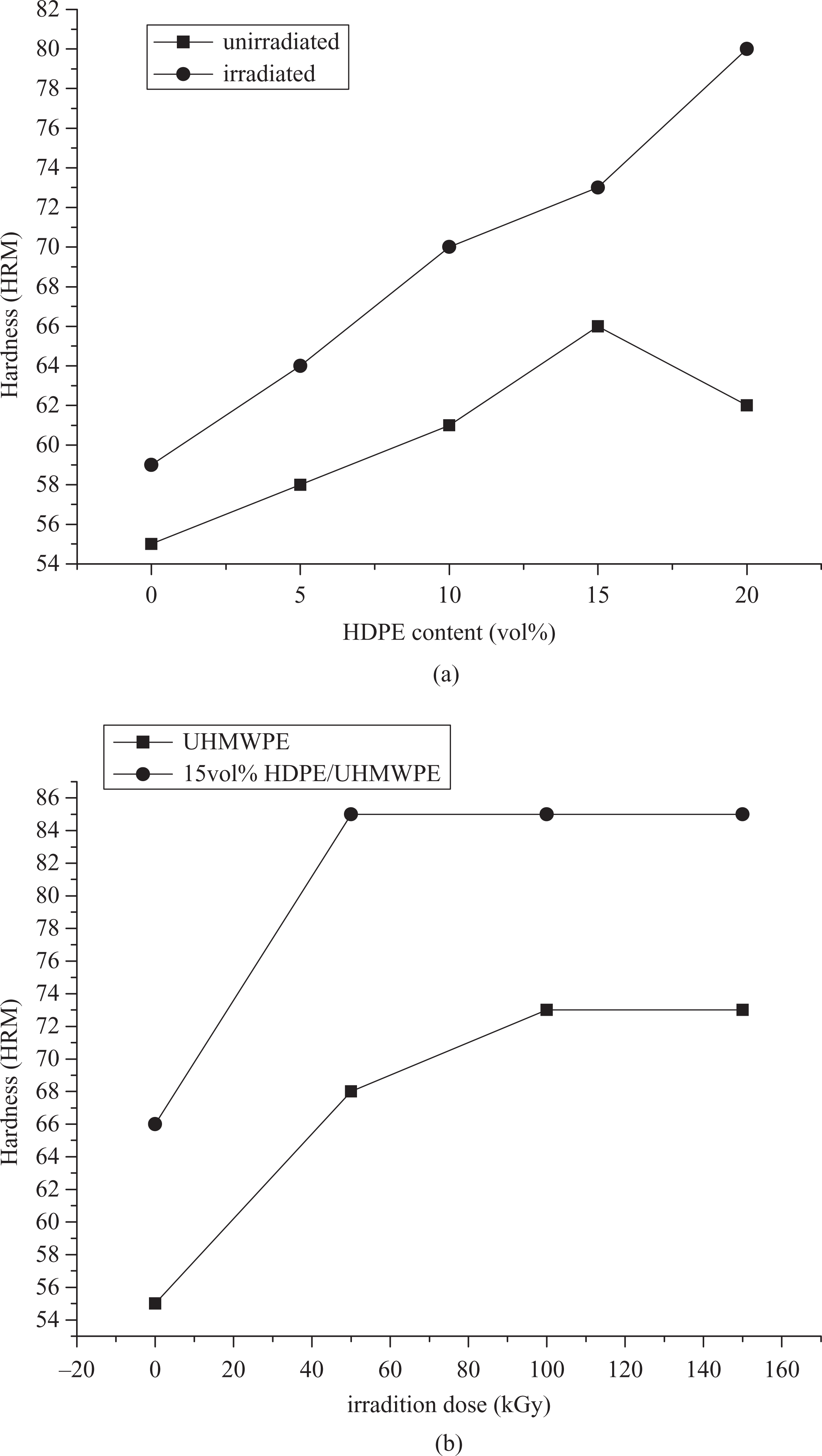
The hardness of HDPE/UHMWPE composites. HDPE: high-density polyethylene; UHMWPE: ultrahigh-molecular-weight polyethylene.
The highest hardness of unfilled sample appears at the dose of 50 kGy, while the highest hardness of 15 vol% HDPE-filled sample appears at the dose of 100 kGy.
The friction coefficient decreases as the HDPE content increases. A minimum point of friction coefficient is formed at the HDPE content of about 20 vol% in Figure 2 and the minimum friction coefficient is 87% that of the pure UHMWPE for the irradiated HDPE/UHMWPE. It is not as obvious for mixing HDPE/UHMWPE as for irradiated HDPE/UHMWPE, where the friction coefficient changes with the variation in the HDPE content. It can been seen from Figure 2(b) that the wear is much lower for the irradiated HDPE/UHMWPE than for the mixing HDPE/UHMWPE with the same components. Choosing the appropriate content of HDPE can obviously reduce the wear of UHMWPE. This strengthening effect of HDPE-filled sample by irradiation is much greater than that by mixing. When the HDPE content is about 20 vol%, the wear of the irradiated HDPE/UHMWPE is the lowest, which is only 56% of that of the pure UHMWPE with the same molecular weight. Relatively, the influence of HDPE content on the wear is not so obvious for the mixing HDPE/UHMWPE, and the lowest wear is 85% of UHMWPE at the point of 15 vol% of the HDPE content. Figure 2 shows that the wear of the UHMWPE/HDPE composite can be significantly reduced by irradiation. The wear of all the UHMWPE composites, both with irradiated UHMWPE and unirradiated one, decreased with increasing HDPE content. This improvement in the wear resistance correlates with an increase in the hardness with increasing HDPE content (Figure 1). The addition of 15 vol% HDPE to the UHMWPE matrix caused about 50% reduction in the wear.
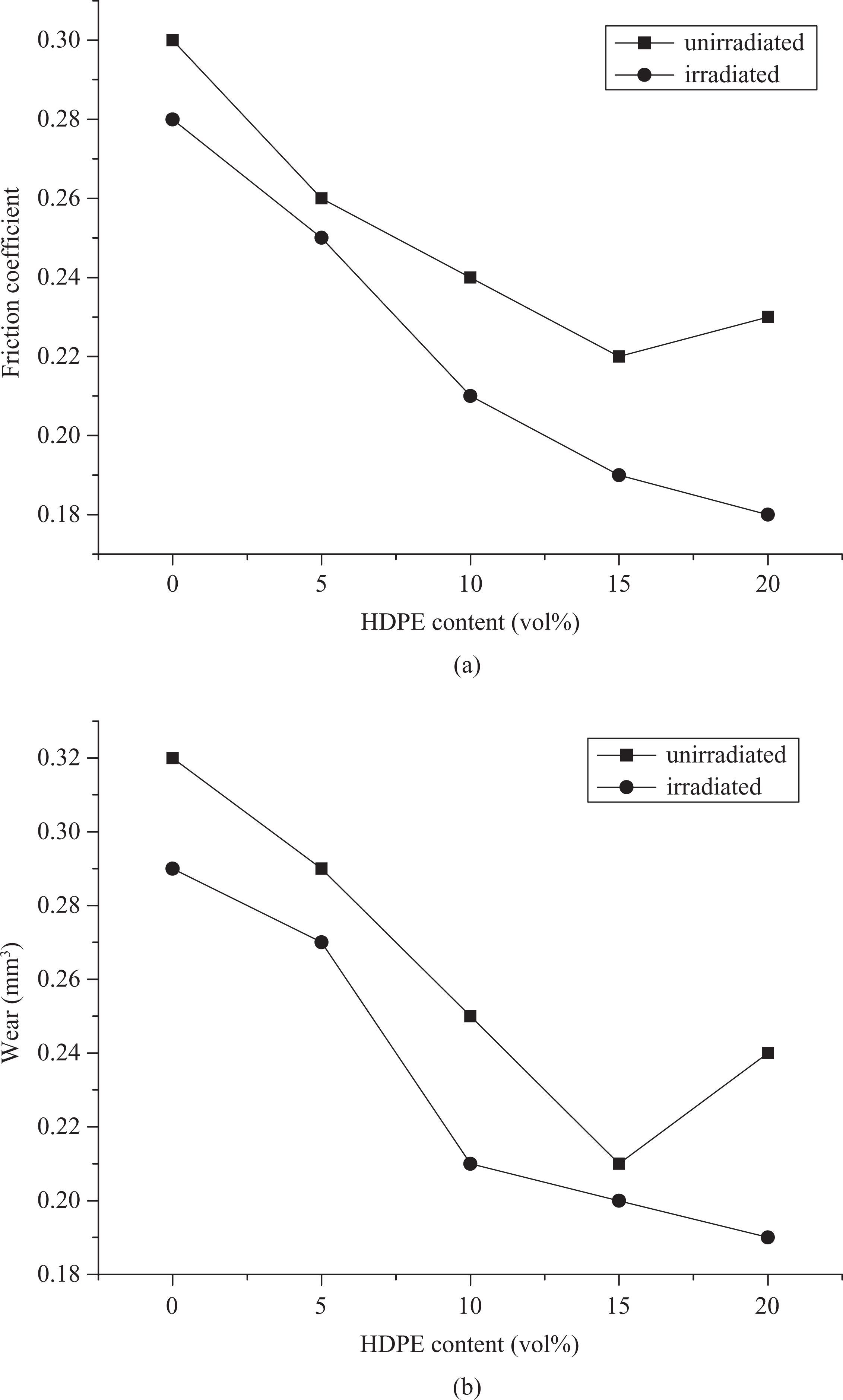
The friction coefficient and wear of HDPE/UHMWPE composites with HDPE content. HDPE: high-density polyethylene; UHMWPE: ultrahigh-molecular-weight polyethylene.
The change in load exerts obvious influence on the friction coefficient and wear. It can be seen from Figure 3 that the friction coefficient and wear becomes lower when the load increases.
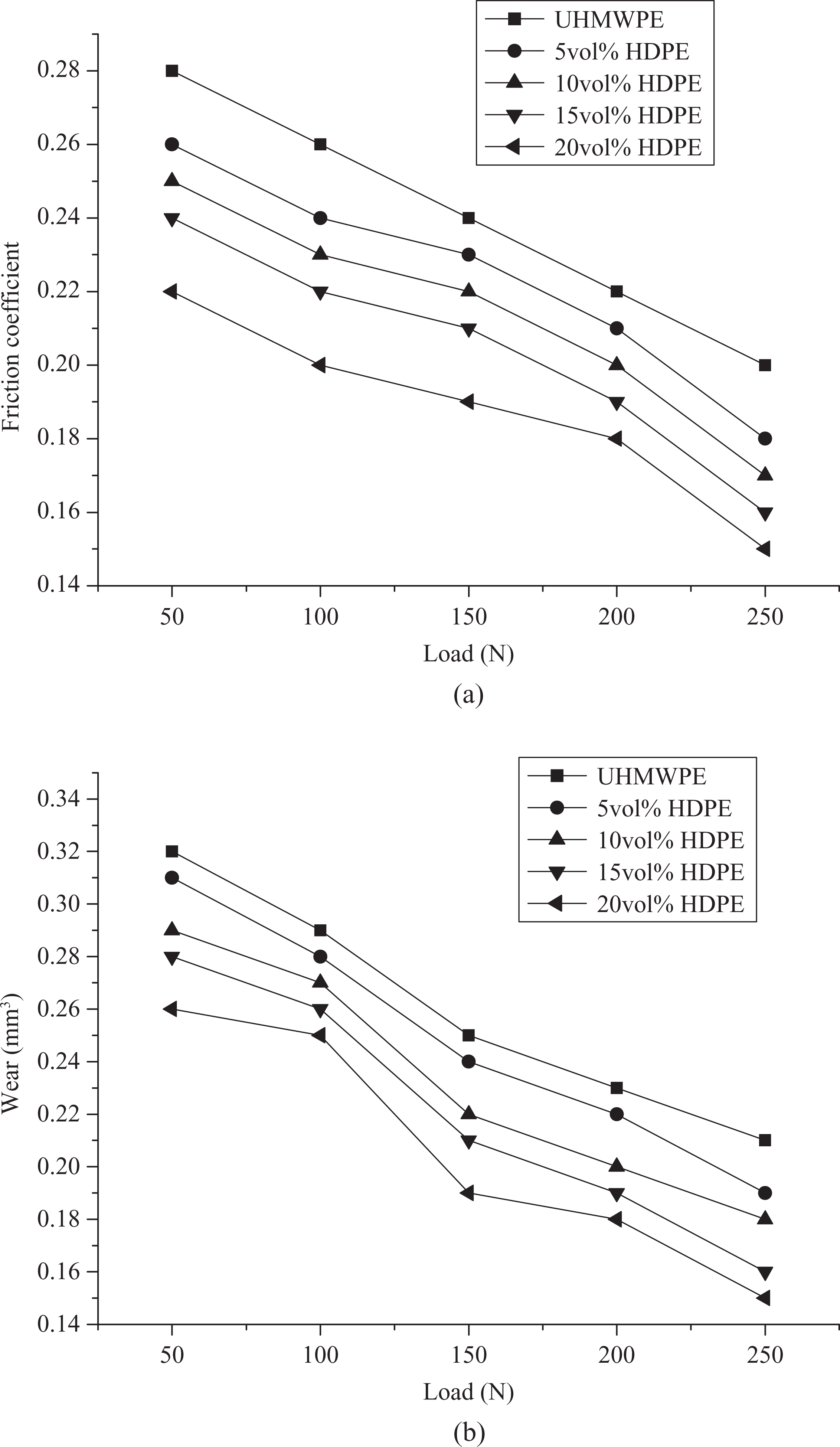
The friction coefficient and wear of HDPE/UHMWPE composites with load. HDPE: high-density polyethylene; UHMWPE: ultrahigh-molecular-weight polyethylene.
Comparing with the pure UHMWPE, UHMWPE composites show a small wear loss after irradiation. HDPE-filled composites show a good wear resistant property, which is caused by the fact that HDPE plays as a protective layer against further wear peeling. In addition, HDPE and irradiation have synergistic effect of wear resistance. The result shows that filling HDPE and irradiation of UHMWPE could improve the wear resistant properties of the UHMWPE composites.
The change in friction coefficients of the samples was caused by the unobvious change in UHMWPE main structure under irradiation environment. From Figure 3(a), compared with the different filled composites, it can be seen that HDPE as single filler had obvious effect on the improvement of friction property.
The wear of pure UHMWPE increased because the breaking of the molecular chains weakened the shear resistant capacity. The HDPE were embedded in the UHMWPE matrix during sliding process resulting in the reinforcement of shear resistant capacity. The irradiation of 20 vol% HDPE/UHMWPE sample showed a best wear resistant property when compared with other kinds of samples before and after irradiation due to the combined reinforcement effect of the two factors.
Figure 4 shows the scanning electron microscopic surface morphologies of pure UHMWPE and UHMWPE composites with and without irradiation. The surface morphologies of the specimens were relatively smooth after irradiation (Figure 4(b) and (c)). The specimens underwent interfacial cross-linking when they were exposed to irradiation environment, during which the two phases were combined tightly. The surface of the pure UHMWPE changed into ‘honeycomb-like’ structure without irradiation (Figure 4(a)). For the HDPE-filled composite with irradiation, the HDPE were exposed obviously on the surface and the surface is the smoothest (Figure 4(c)). The UHMWPE matrix in the skin layer was preferentially eroded by irradiation. As a result, there are large numbers of debris appeared on the composite surfaces (Figure 4(b)).
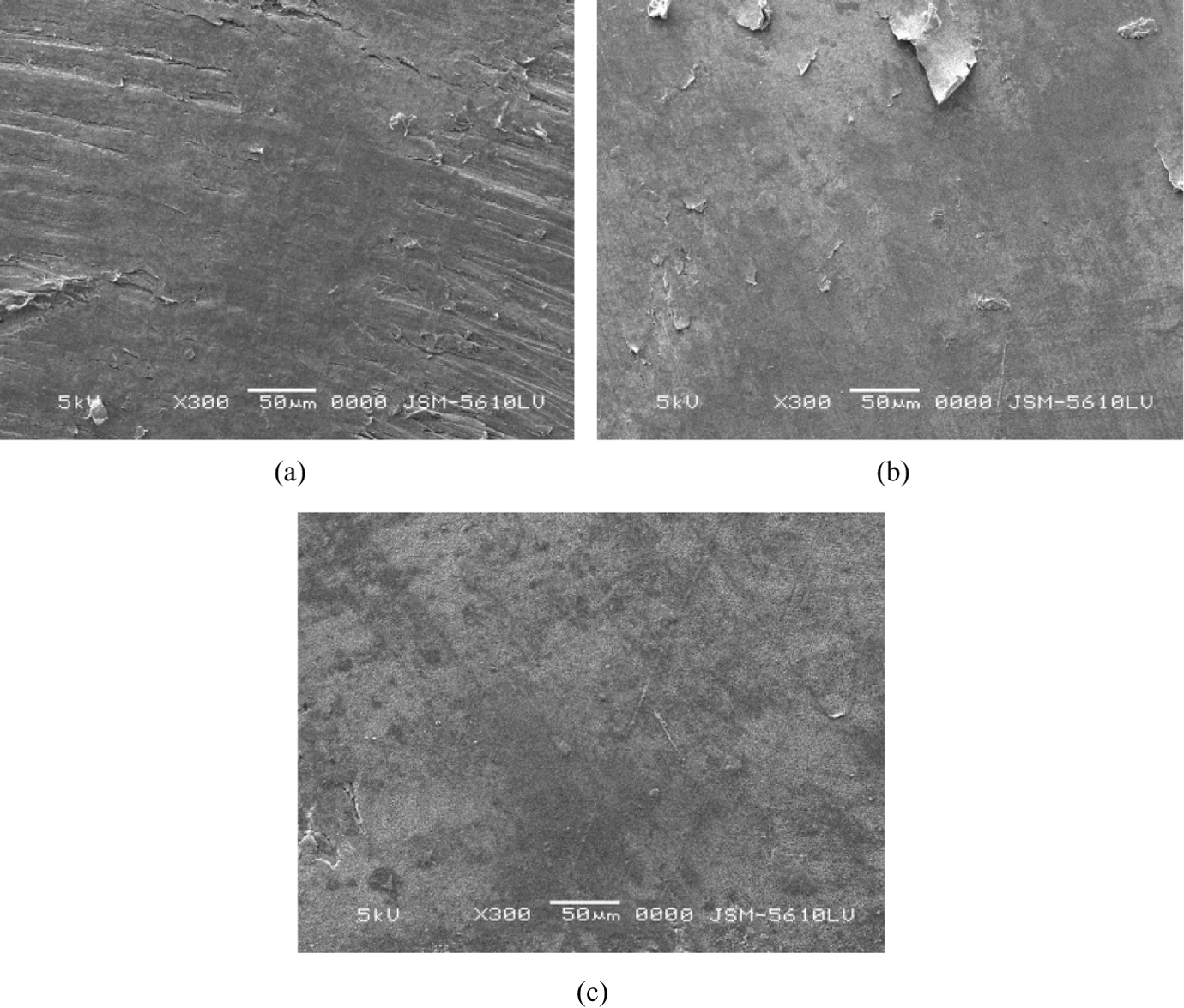
SEM morphologies of the worn surface of HDPE/UHMWPE composites. SEM: scanning electron microscopic; HDPE: high-density polyethylene; UHMWPE: ultrahigh-molecular-weight polyethylene.
The worn surfaces of the unirradiated and irradiated UHMWPE exhibited severe plastic deformation (Figure 4(a) and (b)), which indicated that the adhesive wear took the dominant wear mechanism. Comparing with the pure UHMWPE, less wear debris were produced for HDPE-filled composites and irradiation can effectively improve the wear resistance of the composites (Figure 4(c)), which were consistent with the result of wear (Figure 3(b)). There was no obvious wear scar on the irradiated UHMWPE after the friction test. However, in the case of unmodified UHMWPE, the wear scar was very obvious.
Conclusions
The hardnesses of filled samples are higher than that of unfilled samples for both irradiated and unirradiated samples. The hardness of 15 vol% HDPE-filled sample is the highest for the unirradiated samples. For irradiated samples, the hardness of the composite sample increased with the content of HDPE.
The wear of all UHMWPE composites, both with irradiated UHMWPE and unirradiated one, decreased with increasing HDPE content. When the HDPE content is about 20 vol%, the wear of the irradiated HDPE/UHMWPE is the lowest.
Footnotes
Funding
The work is supported by National Natural Science Foundation of China #11261066, Applied Basic Research Programs of Science and Technology Department Foundation of Yunnan Province of China (project number 2010CD21) Educational Commission Important Project of Yunnan Province of China (project number 2011Z008).