




Abstract
In accordance with the principles of sustainable development, improving the quality and durability of structural elements and coatings, the construction industry requires the development and the implementation of resource- and energy-efficient building materials, as well as innovative technologies for their production. The use of complex modifiers for no-slump concrete mixtures and concrete is becoming increasingly widespread in modern materials science. The article presents the studies of influence of polymer additive structured carbon nanomaterials on physical and mechanical characteristics of no-slump concrete mixtures. The methods of infrared spectroscopy and thermogravimetric analysis showed that the use of carbon nanomaterials alters the structure of no-slump concrete mixtures significantly. As a result of the fact that the high-strength nanomaterial is the centre of crystallization of cement stone neo-formation, a denser reinforced microstructure is formed, which increases significantly the strength properties of no-slump concrete mixtures. The inclusion of a complex polymer additive in no-slump concrete mixtures leads to higher and longer plasticizing, which plays an important role in the production of monolithic products. It was determined that, in the presence of a complex modifier (a polymer additive structured by carbon nanotubes), the crystalline structure of calcium silicate hydrate is compacted, which determines high physical and mechanical characteristics of modified no-slump concrete mixtures. It was experimentally shown that the additive acted as an accelerator of a setting and hardening cement test and also increases its strength characteristics. In general, in this study, there is a water-reducing effect from the application of the additive for all no-slump concrete mixtures. Water consumption is reduced by 5% of the mass, while the strength is increased by 19%. No-slump concrete mixtures recipes modified by polymer additives, structured by carbon nanotubes, with high performance were developed.
Introduction
Today, a promising area of materials science is study of composite materials based on polymers, which are called polymer composite materials (PCM) They are one of the most numerous and diverse types of materials used in many industries. Their use gives a significant economic effect. Among the most interesting and promising there are polymers (plastics, elastomers, fibres), and especially filled ones. The possibilities of polymers are extremely wide due to the diversity of polymers and fillers, the inexhaustible variability of polymer composites and the methods of their modification. The main technological method for obtaining polymer composites for a long time was the mechanical mixing of the filler and the polymer matrix. Many different substances are used as fillers for PCM. The simplest and most economical method for the production of such materials is the mixing of a polymer in a liquid state with a nanosized phase and subsequent polymerization of the resulting composite. With the help of modification, it is possible to obtain various polymer composites with the necessary mechanical and operational characteristics. Therefore, a very important task is to study the effect of various components on the initial properties of the polymer.
The first patent for a polymer composite containing fibre-reinforced synthetic resin was issued in 1909. However, until now, the development and production of polymer composite building materials is relevant and in demand, especially in the production of structural elements and coatings, because these constructions carry the greatest loads at relatively large span sizes. Cement-based mixtures requiring specified parameters are used directly in the manufacture of these structures.1–8
One of the simple and effective ways to improve the performance of cement concrete mixtures is the development of complex modifiers using polymers. At the same time, the properties of modifier components, the composition of no-slump concrete mixtures, technological factors, operating and climatic conditions are assumed to be interconnected.2,3,9
The most common plasticizing additives are polymethylene naphthalene sulfonates and lignosulfonates. However, such materials are effective at high content. In addition, their production is environmentally unfriendly, so there is a perspective to create new environmentally friendly additives that are effective at low concentrations, many times lower than the polymethylene naphthalene sulfonates and at the same time capable of improving the performance of no-slump concrete mixtures. There are a number of publications7,6,10 that demonstrate the effectiveness of polycarboxylate.
The research11–17 demonstrated that the introduction of polycarboxylate-based polymer plasticizer increased the early strength of concrete, reduced significantly the consumption of water and cement with a small amount of input additive, which in turn made it possible to manufacture high-strength, high-quality no-slump concrete. However, polycarboxylate-based plasticizers do not always provide the required improvement in the performance of the concretes.18–22 Consequently, the researchers are currently working on the creation of complex modifiers based on polycarboxylate ethers.
A lot of attention is paid to carbon nanotubes as nano-modifiers that improve the properties of no-slump concrete mixtures. The introduction of multilayer carbon nanotubes with a diameter close to the thickness of nano-disperse phase layers C-S-H into no-slump concrete mixtures may have different effects on hardened cement paste properties.23–28 Koward 25 determined an increase in strength when a small number of multilayer nanotubes were introduced into high-quality concrete. However, the number of carbon nanotubes relative to the volume of hardened cement paste is quite small (fraction of per cent), which causes some technological difficulties with their uniform distribution in the cement matrix.
Currently, carbon nanotubes (CNTs) and carbon nanofibers (CNFs) are used as carbon nanofillers. CNTs have a number of unique properties in contrast to classical fillers. Researchers Vesmawala, G.R, Vaghela, A.R, Yadav, K.D, and Patil, Yo. 29 showed the positive influence of multilayer carbon nanotubes on improving the structure of hardened cement paste, increasing its fracture and dynamic viscosity, water resistance, corrosion resistance due to the fact that the carbon nanotubes in the matrix act as “embryos” crystals of elongated shape, which contribute to its ordering to increase the conditionally closed microspores. Carbon nanotubes (СNT) can accelerate cement hydration, help to crystallize calcium hydroxide in hydrated cement paste and improve the mechanical properties of cement-based materials.
Thus, the main problem of nano-modification is to control the process of forming the structure of the material “bottom-up” (from nano-levels to hardened cement paste macrostructure) and kinetics of the whole spectrum of chemical reactions accompanying the hardening process. Accordingly, the use of nano-disperse modifiers makes it possible to control the interaction kinetics between cement and water and to achieve maximum positive effects at the following stages: the dissolution of cement grains, obtaining the specified rheology; colloidation, providing the necessary mobility in time; and crystallization, increasing the number of centres of neoplasms crystallization and thus increasing the strength, water and frost resistance of concrete. The complex of physico-chemical interactions in the hardened cement paste structure at the nanoscale promotes the passage of hydration reactions, revealing new patterns for understanding the nature of hydrate phases and the development of high-performance no-slump concrete mixtures. 30 The modification of the cement mixture involves influencing the processes that occur during the hydration of clinker minerals and the cement matrix structure formation.31,32 At the same time, problems of dispersion and homogeneous distribution of carbon nano-modifiers in the cement matrix environment have not been solved due to increased inclination to agglomeration, insufficient adhesion of nanotubes to the matrix, making it impossible to fully utilize their high elasticity modulus.
In accordance with the principles of sustainable development, improving the quality and durability of structural elements and coatings, the construction industry requires the development and implementation of resource- and energy-efficient building materials, as well as innovative technologies for their production. The use of complex modifiers for cement-concrete mixtures and concretes is becoming increasingly popular in modern materials science. The main advantage of complex modifiers is that the material and structure are created at the same time. Complex polymer modifiers can be designed and created for the performance of specific tasks, where all the operating conditions of the material will be taken into account. Accordingly, when designing a new composite, it is possible to set characteristics for it that are significantly superior to those of traditional materials in fulfilling this purpose and not inferior to traditional materials in any other aspects.
Thus, the development of complex modifiers based on polycarboxylate plasticizers in combination with carbon nanostructures to improve the performance characteristics of structural products and coatings based on cement concrete mixtures is an urgent problem in modern materials science; according to this, the goal and task of the work was set, as well as the scientific novelty was shown.
The purpose of the work is the technological aspects of obtaining new composite materials with improved performance characteristics. To achieve this goal, the corresponding task was solved – to conduct experimental studies to assess the effect of a complex polymer additive structured with carbon nanotubes on the physical and mechanical characteristics of cement concrete mixtures.
Materials and methods
Portland cement clinker chemical-mineralogical composition.

Portland cement physical and mechanical properties.

A shallow filler is river sand with a modular size 1.89 mm, while a large filler is river gravel of 5–20 mm.
The experimental studies were carried out using standard and special methods. The rheological properties of cement pastes (plastic viscosity, the maximum shear stress) were investigated using the rotary viscometer RHEOTEST®RN 4.1 with the “cone-plate” measurement system according to DIN 53018 (Figure 1). The results were processed according to Bingham plastic model (1) A rotary viscometer Rheotest® RN4.1.

The concrete composition was designed in accordance with the recommendations of the European Federation of Specialist Construction Chemicals and Concrete Systems (The European Guidelines for Self-Compacting Concrete: Specification, Production and Use; ACI 237R-07 Self-Consolidating Concrete). It is more appropriate to express the ratio of the initial components by volume rather than by mass. At the first stage, the ratios between the components are established on the basis of typical ranges of their content, which provide normalized indicators of the concrete mixture: – water/powder ratio (cement, mineral additive, sand fractions smaller than 0.125 mm) by volume from 0.80 to 1.10; – total dispersion content from 160 to 240 L (400–600 kg/m3); – cement content - 350–450 kg/m3 (cement consumption above 500 kg/m3 can increase shrinkage and yield of concrete; consumption less than 350 kg/m3 can be acceptable only if other fine mineral fillers or pozzolanas are used); – a large filler content – from 28 to 35% by volume; – water-cement ratio is based on EN 206-1; it is usually not more than 200 L/m3 – a sand content is defined as the difference between the total volume of the concrete mixture and the volume of the large filler and the cement paste.
Further, it is necessary to adjust the composition to meet the requirements for hardened concrete, in particular its durability. The basic concrete composition was calculated using a method that achieves the maximum packing ratio of large and small fillers, the cavities between which are filled with the cement and sand grout. Ethacryl HF (France) from the polycarboxylate class was used as a polymer additive (Figure 2) A structural formula of superplasticizer Ethacryl HF (a:b:с = 6: 1: 0-5, n = 1–100).
The complex modifier was produced by dispersing carbon nanotubes in an aqueous medium with the aid of an ultrasonic disperser (22 kHz frequency) for 10–20 min with the gradual addition of the required amount of polymer superplasticizer to ensure uniform distribution of nanoparticles in the mixture. The complex modifier was introduced into the mixing water, where it was previously mixed until the moment of introduction into the cement. Mixing components were mechanically mixed with a mixer for 120 s. The resultant slurry was then injected into the cement, mixed and given hydrated cement paste with certain concentrations - a polymer additive of 4.5 mass. % and carbon nanotubes 0.1 or 0.5 mass. % relative to the amount of cement.
Multi-layer carbon nanotubes synthesized by catalytic CVD synthesis were used for cement matrix reinforcement33,34 using three-component iron catalysts. 35 The outer diameter of a carbon nanotube (CNT) was 10–40 nm, the specific surface was 200–400 m2/h and the bulk density were 20–40 g/dm3.
The infrared spectroscopy of the specimens was registered on the Perkin-Elmer Fourier-transform IR Spectrometer, model Spectrum 65, using the Miracle ATR (ZnSe crystal) set-top box in the 4000-600 cm−1 region, for each spectrum 20 consecutive scans were averaged. Recording and subtraction of the background spectrum were done automatically.
Сhemical composition and properties of carbon nanotubes.

Moreover, physical-mechanical tests of modified no-slump concrete mixtures were carried out, according to DSTU B.V. 2.7-187:2009, DSTU B.V. 2.7-188:2009 and DSTU B B.2-214:2009, which covered determination of density, timing of cement setting, and ultimate compressive strength. The cement concrete mixtures study was conducted on samples 2 × 2 × 2 cm, which were tested for 1.7 and 28 days of curing under normal conditions (temperature was 20 ± 3°C, relative humidity was 60 ± 5%).
Results
The approximate mineralogical composition of Portland cement clinker.

The properties of cement are due to the properties of the mineralogical composition of Portland cement clinker as follows: - tricalcium silicate (alite) - C3S - provides high strength, hardening rate and other cement properties; - dicalcium silicate (belite) - C2S - hardens slowly, but gives the cement high strength, increasing over time; - tricalcium aluminate (celitis) - C3A - harden quickly, but its hardening products have low strength; - four-calcium calcium aluminoferrite (Brownmillerite) - C4AF - hardens slowly.
Physical and mechanical properties of hydrated cement paste with a complex additive.
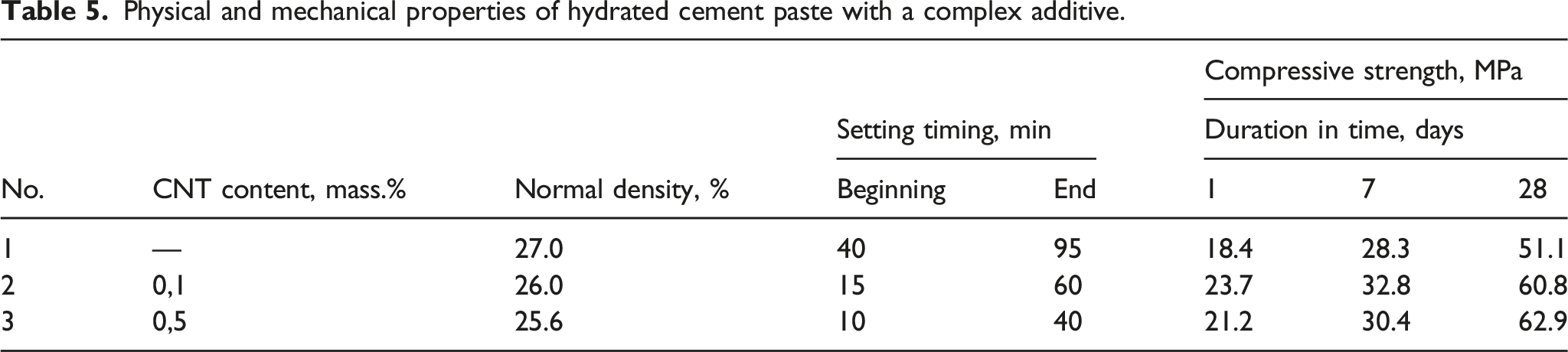
The acceleration of composite no-slump concrete mixtures hydration and the increase in their strength point to the interaction of a polymer additive structured carbon nanotubes with a no-slump concrete mixture providing a puzzolan portland cement reaction (binding of free lime released during cement hardening).1,36
All types of samples were made in the amount of three pieces. The tables show averages. In order to study the influence of the complex modifier on the properties of hardened cement paste, the method of infrared spectroscopy was applied. Samples of hardened cement paste with a polymer additive, structured by carbon nanotubes, were investigated. The results of the studies are presented in Figure 3. IR spectrum of hydrated cement paste for 28 days of hardening: 0 – unhydrated cement; 1-checking hydrated cement; two- hydrated cement of 0.1 mass.% CNT; three- hydrated cement of 0.5 mass.% CNT.
The oscillation bands with maxima at 3643 and 3400 cm−1 in the infrared spectrum of modified hardened cement paste are caused by stretching vibrations of O-H groups, similar to those in the infrared spectrum of the control sample. The bands in the 890-970 cm−1 area correspond to the stretching vibrations of the Si-O and Al-O bonds. The increase in the absorption band intensity reflects the increase in cement clinker hydration products. The obtained IR spectroscopy results are well consistent with the work by Horgnies et al. 37 and Mazurak. 38 The absorption band at 1400-1600 cm−1 indicates the presence of hydrosilicate submicrocrystals similar to the minerals of the tobermorite group (5CaO 6SiO2(OH)2 4H2O) of low-base calcium hydrosilicates - CSH-(I)), which are in the sample rather than in the checking sample. The absorption bands in these areas indicate a higher degree of crystallization of the above calcium hydrosilicates in the presence of a complex modifier.1,39 More complete hydration of clinker minerals is determined in the presence of carbon nanotubes in the amount of 0.1 mass. %.
Thus, the use of a complex polymer additive with multilayer carbon nanotubes significantly changes the structure of hardened cement paste due to the directional crystallization of calcium hydrosilicate neoplasms, accelerates the hydration of silicate clinker minerals and the crystallization of hydrosilicates and the basicity of hydrosilicates operational properties.1,38,39
Thermogravimetric analysis of hydrated cement paste samples.
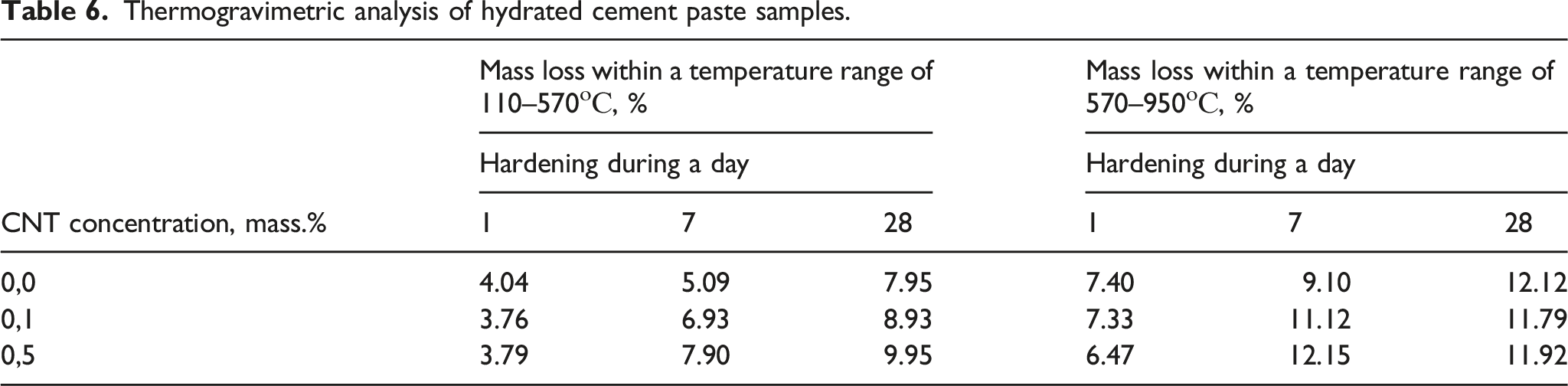
Therefore, according to thermogravimetric analysis, it can be concluded that the acceleration of cement hardening is caused by the fact that the polymer additive, structured with carbon nanotubes, accelerates the hydration reaction of the silicate phase, which in the future, crystallizing forms the crystalline growth of hardened cement paste, and the formation of low-based hydrosilics. The main confirmation of the proposed mechanism of a polymer additive structured by carbon nanotubes is a reduction in mass loss in the temperature range (550–950) and an increase in mass loss in the temperature range (550–950).
Thus, research results indicate that a polymeric additive structured with carbon nanotubes accelerates the setting and hardening of hydrated cement paste and increases the strength of the no-slump concrete mixtures. Theoretically, it can be assumed that this occurs due to the formation of a volumetric network in the cement stone due to the presence of carbon nanotubes, which are the centers of crystallization of cement stone hydrosilicates, and also reinforce and compact the cement stone throughout the volume.
Such conclusions are confirmed by experimental results in numerous works.29,36,39,41–44 To obtain a high dispersion of CNTs and subsequent uniform distribution in the cement matrix, ultrasonic treatment of carbon nanotubes in acrylic acid solutions was carried out. Results from Raman Spectroscopy (RS) and Transmission Electron Microscopy (TEM) showed that polyacrylic chains were covalently bound to carbon nanotubes rather than adsorbed.
29
Figure 4 shows the interaction of cement hydration products (Ca(OH)2 and C-S-H) with carboxylic groups on the surface of carbon nanotubes. Reaction scheme between carboxylated nanotubes and cement hydration products (Ca(OH)2 и C-S-H).
Therefore, it can be assumed that by extracting the dispersion of carbon nanotubes in an aqueous solution of a polymer additive polycarboxylate type, in which up to 5% of acrylic acid residues are present, by ultrasonic treatment, stable and homogeneous aqueous dispersions of carbon nanotubes with grafted links were obtained. This ensures a more even distribution of CNT in the cement matrix, as well as a chemical bond between them, which significantly improves the performance of such no-slump concrete mixtures.
Variation of mass and strength of nano-modified concrete samples during alternate freezing-defrosting.

Therefore, nano-modified concretes have high corrosion resistance to various corrosive media, including acids. Concrete samples with a CNT of the pattern 1 (separate manufacturing technology), with an exposure of 6 months in an aggressive medium such as a magnesium sulfate solution and 5% sodium sulphate, showed a slight decrease in the coefficient of corrosion resistance, to 0.89 and 0.90 respectively. At the same time, in the hydrochloric acid solution, the breakdown of the samples occurred less intensively, that is, the Kc coefficient decreased to 0.87 with the CNT.
Discussion
Nanostructured bulk materials are characterized by greater strength under static and fatigue loading, as well as stiffness compared to materials with a conventional grain size. Therefore, the main direction of their use at present is the use as high-strength and wear-resistant materials. Thus, the yield strength increases by 2.5–3 times compared to the usual state, and plasticity either decreases very slightly, or for Ni3Al it increases 4 times. Composites reinforced with carbon nanofibers and fullerenes are considered as promising materials for operation under dynamic impact conditions, in particular for structures subjected to vibration and dynamic effects.
The production of one of the most common composite materials, namely CNT, is as follows. The carbon formed during the thermal decomposition of the hydrocarbon dissolves in the metal nanoparticle. Having reached a high concentration of carbon in the particles on one of the faces of the particle-catalyst, an energetically favorable “removal” of excess carbon occurs in the form of distorted semi-fullerene caps. This is how a nanotube is born. The decomposed carbon continues to flow into the catalyst, and in order to release the excess of its concentration in the melt, it must be constantly disposed of. The rising hemisphere (semi-fullerene) with surface melts captures dissolved excess carbon, whose atoms outside the melt form a C bond due to being a cylindrical framework-nanotube.
The melting temperature of a particle in a nanosized state depends on its radius. The smaller the radius, the lower the melting point due to the Gibbs-Thompson effect. Therefore, iron nanoparticles with a size of about 10 nm are in the molten stash below 600C. At present, low-temperature synthesis of BHT by the method of catalytic pyrolysis of acetylene in the presence of Fe particles at 550C. Lowering the synthesis temperature also has negative consequences. At lower temperatures, CNTs with a large diameter (about 100 nm) and a strongly defective structure such as “bamboo” or “nanocones” are obtained. The resulting materials only consist of carbon, but they do not approach the extraordinary characteristics (for example, Young’s modulus) observed in single-walled carbon nanotubes obtained by laser ablation or electric arc synthesis.45,46
Toxicity of nanotubes. Experimental results in recent years have shown that long multi-walled carbon nanotubes can elicit a response similar to that of asbestos fibers. People employed in the extraction and processing of asbestos are several times more likely to develop tumors and lung cancer than the general population. The carcinogenicity of fibers of different types of asbestos is very different and depends on the diameter and type of fibers. Due to their small vase and size, carbon nanotubes penetrate the respiratory tract along with the air. Small particles and short nanotubes are obtained through pores (diameter 3–8 μm), while long nanotubes can linger and cause pathological changes over time.
Comparative experiments on the addition of single-walled carbon nanotubes to the food of mice showed the absence of a complete reaction by the latter with nanotubes with a length of the order of microns. Whereas the use of nanotubes shortened with a length of 200–500 nm led to “suturing” of needle nanotubes into the walls of the stomach. Therefore, the environmental and sanitary part of the use of CNTs requires further research and additional consideration, since due to the unique technical, physical and operational characteristics, there is an increase in the use of CNTs. But a comprehensive study of the impact of the use of CNTs on human health has not been conducted.
Conclusions
Conducted theoretical and experimental studies showed the possibility of producing high-quality nano-modified concrete due to the use of a carbon nano-modifier - carbon nanotubes (CNT), which is a suspension, dispersed in a polymer additive solution of polycarboxylate type. The areas of optimal patterns of concrete mixtures, according to the components of carbon nano-modifier, were determined, ensuring the production of concrete mixtures with the index of mobility by diameter of the cone and with an optimal ultimate compressive strength. It was found that is the dispersion of carbon nanotubes with a content of 0.1 mass.% in relation to cement had the best effect on the no-slump concrete mixtures compressive strength.
The IR spectroscopy method established that when cement concrete mixtures are modified by a complex modifier, hydration products are increased. It was asserted that in the presence of a polymer additive structured by carbon nanotubes, a higher degree of crystallization of calcium hydrosilicates is observed, which results in high physical and mechanical characteristics of the modified no-slump concrete mixture. A positive effect on frost resistance and corrosion resistance of nanomodifiers was established in comparison with control samples. Concrete samples with CNTs, when kept for 6 months in an aggressive environment - in a solution of magnesium sulfate and sodium sulfate of 5% concentration, showed a slight decrease in the corrosion resistance coefficient, respectively, to values of 0.89 and 0.90. At the same time, in a solution of hydrochloric acid, the destruction of the samples occurred less intensively - the coefficient Kc decreased to a value of 0.87 with CNTs.
The efficiency of the application of carbon nanotubes dispersed into a polymer additive for the production of a nano-modified no-slump concrete mixture consists in improving the quality and durability of structural elements and coatings, ensuring their operational reliability and the possibility of using of multi-tonnage waste products (TPP ash and, respectively, blast furnace slags).
The scientific novelty of the research lies in the technological determination of the area of optimal compositions of concrete mixtures according to the content of the components of the carbon nanomodifier, which ensures the production of concrete mixtures with an index of mobility according to the diameter of the cone flow, as well as concrete with an optimal compressive strength.
Footnotes
Declaration of conflicting interests
The author(s) declared no potential conflicts of interest with respect to the research, authorship, and/or publication of this article.
Funding
The author(s) disclosed receipt of the following financial support for the research, authorship, and/or publication of this article: This work was supported by the Science and Technology Department of Ningxia, the Scientific Research Fun of North Minzu University (No. 2020KYQD40) and China Scholarship Council (No. 202008100027, No. 202108100024).
