




Abstract
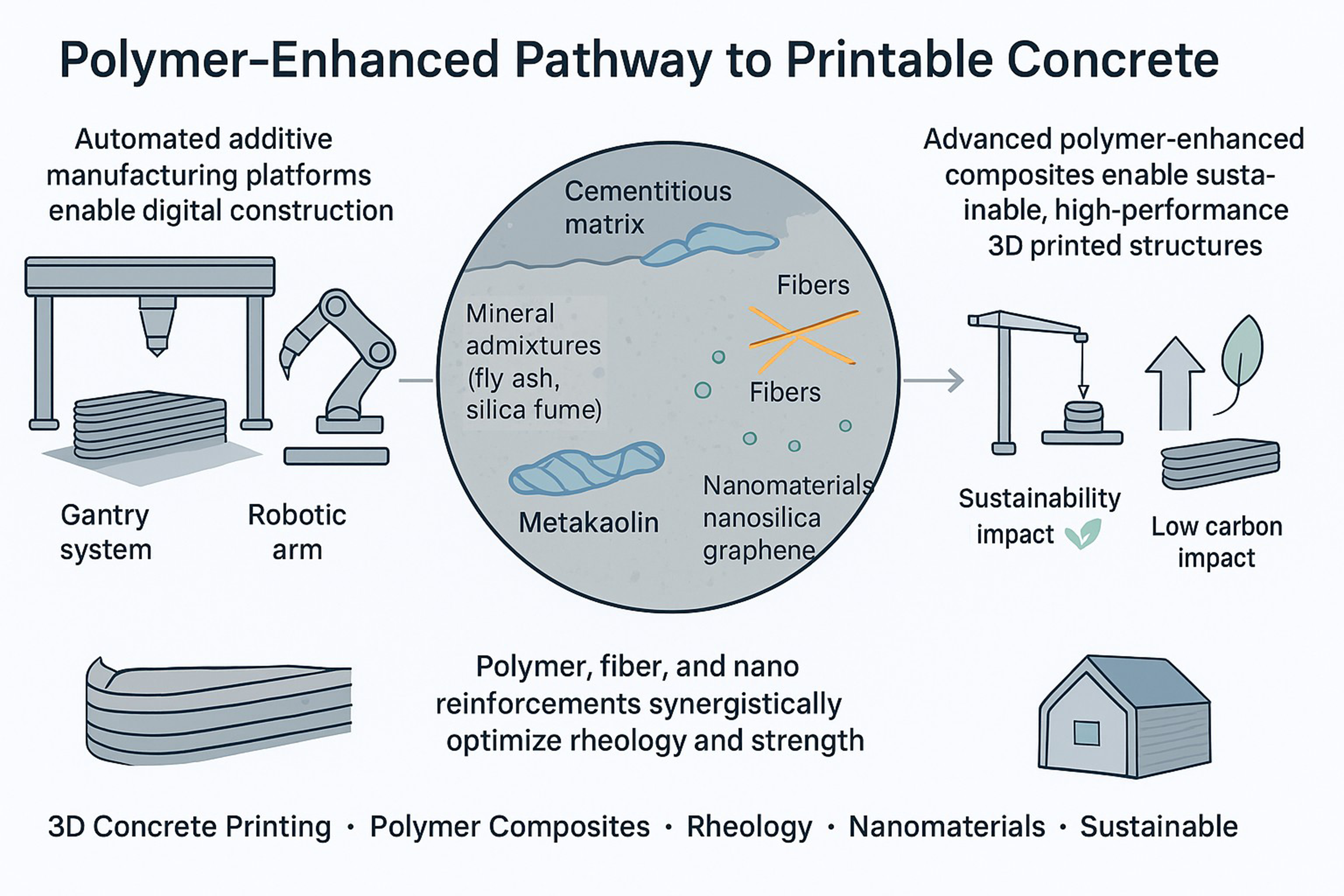
Construction industry is increasingly adopting 3D concrete printing (3DCP) to enhance sustainability, efficiency, and design freedom. This review examines the pivotal role of polymer-enhanced composites in overcoming the inherent limitations of traditional concrete for additive manufacturing. It analyzes the interplay between 3DCP hardware—gantry, robotic, and crane systems—and critical process parameters like pumpability, extrudability, and buildability. The paper provides a detailed analysis of material considerations, emphasizing how cementitious matrices, aggregates, mineral admixtures, fibers, and chemical additives (many polymer-based) are engineered to achieve optimal fresh and hardened properties. Finally, the cutting-edge contribution of nanomaterials in further enhancing these cement-polymer composites is explored, underscoring their ability to improve the performance and application of 3D printed structures. The analysis concludes that the strategic integration of polymers and nanomaterials is not merely additive but transformative, enabling precise control over rheology, enhancing mechanical performance, and improving interlayer adhesion. The future of 3DCP hinges on the continued co-development of such advanced, multi-functional composites to realize fully digital, sustainable, and resilient construction.
Keywords
Get full access to this article
View all access options for this article.
References
Supplementary Material
Please find the following supplemental material available below.
For Open Access articles published under a Creative Commons License, all supplemental material carries the same license as the article it is associated with.
For non-Open Access articles published, all supplemental material carries a non-exclusive license, and permission requests for re-use of supplemental material or any part of supplemental material shall be sent directly to the copyright owner as specified in the copyright notice associated with the article.
