




Abstract
Aiming for the development of experimentally validated computational models to predict the mechanical properties of 3D-printed composites, the present study proposes a micromechanical approach by using a simplified unit cell model to characterize the material properties and behavior of 3D-printed composites manufactured through fused deposition modeling. The effective properties of the voided polymer matrix phase of the material are computed by calculating the void density as a tensorial meso-structural variable. These effective properties along with those of the fiber are input into a simplified micromechanical model to predict the material properties of the 3D-printed composite. The predictions are seen to be in very good agreement with the experimental values. The present approach is much simpler and less computationally costly compared to the finite element homogenization method. In addition, the present approach has the potential to simulate the response of the 3D-printed composite under different loading conditions.
Keywords
Introduction
In recent years, additive manufacturing (AM) has been used for the fabrication of polymeric products with complex geometries. There are different methods for AM; the most commonly used ones being fused deposition modeling (FDM), streolithography, selective laser melting, and digital light processing. From among the aforementioned AM methods, FDM is of particular interest because of its low cost, minimal material waste, and easy usage.1,2 In FDM, the final part is manufactured by adding successive layers of molten thermoplastic through an extruder. FDM parts have attracted various applications in the auto and aerospace industries, 3 medical and biomedical industries, 4 and telecommunications 5 to name a few. However, such 3D-printed components have so far been used primarily as prototypes rather than functional load-bearing parts.6-8 This limitation of use is mainly due to the low strength of thermoplastic materials and the process of the FDM method as compared to conventional manufacturing techniques such as injection molding and machining. 9 One way to enhance the mechanical properties and thus the functionality of 3D-printed thermoplastic components is the inclusion of reinforcing agents such as fibers or particles. This has led to the emergence of an advanced class of composite materials called reinforced additively manufactured (RAM) composites.
Tensile, fatigue, and creep experiments coupled with microscopic analysis have been performed to give quantitative and qualitative information about the behavior of FRAM composites under different loading conditions. 10 Tensile tests performed by Melenka et al. 2 showed that the elastic modulus of continuous fiberreinforced 3D-printed composite parts was significantly enhanced with the fiber volume fraction. A comparative experimental study conducted by Techinalp et al. 11 on short-fiber composites manufactured by FDM and compression molding showed significant porosity in the FDM parts, resulting in a slight decrease in the tensile strength and modulus compared to the molded samples. Also, 3D-printed samples demonstrated a much higher fiber orientation in the printing direction. The fatigue of 3D-printed composites has been studied by Imeri et al. 12 Tests to study the creep behavior of 3D-printed nylon composites at various temperatures conducted by Mohammadizadeh et al. 13 revealed that the addition of fiber reinforcement could improve the creep compliance and recovery.
Most of the works done on 3D-printed composites have so far been experimental. However, experimental characterization of 3D-printed composites may not always be economically expedient. Analytical methods such as the rule of mixtures2,14-17 and strength of materials18,19 have already been used to estimate the overall properties of 3D-printed polymer parts in the absence of reinforcement. One alternative is the development of suitable computational models to characterize and study the behavior of 3D-printed composite materials. Somireddy and Czkanski 20 have applied the computational homogenization method to predict the final constitutive behavior of parts printed with polymeric composite materials. The present paper employs a simplified unit cell micromechanical (SUCM) model to predict and characterize the material properties of 3D-printed fiber-reinforced composite materials. The SUCM model is a simplified version of the method of cells developed by Aghdam et al. 21 to study the collapse behavior of metalmatrix composites. This model has so far been used to study the behavior of conventional continuous fiberreinforced composites under different loading conditions.22-24
Materials and Methods
Simplified unit cell model
According the SUCM, the composite lamina is assumed to be represented by a square representative volume element (RVE) made up of four subcells; one fiber and three matrix subcells as shown in Figure 1. X
1
represents the longitudinal direction, while X
2
and X
3
serve as the transverse directions. Another basic assumption of the SUCM is that normal and shear loads act independently from one another such that the responses of the composite due to normal and shear loading can be studied separately. The RVE for the simplified unit cell model.
Response to normal loading
Considering the compatibility of displacements in the RVE, the following three equations can be written





Combining equations (1–7) leads to a system of eight equations and eight unknowns as follows


The above-stated formulation of the response of the composite lamina to normal loading allows for the calculation of the normal elastic properties of the composite as follows



Response to shear loading
Similar to normal loading, the equilibrium conditions establish the relationships between micro and macro stresses







Equations (13–19) result in the following system of four equations and four unknowns


Modeling the elastic constants of 3D-printed parts
A 3D-printed part manufactured through FDM can be regarded as a material consisting of imperfectly bonded polymer filaments and voids. Due to this imperfect bonding, the current methods of estimating the elastic constants of solids with voids cannot be applicable to a 3D-printed component.
25
In general, there are two different approaches to calculating the effective properties of 3D-printed polymer parts; mechanics of material approach (based on the rule of mixtures) and homogenization approach. Assuming the 3D-printed part to be an aggregate of polymeric filaments, Rodriguez et al. have considered a tensorial meso-structural variable called area void density to each point in the continuum and have proposed the following relations for the effective longitudinal and transverse properties based on the rule of mixtures.
26




In the above given relations, ρ
1
is the area void density in the plane normal to the filaments. It should be noted that the extruded filaments tend to flatten marginally when deposited onto the previous layer resulting in a shape, the cross-sectional area of which is shown in Figure 2. l
1
and l
2
are the lengths of the major axes of the elliptical filament. Δ and δ represent the sizes of the negative gaps between the filaments. Using the aforementioned relations, the isotropic polymer matrix component of the 3D-printed composite can be modeled as an orthotropic material reinforced by fibers. This approach allows the use of the SUCM for the micromechanical modeling of 3D-printed composites. The cross-sectional area of the extruded filaments.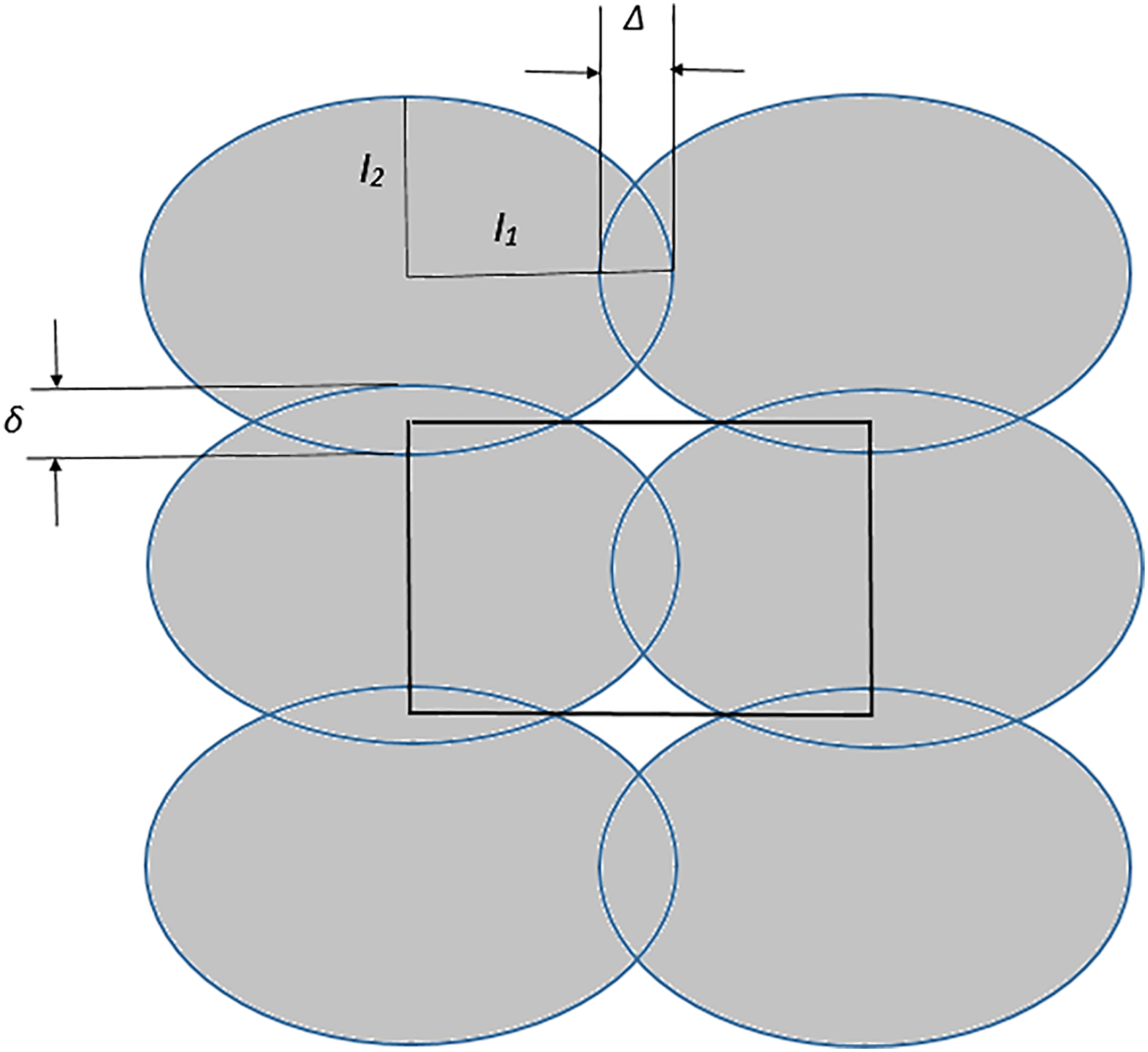
Validation and Results
To validate the proposed micromechanical approach, the results are compared with the those of the research by Somireddy
18
in which the effective material properties of 3D parts fabricated from ABS polymers reinforced with short carbon fibers have been evaluated by the numerical homogenization of a periodic RVE consisting of the reinforced matrix material as well as the voids due to 3D printing as shown in Figure 3. The sizes of the RVE are obtained from microscopic images of the printed parts. These dimensions of this RVE are used to extract the tensorial meso-structural variable, area void density ρ
1
. Representative volume element dimensions of the 3D-printed composite used for FE numerical homogenization.
Material properties of fiber and matrix components.

In order to be able to calculate the effective properties of the voided matrix, the first step is to elicit the geometric parameters l 1 , l 2 , Δ, and δ from the RVE by knowing the coordinates of the intercepts of the ellipses from the dimensions given in Figure 3. Using these values, the void density ρ 1 , of the ratio of the voided area to the total area, is calculated.
Geometric parameters of the extruded filaments.

Effective material properties of the voided polymer matrix.

Now, the elastic properties of orthotropic matrix and carbon fiber are input into the SUCM to estimate the constitutive behavior of the 3D-printed composite parts. However, since the SUCM has been developed based on the assumption of continuous fiber, one needs to evaluate the corresponding volume fraction so that the results can be compared with those of short-fiber composites reported in reference.
Mechanical material properties of the 3D-printed composite.

The SUCM results are seen to be in very good agreement with the experiment. The homogenization method is seen to have overpredicted the strength of the material. This difference is mainly due to the existence of voids in the fiber material. However, the SUCM results are seen to be in much better agreement with those of the experiment. This is because of the value of the volume fraction of the equivalent continuous fiber which was obtained from the experimental value of longitudinal modulus which has, to some extent, accounted for the meso-structure of the material.
Using the SUCM, one can also simulate the mechanical testing of the unidirectional laminate and generate the stress-strain curve for the material within the elastic regime. Figure 4 shows the stress-strain behavior of the unidirectional specimens obtained experimentally compared to the prediction by the SUCM. The predictions by the SUCM are seen to be reasonably close to the experimental results within the elastic region. Stress-strain behavior of the unidirectional 3D-printed composites.
Conclusions
The present study proposed a micromechanical approach by using a simplified unit cell model to characterize the material properties and behavior of 3D-printed composites manufactured through fused deposition modeling. This methodology aims to serve as a substitute for the time-consuming and expensive experimental work. The predictions made by this method are validated through comparison with those of the finite element homogenization technique as well as experimental results. A promising aspect of the current micromechanical approach is its ability to model the response of 3D-printed composites to different loading conditions and subsequently identify and predict the modes failure of each of the constituent materials, that is, fiber and matrix. The next step in this direction is the implementation of plasticity into the micromechanical model.
Footnotes
Declaration of conflicting interests
The author(s) declared no potential conflicts of interest with respect to the research, authorship, and/or publication of this article.
Funding
The author(s) disclosed receipt of the following financial support for the research, authorship, and/or publication of this article: This work was supported by the Natural Sciences and Engineering Research Council of Canada-Discovery Grant Program.
