



Abstract
This research work addresses the influence of graphene and basalt filler on mechanical properties and free vibration behavior of banana/sisal hybrid composite. Banana/sisal hybrid composites were prepared with three weight percentage (wt.%), 6 wt.% of graphene, and basalt filler by a compression molding process. The improvement in tensile strength of 24.8% and 30% was noticed for the basalt (6 wt.%) and graphene (6 wt.%) filler addition, respectively. Comparing with basalt addition, graphene addition provides an 1.5 times improvement in flexural strength. The tensile fractography was also carried out and studied the interfacial bonding of the composite. From the morphology, it was observed that there was a good interfacial adhesion between the fiber and the matrix which enhance the mechanical property of the hybrid composite. The free vibrational behavior of the hybrid composite has also been analyzed. The modal analysis shows the enhanced natural frequencies and modal damping for the addition of 6 wt.% of graphene filler in the hybrid composite.
Introduction
Physical and mechanical properties of natural fibers [Venkateshwaran N et al., 2010]. 2
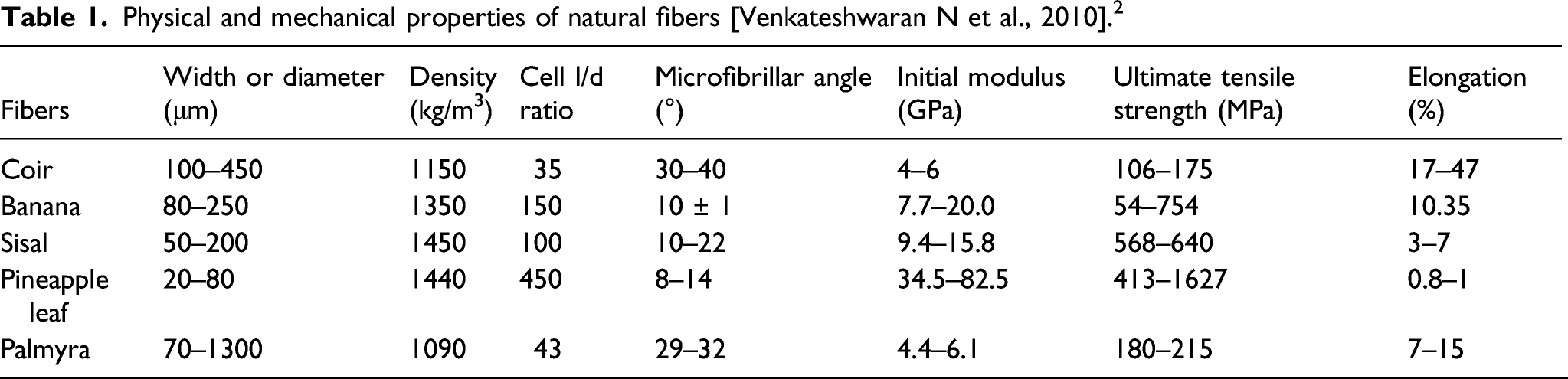
These fibers can be used to prepare polymer-based composites. 5
Technical parameter.

Technical parameters.

Nowadays basalt fiber has a greater interest in the scientific community due to its physical properties such as high rigidity and low elongation at break, compared to steel and carbon fiber. Due to these characteristics, it is a valuable material for present and future scientific exploitation. With the current engineering marvels in CBF (Continuous Basalt Fiber) manufacturing technology, CBF can be manufactured much faster than fiberglass production with a low density of 2.6–2.8 g/cc compared to steel, very cost-efficient than carbon fiber, and exhibits good strength than glass fiber. Basalt also has good abrasion properties with hardness values ranging from 5 to 9 on Mohs scale. 10
Coconut sheath with PE (Poly Ethylene) matrix with 3 wt.% nanoclay exhibited better damping characteristics with higher storage modulus at maximum and minimum temperature regions. 11 When jute fibers are treated with alkaline solution their original crystalline structure changed due to the absorption of alkali solution in the cellulose level which resulted in the swelling of these structures. Those treated fibers exhibited good damping factors and storage modulus when the dynamic analysis was done. 12 When nanoparticles were added to natural fiber composites they acted as secondary reinforcement resulting in improved dynamic and thermal properties. The studies carried out on the effect of nanomaterials in PALF (Pineapple Leaf Fiber) and banana fiber reinforced Poly Propylene (PP) composites found out that 3 wt.% of nanoparticles exhibited better mechanical properties than 5 wt.%. 13 Bamboo mats with epoxy and PE matrix were also studied with different weight percent of nanomaterials and those composited showed better mechanical properties for different weight percent levels. 14
Sathishkumar et al. investigated the mechanical properties and free vibrational characteristics of cotton/sisal hybrid composite. The increase in the number of layers in the composites shows better mechanical and damping properties. 15 The addition of basalt powder enhances the mechanical and dynamic mechanical thermal properties of the composite.
Nanoclay addition in the polymer matrix composite manufacturing improved the tensile strength of the composite plate. 16 The basalt powder has a very fine grain structure; it can be extracted from the ballast rock. It can be used as a cost-effective filler for the preparation of epoxy composites in comparison to synthetic materials like alumina, silica, and graphene.17,18 The hybrid effect was obtained by introducing the basalt powder into epoxy resin and reinforcing it with glass fiber. 19 During the evaluation of tensile and flexural properties on basalt fiber tubes, an improvement was noticed when compared to glass fiber tubes. 20 The hand lay-up process of basalt/flax hybrid natural fiber composite with epoxy as a matrix shows the improvement in the mechanical properties for the increased basalt fiber content. 21 The evaluation of polymer concrete, with basalt powder, shows the improvement in the mechanical properties with increasing epoxy to basalt powder weight percentage by 25%. 22 The thermal and mechanical properties were improved by the addition of basalt powder during the investigation of mechanical and thermal properties on basalt fiber hybrid epoxy composites. 23
From the literature survey, it was observed that the effect of basalt and graphene filler material on mechanical and free vibration characteristics of banana/sisal natural fiber-reinforced hybrid composites was not reported. In the present work, the banana/sisal natural fibers are used as reinforcement along with basalt and graphene as filler material. The objective of this work is to investigate the influence of basalt and graphene filler addition on the mechanical properties and the free vibrational characteristics such as natural frequency and modal damping of banana/sisal natural fiber hybrid composites. The fracture morphology of the composite material is analyzed using (Scanning Electron Microscope) SEM testing. The physical and chemical behavior of hybrid composite has been analyzed using the Fourier-Transform Infrared Spectroscopy (FTIR) spectrum.
Materials
Tensile properties and diameter of banana and sisal fibers. [Maries Idicula et al., 2010]. 3

Properties of banana and sisal fiber. [Maries Idicula et al., 2010]. 3

Preparation of hybrid composite material
The hand lay-up technique and the compression molding process were used to prepare the banana/sisal hybrid composite with 60% of the matrix and 40% of reinforcement. Filler materials of basalt powder and graphene powder (Ultrapure graphene powder Purity >99%) were used in the range of 3 wt.% and 6 wt.%. Five different composite plates were prepared for different filler ratios in the range of 3 wt.% basalt with banana/sisal (S1), 6 wt.% of basalt with banana/sisal (S2), 3 wt.% of graphene with banana/sisal (S3), 6 wt.% graphene with banana/sisal (S4), 3 wt.% of basalt, and 1 wt. % of graphene with banana/sisal (S5). The epoxy resin (LY536) and hardener (HY951) were mixed in a ratio of 10:1. Banana and sisal fibers have been placed layer by layer in the cross-lay pattern. The matrix mixed with the filler was applied over all the layers of the reinforcement. A steel roller was used to roll continuously over the fiber for the uniform flow of resin and to avoid the interruption of air bubbles. After the laying process was over, the mold was closed. The mold surface heating temperature of 100°C with 30 bar and the holding time of 2 h has been given for the material preparation. The mold was cooledto room temperature; it takes 2 h to attain room temperature. Finally, 300 mm × 300 mm × 10 mm of banana/sisal fiber with basalt and graphene filler hybrid composite laminates were taken for different tests.
Testing methods of composites
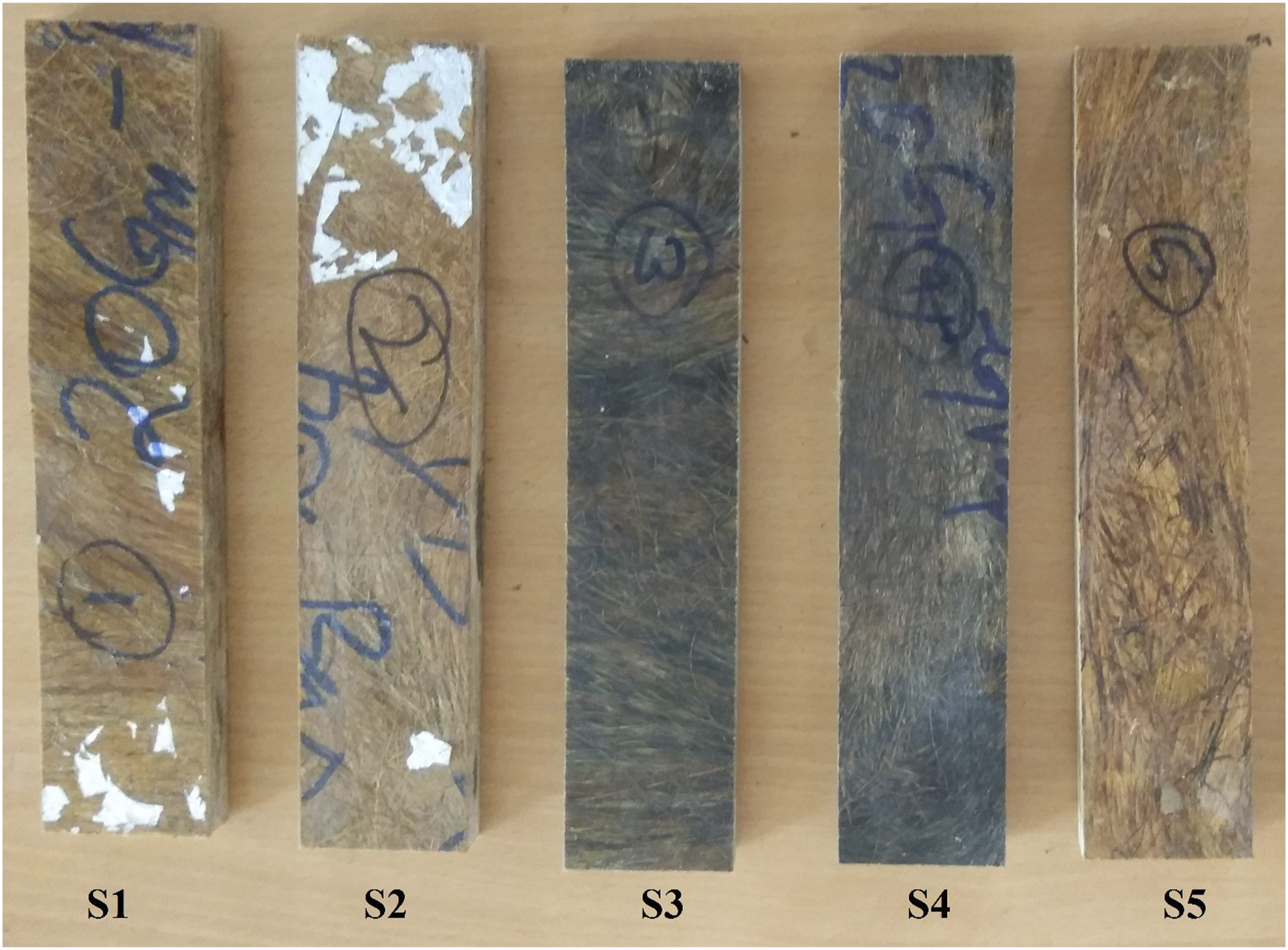
The prepared tensile and flexural samples as per American Society for Testing and Materials (ASTM) standards are shown in Figures 1 and 2, respectively. The tensile test was carried out based on the ASTM D 638–14
24
standards and the sample size was 200 mm × 20 mm × 10 mm. The electronic tensometer setup was used to perform the tensile testing with a crosshead speed of 1.5 mm/min using the load cell of 20 kN. A three-point bend test (Make: Fuel Instruments and Engineers Pvt. Ltd, Model: UTE40) was used to measure the flexural properties as per ASTM D 790–03.
25
The flexural samples were prepared with a size of 200 mm × 25 mm × 10 mm having a length to thickness ratio of 21:1. In the bend test, the load cell of 10 kN was used with a crosshead speed of 2 mm/min. The impact test samples were prepared as per ASTM D 256.
26
The sample size was 63 mm × 12.7 mm 10 mm. Three specimens were prepared for testing and the average values were reported. Specimens for tensile test. Specimens for flexural test.
Morphology analysis of composites
Morphology analysis of fractured tensile specimens of banana/sisal with graphene and basalt filler hybrid composite was studied and analyzed using SEM of Make: ZEISS model: EVO LS 15, Electron gun accelerating voltage: 15 KV, and Tungsten Filament (Agar A054) were used in the process.
FTIR testing
The chemical functional groups and bonding of the banana/sisal reinforced graphene and basalt filler hybrid composite were ensured using FTIR spectroscopy (Model: ATR-FTIR, Make: BRUKER, Germany, range: 500 cm−1–6500 cm−1) with attenuated total reflectance was used for the detection from 4000 cm−1 to 500 cm−1.10 mg of powders (size 5105 nm–6349 nm) were prepared from each hybrid composite (S1, S2, S3, S4, and S5) using hammering continued with the ball milling process.
Modal analysis
The modal analysis technique was used to analyze the dynamic characteristic of banana/sisal natural fiber reinforced polymer hybrid composites. This technique was used to find out the fundamental natural frequency, damping factor, and mode shape of the composites. The modal analysis was performed by using an impact test with the help of an impact hammer. The impact hammer with a sharp hardened tip (DYTRAN, model 5800B2) was used to hit the composite material (dimension: 100 mm × 44 mm × 10 mm) at three equally spaced to obtain high frequency. The accelerometer (DYTRAN, model 3055D2) was attached to the free end of the composites material used to measure the displacement (Figure 3). The accelerometer was connected with a data acquisition system (DAS) (m+p international, inc, USA). The DAS connected with the computer to analyze the measured displacement signals. Two separate ports were used for getting the output signal, one from the accelerometer signal and the other from measuring the magnitude of the response by the impact hammer from composite material. Experimental setup of vibrational analysis.
Damping factor
Damping is the most important dynamic characteristic of wood, metals, and polymer composites. Damping characteristics of natural fiber reinforced polymer composite differs from other materials. Damping for natural fiber reinforced polymer composites is difficult to study which is due to their chemical constituent and physical interface between fiber and matrix. Damping characteristics of banana/sisal fiber reinforced polymer hybrid composites were measured using the half-power bandwidth method. Fast Fourier transform (FFT) analyzer is used to generate the frequency response curve from the measured displacement signal. The damping factor has been calculated using the frequency response curve. The damping values were obtained based on
Results and discussion
Mechanical properties of banana/sisal hybrid composite with basalt and graphene.

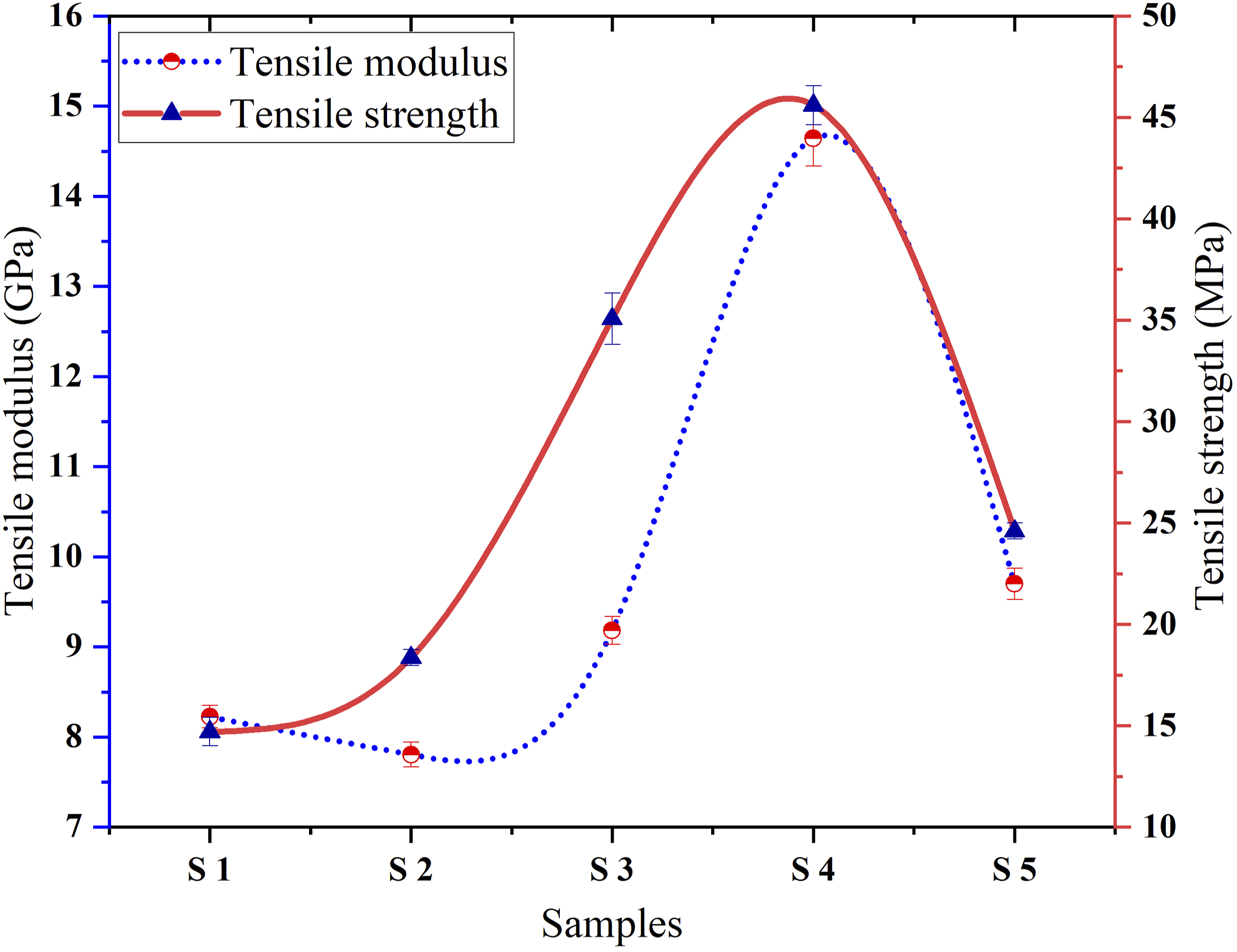
Effect of nanofiller on the tensile strength and tensile modulus of the hybrid composite.
Comparing S1 with S3, the improvement of the tensile strength was nearly 2.38 times as with S4 provided 3.1 times. S5 is a combination of graphene and basalt shows an improvement of 0.67% times. The strong interface region can transfer the load between the matrix to the fiber surface in a uniform fashion and may take up more load by proper bonding at the interface. 19 From Figure 4, it was observed that the tensile modulus was gradually increased with the addition of filler, and S4 of 6 wt% graphene provides the maximum tensile modulus of 14.64 GPa.
Table 6 provides information about the flexural properties of the banana sisal composite with basalt and graphene filler. From Figure 5, it was observed that the addition of filler improved the flexural properties of the material. The addition of filler was used to improve the interfacial bonding between the matrix and the fiber, which enhances the mechanical properties. For 3 wt% of basalt addition in the matrix in the banana sisal natural fiber composite, a flexural strength of 81 MPa was obtained. 27% of strength was improved with the addition of 3 wt% of basalt (S2). The graphene as a filler provides the maximum flexural strength (204.5 MPa) at 6 wt% addition (S4). Compared with basalt addition, the graphene provides 1.5 times improvement in flexural strength. Since the banana fiber has higher strength while comparing with sisal fiber, it survives the elevated stress. Due to this reason, the hybrid composite has enhanced flexural properties. The samples S1, S2, S3, S4, and S5 provide the impact strength of 2 J. Influence of nanofiller on flexural strength and flexural modulus of the hybrid composite.
Fracture morphology
Tensile fractography of hybrid banana/sisal fiber reinforced with different weight percent compositions of basalt and graphene powder was shown in Figure 6. More fiber pullout was observed in Figure 6(a) and the addition of basalt reduces the fiber pullout in Figure 6 (b) since the filler addition improved the bonding and also increase the tensile and flexural strength (S2). From Figure 6(c) and (d) of graphene addition, it can be observed that the broken fibers were tightly surrounded by the matrix shows the good interfacial adhesion between the fiber and the matrix, and also there was no filer pullout observed, due to this better interfacial addition of the graphene filler the tensile strength has also been enhanced. It was clearly observed from 6(d) that the split of banana/sisal fibers due to the high load carrying capacity, due to the better interfacial addition, the matrix failure first, and transferred the load to the fiber. This was the reason for the increase of tensile strength in S4. The clear crack observed in Figure 6(c) and (d) over the epoxy matrix shows the brittle nature of the material. This indicates the matrix failure occurred first and the stress was transferred to the fiber.
27
(a–e) Fracture morphology.
FTIR results
From the FTIR spectroscopy analysis, the samples S1 and S2 show the peak at 3420 cm−1 (O-H), 1080 cm−1 (Si-O), 1630 cm−1 (H-O-H), 2854, and 2928 cm−1 atmospheric carbonation, 1100 cm−1 (S-O-Si) and 1200–800 cm−1 are silica and cristobalite. From the samples S3 and S4 of Figure 7, the peaks of 2900 cm−1 (-CH Stretch), 1730 cm−1 carbonyl peak, 1500 cm–1 lignin, 664 cm−1 (-COOH), 1432 cm–1 (-CH2), 1652 cm−1 non-alkalized, peaks at 3430, 2960, and 1700–1600 cm−1 correspond to -OH or COOH, CH3, and C=O, representing the presence of functional groups of original graphene.
28
COOH bending peaks (664 cm−1) were observed in all composites, a similar observation was noticed by Sgriccia et al.
29
FTIR spectrum of samples S1, S2, S3, S4, and S5.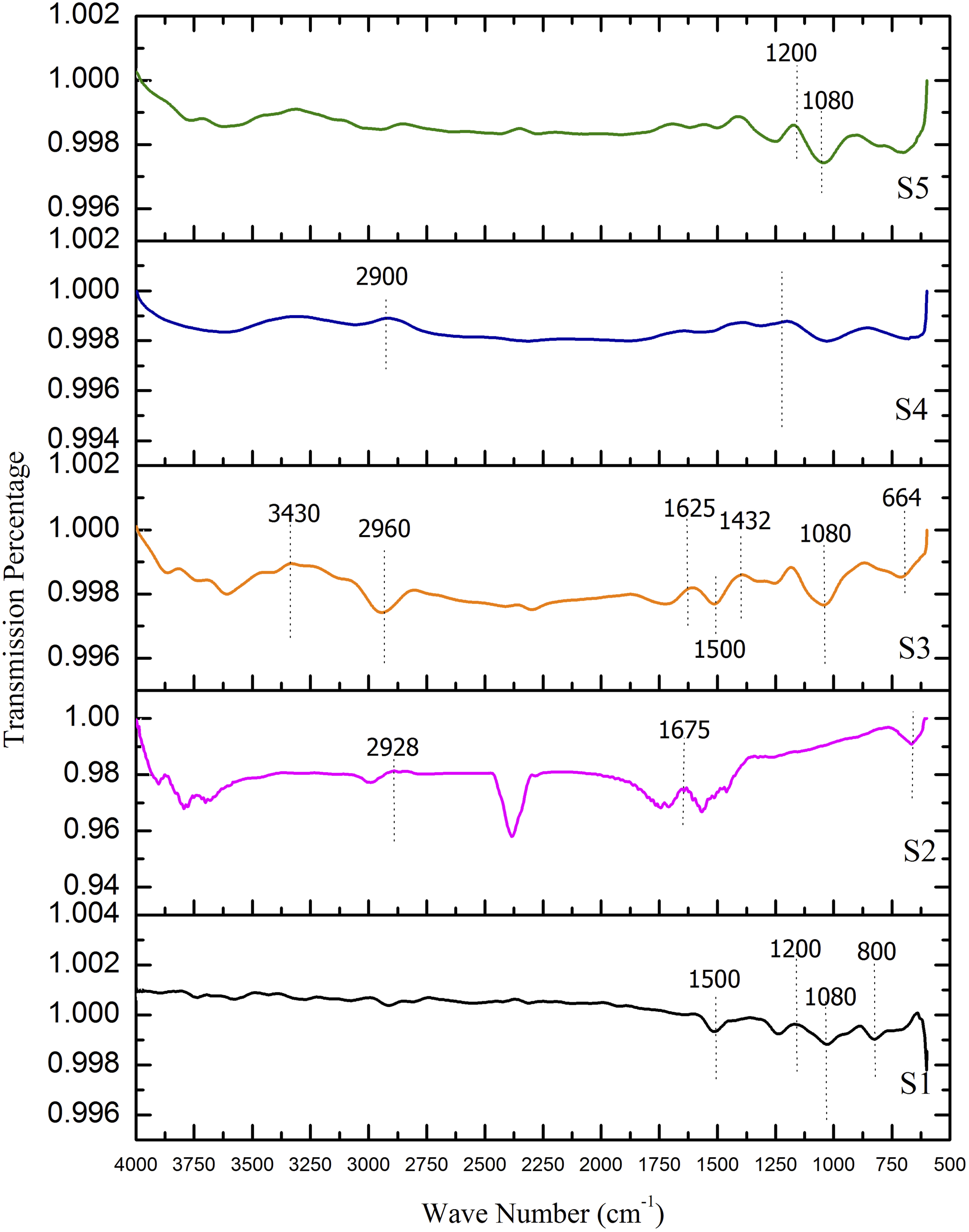
Modal analysis
From Figure 8, it was observed that the natural frequency gradually increased with the addition of a nanofiller. The maximum natural frequency was obtained for 6 wt. % of graphene filler addition (S4) in the banana/sisal hybrid composite, similar results were reported for the addition of nanoclay in the hybrid composite.
11
The improvement in the frequency of vibration is due to the enhancement in the tensile modulus of the composite. The experimental natural frequency values of S4 are shown in Figure 9. Influence of filler on the natural frequency. Frequency response function of S4.

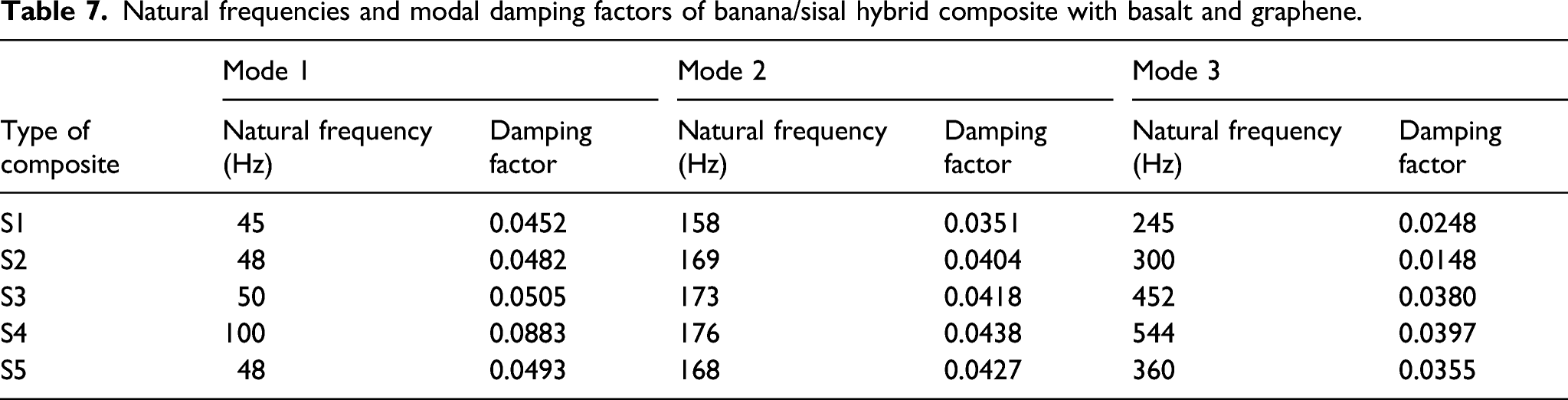
A similar trend has been observed on natural frequency for the 2nd and 3rd modes also (Figure 10). This is due to the addition of nanofiller which improves the bonding of the matrix and the reinforcement of the banana/sisal hybrid composite.30–32 The influence of basalt and graphene nanofiller addition on natural frequencies and damping factors of banana/sisal hybrid are listed in Table 7. Effect of Natural frequency in all three modes. Natural frequencies and modal damping factors of banana/sisal hybrid composite with basalt and graphene.
Effect of fillers on damping factor
The damping factor values are calculated using the half-power bandwidth method for the hybrid composites. From Figure 11, it was observed that the S1 has a damping factor value of 0.0452 and the S2 has a damping value of 0.0482 at mode 1. The modal damping increases for the addition of basalt filler; further, it increases for the addition of graphene filler. Comparing with basalt filler addition, graphene fillers have the superior modal damping factor in all three modes. The damping factor of mode 1 of S4 has the maximum damping factor compared to mode 2 and mode 3. The maximum modal damping of 0.0883, 0.0438, and 0.0397 were observed for the 6 wt% of graphene addition (S4) on mode 1, mode 2, and mode 3, respectively. The addition of nanofiller in the matrix used to improve the interlocking of the fiber and matrix surface can provide frictional resistance and mechanical interlock due to the larger surface area exposed by the nanofiller resulting in enhanced internal damping.33,34 Effect of Damping factor on three modes.
Conclusion
Preparation of banana/sisal fiber reinforced hybrid composite with 3–6 wt.% of graphene and basalt have been carried out using a compression molding process. From the investigation of the composite material, the following observations were drawn. • The addition of nanofiller in the banana/sisal hybrid composite enhanced the mechanical properties. • The maximum tensile strength of 45.6 MPa was observed for the 6 wt.% of graphene filler addition. • It was observed from the tensile fractography, the addition of graphene nanofiller provides better interfacial adhesion between the fiber and the matrix. • Enhanced flexural strength of 204.5 MPa was obtained for the 6 wt.% of graphene filler. Comparing with basalt addition, the graphene addition provides better flexural strength. • Addition of 6 wt. % of graphene filler (S4) provides the maximum natural frequency of 100 Hz, 176 Hz, and 544 Hz at mode 1, mode 2, and mode 3, respectively. • Improvement in the damping factor of 0.0883, 0.0438, and 0.0397 was noticed in S4 at mode 1, mode 2, and mode 3, respectively.
Footnotes
Declaration of conflicting interests
The author(s) declared no potential conflicts of interest with respect to the research, authorship, and/or publication of this article.
Funding
The author(s) received no financial support for the research, authorship, and/or publication of this article.
