



Abstract
In the present work, a combination of experimental and numerical procedure is proposed to study the effects of different hygrothermal conditions on the creep strain, viscoelastic properties of nanocomposites, and mechanical properties of such nanocomposite-based carbon fiber–reinforced polymer (CFRP) hybrid composite materials. Ultrasonic probe sonicator is used to randomly disperse the multiwalled carbon nanotubes into an epoxy to minimize agglomerations. Dynamic mechanical analysis is employed to conduct the creep tests under different hygrothermal conditions of such nanocomposite samples. The Findley power law is used to obtain the long-term creep behavior of nanocomposite materials. Prony series is used to determine the viscoelastic properties of nanocomposite material in the frequency domain. Coefficient of moisture expansion (CME) is independent of moisture concentration; thus, CME of the nanocomposite is also determined. Strength of materials and Saravanos–Chamis micromechanics (SCM) have also been utilized to obtain the mechanical properties of such hybrid composite materials under different hygrothermal conditions. It has been found that the inclusion of multiwalled carbon nanotubes in the nanocomposite and hybrid composites improves storage modulus and loss factor (i.e.,
Keywords
Introduction
Since the discovery of carbon nanotubes (CNTs), 1 they have attracted the research community for their exceptional mechanical and thermal properties such as higher Young’s modulus, lower specific weight, and high specific surface area for different practical applications. The hygrothermal effects on the conventional carbon fiber–reinforced polymer (CFRP) composites were experimentally studied. 2 The characterization of elastic and damping properties of laminated beams were investigated under a hygrothermal environment and also discussed about the nonlinear strains produced due to humidity in such CFRP composites.3–5 Investigation was carried out on the damping coefficients of CRPF composites by incorporating some micromechanical methods.6,7 The essential steps were addressed based on the interaction between the CNT and polymer from chemical functionalization, and physical methods and effects of geometry on the mechanical properties were also obtained. 8 The thermal and mechanical properties of multiwalled carbon nanotubes (MWCNTs)-reinforced epoxy-based material were reported and addressed that the improved dispersion can be achieved by chemical functionalization of inclusions in the matrix phase. 9 Experimental moisture diffusion data were presented for the conventional CFRP composites. 10 Experiments were conducted on single and MWCNT-based nanocomposites and observed that enhancement in damping ratio may be more dominant than that of stiffness. 11 The advantages and disadvantages of the chemical functionalization process for CNTs into the matrix phase and their elastic properties were reported.12,13 Zhang and Wang 14 performed the experiment on the natural fibers–based composites (such as mixture of roselle and sisal with a 1:1 ratio with resin) under a hygrothermal environment.
Due to the moisture effect, the elastic properties of such composite material systems may be decreased. 15 Effect of the humidity in the yarns of the shell structure with the moisture-responsive smart materials was studied.16,17 Inclusion of CNTs in nanocomposites decreases in creep strains by 53% compared to the epoxy matrix which was found based on the long-term creep behavior of the nanocomposites by time temperature superposition in a dynamic mechanical analyzer. 18 The indentation tests were carried out at high temperature to determine the mechanical properties of nanocomposite-based material system. 19
It was found that the damping ratio of the hybrid composites may increase with the addition of CNTs. 7 An experimental study was performed for the hygrothermal effect on the CNT-reinforced epoxy materials, and it was also reported that the fatigue strength may decrease in the hygrothermal environment for such composite materials. 20 The mechanical properties of nanocomposites were obtained in which samples were prepared by an in situ polymerization method and creep, and time temperature superposition tests were also conducted to obtain the viscoelastic properties of such nanocomposite materials. 21 The effect of hygrothermal treatments on mechanical properties of carbon fiber–reinforced resin-based composites was discussed. 22 The viscoelastic properties of short fibers–reinforced composites using dynamic mechanical analysis (DMA) were obtained in high-moisture conitions.23–26 The MWCNTs were synthesized by chemical vapor deposition along with natural fibers to fabricate ceramic-based composites. 27 The creep behavior was analyzed for glass fiber–reinforced epoxy-based composites. 28 The stress relaxation and strain recovery data were determined and employed to obtain viscoelastic properties of composite materials. 29 The hygrothermal effects on the glass fiber and nanoclay-reinforced viscoelastic composite material system were addressed. 30 The clay nanoparticles–based composite laminates were experimented for the modal analysis. 31 Agglomeration effects of CNTs and vibration damping characteristics of hybrid nanocomposite-laminated structures were studied and analyzed.32–37 Subramani and Ramamoorthy 38 performed the vibration analysis of MWCNTs-reinforced composite shell to investigate the enhancement in natural frequencies and damping of the polymer composite structure. Kundalwal et al.39,40 addressed the prediction of thermomechanical properties of fiber-reinforced composites using several micromechanic models. Almeida et al. 41 reported the creep/recovery, stress relaxation, and viscoelastic behavior of carbon fiber–reinforced epoxy filament wound composites of distinct fiber orientations (such as [0]4, [30]4, and [60]4). Creep and residual properties of filament-wound composite rings under compression loads were determined, and viscoelastic response of such carbon/epoxy filament-wound composite rings in harsh environments was also presented. 42 Almeida et al. 43 investigated the interfacial and creep characteristics of carbon fiber–reinforced epoxy laminates at different fiber orientations. Findley’s and Burger’s fittings were used to analyze creep data from the DMA and correlate structure and temperature-dependent property of such composites. Ornaghi et al. 44 evaluated creep, recovery, and viscoelastic properties of unidirectional carbon/epoxy filament wound composite laminates under controlled stress, time, and temperature. Costa and Barros 45 carried out an experimental program to characterize the tensile creep behavior of an epoxy-based structural adhesive, and long-term creep behavior was obtained based on the Burger nonlinear fitting. Montazeri and Montazeri 46 studied on the mechanical and viscoelastic properties of epoxy composites at different contents of multiwalled carbon nanotubes.
In the past few decades, conventional CFRP composites have gained a lot of interest in engineering applications due to their high specific stiffness, 43 but it is vulnerable under a hygrothermal environment, so it may be expected that the nanocomposite (i.e., MWCNTs embedded in epoxy) and hybrid composite (reinforcing carbon fibers in such nanocomposites) may improve such drawbacks associated with conventional CFRP composite materials. Such composites may have several real-life applications. So, the present study proposes a combination of experimental and numerical procedure in order to determine the frequency-dependent viscoelastic properties of nanocomposite materials under different hygrothermal conditions. The present work also addresses the short-term creep behaviors of the nanocomposites which are obtained using DMA-8000 under several hygrothermal environments. Long-term creep behaviors of such nanocomposite materials have been obtained based on the Findley power law. Prony series representation of the relaxation modulus of nanocomposites under hygrothermal conditions has been carried out. The present study also reports the coefficient of moisture expansion (CME) at different temperatures. Mechanical properties and shear loss factors of the hybrid composite materials under different hygrothermal conditions have also been determined using Saravanos–Chamis micromechanics (SCM) and strength of materials (SOM) and compared with experimental results. It is found that MWCNTs may play a vital role in both nanocomposites and hybrid composites so these materials may sustain the highly humid environment at elevated temperatures.
Experimental configurations
The nanocomposite samples are fabricated, and images have been captured using scanning electron microscopy (SEM) for microscopic analysis. The creep tests under hygrothermal conditions are performed on a DMA-8000 which is discussed in the following subsections.
Nanocomposite and hybrid composite samples fabrications
An ultrasonic probe sonicator is used for the mixing of randomly oriented MWCNTs with 0%, 4%, and 8% volume fractions (approximately 0%, 1%, and 2% by weight) into the preheated epoxy. A multiwalled carbon nanotubes–reinforced polymer composite (modified matrix) is poured into the mould, and nanocomposite-based samples are fabricated with required dimensional accuracy. At least five samples prepared for each DMA testing with 12 h of ultrasonic mixing of MWCNTs into the epoxy to minimize the agglomerations in the fabricated nanocomposite and hybrid composite. For the nanocomposite-based CFRP hybrid composite sample, the hand layup technique is used. The nanocomposite is brushed onto the unidirectionally placed carbon fiber (i.e., 32.5% and 49.8%), and samples were fabricated with the dimensions of 25 mm × 3 mm × 1 mm. For each volume fraction of the reinforcement, five samples are fabricated as per the ASTM-D4065 standard for testing and materials in DMA-8000. The materials (such as MWCNTs, carbon fiber and epoxy)used to prepare nanocomposite and hybrid composite samples are procured from ADNANO technologies and HINDOOSTAN composites.
Hygrothermal creep tests in DMA-8000
Nanocomposite samples embedded with different volume fractions, that is, 0%, 4%, and 8% (approximately 0%, 1%, and 2% by weight), of the MWCNTs are tested in DMA-8000 under different hygrothermal environments (such as RH60% and RH95%) at elevated temperatures. The nanocomposite sample is fixed under tension support with constant stress to record the creep strain rate. DMA-8000 along with an auxiliary humidifier is used to create such hygrothermal environments in the chamber for the nanocomposite-based sample. Controlled humidity and temperature are maintained in the chamber during the creep test.
Determination of viscoelastic and mechanical properties of nanocomposites and hybrid composites
The nanocomposites and hybrid composites are fabricated with minimum agglomerations and required dimensional accuracy as per the ASTM-D4065 standard. The viscoelastic properties of nanocomposite and transversly isotropic mechanical properties of hybrid composites are obtained based on the mathematical formulations presented in the Determination of Viscoelastic Properties of Nanocomposite Using Prony Series section and the Mathematical Formulations for Mechanical and Viscoelastic Properties of Hybrid Composites section. The schematic diagram of the proposed methodology is presented in Figure 1. In the present work, CNTs are randomly distributed in a polymer (epoxy) which is termed as a nanocomposite whereas carbon fibers are reinforced in the nanocomposite which is termed as hybrid composite or CNT-based hybrid composite. Based on the SCM and SOM, the constitutive matrix which relates the stress and strain of the hybrid composite material has been determined. Flowchart of experimental and numerical procedure.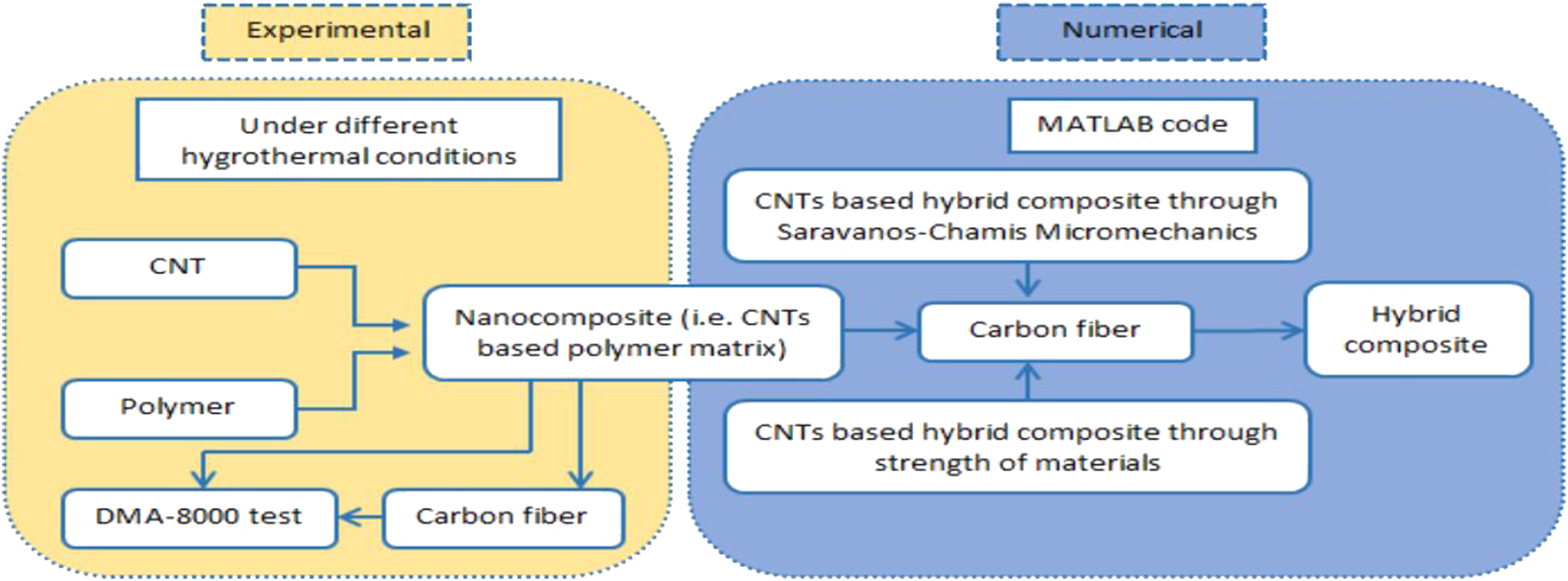
Determination of viscoelastic properties of nanocomposite using Prony series
The nanocomposite samples with 0%, 4%, and 8% volume fractions (approximately 0%, 1%, and 2% by weight) of MWCNTs are reinforced and tested in DMA-8000 to obtain the creep strain. Creep compliance

In the present work, the Findley power law is used for determining the long-term creep which is written in equation (2)

The relaxation modulus

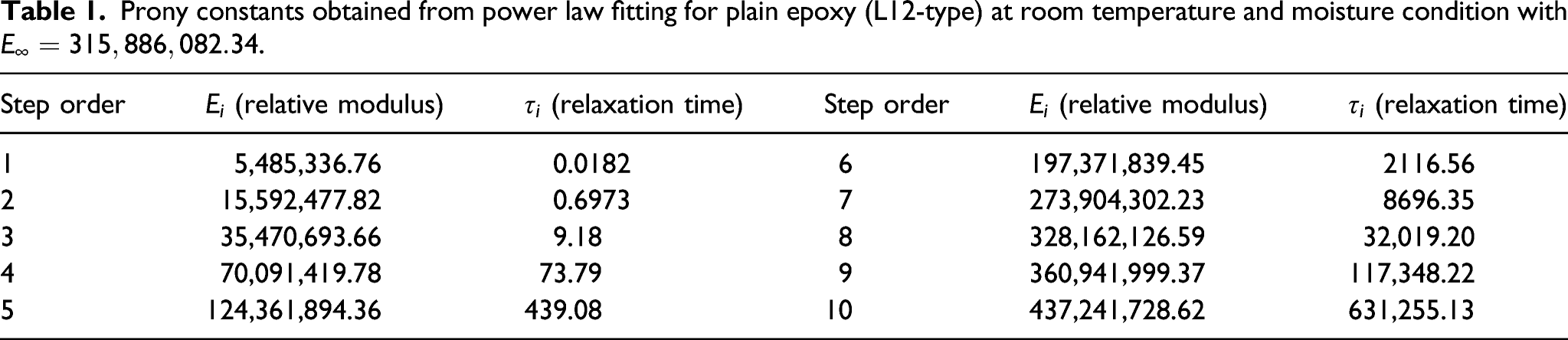
The Prony constants used in the equation (3) are not completely fitting constants but are essential parameters with physical significance in the formulation. After determining relaxation modulus in the time domain, Prony constants of equation (3) are further used to determine the frequency-dependent storage modulus


Prony constants obtained from power law fitting for plain epoxy (L12-type) at room temperature and moisture condition with
Mathematical formulations for mechanical and viscoelastic properties of hybrid composites
Mathematical formulations for numerical determination of mechanical and viscoelastic properties of hybrid composites are presented in the following subsections.
Saravanos–Chamis micromechanics for square packing hybrid composites
Square packing array is assumed in the SCM
47
to reinforce the carbon fiber into the nanocomposite. The rule of mixture is used and considered uniform stresses and strains in this micromechanic modeling. The longitudinal and transverse modulus of hybrid composites can be expressed as follows

Further, in-plane shear modulus and transverse shear modulus can be obtained as follows

In-plane shear and transverse shear damping can be expressed as follows

Strength of materials for hexagonal packing hybrid composite
Strength of the materials method forumlation
48
is employed to determine the mechanical properties of hybrid composite materials considering the hexagonal representative volume element. Rule of mixture and iso-field conditions are assumed for induced stresses and strains in the hybrid composite with perfect bonding between the nanocomposite and reinforcement. The constitutive relations can be written as follows:


The transverse stresses induced in the nanocomposite and reinforcement will be equal to the transverse stresses induced in the hybrid composite from iso-field conditions whereas the longitudinal strains in the nanocomposite, reinforcement, and hybrid composites are equal from rule of mixture which can be represented as follows

The constitutive relation between stress and strain for hybrid composite lamina can be written as

Expressions of the matrices C1, C2, V1, and V2 are available in the literature. 48 Numerical values of the matrices have been calculated based on the properties of the constituents of the hybrid composite materials.
Results and Discussion
Various results of nanocomposites and hybrid composites are obtained based on the abovementioned experimentation and mathematical relations which are presented in the following subsections.
SEM images of dispersed MWCNTs and carbon fiber in nanocomposite and hybrid composite samples
Figure 2(a) shows the SEM image of the nanocomposite at high magnification for 8% volume fraction (approximately 2% by weight) inclusion of randomly oriented MWCNTs, and Figure 2(b) shows the SEM image of the hybrid composite for 49.8% volume fraction of the carbon fiber. The MWCNTs produced are clustered which can be seen in the form of white patches/clusters. It is observed that at least 12 h of ultrasonic probe sonication is required for mixing of MWCNTs into the epoxy to minimize the agglomerations in the nanocomposite and hybrid composite, respectively. Scanning electron microscopy images: (a) MWCNT-reinforced polymer nanocomposite sample and (b) carbon fiber–reinforced polymer nanocomposite, that is, hybrid composite sample.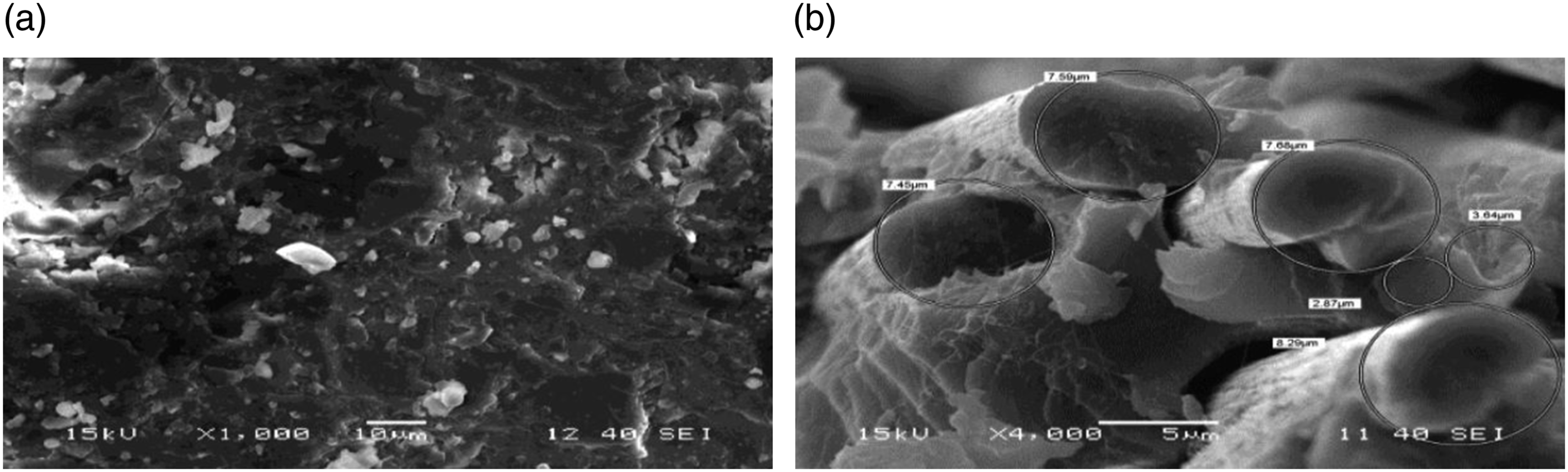
Weights of nanocomposite and hybrid composite sample before and after creep test in DMA-8000
Percentage increase in weight of nanocomposite and hybrid composite samples after the hygrothermal creep test.

Creep test of nanocomposite in DMA-8000 under controlled hygrothermal environment
Creep tests are conducted for nanocomposite samples with 0%, 4%, and 8% volume fraction (approximately 0%, 1%, and 2% by weight) of MWCNTs in DMA-8000 at different moisture conditioning (i.e., RH60 and RH95) at elevated temperatures. Short-term creep strain data are recorded for five tests for same input under tension support with the same volume fraction of the MWCNTs, which are further averaged and shown in Figure 3(a) while Figure 3(b) shows the curve fitting for long creep strain behavior in the time domain at 25°C with 60% moisture concentration. Creep strain behavior of such nanocomposites in highly humid conditions (95%) at 25°C is also depicted in Figure 3(c) and (d). Long-term creep strain behavior is obtained by determining Findley’s parameters. The effects of moisture (RH60) in higher temperature (50°C) on short-term and long-term creep strain are also observed which are shown in Figure 3(e) and (f), whereas Figure 3(g) and (h) shows the creep strain behaviors for RH95. It is clear from figures of short- and long-term creep behaviors that the presence of MWCNTs reduces the strains in the nanocomposite samples. Creep strains of nanocomposite samples: (a, c, e, g) short-term behaviors under hygrothermal conditions; (b, d, f, h) long-term behaviours under hygrothermal condition; (i) variation with RH at 25°C; (j) variation with RH at 50°C.
Coefficient of moisture expansion (CME) at different temperatures.

Frequency dependent viscoelastic properties of nanocomposite materials
Based on the Prony series representation, relaxation modulus of the nanocomposite samples under different hygrothermal conditions is determined as shown in Figure 4(a) and (b). Significant decrease is observed in the relaxation modulus at higher temperature and moisture concentration. Obtained Prony constants (such as relaxation time and relative modulus) have been further used to determine frequency-dependent viscoelastic properties of such nanocomposites. (a, b, g, h) Variation of stress relaxation with time of nanocomposites at 25o C and 50o C considering RH60 and RH95; (c, d, i, j) variation of storage modulus; (e, f, h, l) variation of loss factor of nanocomposites with frequency at 25o C and 50o C considering RH60; variation of (m, o) storage modulus and (n, p) loss factor with RH at 25°C and 50°C.
It can be observed that with inclusion of MWCNTs, the storage modulus (Figure 4(c) and (d)) and loss factor (Figure 4(e) and (f)) of such nanocomposite samples in RH60 and RH95 may be improved. The relaxation modulus at 50°C in different moisture concentrations (such as RH60 and RH95) is shown in Figure 4(g) and (h) whereas storage moduli and loss factor of such nanocomposites are depicted in Figure 4(i) and (j) and Figure 4(k) and (l), respectively. At 8% volume fraction of MWCNTs, higher viscoelastic properties are observed under different hygrothemal environments. It can be observed from Figure 4(c), (d), (i), and (j) that storage modulus increases with frequency, but initially the rate of change is more due to transient effects which can been seen in the zoomed view of these figures, and it is slowly converging toward steady or final value.
Comparison of elastic modulus of nanocomposite at room temperature.

Mechanical and shear loss factors of hybrid composite
Properties of the constituents used for hybrid composite materials.


Variation of (a) E11, (b) E22, (c) G12, (d) G23, (e) η12, and (f) η 23 at 25°C with the volume fraction of carbon fiber reinforcement in RH60.
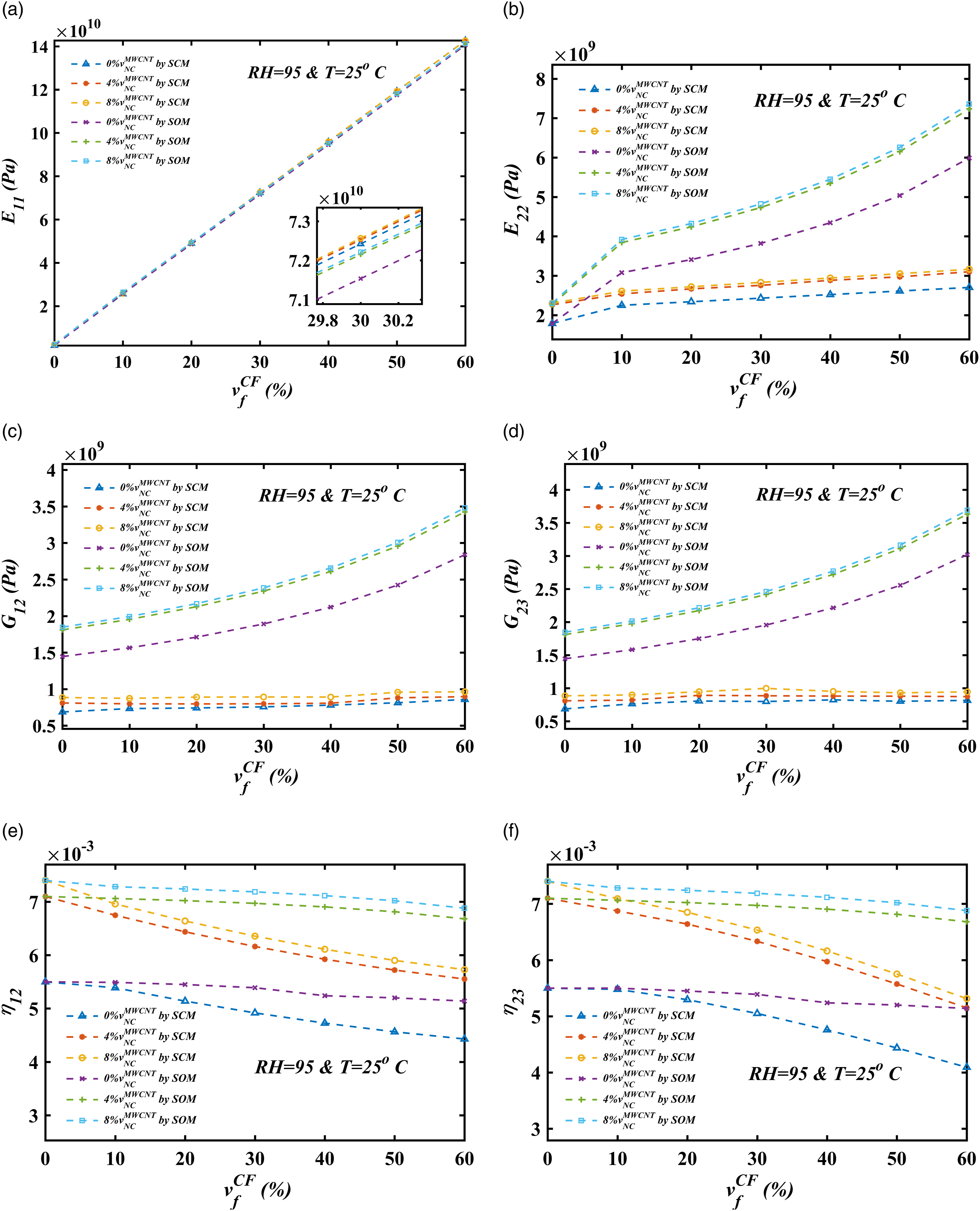
Variation of (a) E11, (b) E22, (c) G12, (d) G23, (e) η12, and (f) η 23 at 25°C with the volume fraction of carbon fiber reinforcement in RH95.

Variation of (a) E11, (b) E22, (c) G12, (d) G23, (e) η12, and (f) η 23 at 50°C with the volume fraction of carbon fiber reinforcement in RH60.

Variation of (a) E11, (b) E22, (c) G12, (d) G23, (e) η12, and (f) η 23 at 50°C with the volume fraction of carbon fiber reinforcement in RH95.
Variations of longitudinal, transverse, and shear moduli and shear loss factors with carbon fiber volume fractions (0%–60%) at 25°C with RH60 are shown in Figure 5(a–f). The properties (such as longitudinal, transverse and shear moduli, and shear loss factors at 25°C with RH95) of hybrid composites are presented in Figure 6(a–f). In such a highly humid environment, the significant effect of MWCNTs is observed in the hybrid composite which improved the stiffness and damping properties of hybrid composite materials.
The mechanical properties of hybrid composites are also determined at comparatively high temperature of 50°C under a humid environment (RH60) as shown in Figure 7(a–f). Figure 8(a–f) shows the longitudinal, transverse and shear moduli, and shear loss factors at 50°C under a highly humid environment (RH95) and observed that the MWCNTs are improving the stiffness and damping properties of hybrid composites.
Comparison of numerical and experimental results for hybrid composites
The fabricated hybrid composite samples are tested in DMA-8000 with frequency scan under different hygrothermal environments. Material properties such as longitudinal and transverse moduli, storage modulus, and shear loss factors are obtained. In high moisture concentration, the longitudinal and transverse moduli and storage modulus decreased, but significant increase in shear loss factor is observed.
Comparison of experimental and numerical results of hybrid composite material properties considering 8% MWCNT at 25°C.

Conclusions
In the present study, a combination of experimental and numerical methodology is proposed using DMA-8000 which is capable to obtain the viscoelastic properties of nanocomposite and hybrid composite materials. The microscopic study on the SEM indicates that at least 12 h of ultrasonic probe sonication needs to be performed for proper dispersion of MWCNTs into the epoxy to minimize the agglomerations in the nanocomposite and hybrid composite. Experimentally, the creep test under tension support is conducted under different hygrothermal conditions and determined the Prony constants from the long-term creep behavior, which were further used to determine the time-dependent relaxation modulus. The viscoelastic material properties (i.e., storage modulus and loss factor) are determined in the frequency domain of such nanocomposites.
It is observed that due to absorbed moisture in the samples, CME has an independent impact on the nanocomposite which leads to compressive strain in the reinforcement. It is also found that as the MWCNT percentage increases, loss factor of the nanocomposite improved in a highly humid environment with increasing temperature. Hence, 8% of MWCNT volume fraction (approximately 2% by weight) embedded in the nanocomposite can be useful for applications under a hygrothermal environment. The mechanical properties and shear loss factors of hybrid composites are obtained by using the SCM and SOM methods. Result showed that the longitudinal and transverse moduli are increasing with the increasing volume fraction of the carbon fiber. Presence of MWCNTs in the nanocomposite may improve the shear modulus and shear loss factors in the temperature (i.e., 25°C and 50°C) with different RH at 60% and 95%.
The frequency scan test conducted on DMA-8000 under different hygrothermal environments (i.e., RH60 and RH95) for the hybrid composite sample with 32.5% and 49.8% volume fractions of the carbon fiber into nanocomposites (considering 2% MWCNTs weight fraction) to obtain longitudinal and transverse moduli, and loss factors and comparisons have been made with the obtained results from SOM and SCM. Experimental results showed significant decrease in the properties which is due to irreversible moisture absorbed through the thickness of the samples of such nanocomposite and hybrid composite. It is evident from the comparative study that the overall material properties are increased by the inclusion of MWCNTs, and obtained viscoelastic and mechanical properties of such nanocomposite and hybrid composite material systems can be useful for the different structural applications under a hygrothermal environment to study their vibration or dynamics characteristics.
Footnotes
Declaration of conflicting interests
The author(s) declared no potential conflicts of interest with respect to the research, authorship, and/or publication of this article.
Funding
The author(s) disclosed receipt of the following financial support for the research, authorship, and/or publication of this article: The authors kindly acknowledged the IMPRINT cell of the Ministry of human resource development (MHRD) and Department of science and technology (DST), Government of India for a project grant (Project. No. 6292) under which the research work was carried out.
