



Abstract
This study investigates the multiwalled carbon nanotube as potential mechanical reinforcement in epoxy polymer. It is found that, by adding various concentrations of nanotube, both flow stress and fracture strain increased. Furthermore, the presences of the multiwalled carbon nanotubes are found to nucleate crystallization in the epoxy. This crystal growth is thought to enhance the strength of composite. The fracture surface analysis of the composite reinforced by carbon nanotube is used the scanning electron microscopy.
Introduction
The composite materials with epoxy-based matrix are used extensively as structural components in aircraft, aerospace and automobile industry. It results from their high-adhesion, low-weight, and good chemical resistance1–3. In order to enhance the mechanical properties of epoxy-based composite, they can add many types fillers for example particles or short fibers. In the last decades, the multi-walled carbon nanotube (MWNT) is used as the filler in polymer matrix composite has attracted considerable interesting due its extraodinary mechanical, thermal and other functional properties4,5. Epoxy composites with MWNTs reinforcements have been fabricated using different purification and dispersion processes6–9. MWNTs tend to agglomerate during mixed together with polymers due to the strong van der Waals forces among them and inherently inert nature of MWNTs. Therefore, it becomes a very important role in controlling the mechanical and thermal characteristics of the nanocomposites to disperse MWNTs in polymer matrix. Efficient dispersion and alignment of MWNTs within a matrix is still a challenge and it could play the main role driving the diffusion of MWCNT as nano-reinforcements on industrial scale10,11.
There many literatures reported that the percentage of MWNT additions to enhanced the mechanical property of composite. Several micromechanical models have been proposed to explain the mechanical properties of the nanocomposites12–15. But there are very little published study on the influence of the strain rate on the mechanical properties and fracture mechanism of nanocomposite. During the manufacturing and using process, the structural components are usually subjected to the different strain rate effects. The main purpose of this study is investigated that the mechanical properties of epoxy composite samples reinforced by different percentage of multi-walled carbon nanotubes additions. The Material testing system (MTS) is used to exam the mechanical properties of nanocomposites samples with different strain rate. Furthermore, the carbon nanotube dispersion and the fracture surfaces are analyzed by performing scanning electronic microscope (SEM).
Material Preparation and Experimental Procedure
The polymer matrix used in this study is a commercially available low viscosity epoxy resin (NC826A), and NC826B hardener. The epoxy was supplied by Everwide Chemical Co., Ltd. Furthermore, multi-walled carbon nanotubes (MWNT) used in this study was supplied by NICHING Industrial Co. Ltd (see

SEM feature of MWNT
All the composite specimens and the neat resin specimen were mechanically polished to minimize the influence of surface flaws. The standard of mechanical testing is ASTM D3410. The compressive examinations were carried out at room temperature of 25°C by using Materials Testing System (model MTS 810 with the load cell of capacity 30 kN) and the strain rate of 10−3, 10−2 and 10−1 s−1. The fracture surface analysis was performed by scanning electron microscopy (model FEI Quanta 400 F at 15 kV). The specimens were coated with a thin layer of gold prior to examination by SEM. The schematic illustration of the experimental procedure is shown in

The schematic illustration of the experimental procedure
Stress-Strain Behaviour
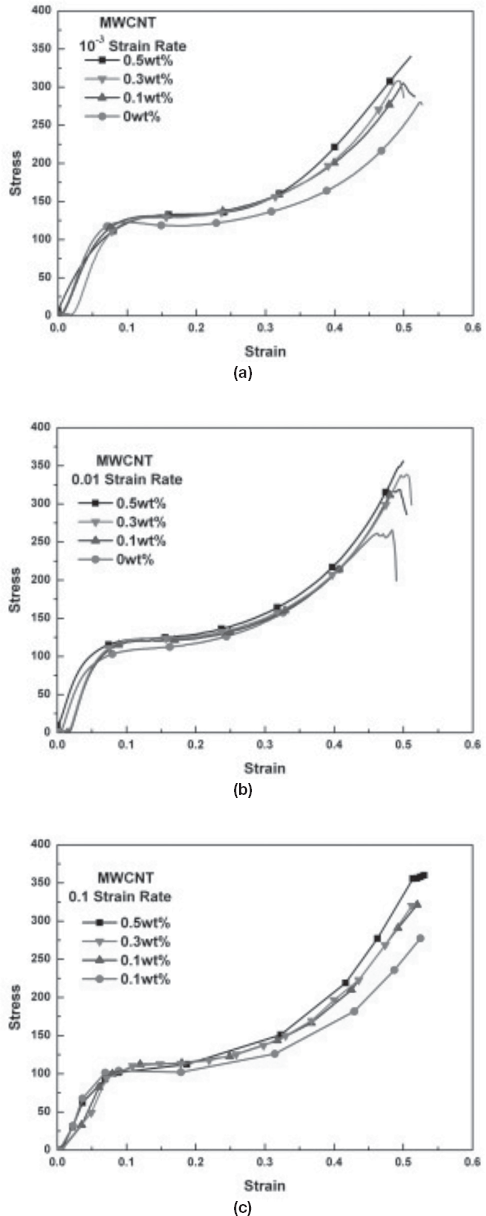
Stress-strain curves of nanocomposite deformed at temperatures of 25°C, under different MWNT contents and strain rate of (a) 10−3 s−1; (b) 10−2 s−1; (c) 10−1 s−1 procedure
To investigate the effect of the strain rate the dynamic response of the nanocomposite specimens,

True stress as function of at true strains of 0.1 and 0.2 under different strain rate and the MWNT contents of (a) 0%; (b) 0.1%; (c) 0.3%; (d) 0.5%
The dependence of the flow stress on the strain rate can be calculated by using the following strain rate sensitivity parameter:

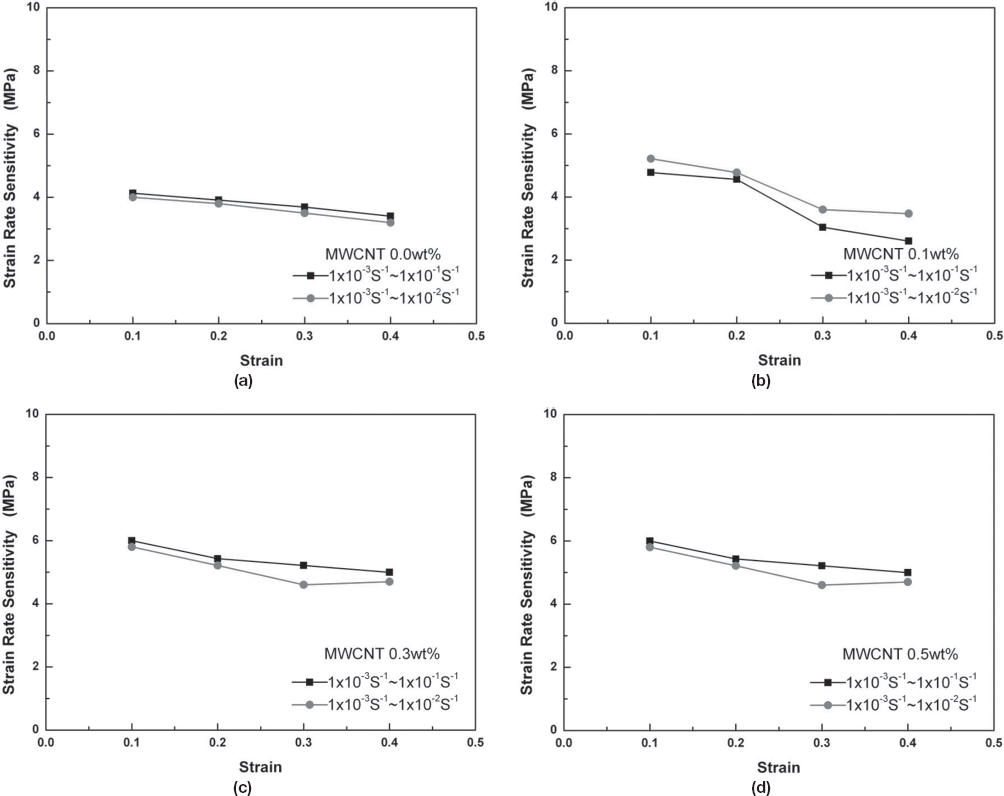
Variation of strain rate sensitivity with true strain as function of strain rate under different MWNT contents (a) 0%; (b) 0.1%; (c) 0.3%; (d) 0.5%
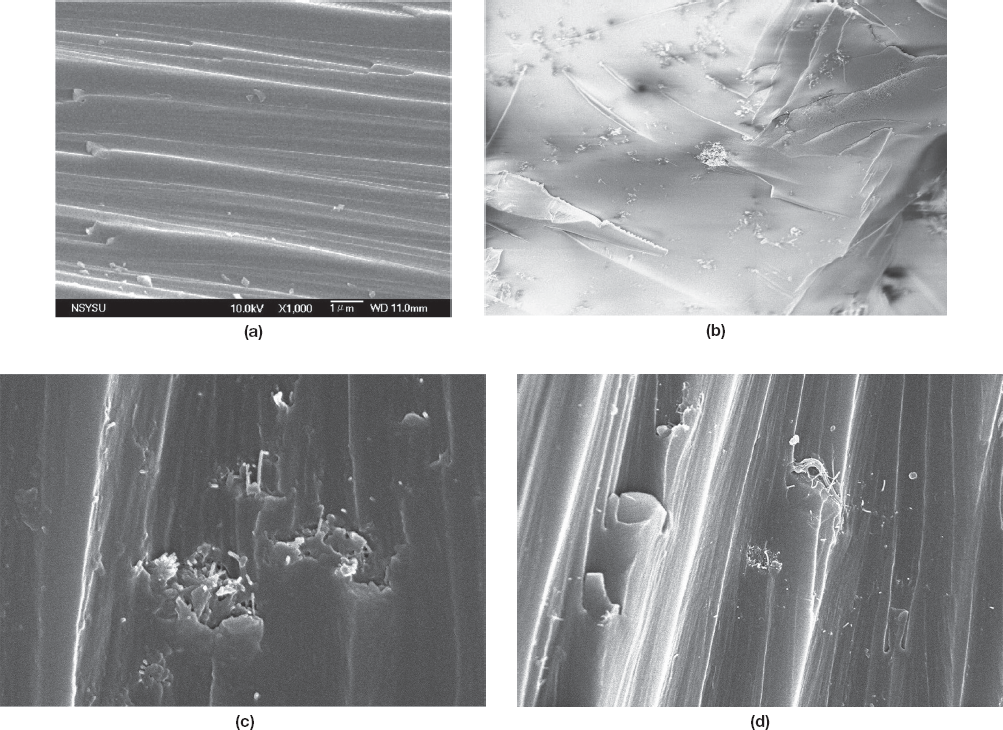
Fracture surface features at different MWNT contents (a) 0%; (b) 0.1%; (c) 0.3%; (d) 0.5%
Mechanical experiments on the nanocomposite with MWNT reinforcements have been conducted to investigate the influence of the strain rate and contents of MWNT on the deformation flow response and fracture analysis. The mechanical behaviour of the nanocomposite is sensitive to both strain rate and contents of MWNT. Fracture analysis show that catastrophic failure takes place in all tested condition specimens. The fracture observations show that the flow stress increases related to the inhibition of the slip band by MWNT.
Footnotes
Acknowledgment
The authors gratefully acknowledge the financial support provided to this study by the Ministry of Science and Technology of “Taiwan” under Grant No. MOST 102-2221-E-151-006-MY3.