



Abstract
In the present study, Taguchi design of experiments (DOEs) L18 orthogonal array has been used for the investigation of the mechanical behavior of rigid polyurethane foam (RPUF) composites. The outcome of the process parameters such as polyol, filler, surfactant, catalyst, blowing agent, and anti-flaming agent on the mechanical properties, such as tensile, flexural, and compressive strengths and hardness (Shore D) of RPUF composites, has been examined, and the resulted data were analyzed by means of Taguchi design of experiments. The raw data for the average values of the mechanical properties and the signal-to-noise (S/N) ratio for each parameter were evaluated at three levels, and the analysis of variance (ANOVA) and optimum process parameters are determined. The confirmation experiments were performed for the validation of the improved performance and to measure the contribution of individual parameter on the responses. The confirmation experiments revealed the average tensile strength, average compressive strength, average flexural strength, and average hardness (Shore D) as 5.24 MPa, 6.37 MPa, 12.28 MPa, and 72.43, respectively, which fall within the 95% confidence interval of the anticipated optimum process parameters.
Introduction
Polyurethane (PU) is one of the leading contenders of the highly diverse family of polymers. The unending adaptability of the polyurethane has led to its numerous applications, that is, from low density packaging products to high performance medical substances and, from thermally stable insulation for space exploration vehicles to extremely flame-retarded flexible cushioning. Rigid polyurethanes foams (RPUFs) are one of the important classes of cellular materials finding recognition in different industrial sectors due to their high-performance applications. Rigid polyurethanes foams can display a range of properties which enable them flaunting a variety of applications, depending upon the chemical reagent used in their synthesis.
Like other engineering products, in order to improve the price and reliability of RPUF composites, it is desirable to optimize their processing limits that govern the inclusive properties of the final products. The processing limits of any product can be optimized by using statistical tools that involve a strategic experimentation, followed by a derivation of the variables of interest over a definite range. 1 Taguchi Design of Experiment (DOE) is one of the easiest, reliable, and practical statistical methods and is efficient for designing processes that operate consistently and optimally over a variety of conditions. Taguchi’s signal-to-noise ratios (S/N), are the log functions, based on Orthogonal Array (OA), that provide a set of well balanced (minimum) experiments and desired output on the basis of independent evaluation of the factors. 2 The importance of these factorial designs is their foundation of industrial experimentation for product and process development and improvement. Being easy and reliable, this approach has been used by many researchers for the optimization of the process parameters in their respective studies. 3 Barick et al. optimized the processing parameters for the fabrication of thermoplastic polyurethane/millable polyurethane blend systems, reinforced with organoclay. 4 Melt mixing of polypropylene/ethylene propylene diene monomer rubber (EPDM)/organoclay nanocomposites was also optimized by employing the Taguchi methodology. 5 Arunkumar et al. used the response surface methodology (RSM) for generating a mathematical model and to optimize the coating procedure of polyurethane on the acrylonitrile butadiene styrene. Paint flow rate, part–applicator distance, and paint viscosity were considered as input parameters to optimize the responses (dry film thickness, rating value, and distinctness of image). 6 Bil et al. optimized the polyurethane structure for applications in bone tissue engineering. The results obtained by them indicate that, an optimal ratio of hard to soft segments may be obtained for the culture of human osteogenic cells. 7 Bratov et al. optimized the composition of ammonium ion sensitive membrane based on a photo-curable aliphatic urethane diacrylate oligomer. 8 Eslick et al. used a stochastic optimization method for predicting the polyurethane structures having a given set of physical and chemical properties. 9 They described an extension of the use of connectivity indices, within a computational molecular design framework to design novel polyurethane structures. Im et al. used central composite design optimization method to examine the conditions for pyrolysis of polyurethane to attain a solid product with a high iodine number. Under the optimum conditions, the iodine number and the yield of solid product were estimated to be 582 mg/g and 15 g, respectively. 10 El-Shekeil et al. employed Taguchi L9 OA to optimize the processing parameters of thermoplastic polyurethane reinforced with cocoa pod husk fibers, and the ultimate tensile strength was considered as the response. 11 Zavala et al. performed the optimization of polyurethane production in a semi-batch reactor. The performance of the polyurethane reactor was reportedly enhanced by implementing the tools and approaches from the process system engineering discipline. 12
From the literature studies, it is evident that only a few studies have reported the application of Taguchi method for the estimation and improvement of the mechanical and surface properties of RPUF composites. The present study has been conducted with an aim to develop RPUF composites and to optimize their formulation for desired mechanical properties by using Taguchi DOE, with a purpose to improve their reliability for the selective applications. The L18 mixed OAs are used to increase the experimental efficiency. The effects of different process parameters such as polyol, filler, surfactant, catalyst, blowing agent, anti-flaming agent on tensile, flexural, and compressive strength, as well as hardness (Shore D) of RPUF have been extensively investigated.
Materials and methods
Materials
Castor oil (99%), 4, 4′-diphenylmethane diisocyanate, and dibutyltin dilaurate (DBTDL; catalyst) were brought from Shivathene Linopack Ltd, Parwanoo, Himachal Pradesh, India. Calcium carbonate (CaCO3; filler), silicon oil (surfactant), and n-pentane (blowing agent) were purchased from CDH(P) Ltd., New Delhi, India. Triethylenediamine (TEDA) (99%; catalyst), melamine (2,4,6-triamino-1,3,5-triazine; anti-flaming agent), tris (2-chloroethyl)phosphate (TCP; anti-flaming agent), tris (1,3-dichloro-2-propylphosphate) (TDCPP; anti-flaming agent), cobalt octoate (catalyst), and fly ash (filler) were supplied by Standard Chemicals (ISO 9001:2008 certified), Tilak Bazar, New Delhi, India. Glycerol was obtained from Sisco Industries Pvt. Ltd. All the reagents were of analytical grade and were used as supplied.
Development of rigid polyurethane foam composites
Rigid polyurethane foam composites were prepared by employing a two-step method. First, the castor oil was modified to obtain polyol according to the procedure reported in prior studies.13–15 Then all the components, as per the experimental design strategy, were added into a beaker and stirred at room temperature for the adequate mixing. The prepared mixture was spread into a pre-lubricated metal mould (200 × 200 × 100 mm) and left to stand for 96 h, for complete curing. After de-moulding, the prepared composite foam was cut into required dimensions and tested for its hardness, compressive, flexural, and tensile strengths. The samples of different formulations are given in Figure 1. Different formulations of rigid polyurethane foam.
Mechanical testing of rigid polyurethane foam composites
The mechanical properties of the prepared RPUF composites have been determined according to the standard procedures. Testing is conducted on three specimens of each concentration, and the average value of the three has been reported. Tensile, compressive, and flexural strengths of the resulted foam composites were measured at room temperature using Instron (Model No. 3369) universal testing machine (UTM) as per ASTM D-638, ASTM D 695, and ASTM D 790 methods, respectively. Shore D hardness of the RPUF composites was determined by Durometer Hardness Tester (Model: PosiTector® SHD) as per the ASTM D2240 method.
Design of experiments
Selected process parameters and their levels.
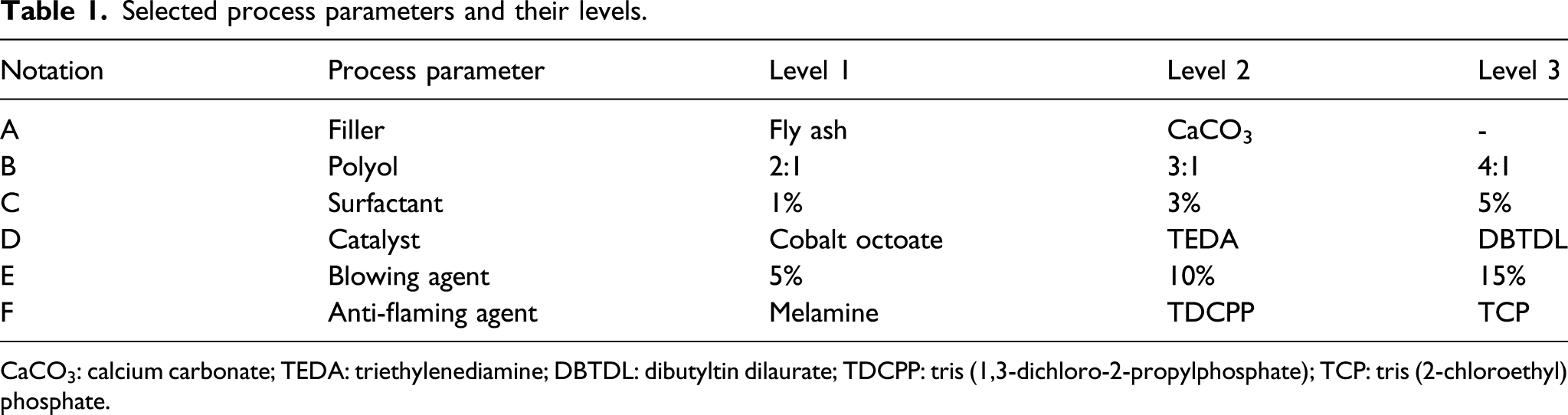
CaCO3: calcium carbonate; TEDA: triethylenediamine; DBTDL: dibutyltin dilaurate; TDCPP: tris (1,3-dichloro-2-propylphosphate); TCP: tris (2-chloroethyl)phosphate.
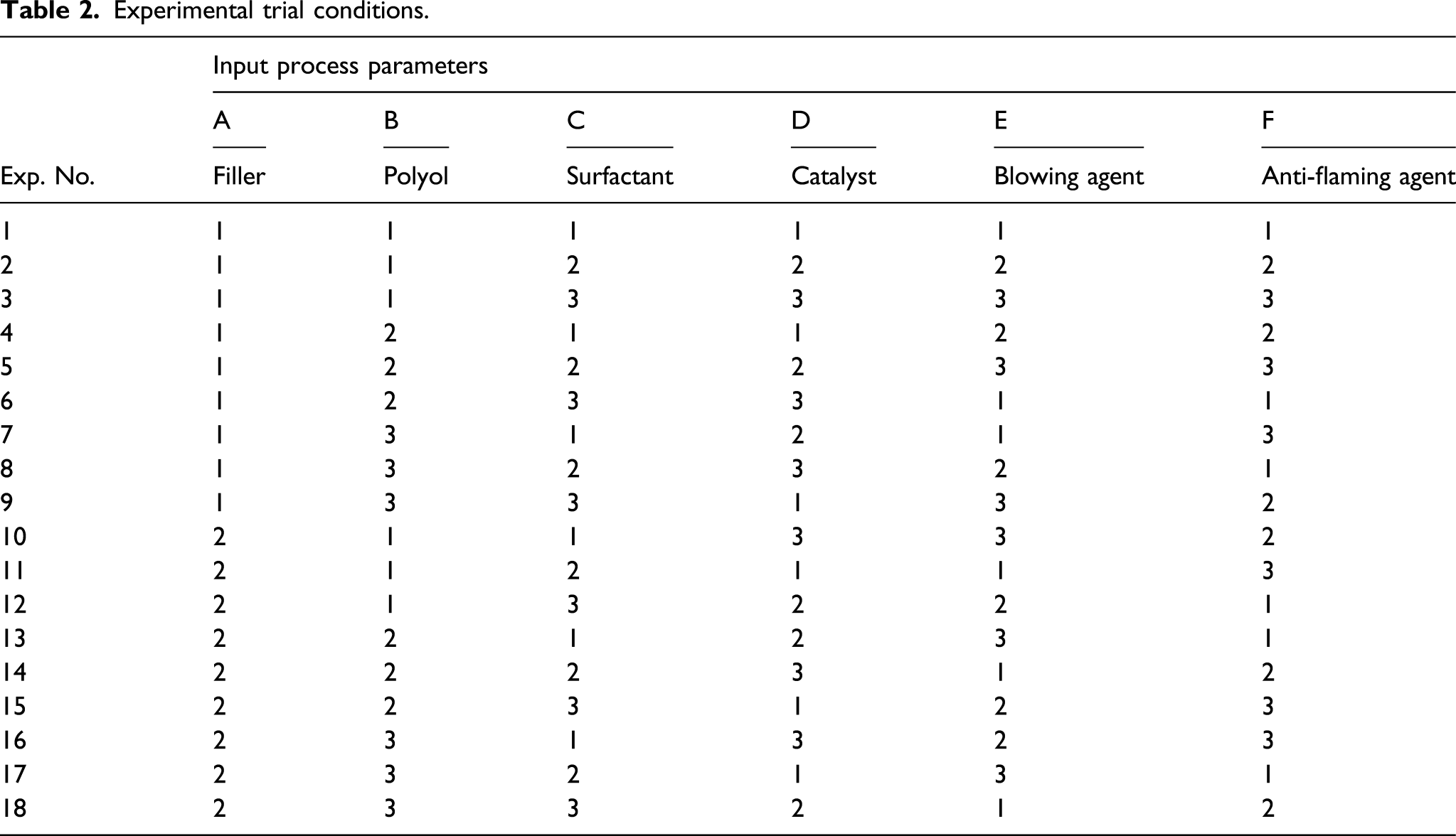
Experimental trial conditions.
Result and discussion
The experiments are designed by using the parametric approach of the Taguchi’s L18 OA. Analysis of data is conducted by employing the standard strategy suggested by Taguchi. The most favorable (optimal) conditions of the process parameters are determined by analyzing the response curves and the ANOVA tables. Further, the effects of process parameters, that is, filler, polyol, surfactant, catalyst, blowing agent, and anti-flaming agent on the selected response characteristics, that is, tensile strength, flexural strength, compressive strength, and hardness have been determined.
Tensile strength, flexural strength, compressive strength, and hardness
Tensile strength, compressive strength, flexural strength, and hardness of different formulations of rigid polyurethanes foams.

Mean signal-to-noise ratios for each level of process parameters.

The signal-to-noise (S/N) ratio associates the two different types of the parameters (mean value of the quality trait and variance about this mean) into a single one. The average values and the S/N ratios of the response traits for each parameter, at different level, are measured from the experimental data. The response curves (main effects) of each process parameter are used to study their effects on the response traits. The analysis of variance (ANOVA) for the raw data and the S/N ratio is performed to identify the most influential parameters and to determine their effects on the response characteristics. The effect curves of process parameters, both for S/N ratio and raw data, are drafted as Figure 2(a)–(d). The Table 5 shows the results of ANOVA for different response traits, that is, for Signal-to-Noise ratio and raw data curves versus process parameters on (a) tensile strength, (b) compressive strength, (c) flexural strength, and (d) hardness. Results of ANOVA for (a) tensile strength, (b) compressive strength, (c) flexural strength, and (d) hardness. ANOVA: analysis of variance; DOF: degree of freedom; SS: sum of squares; V: variance; F-ratio tabulated: 3.223; P%: percentage contribution.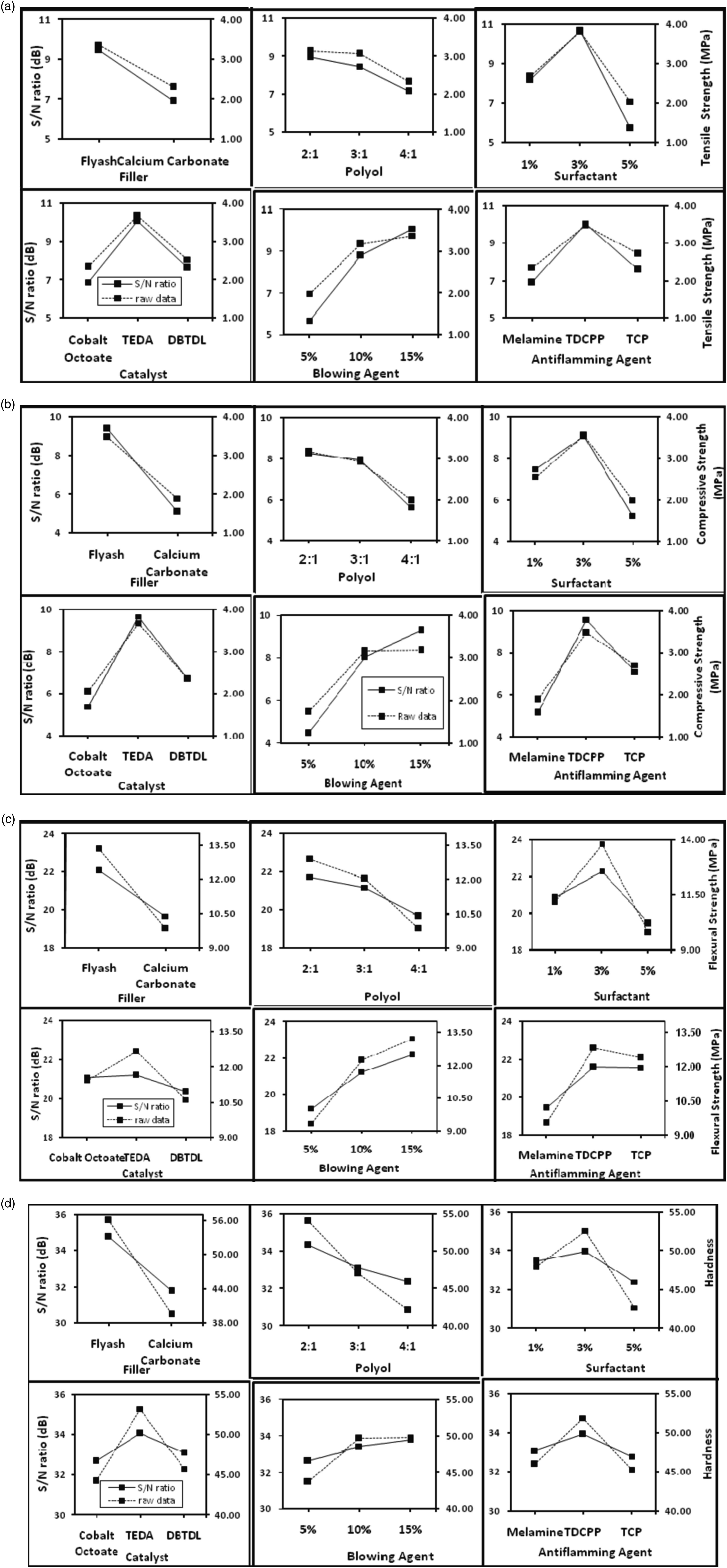

The optimum value of process parameters for the anticipated range of tensile strength, flexural strength, compressive strength, and hardness.

CaCO3: calcium carbonate; TEDA: triethylenediamine; DBTDL: dibutyltin dilaurate; TDCPP: tris (1,3-dichloro-2-propylphosphate); TCP: tris (2-chloroethyl)phosphate.
Confirmation experiments
The confirmation experiments are the conclusive steps in validating the inferences from the former round of investigations. The selected numbers of experiments have been carried out by setting the significant parameters at the optimum conditions, while the insignificant parameters were kept at the economic levels. The average of the results of the confirmation experiments is compared with the predicted average, which depends on the tested parameters and their levels. The three confirmation experiments, each for the tensile strength, compressive strength, flexural strength, and the hardness, are performed at the optimum combination of the process parameters. Filler is set at first level, polyol at first level, surfactant at second level, catalyst at second level, blowing agent at third level, and anti-flaming agent at second level. From the confirmation experiments, the average values of the tensile strength, compressive strength, flexural strength, and the hardness (Shore D) are recorded as 5.24 MPa, 6.37 MPa, 12.28 MPa, and 72.43, respectively, which fall within the 95% confidence interval of the anticipated optimum process parameters.
Conclusions
The RPUFs are the most widely used materials in various industrial and engineering applications, including false roofing, sandwiched construction panels, railway assemblies, and in buildings for thermal insulation purposes. Rigid polyurethanes foams can be tailor-made to exhibit different properties, depending upon the applications to be employed. The present study has been conducted with an aim to develop RPUFs and optimize their formulation for desired mechanical properties, with a purpose to improve their reliability for the selective applications. For this, different fillers, catalysts, and anti-flaming agents are explored to find the best suitable formulation. Further, the concentrations of polyol, surfactant, and blowing agent are optimized for better mechanical properties. In order to achieve consistency in the final product, the effects of process parameters, that is, filler, polyol, surfactant, catalyst, blowing agent, and anti-flaming agent on the selected response characteristics, that is, tensile strength, compressive strength, flexural strength, and the hardness, have been studied by using Taguchi DOEs. The raw data for the mean values of the response characteristics and S/N ratio for each parameter have been analyzed at three levels (L1, L2, and L3). The experiments are designed by applying the parametric approach proposed in the Taguchi’s L18 OA. Each experiment is repeated thrice under trial condition and for every replication, tensile strength, compressive strength, flexural strength, and hardness (Shore D) are measured. The response curves of the process parameters are plotted for S/N ratio and the raw data, for analyzing the influence of the process parameters on the response traits. The ANOVA of raw data and the S/N ratio is performed to recognize the most influential parameters and their effects on the response characteristics. The optimal combination of process parameters is recorded as filler at first level, polyol at first level, surfactant at second level, catalyst at second level, blowing agent at third level, and anti-flaming agent at second level. The confirmation experiments for different response characteristics are performed at these optimum levels of the process parameters. It is concluded from the confirmation experiments that the average tensile strength is 5.24 MPa, the average compressive strength is 6.37 MPa, the average flexural strength is 12.28 MPa, and the average hardness (Shore D) is 72.43, which fall within the 95% confidence interval of the predicted optimum parameters.
Footnotes
Acknowledgments
We are thankful to Delhi Technological University for providing us necessary facilities to conduct these studies.
Declaration of conflicting interests
The author(s) declared no potential conflicts of interest with respect to the research, authorship, and/or publication of this article.
Funding
The author(s) received no financial support for the research, authorship, and/or publication of this article.
