



Abstract
In present research, the flexural properties of glass/epoxy composites reinforced by nanoclay particles (3, 5 and 7 wt.%) under various hybrid thermal cycling and shock loadings (15 and 30 thermal cycles at immediate −70°C and +100°C temperatures) have been investigated. It was found that the flexural strength of 5 wt.% nanoclay/glass/epoxy nanocomposites under 15 and 30 hybrid thermal loadings was enhanced by 19.35% and 20.78%, respectively. Also, after 15 hybrid thermal loadings, the flexural stiffness of 5 wt.% clay/glass/epoxy nanocomposites increased by 9.30% compared to static conditions. More importantly, after 30 hybrid thermal loadings, by adding more filler contents, the flexural stiffness was increased. For instance, at 7 wt.% clay/glass/epoxy nanocomposites, the flexural stiffness enhanced 17.97% compared to neat composite. FESEM morphology images confirmed that presence of optimum filler contents changed the composites inherent properties. Therefore, the outcome of this research can show various remarkable advantages for researchers to apply nanoclay as nanofillers to reinforce composites structures under hybrid thermal cycling and shock applications.
Keywords
Introduction
The application of structural composites is increasing in advanced industries such as aerospace when they are exposed to cryogenic temperature, thermal cycling and thermal shocks. Thus, thermal loading conditions in the categories of thermal cycling and thermal shocks have been focused on by many researchers. However, reduction of mechanical properties due to thermal loadings is a threat for using structural materials. When the temperature is decreased to cryogenic temperature, internal stresses are generated in the epoxy matrix. 1 Therefore, this remarkable application of polymer composites forced researchers to perform considerable investigation on the application of composites under thermal cycling and cryogenic temperature, called shocks, and find various methods to improve the mechanical properties of polymer-matrix composites.
In some researches, the thermal loading conditions are applied on neat composite structures without nano particles.2-15 Chawla 2 considered the thermal cycling effect on copper matrix-tungsten fiber composites. They found that for a given magnitude of temperature change, the extent of slip deformation in the matrix was higher for high rate cycling than for slow rate cycling. Eslami-Farsani et al. 3 studied the effects of thermal cycles on hardness and impact resistance of three types of phenolic-matrix composites. Abdollahi et al. 4 conducted an experimental study of the effects of cryogenic cycling and metal surface treatment on flexural properties of aluminum epoxy/basalt fibers laminate composite. Each cryogenic cycle was carried out in 4 min and temperature range was between −40°C and 25°C. Flexural properties were evaluated on samples after 15 and 30 cycles and compared to non-exposed samples. It was observed that while the cryogenic cycling decreased, the flexural strength of the fiber metal laminate (FML) increased. Khalili et al. 5 investigated the effect of thermal cycling on the tensile behavior of three types of polymer-matrix composites and found that the ultimate tensile strength of the specimen reinforced with woven basalt fibers enhanced by 5% after thermal cycling. Jafari et al. 6 tested the effect of thermal cycles on the mechanical properties of glass fiber-reinforced plastic (GFRP) pultruded profiles with different geometries. It was found that the tension specimens performed better in comparison to compression specimens in terms of strength retention after thermal exposure. Kim et al. 7 measured the tensile properties of T700/epoxy composite structures, which had been cycled with thermo-mechanical loads at low temperatures, and applied thermo-mechanical tensile cyclic loading was applied to T700/epoxy unidirectional laminates at room temperature (RT) to −50°C, −100°C, and −150°C, respectively. Results showed that tensile stiffness significantly increased.
Ray 8 reported the effects of thermal and cryogenic conditionings on mechanical behavior of thermally shocked glass fiber/epoxy composites. They believe that a very large thermal expansion mismatch may result in weakening the fiber–matrix interface and/or a possible matrix cracking due to thermal shock stress. Ray 9 assessed the effects of thermal shocks on interlaminar strength of thermally aged glass fiber-reinforced epoxy composites. He stated that the short conditioning time followed by thermal shock resulted in a reduction of shear strength of the composites. Kang et al. 10 evaluated the cryogenic performance of adhesives using composite–aluminum double-lap joints and tested three types of adhesives for the ability to bond carbon fiber-reinforced plastic composites developed for cryogenic use and aluminum alloy (Al 6061-T6) for lining the tank using double-lap joint specimens. They compared the bond strength of each adhesive and fracture characteristics at room temperature and cryogenic temperature −150°C. Ibekwe et al. 11 studied glass fibers reinforced unidirectionally, and cross ply laminated composite beams were subjected to low-velocity impact and compression after impact (CAI) testing at low temperatures and evaluated the effect of environmental temperatures on the impact damages and on the residual compressive buckling strength and elastic modulus based on the test results. Surendra Kumar et al. 12 investigated the mechanical behavior of glass/epoxy composites at cryogenic temperature and compared the mechanical performances of the laminated specimens at cryogenic conditions with room temperature properties. Torabizadeh et al. 13 developed a finite element model to perform the progressive failure analysis of quasi isotropic composite plates at room temperature and thermal shock equal to −60°C and compared the results with their experimental observations and eventually, the results were in a reasonable agreement with the experimental data at room temperature and −60°C. Mahato et al. 14 studied the effect of short term exposure of thermal shock conditioning on the mechanical properties of glass/epoxy composites and stated that different coefficients of thermal expansion during thermal shock conditioning and a significant amount of pre-existing residual stresses govern the stress distribution and ultimately the mechanical properties of glass/epoxy composite. Kubit et al. 15 determined the influence of temperature gradient thermal shocks on the interlaminar shear strength of fiber metal laminate composite and reported that the failure mode and interlaminar shear strength depend on the number of shock cycles.
The second classification of the researches are about the mechanical properties of polymer composites reinforced with nano particles under thermal loading conditions.16-18 Zhai et al. studied thermal shocks’ properties and strengthen mechanisms of Al2O3/TiO2 nanocomposites’ ceramic coating deposited by plasma spraying technology and indicated that the thermal shocks properties get ahead of that of conventional Al2O3 and Al2O3/TiO2 coating. 16 Najafi et al. 17 investigated the effect of nanoclay addition on impact properties of composite and fiber metal laminates before and after exposure to high temperature shock and found that nanoclay has an effective role in maintaining impact properties of the specimens. Weir et al. 18 developed nanocomposites with calcium fluoride (nCaF2) nanoparticles and investigated the thermal cycling behavior and reported that after thermal cycling, the nCaF2 nanocomposites had flexural strengths five times higher than the resin without nano particles.
Furthermore, application of nanoclay as an economic and accessible reinforcement to improve the mechanical properties of neat resin and glass/epoxy laminated composite materials has been taken into consideration in the literature.19–26 Tsai and Wu 19 performed a symmetric investigation regarding the organoclay effects on the mechanical behaviors of glass/epoxy nanocomposites. They applied three different loadings, 2.5, 5 and 7.5 wt.% of organoclay into the epoxy resin and observed that the longitudinal tensile and flexural strength decreased by means of organoclay nanoparticles. Saad et al. 20 studied the thermal degradation of brominated epoxy resin-organoclay (Cloisite 25A) based nanocomposites. They represented that thermogravimetric analysis showed higher thermal stability for the epoxy nanocomposites compared to pure epoxy. Raghavendra et al. 21 represented the effects of Cloisite-15A and OMIB nanoclays in vinylester/glass on mechanical, thermal and fire retardation behaviors. Best tensile strength, Interlaminar shear strength, flexural strength and impact strength of vinylester/glass increases as much as 4 wt.% loading with the addition of OMIB, however, lowered when compared to Cloisite-15A. Binu et al. 22 studied the effects of nanoclay content on the mechanical and thermal properties of nanocomposites, and a series of glass fiber-reinforced polyester nanocomposites with 0, 0.5, 1, 1.5 and 2 wt.% Cloisite-15A, and found that with 1 wt.% nanoclay have the highest improvements on the performance. Heydari-Meybodi 23 determined the low-velocity impact (LVI) response of the unidirectional glass/epoxy laminated composites, reinforced with various contents of Cloisite-30B and Cloisite-15A nanoclay (0, 3, 5 and 7 wt.%) and found that the beams with 5 wt.% nanoclay have the highest energy absorption. Ahmad Rafiq et al.24,25 studied the effects of nanoclay addition in glass fiber-reinforced epoxy composites on impact response, flexural properties and water uptake resistance at different temperature. They indicated that the addition of nanoclay improved the peak load and stiffness of reinforced nanocomposites and at 1.5 wt.% of nanoclay loading, the flexural modulus is highest with improvements of 15% for water 23°C and 14% for water 80°C. Pol et al. 26 investigated the effect of nanoclay and nanosilica (3, 5, 7 and 10 wt.%) on mechanical properties of glass epoxy composites. The tensile strength and toughness of nanocomposite increased by 7% and 10% after adding 5 wt.% nanoclay.
A comprehensive survey in the available literature reveals the lack of deep research about the effect of hybrid thermal cycling and shocks on the mechanical properties of glass/epoxy composites reinforced by nanoparticles. Thus, in the present study, the effect of hybrid thermal cycling shocks on the flexural properties of 3, 5 and 7 wt.% nanoclay/epoxy nanocomposites is fully investigated using a series of flexural bending tests under 15 and 30 thermal cycles at −70°C and +100°C sudden shocks.
Experimental study
Materials
The YD-128 is a liquid type standard epoxy resin derived from Bisphenol-A. The YD-128 epoxy resin and polyamine hardener were supplied by Kukdo Chemical Company, South Korea. Generally, YD-128 is widely used in many industrial applications. In addition, Teta, used as the hardener, was supplied by the AkzoNobel Company, China. The unidirectional (UD) E-glass fabric was supplied by Taishan Fiberglass Inc., China. The specifications of E-glass UD fiber and the resin are presented in Tables 1 and 2.
Properties of YD-128 epoxy resin.

Specifications of the E-glass UD fiber.

The Montmorillonite K10 nanoclay was supplied by Sigma-Aldrich Chemie GmbH, Germany. The average diameter is approximately in intervals of 10–40 nm with density of 0.5–0.7 g/cm3. Figure 1 shows the field emission scanning electron microscopy (FESEM) of the procured nanoclay. In addition, the X-ray diffraction (XRD) pattern of pure nanoclay, is represented in Figure 2. FESEM image and XRD pattern are taken by the nanoclay supplier (Sigma-Aldrich Chemie GmbH). As shown in Figure 2, it is clearly observed that the position of the XRD peak which shows two peaks in 1.8653 and 8.1979 degree (2*theta) and confirms purity of the nanoclay.
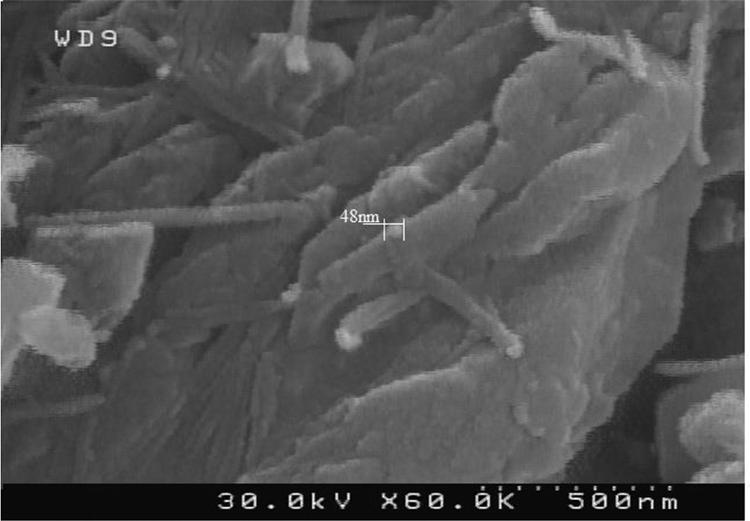
Scanning electron microscopy image of nanoclay, prepared by Sigma-Aldrich Chemie GmbH, Germany.
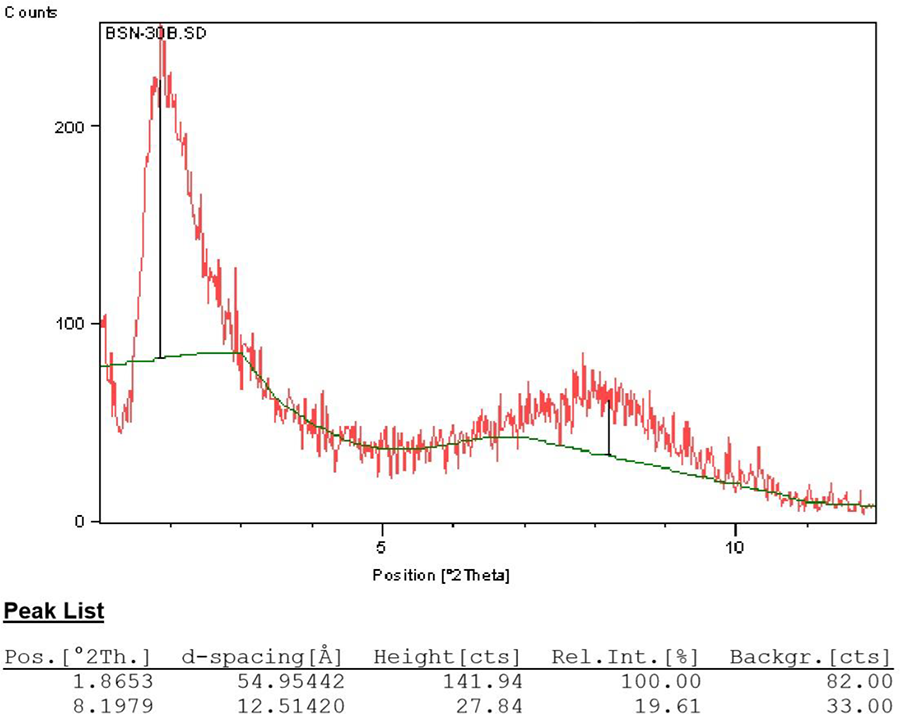
XRD result of nanoclay, prepared by Sigma-Aldrich Chemie GmbH, Germany.
Specimen preparation
To fabricate glass/epoxy composite specimens, the hardener was added to the epoxy resin at a ratio of 1:10 and stirred gently by using a mechanical stirrer (Heidolph RZR2102) for 5 min at 100 rpm. Stirring at low speed was very important to avoid any undesirable bubble formation.
The glass/epoxy composite specimens were manufactured using the hand layup process. Sixteen layers of E-glass UD were cut into a sheet of dimensions of 130 × 100. Then, layers were stacked with YD-128 epoxy resin and impregnated at room temperature. A roller was used to release the trapped air and voids. Later, samples were kept under 750 N static weight to get the trapped bubbles out and reach to around 4 mm final thickness. The fabricated sheet was also pre-cured under static pressure for 48 h. In order to do the post-curing process, the sheet was placed at room temperature for 1 month at 30°C. Finally, the test specimens were cut in accordance with ASTM D2344M standard by the water jet cutting process for the 3 points bending tests. The drawing of the test specimen is shown in Figure 3.

Drawing of the bending test specimen (dimensions in mm), ASTM D2344M.
In order to prepare composite specimens with nanoclay particles, all previous steps were kept as the same as before, but standard processes are followed before adding the hardener. The nanoclay content to fabricate nanocomposite specimens were taken from the literature.19–26 Then, epoxy resin was mixed with 3 wt.%, 5 wt.% and 7 wt.% nanoclay and stirred for 10 min at 120 rpm, and then the mixture was sonicated via 14 mm diameter probe-sonicator (Hielscher UP400S) at an output power of 150 W and 12 kHz frequency. The approach was used to disperse the nanoclay particles in YD-128 epoxy resin. Time for sonication depends on the filler contents and has been defined based on whether fillers remain intact, but it was around 15 min. It is worth noting that during the sonication, the mixture container was kept cold by the aid of an ice bath to prevent the overheating of the suspension.
Test setup
The universal testing machine, STM-150 made by Santam Co., Iran, was utilized to perform the flexural bending tests in accordance with ASTM D2344M standard (Figure 4). The cross-head speed for the tensile test was set at 1 mm/min.

The universal Santam testing machine, STM-150 to perform the flexural three points bending tests, ASTM D2344M.
Tests results
Static tests
A series of tests under static loadings were carried out to determine flexural properties of fabricated composite structures. In order to evaluate the fiber weight fraction, the burn-off test was performed to obtain the glass fiber content. The mass of particles is directly measured after sample burn-off, whereas the mass of fibers is evaluated from the sample dimensions and the fiber mat areal weight, which has been measured prior to sample preparation. In order to maintain the statistical reliability, five samples were tested in each step. The force versus displacement curve was obtained from flexural three bending tests and represented in Figure 5. For more clarification, all mean values of the flexural strength and the stiffness of fabricated glass/epoxy composite structures and 3 wt.%, 5 wt.% and 7 wt.% clay/glass/epoxy nanocomposites are demonstrated in Tables 3 to 6 and compared in Figure 6.
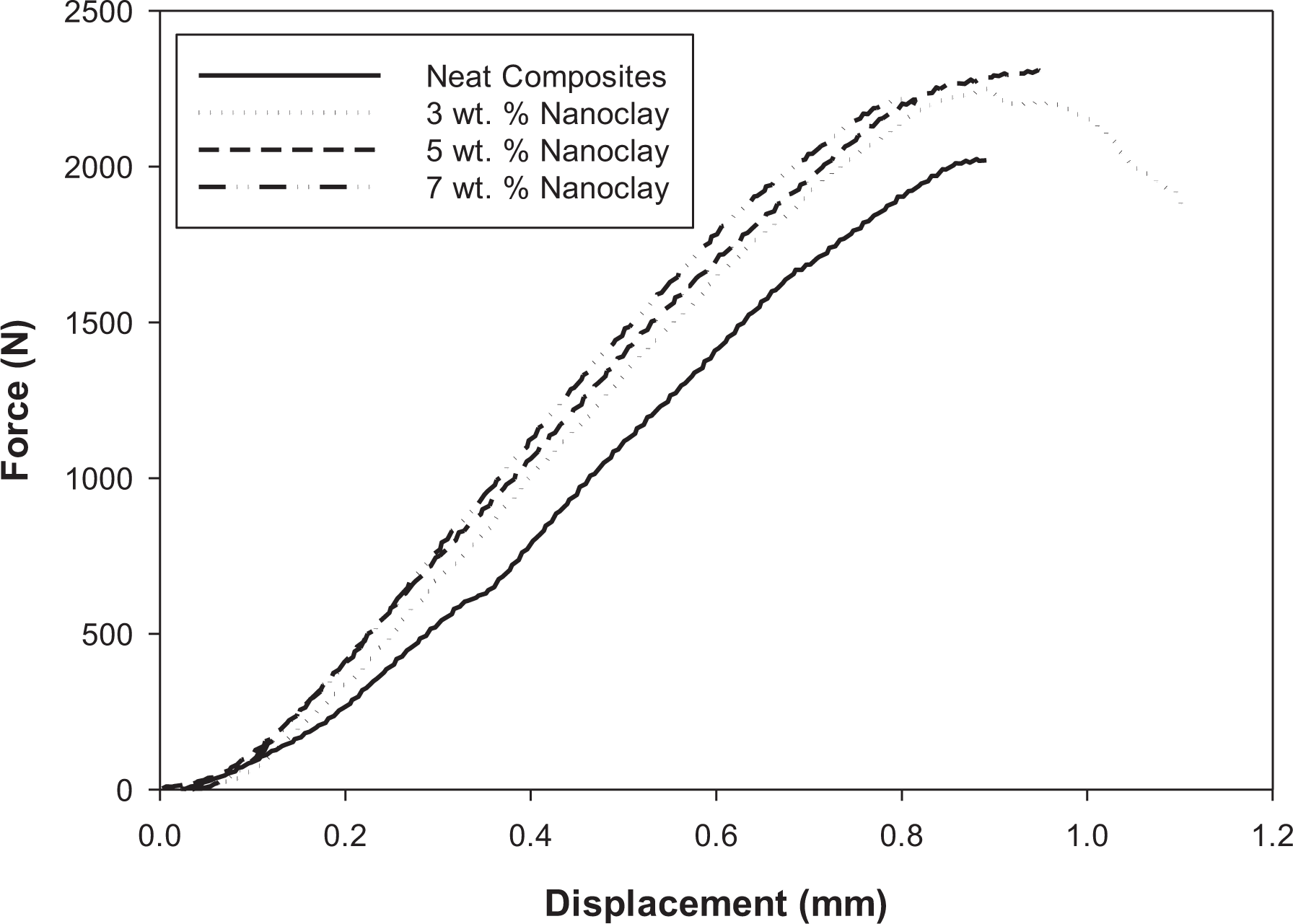
Force vs. displacement for neat composites, 3 wt.%, 5 wt.% and 7 wt.% nanoclay/glass/epoxy nanocomposites under static loadings.
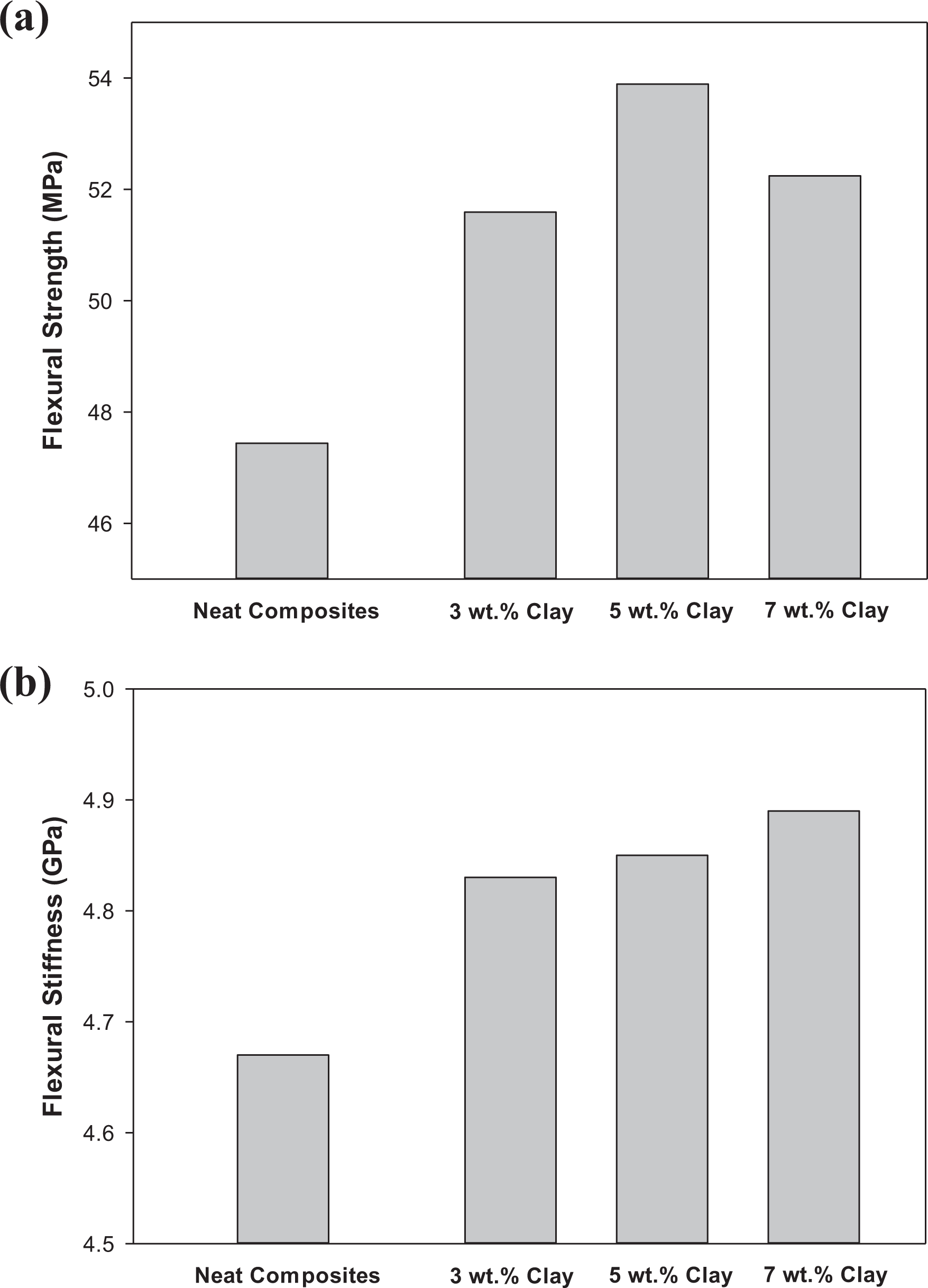
Flexural properties for neat composites, 3 wt.%, 5 wt.% and 7 wt.% nanoclay/glass/epoxy nanocomposites under static loadings. (a) Flexural strength (MPa) and (b) Flexural stiffness (GPa).
Flexural strength and stiffness of glass/epoxy composites under static loadings.

Flexural strength and stiffness of 3 wt.% nanoclay/glass/epoxy nanocomposites under static loadings.

Flexural strength and stiffness of 5 wt.% nanoclay/glass/epoxy nanocomposites under static loadings.

Flexural strength and stiffness of 7 wt.% nanoclay/glass/epoxy nanocomposites under static loadings.

The flexural properties glass/epoxy composites are generally supposed to be improved by addition of the clay nanoparticles. First, in order to determine a suitable amount of filler content, a number of test specimens based on different nanoclay weight fractions, namely 3, 5 and 7 wt.%, were prepared and in each state at least Five specimens have been tested. The results of the flexural tests are presented in Figure 6. However, the best flexural strength was achieved for 5 wt.% and improved by 13.60% compared to the neat composite structures without nanoparticles (Figure 6(a)) The FESEM pictures taken from fractured surfaces confirmed a good dispersion of the nanoclay in nanocomposites with 5 wt.% content (Figure 7). The low capability of achievement for an optimum dispersion and agglomeration severely affect nanocomposite specifications by feeding more filler and plays a role in creating impurities. Thus, agglomerates create stress concentration points and, in terms of agglomerates at 7 wt.% nanoclay, it can lead to lower mechanical properties (flexural strength) of the glass/epoxy nanocomposite. In addition, after adding more filler to the epoxy resin of composite structures, the composites tend to behave as brittle materials and it can be clearly recognized in Figure 5. As force-displacement diagram shows at 7 wt.% nanoclay, the width of the curve is decreased in comparison to 5 wt.% and it illustrates that the presence of 7 wt.% nanoclay prevents the movement of polymer chains and make it stiffer and more brittle.

FESEM images of fracture surface morphology for nanoclay epoxy nanocomposites. (a) Neat composite, glass/epoxy nanocomposites with nanoclay contents (b) 3 wt.%, (c) 5 wt.% and (d) 7 wt.%.
Unlike the flexural strength, the flexural stiffness of fabricated nanocomposites, which is shown in Figure 6(b), indicates that the flexural modulus increased by using a higher amount of nanoclay content. Thus, the maximum improvement in the flexural modulus by 7 wt.% of the nanoclay content was 4.71%.
Thermal cycling
Five sets of samples were fabricated for each 15 and 30 cycles. The complete cycle was defined as 10 min in the methanol at −70°C and then immediately for 10 min inside the oven at +100°C. Thus, the total time for 15 cycles was 300 min and 600 min for 30 thermal cycles. More importantly, liquid nitrogen (LN) as the coolant fluid was used to set and fix the temperature of methanol fluid. The temperature was measured using thermocouple embedded in the methanol.
Effect of thermal cycling on flexural properties
In the present study, specimens were cycled 15 and 30 times and flexural properties compared with one set of non-cycled samples (static) on the glass/epoxy composites and reinforced glass/epoxy nanocomposites with 3, 5, 7 wt.% nanoclay. Therefore, the effect of hybrid thermal cycling and shock on the flexural properties of reinforced composites with nanoclay have been considered.
As previously stated, under non-cycled static condition in Figure 6, the nanoclay improves the flexural strength and stiffness. It was observed that after 15 thermal cycles, the maximum improvement on flexural strength found in the optimum fraction of nanoclay (5 wt.%) equal to 19.35% and after 30 thermal cycles, there was maximum increase on flexural strength at 5 wt.% as the optimum filler content by 20.78% (Table 7). Therefore, the presence of nanofiller plays a reinforcement role in the composite structures subjected to hybrid thermal cycling shock. On the neat composite structures, thermal cycles were influenced by 5.00% and 6.66% reduction on flexural strength after 15 and 30 thermal cycles, respectively (Table 8). It can be stated that the presence of optimum filler contents changes the composite’s inherent properties and its specification to make it strengthen against thermal cycling shocks. In terms of using more nanofiller higher than the optimum value (such as 7 wt.%) of nano fillers into the resin of composite structures, the flexural strength tends to decrease under thermal cycles in comparison to optimum nano filler weight percent (Figure 8(a)).

Flexural properties vs. 0, 3, 5, 7 wt.% nanoclay contents under thermal cycling condition (non-cycled, 15 cycles, 30 cycles). (a) Flexural strength (MPa), (b) Flexural stiffness (GPa).
Flexural strength and stiffness after 15 and 30 thermal cycles on neat composites and nanoclay/glass/epoxy nanocomposites with 3, 5, 7 wt.%.

Thermal cycles’ effect on flexural strength and stiffness of neat composites and clay/glass/epoxy nanocomposites with 3, 5, 7 wt.% nanoclay contents.
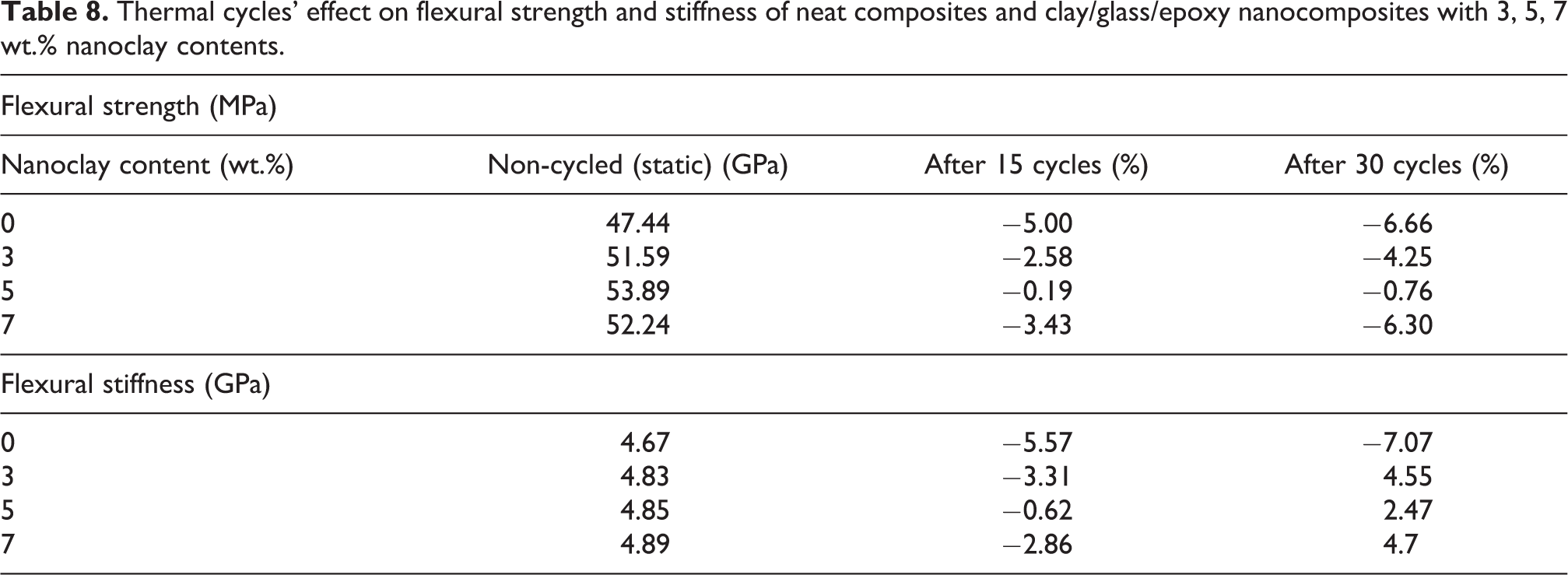
Generally, adding nanoclay into the matrix of composite structures can improve the flexural stiffness of composites under non-cycled static condition (Figure 8(b)). But, under 15 cycles conditions, there was an optimum filler content and maximum flexural stiffness of 5 wt.% clay/glass/epoxy nanocomposites was 4.82 GPa and increased 9.30%; it was in contrast to static conditions that flexural stiffness at 7 wt.% was higher than 5 wt.%.
As follows, after 30 thermal cycles, by adding more filler content, the flexural stiffness was increased. For instance, at 7 wt.% clay/glass/epoxy nanocomposites, flexural stiffness was changed to 5.12 GPa and means that it was enhanced 17.97 compared to neat composites results.
On the other hand, more thermal cycles on neat composites, can affect and reduce the flexural stiffness of composite structures to −7.07% after 30 hybrid thermal cycles, but for nano composite, increasing the weight percent of nano filler can achieve significantly higher flexural stiffness under 30 cycles continuously. It proves that by increasing stiffness, elongation decrease dramatically and so the material tends to be more brittle. This point has been investigated using FESEM images of the nanocomposites surface as shown in Figure 9. It can be observed that after 30 thermal cycles, some cracks appear due to thermal shocks after 600 min on the specimen propagated and makes the composite too brittle to take loads.

FESEM high-resolution image of vertical surface morphology of 7 wt.% clay/glass/epoxy nanocomposites after 30 thermal cycles.
Another outcome of the present study is that the flexural stiffens of reinforced composites with nanoclay fillers dramatically increased after 30 cycles of thermal shocks. These phenomena can be due to shrinkages in epoxy matrix under thermal cycling and the viscoelastic behavior of epoxy matrix can enhance the flexural stiffness of clay/glass/epoxy nanocomposites. Perfect bonding of nanoclay between the matrix and glass fibers can be another reason (Figure 10).

FESEM high-resolution image of bonding quality of 5 wt.% clay/glass/epoxy nanocomposites after 30 thermal cycles.
Consequently, 5 wt.% nanoclay was enhanced the flexural properties of glass/epoxy nanocomposites subjected to the thermal cycling and static condition. Thus, the present work will open a various remarkable advantageous for researchers to apply nano fillers with optimum weight fraction to reinforce composites under hybrid thermal cycling and shock applications.
Conclusions
In this research, effect of nanoclay particles (3, 5 and 7 wt.%) to improve the flexural properties of glass/epoxy nanocomposites under different hybrid thermal cycles with shocks has been investigated. According to the experimental observations, under static loading, by increasing the weight fraction of nanoclay, the flexural strength increased by 13.60% using 5 wt.% nanoclay fillers, then 10.12% improvement by means of 7 wt.% nanoclay particles. Unlike the flexural strength, the flexural stiffness of fabricated nanocomposites increased by using a higher amount of nanoclay contents. Thus, the maximum improvement in the flexural modulus by 7 wt.% of the nanoclay was 4.71%. While reinforced nanocomposites were subjected under hybrid thermal cycle and shock loadings, it was observed that after 15 thermal cycles, the maximum improvement on flexural strength found in the optimum fraction of nanoclay (5 wt.%) was equal to 19.35% and after 30 thermal cycles, there was a maximum increase on flexural strength again at 5 wt.% by 20.78%. Also, after 15 hybrid thermal cycles and shocks, the flexural stiffness of 5 wt.% clay/glass/epoxy nanocomposites increased 9.30% compared to static conditions. In addition, the result of flexural stiffness at 7 wt.% was higher than 5 wt.% clay/glass/epoxy nanocomposites after 15 hybrid thermal cycles. More importantly, after 30 thermal cycles, by adding more filler contents, again the flexural stiffness was increased. For instance, at 7 wt.% clay/glass/epoxy nanocomposites, the flexural stiffness enhanced 17.97% compared to neat composite structures.
Consequently, the flexural stiffness of reinforced nanocomposites with nanoclay fillers increased drastically after 30 cycles of hybrid thermal loadings. It can be due to shrinkages in epoxy matrix under thermal cycling and the viscoelastic behavior of epoxy matrix which lead to enhancing the flexural stiffness of clay/glass/epoxy nanocomposites. Therefore, the obtained accomplishments can open a various remarkable advantage for researchers to apply nano fillers with optimum weight fraction to reinforce composites’ structures under hybrid thermal cycling and shock applications.
Footnotes
Declaration of conflicting interests
The author(s) declared no potential conflicts of interest with respect to the research, authorship, and/or publication of this article.
Funding
The author(s) received no financial support for the research, authorship, and/or publication of this article.
