



Abstract
Differential Scanning Calorimetry (DSC) is considered one of the most adaptable thermal analysis characterization techniques. It can be applied to polymers and their blends, composites, multilayer to study various thermodynamic processes like glass transition temperature (Tg), specific heat capacity and other related kinetic properties and also clarify the material structure, morphology and crystallinity of polymers. In the present paper we have reported thermal analysis of Polymethyl methacrylate (PMMA), Polyvinylidene fluoride (PVDF), Polysulfone
Introduction
Polymer and their blends have always been the thrust area of research and development for many researchers1,2 as well as industrial community so that the characteristic defects and faults of a particular polymer can be managed or minimized using blending or double-layer formation technique. Similar techniques are also used to develop new polymeric materials which could have more scientifically attractive properties and further can be utilized in other fields of applications. This research work is more focused on the blending of the two polymers and its layered formation. Before we start the processing of polymer blends and mixing any, one should have the basic idea of their physical compatibility. The latter can be defined as the appreciation of the overall blend composition and its properties at the macroscopic scale and it depends on various factors like miscibility, the morphology of the blend, their proportions etc. Thus, the final properties of the resulting blend and layering depend on the degree of miscibility between its components, composition, solvent, and morphology of the polymer system. 3 The miscibility and preliminary affinity between two polymers can be checked by the study of change in the glass transition temperature (Tg) after blending. The appearance of single glass transition temperature (Tg) peak in polymer blends shows the miscible behavior of two polymers and more than one peak glass transition peak reflects the partially miscible or immiscible behaviors of two or more polymers. 4 The different methods used to describe the glass transition temperature (Tg) are available in many books and publications by researchers which is mainly based on the heat flux measurement over a wide range of temperature by differential scanning calorimeters. 5
A thermal investigation method called DSC is used to reveal the thermal changes in polymers, for example, the melting point temperature (Tm) and the glass transition temperature (Tg). The melting point and glass transition temperature of many polymers are available from standard compilations values, and DSC measurements specify probable polymer degradation by dropping of the estimated melting point (Tm) which depends upon the molecular weight of the polymer. Thus lower grade polymers will likely to have lower melting points than reference with higher molecular weights. It can also be utilized to assess various polymers and drugs concentrations. This is probably due to the wide range of temperature accessible over which a mixture of compounds melts is dependent on their comparative amounts. This effect occurs due to a phenomenon which is known as freezing point depression, which generally occur when a different solvent is added to a polymer mix. As a result, an impure substance melts over a wide range and shows a widen peak at a temperature much lower than that of the pure substance as studied and reported in literature by Brydson et al. 6
The method was developed by a team of researchers ES Watson and MJ O’Neill in year 1960 and commercially introduced in 1963 in Pittsburgh Conference on “Analytical Chemistry and Applied Spectroscopy.”Wunderlich
7
and Dean
8
dealt with the technique DSC which was developed coined to measures energy directly and allows precise measurements of heat capacity by the sophisticated instrument. The basic principle underlying this method is that once the sample undergoes a physical transformation like phase transitions, more or less heat will required to flow than reference so as to maintain the same temperature. The amount of heat that should flow to the sample depends on the type of process whether it is endothermic or exothermic. When the difference of heat flow between the sample and reference is observed, differential scanning calorimeters would be able to measure the amount of heat absorbed or released throughout such transitions. DSC can also be utilized to observe more sensitive physical changes, like glass transitions.9,10 It is wide utilized in industrial settings as a high quality control instrument due to its ability in evaluating sample purity and for finding out chemical compound action. It can even be used to observe fusion and crystallization events as well as glass transition temperatures (Tg). O’Neill
11
used DSC to check oxidation and other chemical reaction. In addition to this glass transition temperature, Tg may be defined as the temperature at which the polymer structure changes into a viscous liquid or becomes rubbery on being heated. It is the temperature at which amorphous polymers acquires the properties of glassy state like being brittle, stiff and rigid on cooling. This temperature can be used to identify the polymers. It generally depends on the chemical structure of the polymer and the mobility of polymeric chains which generally lies between 170 K and 500 K for most of the synthetic polymers. The two class of polymers behaves in different ways like amorphous polymers shows Tg whereas crystalline polymers exhibit a Tg along with melting temperature Tm since semi-crystalline polymers have crystalline as well as amorphous part. The transition from glassy to rubbery state brings a considerable change in the physical property of the polymer like change in hardness, volume, percent elongation to break and Young’s modulus. Tg can be determined by using a very sensitive and reliable technique called DSC (Differential Scanning Calorimetry) or DTA (Differential Thermal Analysis). This technique can be work for both amorphous as well as semi-crystalline materials. Both of the thermal analysis methods either DSC or DTA produces exothermic and endothermic transitions peaks with providing thermal variations and indicate phase changes.
12
There are various factors which affect the glass transition temperature like13,14 Chemical Structure of the polymer which includes Molecular weight, molecular structure, polar group and chemical cross linking. Mixing of plasticizer in polymer increases the free volume in the material structure and thus the polymer chains can move around at lower temperatures resulting in decrease in Tg of a polymer. Increase in water content or moisture leads to the formation of hydrogen bonds with polymeric chains and brings more gap between polymeric chains. Hence increases the free volume gives lowers the glass transition temperature (Tg). This further describes the higher value of entropy for the amorphous material and lower value for crystalline material. The higher value of entropy indicates the high value of glass transition temperature (Tg). High Tg may also due to increase in surrounding pressure due to decrease in free volume. Some other factor may include film thickness, interaction in polymer bonds and flexibility of polymer chain.
Glass transition peak might be seen at the level where the temperature of amorphous solid is found to be increased. These changes mark as a step in the baseline of the recorded DSC signal. Since the sample is undergoing a change in heat capacity; thus no recognized phase change occurs as discussed by Brydson et al. 6 The amorphous solid becomes less viscous with the increase in temperature with the increasing value of resistive frictional forces. Eventually the particles may acquire to have enough volume to freely move and to organize them into a crystalline structure course of action and termed as crystallization temperature (Tc). This progress of stage from indistinct strong to crystalline strong is an exothermic procedure, and results in the presence of top in the DSC sketch. As the temperature expands, the sample reaches to its melting temperature (Tm). The melting process results to get an endothermic peak in the DSC curve. DSC technique has been proved to be a vital tool in producing phase diagrams for various chemical systems and phase transition in the various systems and it also has the ability to determine transition temperatures and enthalpies.
DSC analysis does not require large samples, numerous control or extensive method involvement make it more advantageous. These are few advantages offered by this powerful thermal analytical tool, which has been proven to have much more measurement capability than just determining a melting point. This paper reports a DSC study on PVDF-PMMA double layer and films of blends of PVDF and PSF that were prepared in different ratios by weight percentage. For all blend ratios used for PVDF: PSF (80:20, 70:30 and 60:40), the DSC test describes the miscibility behavior by observing the glass transition temperature in polymer blends and composites.
A lot of work has been reported on single polymer thin films and researchers have produced the results that helped in gaining a better insight into the molecular processes and phase transition in these polymers.15,16 The effects of interfacial phenomenon on electrical behavior have attracted the attention of many researchers and open new areas of research in understanding the polymeric insulating materials. The polymeric interfaces strongly acts as charge-carrier trapping sites in double-layered heterogeneous polymeric system and blends. 17 Therefore, it has become essential to study the effect of interfaces in polymers blends and double layer since most practical insulators comprises of several insulators and semiconductors. PMMA and PSF used in the present research work belongs to amorphous and PVDF to semi-crystalline class of polymers having different glass transition temperatures and structural morphologies. However, the studies on various mechanisms of blend and layered structures are yet to be completely explored. Thus, it became evocative to investigate the role of polymer-polymer interface in polymeric double-layer and blend samples. Therefore, the present work proposes to undertake the extensive and careful thermal studies in a distinct combination of double-layer and polyblend of polar, amorphous and semi-crystalline polymers for which studies are scarce in available literature. The aim of this paper is to study and verify the miscibility of the blends and double layer using theoretical and experimental characterization methods.
Experimental
PMMA, PVDF, PSF, PVDF-PSF polyblend and PMMA-PVDF double-layer samples were prepared by utilizing the arrangement developed technique.18-21 The commercial PVDF [Solef 1015 PVDF Powder], PMMA [BDH Ltd., England] and PSF [UDEL P1700 PSF Pellets] used were supplied by Redox India Pvt. Ltd. To prepare PMMA, PVDF and PVDF-PSF polyblend samples, the solution of the required polymer(s) with desired concentration was prepared in a common solvent N, N, dimethylformamide (DMF) at 50°C using an indigenously made hot plate magnetic stirrer. The solution was kept at 50°C for a period of 1 hr and then kept at room temperature for 2 hrs to end up the solution that becomes homogeneous. The optically plane cleaned glass plate at ambient temperature was then kept immersed in the polymer solution for about 90 min but at the same temperature for about 10 min for PMMA. The plate was then gradually removed from the arrangement, leaving a uniform micron thin polymer film on the plate. The dried polymer samples on glass plate were kept at room temperature outgassing in air at 60°C at 0.0134 Pa (10−5 torr) for a further period of 12 hrs to expel the traces of any leftover solvent. Polymer film is then gently peeled off from the glass plate. Polyblend films with different polymer ratios by weight were formed using two polymers PVDF & PSF. The weight proportion of PVDF: PSF as wt% is varied as 80:20, 70:30 and 60:40 respectively. The prepared thin films of PMMA and PVDF were then stacked one over the other and compressed together under a compression molding machine at a temperature of 65°C and pressure of 2500 lbin−2 (17.25 MPa) to yield double-layer samples with PMMA on one side and PVDF on the other. Thus PVDF, PMMA and PVDF-PMMA double-layer samples are prepared. All polymer samples were kept different vacuum desiccators; loaded up with silica gel to keep them safe from environmental humidity. The circular shaped polymer samples thus prepared were having diameter of 5 cm and thickness 35–50 µm.
Differential Scanning Calorimetry (DSC) experiments were carried out for all single, blend and double-layered samples with Perkin Elmer Differential Scanning Calorimeter-Pyris 6 DSC at USIC, Delhi University, New Delhi in an inert atmosphere of argon gas flowing at the rate of 25 cc/min. which has accuracy of ±2°C. The polymer thin film samples were cut into small pieces and were kept in aluminum pans. The samples were weighed in a microbalance. The weight of the free polymer film sample piece (PMMA, PVDF, PMMA-PVDF double layer and PVDF-PSF polyblend in ratio by wt% as 80:20, 70:30, 60:40) used for the DSC measurements varied from 1.5 to 3.8 mg. Alumina was taken as reference material. The temperature range scanned was 30–300°C. The rate of heat flow was kept constant to be 3°C/min. All polymeric samples were subjected to two DSC thermal scans with similar temperature range and heating rate. The first DSC thermal scan was just for the removal of residual solvents, and erase the thermal history of the polymer. The reported DSC thermal scans are from second cycle of heating. Several batches comprising 12–15 samples were prepared. These batches were prepared separately for PVDF, PMMA, PVDF-PMMA double layer and polyblend samples of PVDF-PSF in different ratios by weight as 80:20, 70:30 and 60:40 respectively. Sample for investigation were randomly chosen from their respective batch. Experiments were repeated for four to five times for a particular type of sample, chosen differently from its batch on every experimental cycle. All the experimental observations were reproducible and carried out with accuracy having the standard deviation to the mean value of ±3%. The DSC sketches were obtained for polymer sample as a function of temperature.
Results
Thermal characterization of polymeric blend and double-layered samples was performed using DSC (Figures 1, 2 and 3) represents DSC plot for PMMA, PVDF and PVDF-PMMA double-layered sample respectively. It is observed that PMMA sample has a single peak at 106.8°C which signifies its glass transition temperature. Several researchers have reported comparative Tg in PMMA.22-24 The DSC plot recorded for PVDF shows the melting temperature of PVDF which corresponds to a peak at 163.2°C. However, PVDF has ultra-low glass transition temperature.25-27 The occurrence of a single transition at 165.6°C in DSC plot for double-layered sample, confirms the formation of double layer.

DSC thermogram of PMMA sample.

DSC thermogram of PVDF sample.
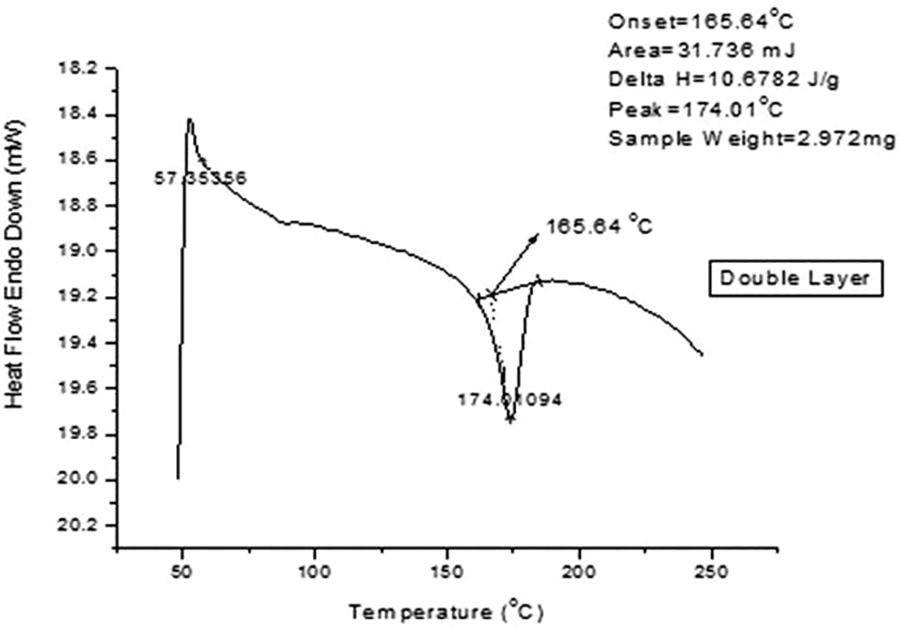
DSC thermogram of PVDF-PMMA double-layered samples.
The experimental results indicated that the Tg for double-layered polymer sample is higher in comparison to PMMA or PVDF taken individually. This can be discussed on the basis of the amount of free volume in double-layered polymer sample. Doolittle 27 Turnbull and Cohen et al.28,29 experimentally illustrated the concept of free volume to a wide variety of disordered solids. The availability of free volume in a polymer matrix system facilitates the higher probability for the movement of its molecular segment. By laminating PMMA and PVDF, one on top of the other; the structure of the voids present in both the polymer matrix is disrupted, consequently the free volume of the resultant polymer matrix decreases. This decrease in free volume restricts the mobility of the chains forming a compacted structure and therefore more energy is required to activate the segmental motion of the polymer chains. Hence, the double-layer sample uncovers a comparatively higher Tg.
Further, DSC study is also carried out to investigate the effect of PSF in PVDF-PSF blend, with different concentrations, on the value of Tg. The results for pure polymer and their blends with different compositions by wt% (weight percentage) are shown in Figures 4–7. Figure 4 shows the DSC plot for Polysulfone (PSF), where the Tg is found to be 185°C. The DSC results for PVDF-PSF blend samples with different compositions viz. 80:20, 70:30 and 60:40 respectively are shown in Figures 5–7. The Tg is found out to be 163.1°C, 164.5°C and 168.6°C respectively. It is also observed that the Tg value increases with decreasing PVDF composition in the blend samples.
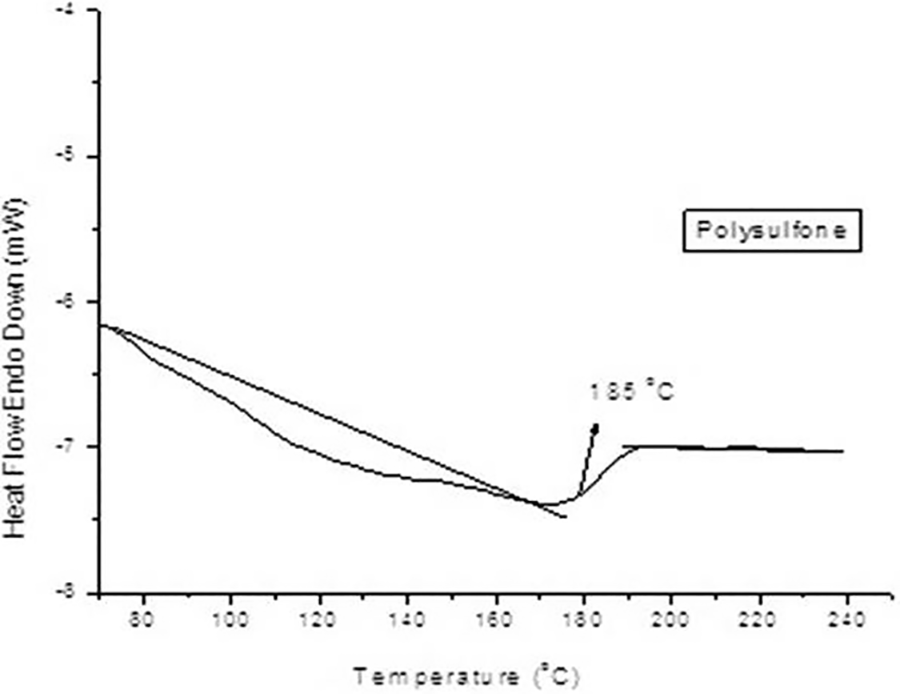
DSC thermogram of polysulfone sample.
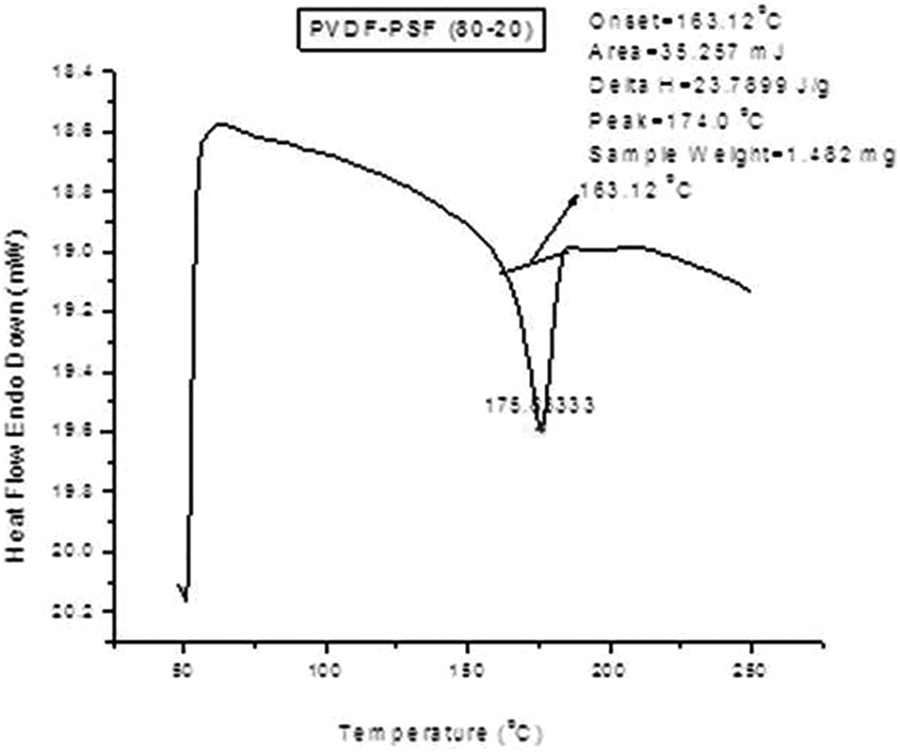
DSC thermogram of PVDF-PSF (80–20) blend sample.

DSC thermogram of PVDF-PSF (70–30) blend sample.

DSC thermogram of PVDF-PSF (60–40) blend sample.
The Tg for polymer blend has been calculated by using an approximate relationship between Tg for blend samples and composition as given by the sample (rule of mixture) for binary mixture by Fried 30 in Equation 1

where, W1 and W2 are the weight fraction of two polymers used, having glass transition temperature Tg1 and Tg2 respectively. From these calculations, the value of Tg’s for the above blend compositions observed are listed below in Table 1.
The glass transition temperature (Tg) analyzed experimentally using DSC and calculated theoretically using Eq. 1.

It is seen that the calculated values of Tg for polymer blends are slightly higher than those found by DSC technique for all the compositions but are well with in ±3% admissible range of experimental errors. It has been reported that Tg’s behavior for polymer blends has been used as a measure of miscibility. The appearance of a single peak at a temperature intermediate between the Tg of pure polymer is indicative of molecular homogeneity, while the appearance of multiple peaks reflects phase separation of the blend’s components.31,32 In the present study the DSC technique averment the state of miscibility by recording a single sharp Tg for polymer blends and double layer.
Conclusion
The thermo-analytical technique DSC has obtained valuable information about the phase transitions and Tg for PVDF-PMMA double-layer and PVDF-PSF polyblend samples. The experimental results were found to be in close confirmation with amorphous nature of PMMA and semi-crystalline nature of PVDF. The results also revealed that PVDF-PMMA double layer is characterized by a single Tg peak at higher temperature, as compared to that of PMMA or PVDF which confirms the formation of double layer with reduced free volume availability, due to disrupted geometry of the voids present in parent polymer matrix i.e. PMMA or PVDF. Hence, to activate the restricted segmental motion of the polymeric chains, more energy is required, causing a higher glass transition temperature. DSC also revealed the complete miscibility of PVDF and PSF in case of polyblend samples. This was also found to be in good agreement with the result calculated from Fried formula for binary mixtures and hence confirms the reported behavior of the discussed heterogeneous polymeric systems.
Footnotes
Declaration of conflicting interests
The author(s) declared no potential conflicts of interest with respect to the research, authorship, and/or publication of this article.
Funding
The author(s) received no financial support for the research, authorship, and/or publication of this article.
