



Abstract
In this work, a series of high-density polyethylene (HDPE)/asphaltene composites were fabricated via the melt blending method. The composites were characterized, and the degradability, thermal, and mechanical stabilities of the products were analyzed. TGA results showed that HDPE/asphaltene composites had better thermal properties, e.g. higher degradation temperatures than asphaltene-free pristine HDPE. The high intermolecular interactions between the asphaltene and HDPE resulted in the degradation mechanism break, delaying the decomposition of composites and increasing their thermal stabilities. The results of DSC analysis indicated that the presence of asphaltene induces higher crystallinity and melting temperature in the composite matrix. According to the XRD results, the crystalline size was increased by increasing the asphaltene loading level due to the nucleating effect of asphaltene and the proper interactions developed between the asphaltene particles and HDPE chains. The proper dispersion of asphaltene in the composite matrix was confirmed by SEM images. The obtained results from the hardness analysis indicated higher mechanical stability for the composites, proportional to the content of the incorporated asphaltene to the composite. The results showed that asphaltene can be considered as an appropriate choice to improve the HDPE properties.
Keywords
Introduction
Composites have been known as superior materials for over 30 years. The usage of composites has been increased, and in the new markets, they had a lot of influence and conquest. Ordinary materials cannot solve many industrial needs and requirements, and it needs a wide range of properties to change. On the other hand, in engineering applications, often integrating properties is needed. For example, in aerospace, underwater, transportation, and other applications, it is not possible to use one type of material to provide all the desired properties. In these industries, we need materials with high strength, lightweight, and high resistance to abrasion and strike.1,2
Reinforcing filler in the polymer composite matrix has been intended to improve the mechanical and thermal properties and increase the stability of composites.3–6 The improvement of the properties depends on the volume fraction, particle size and distribution, and the chemical nature of the filler. The extent of reinforcement depends on the compatibility between the surface of the filler and the polymer matrix. Therefore, many types of fillers have been functionalized to enhance the interaction between the filler surface and the polymer.7–9 Nanoparticles are good candidates as reinforcing fillers due to their capability to provide high interphase surface area.10–12
Asphaltene is the most polar and substantial component of the crude oil that any changes in operating conditions, such as changes in temperature, pressure, and component composition can lead to its precipitation in reservoirs, refinery equipment, and pipelines.13–16 This component is an unwanted substantial existing in the heavy crude oil that can be put to good use.
Siddiqui provided polystyrene and polypropylene composite with different amounts of asphaltene.17,18 The results indicated that the thermal stability and viscoelastic proprieties of the composite increased by increasing the asphaltene amount. He expanded his studies by investigating the asphaltene-methyl methacrylate and low-density polyethylene-asphaltene composites.19,20 The results confirmed the asphaltene capability for enhancing the thermal and viscoelastic properties of composites.
High-density polyethylene (HDPE) is a cost-effective thermoplastic polymer that has a different application in the packaging, customer goods, and fibers, and textiles. However, it has some disadvantages, like low stiffness and heat resistance, which can be improved using the technology of composite materials. The objective of the present work is to investigate the possibility of improving the properties of HPDE by loading asphaltene, obtained from Iranian heavy crude oil, in the HDPE composite matrix. To the best of our knowledge, the potential application of asphaltene as filler in the HPDE matrix has not been studied yet.
Experimental
Materials
HDPE was supplied from Tabriz Petroleum Company of Iran with a melting flow index (MFI) and a density of 3.98 g/10 min (under 2.16 kg at 190°C) and 0.96 g/cm3, respectively. Normal heptane (99%, Sigma-Aldrich) was used as the precipitant to extract asphaltene from one of the Iranian reservoir heavy crude oils located in the southwest of Iran, according to the procedure reported in previous studies.14,15
Preparation of HDPE/asphaltene composite
At First 2.5 g of HDPE was dissolved in 40 mL of toluene while heated and continues stirred at a speed of 80 rpm. When the mixture temperature reached 110.6°C, HDPE was completely melted in toluene. Then different amounts of asphaltene were added to the mixture while stirring to dissolve asphaltene completely. The blended mixtures were separately prepared as films and cooled for 24 h. The samples were named PA0, PA1, PA2, PA3, and PA5 with the asphaltene weight percent of 0, 1, 2, 3, and 5, respectively.
Characterization
The crystalline structures of pristine HDPE and composites were analyzed using X-ray Diffraction (XRD) diffractometer (model Philips PW1730) with 3uk lump and λ = 1.54 Å. The surface structures of pristine HDPE and composites were analyzed using TESCAN, MIRA III Field Emission Scanning Electron Microscopy (FESEM). Thermogravimetric (TG) analysis was conducted using Q600, TA instrument to evaluate the thermal stability of pure HDPE, and asphaltene-loaded composites. For this purpose, about 5 mg of each sample was heated from ambient temperature to 600°C with a heating rate of 20°C/min, under the continuous argon flow. Differential scanning calorimetry (DSC) technique was used to investigate the crystalline degree, melting enthalpy, crystalline temperature, and crystalline enthalpy of the HDPE/asphaltene composites. DSC analysis was carried out in the temperature range of 40 to 180°C at a heating rate of 20°C/min, under a continuous flow of argon gas using a Q600, TA instrument. The hardness of HDPE/asphaltene composites was determined according to ASTM D 2240-15 using the A-type Shore durometer (Teclock-02548) and applying 1 kgf load for 1 second.
Results and discussion
Thermogravimetric analysis
TG curves were used to determine the thermal stability of the composites by investigation of the mass changes of the samples as a function of temperature. Figure 1a shows the composite weight percent versus temperature change for samples PA0, PA1, PA2, PA3, and PA5. It is noteworthy that the samples of pure HDPE and PA1 degraded in the range of 320 to 503°C, whereas the degradation temperature range of composites containing 2% or more asphaltene was shifted to the range of 390 to 530°C. This indicates a higher thermal stability of the composites compared to the pristine HDPE and 1% asphaltene containing composite. The graphs show that as a result of degradation, at 600°C, only 4.2% of pure HDPE remains, while the composite containing 5% asphaltene leaves 10.3% residue at the same temperature. The decomposition residue for PA1, PA2, and PA3 is 8.7, 7.8, and 9.11%, respectively. By increasing the asphaltene concentration in the HDPE matrix, intermolecular interactions increase, preventing the decomposition and production of gaseous constituents. The peaks that appeared in the differential TG curves in Figure 1b is the maximum weight loss temperature (Tl) of composites. According to the DTG curves, Tl increased from 457°C for pure HDPE to 475°C for AP5. These results indicate that asphaltene has a protecting ability to delay the decomposition of composite, interrupt the formation of radicals in the degradation mechanism, and increase the thermal stability of the composite. 14 However, from Figure 1a and 1b, it can be seen that the thermal stability increase for asphaltene concentration change from 1 to 2% is much more than that of 2% to 5%. The homogenous dispersion of asphaltene results in effective interaction between HDPE volatile structure and asphaltene molecule, which thereupon effectively prevents the destruction of the composite. By increasing the asphaltene concentration, large aggregates are likely to form, which results in a non-homogenous dispersion of asphaltene. Therefore, the addition of asphaltene is more effective at lower concentrations. The same results have been achieved by previous studies.17–20
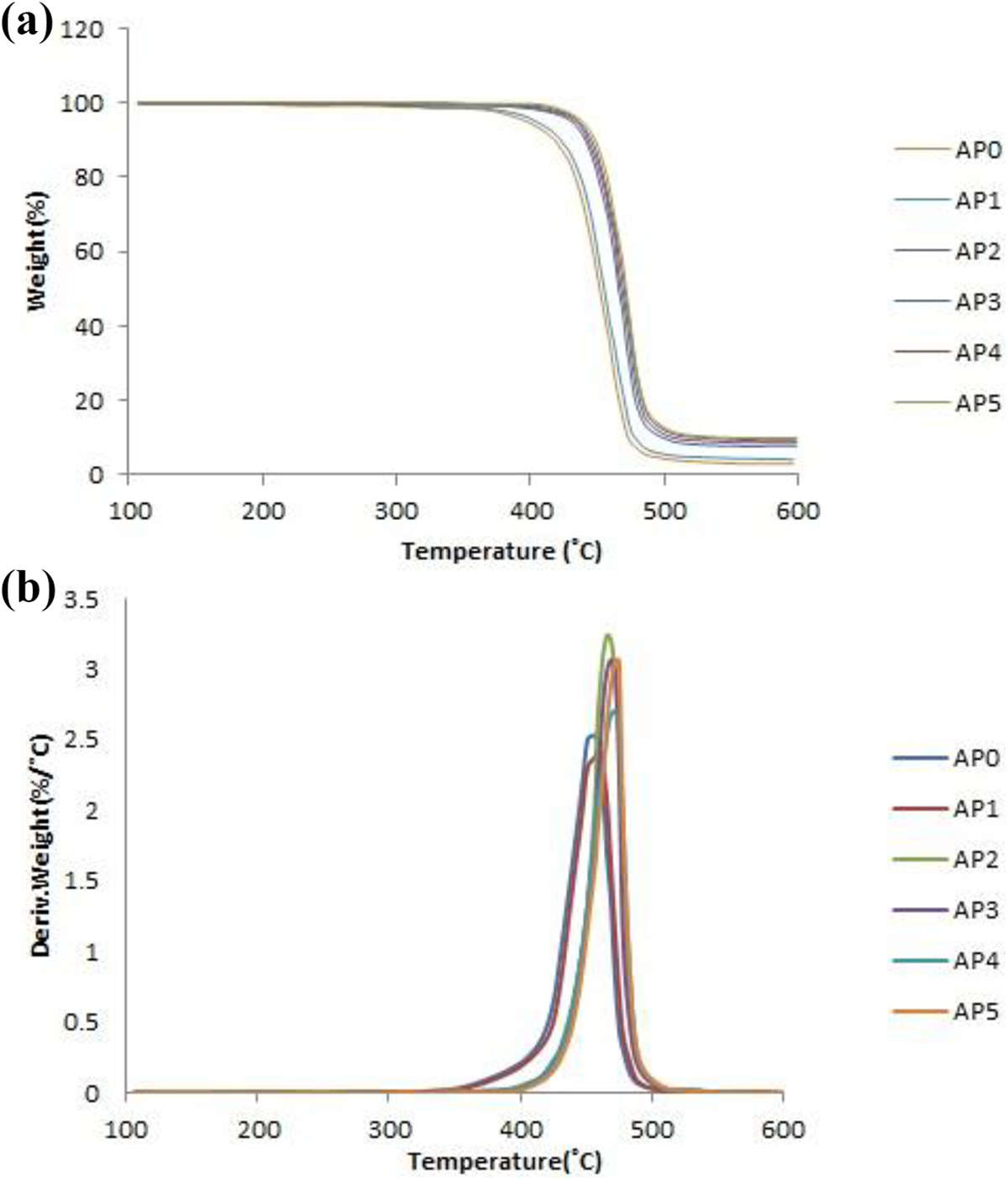
TGA (a) and DTG (b) curves of pure HDPE and HDPE/asphaltene composites.
Differential scanning calorimetry analysis
The DSC micrographs, as shown in Figure 2, demonstrate the melting and crystallization behavior of pure HDPE and different asphaltene composites in a melting-recrystallization process. Table 1 indicates the melting temperature (Tm), the heat of fusion (ΔHm), crystallization temperature (Tc), and heat of crystallization (ΔHc). Melting and crystallization temperatures increased by increasing the amount of asphaltene, which indicates the strong intermolecular interactions between asphaltene and HDPE. The degree of crystallinity of composites is calculated by the following equation, as reported in the literature. 20
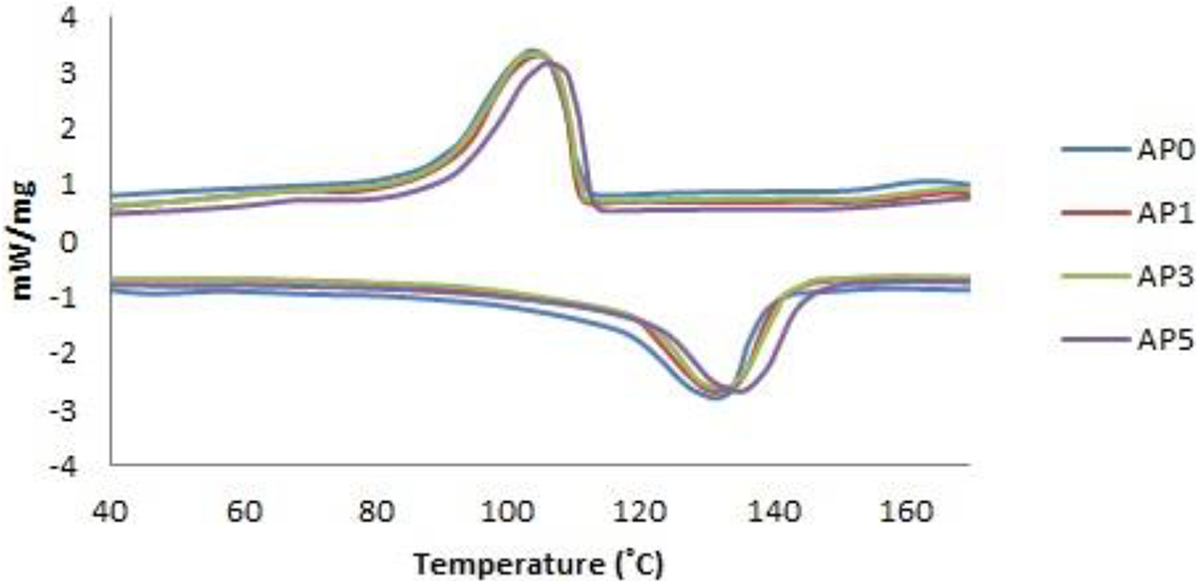
DSC curves of pure HDPE and HDPE/asphaltene composites.
The results derived from the DSC measurements of HDPE-asphaltene composites.


where,
X-ray diffraction analysis
Figure 3 indicates the XRD patterns of PA0, PA1, and PA5. The dominant diffraction peaks at 2θ: 21, 24, 36, and 40 can be seen. A peak at 30° is clear for PA0 sample. These are the characteristic peaks for HDPE and the composites. The crystalline size of composites and HDPE was calculated according to the Scherrer’s formula using XRD patterns. 14 The crystalline size of PA0, PA1, and PA5 was calculated to be 6.9, 9.8, and 13.4 nm, respectively. The crystalline size was increased by incorporating the asphaltene to the HDPE matrix. This fact is in agreement with the DSC results and shows that the increase in the asphaltene concentration causes local discipline in the structure of composites.

XRD patterns of pure HDPE and HDPE/asphaltene composites.
Scanning electron microscopy analysis
Figure 4 (a, b, c) shows the FESEM images of PA1, PA3, and PA5 composites. As can be seen, the surface of the PA1 composite is smooth and without aggregate, due to the proper distribution of asphaltene in the HDPE matrix. However, on the surface of PA3 and PA5 composite, asphaltene aggregates are dispersed and well visible. It can be concluded that more than 5% increase in asphaltene amount can have an adverse effect on the thermal and mechanical properties of asphaltene due to the improper distribution of asphaltene and a large number of cluster formation.

SEM image of HDPE/asphaltene composite 1% (a), 3% (b), 5% (c).
Shore a hardness analysis
The results of surface hardness for pure HDPE and the asphaltene composites are shown in Table 2. The hardness of HDPE/asphaltene composites was higher than the hardness of pristine HDPE, and by increasing the quantity of asphaltene in the composite, the hardness increases. It can be concluded that in addition to thermal stability, the asphaltene in the HDPE matrix enhances the mechanical stability of the composite.
The results of shore A hardness measurements for HDPE/asphaltene composites.

Conclusion
The thermal stability analysis of HDPE/asphaltene composites using the TGA technique indicated that the degradation temperature range increases to higher values with the increase of asphaltene amount. The decomposition residue at 600°C was increased from 4.2% for pure HDPE to 10.3% for composite containing 5% asphaltene. Besides, the maximum weight loss temperature of composites increased from 457°C for pure HDPE to 475°C for composite containing 5% asphaltene. The high intermolecular interactions between the asphaltene and HDPE delayed the decomposition of composite and generating gaseous components. The melting and crystallization temperature and degree of crystallinity increased, proportional to the amount of asphaltene in the matrix. The results of XRD analysis were in agreement with the DSC results, demonstrating an increase in the crystalline size with increasing the asphaltene concentration from 6.9 nm to 13.4 nm. It seems that asphaltene causes local discipline in the structure of composites. Shore hardness analysis indicated that with increasing asphaltene content from 0 to 5% the hardness increased from 41 to 79, indicating a positive effect of asphaltene on the mechanical strength of the composite. It was concluded that the asphaltene can act as a thermal and mechanical protecting agent due to the high intermolecular interactions between asphaltene and HDPE to arrange the polymer chains and delay the decomposition of the composite.
Footnotes
Declaration of conflicting interests
The author(s) declared no potential conflicts of interest with respect to the research, authorship, and/or publication of this article.
Funding
The author(s) received no financial support for the research, authorship, and/or publication of this article.
