




Abstract
Mechanical, dynamic-mechanical and thermal performance of polypropylene (PP) composites which are composed of (3-Aminopropyl) triethoxysilane (APTES) functionalized Halloysite nanotubes (HNTs) were investigated. Functionalization of HNTs was confirmed by the presence of amine stretching peaks in the FTIR spectrum. A decrease in the agglomeration and high dispersion of APTES-HNTs across the PP matrix was confirmed by scanning electron micrographs (SEM). The mechanical properties of APTES-HNT-PP polymer composites were superior over their unmodified counterparts. Tensile properties such as maximum strength, Young’s modulus and impact strength were significantly enhanced by 28%, 45% and 60% respectively, with 6 wt% incorporation of surface-modified HNTs into PP matrix. A drastic improvement of stiffness and thermal stability of composites was noted with the incorporation of APTES modified HNTs into PP polymer. Differential scanning calorimetry (DSC) analysis showed a total increase of 22% in the crystallinity of clay polymer nanocomposite after filled with surface-modified HNTs. Overall, the outcome of this research confirms the modification of the surface of HNTs with a silane coupling agent, which enhances the mechanical and thermal performance of PP composites incorporated HNTs.
Keywords
Introduction
Generation of polymer nanocomposites with the reinforcement of nanomaterials has an important deal of attention due to that nanomaterials can enhance the mechanical, physical and thermal characteristics even at a lower addition of nano-filler.1–3 The expansion of mechanical and thermal performance of resultant polymer nanocomposites could be governed by several factors including the type and aspect ratio of nano-filler, degree of dispersion, interfacial adhesion of nano-filler and polymer matrix as well as the orientation of polymer matrix.4,5 Among these factors, the degree of dispersion and interfacial bonding between nano-filler and polymer play a critical role in the mechanical and thermal performance of the resultant polymer nanocomposites.6,7
HNTs are form of multi-walled hollow tubular clay mineral having a similar stoichiometric composition of kaolinite with the structural formula of Al2Si2O5(OH)4.nH2O which are occurring naturally. The outer surface of HNTs has SiO2 bonds, while Al2O3 bonds are present in the inner lumen of the nanotubes.8–10 In recent years, HNTs have received great attention by the researchers as a new type of nano-fillers for the generation of polymer composites owing to their good aspect ratio, easy availability and biocompatibility.11,12 Most commonly HNTs are found with fine tubular structure with an approximate tube length of 300–1500 nm and an inner and outer diameter around 15–100 nm and 40–120 nm, respectively. 13
Among the wider range of conventional polymer matrices, polypropylene (PP) is the widely used polymer for a range of applications such as packaging, home appliances, automotive, etc. due to its easy processability, economical, low density and solvent resistant properties.9,14 However, PP has limitations in specific engineering applications due to its moderate mechanical properties. Incorporation of nano-fillers such as HNTs into PP could enhance the mechanical and thermal properties.15,16 However, similar to other nano-fillers, HNTs too have drawbacks of poor dispersion with the polymer matrix which causes a significant drop in the mechanical properties of the resultant polymer nanocomposites. 17
Similar to other nano-fillers, HNTs demonstrate difficulties in the dispersion and found to show significant agglomeration while obtaining clay polymer nanocomposites. The main reason beyond agglomeration of HNTs is the restriction of proper dispersion due to the presence of a large number of hydroxyl groups and hence agglomeration occurs in the non-polar polymer matrices. 18 Surface functionalization or modification of nano-fillers is often the used technique to modify the surface of nanomaterials to reduce the agglomeration and enhance the dispersion of nanomaterials in the polymer matrices. 19
Sikora et al. 20 studied on the improved physical, and thermal properties of HNTs filled polyethylene (PE) matrix composites. They reported that the ultimate tensile strength increased by 16 MPa. However, they also noticed that strain at ultimate stress, impact strength and hardness of the examined specimens slightly decreased. This is mainly due to the agglomeration of nano-fillers within the polymer matrix. Also, the lack of interfacial interaction between nano-fillers and polymer could be the reason for the reduction of mechanical properties. Surface functionalization of nano-fillers improves the interfacial adhesion between nano-fillers and polymer matrices which in turn enhances the thermal and mechanical performance of polymer composites.19,21 Many reports suggest that organosilanes could be more effective for the inorganic clay nanomaterials such as nano-silicates, HNTs etc.22,23 Albdiry et al. 24 studied about the outcome of the surface-modified HNTs on the impact fracture behavior of HNTs reinforced unsaturated polyester nanocomposites. They noticed a significant enhancement of impact strength for the surface-modified HNTs nanocomposites as compared to the unmodified ones. Functionalization of HNTs with silane coupling agent can enhance the diffusion and interfacial bonding between the polymer matrix and nano-fillers which leads to increased mechanical and thermal characteristics.22,25,26 Ng and Chow 27 investigated the surface-modified HNTs filled PP and PA66 polymer blends. They reported that flexural strength and modulus improved significantly due to the reinforcing and compatibilization effect of surface-modified HNTs. Thermal stability of PP/PA66 composites increased significantly with the addition of surface-modified HNTs. This is mainly due to the heat barrier effects of surface-modified HNTs in the polymer composites. In the present work, we have functionalized HNTs with APTES coupling agent, which is one of the best silane coupling agents, especially for inorganic nano-fillers. We have achieved a good mechanical (28% higher tensile strength as compared to pure PP) and thermal stability (increased by 17°C) with a small quantity (6 wt%) of HNTs with APTES modification. Besides, a significant increment in the impact strength (40% higher as compared to pure PP) was also noted.
The aim of this study is to examine and compare the effects of functionalization of HNTs with APTES on the surface morphology, tensile, impact, dynamic-mechanical and thermal performance of PP nanocomposites reinforced with HNTs. For this, polymer nanocomposites of altered weight percentages of unmodified and APTES modified HNTs reinforced with PP (HNTs-PP) were prepared, and their morphology, tensile, impact, visco-elastic and thermal performances were investigated.
Experimental
Materials
Polypropylene (Titanpro 6331), a type of homopolymer with injection molding grade was used. The melt flow index and the density of PP were 14 kg.m−3 and 0.9 kg.m−3, respectively. Halloysite nanotubes and (3-Aminopropyl) triethoxysilane (APTES) were obtained from Sigma-Aldrich, Malaysia. Typical HNTs with the diameter, length, pore size and surface area of 30–70 nm, 1–3 µm, 1.26–1.34 ml.g−1 and 64 m2.g−1, respectively were used. Calcium chloride and toluene were obtained from SD Fine Chemicals and were used as obtained without further purification.
Modification of HNTs
Surface functionalization of HNTs was carried out with APTES as reported earlier. 23 Calculated quantity of APTES was dissolved in 25 ml of toluene and was subjected to ultrasonication for 10 min. 0.6 g of halloysites was transferred to APTES mixer, and the suspension was dispersed ultrasonically (ultrasound probe; Cole Parmer, USA; 20 kHz; 750 W) using a tapered microtip (6.35 mm diameter) for 30 min. Then the above suspension was subjected to reflux at 120°C for 20 h under constant stirring. For the dry environment, a calcium chloride drying tube was attached to the end. The resultant solid mixture was filtered and washed with toluene to ensure the removal of excess APTES. Finally, the slurry was then dried at 120°C for 12 h for further curing.
Preparation of HNTs/PP polymer composites
The preparation method of PP composites was the same as described in our previous work. 28 Previously dried and weighed both the unmodified and surface-modified HNTs with different weight percentage were mixed with PP granules by using an internal mixer (Brabender Plasticorder PL2000-6 with a volumetric capacity of 69 cm3 with the rotor speed and time of mixing were 50 rpm and 10 min, respectively) at 180°C. Materials obtained from the internal mixer were pelletized. After cooling them to room temperature they were molded by using compression machine (LP-S-50 Scientific Hot and Cold Press).
Characterization
FTIR analysis was used to check the structural modification of HNTs before and after surface modifications. For this, the pellets of unmodified and surface-modified HNTs were prepared by grounding and pressing well with KBr of definite proportion. FTIR test was carried out from the wavelength of 400 to 4000 cm−1 with 0.85 cm−1 resolution by FTIR Spectrophotometer (FTIR 8300 Shimadzu, Japan). The effect of surface modification on the morphology was studied by fractured surfaces of PP composites filled with HNTs employing FE-SEM (Quanta 400 FE-SEM). Mechanical properties such as tensile (Instron 5980) and impact tests (Model CE UM-636) were conducted according to ASTM standards D638 and D256-10, respectively for virgin PP and its composites filled with unmodified and surface-modified HNTs with a constant crosshead speed of 20 mm.min−1 at room temperature. For both tensile and impact properties, a total of six specimens were tested, and at least five replicate specimens were presented as an average of tested specimens. DMA test (Perkin-Elmer DMA8000) was carried out and the samples were exposed to a cyclic tensile strain with the force amplitude of 0.1 N at a frequency of 1.0 Hz. Storage modulus and damping factor (tan delta) were determined from room temperature to 120°C at a heating rate of 3°C min−1. TGA analysis (Perkin-Elmer STA6000 TA instrument) was carried out between room temperature and 600°C at a heating rate of 10°C.min−1 with the constant flow of nitrogen at a flow rate of 20 ml.min−1. DSC was carried out for HNTs (before and modification with APTES) filled PP polymer composites using DSC equipment (Mettler Toledo DSC 1-32) to measure the melting and crystallization temperatures and also the crystallinity. Investigations were carried out by heating the samples in an enclosed aluminum pan from ambient temperature to 120°C at the rate of 10°C.min−1. The samples were subjected to cooling to room temperature to eliminate the thermal history. Second heating was carried out with the same procedure to obtain heat flow vs temperature thermograms. All tests were accomplished using an inert atmosphere (nitrogen flow with 20 ml.min−1).
Results and discussion
FTIR analysis
The surface modification of HNTs with APTES was confirmed by FTIR analysis, and the FTIR spectra of unmodified and APTES modified HNTs are represented in Figure 1. As seen from this Figure 1, unmodified and APTES modified HNTs show the characteristic broad peaks at around 3620 cm−1 which represents the inner O-H stretching vibrations of Al-OH groups of HNT nanotubes. The peaks at 1652 cm−1 exhibit O-H deformation and stretching of water molecules and the peaks at 1141 cm−1 and 1025 cm−1 represent Si-O-Si stretching vibration and in-plane stretching of Si-O on the surface of HNTs.29,30
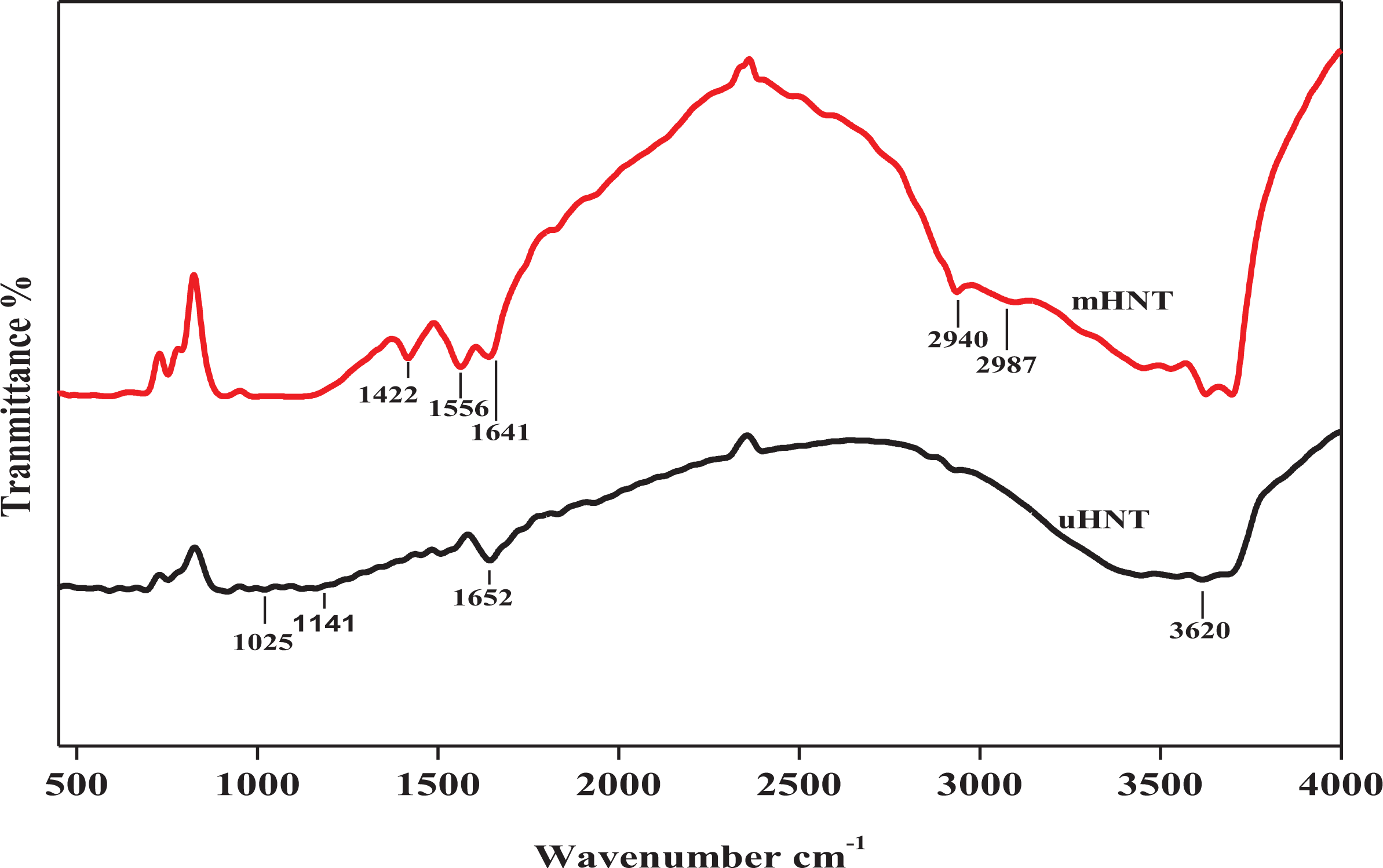
FTIR spectra of unmodified (uHNT) and APTES modified HNTs (mHNT).
The FTIR spectra of APTES modified HNTs exhibit new peaks as compared to unmodified HNTs, as shown in Figure 1. The new peaks at 2987 cm−1 and 2940 cm−1 exhibit the stretching band of aliphatic C-H groups. The deformation vibration of NH2 groups shows the peaks at 1641 cm−1 and 1556 cm−1 which could be noted in the APTES functionalized HNTs, however these peaks disappeared in the FTIR spectrum of unmodified HNTs. These new peaks of APTES modified HNTs correlated to the chemical bonds of APTES and confirmed the surface modification of HNTs with APTES.
Morphological studies
The surface morphology of the HNTs and impact fractured samples of PP composites filled with HNTs (with and without surface functionalized) was investigated. Figures 2A, 2B and 2C demonstrate the morphology of HNTs, PP composites incorporated by unmodified and surface-modified HNTs, respectively. From Figure 2B, it can be seen that the accumulation and poor distribution of unmodified HNTs throughout the PP matrix. The agglomeration was due to poor interfacial bonding between unmodified HNTs and polymer matrix, which results in the formation of a stress concentration point. These stress concentration points lead to lowering the mechanical properties of HNTs filled PP polymer nanocomposites. 31 However, in the case of HNT filled polymer nanocomposites filled with surface-modified HNTs (6 wt%), the surface-modified HNTs were well distributed throughout the polymer. Comparatively, fewer agglomeration might be seen than the unmodified HNTs/PP composites (Figure 2C).

FE-SEM images of (A) pure HNTs (B) fractured samples from the impact test of 6 wt% of unmodified and (C) surface-modified HNTs filled PP polymer composites.
From Figure 2C, it is clear that after surface modification of HNTs, interfacial adhesion between HNTs and PP polymer significantly improved which leads to a drastic increase in the mechanical and thermal properties of the resultant clay polymer nanocomposites. Furthermore, the modification of HNTs with APTES considerably reduces the stress concentration points due to well distribution of HNTs throughout the PP polymer which results in the improvement of the mechanical performance of polymer composites.22,27
Effect of APTES functionalized HNTs on the mechanical properties
Figure 3 shows the results obtained from stress–strain curves of PP and samples containing different weight percentage of unmodified and APTES functionalized HNTs. It could be seen from Figure 3 that a substantial enhancement in the tensile strength could be noticed by the incorporation of HNTs regardless of their surface modification as compared to virgin PP polymer. Compared to virgin PP polymer, the incorporation of 6 wt% of unmodified and surface-modified HNTs into PP polymer drastically enhanced the tensile strength by 20% and 28% respectively. It is observed that the surface-modified HNTs with APTES modified HNT doped polymer composites exhibited good tensile properties which agree well with the results of FTIR and SEM. This improved tensile properties due to the efficient load transfer from the polymer matrix to filler proves the effective distribution of HNTs across the polymer matrix. In addition, regarding FTIR results, increasing hydrogen bond interaction between surface-modified HNTs and the PP polymer enhances the compatibility between them and leads to better tensile strength.

Stress–strain graph of unmodified and surface-modified HNTs-PP polymer composites.
Further, the surface modification of the high aspect ratio of HNTs stimulates filler-polymer interface, further increasing the mechanical performance of HNTs-PP polymer composites. These findings are well relate to the literature reports.13,19 Guo et al. 19 reported that a good enhancement of tensile properties for 6 wt% surface-modified HNTs filled with Polyamide 6 (PA6) composites than pure PA6 resin.
However, PP polymer composites by the addition of 8 wt% of HNTs showed an insignificant weakening of tensile strength because of the increased filler concentration above the optimal content (above 6 wt%). Also, due to the weak interfacial adhesion of filler as well as polymer also increased the stress concentration points. Similar to tensile strength, modulus also meaningfully improved by the addition of HNTs into the polymer. This trend again agrees well with the literature reports. Albdiry and Yousif 27 observed that the tensile properties were likely to decline due to further addition of HNTs above the optimum content (3 wt%) into the polymer. However, tensile modulus enhanced by 45% with the incorporation of higher weight percentage (above 8 wt%) of surface-modified HNTs-PP polymer composites than the virgin PP. This conclusion again claimed a good distribution of surface-modified HNTs with APTES within the PP matrix. Steady improvement of impact strength might be witnessed with an increase in HNTs into PP polymer.
The incorporation of a small quantity of highly dispersed and surface-modified HNT in PP composites behaves like plasticizer which helps dissipating the impact energy across the composites. However, a reduction of toughness might be detected for the polymer composites with a further addition of HNTs above an optimal range (6 wt%). Other investigators also reported similar outcomes.13,17 The impact strength of HNTs (unmodified and APTES modified) filled PP composites were also studied and are shown in Table 1. It can be seen that the impact strength increased with an increase in the addition of HNTs into PP composites.
Mechanical properties of HNTs (unmodified and APTES modified) filled PP nanocomposites.

The maximum impact strength obtained was 31.8 J.m−1 for the surface-modified HNT filled PP composites. It was also noticed that the impact strength was much higher for the PP composites with the incorporation of surface-modified HNTs as compared to unmodified and virgin PP. The obtained results correlate with the results reported in the literature. Vahedi and Pasbakhsh 32 studied the impact and fracture properties of surface-modified HNTs and epoxy nanocomposites. It was reported that the impact strength of epoxy nanocomposites significantly increased with the addition of surface-modified HNTs into the polymer matrix due to the increased dispersion of nanotubes across the polymer matrix and better interaction between the HNTs and polymer.
DMA analysis
DMA was conducted to examine the outcome of the surface-modified HNTs doped polymer composites on the visco-elastic performance. This study is beneficial for the assessment of visco-elastic performance of the nanocomposite with varying temperature and mechanical stress. 33 Figure 4 displays the curves of storage modulus (E’) of HNTs filled PP nanocomposites. It could be seen from Figure 4 that the storage modulus increased at a lesser temperature of −50°C and after that a steady reduction with a gradual enhancement of temperature was observed. At low temperature (−51°C), the storage modulus (E’) was greater for the unmodified HNTs doped polymer composites than the virgin PP, and it improved further with the incorporation of surface-modified HNTs.

Storage modulus (E’) of with and without the surface-modified HNTs/PP polymer composites.
It has been noticed that the loading of 6 wt% of the surface-modified HNTs into PP polymer enhanced the storage modulus to 5.55 GPa, which is 28% greater than the virgin PP. A higher storage modulus for the surface-modified HNTs incorporated polymer composites than the virgin PP displays a good distribution and interfacial bonding between the surface-modified HNTs and PP polymer, which correlate with the observations of SEM and FTIR. Other researchers also reported similar outcomes. 11
Lecouvet et al. 34 reported on the flammability and thermal performance of HNTs filled polyethersulfone (PES) composites which were synthesized by melt processing. They found that the storage modulus drastically improved by 40% with the addition of 16 wt% HNTs into polymer than the virgin PES polymer. This is due to the greater intrinsic toughness of HNTs.
Figure 5 illustrates the loss modulus (E”) of the PP composites with the incorporation of different weight percentage of unmodified and the surface-modified HNTs.
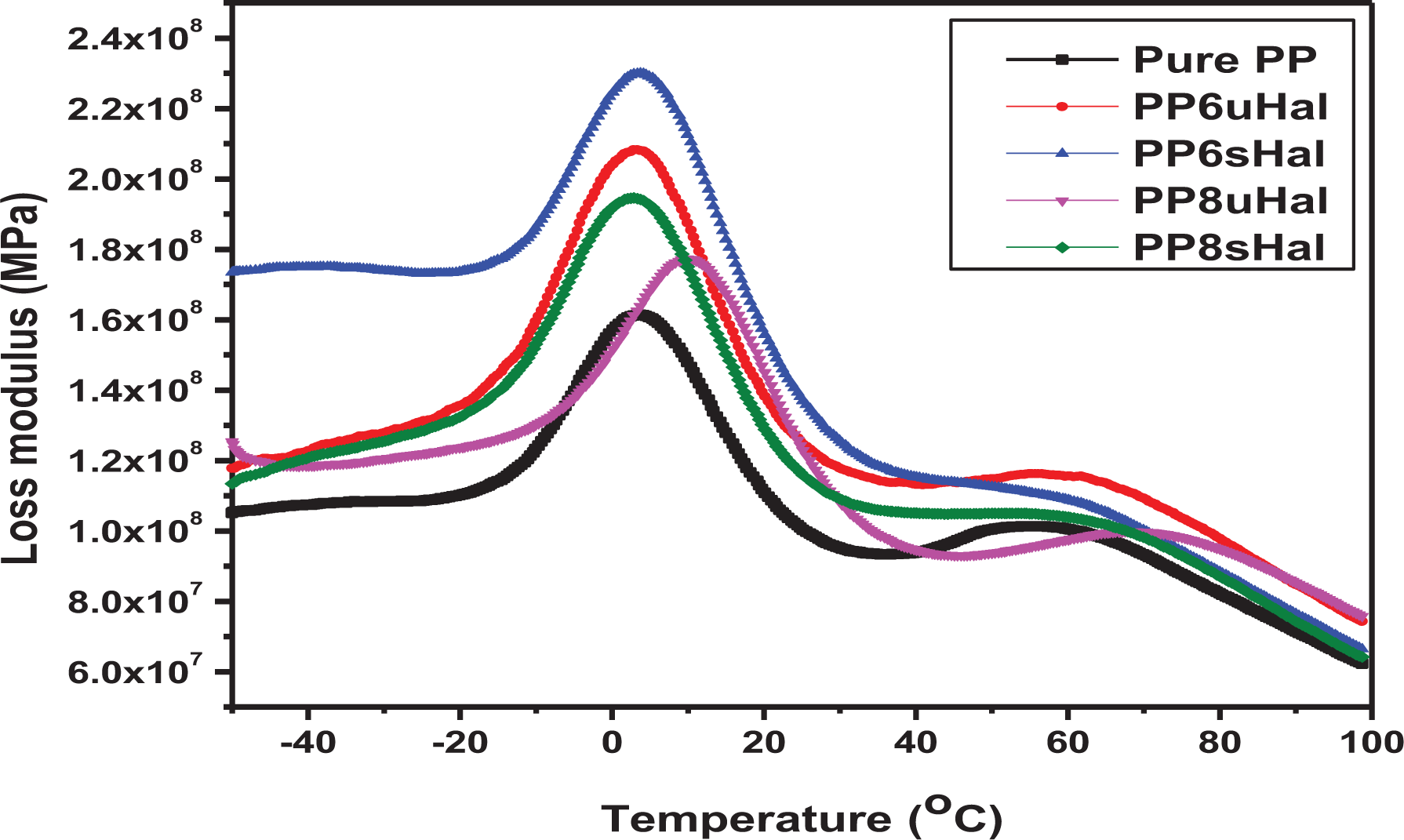
Loss modulus of with and without surface-modified HNTs-PP polymer composites.
A wider loss modulus peak has been noted with the peak height was comparatively higher for virgin PP polymer than the HNTs loaded polymer composites. The loss modulus curves of the surface-modified HNT incorporated PP composites showed lesser peak height which confirms the better modulus and declined loss factor. This is due to good distribution of HNTs throughout the PP matrix as well as good interfacial bonding between polymer and filler. 35 It could be observed from Figure 6 that there is a substantial raise in the Tg with the addition of surface-modified HNTs doped polymer composites than pure PP. The Tg for pure PP was at 6.8°C, whereas Tg with the incorporation of surface-modified HNTs of 6 wt% and 8 wt% were at 7.2°C and 8.3°C, respectively. This could be due to the constraint of segmental movement in the polymer chain after the incorporation of HNTs, which improved the modulus and leads to larger Tg of the polymer composite. 36
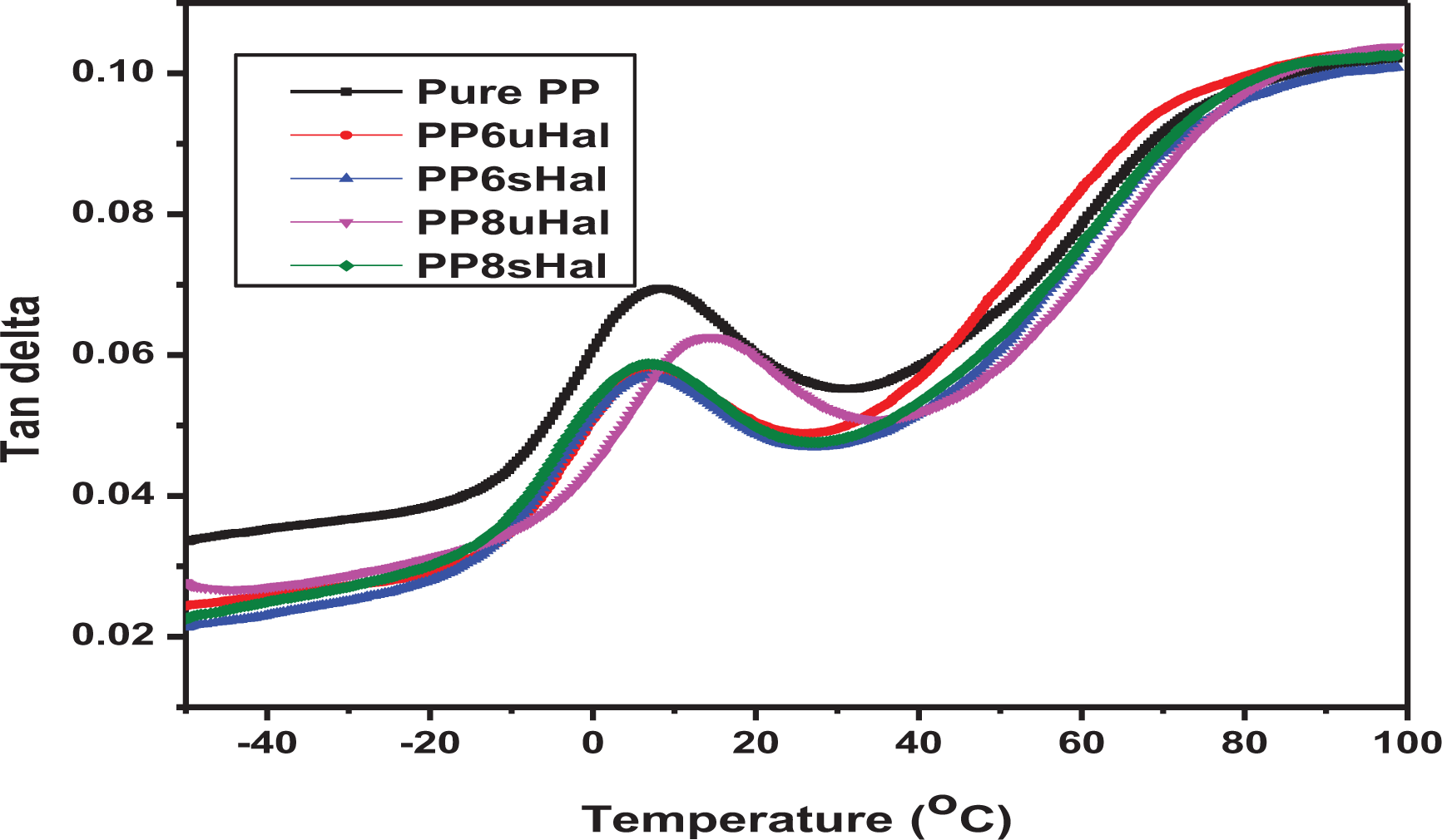
Tan δ of with and without surface-modified HNTs-PP polymer composites.
TGA analysis
The thermal stability of polymer composites filled with and without surface-modified HNTs was examined using TGA. TGA graph of virgin PP and its polymer composites incorporated with and without surface-modified HNTs have been shown in Figure 7. A small rise in the thermal steadiness could be observed with the incorporation of HNTs into PP polymer. Table 2 shows the thermal stability of the samples with different wt% loading of with and without surface-modified HNTs and their proportions of char remaining at the extreme temperature (600°C). It is good to indicate that the thermal stability is significantly enhanced by 18°C with the incorporation of surface-modified HNTs into PP polymer composites than virgin PP. The improved thermal stability displays good interfacial bonding between the surface-modified HNTs and PP polymer. However, a substantial reduction in the thermal stability for unmodified HNTs filled PP polymer composites at the maximum weight loss point than virgin PP could be noted. Similar outcomes have been described in the literature. 37 It is also noticed that a considerable reduction of thermal stability for the samples of PP composites filled HNTs (higher than 6 wt%, an optimum quantity). These results are in agreement with the mechanical properties observed in this study and also other reports in the literature. 11 The reason for the reduction of thermal stability is due to the increased number of agglomeration with a further addition of HNT fillers.
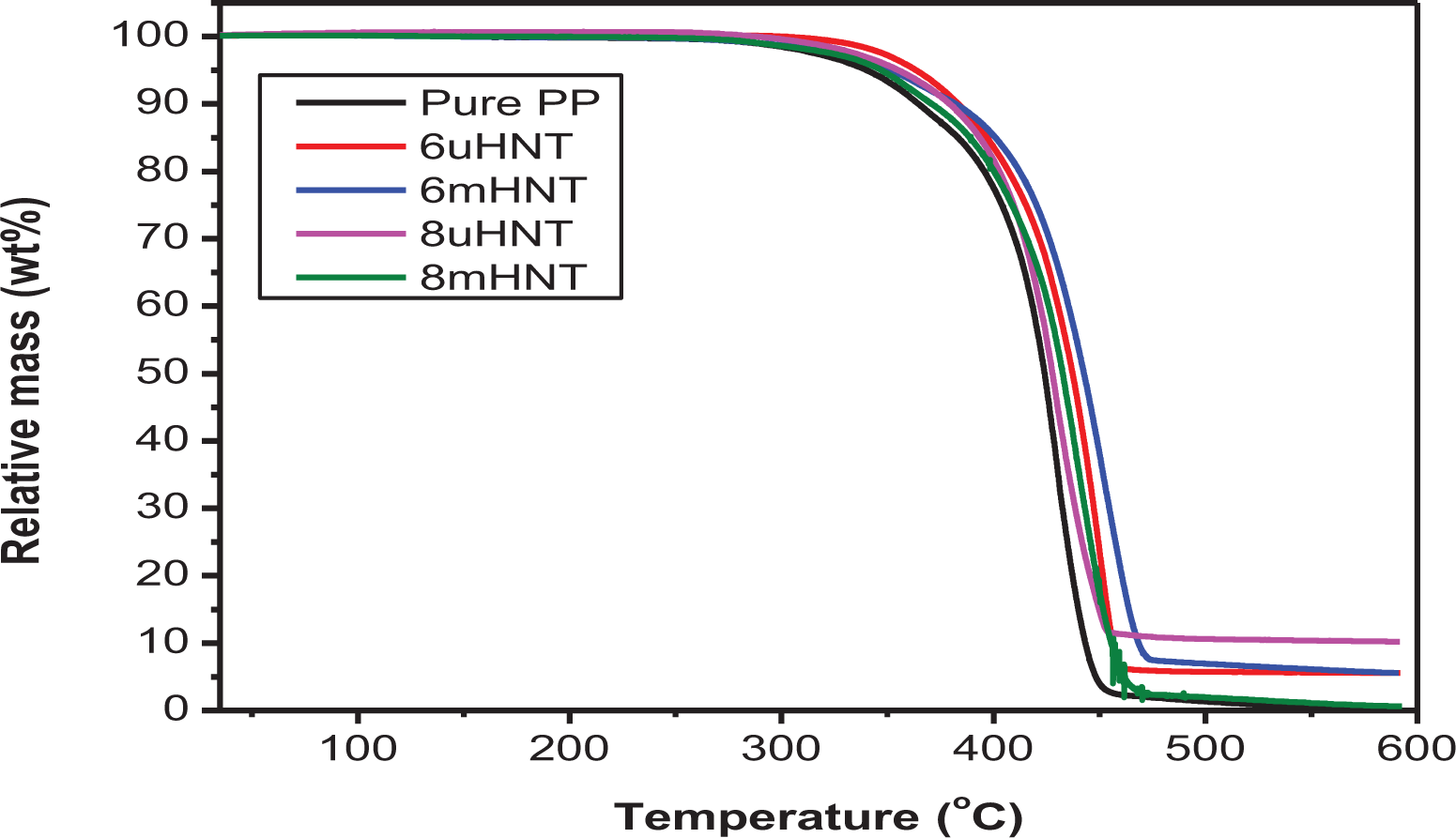
TGA curves of virgin PP, with and without surface-modified HNTs-PP composites.
TGA and DSC values of crystallinity (Xc), melting (Tm) and cold crystallization temperatures (Tc),

It is significant to note that the charred remains of HNTs doped polymer composites considerably greater than virgin PP. This outcome illustrates the amount of HNTs incorporated into polymer composites and hence an enhanced thermal stability of the HNTs-PP polymer composites.
DSC analysis
DSC was conducted to explore the effect of incorporation of with and without surface-modified HNTs into PP polymer composites. Figures 8 and 9 display the melting as well as crystallinity thermograms of HNTs-PP polymer composites.

DSC melting thermograms of virgin PP and its polymer composites with the incorporation of HNTs with and without surface functionalization.

DSC cooling curves of virgin PP, with and with surface-functionalized HNTs-PP polymer composites.
Table 2 displays the crystallinity (Xc), melting (Tm), and cold crystallization temperatures (Tc) for the HNTs (with and without surface modified) incorporated PP composites. The melting temperature (Tm) peak displays a substantial rise in the melting temperature (Figure 8). The peaks of melting temperature moved to 169.83°C with the incorporation of 8 wt% surface-functionalized HNTs, while the peak of melting temperature for virgin PP was at 166.65°C. An increase in the melting temperature could be due to the strengthening effect, which limits the unrestricted movement of polymer chain fragments in the HNTs incorporated polymer composites. 15 It is described that the incorporation of HNTs prompted the nucleating effects in the composites which leads to the improved crystallinity of HNTs doped polymer composites.13,37
The cold crystalline temperature (Tcc) of HNTs-PP polymer composites moved to lesser temperature after the incorporation of HNTs. The Tcc for the virgin PP was at 123.52°C, and with 8 wt% of HNTs loading into PP matrix, Tcc moved to 121.02°C. The lesser Tcc as compared to virgin PP specifies the incorporation of HNTs supporting the kinetics of nucleating effect in the HNTs-PP polymer composites and thus the better crystallinity.38–40
Conclusions
In this investigation, the influence of the surface-modified HNTs on the mechanical, dynamic-mechanical and thermal performance of HNTs-PP polymer composites has been examined. SEM results show that the APTES modified HNTs were well isolated within the PP polymer than the unmodified ones, due to reduced agglomeration. The tensile strength, modulus and impact properties were improved by 28%, 45% and 60% respectively with the incorporation of 6 wt% of the surface-modified HNTs doped polymer nanocomposites than the virgin PP polymer. The thermal investigation displays that the thermal stability and crystallinity improved by 18°C and 22% respectively for the HNTs-PP polymer composites with the surface modification by APTES than virgin PP. DMA analysis exhibited an enhanced dynamic modulus by 28% than virgin PP. The surface-modified HNTs reinforced PP polymer composites find wider applications not only in packaging but also in automotive, structural and home appliances.
Footnotes
Declaration of conflicting interests
The author(s) declared no potential conflicts of interest with respect to the research, authorship, and/or publication of this article.
Funding
The author(s) received no financial support for the research, authorship, and/or publication of this article.
