




Abstract
The article presents a study about the stress relaxation by means of time-sensitive interfacial shear stress transfer between the interface of the fiber and matrix. The behavior of stress relaxation of glass fiber (GF)-reinforced high-density polyethylene (HDPE) composites is measured experimentally and then compared with Cox shear-lag analytical model predictions. Furthermore, the effect of supplemented interfacial interaction between the interface of the fiber and matrix is analyzed by the introduction of an interfacial coupling agent called Fusabond M603. In addition, the results showed that the stress relaxation behavior of GF-reinforced HDPE composite can be predicted by using a Cox shear-lag model. On examination, the experimental data and analytical model showed a favorable correlation which can be useful for future applications of the intended products made of polymer-based composites.
Introduction
The physical properties of polymer-based composite depend on the quality of interfacial adhesion between the fiber and the matrix. To further advance the understanding of composite properties which can be strength and modulus, a detailed examination of the effect of fiber on the viscoelastic composite is performed. The suitable values of strength and modulus are vital when it comes to the mechanical strength and elasticity of the composite. The improvement in the characteristics will make the composite resilient in the situations when it is under stress which can be static or dynamic. The viscoelastic properties of composites are important in evaluating the long-term performance strategy based on the use and time. The time-dependent properties are creep and stress relaxation that can affect the composite. In addition, the investigation of viscoelasticity can be a useful guide for describing stress relaxation in polymer-based composites. Also, this indicates that the viscoelastic behavior of polymer-based composites can help in creating an analytical model to predict stress relaxation and creep. The structural stability can be foreseen by evaluating the composite stress-relaxation data. 1 The intrinsic correlation between the viscoelastic occurrences such as stress relaxation and creep can be interchanged by developing models for predictions. 2 Previous studies have shown that mechanical strength can be improved by incorporating fiber into the polymer matrix, which as a result enhances modulus and strength. The study presented by George et al. 3 shows the behavior of stress relaxation of pineapple fiber-reinforced polyethylene (HDPE). The report mentioned that the stress decay occurs over time as a result of chemical and physical functions that include crystallization, orientation of fibers, and bond breakage. Geethamma et al. 4 presented the stress relaxation of short coir fiber-reinforced natural rubber. Also, they established that the fiber orientation, strain, and fiber loading have an effect on the stress relaxation behavior of the composite. In the reported investigations it is being presented that the incorporation of fiber slows down the rate of stress relaxation. 5 Furthermore, the incorporation of elastic fiber in viscoelastic matrix has shown particular results where the fiber exhibit time-dependent behavior. It is also being reported that the stress relaxation in the composite is a result of chemical interaction at the interface of the fiber and matrix. 6,7 The characteristics of interface between the fiber and the matrix depends on the molecular structure. 8 -10 The weak interfacial characteristics minimize their probability of being a useful reinforcing agent because of hydrophilicity; therefore, coupling agents are considered to optimize the interface of fibers.
The adhesion between the polymer and the fiber can be improved by employing coupling agents. 11 -14 The silanes and maleated compounds as coupling agents restrain the matrix and fiber to develop a strong functional composite. 15 -19 Also, the coupling agents help to distribute and transfer the load evenly between the fiber and the matrix. The main reason for enhanced characteristics of composites by using coupling agent is due to advancement in bonding and immobility of the matrix chain. In addition, the relaxation time is directly correlated to cross-linking density of the matrix, molecular mobility, and presence of chemical interaction between the coupling agent and the matrix. Moreover, studies also proposed that the covalent interfacial bonding is responsible for restraining polymer mobility which reduces the rate of stress relaxation due to the increase of interfacial strength. The cross-linking polymers capture the covalent network and relax the internal stresses due to bond rearrangement in response to the applied stress.
Meanwhile, the nonlinear viscoelasticity of composites is modified because of time-dependent shear stress transfer at the fiber–matrix interface. Numerous researchers applied a tensor approach to explain the stress mechanism at the interface of the fiber and viscoelastic matrix. 20 The precise tensor method does not offer a straightforward analytical model for the explanation of fiber-reinforced composite stress relaxation with respect to aspect ratio and fiber loading. The models have been created which show that concentrated shear stress is responsible for fiber breakage in the matrix and the decrease of these stresses occurs with time. 20,21 The explanation of shear stress decay for any model is case specific which depends on individual geometry. 22 The load applies as tension on the composite is distributed from the matrix to the fiber by shear. This experience the fiber and matrix distinct axial displacement due to different elastic modulus.
Stress relaxation behavior
Cox 23 developed an analytical model which was based on the theory of shear lag. The model proposed that the modulus of fiber and matrix is the main determinant of the efficiency of transferring load on the fiber composite. The accuracy of shear-lag methods was critically assessed by Narin. 24 Also, Chen and Yan 25 proposed the shear-lag model with a cohesive fiber–matrix interface for the analysis of stress transfer between the fiber and the matrix. Similarly, Obaid et al. 26 developed a theory that explains the stress relaxation using elastic properties of the composites. The theory shows that the difference between the fiber and the matrix moduli increases in the viscoelastic matrix when the modulus reduces with time.
The shear modulus of matrix reduces with time simultaneously decreasing the shear stresses at the interface of discontinuous fiber and matrix. The reduced modulus and shear stress cause the stress and strain in the fiber to decrease as shown in Figure 1.

(a) Before loading and (b) after loading. Stresses decreases over time due to the decay in fiber/matrix composite during stress relaxation.
The efficiency of elastic fiber in the composite reduces with time when implanted in viscoelastic matrix. Furthermore, if the similar fiber is tested independently, then it will not show the time-dependent behavior which is observed when fibers are analyzed within the viscoelastic matrix. The alternating behavior of fiber can be attributed to the variations in shear modulus as defined by the model. The modifying shear modulus is responsible for the stress relaxation rate introduced by the incorporation of fiber in the matrix.
An analytical model is being derived by integrating the time-dependent shear modulus of the matrix into Cox’s shear-lag equation 26 :


The relaxation modulus of the composite consistently dependent on time is related to the matrix modulus Em(t) and fiber modulus Ef calibrated by the volume fractions of matrix Vm and volume fractions of fiber Vf. The equation shows that time dependence of elastic modulus of matrix have strong impact on time dependence of the composite. The model demonstrates the significance of time-dependent reinforcement effectiveness factor n(t). The n(t) factor explains the rate of stress transformation between the fiber and the matrix. Also, as revealed in equation (2), the time dependence of n(t) factor generates from the time dependence of the matrix shear modulus Gm(t).
The utilized study includes a comparison of the experimental stress relaxation behavior of glass fiber (GF)-reinforced HDPE composites to the predictions of Cox shear-lag analytical model proposed in equations (1) and (2). Furthermore, stress relaxation behavior of composites at the GF-HDPE matrix interface is being examined by introducing Fusabond (FB) M603 as coupling agent. The shear-lag model described the time-dependent stress transfer efficiency factor as the main reason in stress relaxation behavior with variable GF loading in the HDPE matrix.
Experiment
Materials and preparation of composites
The Nova Chemicals in Alberta Canada provided the HDPE (SCLAIR 2710) resin which has a melt flow index of 17 g/10 min. PPG Industries (Pittsburgh, Pennsylvania, USA) known as Chop Vantage HP 3563 supplied the GFs. HDPE, which is viscoelastic, has an elastic modulus of 1100 MPa and long-term modulus of 550 MPa. Also, HDPE has a Poisson’s ratio of 0.35 and relaxation time constant of 250 s. Moreover, the elastic modulus of GF is 80 GPa, and the Poisson’s ratio of GF is 0.2. The implemented analytical model applied the modulus and passion ratio of HDPE and GF. Dupont Canada provided the coupling agent (FB M603). FB M603 is a random ethylene copolymer resin which is classified as maleic anhydride. Table 1 presents the composition of GF-reinforced HDPE composites. The compounding of materials was carried out by using a corotating intermeshing ZSE-18 Leistritz extruder (Leistritz Extrusionstechnik GmbH, Germany). The extruder was being operated with a screw speed of 25 r/min and with varied pressure from 110 psi to 120 psi. The obtained pellets were placed for 12 h in oven for drying at 80°C. The dried pellets were subjected to compression molding to obtain the final shape of dog-bone considering the ASTM D638 standard. At first, the compression molding temperature was maintained at 190°C and then after 12 min the temperature was dropped to 170°C. Finally, the load was removed, and tensile specimen was retrieved from the mold.
Composition of glass fiber-reinforced HDPE composite.

HDPE: high-density polyethylene; GF: glass fiber; FB: Fusabond.
Stress relaxation response
The specimens for stress relaxation were sectioned from the center of compression-molded tensile samples. The sectioned specimen had dimensions (L × W × H) of 20 × 3 × 1 mm3. The TA Q800 Dynamic Mechanical Analyzer (DMA, TA Instruments, USA) with tensile clamp was implemented to characterize the behavior of stress relaxation. The stress relaxation tests were carried out at 30°C for 250 min with 0.08% constant strain.
X-Ray tomography
The high-resolution SkyScan-1172 (Bruker, Germany) X-ray microtomography was used for the images of selected area of specimen with the shadow image as shown in Figure 2(a) and (b). The X-ray source cone beam without filter was aligned as 25 keV and 140 mA beam current. The rotation of samples was done in increments of 0.4° in a range of 180°. The resolution of camera was 4000 × 2300 pixels with voxel resolution of 10 μm. The software NRecon based on FeldKamp algorithm was used to reconstruct the images. The reconstruction of images helped in recognizing by choosing diverse array of thresholds. The variety of threshold appears due to the difference in absorption capability of GF and HDPE. The parameters stayed constant during the characterization of specimen and image reconstruction. The volume of specimen was measured by utilizing a method derived from MIL concept. 27,28
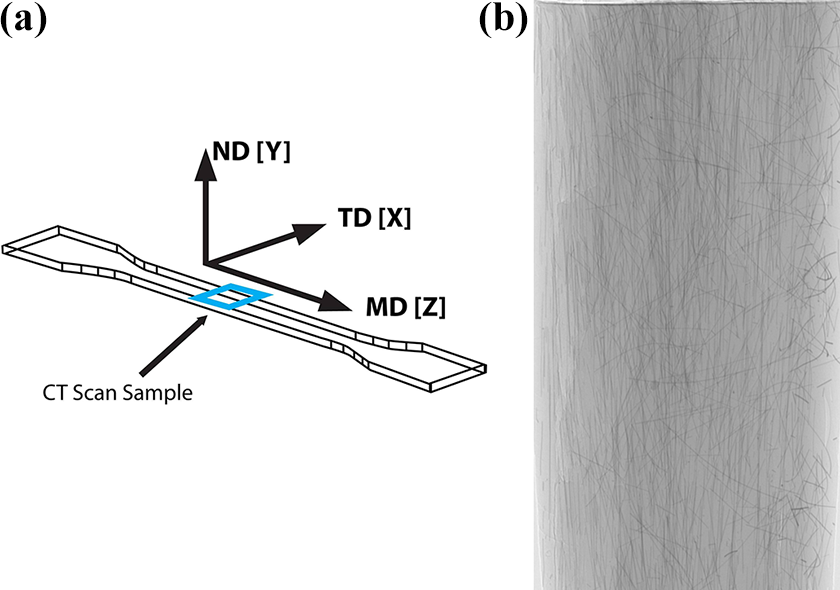
(a) Section of the sample collected from the X-ray microtomography and (b) computed tomography scan image of the collected sample.
Results and discussion
The tomographic results in Figure 3 shows that fibers orient randomly in longitudinal (0° and 180°) and transverse directions when high shear forces are applied during compression molding. Also, the 3D rendering of the images in Figure 4 shows the fiber reorientation and longitudinal alignment in the direction of applied force. The segmentation of individual fiber with the help of 3D data allowed the examination of orientation for each individual fiber to be quantified. Figure 5(a) and (b) presents the scatter plot of fiber orientation on polar coordinate θ for 10% fiber in HDPE with and without the application of load. The scatter data show that the intensive quantity of fiber orientation is in longitudinal direction with the application of load when compared with the fiber orientation which happens without the application of load. The statistical analysis in Figure 5(c) reveals that the 72% ± 1.2% fiber oriented longitudinally (0° and 180°) with the application of load in comparison to 32% ± 2.3% fiber orientated without the application of load. The identical result has been found for 5% GF and 15% GF in HDPE matrix as presented in Table 2.

Cross section of (a) 5% GF, (b) 10% GF, and (c) 15% GF images (voxel size = 10 μm) after compression molding.

Cross section of (a) 5% GF, (b) 10% GF, and (c) 15% GF images (voxel size = 10 μm) after application of load.

Fiber orientation of 10% GF in HDPE. (a) Polar coordinate without application of load, (b) polar coordinate with application of load, and (c) fiber distribution with respect to angle θ.
Orientation of fiber and relaxation modulus with constant 0.08% strain.

HDPE: high-density polyethylene; GF: glass fiber; FB: Fusabond.
The fiber orientation results comply with the analytical model supposition. Also, it is shown that the GFs are appropriately dispersed in the HDPE matrix. Furthermore, the fiber aspect ratio has strong influence on mechanical properties. The analysis of final aspect ratio after compression molding becomes important in association with the analytical model. The X-ray tomography results show that the aspect ratio of GF is 12.1 ± 1.1 μm.
The stress relaxation of 5%, 10%, and 15% GF-reinforced HDPE composites are shown in Figure 6. The absolute modulus of the composite rises with the addition of elastic fiber. The rise in absolute modulus is anticipated because of high modulus of fibers. Also, Figure 6 indicates that the stress relaxation is also being decelerated with the addition of fibers. The effect of fiber on stress relaxation can be predicted by the rule of mixture (equation (2)) because elastic modulus (Em) is a function of time and reinforcement efficiency factor is considered as a function of time.

Stress relaxation behavior of GF/HDPE composites reinforced with 5%, 10%, and 15% fiber volume fractions.
The data collected from experiment werecompared with the prior prediction gained from analytical model which was generated from equations (1) and (2), where equation (2) integrates the effect of altering shear modulus (Gm) on the reinforcement efficiency factor (Figure 7). The prediction of the analytical model was calculated by considering an aspect ratio of 12.1 ± 1. The mathematical analysis of matrix included the measurement of relaxing shear modulus of the matrix (Gm(t)) and relaxing elastic modulus (Em(t)) of the neat matrix. In addition, (Gm(t)) and (Em(t)) were calculated by considering GF-reinforced HDPE as an isotropic material having Poisson’s ratio of 0.20. Table 2 presents the value of relaxation modulus (Gm(t)) calculated at time t = 0 min and t = 150 min. The relaxation modulus increases with the increase of GF content in the HDPE matrix. The increase in the amount of GF slows down the relaxation rate and the stress relaxation decreases with time.

Comparison of experimental stress relaxation to the analytical model: (a) 5% GF, (b) 10% GF, and (c) 15% GF.
Figure 7 indicates that the collected experimental data are in good agreement with the analytical model predictions. Furthermore, the analytical model made it possible to conveniently measure the relaxation of GF-reinforced HDPE composite with experimentally measurable properties of the fiber and matrix. The values of Em and Gm used in the analytical model provides good fit with experimentally obtained stress relaxation results of 5%, 10%, and 15% fiber increment in the HDPE matrix. Also, by utilizing the factor of time-dependent shear stress transfer coefficient explains the influence of fiber on stress relaxation.
The incorporation of homogeneously mixed FB M603 in the HDPE matrix can change the behavior of stress relaxation of composite. Also, covalent bonding can be promoted at the interface of the fiber and matrix which can hinder the mobility of polymer chain. The hindrance in the chain mobility can decelerate the stress relaxation. Figure 8 shows the comparison of stress relaxation behavior of 5% HDPE without and with 3% FB M603. The addition of low-molecular-weight 3% FB slows down the stress relaxation in comparison to 5% GF-reinforced HDPE composite because of the chain mobility reduction and the presence of chemical attachment at the HDPE/GF interface. The deceleration of stress relaxation can also be attributed to polymer crystallinity. 5

Comparison of experimental stress relaxation (a) without the addition of FB and (b) with the addition of FB.
Figure 9 demonstrates that the experimental data are in good agreement with the predicted analysis. The addition of 3% FB in 5%GF, 10% GF, and 15% GF-reinforced HDPE composite increases the relaxation modulus and decelerates the relaxation rate. In the case of time period when the stress relaxation is small, the predicted agreement decreases between the results of the analytical model and the experimental results. The results show that the FB M603 generates strong interfacial adhesion and sufficiently enhances the bonding strength between GF and HDPE matrix that slows down the relaxation rate. The rate of stress relaxation in HDPE/GF/FB composite depends on the pace by which the bonds are broken and the speed by which HDPE chain again become mobile. The FB decreases the rate of relaxation and hinders the mobility of HDPE as it adds more chemical bonds at the interface of GF and HDPE matrix. The HDPE chains which are constrained by the fiber with the help of chemical bonds become mobile with time as the intermolecular linking weakens. Moreover, the analytical model predicts good agreement with experimental data and depends on the time-dependent shear stress transfer between the fiber and the matrix. The outcome shows that stress-relaxation behavior is related to time-dependent shear stress transfer with consideration that the matrix changes near the interface are not disturbed.
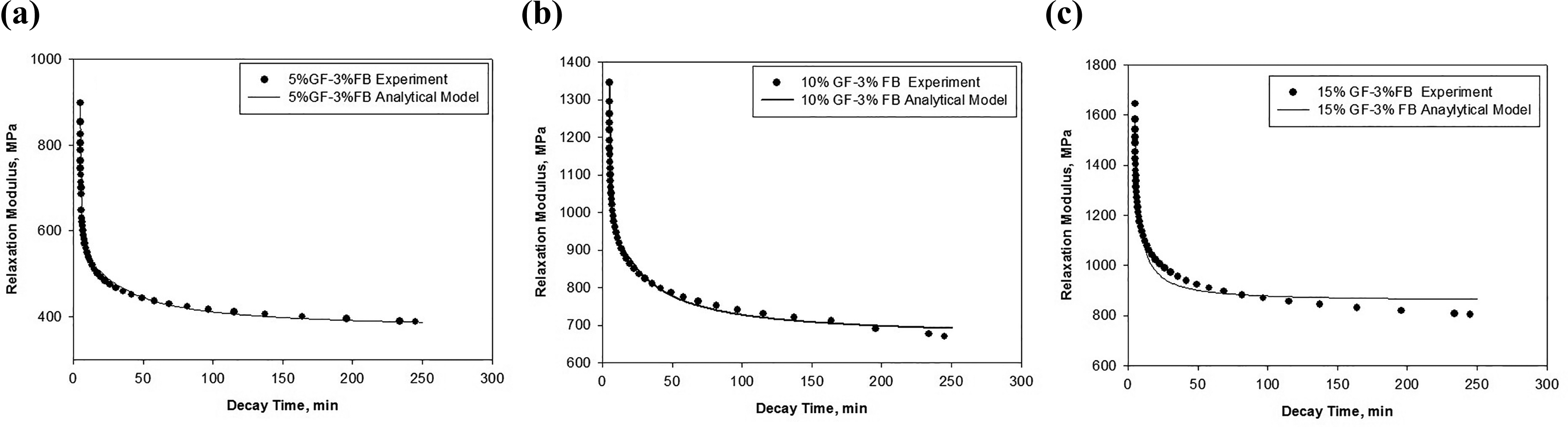
Comparison of experimental stress relaxation to the analytical model (a) 5% GF–3% FB, (b) 10% GF–3% FB, and (c) 15% GF–3% FB.
Conclusions
The investigation concluded that the stress relaxation of GF-reinforced HDPE composite can be predicted by employing an analytical model which uses a viscoelastic shear-lag method. The results showed good agreement between the analytical model and the experimental results. The results also showed that the analytical modeling is a valuable approach to predict stress relaxation behavior accurately.
The analytical model demonstrates that the behavior of stress relaxation of GF-reinforced HDPE composite can be described using a time-dependent stress transfer at the interface of the fiber and matrix. Additionally, the FB incorporation in the HDPE matrix changed the relaxation rate of GF-reinforced HDPE composite. Also, the incorporated HDPE matrix with FB provides good agreement of stress-relaxation behavior with the experimental results when compared with the predicted analytical model. Finally, the analytical model based on Cox shear-lag approach shows that time-dependent stress transfer efficiency and time-dependent matrix modulus are important factors when it comes to investigation of stress-relaxation behavior of the HDPE/GF/FB composite.
Footnotes
Acknowledgements
The authors acknowledge the support from King Abdulaziz University, Jeddah, KSA.
Declaration of conflicting interests
The author(s) declared no potential conflicts of interest with respect to the research, authorship, and/or publication of this article.
Funding
The author(s) received no financial support for the research, authorship, and/or publication of this article.
