




Abstract
The main objective of the present work was to study the role of carbon nanotube (CNT) on the microstructure development and physical, mechanical, and rheological properties of poly(lactic acid) (PLA)/natural rubber (NR)/CNT hybrid nanocomposites. The PLA/NR blend samples with constant blend ratio (90/10) were prepared by melt mixing in a laboratory internal mixer at a temperature of 190°C. The behavior of the PLA/NR blend was examined depending on the CNT content (0.5–6 wt%). The droplet size and droplet size distribution of the NR phase decreases with the increase in CNTs content. This could be explained in terms of compatibilizing effect of CNT and the changing of the viscosity ratio of the blend phases. The development of the microstructure and the physical properties of the blend were also investigated according to the CNT contents by measuring the linear viscoelasticity. The elongational behavior and mechanical properties of the blends were strongly dependent on the location of the CNT. The CNT worked as an efficient compatibilizer and also it worked as a reinforcing filler making the matrix more rigid.
Introduction
Over the past few years, biodegradable polymers issued from renewable resources have attracted widespread interest academically and industrially because they are good candidates as an alternative to petroleum polymers and also a solution to the environmental problem of plastic waste.
Poly(lactic acid) (PLA) is a thermoplastic polyester that is well-known as a biodegradable and biocompatible polymer. PLA is derived from renewable resources such as sugar, corn, potatoes, cane, and beet. It can be processed by conventional processing methods such as injection molding, film blowing, extrusion, and thermoforming. PLA is used for various applications such as packaging, medicine (including drug delivery system and tissue engineering), agriculture, and textile. It exhibits high strength and modulus. 1,2 However, some of its applications are limited by its high brittleness and poor crystallization behavior. To overcome these limitations, many strategies have been employed such as copolymerization, melt blending of PLA with other polymers, and the addition of plasticizer. 3 -5
Rubbers are good candidates as a second-phase polymer to enhance the toughness of brittle thermoplastics. The rubber phase acts as stress concentrators, initiating and terminating crazes in the brittle polymer and so enhancing the fracture energy absorption of brittle polymers and ultimately leads to improved toughness of materials. 6 -8
Natural rubber (NR) is a renewable resource derived from rubber trees. It exhibits excellent flexibility, toughness, biocompatibility, biodegradability, and low cost that makes it a suitable candidate to improve the brittleness of PLA. 9,10
As we know, due to the non-polarity of NR and polarity of PLA, these two polymers are immiscible with others, which results in phase separated morphology. 11 It is well-known that the final properties of immiscible polymer blends are influenced by both the size and interface of the dispersed phase. Thus, it is essential to add a compatibilizer to improve the morphology of immiscible blends. 12 One strategy is to use inorganic solid particles as a compatibilizer. In particular, layered silicates have been reported to improve the morphology of PLA/NR blends. 13
Carbon nanotubes (CNTs) have attracted significant attention in recent years due to their high aspect ratio and remarkable mechanical, thermal, and electrical properties, rendering them as an ideal filler for advanced polymer composites and gels. 14 -18 However, due to strong interparticle interactions, individual CNTs tend to form micrometer size bundles which entangle and condense into larger agglomerates with inferior properties. 14 -18 In other words, the material properties of CNT nanocomposites are controlled by the state of CNT dispersion in the polymer matrix and nanotube/polymer interfacial interactions. 15 Researchers are still facing challenges to achieve homogeneous dispersion of CNTs at single-nanotube level and to enhance the CNT/polymer interfacial interactions.
However, the more fundamental question of how dispersion at different length scales affects network formation and the ensuing composite properties remains a challenge. Individually, dispersed CNTs affect the system crystallization behavior and enhance the mechanical properties of CNT/polymer nanocomposites. 14 -18 Other properties such as electrical and thermal conductivity are strongly sensitive to the formation of a percolated network.
Rheological analysis of polymer/CNT blends can provide insight into their microstructure and can be related to the enhancement of polymer properties. The rheological properties of polymer/CNT blends are influenced by the nanotubes aspect ratio, the CNT volume fraction, polymer-CNT interactions, and the state of CNT dispersion and network formation.
In this study, the mechanism of the role of multiwall carbon nanotube (MWCNT) as a compatibilizer in a PLA/NR blend system and the resulting morphology development were investigated. And also the physical, mechanical, thermal, and rheological properties of PLA/NR/MWCNT blends were assessed. This will provide a better understanding of the influence of MWCNT over the properties of polymer blends, depending on their location and compatibility in the blend.
Experimental
Materials
The basic materials used in this work were PLA (grade 4032D, Mn = 90,000 g mol−1, Mw = 181,000 g mol−1, Polydispersity Index (PDI) = 2.01) was provided by NatureWorks (Minnetonka, Minnesota, USA). NR was kindly supplied by Malaysian Rubber (Sungai Buluh, Malaysia) under the trade name CV60 (Mooney viscosity ML (1 + 4) 100°C = 60). MWCNTs with 10–20 nm outer diameters were made in Cheap Tube Co., Ltd. (Grafton, Vermont). Specifications of the materials used are described in Table 1.
Characteristics of components used.

Sample preparation
The hybrid nanocomposite samples were prepared by melt compounding in a 60 cm3 laboratory internal mixer (Brabender Plasticorder W50, Berlin, Germany) equipped with a Banbury-type rotor and a nitrogen gas purging device. All samples were prepared under the same processing conditions (Tmixing = 190°C, rotor speed = 100 r min−1, and fill factor = 75%). The denoted codes and composition of the samples are described in Table 2. All the composite constituents were dried at 80°C for 24 h before melt blending.
Formulation of the composite and nanocomposites.

PLA: poly(lactic acid); NR: natural rubber; MWCNT: multiwall carbon nanotube. PLNR is a code of sample.
Sample characterization
Morphology characterization
The morphology of the blends was investigated using a scanning electron microscope (SEM) (Philips XL30, Netherlands) with 20 kV accelerating voltage. The samples were cryogenically fractured by first keeping in liquid nitrogen for 15 min and then quickly fractured. The cryogenically fractured surfaces were coated with gold for enhanced conductivity using SPI sputter coater.
Thermal analysis
Thermogravimetric analysis (TGA) measurements were performed under nitrogen atmosphere by using a Thermogravimetric Analyzer (TGA 7; Perkin Elmer, Waltham, Massachusetts, USA). All samples were heated from 50°C to 650°C with the heating rate of 10°C min−1.
Rheological measurements
The melt viscoelastic properties of the samples were studied with a rheometric mechanical spectrometer (USD 200; Paar Physica, Austria) equipped with parallel plate geometry with a diameter of 25 mm. The samples in the granule form were vacuum dried under 80°C in an oven, to prevent moisture induced degradation, before the measurements. The rheological measurements were carried out in the linear viscoelastic regions. The melt linear viscoelastic behavior of the samples was characterized in the frequency range of 0.1–1000 s−1 using a strain amplitude of 1%, proved to be in the linear viscoelasticity range by means of strain sweep measurements at temperatures of 200°C.
Mechanical properties
Tensile specimens were punched out from the molded sheets using ASTM Die-C. The tests were carried out as per the ASTM D 412 methods in a Gotech Testing Machines Inc. (GT-7016-A; Gotech, Taiwan) at a cross-head speed of 10 mm min−1. Results were averaged on five measurements.
Dynamic mechanical thermal analysis
The dynamic mechanical thermal analysis (DMTA) was conducted using rectangular samples having dimensions of 25 × 10 × 2 mm3 on DMTA machine (Triton-Tritec 2000, U K). The dynamic temperature sweep tests were conducted at 1 Hz frequency and 0.05% strain within temperature ranges of −100 to +150°C.
Results and discussion
Morphology
Figure1 shows the SEM micrographs of all PLA/NR blend and its nanocomposites containing different CNTs concentration.
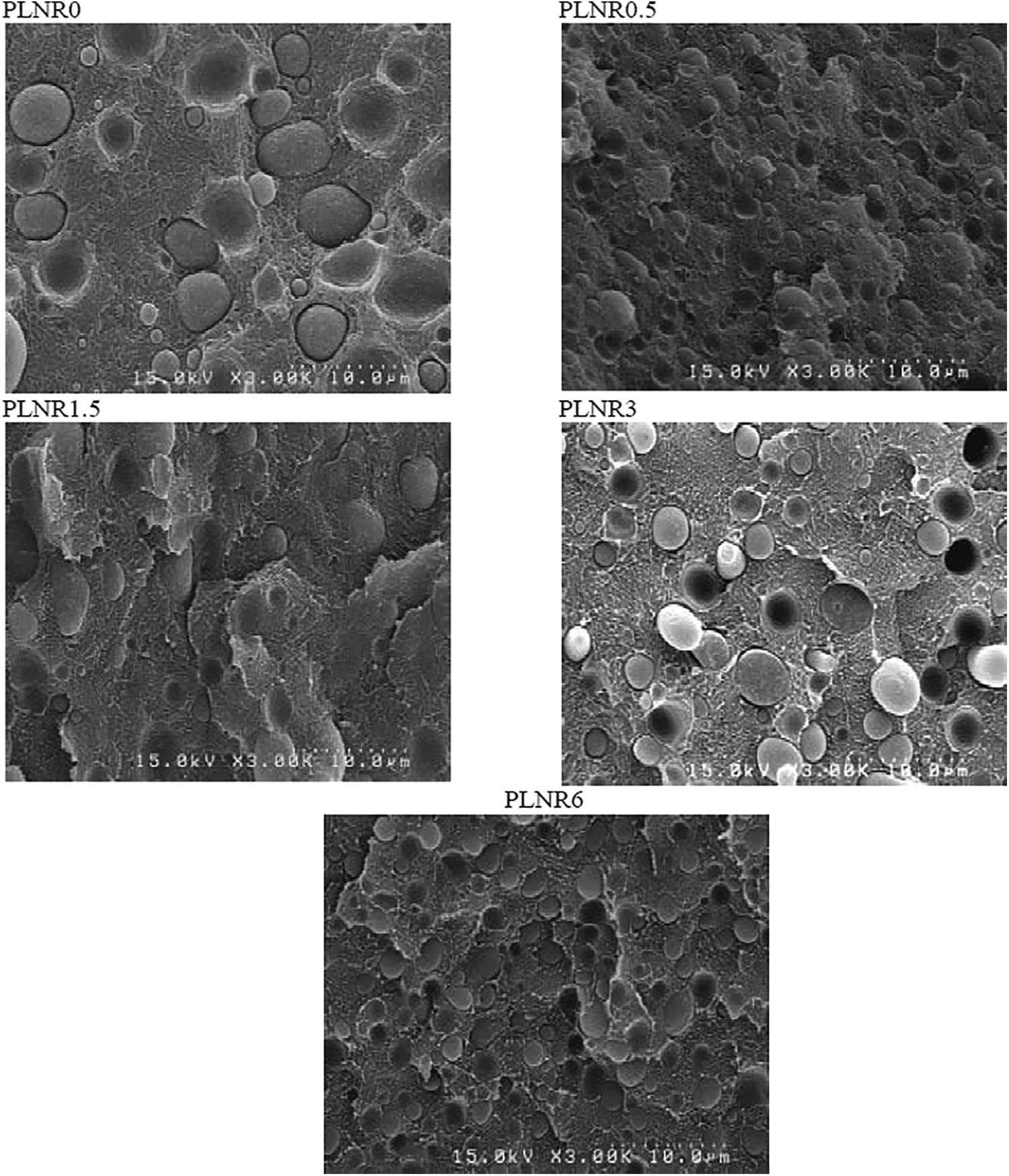
SEM micrographs of PLA/NR blend and its nanocomposites. SEM: scanning electron microscope; PLA: poly(lactic acid); NR: natural rubber.
The PLA/NR sample shows a matrix-dispersed-type morphology in which the NR particles, with an average diameter 2.57 µm, were finely dispersed in the PLA matrix. Table 3 represents the number averaged diameters of the NR droplet that are obtained from quantitative analysis of the SEM micrograph. It is obviously seen that the droplet size and droplet size distribution of the NR phase decreases with the increase in CNTs content.
Weight-average rubber droplet size diameter (dd) and rubber DSD of PLA/NR blend and its nanocomposites.

DSD: droplet size distribution; PLA: poly(lactic acid); NR: natural rubber.
In the immiscible polymer blend system, the location of the CNTs depends not only on the affinity between the polymer and CNTs but also on the CNTs content, which results in different morphology and physical properties of the blend.
To determine the affinity between polymer and CNTs, we calculate the wetting coefficient. The wetting coefficient is a good parameter to estimate the selective location of CNTs in PLA/NR blends.

where γij is the interfacial tension between the materials.
If ω > 1, the CNTs will mainly be located in NR phase; if ω < 1, the CNTs will be present in PLA phase; and if −1 < ω < 1, the CNTs would be at the interface.
Interfacial tension between components is usually calculated with theoretical models such as the Girifalco–Good equation 19

where γi and γj are the surface tensions of the i and j components.
According to the literature surface tension of PLA, NR, and nanotube are 30.81, 16.75, and 27.8 mN m−2, respectively. 20 So the wetting coefficient was 0.61. According to this result, the CNT are preferentially localized at the interface.
Two effects have to be considered to explain the decrease of the rubber droplet size when adding the CNTs, which are a compatibilizing effect and a change of the viscosity ratio of the blend phases. According to the wetting coefficient value, at low CNT concentration, the CNTs localized at the interface. Hence, the compatibilizing effect of the CNTs could be predominant. At high CNT concentration, the change of the viscosity ratio between the two phases was expected to play an increasing role. The presence of CNTs in the PLA phase increased the PLA viscosity and facilitated the droplet breakup of the dispersed high-viscosity rubber phase, inducing a further decrease of rubber droplet size.
Dynamic mechanical analysis
Figure 2 shows the storage modulus and tanδ of PLA/NR blend and its nanocomposites, over the temperature range from −100°C to 150°C. The E′ curve of the blend exhibited two drops corresponding to the glass transition temperature of their constituents, revealing the immiscibility of the system. As expected, NR decreased the modulus of the PLA, being this effect stronger at temperatures above the rubber Tg (−70°C). As we can see, the addition of the CNTs resulted in an increase of the modulus values of the blends and the reinforcing effect gradually increased with the CNT concentration.
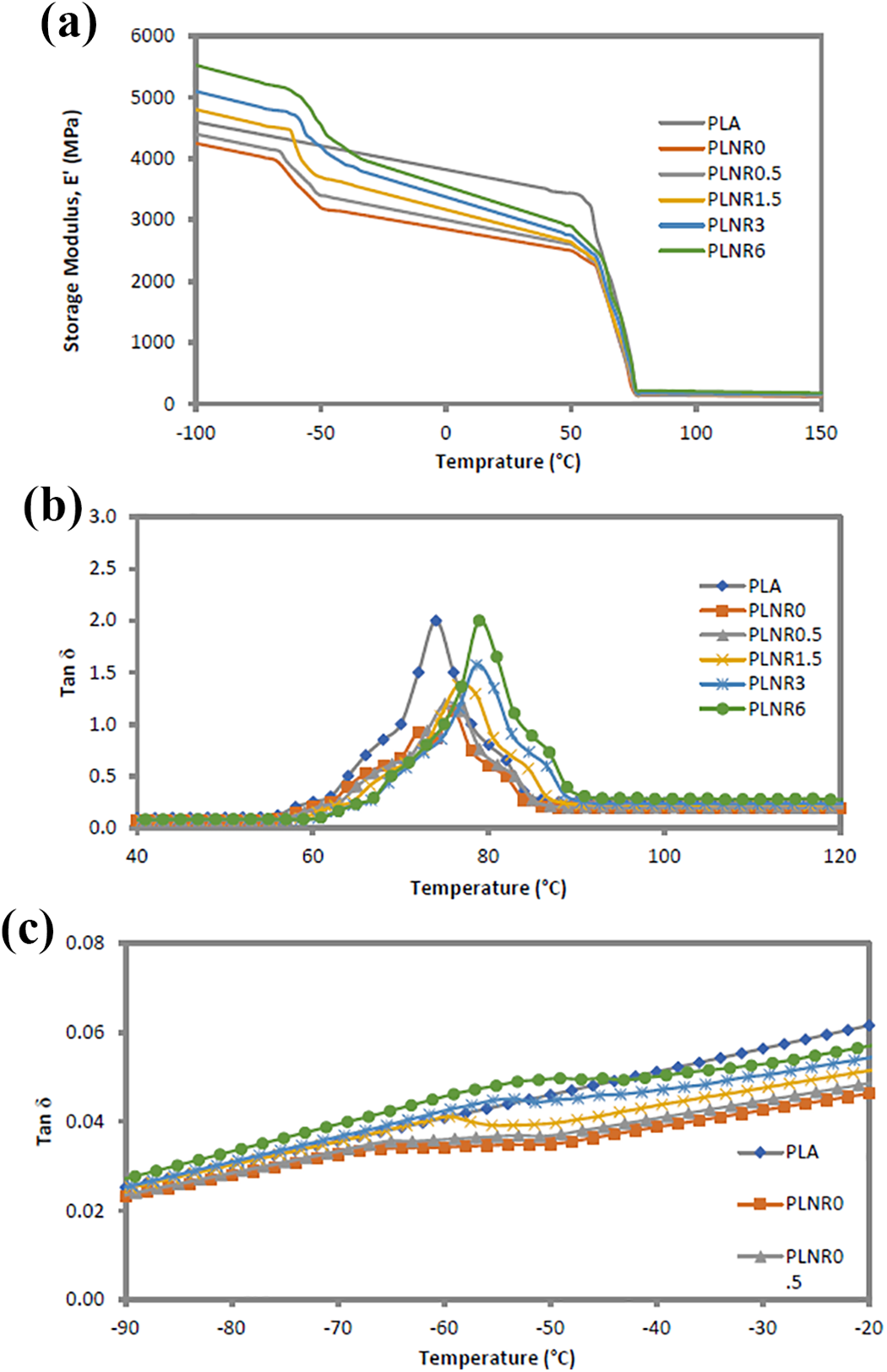
(a) to (c) Storage modulus and loss angle (tanδ) versus temperature plots of PLA/NR blend and its nanocomposites. PLA: poly(lactic acid); NR: natural rubber.
Moreover, a shift of NR Tg from −65.6°C to −53.1°C was observed by the addition of 6 wt% of CNTs (Figure 2(c)). This shift would indicate that CNT reduced the rubber chain mobility due to the formation of strong CNT-NR interactions and showed an affinity for the elastomeric phase. The same behavior was seen for PLA phase. The PLA Tg changed from 74°C to 78.9°C by increasing the CNTs up to 6 wt%. In low concentration of CNTs (below 1.5 wt%), due to its location at the interface of PLA and NR phases increasing the Tg of both phases were not observed. On the other hand, in high level of CNTs (more than 3 wt%), the concentration of CNTs at interface layer was saturated and its concentration in PLA and NR phases increased.
Mechanical properties
The tensile behavior of the materials is presented in Table 4. PLA is a rigid and brittle polymer with a very low elongation at break. The addition of NR to the PLA matrix changed the brittle behavior of PLA to a ductile behavior with formation and propagation of a neck during stretching. An elongation of 55.5% was observed with the addition of 10 wt% of NR, while Young’s modulus and tensile strength decreased.
Mechanical properties of the Acrylonitrile Butadiene Rubber compounds.

PLA: poly(lactic acid).
The addition of the CNTs to the blend drastically changed the mechanical response of the material. CNTs gave rise to a marked increase of the elongation at break, of up to 65.3% with 0.5 wt%, without dramatically changing the modulus and strength. As it was previously demonstrated, CNT is localized at the polymer blend interface and interacts physically with the elastomer phase. As the deformation progresses, the crack starts and grows at the interface zone. However, the nanoparticles align in the direction of the applied stress and act as stress homogenizers allowing slippage and redistribution of stress among polymer chains, hindering the growing cracks. This statement allows us to explain the increase of the elongation at break in the presence of CNTs. However, this value dropped to 15.5% and 9.2%, when increasing the CNTs concentration to 3 wt% and 6 wt%, respectively, probably due to the formation of agglomerates.
On the other hand, the addition of CNTs hardly varied Young’s modulus, but a significant decrease of the maximum tensile strength (corresponding to the yield strength) was observed. The incorporation of CNTs suppressed the neck formation and led to a more homogeneous deformation of the blend. The nanocomposites containing CNTs exhibited an increase in the modulus value with CNT content.
Thermal degradation
The non-oxidative degradation of the materials was studied by TGA. Usually, the addition of CNTs to a polymer results in an increase of the degradation temperature by acting as a superior insulator.
Table 5 reports the thermal degradation data for the prepared samples. A shift in the thermal degradation toward higher temperatures of up to 12°C for 3 wt% CNT is observed.
Thermal degradation data of the samples, reporting the Tonset, T10%, and Tp of the DTG plot of samples.

PLA: poly(lactic acid); DTG: differential thermogravimetry; Tonset: onset temperature (°C); T10%: temperature at an initial mass loss of 10%; Tp: temperature at the maximum weight loss rate.
Rheology
Storage modulus of the PLNR and their nanocomposites are shown in Figure 3(a). PLNR shows a strong frequency dependence with a typical terminal behavior at low frequencies. In contrast, G′ of PLNR nanocomposites show a weak frequency dependence and increase with the CNT content. As demonstrated in Figure 3(b), the complex viscosity of PLNR blends increases with CNT content while the frequency dependence is more pronounced with the added CNTs. For example, the η* at 0.1 rad s−1 of PLNR6 (133,000 Pa s) is enhanced approximately 32 times higher than that of PLNR (4100 Pa s) as listed in Table 6.
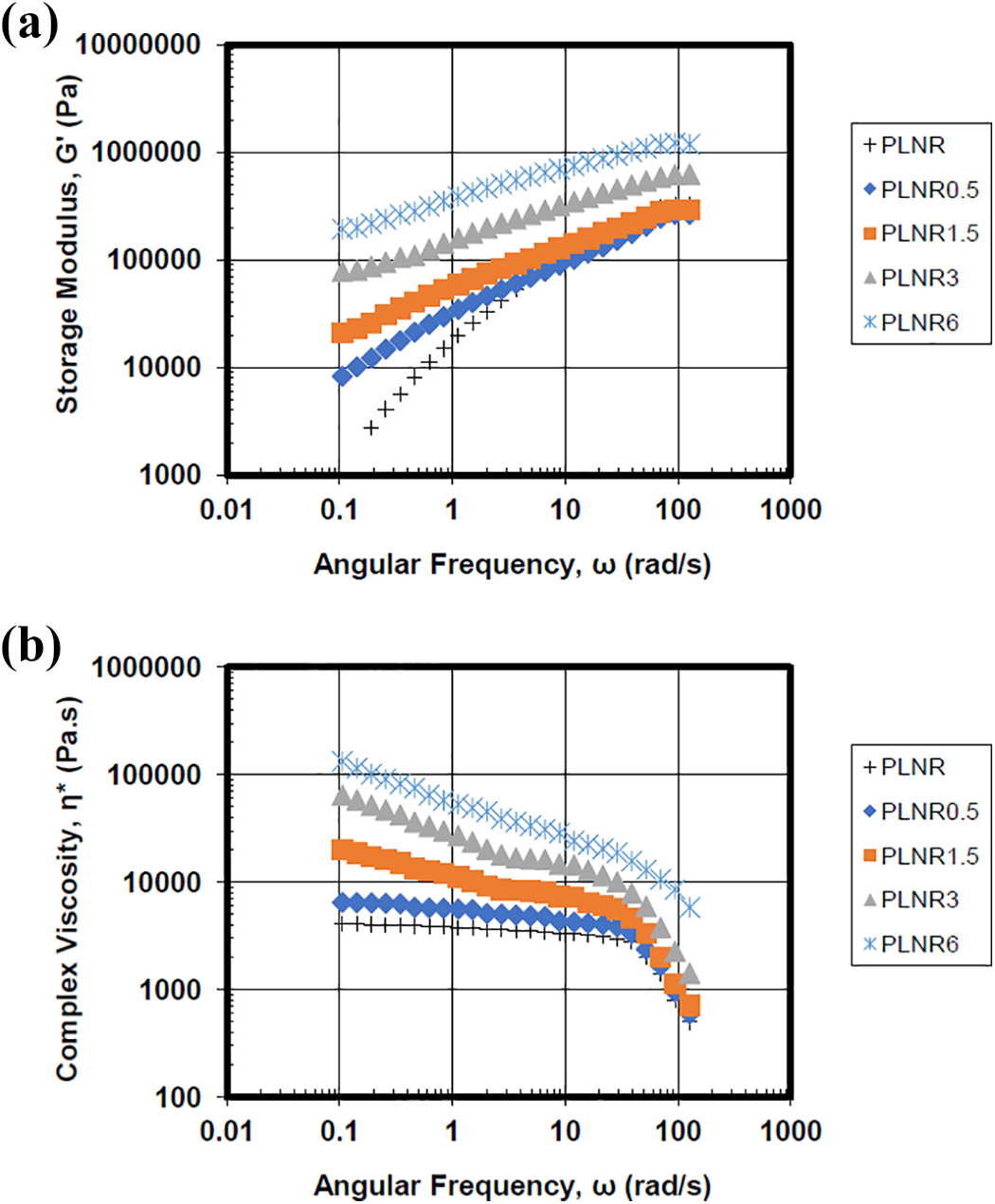
(a) Storage modulus (G′) and (b) complex viscosity (η*) of PLNR and their nanocomposite as a function of frequency at 200°C.
Complex viscosity at 0.1 rad s−1 and terminal slope of the PLA/NR/CNT nanocomposites.

PLA: poly(lactic acid); NR: natural rubber; CNT: carbon nanotube.
One of the reasons for this change is the increase of the surface area due to the reduction in drop size in the dispersed phase. These results indicate that the increase in moduli as well as complex viscosity of PLNR nanocomposites is caused by the formation of network structures.
For the blends containing 0–1.5 wt% carbon nanotube, the moduli at the low-frequency region increase rapidly, and the terminal slope levels off gradually with the CNT content as well, which is caused by the formation of a 3D percolation structure. This nonterminal behavior at the low CNT content indicates that the percolation network is formed due to the presence of CNT at the interface. On the other hand, the moduli of PLNR6 increase even at high frequencies, which is caused by the filler effect of the excess CNT in the matrix phase.
Conclusion
In this work, the role of CNT on the physical, mechanical, and rheological properties of PLA/NR/CNT hybrid systems was studied. The nanocomposites showed matrix-disperse-type morphology which the droplet size of the NR phase decreased with an increase in CNTs content. The results of DMTA tests revealed that in low concentration of CNTs (below 1.5 wt%) the CNT is located at the interface and in high level of CNTs (more than 3 wt%) the concentration of CNTs at interface layer was saturated and its concentration in the PLA and NR phases increased. These results were further verified through mechanical and rheological properties.
Footnotes
Declaration of conflicting interests
The author(s) declared no potential conflicts of interest with respect to the research, authorship, and/or publication of this article.
Funding
The author(s) received no financial support for the research, authorship, and/or publication of this article.
