



Abstract
This research is focused on the development of a new starch-based nanocomposite films reinforced with cellulose nanofibrils (CNFs) for food packaging purposes. A series of starch films were produced by the solution casting method with various concentrations of glycerin, CNF, and citric acid (CA). Mechanical properties of the films were investigated using tensile tests. Based on the results, the best formulation with optimal mechanical properties was introduced by different amounts of various gums to study the effects of the gums on tensile properties of the samples. Fourier-transform infrared analysis was performed to study posttreatment chemical structure of the sample to confirm the cross-linking and esterifying of the nanocomposite films. Results revealed that the tragacanth gum had a negative impact on the mechanical properties, while the frankincense gum (F-gum) and Arabic gum positively influenced the mechanical properties through strengthening the network structure. The sample containing 0.3 g of F-gum (10% w/w, relative to the starch weight) showed the best results compared to the control films.
Introduction
Development of biodegradable green composites has recently drawn a considerable deal of attention as they can effectively replace the synthetic materials in numerous applications. Moreover, their environmental impact at all stages of their life cycle, including recycling and final disposal, is of crucial significance. 1 -3 Starch is a natural polysaccharide, which has the second rank as the most abundant organic compound in nature after cellulose. Owing to its unique biological properties, such as biodegradability and nontoxicity, starch can be employed as an environmentally friendly alternative to petroleum-based polymers in the production of edible packaging material to control the food quality. 4 Starch-based materials can eliminate environmental concerns, but they also have some limitations including poor mechanical properties and brittleness. 4 -8 In this regard, the production of thermoplastic starch is essential to improve the film flexibility. 9 Two major methods have been utilized to modify the starches and increase its compatibility with various characteristics and applications. The first one is chemical modifications of starch (i.e. cross-linking and oxidation); the other method involves the incorporation of other ingredients, such as gums. 10 In case of cross-linking approach, citric acid (CA) can be mentioned as a potential cross-linking agent according to Reddy and Yang. 11 CA is a naturally occurring organic acid generally classified as a safe food additive, so it can be used in applications with close contact to food. Studies on the mechanical and thermal properties of starch films have shown that CA improves the tensile strength and thermal stability of the starch. In addition to cross-linking agent, CA can be also used as the plasticizer, which is evident from its effects on tensile properties since starch films containing proper CA content showed the highest cross-linking density. 12 -14
Biodegradable packs made of pure biopolymers have qualitatively poor mechanical properties than the alloyed films which have limited their industrial use in packaging. Thanks to nanotechnology advance, by incorporation of natural fibers (such as cellulose nanofibrils (CNFs)), the mechanical properties of biopolymer-based films could be substantially improved. 1,12 Application of nanotechnology in food packaging has expanded the use of edible and biodegradable films and hence reduced the packaging waste associated with processed foods. Furthermore, the fresh foods can be preserved for longer time by extending their shelf life. Cellulose has no harmful effects on human health and has been used as a highly effective additive to improve the product quality and processing properties in various fields of application. Results have indicated that nanofibrilated cellulose could greatly improve the film strength and flexibility. 3,15
A combination of biofibers with polymer matrices, from both nonrenewable and renewable resources, can result in the formation of composite materials with competitive properties relative to the synthetic composites. 3 The mechanical properties of thermoplastic corn starch matrix were increased by the addition of CNFs due to the formation of hydrogen bonds, indicating the improving effects of CNFs on the film strength. 10 There are however some challenges in incorporation of CNFs within the nanocomposite structure including the efficient dispersion of particles in the polymeric matrix and compatibility of nanofiller with the matrix. Regarding the hydrophilic nature of nanocellulose, the best method to prevent from aggregation in the process of cellulose nanocomposites preparation is solution casting. 3,16,17
Interactions at the fiber–matrix interface as well as the cellulose compatibility with the corn starch molecules can affect the system properties. Well-dispersed cellulose nanoparticles contribute a higher interfacial area and a good fiber networking within the matrix, leading to enhanced properties. 18 To achieve better dispersion, the composite films can be combined with other materials such as gums due to the synergistic interaction between starch and gums. 10,19 Wei et al. showed a decline in hydrophilicity of gellan gum/purple sweet potato composite films; but in gellan gum films alone, the mechanical properties were improved. 20,21 In another research by Kim et al., the effect of various gums (Arabic gum (A-gum), k-carrageenan, gellan, and xanthan) on tapioca starch films was studied, they showed that 0.2% gellan gum can improve the mechanical properties of the films, while addition of other gums had no impact on the tensile strength of starch films. 10 According to Nadanathangam et al., due to its high surface energy and hydrophilic nature, nanocellulose has high aggregation tendency. The gum can reduce the surface energy and increase the composite films strength and flexibility by decreasing the sizes of aggregated granules. 19,22 In this regard, in the present study, as a dispersant, gum was added to uniformly distribute the nanocellulose across the starch film. Effects of various additive materials such as plasticizers, salts, gums, nanoparticles, and cross-linking agents on mechanical properties of starch have been investigated. To the best of our knowledge, no study has addressed the effect of simultaneous presence of gum, plasticizer, and CNF on the properties of cross-linked starch film. In this research, properties of starch films containing various gums in the presence of CA and nanocellulose were studied and effects of the gums on the mechanical properties of the starch nanocomposite films were investigated.
Materials and methods
Materials
Commercially available corn starch was supplied by Glucosan Industry Co. (Ghazvin, Iran). Glycerol, CA, sodium hypophosphite (SHP), and gums were also purchased from Jahan Chimi Trading Co. (Iran). CNFs were provided by Nanonovin Polymer Co. (Iran).
Preparation of the films
In a typical procedure, 3 g starch was mixed with distilled water (100 mL), different concentrations of glycerin (Table 1), CA (Table 2), CNF (Table 3), and SHP (50% w/w on weight of CA used). The solution was heated to 90°C under magnetic stirring for 30 min to ensure complete starch gelatinization. 11,12 Then, the specific amount of the sample was poured into an acrylic casting tray to form films with 0.12 ± 0.01 mm thickness and then dried at room temperature for 72 h.
The amount of materials used (g) to evaluate the effect of glycerol content.

The amount of materials used (g) to evaluate the effect of CA content.

CA: citric acid; SHP: sodium hypophosphite.
The amount of materials used (g) to evaluate the effect of CNF content.

CA: citric acid; SHP: sodium hypophosphite; CNFs: cellulose nanofibrils.
Based on the results, the best formulation with optimal mechanical properties was used and different amounts of gums were added to study the effect of gums. In a typical procedure, 3 g starch was mixed with distilled water (100 mL), glycerol (30% w/w, relative to the starch weight), CA (5% w/w, relative to the starch weight), SHP (50% w/w, relative to the CA weight), and CNFs (5% w/w, relative to the weight of total solids). Then, different amounts of gums (0.1 g, 0.2 g, 0.3 g, and 0.4 g) were added to distilled water at room temperature (25°C). The solution was heated to 90°C under magnetic stirring for 30 min to ensure on complete starch gelatinization. 11,12 Then, a specific amount of the sample was poured into an acrylic casting tray to form films with 0.12 ± 0.01 mm thickness. The trays were then dried at room temperature for 72 h. The amounts of materials used are reported in Table 4. T1–T4 are related to samples containing tragacanth gum (T-gum), F1–F4 refer to samples containing frankincense gum (F-gum), and A1–A4 indicate the A-gum-containing samples.
The amount of materials used (g) to evaluate the effect of gum content.
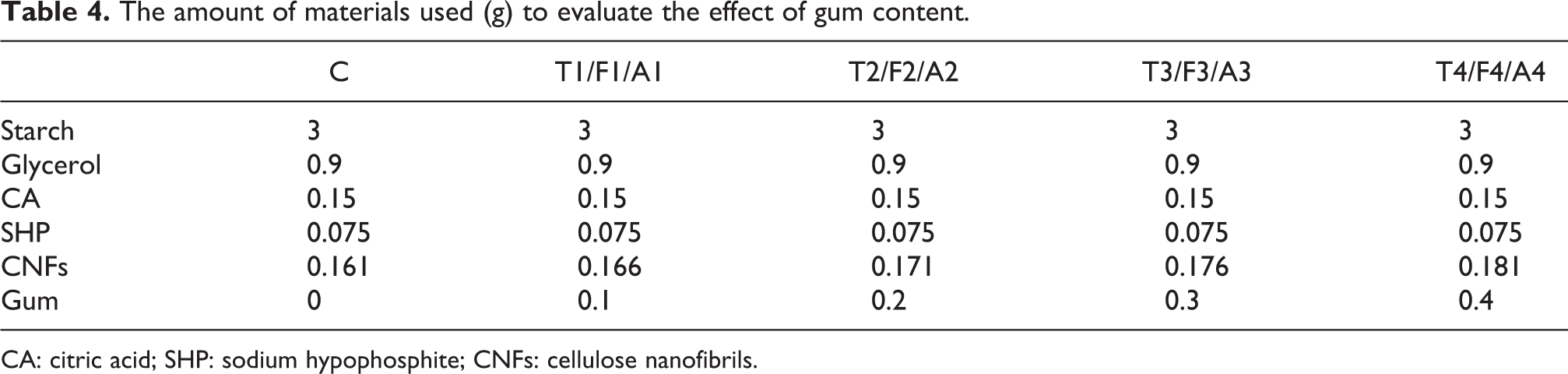
CA: citric acid; SHP: sodium hypophosphite; CNFs: cellulose nanofibrils.
Tensile properties
The mechanical properties of the samples were measured by a Santam tensile testing machine (STM20, Iran) equipped with a 200 N load cell, according to ASTM D882-02 standard. Each film was cut into rectangular strips (1 cm × 10 cm) and placed between two jaws. A constant rate of strain (5 mm/min) was applied to the specimens.
Fourier-transform infrared spectroscopy
Fourier-transform infrared (FTIR) analysis of raw starch as well as chemically treated nanocomposites was performed to confirm the cross-linking and esterification of the nanocomposite films. A JASCO 6300 FTIR (Japan) spectrophotometer was used to obtain the spectra.
Results and discussion
Effect of glycerol content
Effect of glycerol content on tensile properties of the films is presented in Table 5. Both the control and cross-linked films containing glycerol at less than 30% were highly rigid and brittle, making them impossible to test as they broke prior to being mounted into the jaws. The highest tensile strength was obtained at a glycerol concentration of 30%, which was used for all further studies. Indeed, glycerol could interact with the hydroxyl groups of the starch and break the intermolecular hydrogen bonds. At glycerol concentrations above 30%, the plasticizing effect was so large that facilitated the movement of starch molecules, leading to large elongations at break but rather decreased tensile strength. 23 -25
Mechanical properties of starch films, effect of glycerol content.

Effect of CA content
Cross-linking of starch films with CA improved the tensile strength of the films, as presented in Table 6. A certain amount of CA is necessary to reach to proper increase of the tensile strength. CA concentrations below 5% resulted in a relatively low improvement in the tensile strength, while concentrations beyond this amount decreased the film’s tensile strength. Cross-linking can increase the molecular weight of the starch and provide better intermolecular interactions, leading to better tensile strength. At low concentrations of CA, the cross-linking between the starch molecules is insufficient to improve the tensile strength. 19
Mechanical properties of starch films, effect of CA content.

CA: citric acid.
As mentioned in numerous research works, 14,26 -31 the effect of CA on the mechanical properties of starch films highly depends on its content in the film. Based on the results of this study, 5% CA could serve as a cross-linking agent, thereby improving the mechanical properties by restricting the mobility of the starch polymer chains 14,15,32 ; over-consumption of CA (5–10%, w/w), however, ended up with the presence of residual-free CA molecules between the polymer chains, enhancing the chain mobility and interchain spaces and voids and changing the CA role from a cross-linking agent to a plasticizer, thereby declining the film strength. From Table 6, it could be seen that one could increase the tensile strength and modulus while lowering the elongation at break by adding CA at up to 5% w/w, beyond which CA content the tensile strength and modulus decreased and the elongation at break increased. These results proved that, when the CA content goes beyond 5% w/w, the CA acts as both a cross-linking agent and a plasticizer. Ghanbarzadeh et al. reported similar results about the effect of CA on the mechanical properties of corn starch films. 12 SHP was used as catalyst in the cross-linking reaction adapted from Reddy and Yang research. SHP catalyst did not affect the films properties but increased the reaction speed and the intermediate anhydride formation rate, by weakening the hydrogen bonding between the carboxylic acid groups encouraging the reaction at lower temperatures. 12,33,34
Effect of CNF content
Starch films with different amounts of CNF were prepared and designated as N0–N7. The results of tensile experiments are tabulated in Table 7. At lower concentrations of CNF (up to 3% w/w), the CNF acted as an impurity exhibiting some nonuniform distribution through the matrix, inducing heterogenous stress concentration in the starch film which, in turn, led to decreased tensile strength. At higher concentrations, the nanoparticles were dispersed across a larger volume of the matrix and hence dispersed the stress to a larger space, making larger regions to participate in the deformation process. 7,35
Mechanical properties of starch films, effect of CNF content.

CNFs: cellulose nanofibrils.
With increasing the CNF content up to 5% w/w, tensile strength of the samples increased slightly, possibly due to the inappropriate distribution of CNF nanoparticles. At higher CNF dosages, the tensile strength decreased. This could be explained by the agglomeration of nanofibers at such CNF contents. Increasing the CNF content beyond 5% w/w increased the fiber–fiber interactions, leading to agglomeration of the nanofibers. The same trend was reported by Santos et al., 3 Madhumitha et al., 4 and Ashori et al. 7 Based on the results, the samples containing CNF at 5% w/w showed better mechanical properties.
Effect of gums
Results of the tensile tests are reported in Tables 8 –10. According to the results, an increase in the T-gum content decreased the tensile strength of the starch films. Ojagh et al. investigated the effect of T-gum on the mechanical properties of chitosan film, reporting no significant changes in the tensile strength yet reduced flexibility of the films. 36 Upon adding the T-gum to the starch film, the film became more brittle. Uniform dispersion of CNFs is the key to improving the strength of composites. Due to incompatibility of the starch with T-gum, the tragacanth was neither well dispersed through the matrix nor contributed to better dispersion of CNF, thereby increasing and decreasing the brittleness and tensile strength of the starch film, respectively. 37,38 By increasing the added amount of A-gum to up to 2.27% w/w (Table 9), tensile strength of the sample increased initially but then decreased. As suggested by Table 10, the tensile strength increased by increasing the F-gum content to up to 8.5% w/w, beyond which gum content the tensile strength decreased. As shown in Figure 1, the results were in agreement with those reported by Nadanathangam et al., concluding that the nanocellulose could improve the tensile strength of starch film, with the gum addition enhancing its mechanical strength. 22
Mechanical properties of nanocomposite films containing T-gum.

T-gum: tragacanth gum.
Mechanical properties of nanocomposite films containing A-gum.

A-gum: Arabic gum.
Mechanical properties of nanocomposite films containing F-gum.

F-gum: frankincense gum.

Tensile strength of nanocomposites as a function of gum concentration.
Upon the addition of the F-gum, the mechanical properties of the starch nanocomposites changed significantly, with the tensile behavior changed from brittle to ductile. The most significant impact of increasing the tensile strength was decreased elongation at break, while the addition of the F-gum increased not only the tensile strength but also the elongation at break and the modulus. These effects could extent the application of starch films. Addition of the F-gum well contributed to uniform distribution of the nanocellulose through the nanocomposites. The improved mechanical properties could be also attributed to the formation of strong intermolecular interactions between the frankincense macromolecules and the starch due to their structural similarities. Compatibility of the starch with the F-gum and uniform distribution of nanofillers can improve the tensile properties of films by strengthening the biopolymer network.
The stress–strain curves of T1, A1, and F4 samples in Figure 2 demonstrate the brittle behavior of T-gum films and the ductile behavior of the films with A- and F-gums. By increasing the interaction between the nanofillers and the matrix in the sample F4, cold drawing, necking, and strain hardening occurred due to the strong network.
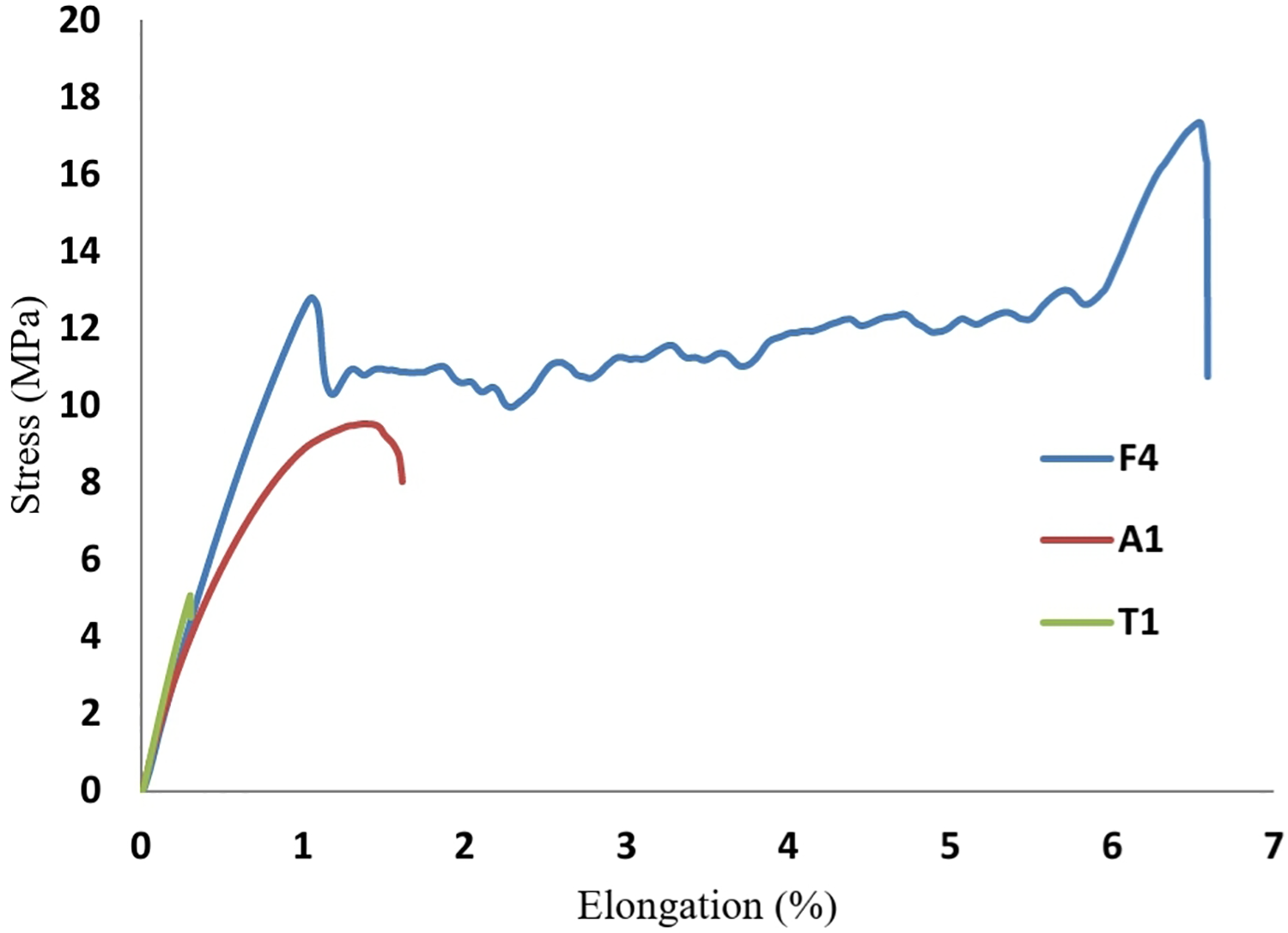
Stress–strain curve of T1, A1, and F4 samples.
FTIR analysis
FTIR analysis was used to study the posttreatment chemical structures and confirm the cross-linking and esterifying of nanocomposite films. FTIR spectra of G1 and F4 samples are depicted in Figure 3. The band at 1646 cm−1 indicates the tightly bound water in the starch owing to its hygroscopic behavior. 27 The band at 1713 cm−1 is related to the carboxyl and carbonyl esters groups of cross-linked films. 11 Since the films were thoroughly washed to remove the unbound CA and catalyst, the presence of the carbonyl peak confirms the chemical linkages between CA and starch. The band at 2800–2926 cm−1 can be also assigned to the C–H stretching bands (methyl/methylene groups). 8,11,27,39 -42
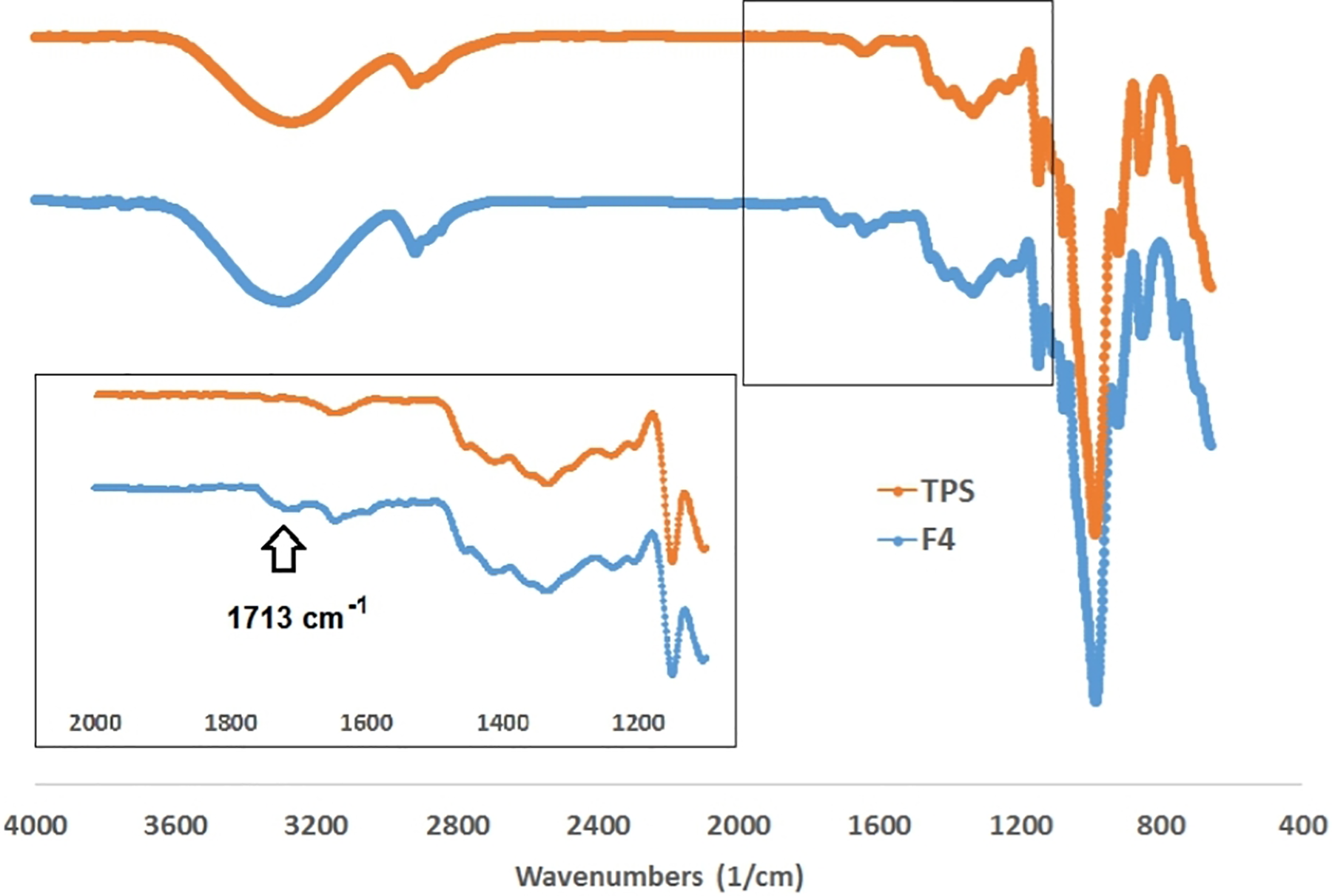
FTIR spectra of the noncross-linked starch film (TPS) and F4 samples.
Conclusion
The purpose of the present work was to evaluate the influence of various gums on the mechanical properties of the starch nanocomposite films. The influence of glycerin, CA, and CNFs on the mechanical properties of starch films was also investigated, and the optimal concentration was specified. Before using the gums, with increasing the content of CNFs to up to 5% w/w, the tensile strength of the samples increased slightly, possibly due to inappropriate distribution of the CNF nanoparticles. The tensile strength then decreased with further increasing the CNF content. This could be explained by the agglomeration of nanofibers at higher CNF contents. Keeping the contents of glycerin, CA, and CNFs unchanged; the effects of different gums at various dosage on the mechanical properties of the starch films were further addressed. According to the results, F-gum led to proper dispersion of CNFs throughout the matrix. By enhancing the fiber–matrix interactions and contributing to higher interfacial area and compatibility between the cellulose and corn starch molecules, the gum managed to uniformly distribute the nanofillers through the matrix, thereby improving the mechanical properties of the starch nanocomposite films. Therefore, the mechanical properties of the nanocomposite films were improved by strengthening the network of the films. At low dosages, the addition of the A-gum improved the mechanical properties of the film samples. The tensile strength of the films, however, decreased by incorporation of T-gum. The results of FTIR analysis confirmed the cross-linking between the CA and the starch.
Footnotes
Declaration of conflicting interests
The author(s) declared no potential conflicts of interest with respect to the research, authorship, and/or publication of this article.
Funding
The author(s) received no financial support for the research, authorship, and/or publication of this article.
