




Abstract
The incorporation of antimicrobial agents into packaging materials is an effective method to inhibit the microbial population and aimed at specific microorganisms to provide better and safe products. The present study aims at developing an effective antimicrobial film with silver ions as an antimicrobial agent with and without ethylene-vinyl acetate (EVA). In the present work, two different masterbatches (MBs) were prepared. In the first case MB of 90%, linear low-density polyethylene (LLDPE) and 10% silver ions as an antimicrobial agent were prepared. In the second case MB of 80%, LLDPE, 10% silver ion, and 10% EVA were prepared. An antimicrobial film with low-density polyethylene and different percentages of the MB (0–30%) was prepared and tested under Japanese Industrial Standard (JIS Z 2801:2000) for Escherichia coli bacteria and Staphylococcus aureus bacteria. With the increase in the percentage loading of MB, the living amount of bacteria decreases. The decrease in the living amount of bacteria was greater when EVA was incorporated.
Keywords
Introduction
The antimicrobial film has emerged as a new concept of active packaging. Incorporation of the antimicrobial agent into polymer film suppresses the activity of microorganisms resulting in the protection of foods against deterioration by the action of microorganisms. The use of antimicrobial packaging is more effective compared to direct adding of antimicrobial agents into foods.
The effect of silver ions against microorganisms is well established because of its low risk for bacterial resistance, effectiveness in very low concentrations, and having no human toxicity. Many polymers have been used for preparing the antimicrobial film for food packaging including low-density polyethylene (LDPE), high-density polyethylene, polypropylene, polystyrene, and so on.
The preparation of polymer film by blown film extrusion is a quick method and suitable for large production. However, many of the antimicrobial agents are highly sensitive to film production processing conditions and loss of antimicrobial agents at an elevated temperature and pressure results in a decline in their performance.
In this study, a convenient method for the production of antimicrobial polymer film has been carried out by the use of masterbatch (MB). Also, the evaporation of antimicrobial agents due to processing conditions has been addressed by incorporating ethylene-vinyl acetate (EVA).
Food products can be contaminated by undesirable microbes. Antimicrobial films prolong the shelf-life and improve the safety or sensory properties of fresh foods. 1
The integration of antimicrobial agents in packaging materials is aimed at killing or inhibiting microorganisms. The use of antimicrobial agents in food packaging can control the microbial population and target specific microorganisms. Antimicrobial agents are an effective tool for controlling the microbial population and targeting specific microorganisms. 2,3 Applications of various antimicrobials substance such as sorbates, nisin, silver zeolite, and various polymers used for food packaging such as polypropylene, high-density polyethylene, polystyrene, and LDPE have been reported. 4,5 Due to the relatively high temperature involved in the manufacturing of antimicrobial film, there is considerable loss of antimicrobial agents during the film blowing process. 6 -8 The use of MB for the incorporation of the antimicrobial agent is an effective method. Some researchers have used EVA/antimicrobial MB for the production of antimicrobial film and reported retention of a greater amount of volatile antimicrobial agent. 9,10 Nisin was found to be effective in suppressing Staphylococcus aureus and Listeria monocytogenes when used in LDPE film and in inhibiting Salmonella typhimurium when used with polyvinyl chloride, linear low-density polyethylene (LLDPE), and nylon. 11,12 The effect of potassium sorbate as an antimicrobial agent in LDPE and LLDPE has been reported. 13 -15 The application of benzoic anhydride in LDPE film resulted in a delay in mold growth and was effective in controlling microbial growth and its suitability for food packaging have been reported. 16,17 The application of hexamethylenetetramine as an effective antimicrobial agent has been reported. 18,19 The use of ions of silver and copper as an antimicrobial agent has been reported. 8 Silver is generally recognized as nontoxic material and use of silver ion to inhibit a wide range of microorganism has been reported, 20,21 and because of its bactericidal efficacy, silver ion has generated renewed interest. 22 Silver is used for food packaging as an antimicrobial agent. 23,24 Silver ions are highly effective against microorganisms and are explained by the oligodynamic effect. 25 A higher concentration of silver ions resulted in greater germicidal effect. 26 EVA is used for MB preparation as it minimizes the loss of the active ingredients and also acts as a coupling agent between the LDPE and silver ion. 27 EVA is used as an antimicrobial agent due to its inherent property of activity against bacteria. Antimicrobial films are emerging as a new concept to reduce, inhibit, or delay the growth of microorganism for food packaging. 28 Incorporation of silver nanoparticles enhances tensile strength and antimicrobial properties. 29 The growth rate of bacteria was restricted when silver nanoparticles were added in polyethylene. 30 The evaporation loss of antimicrobial agent during the film-blowing process due to elevated temperature is a major challenge. The emergence of some resistant bacterial strains such as Escherichia coli and S. aureus is the major challenge to overcome as it results in huge health-care cost because of infections caused by them. 31 Escherichia coli is a gram-negative rod-shaped bacterium that is commonly found in the lower intestine of warm-blooded organisms. Most E. coli strains are harmless, but some can cause serious food poisoning in humans and are occasionally responsible for product recalls. Staphylococcus aureus is a spherical bacterium. Staphylococcus aureus can cause a range of illnesses from minor skin infections to life-threatening diseases.
Materials selection
LLDPE M26500 Reliance grade.
LDPE 24 FS 040 Reliance grade.
EVA N 8038 Polene grade.
Silver ion antimicrobial agent.
Table 1 lists the properties of materials.
Properties of materials.
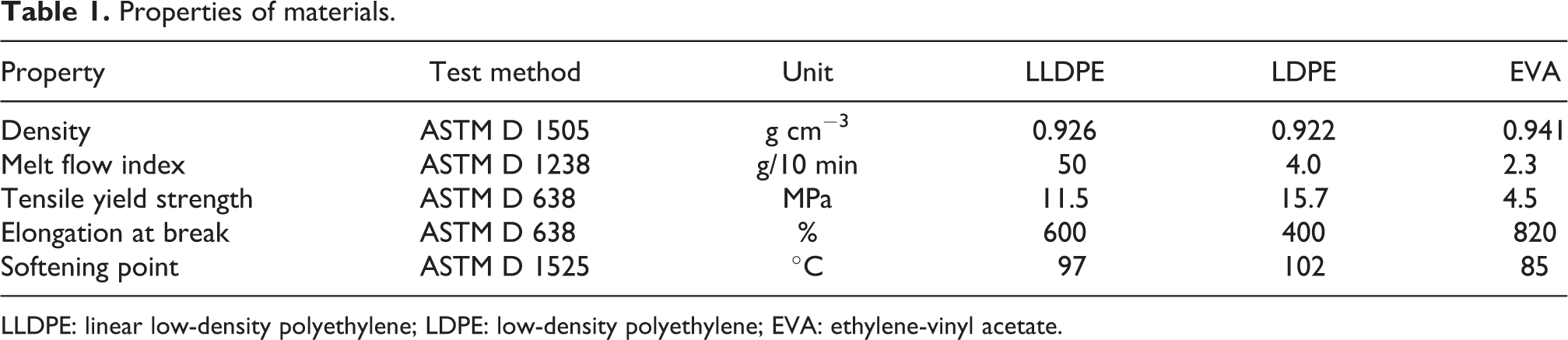
LLDPE: linear low-density polyethylene; LDPE: low-density polyethylene; EVA: ethylene-vinyl acetate.
MB preparation
In the plastics industry, concentrates of pigments and additives in a polymer matrix are characterized by the term MB. This is usually in the form of pellets. They are used for dust-free precise feeding of pigments and additives into polymers and compounds. They produce a high-quality product, and higher uniform loading of additives is possible. For preparing MBs, two different compositions were prepared. In the first composition for preparing, the antimicrobial MB, silver ion as antimicrobial agent additives is chosen for this research works. In this case, an MB is prepared with 90% LLDPE and 10% silver ion as antimicrobial agent additive. In the second case, EVA is used in antimicrobial MB due to the inherent property of activity against the bacteria and as a coupling agent along with silver ion. In this case, the MB is prepared with 80% LLDPE, 10% EVA, and 10% silver ion antimicrobial agent additive. Tables 2 to 4 show the formulation for antimicrobial polymer film.
Formulation for antimicrobial MB without EVA.

MB: masterbatch; EVA: ethylene-vinyl acetate; LLDPE: linear low-density polyethylene
Formulation for antimicrobial MB with EVA.

MB: masterbatch; EVA: ethylene-vinyl acetate; LLDPE: linear low-density polyethylene.
LDPE film formulation with different concentrations of antimicrobial MB with and without EVA.
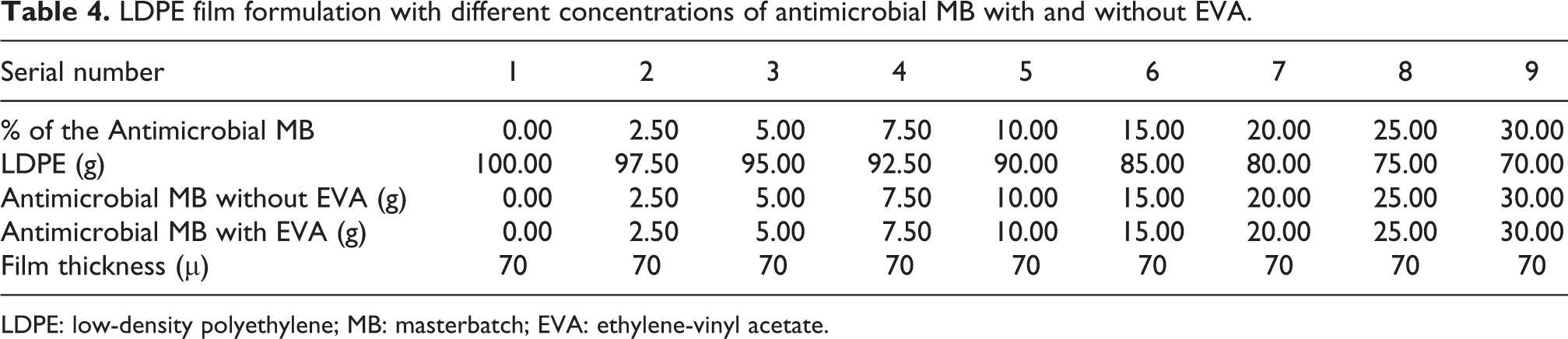
LDPE: low-density polyethylene; MB: masterbatch; EVA: ethylene-vinyl acetate.
Film preparation
The production of plastic film is primarily achieved by blown film extrusion. Many important factors are considered for the production of antimicrobial film, such as the method used to incorporate the antimicrobial agent into the polymer or MB, the optimal extrusion conditions to minimize the loss of agents, the extent to which an additive polymer could reduce the evaporation losses of volatile antimicrobial agents, and the extent to which an additive polymer could control the release of the antimicrobial agent into the food product.
The following steps were carried out for film processing. Processing conditions for the film are mentioned in Table 5. LDPE films were cast through an extruder with and without EVA at a different percentage (0–30%) of the MB. All the films are tested under JIS Z 2801:2000. After testing, a comparison is carried out between colony-forming unit (CFU) forms in the antimicrobial MB and EVA-based antimicrobial MB. The MB is prepared with a twin-screw counterrotating screw extruder.
LDPE film processing conditions.

LDPE: low-density polyethylene.
Determination of antibacterial activity using JIS Z 2801:2000
A cell suspension of either E. coli (2.5 × 10⁵ to 1.0 × 10⁶ cells ml−1; NCIMB 8545) or S. aureus (2.5 × 10⁵ to 1.0 × 10⁶ cells ml−1; ATCC 6538p) is prepared in 1/500 nutrient broth. An aliquot (400 μl 16 cm−2) is then placed onto at least three replicate subsamples per species of the treated surface under test and six replicate subsamples per species of the untreated surface and held in intimate contact using a sterile polyethylene film (typically 40 × 40 mm2 on a test piece measuring 50 × 50 mm2). The three replicate subsamples of the treated material and three of the six replicate subsamples of the untreated material are then incubated for 24 h at 35°C at saturation humidity. After incubation, the samples are transferred to individual containers containing an aliquot (typically 10 ml) of a neutralizer validated for the biocide used in the treated material. The film is separated from the surface and the suspension remaining on the surface homogenized with the neutralizer. Three replicate subsamples of the untreated material are also processed in this manner before incubation to provide baseline data. In some instances, where samples are either non-regular in shape, are overly large, or have properties which make immersion in a neutralizer solution impractical, the cell suspension remaining on the surface is recovered by transferring the cover film only to the neutralizer solution and then recovering the remaining inoculums using sterile swabs. The numbers of CFUs within the resulting suspensions are then enumerated using an appropriate microbiological technique (e.g. porous plate, spiral dilution, etc.). The data from JIS Z 2801:2000 is usually expressed as an antimicrobial value calculated from the difference between the Log10 numbers of CFUs on the treated surface with that measured on the untreated surface although in some cases the actual data as CFU cm−2 is presented.
Results and discussion
Figure 1 and Table 6 show variation in the living bacteria cells of E. coli with time for different percentage loading of the MB of the antimicrobial agent without EVA. Figure 2 and Table 7 show variation in the living bacteria cells of E. coli with time for different percentage loading of the MB of the antimicrobial agent with EVA. There is an increase in bacterial cell count with time when no antimicrobial agent is impregnated in the polymer film. There is a decrease in the bacterial count when the antimicrobial agent is impregnated to the polymer film. The rate of decrease is higher with percentages increase in loading of MB and is the minimum for 30% MB loading. The living amount of E. coli bacteria is found to be 15 CFU ml−1 for the antimicrobial film with 30% MB loading. Silver ion inhibits the respiratory chain of E. coli and reacts more quickly and readily. 32,33 Silver ions are able to combine to cellular enzymes of microbes and get attached to the bacterial cell membrane causing leakage of cell components and interference of the respiratory system and causing the death of the bacteria. 34 Significant reductions of S. aureus and E. coli bacteria were reported when treated with silver ion. 35 The rate of decrease in the living amount of bacteria is higher with the incorporation of EVA in the MB. Application of EVA along with antimicrobial agent for MB resulted in retaining a higher amount of antimicrobial agent (about 75%). 3,10

Effect of the silver ion as an antimicrobial agent on Escherichia coli bacteria with different filler loading without EVA.

Effect of the silver ion as an antimicrobial agent on Escherichia coli bacteria with different filler loading with EVA.
Result for Escherichia coli bacteria for different concentrations of antimicrobial MB without EVA.

MB: masterbatch; EVA: ethylene-vinyl acetate; CFU: colony-forming unit.
Result for Escherichia coli bacteria for different concentration of antimicrobial MB with EVA.

MB: masterbatch; EVA: ethylene-vinyl acetate; CFU: colony-forming unit.
Figure 3 and Table 8 show variation in the living bacteria cells of S. aureus with time for different percentage loading of the MB of the antimicrobial agent without EVA. Figure 4 and Table 9 show variation in the living bacteria cells of S. aureus with time for different percentage loading of the MB of an antimicrobial agent with EVA. There is an increase in bacterial cell count with time when no antimicrobial agent is impregnated in the polymer film. There is a decrease in the bacterial count when the antimicrobial agent is impregnated to the polymer film. The rate of decrease is higher with percentages increase in loading of MB and is the minimum for 30% MB loading. Living amount of S. aureus bacteria is found to be 12 CFU ml−1 for an antimicrobial film with 30% MB loading. The higher level of silver ion is strong enough to destroy S. aureus bacteria. Colloidal silver solutions with an ionic silver concentration of 30 ppm or higher are strong enough to destroy S. aureus. 36

Effect of the silver ion as an antimicrobial agent on Staphylococcus aureus bacteria without EVA for different filler loading.
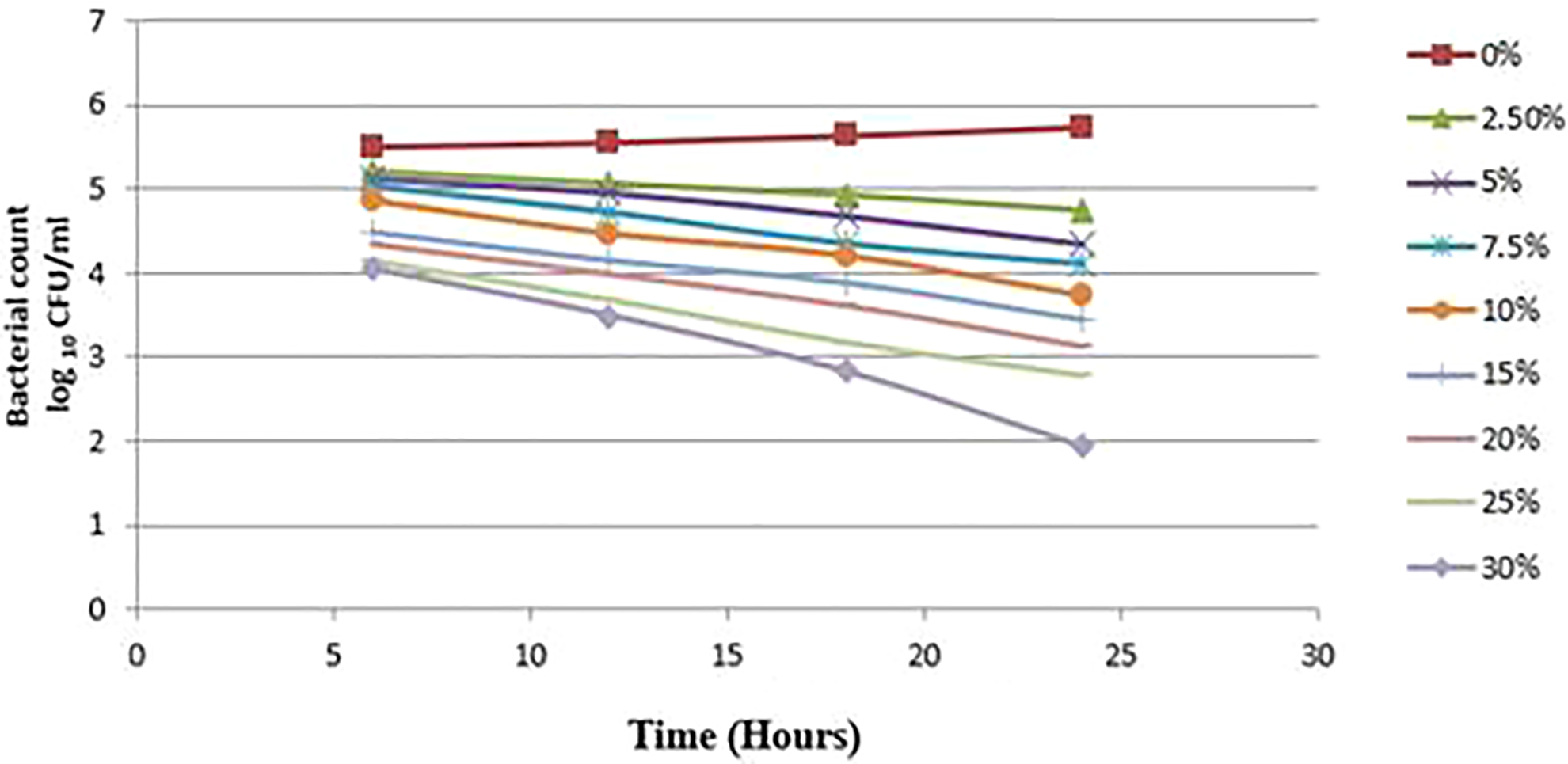
Effect of the silver ion as an antimicrobial agent on Staphylococcus aureus bacteria with EVA for different filler loading.
Result for Staphylococcus aureus bacteria for different concentrations of antimicrobial MB without EVA.
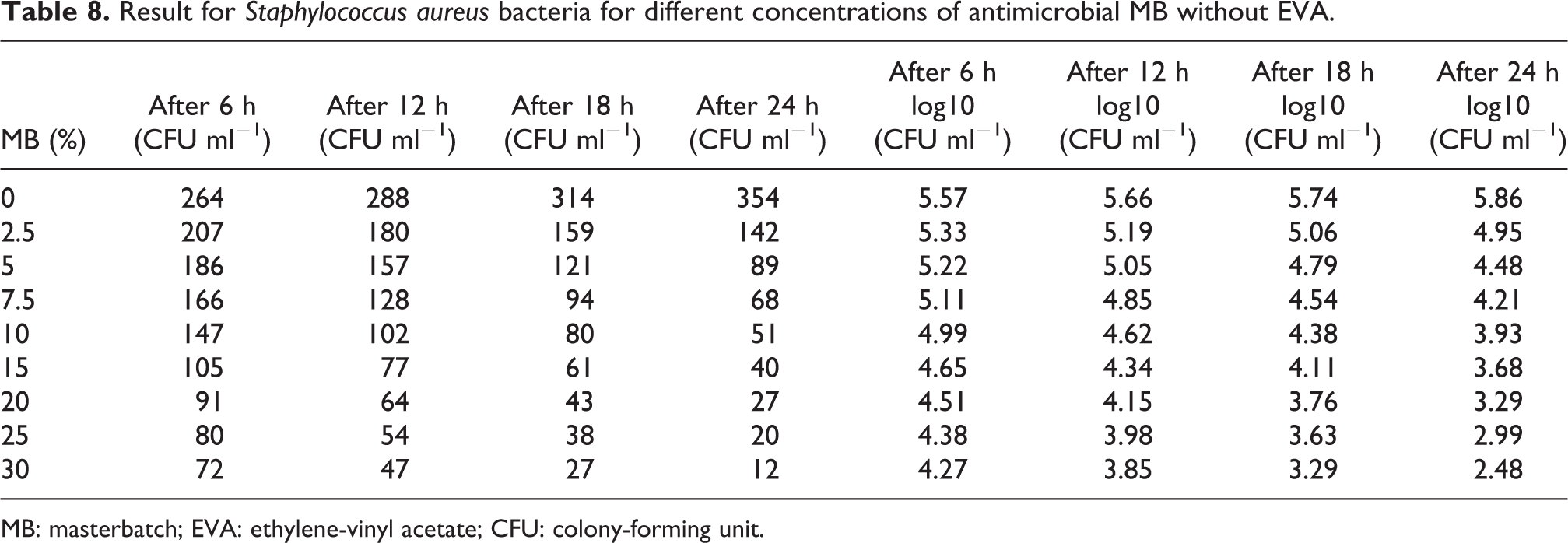
MB: masterbatch; EVA: ethylene-vinyl acetate; CFU: colony-forming unit.
Result for Staphylococcus aureus bacteria for different concentrations of antimicrobial MB with EVA.

MB: masterbatch; EVA: ethylene-vinyl acetate; CFU: colony-forming unit.
Figure 5 shows variation in living bacteria cells with percentage variation in the MB of the antimicrobial agent for 24 h with and without EVA for E. coli bacteria. The rate of decrease of the bacterial count is higher for MB with EVA compared to that without EVA. EVA acts as a coupling agent between the silver ion and LDPE, enhancing its antimicrobial effect. Figure 6 shows variation in living bacteria cells with percentage variation in the MB of the antimicrobial agent for 24 h with and without EVA for S. aureus bacteria. The rate of decrease of the bacterial count is higher for MB with EVA compared to that without EVA.
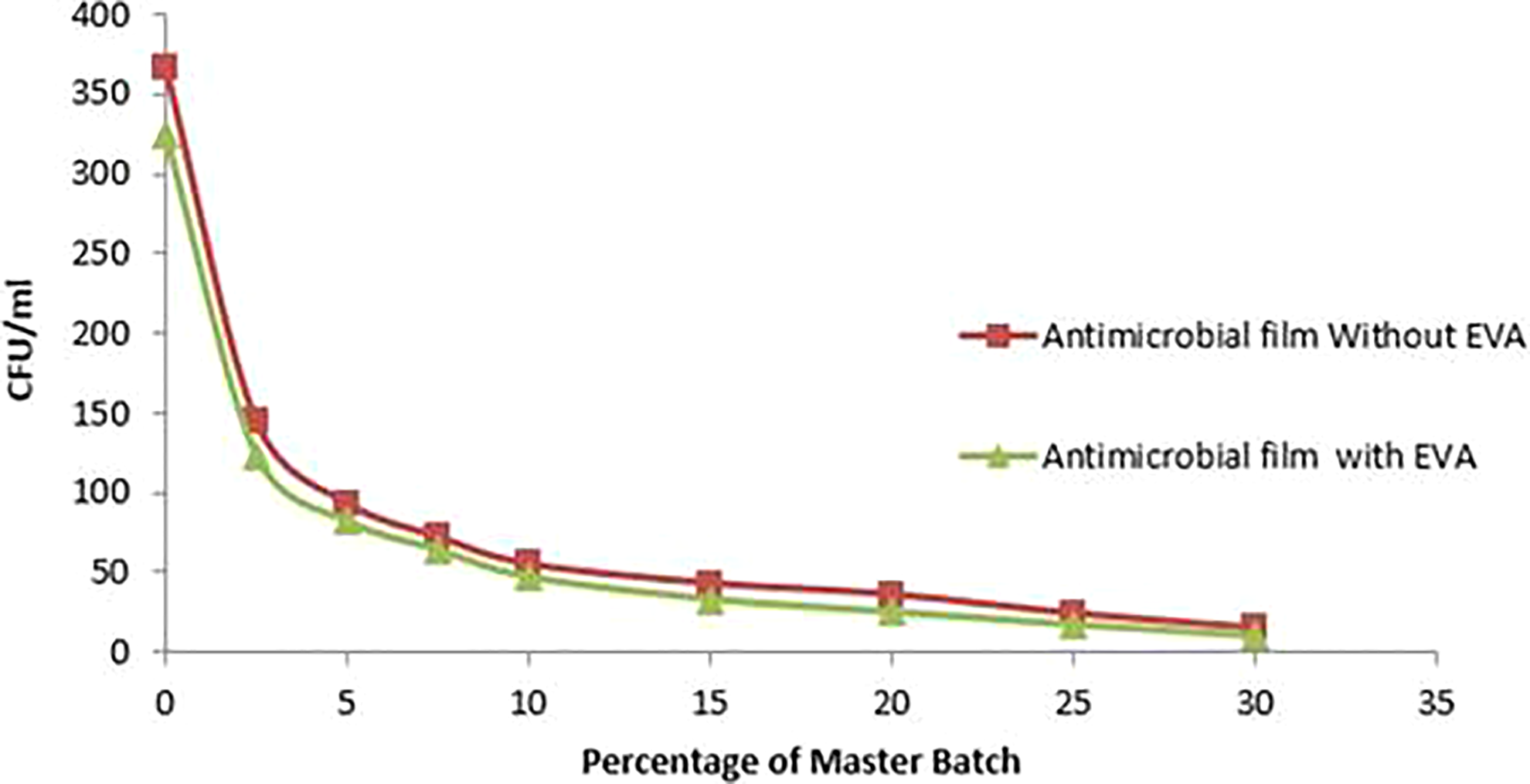
Effect of the silver ion as an antimicrobial agent on Escherichia coli bacteria with different filler loading with and without EVA for 24 h.

Effect of the silver ion as an antimicrobial agent on Staphylococcus aureus bacteria with different filler loading with and without EVA for 24 h.
Conclusion
There is a decrease in the living amount of bacteria with an increase in the percentage loading of the MB. With the maximum loading, that is, 30% of the MB, the living amount of E. coli bacteria was found to be 15 CFU ml−1, whereas S. aureus was found to be 12 CFU ml−1. The decrease in the living amount of bacteria was higher when EVA was incorporated. The decrease in S. aureus bacteria is higher as compared to E. coli bacteria. Results indicate that silver ion is an effective antimicrobial agent and EVA acts in enhancing silver ion performance as the antimicrobial agent.
Footnotes
Declaration of conflicting interests
The author(s) declared no potential conflicts of interest with respect to the research, authorship, and/or publication of this article.
Funding
The author(s) received no financial support for the research, authorship, and/or publication of this article.
