




Abstract
Silicon carbide whiskers (SiCws) were modified with silane coupling reagent with the aid of ultrasonic agitation, and SiCw/SEBS (styrene-ethylene-butadiene-styrene) grafted with maleic anhydride(SEBS-g-MAH) composites were prepared by a solution method. The effects of modification on the SiCw and the structure morphology, mechanical property, thermal stability, and hydrophobicity of composites were studied. The results show that the tensile strength of composites increased gradually with increasing filler contents, ranging from 19.05 to 24.91 MPa. The pyrolysis temperature of composites to begin to lose mass increased gradually. Comparing with the pure SEBS-g-MAH film beginning to lose mass at 365°C, the composite with 2.5% modified SiCw lost mass at 402°C, which had improved by 37°C. With increasing content of SiCw, the hydrophobicity of composite was enhanced. Compared with the pure SEBS-g-MAH film, the water contact angle of composite with 2.5% SiCw had been enlarged by 40%, from 65.56° to 91.57°.
Introduction
Recently, adding functional fillers into the polymer matrix has improved the comprehensive properties of composites, as some studies have shown. 1,2 Many particles were used as filler in the preparation of polymer composites, such as boron nitride (BN), 3 silicon carbide (SiC), 4 graphene, 5 and so on. As we all know, graphene has super high strength, outstanding thermal stability, and electrical conductivity. Just because of its electrical conductivity, the application in the insulating material is limited. Silicon carbide whisker (SiCw), as functional filler, was used in the preparation of composites. 6 With a certain aspect ratio, SiCw owns many excellent properties, such as high thermal conductivity, high thermal resistance, and strong mechanical property. Specially, it has outstanding electrical insulating property conforming to the requirement of electrical insulating material. Nevertheless, for enhancing the properties of composite, the dispersion of SiCw in polymer matrix is the key factor due to easy aggregation of SiCw and bad compatibility between polymer matrix and SiCw. 7 Some scholars are devoting themselves to improve the dispersion of fillers in the matrix. A common method is surface modification of filler to enhance the interfacial adhesion between filler and polymer matrix. Li et al. 8 used silane coupling reagent (KH-1100) to modify the fillers in the preparation of BN/SiCw/polysulfone composites and the result indicated that the thermal conductivity of composites had improved. Lv et al. 9 used silane coupling reagent (KH-550) to modify TiO2 in the preparation of hydrogenated castor oil/KH550-TiO2 nanocomposites and the result indicated that the KH-550 had improve the dispersion of TiO2 in the hydrogenated castor oil.
SEBS grafted with maleic anhydride (SEBS-g-MAH), which has much excellent performance, such as high elasticity, thermal stability, fine plasticity, and so on, is usually used as a compatibilizer and reinforcing agent 10 -13 and rarely used as polymer matrix in practical applications although its film has electrical insulating property and barrier property. For us, it is eager to apply SEBS-g-MAH resin as matrix materials in manufacture of peelable film with excellent performance for light emitting diode (LED) or liquid crystal module (LCM) circuit protection. We are investigating a useful and innovative method to improve the mechanical strength and thermal stability of SEBS-g-MAH film while other original properties do not change or slightly change.
In this article, SiCw was modified by silane coupling reagent and the SiCw/SEBS-g-MAH composites were prepared by a solution method. It was studied that the effect of modification and addition amount of SiCw on the dispersion, mechanical property, hydrophobicity, and thermal stability of composites.
Experiment
Materials
With the grafting degree of 1.5% succinic anhydride, SEBS-g-MAH copolymer (Kraton FG 1901X) was obtained from Shell Chemicals (Houston, TX, USA) and its number-average molecular weight (Mn) is 5.19 million. SiCws with the size of 25–50 μm were purchased from Qinhuangdao ENO High-Tech Material Development CO., Ltd. (Qinhuangdao, Hebei, China). The purity of the SiCw is higher than 80%. (3-Aminopropyl)-triethoxysilane (KH-550) was gained from Macklin Reagent Company (Shanghai, China). Ethanol and cyclohexane reagents were all acquired from Guangzhou Chemical Reagent Factory (Guangzhou, Guangdong, China).
Preparation of modified SiCw
SiCw was modified with silane coupling reagent KH-550. SiCw (1.0 g) was added into 500 mL of absolute ethanol. The mixed solution was sonicated for 30 min at room temperature and designated as A solution. Twenty milliliter of KH-550 was added into 500 mL ethanol/H2O mixed solvent (v/v = 1:5 vol%). The mixed solution was sonicated for 30 min at room temperature and designated as B solution. Then, the B solution was mixed with the A solution, and the mixed solution was sonicated for 6 h in the water bath at 60°C. Finally, the mixed solution was filtrated under low pressure, washed with ethanol and deionized water until the pH of wash solution reached neutral, and then dried for 24 h at 60–80°C.
Fabrication of SiCw/SEBS-g-MAH composite membrane
SiCw/SEBS-g-MAH composites were prepared by a solution mixing method. The modified SiCw addition contents were fixed on 0.0, 0.5, 1.0, 1.5, 2.0, and 2.5 wt%, respectively. The unmodified SiCw addition content was same as the modified SiCw. The composite solution was evaporated at ambient temperature and stayed overnight. Figure 1 shows the preparation of SiCw/SEBS-g-MAH composite films.
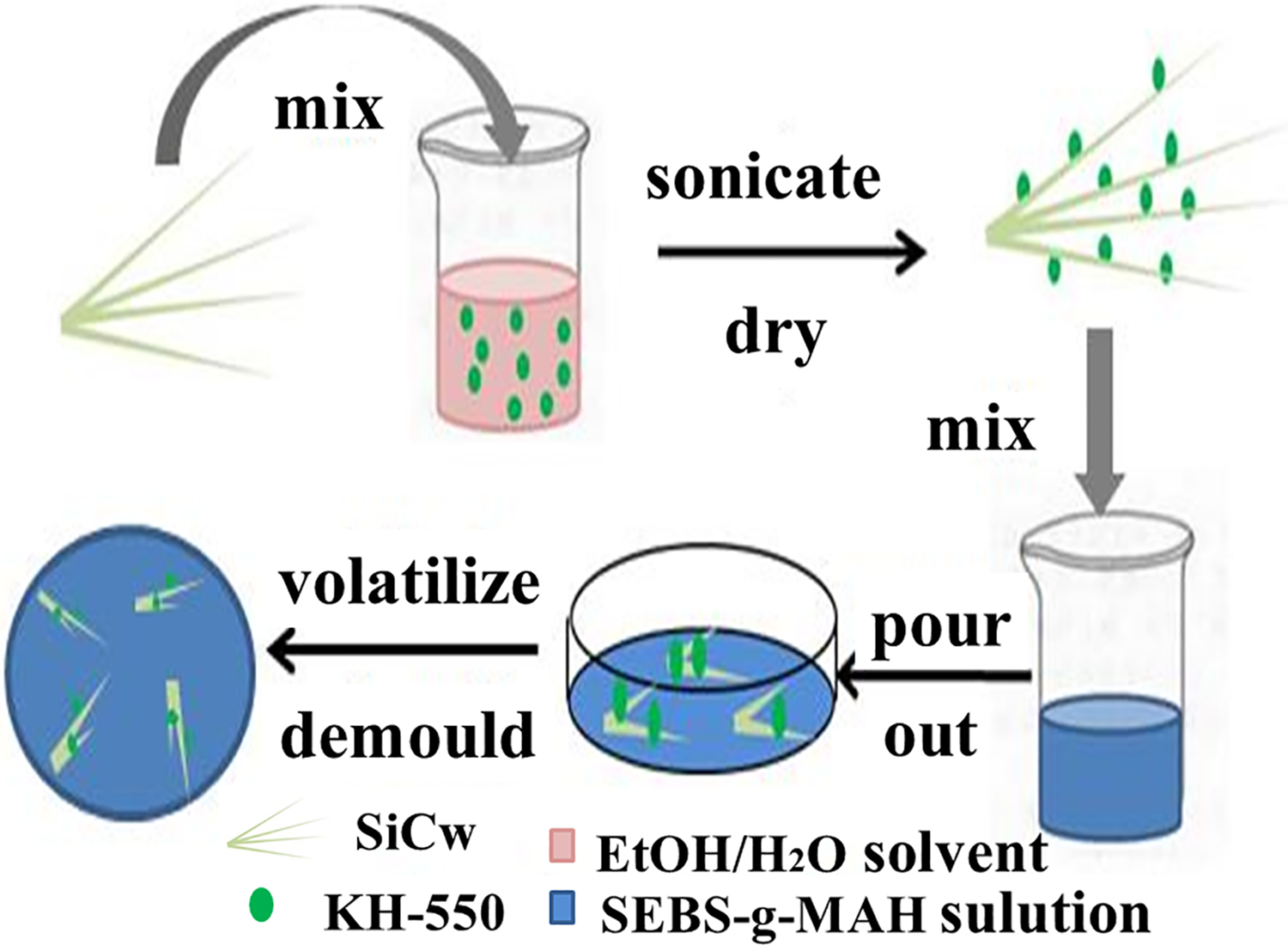
The preparation of SiCw/SEBS-g-MAH composite films.
Testing and characterization of composites
Fourier-transform infrared spectroscopy
Fourier-transform infrared (FTIR) test of unmodified SiCw and modified SiCw was conducted on a Perkin Elmer FTIR spectrum 100 (Perkin-Elmer Corporation, Fremont, CA, USA) at room temperature. The samples were prepared by using KBr pellet or film method and scanned within the range from 400 to 4000 cm−1.
Scanning electron microscopy
Scanning electron microscopic (SEM) images were taken on a Zeiss ATC-SCUT scanning electron microscope (EVO 18, Carl Zeiss, Jena, Germany). The dispersion of unmodified SiCw and modified SiCw in the polymeric matrix was observed visually throughthe SEM images.
Mechanical properties
The mechanical properties of the neat SEBS-g-MAH and composite films were tested by Automatic Control Electron Meter of AG 10TA at a crosshead speed of 50 mm/min, according to GB/T528-1998. The films were cut into dumbbell-shaped and the procedures were conducted at room temperature.
Thermogravimetric analysis testing
Thermogravimetric analysis (TGA) was carried out using a Mettler Toledo TG/DTA thermal analyzer (Mettler Toledo AG Corporation, Columbus, OH, USA) to measure the temperature of composite films to beginning losing mass. The experiments were performed in the range of 40–600°C at a heating rate of 10°C min−1 under nitrogen atmosphere. Before starting the testing, the samples were dried in the drying cabinet.
Contact angle testing
Contact angle was tested using Attension Optical Contact Angle Meter of Theta with pure water as probe liquid at room temperature. The higher contact angle indicates the surface of composite film has a better hydrophobicity
Results and discussion
FTIR spectroscopy analysis
For better understanding the change between unmodified SiCw and modified SiCw, FTIR spectroscopy had been employed to identify functional groups of SiCw before and after modifying. Figure 2 shows FTIR spectra of unmodified SiCw (curve a) and modified SiCw (curve b). As Figure 2 shown, a new absorption peak for modified SiCw appeared at 2922 cm−1, corresponding to C–H bond stretching vibration adsorption peak which derives from silane coupling reagent. The absorption at 1700 cm−1 was related to the bending vibration of N–H bond on the modified SiCw. The absorption at 1465 cm−1 was related to the bending vibration of C–H bond from silane coupling reagent. In addition, the peak intensity in the range of 1050 to 1300 cm−1 for modified SiCw increased, indicating that the content of O–Si–O group in modified SiCw increased. When comparing two curves we can find, the portion of the –CH2 group, O–Si–O group, and –NH2 group of silane coupling agent was successfully grafted to the surface of SiCw by covalent bond.

FTIR spectrum of unmodified SiCw (a) and modified SiCw (b).
Structure morphological characterization
In Figure 3(c), it was revealed that the SiCws without the modification of coupling agent were not dispersed well, even the whiskers happened agglomeration in the matrix. It is due to the size effect of micro whiskers and bad compatibility between polar SiCw and nonpolar polymer matrix. As Figure 3(d) shows, we can found that the crystal whiskers were reasonably dispersed well in the SEBS-g-MAH matrix at 2.5 wt% SiCw loading after modifying. Combining with the FTIR spectroscopy analysis above and comparing images in the Figure 3, it was indicated that the modification had enhanced interfacial binding of SiCw and SEBS-g-MAH and promoted the dispersion of SiCw in SEBS-g-MAH matrix.
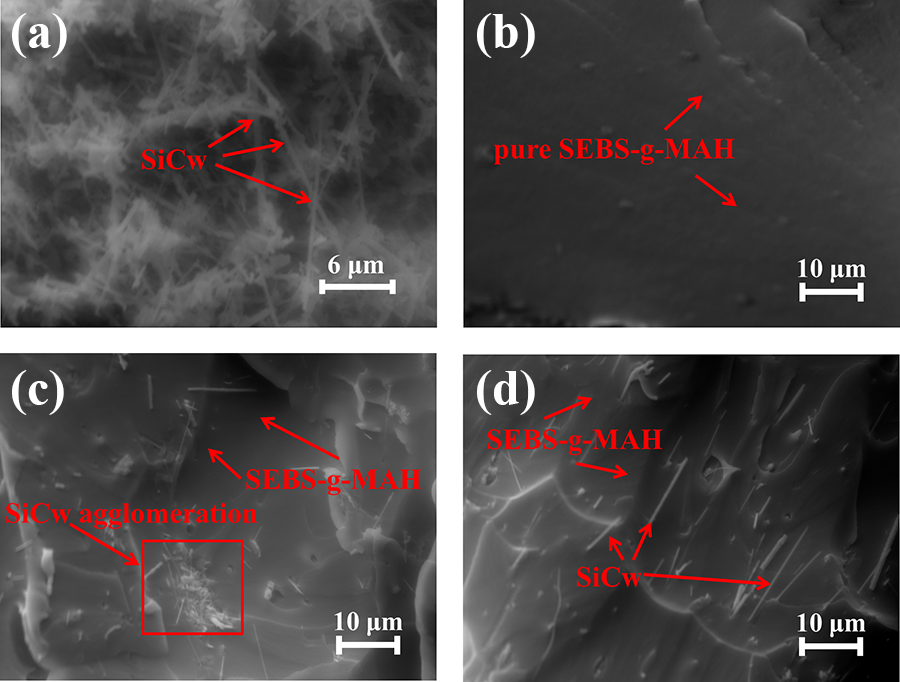
SEM images of pure SiCw (a), fracture surface of pure SEBS-g-MAH film (b), SEBS-g-MAH film with 2.5% unmodified SiCw (c) and SEBS-g-MAH film with 2.5% modified SiCw (d).
Mechanical properties of composites
The mechanical properties of SEBS-g-MAH composites are shown in Figure 4. In Figure 4(a), the tensile strength of unmodified SiCw/SEBS-g-MAH composites were decreased with increasing unmodified SiCw contents in the polymer matrix. On the contrary, the tensile strength of modified SiCw/SEBS-MAH composites were increased with increasing modified SiCw contents. Especially, with 2.5 wt% addition amount of modified SiCw, the tensile strength of composite increased by 30.76%, ranging from 19.05 MPa to 24.91 MPa. As the Figure 4(b) shows, the elongation at break of unmodified SiCw/SEBS-MAH composites were decreased sharply with increasing unmodified SiCw contents, ranging from 590.27% to 497.49%. For the modified SiCw/SEBS-g-MAH composites, the elongation at break of composite with 2.5 wt% content of modified SiCw decreased by 6.9%, from 590.27% to 549.58%. With comparison of the mechanical properties between unmodified SiCw/SEBS-MAH composites and modified SiCw/SEBS-MAH composites, the better properties of modified SiCw/SEBS-MAH composites were attributed to the fine dispersion of modified SiCw and excellent interfacial binding between modified SiCw and SEBS-g-MAH matrix. Combining with the analysis above, the modification of SiCw promoted the dispersion of SiCw in SEBS-g-MAH matrix and then enhanced the performance of the composites.
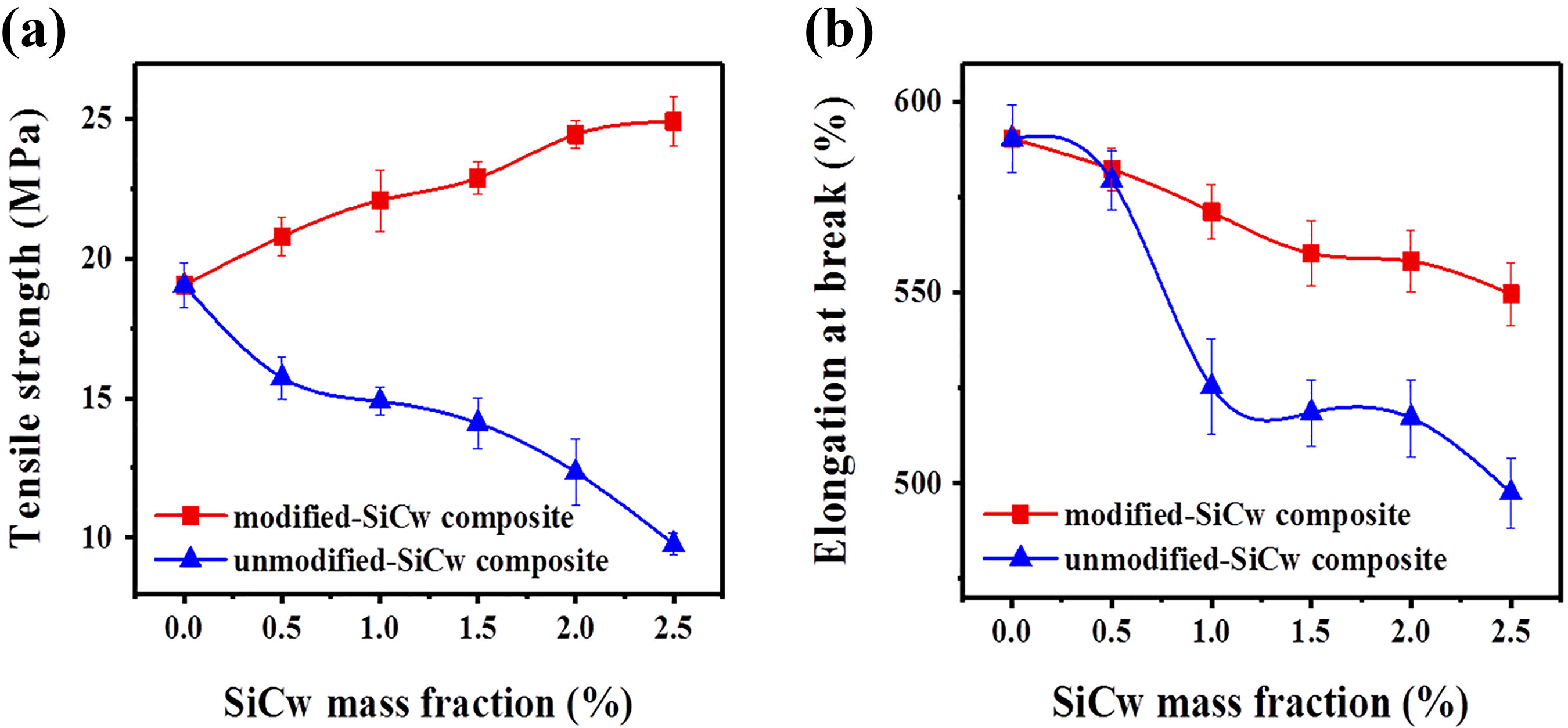
Influence of unmodified/modified SiCw mass fraction on tensile strength (a) and elongation at break (b) of composites.
Thermal analysis of composites
According to the analysis above, it was obtained that the modification of SiCw is essential to enhance the properties of the SEBS-g-MAH composites. For providing further evidence about the effect of modified SiCw within the matrix on the properties of composites, the thermal stability of composites as a function was measured. Figure 5 shows the TGA curves of SEBS-g-MAH composites with different contents of modified SiCw, ranging from 0% to 2.5%. It is shown that, with increasing contents of modified SiCw, the temperature of composites to begin to lose mass increased gradually. Comparing with the pure SEBS-g-MAH film beginning to lose mass at 365°C, the composite with 2.5% modified SiCw loss mass at 402°C, which have improved 37°C. The higher losing mass temperature of composite with 2.5% modified SiCw is attributed to the high thermal stability of SiCws.
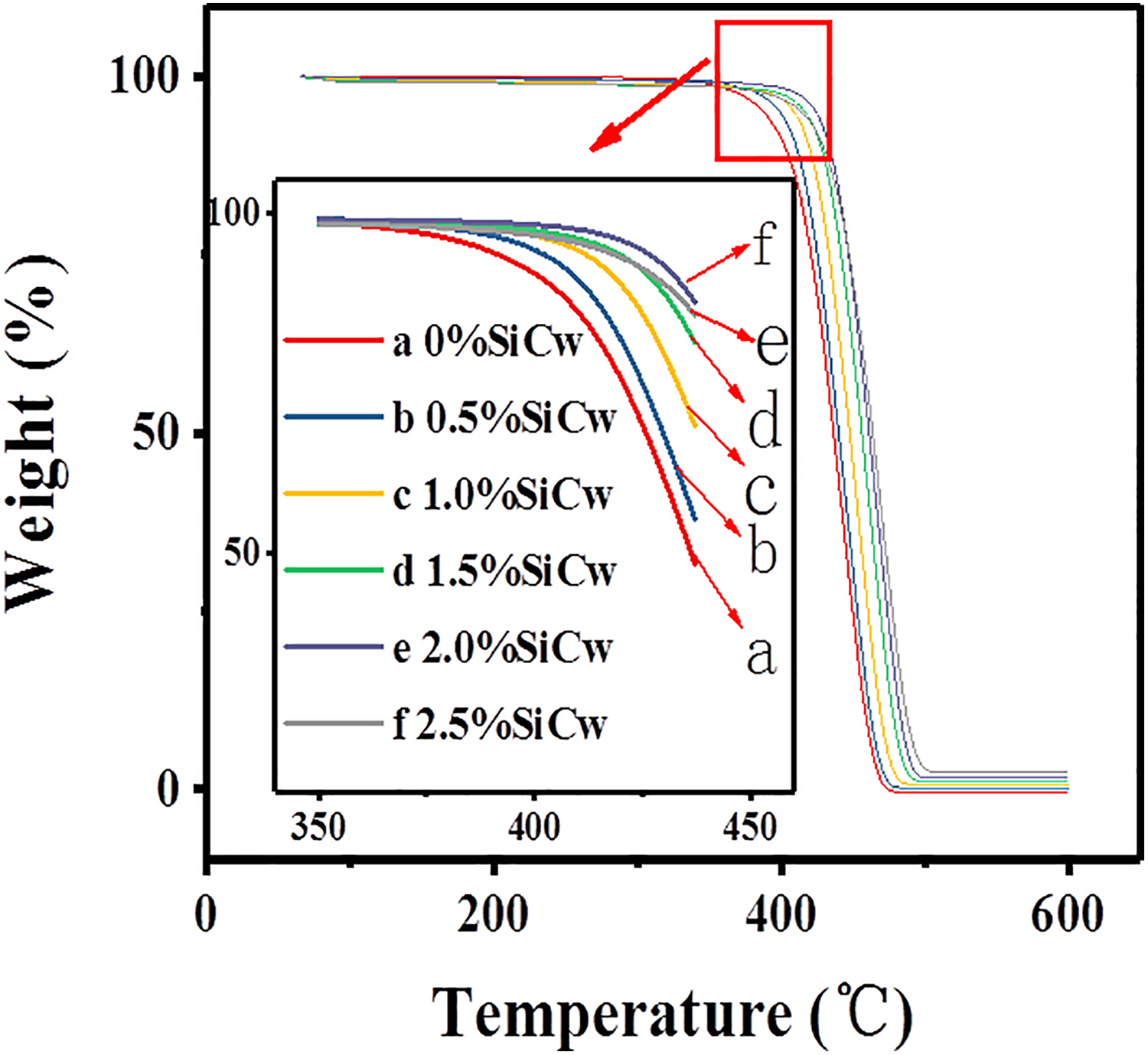
TG curves of SEBS-g-MAH composites with different mass fraction modified SiCw.
Surface properties of composites
The water contact angle on the surface of composite film was measured using water contact angle measurements and the result is shown in Figure 6. Lower surface energy against water the film has, higher contact angle the water droplet on the composite film displayed. The higher contact angle indicates the surface of composite film has better hydrophobicity. As the Figure 6 shown, with increasing contents of modified SiCw, the water contact angle on the surface of composite films were increased gradually, ranging from 65.56° to 91.57°, which explained the hydrophobicity of composites had been enhanced by 40%. Due to the presence of SiCw, the composite film had better hydrophobicity than pure SEBS-g-MAH film. On the other hand, silane coupling reagent could enhance the dispersion of SiCw in the matrix and thus improve the hydrophobicity of composite films.
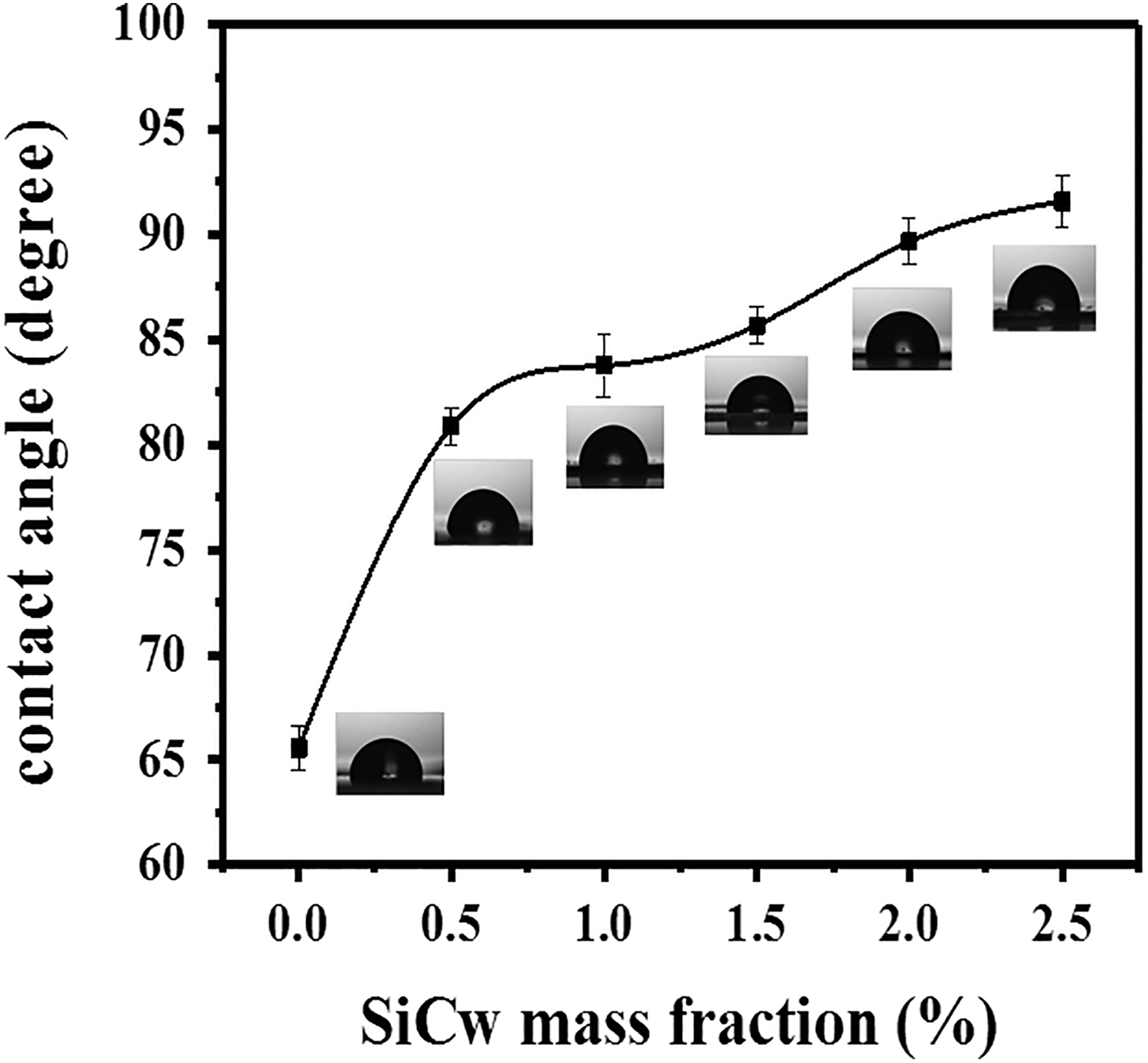
Water contact angle of SEBS-g-MAH composites with different mass fraction modified SiCw.
Conclusion
In this article, SiCw modified with silane coupling agent had a fine dispersion in polymer matrix comparing to the unmodified SiCw. It was known that the groups of coupling agent were successfully grafted to the surface of SiCw and thus enhanced the interfacial adhesion between SiCw and SEBS-g-MAH, and improved the properties of SEBS-g-MAH composites ultimately. While the tensile strength of modified SiCw/SEBS-MAH composites was enhanced by 30.67%, ranging from 19.05 MPa to 24.91 MPa, the elongation at break was decreased, from 590.27% to 549.58%. The mechanical property of unmodified SiCw/SEBS-g-MAH composites had weakened sharply with increasing addition amount of fillers. Thermal stability of composites was improved with increasing the filler loading level and the pyrolysis temperature of composites to begin to loss mass increased gradually, ranging from 365°C to 402°C. Compared with the pure SEBS-g-MAH film, the hydrophobicity of composites with 2.5% SiCw had been enhanced by 40%, from 65.56° to 91.57°. SiCw has high intensity, outstanding thermal stability and electrical insulating property which conform to the application requirement of insulating material. The SEBS-g-MAH composite reinforced by functional SiCw is expected to apply for LED or LCM circuit protection due to its excellent comprehensive properties.
Footnotes
Author contributions
Xiaoyan Pang and Weijie Liang contributed equally to this work.
Declaration of conflicting interests
The author(s) declared no potential conflicts of interest with respect to the research, authorship, and/or publication of this article.
Funding
The author(s) disclosed receipt of the following financial support for the research, authorship, and/or publication of this article: This work was supported by the Special Funds for Applied Science and Technology Research and Development of Guangdong Province (2015B090925022), Guangdong Public Welfare Fund and Ability Construction Project (2016A010103037), Graduate Science and Technology Innovation Fund of Zhongkai University of Agriculture and Engineering (NO.KJCX2018007), Guangzhou Innovation and Entrepreneurship Project (No. 2017104205).