




Abstract
Knitting is a very important textile sector in the area of technological development and also for the economy. The knitted have special characteristics that allow their use in different situations. To use them with better use, it is important to know what these properties are and so apply them for a particular purpose. This work investigates several types of knitted 100% cotton and blend 67% cotton/33% polyester and evaluates its behavior when subjected to mechanical analysis (friction, abrasion, and traction) under the respective standards ASTM D 4970 adapted to ISO 12945-2 and ASTM D 5034. The obtained results show that, for the mechanical properties analyzed, the types of loops present in the structure and the composition of the knitted are fundamental factors for optimizing stress and strain as well as reducing mass loss and the propensity to pilling formation. The double piquet structures have a higher sensitivity to the tests, especially when we insert the polyester synthetic polymer that significantly alters the mechanical behavior.
Introduction
Textile knitting is the branch of the industry that produces fabrics as from loops formed substantially across the width of the fabric and is called “knitting.” There are basically two types of knit fabrics: warp knitting and weft knitting. The weft knitting has a simpler structure than warp knitting and is characterized by the fact that each yarn feeds all the needles in the loom, in an angle of more or less 90° in the direction in which the fabric is produced. This method is more versatile in terms of the variety of products and the type of yarn used. 1 –3 The use includes a variety of purposes, from clothing to technical articles, due to their special features. In general, weft knitting is flexible, elastic, porous, and soft, allowing wide use and arousing the interest of various technological areas. The basic knitting structures are Jersey, Rib, and Reverse Point. The points, in turn, can be simple, reversed, omitted, and retained. 4 –6 Depending on the structure and type of stitch used, these textiles can have combinations of properties. 5,7,8 According to Anand SC, the main factors that affect how knitted fabric per weft are lace length, a linear yarn density, relaxation/finishing path, fabric structure, and the fiber type. 1,9 Therefore, a combination of variables will result in knitted with different properties. However, by changing only the type of fiber used in a structure, the properties are also modified. According to Au, 9 a simple knitted structure (single jersey) made with a fiber type and the same knitted structure with other fiber will have different properties. The aim of this work is to study the influence of structure and composition in the mechanical properties of polymeric knitting fabrics (cotton and polyester blend), produced in one weft knitting machine. Thus, this article contributes to an update of the literature on knitting, for other scientific works, and is also a material that assists in the best choice of the textile article for a given application.
Materials and methods
Samples
The needles diagram, technical face, and technical back of all the samples were shown in the Figure 1.

Aspect of the knitted structures.
For each structure, two different compositions were used, totaling six types of samples. These were submitted to three different tests (pilling test, abrasion, and tensile), using five samples each. For each sample, therefore, 15 specimens were used.
Preparation of samples
The adapted ISO 105-C03 standard was used. Initially, the 15 specimens of each sample were washed at a temperature of 60°C for 30 min, with 2 g/L of detergent powder and 1:40 bath ratio. Thereafter, the samples were dried at 95°C for 1 h and conditioned at rest under a standard atmosphere for 3 days.
Grammage
The grammage was calculated by weighing five specimens of each sample, and the result was done considering the standard deviation as shown in Table 2. The standard used was ASTM D 3776/3887.
Specifications of the samples with cotton (CO) and polyester (PES).

Samples grammage with cotton (CO) and polyester (PES).

Pilling test
For this test, the standard of ASTM D 4970 was adapted to ISO 12945-2. The method used was “Martindale.” This is a test where five specimens of each sample are subjected to friction against a standard wool fabric, making movements called “lissajour.” The total number of cycles used was 2000 with small stops at each 100 cycles to perform a visual evaluation. The pressure used was 9 kPa in each sample.
Abrasion or loss of mass
This analysis consists to evaluate the abrasion resistance of knitted fabrics, and the “Martindale”method used 2000 cycles of lissajour movements, with a pressure of 9 kPa in 5 specimens for each sample. However, there was no stopping every 100 cycles, since the mass loss is minimal in this interval. In this way, after the 2000 cycles, the mass losses of each sample were calculated.
Tensile test
This test was performed by the “Strip” method using the “Dynamometer” test apparatus. The five specimens of each sample were cut out in the dimensions 2 × 6 inch2, approximately, in the directions of the wales and courses. After that, they were subjected to traction until the sample rupture. The equipment generates a stress–strain graph that can be discussed. The standard used was ASTM D 5034.
Results and discussion
Propensity tests for pilling formation
Assays were performed comparing the compositions and structures. The level of pilling formation varies from 5 to 1. The higher this value, the lower the formation of pilling, and vice versa. Figure 2 shows the results obtained by pilling formation assay.
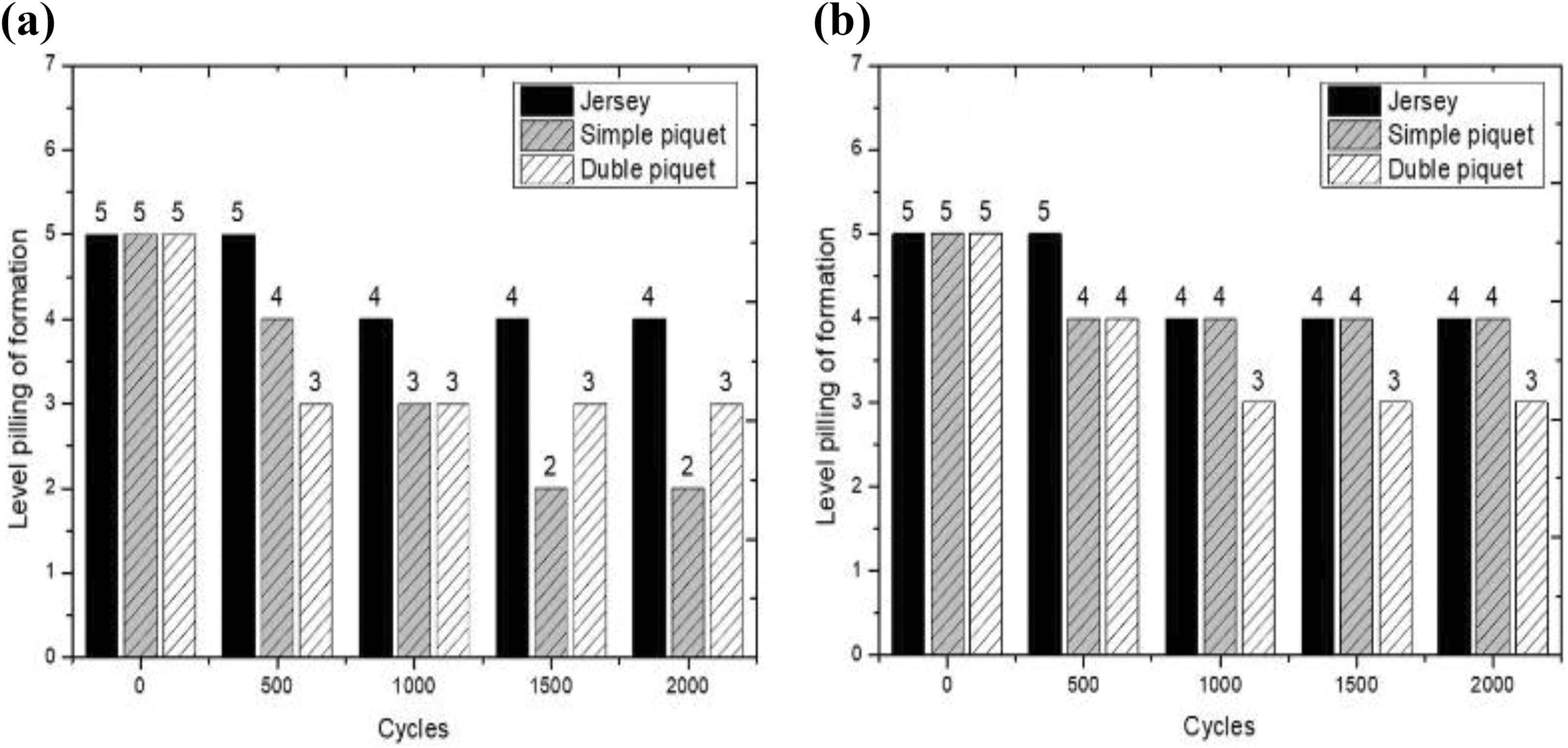
Structural pilling formation test (a) with 100% cotton and (b) with 67% cotton and 33% polyester.
Analysis of the influence of the composition on the propensity to pilling formation from the analysis of the results present in Figure 2.
Through the obtained results, we see that the jersey structure is not influenced by its composition. This can be explained because of its smooth surface that, as a consequence, is responsible for the low friction at the knitted/woven wool interface. The simple piquet drastically varies the formation of pilling when we change its composition. The presence of the polyester in knitted increases the resistance, because of the characteristic of that fiber. Double piquet is not so influenced by composition. However, its surface has more loaded points than the simple piquet, allowing fewer points of superficial contact with the woolen fabric. In this way, there is not so much detachment of fibrils.
Analysis of the influence of the structure on the propensity to pilling formation, from the analysis of Figure 2.
The jersey structure presented the best pilling results. Therefore, we perceive the strong relation of this structure to the resistance of the surface.
The double piquet also maintained its property in pilling formation, regardless of its composition. On the other hand, it shows the strong relationship with its structure.
The simple piquet, in turn, presented little influence of the structure in the formation of pilling. Its structure has surface regularity, due to the low presence of retained points. In this way, the composition (67%/33%; see Figure 2(b)) becomes more significant than the structure.
Abrasion test
This test was performed comparing the structures and compositions, as shown in Figure 3.

Abrasion test of structures (a) with 100% cotton and (b) with 67% cotton and 33% polyester.
Analysis of the influence of the composition on abrasion, from the analysis of Figure 3(a).
We noticed that in the specimens 100% cotton, the composition shows less or nothing relevant, because the results are very proportional. In the 67%/33% test specimens, the mass loss is generally smaller than in 100% cotton knitted. This means that the polyester fiber has good abrasive resistance properties. Thus, we have that the composition is a factor of high importance for flat-knitted fabrics, subjected to abrasive efforts.
Analysis of the influence of the structure in the abrasion, from the analysis of the graphs present in Figure 3(b).
The abrasion tests, for the structures with the presence of cotton in its totality, show the high dependence of the flat-knitted fabric structure on the loss of mass, because for the three structures studied, the results are quite similar. The abrasion tests for structures with 67%/33% show high interference of the structure in the loss of mass, because the results are different. This can be explained by the distribution of the composition, in each mesh, if presented differently, because of the different knitting points that make up the fabric geometry (in this case, fang and normal). In general, the 100% cotton knitted presented with greater loss of mass, in relation to the mixture. When we work with fibers with low abrasion resistance, we have high mass loss, regardless of the geometry of flat-knitted fabrics. However, when it comes to fibers with high abrasion resistance, the choice of structure directly influences the loss of mass.
Tensile tests
Figures 4 and 5 of the tensile tests indicate the influence of structure and composition on stress–strain results.

Stress–strain in 100% cotton composition.
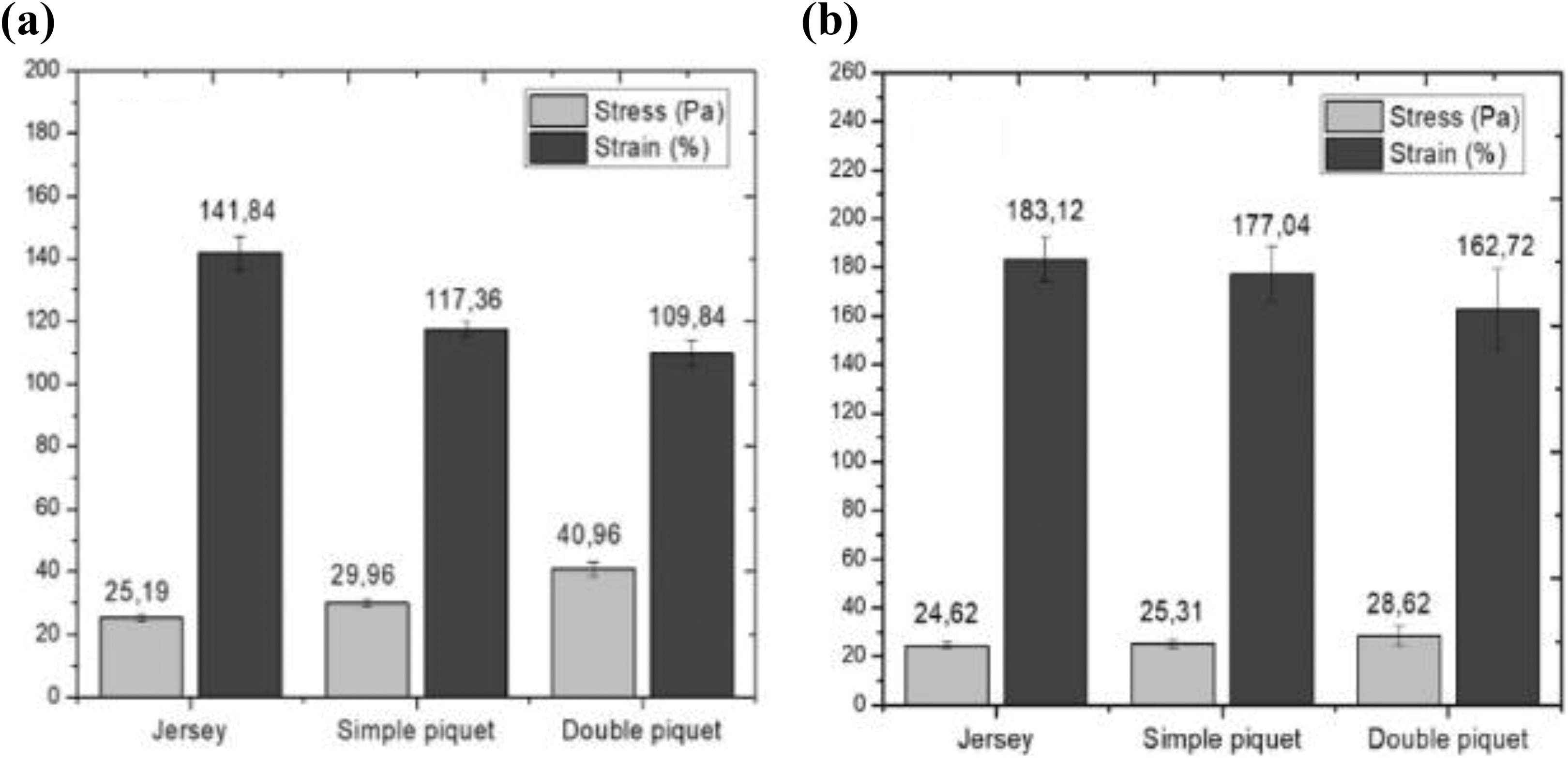
Stress–strain in composition 67% cotton and 33% polyester.
The tests submitted in the flat knitted structures in the direction of the courses Figures 4(a) and 5(a) show that, for the structures jersey, simple piquet and double piquet, the geometry, and the loop involved provoke significant increase in the stress and decrease in the strain of both structures. This occurs principally in the jersey, because the normal loops in the structure allow the sliding of the loop. Thus, a smaller rupture stress occurs. Of all the structures, the double piquet begins to receive tension first, and in this way, it is the first to break, which occurs because its structure has several retained loops, contributing to its fragility, as shown in Figure 4(a). Soon after, the simple piquet begins, which has mechanical behavior similar to double piquet. However, stress values are minimal, because the density of the retained points is lower than the double piquet. Figures 4(b) and 5(b) show that the mechanical behavior in the direction of the wales is evidenced for structures that, in their composition, have more points retained, because this makes the structure more “tied” and, in turn, more resistant. In the direction of the wales, there are significant reductions in strain, that is, in this direction, a greater sensitivity or favoring for the slippage of the loops. Again, we observe that for both structures jersey, simple piquet, and double piquet, the geometry and the loops involved provoke significant increase in stress and decrease in the strain of both structures. It is also possible to observe that the efforts in the direction of the wales do not have a total dependence on the composition but on the loops that compose the geometry of the structure of the fabrics of flat knitted.
Figures 4 and 5 show a mechanical improvement in the strain, which is superior to that obtained with the cotton fiber in both direction (courses and wales), adding approximately one-third of synthetic material in the flat-knitted composition, it is possible to obtain a significative increase of the strain supported by the material. Thus, it is highly linked with the polyester percentage composition in the knitted, since the elongation of a cotton yarn is approximately eight times smaller than the polyester, whereas the elongation for a knitting yarn is less than 5%; this, moderately and negatively, affects the stress of the material, and in this way, the structural composition of the knitted directly influences the mechanical behavior or is a factor that predominates over the geometry of the knitted (types of loops involved). The loss of stress in the direction of the wale is related to polyester fibers to be highly deformable with respect to the cotton and to become less susceptible resist to stress in all the geometries, since, in this direction, the loops have high sliding (Figure 5(b)). The moderate stress observed in the direction of the courses is related to the formation of a semicircle, making it less deformable, causing a significant stress to the structures with greater amount of ponts retained (simple piquet and double piquet; Figure 5(a)).
Conclusions
After the tests were carried out, we noticed that the composition and the structure are fundamental factors for the mechanical behavior of flat-knitted fabric structures. For the propensity tests and the formation of pilling, it was evidenced that the structure has greater relevance than the composition. This is because the smoother the surface, the lower the possibility of the fabric forming pilling. In the abrasion tests, the main variable is the composition. More abrasion resistant yarns improve the results of mass loss, which not totally depend on the geometry of the structure but on the fiber that composes it. Firstly, to obtain significant results in the tensile tests, it is necessary to understand the points that constitute the structure, the direction of the effort, and the composition. However, the structure becomes a prime factor for the results of the stress and the increase of the peak of strain occurs with greater intensity as a function of the composition, that is, the stress is influenced on the composition and the strain of the nature of the fiber that compose the flat-knitted fabrics.
Footnotes
Declaration of conflicting interests
The author(s) declared no potential conflicts of interest with respect to the research, authorship, and/or publication of this article.
Funding
The author(s) received no financial support for the research, authorship, and/or publication of this article.