



Abstract
In this article, we report a robust strategy to prepare polymer composites with enhanced thermal conductivity and mechanical properties for geothermal heat pump pipes, in which high density polyethylene (HDPE) used as matrix, various inorganic fillers including zero-dimensional (0D) aluminium spherical particles (Al-SPs), one-dimensional (1D) carbon fibres (CF) and two-dimensional (2D) graphite platelets (GPs), used alone or blended as modifier. The as-prepared polymer composites are GPs/HDPE, GPs/CF/HDPE, GPs/Al-SPs/HDPE and GPs/CF/Al-SPs/HDPE. Thermal conductivity and mechanical properties of these polymer composites were characterised. The results indicate that of all these as-prepared polymer composites, GPs/CF/Al-SPs/HDPE composites are the only one which possesses preferable and comprehensive properties both in thermal conductivity and mechanical properties due to the synergistic effect of filler. The thermal conductivity, elongation at break and tensile strength of GPs/ CF/Al-SPs/HDPE composites prepared with GPs (9 wt%), CF (3 wt%) and Al-SPs (3 wt%) were 0.803 W m−1K−1, 70.6 % and 26.69 MPa, respectively, which could meet the commercial requirements of the geothermal heat pump pipes.
Introduction
Due to the energy crisis, green energy has been attracting more and more attention1,2. Geothermal heat pumps system for heating or cooling in residential and commercial buildings is a new, green and energy-saving method, which can store the extracted heat from conditioned buildings for cooling or release heat into conditioned buildings for heating. About 3 or 4 times more energy for heating or cooling will be produced from one unit of electrical energy by the using of geothermal heat pumps system3. A significant component of the geothermal heat pump system is the heat exchange pipes, which decide the efficiency of the heat pump, and has become the subject of intensive engineering evaluations 4 . In practical application, thermal conductivity of the pipes plays an important role.
In the geothermal heat pump system, the heat exchange pipes composed of high density polyethylene (HDPE) were the first choice due to their chemical stability, high tensile strength and elongation at break 5 . However, compared to the thermal conductivity of commercial heat pump pipes, which is 0.75 W m−1K−1 at least6,7, the thermal conductivity of HDPE, which just varies from 0.2 to 0.4 W m−1K−1, is too low. In order to achieve enough efficiency of heat pumping pipes, the thermal conductivity of HDPE composites must be enhanced and heat conduction modification of HDPE composites is a good way.8–11.
Thermally conductive polymer composites typically comprised polymer matrix and conductive fillers12,13. In the published literature, the combination of different dimensional fillers was reported to achieve a preferable and comprehensive performance in both thermal conductivity and mechanical properties14–19. Luan et al. 15 reported that by combining 2D chemically reduced graphene (CRG) with 1D Ag nanowires (NWs), the thermal conductivity and mechanical properties were improved due to chemical and physical crosslinking effects between nano-structures and polymer chains. Kim et al. 16 combined expanded graphite (EG) and highspeed crusher treated EG (wEG) to prepare a series of polymer composites and observed a synergistic effect on the enhancement of thermal conductivity, which caused by the formation of efficient thermally conductive pathways due to the hybrid of the differently sized. Tian et al. 18 prepared thermally conductive polymer composites, in which paraffin and EVA were used as matrix, and mixed fillers of two-dimensional expanded graphite (EG) and one-dimensional carbon fibre (CF) used as heat conduction modifiers. The results indicate that EG and CF have synergistic enhancement to thermal conductivity of polymer composites. Ren et al. 19 studied thermally conductive composite film based on combination of silicon carbide (SiC) and linear low-density polyethylene (LLDPE) by powder mixing and hot press moulding, and the results demonstrate that thermal conductivity of polymer composites depends on the different dimensions of SiC particles strongly. The current research paid much attention to thermosetting resins as materials in electronic products, but few researches on heat pump pipes were reported.
In this paper, we report research on HDPE polymer composites with enhanced thermal conductivity and mechanical properties for geothermal heat pump pipes. The effects of different hybrid fillers, such as Al-SPs, CF and GPs, which added alone or in combination to generate a synergistic effect on the enhancement of thermal conductivity and mechanical properties of polymer composites, were studied in detail. Compared with the previous studies10,20,21, this is a robust strategy to prepare polymer composites with enhanced thermal conductivity and mechanical properties for geothermal heat pump pipes. Due to the synergistic effect between differently dimensioned fillers, the as-prepared GPs/ Al-SPs/CF/HDPE composites have excellent thermal conductivity and mechanical properties, which can meet the commercial requirements of the geothermal heat pump pipes. As such, it stands out as a promising method to prepare polymer composites with excellent comprehensive properties including thermal conductivity, especially used in the fields of geothermal heat pump pipes.
Experimental
Materials
HDPE with trade mark 2200J was produced by Yangzi Petrochemical Company. Al spherical particles were supplied by Tianjin lung Ying Da Trade Co., Ltd. and its average diameter was 30 μm. Colloidal graphite platelets were provided by Shanghai Yifan graphite Co., Ltd. and its average diameter was 10 μm. Carbon fibre was produced by TORAY Industries Inc, Japan, and its average diameter and length were 10 μm and 2 mm, respectively. Aluminate coupling agents were provided by Nanjing Shuguang Chemical Group Co. Ltd. All the materials were commercial grade products and were used without further purification.
Surface Modification of Fillers
Surface modification of fillers was carried out with aluminate coupling agents. After drying for 2 h at 100°C, the fillers were added into a high-speed mixer (SHR-10A, Zhangjiagang Baer Machinery Co., Ltd.) and heated to 80°C, then the aluminate coupling agents were directly added into the high-speed mixer within 3 min. The mixture continued to mix for 2 min. The final fillers with surface modification were obtained after the fillers had been put in the oven at 80°C for 2 h.
Composites Preparation
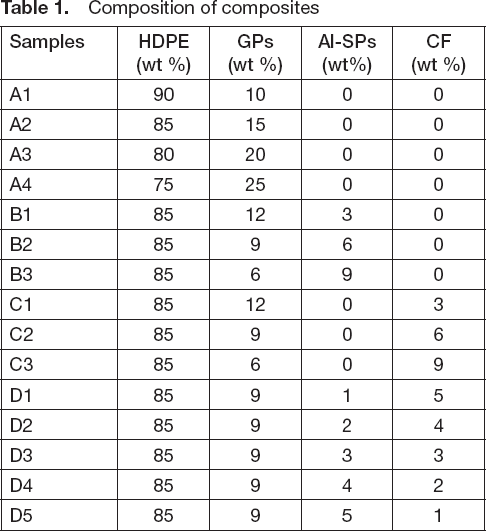
HDPE and modified fillers were mixed in a high-speed mixer at room temperature for 10 min according to recipe of
Composition of composites
Composition of composites
The mechanical properties, including tensile strength and elongation at break of polymer composites, were measured by universal testing instrument (CMT4304, Shenzhen Xinsansi material detection Co., Ltd.) according to ISO527/1–1993(E). The test speed was 5 mm/min and the specimen length between benchmarks was 50 mm. The fracture surface of polymer composites was examined with a scanning electron microscopy (SEM) (JEOLJSM-5900LV, JEOL Ltd., Japan). The thermal conductivity was measured by a Hot Disk instrument (TPS 2500S, Hot Disk Ltd., Sweden) according to ASTM E 1461–01.
Results and Discussion
GPs/HDPE Composites

Mechanical properties of GPs/HDPE composites

Thermal conductivity of GPs/HDPE composites
SEM images of GPs/HDPE composites are shown in

SEM images of GPs/HDPE composites as a function of the GPs contents: (a) 10 wt%; (b) 15 wt%; (c) 20 wt%; (d) 25 wt%
In the GPs/CF/HDPE composites, the total loading of hybrid fillers was 15 wt%.

Mechanical properties of GPs/CF/HDPE composites
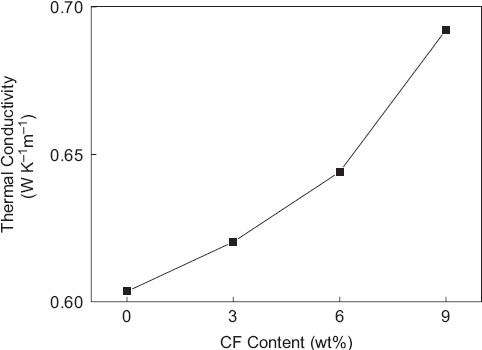
Thermal conductivity of GPs/CF/HDPE composites

SEM of GPs/CF/HDPE (9 wt%/6 wt%/ 85 wt%) composites
In the GPs/Al-SPs/HDPE/composites, the total loading of hybrid fillers was 15 wt%. In

Mechanical properties of GPs/Al-SPs/HDPE composites
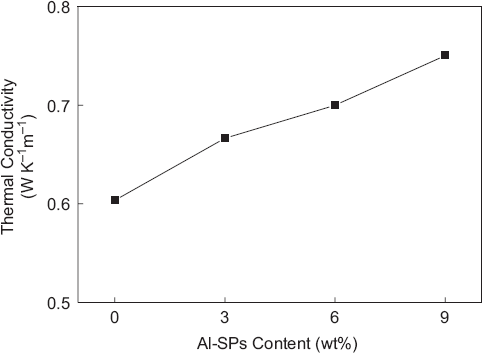
Thermal conductivity of GPs/Al-SPs/HDPE composites
As the content of GPs was 15 wt% in GPs/HDPE composites, GPs were separated in the polymer network, so the large distances among GPs introduced a large thermal resistance
23
. The diameter of Al-SPs was larger than that of GPs. It can be noticed in the SEM images (

SEM images of GPs/Al-SPs/HDPE (9wt%/ 6wt%/85wt%) composites
In GPs/CF/Al-SPs/HDPE composites, the total loading of hybrid fillers was 15 wt% and the loading of GPs was 9 wt%. In
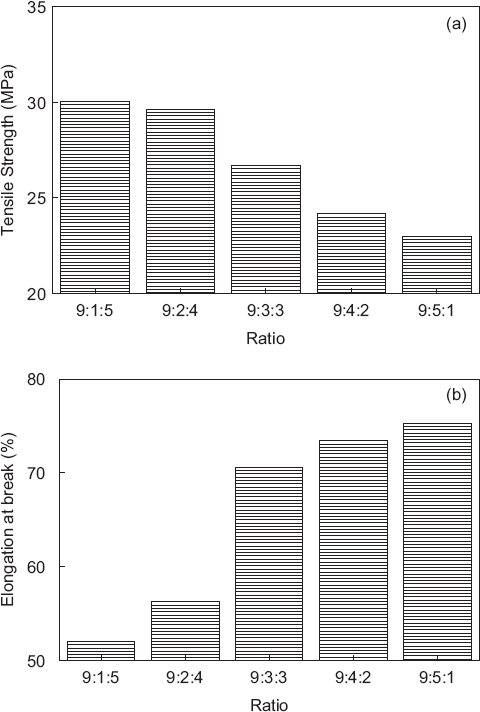
Mechanical properties of GPs/Al-SPs/CF/ HDPE composites. X-axis is the ratio of three contents of Gps, Al-Sps and CF in the GPs/Al-SPs/CF composites. (a) Y-axis is tensile properties; (b) Y-axis is elongation at break

Thermal conductivity of GPs/Al-SPs/ CF/HDPE composites. X-axis is the ratio of the three contents of Gps, Al-Sps and CF in the GPs/Al-SPs/CF composites
The SEM images (
In this paper, polymer composites based on HDPE and different hybrid fillers and possessing enhanced thermal conductivity and mechanical properties for geothermal heat pump pipes, were prepared and investigated. With increasing content of GPs in GPs/HDPE composites, the tensile strength and the thermal conductivity were enhanced, but the elongation at break decreased a lot. The introduction of CF into GPs/HDPE composites could enhance the thermal conductivity and the tensile strength of GPs/CF/HDPE composites, but the elongation at break had a sharp decrease. Al-SPs were introduced into GPs/HDPE composites to form effective Al-SPs/GPs “thermally conductive islands” to improve the thermal conductivity of the GPs/ Al-SPs/HDPE composites, but the tensile strength decreased. When GPs, CF and Al-SPs were combined in GPs/HDPE composites, due to the synergistic enhancement, the thermal conductivity, elongation at break and tensile strength of GPs/CF/Al-SPs/HDPE composites prepared with 9 wt% of GPs, 3 wt% of CF and 3 wt% of Al-SPs have the optimal comprehensive performance and meet the commercial requirements of the geothermal heat pump pipes.

SEM images of GPs/Al-SPs/CF/HDPE (9 wt%/3 wt%/3 wt%/85 wt%) composites
Footnotes
Acknowledgements
The authors would like to thank the Anhui Guotong Company for providing HDPE and thank the Analysis and Test Centre of Hefei University of Technology for testing facilities.