



Abstract
The purpose of this study is to investigate a novel exploitation approach for a mass livestock byproduct, namely sheep wool fibres. In order to fulfil this aim, wool fibre toughened epoxy composites with an amount of 2.4, 4.1 and 5.7 phr were prepared via the hot press method. Initially, mechanical assessment of the composites was executed, in order to evaluate their mechanical integrity. The flexural and shear strength tests showed that the wool fibre-epoxy composites maintain their mechanical properties for up to 4.1 phr and no degradation is detected. Subsequently, the thermal properties were tested. Thermogravimetric analysis proved that adding wool fibres as toughening agent in epoxy matrix can prolong the endurance of the material while reaching high temperatures. The coefficient of thermal conductivity decreased by 30% compared to neat epoxy, something that is also confirmed through simulation, proving that wool fibre-epoxy composites can be considered as a promising insulating material, while exploiting a natural waste.
Keywords
Introduction
Nowadays, there is a global intention to exploit all means of byproducts and waste, since they can be reused as resources to promote circular economy. 1 Composite materials play a major role to this approach, since they can soak up large amounts of wasted materials as reinforcement. Recent studies have focused on the exploitation of food waste,2,3 construction and demolition waste 4 and on natural byproducts such as wheat straw.5,6
This interest has been motivated from the fact that conventional and advanced composites exhibit limited recyclability and end of life disposal alternatives, provoking serious environmental concerns. 7 The resulting composites have similar properties to corresponding construction or insulation materials, while reducing environmental impact with natural fibres as reinforcement. 8
Sheep wool is a material widely used in clothing manufacturing process and textile industry. Except for the main wool production coming from pure Merino sheep and its crosses and ending up to the wool textile industry, large amounts deriving from coarse or semi-coarse type sheep bred in South Europe and Mediterranean countries do not have the proper quality for textiles. 9 As these breeds belong to the dairy type their mean diameter fibres are not suitable for garment industry. These vast sheep wool quantities can be considered to be a renewable resource as they are produced annually and discarded to the environment. In Greece approximately nine million heads of dairy sheep are sheared once a year at the beginning of summer contributing with an amount of approximately 13,000 tonnes discarded in landfills or burned at site of production thus increasing the environmental charge of the farms. 10 The abundance of fleece all over the world indicates the extended fields of application. 11
The idea of using wool for the manufacturing of composite materials is ecological and environmentally friendly, since it promotes recycling. 12 The innovative use of wool could be a promising marketing tool and an easily reliable raw material. Additionally, alternative applications of the wool may lead to a new entry in the market, transforming it to a worthy and profitable competitive product, in comparison with industrial insulating materials. 13
There is a variety of studies, which try to promote the use of sheep wool in composite materials. Especially, different forms of wool (tissue and fibre mat) were used as toughening agents in epoxy matrix in order to evaluate the mechanical performance of composites. 14 Another research concentrated on composite materials with different compositions between wool and epoxy, which were characterized chemically and physically. 15 A study of KN Bharath et al., tried to achieve the maximum efficiency of toughness design (of composite materials) through the failure analysis. 16
A new prospect which promotes the wool as an alternative toughening agent in composites for insulation, is examined in this study. Specifically, the wool from the Greek sheep breeds with coarse wool type, Kalarritiko and Katsika, were chosen for investigation. Taking into consideration that fibres can affect the mechanical properties of composite materials, flexural and shear strength tests were conducted. Wool fibres exhibit a very low coefficient of thermal conductivity, 17 so the insulating behaviour of the composites was also tested. The total cost of the final composite material is low, since there is a large amount of sheep wool that is discarded and remains untapped. This work tends to prove that wool is a valuable and environmentally friendly solution for insulation and industrial use applications.
Materials and methods
Materials and equipment
A two-part resin system was purchased from Neotex that cures in about 3–4 hours approximately at 25°C and a full hardening of 7 days. Epoxol 2874 is a set of epoxy resin and hardener that form the matrix of the manufactured composite materials. The mixing ratio was 100 parts per weight of Epoxy resin with 58 parts per weight of hardener. Wool samples were collected from two different Greek sheep breeds; Kalarritiko and Katsika. A hydraulic Hot-Press (Carver, Model 3856 CE) was used for the manufacturing of composites.
Preparation of wool
The samples were obtained from 34 different sheep (15 from Kalarritiko and 19 from Katsika). The Kalarritiko breed has mainly white coloration, excluding the face, the ears and the feet which have red shades. Its name came from a Greek village, in Ioannina, the village of Kalarrites. The wool production ranges between 1.0 and 2.3 kg per sheep. 18 The Katsika breed has white coloration, apart from the ears, the eyes, and the feet which have black tones. Also, the name of the breed derives from a Greek village, Katsika, which is in the same region with Kalarritiko (Ioannina). The total wool production is about 1.5 to 2.0 kg per sheep. 19
The wool was washed for 15 minutes inside a glass beaker with hot water 40°C and detergent, to remove impurities and dirt. The clean wool was rinsed for 5 min in order to remove any detergent leftovers and left to dry at room temperature for at least 24 hours. Figure 1 demonstrates the washing and drying of sheep wool.

Washing and drying of sheep wool.
The dried wool was mechanically trimmed to 1 cm long bundles with 24.5 cm long shears provided by Easy Composites (UK), in order to achieve a uniform distribution of the wool fibres in the matrix of the composite materials.
Characterization methods
Τhe diameter of the wool was examined with an OLYMPUSSX40 optical microscope and OLYMPUSDP71 camera. 20 The figure editing was accomplished with Cell Image Analysis software.
The flexural and shear tests on the manufactured composites were performed using a compression force dynamometer (Tiedemann Instruments). 21
The thermal behaviour of the composite materials was characterized via thermogravimetric analysis using a TG Apparatus (STA 449 F5 Jupiter), at a heating rate of 20°C/min in nitrogen atmosphere (50 ml/min) and 30 mg of composite. Before each experiment, the instrument was calibrated both for temperature and sensitivity.
The thermal insulating properties were evaluated by measuring the coefficient of thermal conductivity, (k). An appropriate device was constructed in our laboratory, whereas the principle of the measurement is based on the corresponding method of ASTM C177. 22
For the simulation of the insulating specimens, COMSOL Multiphysics version 5.3 software environment was used.
Composite manufacturing and mechanical testing
Shredded wool fibres from both breeds were used to prepare the test specimens. Taking into account relative studies, 13 2.4, 4.1 and 5.7 phr of wool was selected to be used as toughening agent for the composite materials. Seven different samples were prepared, Neat Epoxy as the reference sample, Kalarritiko (2.4/4.1/5.7) and Katsika (2.4/4.1/5.7), that can be summarized in Table 1.
Formulations of prepared samples.

In order to evaluate the mechanical performance of the composite materials and compare them to neat epoxy, five specimens were manufactured, according to the dimensions instructed by the standards.23,24 The corresponding quantities of epoxy resin and wool fibres were mixed and purred in a metallic, matched die, open on sides mould that ensures uniform distribution of wool fibres in the matrix by applying pressure on top, thus removing any excess or disproportions from its open sides. Subsequently, the mould is placed in hot press (at 40°C–17.5 MPa pressure) for curing. 40°C corresponds to a 28–30°C inside the mould and it was necessary to avoid the delay of curing due to low temperature in winter season. The flexural test of the specimens was carried out via three-point bend test according to ASTM D790. 23 The shear test of the specimens was carried out via short-beam strength test according to ASTM D2344. 24
Composite manufacturing and thermal conductivity
The amount of wool fibre in the matrix with the best mechanical performance, was used to manufacture composites for thermal conductivity tests. Disk specimens of 15 cm radius and 8 mm thickness were manufactured in hot press as mentioned above. The thermal conductivity apparatus is designed according to ASTM C177 standard 22 and is composed of a heat modulator along with the sampler. The sampler is made up of three identical disk plates (15 cm radius), where the central hot plate, heated up by the heat modulator, is surrounded by two outer cold plates. The test specimens were mounted between the hot and cold plates. The whole apparatus was thermal-insulated on its boundaries to ensure that no heat loss took place during the test. Figure 2 demonstrates the set-up of the apparatus.
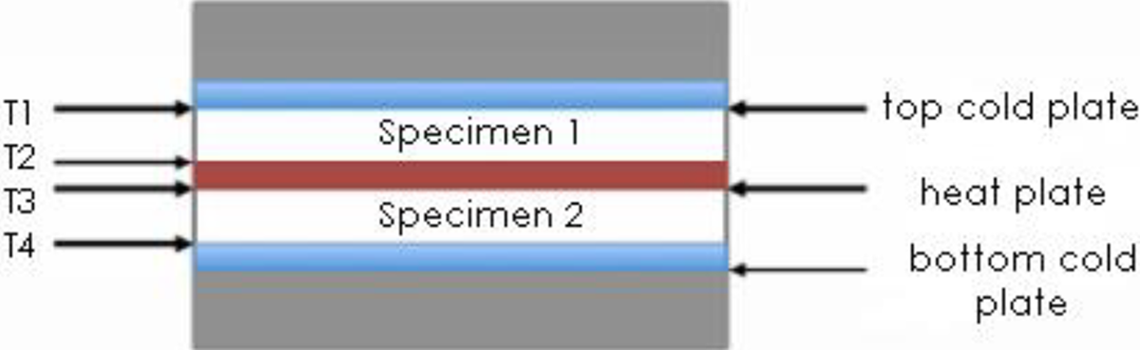
The set-up of the apparatus for calculation of coefficient of thermal conductivity.
The thermal insulating properties of specimens were defined by the calculation of thermal conductivity coefficient (k), using Equation 1.25,26

Where,
Φ: Capacity resistance of heating surface (W),
Sm: Composite’s thickness (m),
A: Composite’s surface area (m2),
Θwm: Composite’s warm surface Temperature (K),
Θcm: Composite’s cold surface Temperature (K).
Results and discussion
Optical microscopy analysis
For the Optical Microscopy Analysis, a number of fibres (100–140) were selected and assessed for their diameter for each animal. The optical microscope was connected with a digital camera to output an image of the samples on the computer. Figure 3a represents a typical image captured by the microscope from Katsika’s wool, while Figure 3b from Kalarritiko’s.

Wool fibre image captured by OLYMPUSSX40 optical microscope (a) Katsika, (b) Kalarritiko.
By running Cell Image Analysis software, the statistical analysis for diameter calculation was extracted and is presented in Table 2.
Average diameter of wool fibre for the two sheep breeds.

Mechanical properties
Table 3 presents the results of the three-point bend test and short-beam test.
Mechanical properties of neat epoxy and composite materials.

The neat epoxy specimen exhibited a flexural strength of 137.25 MPa and a shear strength of 10.4 MPa. Composites manufactured with 2.4 and 4.1 phr of wool fibres appear to maintain these values for both Katsika and Kalarritiko breed. On the other hand, composites with 5.7 phr of wool fibres present a severe degradation of both flexural and shear strength that reaches up to 50%. Related studies have reported no change in mechanical properties for up to 2% w/w and an abrupt decrease, as the amount exceeds 3%. 13 In a study of C Santulli et al., the flexural strength of epoxy resin composites with wool fibres with amounts larger than 50% (v/v), dwindles to 50% than neat epoxy. 27 These findings can be attributed to the higher porosity of composites due to the difficulty in impregnating large amounts of wool fibres. By selecting suitable surface treatments and optimized manufacturing techniques, the mechanical performance of composite materials toughened with wool fibre can be improved, as confirmed in the literature.28,29
Taking into account the results, we can conclude that sheep wool when used in low amounts up to 4.1 phr in epoxy matrices, do not negatively affect the overall mechanical properties of epoxy resin. The most promising materials that contain 4.1 phr of sheep wool fibres will be investigated for their thermal conductivity in Section 3.4. Figure 4 and Figure 5 summarize the mechanical properties in chart type diagrams.

Column chart for flexural strength test.
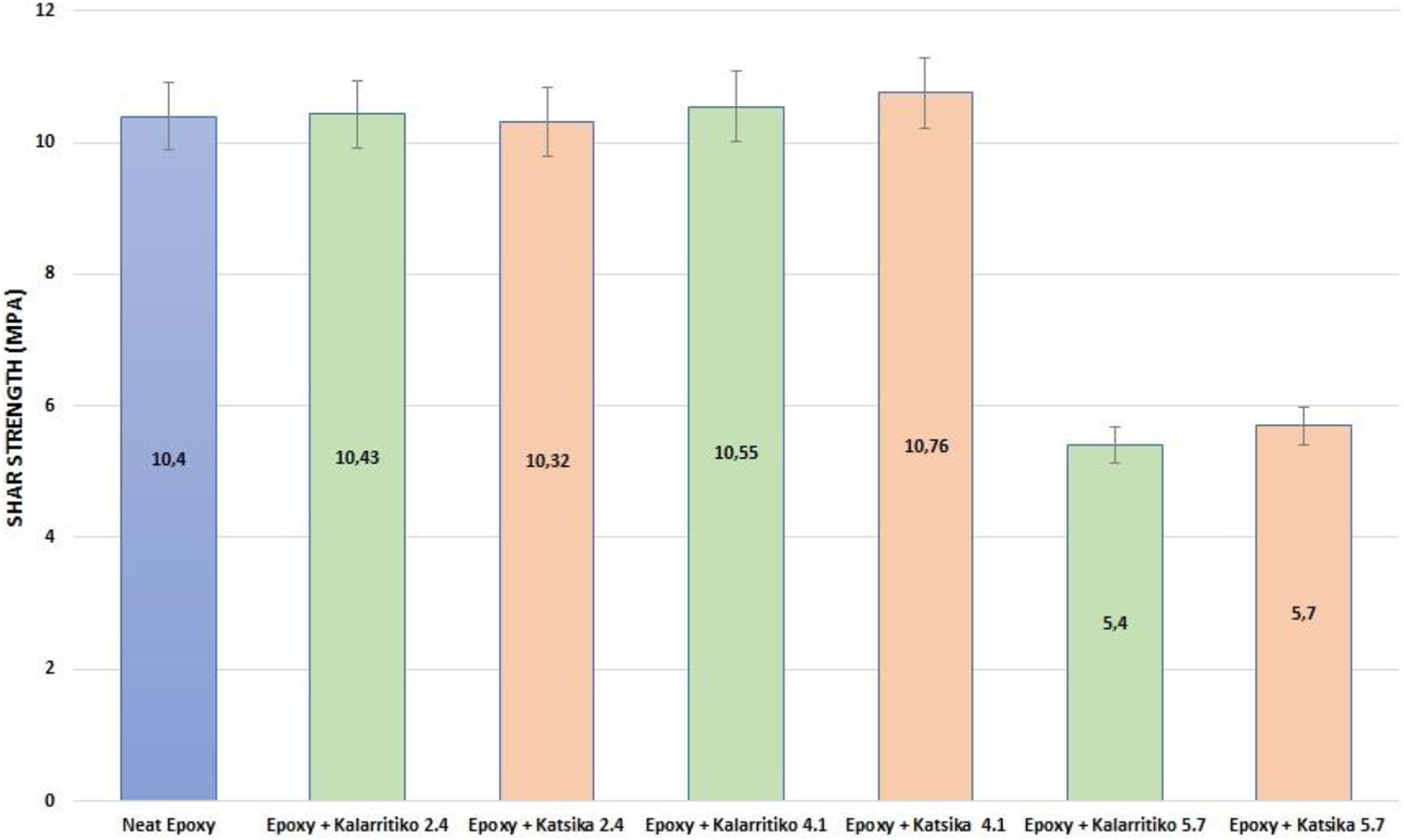
Column chart for shear strength test.
TGA analysis
A specimen is heated at fixed rates according to a regulated temperature programme, and the mass change is measured as a function of temperature. The analysis was performed in accordance to ISO 11358. 30 The thermal behaviour of the manufactured specimens is presented in Figure 6. Regarding the neat epoxy specimen (green curve), a rapid and severe decrease in weight is observed, starting at 370°C until full decomposition at 450°C. This sharp degradation of the epoxy is consistent with the literature since the decomposition starts at approximately 350°C. 31 The red curve indicates the thermal behaviour of the composite specimens with epoxy as matrix and Katsika wool fibres (4.1 phr) as toughening agent. In contrast with the neat epoxy specimen, the degradation of the material lasts much longer. This can be proved lifesaving in case of a fire emergency, since there will be a much higher response time and the construction will endure longer. Furthermore, the composite is fully decomposed at higher temperature than the neat epoxy, i.e. around 480°C. 32 Finally, a negligible difference in the residue (wt. %) after the pyrolysis of each material is observed, that can be attributed to the extra char that is left due to the pyrolysis of wool. 33

TGA curves of the neat epoxy (green curve) and the Katsika wool fibre composite (red curve).
Thermal conductivity
Table 4 demonstrates the values of thermal conductivity coefficient measured as described in section 2.5. Neat epoxy’s thermal conductivity coefficient is in accordance with findings in the existing literature. 34 The thermal conductivity coefficient of specimens containing sheep wool as toughening agent is considerably decreased compared to neat epoxy. This indicates the better thermal insulating behaviour of the composite materials. More specifically, Kalarritiko composites exhibit a downgrade in thermal conductivity coefficient by 25%, while for Katsika composites this decrease peaks at 30%. This small variation in thermal conductivity coefficient between the two breeds could be attributed to the difference in fibres’ radii.
Coefficient of thermal conductivity for neat epoxy and composite materials.

Simulation of heat transfer
COMSOL Multiphysics is a versatile finite element analysis software that is designed to investigate coupled multi-physics problems. In the present study, the Heat Transfer in Solids interface is used to model heat transfer by conduction, through the axial symmetry of the disk specimens manufactured in section 2.5 and already tested for thermal conductivity in section 3.4. Taking advantage of the coefficient of thermal conductivity calculated in 3.4 and applying its values on the model for the 3 different manufactured materials (Neat Epoxy-Kalarritiko4.1 and Katsika4.1), the variation of temperature through the specimen’s thickness can be simulated. The geometry of the model is demonstrated in Figure 7, while its boundary settings, that were set for the model, are presented in Table 5.

Geometry of model simulated by COMSOL Multiphysics.
Boundary settings for each of the three materials.

In order to set the boundary conditions, heat transfer in shells and thermal expansion Multiphysics option was selected. This made possible to interact and model heat transfer between the fibrous material and the heat source that is a constant temperature in boundary 3 of 319.5 K. Thermal insulation boundary condition was selected for the side of the disk to prevent heat loss and to contain the heat within the volume of interest. Heat was applied at the bottom layer (boundary 3) and transmitted to the top layer (boundary 4). Convective heat flux was modelled from Equation (2), where h is the heat transfer coefficient (W/m2 K), q is the heat flow rate and Text represent the external temperature (K).

By computing the previously mentioned parameters, we can simulate the conduction of heat that is originated from boundary number 3 and is spread through the specimens’ thickness until reaching boundary number 4. Figure 8 illustrates the variation of this temperature.

Variation of temperature through the thickness of the three different materials.
The results appear to conform to the experimental results in section 3.4, since it is expected that the specimen with the lowest coefficient of thermal conductivity has the lowest heat flux, resulting to the lowest temperature. The optimum specimen in terms of insulating behaviour, Katsika4.1, along with the heat flux can be imprinted in a graph as shown in Figure 9.

Graph of the Katsika specimen’s heat flux.
Conclusions
In this study, the efficiency of wool fibres from two different Greek sheep breeds as toughening agent in epoxy resin matrix composites was investigated in terms of thermal insulating behaviour, in addition to their mechanical performance when working on low amounts of toughening agent. Both flexural and shear tests demonstrated that amounts up to 4.1 phr can have no negative effect in terms of the mechanical strength. The manufactured composites were studied on their thermal degradation via TGA, confirming that the presence of wool fibres can prolong the decomposition of the material. Thermal conductivity test proved that the coefficient of thermal conductivity can be reduced by 30%, even when the wool fibre is at low percentages (4.1 phr). This finding was also confirmed by simulation through COMSOL Multiphysics. Evidently, a small amount of wool fibre as toughening agent can lead to a significant improvement on the thermal insulating properties of the composite materials, while maintaining epoxy’s mechanical properties. Sheep wool is a renewable organic material with low negative ecological impact that could substitute synthetic materials in building applications. In this study, composite materials with wool exhibit low coefficient of thermal conductivity and as a result they could be used as building insulation materials.
Footnotes
Acknowledgements
The authors would like to thank the ‘Animal Genetic Improvement Center of Ioannina’ and the ‘Greek Network of Transhumant Farmers’ (Epirus) for the supply of the sheep wool.
Declaration of conflicting interests
The author(s) declared no potential conflicts of interest with respect to the research, authorship, and/or publication of this article.
Funding
The author(s) received no financial support for the research, authorship, and/or publication of this article.
