




Abstract
This article presents new data on the individuals who mediate (M-IND) in all active UCDP dyads and lethal MIDs, 1989–2019. The dataset contributes to the systematic study of conflict management in several important respects: it covers both international and internal conflicts, it covers low-intensity violence, and it provides information on individual mediators, who appointed them, and type of mediation. Besides presenting the data collection and descriptive statistics, the article engages with the literatures on multiparty mediation and women, peace and security. M-IND shows that women more commonly are appointed as mediators by nongovernmental organizations than by states and international organizations. Our analysis suggests that greater equality in mediation efforts correlates with the use of more varied mediation strategies and is associated with a greater chance of reaching peace agreements.
Introduction
Mediation constitutes one of the most employed tools for addressing armed conflicts between and within states. The United Nations (2017: 1) emphasizes mediation as an ‘important tool for conflict prevention, management, and resolution’ while a research overview suggests ‘credible evidence of its effectiveness’ (Wallensteen & Svensson, 2014: 315; but Beardsley, 2008). Further, there is growing interest among both policymakers and scholars to explore whether specific characteristics of peacemakers are important for the effectiveness of mediation efforts (Duursma, 2020). Suggesting that this is important is not novel (Bercovitch, 1991; Bowling & Hoffman, 2000), but such questions have previously mainly been studied through small or medium-N research due to limited data availability.
To advance this literature, this article introduces newly collected global data on individual mediators (M-IND) for Militarized Intrastate Disputes (MID) and Uppsala Conflict Data Program (UCDP) conflict dyads 1989–2019. Besides identifying mediators by name, the dataset registers who appointed them, their assigned role in the effort, type of mediation, and biographical information on mediators’ political, diplomatic, and international careers. In total, M-IND covers 552 dyad-years of mediation activity and has detailed data on 1,080 different individual mediators with 1,832 conflict dyad appointments. The new dataset reveals substantial variation in the characteristics of mediation efforts, with an average of 4.68 different individuals involved as mediators every year (SD 6.33, median: 3, min.: 1, max.: 74). 1
While M-IND may be useful for a variety of new inquiries, we suggest it directly contributes to investigations of two key issues in contemporary peace research. First, the debate over whether multiparty mediation is more effective than single-party mediation efforts. The presence of many mediators creates a coalition with broader competence and reputation but may also introduce coordination issues between mediators and the potential inclusion of spoilers into the peace process (Beber, 2012; Menninga, 2020; Mehrl & Böhmelt, 2021). The information in M-IND is conducive for systematic studies of this issue with information about the number and characteristics of individual mediators rather than just who appointed them. Whether a given state or organization deploys one or many mediators towards a conflict – and the seniority of the appointees – is indicative of their commitment to the conflict management effort.
Second, ever since the landmark UNSCR 1325(2000) on Women, Peace and Security, policymakers and scholars have increasingly focused on the issue of gender diversity in conflict management. Since more gender-equal societies have lower conflict risk (Caprioli & Boyer, 2001; Melander, 2005), there are reasons to expect a positive effect of women mediators for ending wars (Hunt & Posa, 2001; Maoz, 2009). To facilitate further studies of this argument, M-IND provides information on men and women mediators for every year of conflict regardless of the outcome of the peace process. This makes it possible to also trace characteristics of mediation over time and identify selection effects concerning the appointment of peacemakers.
In what follows, we describe the key definitions, units-of-analysis, data collection process, and the variables in the M-IND dataset. To illustrate the usefulness of the data, we focus on the multiparty and gender dimensions of mediation efforts and probe how those relate to successful peacemaking. We briefly review existing literature before presenting descriptive statistics from M-IND combined with estimations for how multiple mediators and share of women mediators relate to conflict termination and outcome. Our analysis finds that both the presence of more mediators in the effort, and when this is more gender-equal, are associated with a greater likelihood that a peace agreement is concluded. In the final section, we conclude by discussing further uses of the M-IND dataset.
Introducing the M-IND dataset
To collect systematic information about mediators, we identify relevant armed conflicts/disputes where mediation may occur. M-IND corresponds with the UCDP-PRIO Armed Conflict Dataset version 20.1 and lethal Militarized Interstate Disputes (MID) version 5.0. Armed conflict is defined by UCDP as a contested incompatibility over government and/or territory where the use of armed force between two parties, at least one being the government of a state, results in at least 25 battle-related deaths in one calendar year (Gleditsch et al., 2002; Pettersson & Öberg, 2020). Each conflict can be disaggregated into one or multiple ‘dyads’ defined as the yearly interaction between two primary warring parties (state–state, government–rebel group). M-IND is coded at the most disaggregated unit-of-analysis, the dyad-year, to ensure that mediation efforts connect with the appropriate conflictual interaction. For example, in 2009 there were mediations in the Philippines (Mindanao) conflict but only the dyad of the government vs. MILF (Moro Islamic Liberation Front) and not between the government and ASG (Abu Sayyaf Group). Further, there were no mediations that year in the conflict between the Philippines (government) and the CPP (Communist Party of the Philippines). By providing specific data for each of these dyads, M-IND presents information on mediation in the interaction between the government and MILF, but not involving ASG and CPP, ensuring an appropriate unit-of-analysis for the bargaining process. However, users can easily aggregate the data to conflict or country level.
Militarized interstate disputes (MIDs) are defined as the threat, display, or use of military force short of war by one state explicitly directed towards the government, official representatives, official forces, property, or territory of another state (Jones, Bremer & Singer, 1996). While the violence threshold is lower for inclusion as interstate disputes than an UCDP armed conflict, we consider international crises as high-profile events relevant for the study of mediation. The M-IND dataset begins its coverage in 1989, thus containing 380 different UCDP/PRIO conflict dyads (1989–2019) and 119 MIDs (1989–2014). 2
M-IND uses an inclusive definition of mediation, following the UN, as ‘a process whereby a third party assists two or more parties, with their consent, to prevent, manage or resolve a conflict by helping them to develop mutually acceptable agreements’ (UN, 2012). This broad definition allows us to consider a wide range of mediators including both from the outside and from the conflict-affected society. The latter includes involvement by local civil society that can participate in a peace process and introduce proposals for a future political agreement (Marchetti & Tocci, 2009). We focus on mediation that in some manner involves the warring parties, meaning that our data mainly cover so-called track 1 diplomacy. That does not mean that representatives of the warring sides need to meet face-to-face, as we include shuttle diplomacy and peace proposals presented to both sides. Further, we include mediations involving both the leadership of the belligerents and more lowly ranked representatives, although we suspect that due to information availability local talks are under-reported compared to elite-level processes.
Having identified relevant conflicts and defined mediation, we classify dyad-years into three categories: (i) likely, (ii) unknown, and (iii) unlikely to have mediation. The first category contains dyad-years identified by existing data sources of mediation and peace agreements including Regan, Frank & Aydin (2009), DeRouen, Bercovitch & Pospiesna (2011), Lundgren (2017), Joshi & Darby (2013), Bell & Badaniak (2019) and UCDP (2020). The second category includes dyad-years not covered by these datasets, while the third category consists of cases covered by existing data but coded as without mediation or negotiations. Data collection prioritized information about individual mediators in the first and second categories, although some instances of mediation are found also from the third category. Besides information from case descriptions in existing datasets, source material for the data collection included case study research, NGO reports, biographies, and local and international news media from the Factiva database. For each case, unique search terms were used based on previously identified leads such as specific time for mediation, names of belligerents and third parties, and names of identified mediators in combination with generic terms such as ‘mediat*’, ‘negotiat*’, ‘peace talks’, etc. While most information is collected from English-language sources, the coders also reviewed material in Arabic, French, German, Mandarin, Spanish and Scandinavian languages. Intercoder reliability was carried out through random back-checking of cases by new coders, and regular within-team discussions of coding decisions.
We recognize the difficulties in accessing detailed information about mediation efforts and that M-IND probably does not contain the full universe of mediators. Therefore, future iterations of the dataset will not only extend the time but also include revisions of the existing dyad-years. Possible sources of bias include coding decisions for underlying conflict data (Kreutz, 2015), that more information is available for successful mediation efforts (Lockwood, 2021), and mediation of state and intergovernmental organization representatives are reported more than nongovernmental organizations (Schudson, 1989). Possible temporal bias due to more information being available for recent years is mitigated by a greater availability of biographical texts and case study research for historic cases, and the mediated/non-mediated case ratio is stable over time (see Figure 1A).
The M-IND dataset contains the following variables. For every dyad-year, it includes information about the number of mediators, number of actors these represent, the unique identifier for each mediator, and information about mediators’ use of different (non-mutually exclusive) strategies: shuttle diplomacy, elite/low-level talks, and presentation of proposals. In addition, data about individual mediators provide information in text and codified about name, gender, birth year, nationality, formal position, who they represent, and their political, diplomatic, and international organization background. The unique mediator identifier and UCDP/MID IDs link the two datasets, making it possible to merge individual data and conflict-relevant data across the data structures. By listing mediator names, it is possible for other researchers to extend the data with additional characteristics as needed.
Comparison with existing data
M-IND is the first dataset on the individual characteristics of mediators covering all international and internal conflicts. Existing studies on multiparty mediation have primarily relied on information about the different countries or organizations that have mediated (Frazier & Dixon, 2006; DeRouen, Bercovitch & Pospiesna, 2011). However, some recent efforts have begun to collect information about individual mediators, primarily with the aim of exploring gender inequality in conflict management following UNSC 1325(2000) and subsequent interest in the Women, Peace and Security agenda. Existing data are primarily collected from signatories of peace agreements and have been used to identify women’s involvement and settlement provisions and post-conflict stability (Ellerby, 2013; Krause, Krause & Bränfors, 2018; True & Riveros-Morales, 2019). Some data collections expand the focus to also include women’s involvement in ‘major’ peace processes, but without clear definitions about what constitutes mediation or systematic selection criteria for case inclusion (UN Women, 2012; Stone, 2014; CFR, 2020). This means that some armed conflicts are excluded while other forms of contentious politics are included, including post-election tensions and constitutional crises.
Conflict dyads, mediation, and women mediators 1989–2019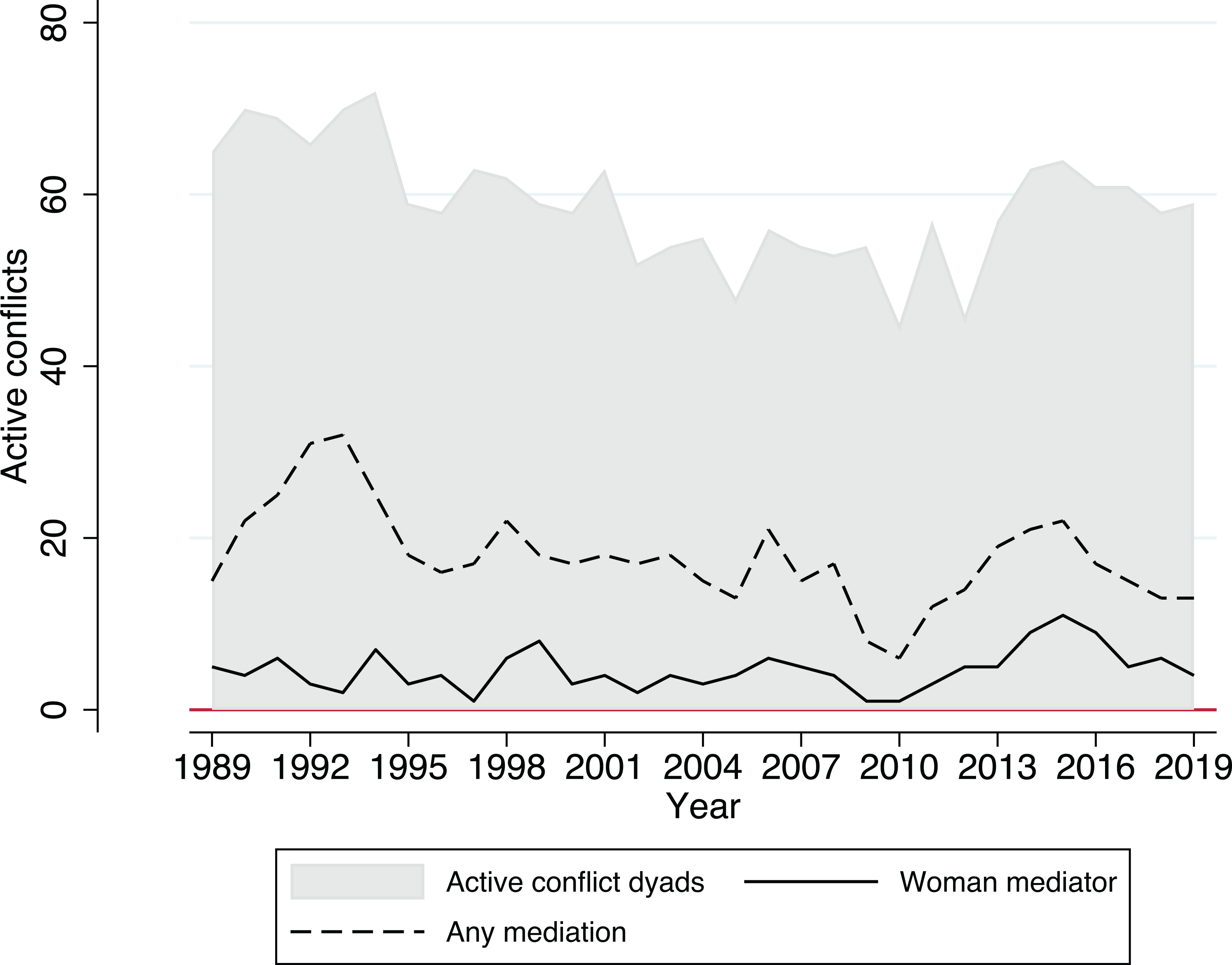
What does M-IND reveal about women and mediation?
Since most contemporary systematic research on individuals within mediation efforts have focused on the role of gender in peacemaking, we use information from M-IND to contribute to this debate (Ellerby, 2013; Olsson & Gizelis, 2015; Kreutz & Cardenas, 2017; Krause, Krause & Bränfors, 2018; Agerberg & Kreft, 2020). The literature regularly reiterates several arguments for why more women in peacemaking should have a positive effect. To begin with, the presence of norms on gender equality reduces the risk of conflict in societies (Melander, 2005; Forsberg & Olsson, 2016). This should contribute to more effective peacemaking if women are included in conflict management regardless of the strategies used by individual mediators. Another advantage of considering women as mediators is that the probability of appointing the most qualified person increases when selected from the total population of candidates rather than half of it (Aggestam & Svensson, 2018). Another suggestion is that women mediators bring specific skills and access to networks to a peace process that can increase the probability of success. This includes a different understanding of the conflict context that can be particularly useful to facilitate progress when talks are deadlocked (Coomaraswamy, 2015; Cárdenas, 2019). This benefit goes beyond the widespread suggestion that women are only entitled to talk about ‘women’s issues’, as women mediators have been found to provide expertise on several issues in peace processes including transitional justice, constitutional design, and land reforms (Turner, 2020). Further, a common claim is that women mediators have access to a wider range of actors such as local civil society that can provide specific local
Women mediators in armed conflict, 1989–2019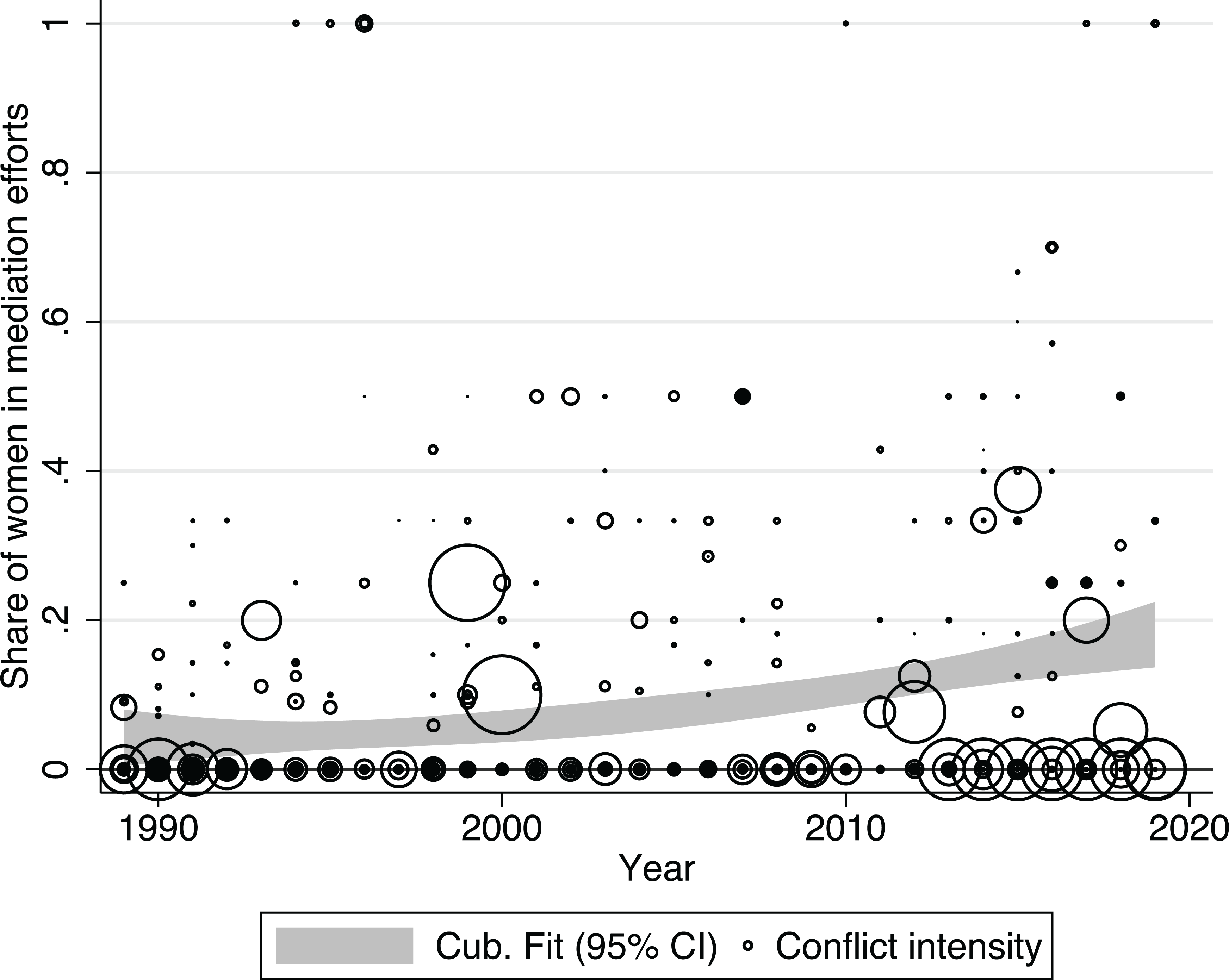
Trends in women mediation
Has there been an increase of women mediators over time? Figure 1 present descriptive statistics over time of both the number of conflict dyads with any woman mediator present (1A), and the ratio of women mediators where 0.0 indicates no women mediators and 1.0 only women mediators (1B). Of the 1,831 annual observations of conflict/dispute covered by M-IND, mediation occurs in 552 (30%) of instances. The grey area in Figure 1A indicates the number of active dyads each year, while the dotted line indicates mediation incidence, and the full line represents mediation effort that includes at least one woman. In Figure 1B, each dot corresponds with a mediation effort with the size determined by conflict severity as determined by annual number of battle-deaths (Pettersson & Öberg, 2020).
Taken together, the information in Figure 1 indicates that mediation continues to be dominated by men, but there is a trend towards greater gender equality in mediation. For the last five years of data (2015–19), there was at least one woman participating in 43% of mediation efforts, which is double the incidence compared with the 1990s. Moving to the share of women in mediation efforts, Figure 1B show a trend break with women becoming increasingly involved following the UNSC 1325(2000), even though there is great variation across cases. The fitted line with 95% confidence interval shows that whereas the share of women mediators in the average peace process during the 1990s is very close to zero, the contemporary setting includes on average some 15–20% women in mediation teams. M-IND identifies a slightly higher share of women mediators in recent years than other data sources, but that may be a consequence of our coverage of all armed conflicts rather than just ‘major’ peace processes.
Appointment of mediators
As the dots in Figure 1B indicate, several of the most violent conflict dyads are without women mediator presence. This can in part be attributed to a regional pattern as we also see that women’s share in mediation teams is lowest in Middle East and North Africa (only 4% of mediated dyad-years), the setting for several of the most violent contemporary wars including Iraq, Syria, and Yemen (Pettersson & Öberg, 2020). In stark contrast, mediation efforts in conflicts in East Asia (15%), Europe/Eurasia (10%), and sub-Saharan Africa (9%) involved women to greater extent; the regions of the Americas (8%) and Central/South Asia (6%) complete the picture.
Mediation selection
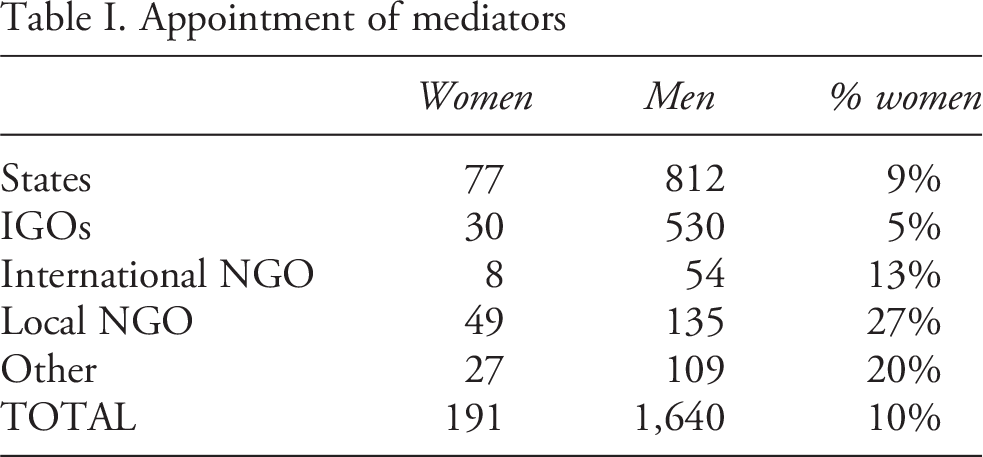
Some of the most high-profile examples of women’s involvement in conflict management emphasize the involvement of civil society and local actors for peacemaking (Dayal, 2018; Gbowee, 2019). With M-IND it is possible to investigate the gender dimension of who is appointed as mediator by different actors. Table I shows that most mediation is done by representatives of states or intergovernmental organizations (IGOs), but these two types of actors are the least likely to appoint women mediators. Although women feature more among appointees from international NGOs, this actor category is also the least prevalent in the data. Of greater importance is that local NGOs involve women to a much greater degree than states and IGOs, which follows the suggested correlation between women peacemakers and local civil society.
One finding from existing research is the link between mediation and the most difficult conflict settings, such as in the presence of human rights violations and sexual violence (Greig, 2005; Clayton, 2013; Nagel, 2019). Table II reports the results of estimations of conflict characteristics and correlation with the number of mediators (Model 1), the number of women mediators (Model 2), and the share of women within the mediation effort (Model 3). Focusing on the coefficients that are statistically significant at the 90% level, Table II shows that the probability of women mediators increases in severe conflicts (data on battle-deaths, duration and conflict come from Pettersson & Öberg, 2020). 3 Model 2 shows that women mediators are less often used in less democratic countries (V-Dem liberal democracy, Teorell et al., 2016; and GDP/capita, WB, 2020), but the main takeaway from this exercise is the trend towards more women’s involvement over time. Taken together, this output does not confidently conclude whether women receive requests to mediate in a certain subset of conflicts, but this is one of many possible questions that can be systematically explored with the M-IND dataset.
The impact of women mediators
Our final use of the M-IND data focuses on the gender dimensions of the characteristics of mediation and the outcomes of the peace process. Besides information about individual mediators, we also collected yearly dyadic information about the incidence of top-level and/or low-level talks involving mediators, shuttle diplomacy, and mediator proposals. Figure 2 provides information about the probability of different types of mediation across the share of women involved. Shuttle diplomacy is the most used type of mediation, and it becomes increasingly common when more women are involved in mediation. The other types of mediation are influenced by whether there is relative gender parity in the mediation effort. The trajectories for top-level and low-level talks are nearly identical even though the former is most common. Although in general corresponding to the gender parity trajectory, we also find that mediation efforts predominantly by women are unlikely in producing peace proposals for the parties to consider. This may be indicative that women mediators more than male focus on identifying consensus solutions rather than enforcing outside settlements (Rauchhaus, 2006; De Langis, 2011).
Conflict characteristics and mediation selection
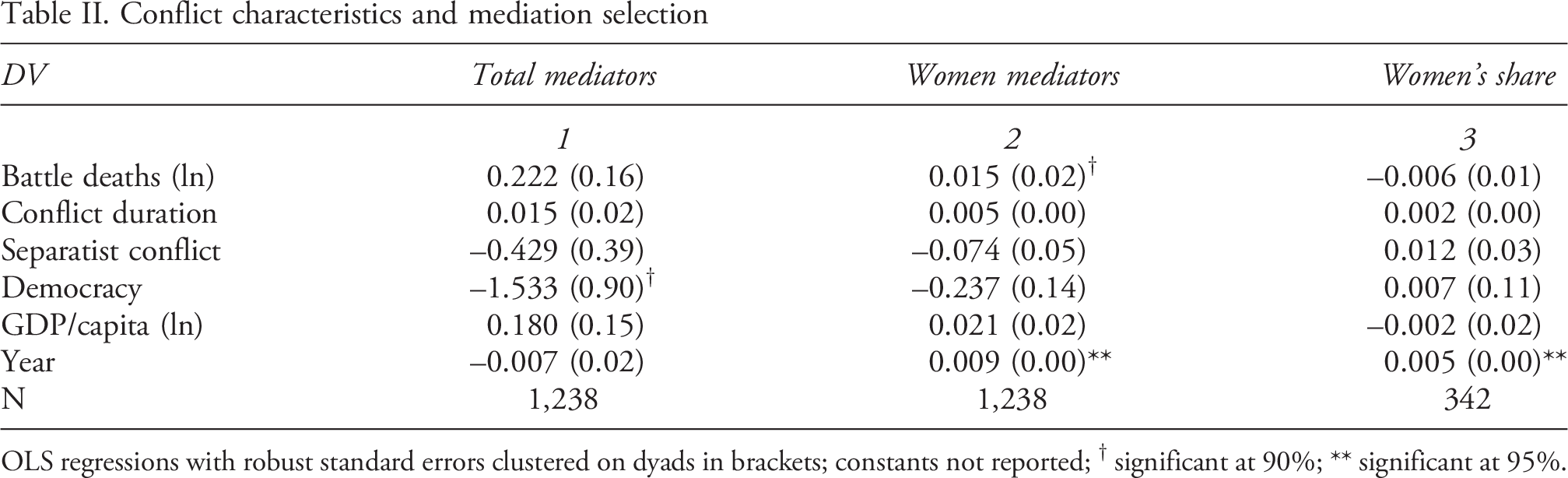
OLS regressions with robust standard errors clustered on dyads in brackets; constants not reported; † significant at 90%; ** significant at 95%.
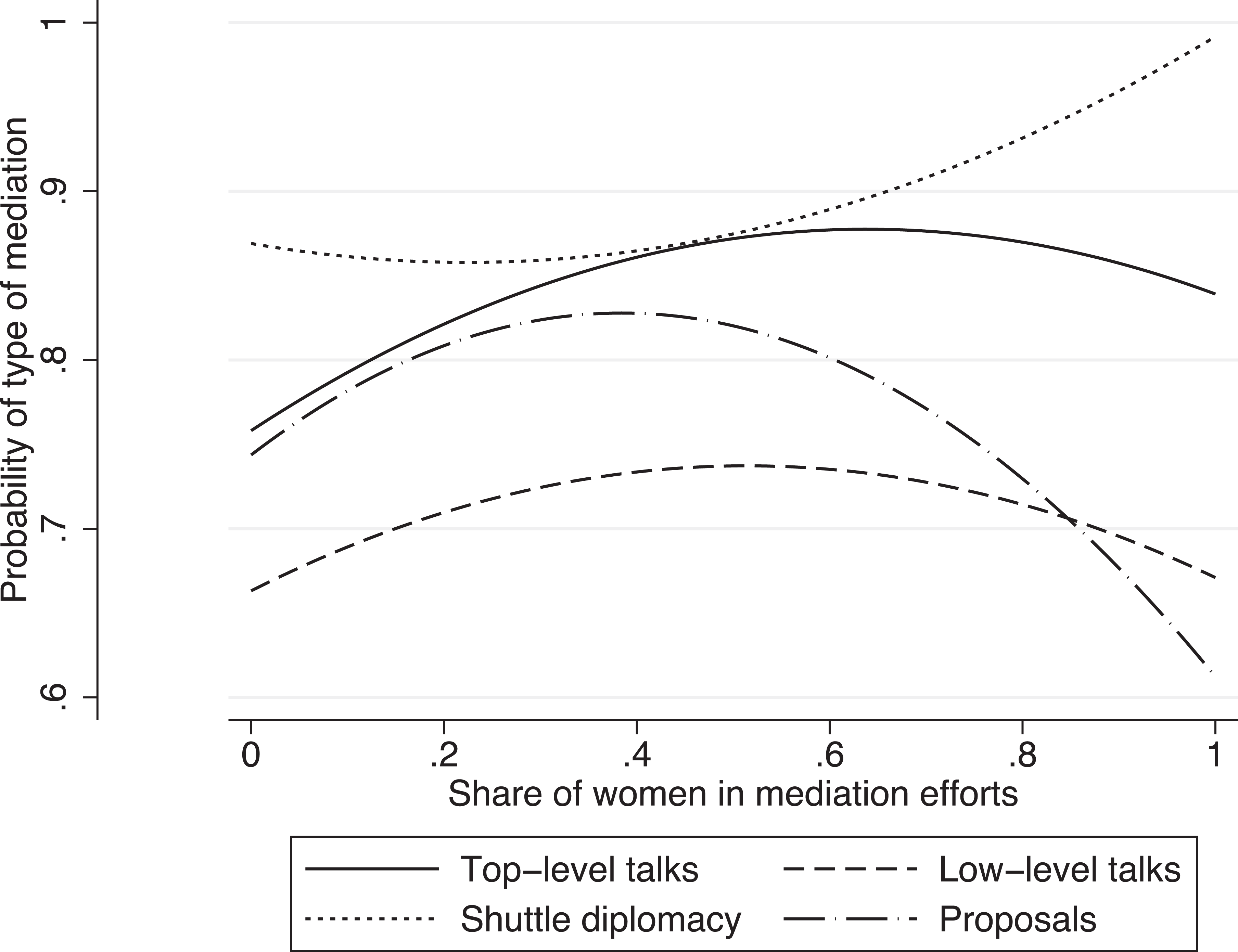
Share of women mediators and type of mediation
Although it is not visible in the figure due to scale, we find that conflicts with more mediators correlate with both conflict termination and the signing of peace
Mediation composition and civil war outcomes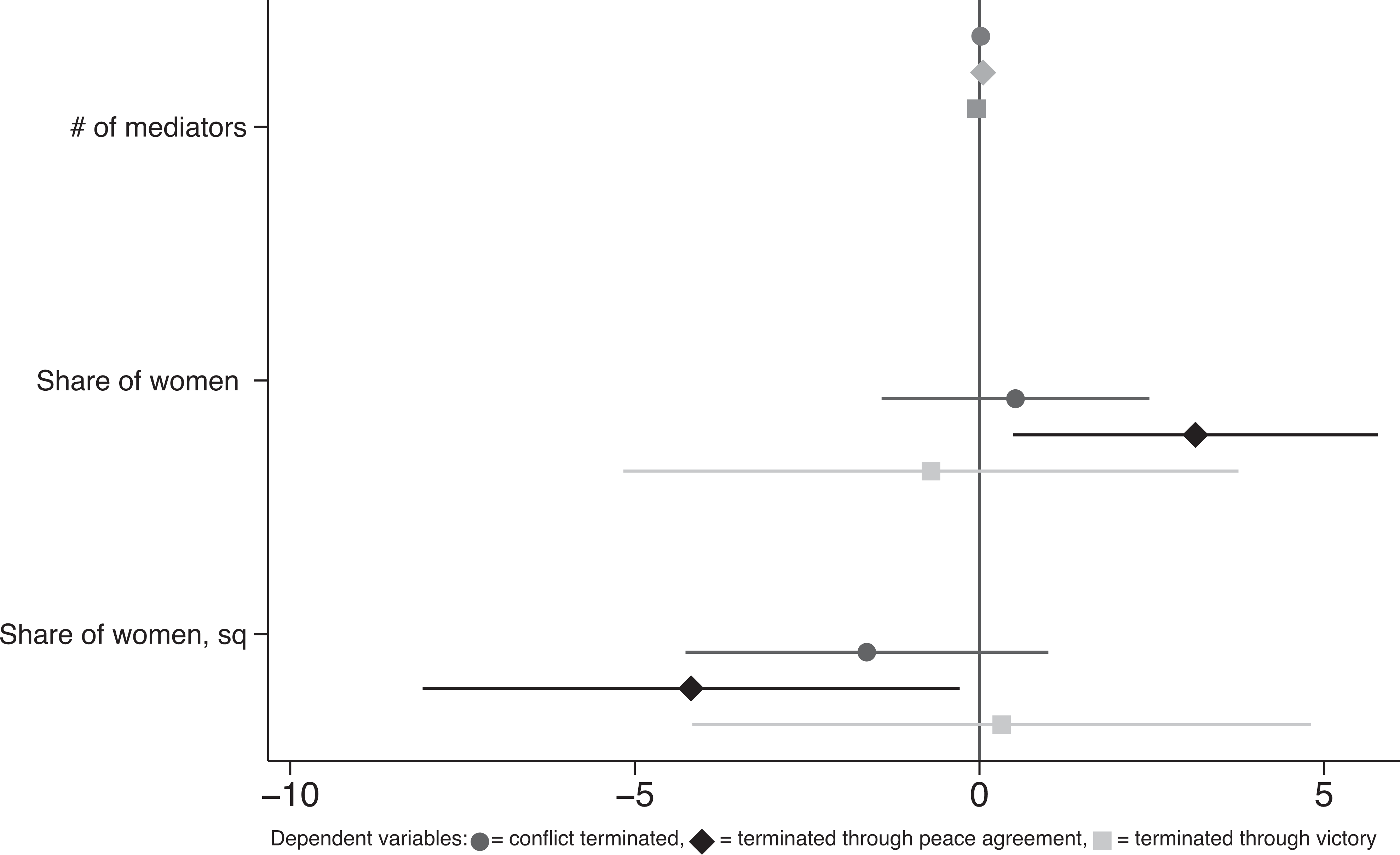
The main correlation that is statistically significant at the 95% level is that conflicts with more women mediators are more likely to conclude with a peace agreement. We also note that the squared term is significant which indicates a curvilinear relationship in the form of an inverted U-shape. Thus, it is efforts with the most gender-equal mediation teams that correlate with a greater probability of peace agreements. The coefficients suggest a similar relationship for the likelihood that a conflict ends, but the results are not statistically significant. For comparison, Figure 3 also reports the output from a model exploring the correlation between mediation composition and the likelihood of victory. Although not statistically significant, the coefficients suggest that victories are least likely when gender-equal mediation efforts are underway. 5 A closer inspection of the shape of the curvilinear relationship show the most dramatic effect when the share of women mediators increases beyond 25% but that the increase flattens out somewhat when the share is over 65–70%. We interpret this as indicative of the positive effect that women mediators can have on a peace process as core representatives rather than included just as a token gesture.
Conclusion
This article introduces the M-IND dataset that includes information about individual mediators in civil conflicts and lethal international disputes in the world, 1989–2019. We illustrate the usefulness of this dataset by presenting descriptive statistics and we perform some statistical analyses to illustrate how this new dataset can be employed for advancing mediation research. Although any findings of this exercise are tentative, M-IND data indicate that the appointment of women as mediators is more common by civil society, and that more gender equality in mediation correlates with a higher likelihood that peace agreements are concluded.
We are confident that the M-IND data will be useful for advancing several aspects of peace and conflict research. First, by providing information about the individuals rather than just which actor has appointed them, these data can serve as the basis for additional studies into the potential and pitfalls of multiparty mediation. Second, by covering both conflicts identified by UCDP and lethal MIDs, these data can potentially encourage scholarship that more systematically explores the differences and similarities of the resolution of internal and international conflicts. Third, by focusing on the dyadic level – containing the most disaggregated annual information in UCDP – this dataset can also advance scholarship into the management of complex conflict settings where peace processes may be underway with some actors but not others. This is a valid concern both for scholars studying peacemaking and the policy community that want evidence-based evaluations, as it reduces the risk of false attribution of ‘peace process failure’ if violence continues involving actors that never were part of the process.
Most specifically, further analyses of the information contained in M-IND will make direct contributions to some of the most vibrant contemporary academic and policy debates. For over two decades, numerous publications and presentations have discussed gender equality in conflict management, but without a solid empirical basis. We illustrate some of the ways that M-IND can help address this shortcoming by our analyses that suggest tentative support for the claim that more gender-equal mediation increases the likelihood of successful outcomes. To this end, this article is only the beginning as we envisage that M-IND can be the basis for the research community to explore the importance of inclusivity in conflict management. Besides gender aspects, such efforts can investigate for example the relationship between external and internal/domestic mediators, or the power relations between mediators appointed by the UN, regional organizations, different states, and NGOs.
Footnotes
Replication data
The M-IND dataset and replication data for the empirical analyses in this article, as well as the Online appendix, are accessible at http://www.prio.org/jpr/datasets, https://www.mind-data.org, and  .
.
Acknowledgements
We are grateful for helpful comments and suggestions from Mireille Affa’a Mindzie and participants at the high-level seminar on ‘Strengthening Women’s Participation in Peace Processes’ in Rome, 3–4 December 2019, Elin Bjarnegård and colleagues at Uppsala University, as well the editor and reviewers. A particular thank you to Yasmine Naila Skheri and Paola Badani Zuleta for coding assistance.
Funding
Kreutz acknowledges funding from Folke Bernadotte Academy (20-00281) and the Swedish Research Council (2020-02368).