




Abstract
The Nasa indigenous group’s Guardia Indígena, whose primary goal is to protect indigenous people and their territories from all types of armed groups, is a nonviolent self-protection organization in Northern Cauca, Colombia. On 5 November 2014, while peace talks were ongoing between the Revolutionary Armed Forces of Colombia (FARC) and the Colombian government, two Guardia Indígena members were shot dead by FARC guerrillas. Without guns or physical violence, indigenous guards captured seven guerrillas responsible for the crime, and, four days later, indigenous organizations held a trial and sentenced the rebels to imprisonment. This article describes those events and investigates how the unarmed guards managed to capture the guerrillas and bring them to trial. The self-organization concept is used to gain insights into the mechanisms and strategies deployed. The mechanisms of the Guardia Indígena include constructing and applying specific social norms and values, developing a common goal, and applying a flexible mix of centralized and decentralized ways of organizing. By combining and activating these mechanisms at carefully chosen moments, indigenous people have succeeded in organizing themselves as a collective movement that is powerful enough to confront armed groups without using violence.
Introduction
The Northern Cauca region is one of the territories in which the Revolutionary Armed Forces of Colombia (Fuerzas Armadas Revolucionarias de Colombia–Ejército del Pueblo: FARC–EP) had a strong influence until the end of 2016, when a peace agreement was signed with the Colombian government. The agreement aimed for a reduction in inequality and a long-term development plan for Colombia (Chagas-Bastos, 2018), and even included an innovative gender perspective whose goal was to ensure women’s leadership in peacebuilding and prevent sexual violence in armed conflicts (Boutron, 2018). The treaty thus represented a real opportunity for change. However, when put to a plebiscite, the agreement was narrowly rejected, with 50.2% voting against and 49.8% in favour. After several changes, however, the agreement was subsequently approved by Congress and immediately resulted in a general decrease in violence. Nonetheless, given that the areas most affected by the conflict – like Northern Cauca – were historically marginalized from state support and management (Chagas-Bastos, 2018; Velasco, 2016), new criminal bands were already fighting to control these territories by the end of 2017 (Valencia et al., 2017). Moreover, in 2018, as many as 56 social leaders were killed in Cauca by unknown assailants (El Tiempo, 2018). In the same year, a new president was elected, representing the party that had opposed the peace agreement. By August 2019, in Northern Cauca alone, 33 leaders had been assassinated (Semana, 2019). That same month, former top FARC commander Luciano Marín, known as Iván Márquez, vowed to return to war because – in his words – the government had violated the peace agreement (Casey and Jakes, 2019). Pessimism is therefore spreading about the sustainability of the peace.
Since 2001, the indigenous Nasa, represented mainly by the Association of Indigenous Councils from Northern Cauca (ACIN), has employed a local self-protection strategy based on what is known as the Guardia Indígena (Indigenous Guard). The Nasa claim that the Guardia Indígena represents a nonviolent initiative because its members are unarmed. Guards use only a bastón (stick), which symbolizes the power bestowed on them by their community. Previous researchers have explored indigenous groups’ role in conflicts in Cauca, focusing on political and land struggles (CECOIN, 2008; Findji, 1991; Findji and Rojas, 1985; Hristov, 2005; Van de Sandt, 2003; Velasco, 2011; Villa and Houghton, 2005). More specifically, research on the Guardia Indígena has focused on historical recounting, indigenous cultural practices, and political goals and outcomes (Hernandez Delgado, 2006; Wilches-Chaux, 2005; Wirpsa et al., 2009). These studies argue that the Nasa’s nonviolent initiatives are an innovative and integral approach to peacebuilding based on cultural practices and traditions. Nonetheless, little is known about how the Guardia Indígena operates and how its actions contribute (or not) to peacebuilding. This study addresses those questions.
In contrast to top-down and institutionalized approaches to peace and conflict, our study adopts a critical approach, focusing on bottom-up and localized conflict de-escalation measures (Andrieu, 2010; Hirblinger and Simons, 2015; Mac Ginty, 2014). Accordingly, the data collection for this study focused on Nasa people’s strategies for managing violent conflict in their everyday local context.
As the main interest is the Nasa contribution to peacebuilding, this study implies a translation of indigenous practical and discursive concepts (Viveiros de Castro, 2004) into terms that can be discussed in current debates on peacebuilding studies. According to Viveiros de Castro (2004), ethnographic research implies a constant comparison of the perspectives of both researchers and their subjects. Thus, the aim is to perform what Viveiros de Castro (2004, 2014) has called a controlled equivocation – that is, to start from the researchers’ own perspectives in the analysis of indigenous practices, but to ‘compare’ their ideas with indigenous concepts in order to find different meanings and understand perspectives from both sides. In the present study, we use the concept of self-organization – referring to order created from the interaction of elements following simple rules (La-Mantia et al., 2017) – to do this. Self-organization serves as an instrument for unveiling the practices of the Guardia Indígena and analysing and reflecting on their impact on everyday peacebuilding.
In this article, we first present our definition of the concept of self-organization. Then, the ethnographic methodology is described, with a focus on the strategies that Nasa people use in their everyday local context to manage violent conflicts. This is followed by a background section that is necessary for understanding both the context of the Guardia Indígena’s actions and this research. The events of 5 November 2014, in which two guards were shot dead by FARC members, are described, and the features of self-organization that can be seen in those events are identified. The different characteristics of the Guardia Indígena organization are then analysed. This analysis is followed by a discussion of how the concept of self-organization made it possible to gain insights into the mechanisms and strategies deployed by the Guardia Indígena to manage violent situations in a nonviolent way. Finally, it is shown how the present study can contribute to debates on the role of self-defence groups such as the Guardia Indígena, their mechanisms for dealing with conflicts, and their contribution to everyday peacebuilding, as well as to the design of post-conflict reconstruction strategies.
Self-organization as a sensitizing concept
Most definitions of self-organization originate from the natural sciences, referring to processes whereby order emerges from the interactions among elements of a system, rather than from interventions by higher-order agents (Johnson, 2001). Definitions of self-organization vary in line with the theoretical traditions within social science (e.g. Aarts, 2007; Boonstra and Boelens, 2011; Escobar, 2014; Sherwood et al., 2016). Regarding social movements, Escobar (2014) explains that self-organization denotes bottom-up processes in which individuals using simple principles create complex collective behaviour. The concept thus highlights the autonomy of elements or the possibility of agency in a decentralized organization (Anzola et al., 2017). Self-organizing processes also emerge, however, from a complex interplay between the intentional behaviour of individuals and unintended and contingent factors (Goldspink and Kay, 2004). As a sensitizing concept, self-organization is the starting point for entering the world of meanings behind the Guardia Indígena’s actions.
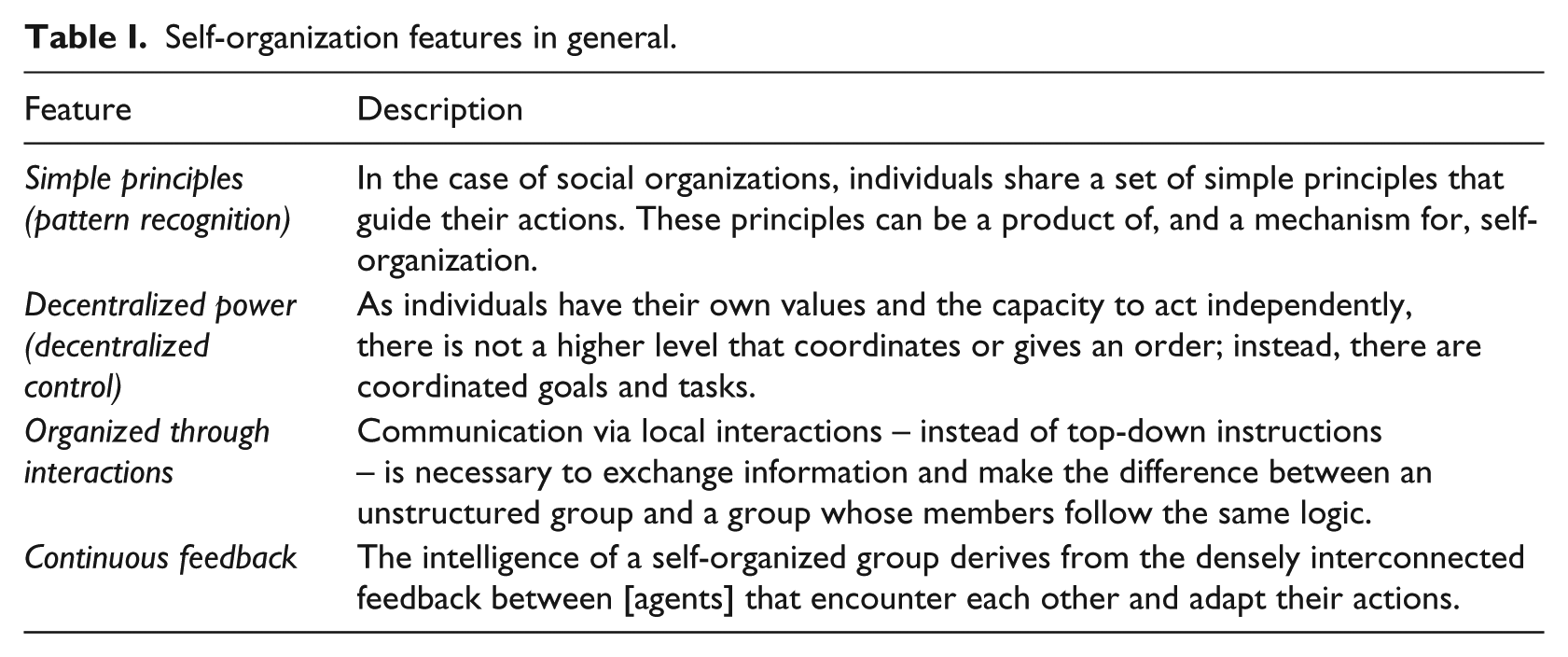
In this article, inspired by conflict and peacebuilding studies (Coleman et al., 2007; Hendrick, 2009; Vallecher et al., 2010), the main features of self-organization are as expressed by Johnson (2001): pattern recognition, decentralized control, and organization through interactions and continuous feedback. In the present study, these features are adapted to social groups as: individuals working together for collective action, in a decentralized way, based on simple rules (see Table I).
Self-organization features in general.
Methodology
This study starts from a perspective that privileges the study of cultural and identity elements for understanding collective actions (Escobar, 1992) – hence the use of rich qualitative data based on ethnographic methods used to observe cultural and identity elements that might have an impact on the strategies and actions of the Guardia Indígena. Moreover, in our research, considerable value has been ascribed to the social constructions of reality or the meaning that people give to their social realities (Yanow and Schwartz-Shea, 2006). Accordingly, the first author engaged in participant observation of various activities while interacting with members of the Guardia Indígena in their own conditions and circumstances (Haverland and Yanow, 2012). Furthermore, we consulted media and document sources to obtain contextual information and to better understand the influence of exogenous events on the activities and responses of the Guardia Indígena and their outcomes.
Methods
The fieldwork for the present study, undertaken by the first author working as a communications collaborator within ACIN and with indigenous guards, took place in ACIN’s headquarters in Santander de Quilichao, Cauca, from March 2014 to March 2015. It took emails and meetings from January to March 2014 before the researcher was accepted as an intern in the organization. Moreover, before the research started, ACIN members consulted the Walas (Nasa shamans), who conducted rituals to consult the nature spirits, after which they gave their approval.
During the fieldwork, the first author engaged in participant observation in 14 Guardia Indígena actions to manage conflict, collaborated in workshops organized by ACIN in 13 communities, and participated in 31 ACIN meetings where immediate political and violent events related to the organization were discussed. Fieldnotes of these events were collected in written records that included details of the dates, activities and people involved, and, when permitted, videotaped. Observations in the field were accompanied by qualitative interviews with 31 indigenous guards and leaders, in addition to frequent informal conversations in context. With the participants’ permission, meetings and interviews were audiotaped, transcribed verbatim, and then translated from Spanish to English.
For this article, the events of 5 November 2014 were selected to illustrate the Guardia Indígena’s organization, activities, and responses for managing conflict. Moreover, the first author was conducting fieldwork when those events happened and therefore could directly collect rich data from participant observation, meetings and interviews specifically related to those events.
Indigenous Nasa and the Cauca region
Indigenous political struggles
ACIN, a federation of 19 Nasa local organizations from 16 resguardos (indigenous territories), is part of a larger and older organization, the Cauca Regional Indigenous Council (CRIC). Both organizations follow the same goals: resguardo expansion; strengthening the cabildos (indigenous authorities); developing knowledge of laws and demanding their fair application; recovering indigenous customs, traditions and history; and training teachers to teach according to the needs of local populations and in their respective languages (CRIC, 1981). Resguardos and cabildos were created in 1592 by the Spanish crown. According to Nasa history, the caciques Juan Tama and Manuel de Quilo y Sicos negotiated the creation of Nasa resguardos to organize indigenous populations and keep their territories (Fals-Borda, 1957; Findji and Rojas, 1985; Friede, 2010). The creation of the resguardos provided the Nasa with land titles and allowed them to set up their own community government and keep some of their traditional customs and social control systems (Rappaport, 1990; Wirpsa et al., 2009). The eventual elimination of the resguardos began in the 1700s and accelerated after independence in 1810 (Hristov, 2009). However, Manuel Quintín Lame (1883–1967), an indigenous leader from Tierradentro, studied the law and found a legal basis for recovering indigenous resguardos. In 1991, after 20 years of CRIC struggles with the Colombian government, indigenous rights and territories were recognized in the Constitution, allowing indigenous people to have a legal framework for their land claims. Today, the resguardos represent indigenous territories, which are distinct legal entities under Colombian law, recognized as communal, unavailable for sale or rent, and governed by indigenous authorities. In 1994, CRIC became a decentralized organization, an umbrella for many local organizations, and leaders from Northern Cauca founded ACIN.
Conflict dynamics
Northern Cauca is part of the Pacific corridor, an entry and exit point for narcotics and weapons smuggling for drug cartels and for provisions for the armies (CNAI, 2007b, 2012; FSD, 2008). Land and resource struggles have led to the presence of both left- and right-wing armies in the region. The now-demobilized FARC and the Ejército de Liberación Nacional (ELN, a guerrilla group of around 2,000 people, which at the time of writing had still not signed up to the peace agreement) were formed in 1970, and paramilitary groups with different names have appeared sporadically since 1950. By 2000, paramilitary groups had come together in the United Self-Defence Forces of Colombia (AUC). Their goals were to take control of regions where they could extract large rents and deny or expel guerrilla access (see, for example, Gray, 2008; Hristov, 2014; Ugarriza and Craig, 2013).
Between 2001 and 2003, the AUC entered Cauca Province, confrontations occurred with the FARC and the ELN, and indigenous people were caught in the crossfire. By 2004, 21 municipalities had been attacked, 52 indigenous leaders had been killed, and around 153 indigenous people had disappeared (CNAI, 2007a). Paramilitary incursions generated a reorganization of indigenous communities (Chaves et al., 2018), and, in 2001, the Nasa formalized the Guardia Indígena to prevent displacement of their communities and protect people against armed groups.
Guards were trained by indigenous leaders on topics such as indigenous rights and indigenous political history and, with the support of international collaborators, instructed on human rights and how to handle dangerous situations. Nowadays, the Guardia Indígena receives sporadic sponsorship from national and international organizations for its equipment and activities. The guards perform territorial control activities, like closing down cocaine-producing laboratories and illegal mines, expelling armed groups, searching for missing people, supporting the cabildos or councils, organizing security and protection during mobilizations and meetings, protecting sacred sites, alerting the community about the risks of bombings or combat, and guarding checkpoints at resguardo entrances and exits.
The events when FARC members killed two guards
The following section is a summary of the events linked to 5 November 2014, when two Guardia Indígena members were shot dead by FARC guerrillas while peace talks were ongoing between the FARC and the Colombian government. The following paragraphs stem from an analysis of interviews and conversations with many guards, who shared their versions of events just a few hours after the incident took place. This information was complemented by fieldwork observations and participant observation. The description is written in the first person, as the events were witnessed by the first author.
5 November 2014
The FARC were commemorating the third anniversary of the death of Alfonso Cano, a guerrilla commander killed by the official army in November 2011. They had posted several street banners in schools and on the roads. An indigenous leader explained that ‘indigenous communities demanded that the propaganda be taken down because the indigenous territory is not a guerrilla territory’. 1 The Guardia Indígena is responsible for such tasks, as part of its territorial control activities. Arriving at ACIN at around 10:30 a.m., I missed the departure of many guards who had left for the villages to take down the banners by a few minutes.
Around 12:00 noon, news arrived: ‘Two indigenous guards had been killed by guerrilla members. All indigenous people should go to Toribío, to help catch the murderers!’ ACIN members immediately organized transportation, and many guards were mobilized to Toribío. ACIN’s headquarters are located in Santander de Quilichao, 42.5 km from Toribío (see Figure 1). The phones were constantly ringing. All members of the community were summoned to join the guards pursuing the guerrillas. ‘We are all guards,’ one leader said to people in the ACIN headquarters. Information about what had happened was still unclear. We knew that the guards had been removing the street banners; that, apparently, in a small village called Sesteadero the situation had escalated; and that the rebels had shot at some guards who were trying to take the banners down. Earlier, the FARC had warned: ‘Any person who dares to remove the propaganda will be considered a military objective.’ Indigenous leaders phoned to try to get more information, but there was no mobile phone coverage in the small towns in the mountains. Meanwhile, a rumour began to spread that three guards were dead, maybe killed by a bomb. All this happened in less than 30 minutes. Everything was very confusing at this stage, but the immediate priority of the indigenous people was to mobilize as many individuals as possible to where the events were happening. About five hours later, seven FARC members were captured and taken to a community centre where they could be provisionally detained.
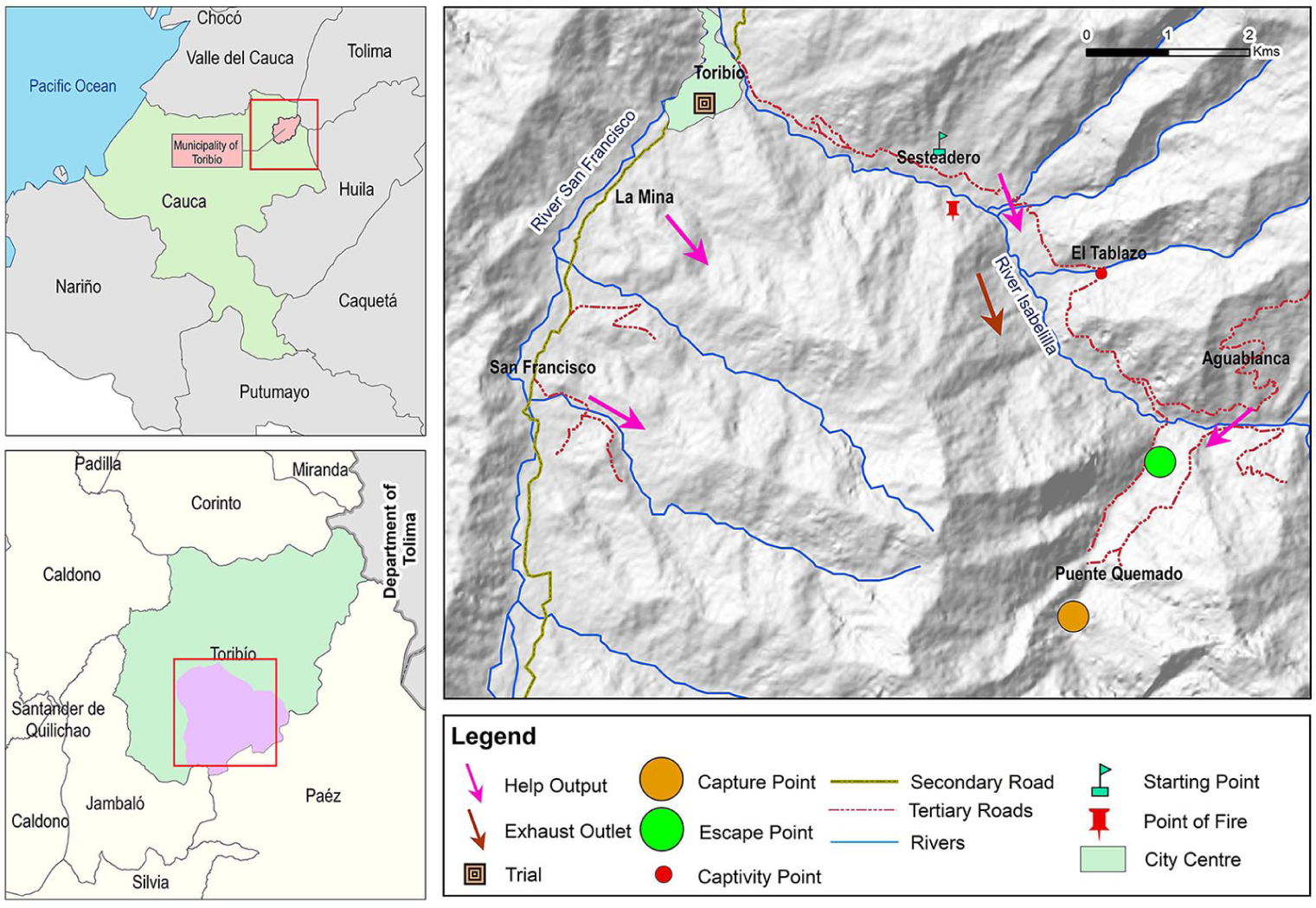
Map showing location of main events on 5 November 2014.
Guards capture the guerrillas
The next day, some of the guards told me their versions of the story. These guards had arrived in Toribío after the shooting and helped in the search for the insurgents. The pursuit took place in the middle of a dense forest, on a mountain of the Colombian Massif, 2 with few roads and scattered communities (see Figure 1). The first two rebels were caught quickly and taken to El Tablazo village. According to the interviewees, catching the other five insurgents proved very tense and difficult.
When the incident started, the guards called on the mountain communities for support. As a result, a few people approached the guerrillas from different directions. They then began shouting to one another – on the one hand, to show the guerrillas that they were surrounding them and, on the other, to pretend that numerous people had already gathered there. The guards thus tried to frighten the guerrillas while giving other people sufficient time to arrive. After about two hours, the guerrillas, who were heavily armed, were surrounded by nearly 400 people.
Once cornered, one of the insurgents took out a grenade and threatened to detonate it. ‘We are not scared by grenades. With that, you kill only five of us, and the others will catch you,’ an indigenous leader exclaimed, according to the guards who excitedly told me what had happened. A guard from Cerro Tijeras continued:
At the beginning I was scared, so I threw myself back when I saw the grenade. I was a little, just a little scared. First, we were just eight or nine people around the guerrillas, but, when the others arrived, we started to ‘get happy’.
3
The brother and friends of one of the guards who had been killed were also there, and they looked very sure about what they were doing . . .. . There was also a mayora [old lady] who is a guard and who looked angry and fearless; she was at the front, and seeing her also motivated me. I didn’t want to die, but it is like I rub off and se me sale el indio!
4
(laughs). Because, when we are together, we feel more indigenous.
After a while, the guards asked the insurgents to accompany them to their community for a trial, but the rebels refused. In response, one of the leaders told them, ‘either you go with us, or we go with you to your camp’. The rebels called their commanders. ‘It was perhaps to ask for reinforcements, but, apparently, they were told to defend themselves as best they could – that they were alone. We believe this answer was because [FARC leaders] did not want to jeopardize the peace process,’ 5 explained the guard. Finally, the guerrillas surrendered to the unarmed communities and were taken to the community centre where they would be temporarily detained.
Two guards are killed
Two months later, I talked to the Guardia Indígena coordinator for Toribío, who explained:
For us to take a banner down, we do not ask the community, because the community has already given us the order, but before we pulled [the banners] down, we talked [with the rebels]. First, we exhausted dialogue. We got divided into three groups in different villages to speak with those people [guerrilla members]. The most difficult was in the village El Sesteadero because the guys didn’t want to remove the banners. We gave them time: 10 minutes, 5 minutes more, 20 minutes. But they didn’t remove the banners when we asked . . .. . They said, ‘We have orders from our commander to keep the banners there at all cost.’ But our community’s order is to remove the banners. We have our position, and we are the owners of this territory. We are in charge here; nobody can give us orders here. Not armed groups, not people from outside. We can take care of the territory and ourselves. So, Manuel, I think, he climbed a tree . . .. and started to remove the banners, and the rebels were very close and started shooting as though they were fighting an armed man, right? So, some guards went over to them to demand respect; [other rebels] from the other side
6
were covering and also started shooting the guard in the tree. The guard fell down; we thought he was dead, but he wasn’t; but he managed to pull the banner down, and the shooting continued as though they were fighting a military group. Authorities, people, children were close by, because in such a situation all community members mobilize. We all threw ourselves to the ground.
After this, the two rebels left the town in the direction of the other group of rebels who were waiting in the mountains. The coordinator explained what happened next:
[In other situations] we talked to the military and the guerrilla . . .. . We told them to explain to us, in front of the community: What, then, is your goal? Are you here to protect or to kill people? . . .. So, we decided to go after [the rebels] . . .. . Not to capture them, but to bring them to the community for an explanation . . .. . So, Manuel went ahead; he was even without the bastón. He had suspended this [on his back]. So, [the rebels] shot him, and he was not even close to them. The [two guards] were like 15 metres away . . .. They had not even arrived, and this rebel saw the guards coming and just shot them. The [guards] didn’t have the opportunity to talk, to tell them anything.
7
According to the coordinator, one rebel shot the guard to scare the rest and to discourage the group from continuing the pursuit. The first guard was immediately killed; the other one was seriously injured and died some minutes later. This situation, however, instead of scaring and discouraging the indigenous guards, generated the opposite response: people got angry and decided to take action. When the two guards were shot, many indigenous guards used their radios to call all community members. As the Guardia Indígena coordinator for Toribío recounted the developments:
At that moment, there were not many guards, because the guards were dispersed over all the territory. A person takes more time to give information than anything else, because, after someone has provided information, the guards come from everywhere. Thus, while we were coming from behind, in the upper part of the mountain other guards were already waiting for the rebels. In practical terms, here in the territory, those who commit a crime, who kill someone, do not have a way to leave, because guards are going to be everywhere, in each territory, in each path.
The trial
The Special Indigenous Jurisdiction (see Rappaport, 2003), Article 246 of the 1991 Constitution, allows indigenous people to implement their own legal systems, based on their own traditions and customs, on indigenous territories. In the events of 5 November, the rebels were from indigenous communities and the crime occurred on indigenous territory, thus giving proper jurisdiction to indigenous laws. The Nasa legal system is based on the Ley de Origen or Law of Origin. According to Marcos Yule (2012), a Nasa ethno-linguist and leader, the Ley de Origen is conceived as a set of measurable fair actions based on the path charted by the elders – in interaction with the other beings on Earth – directed towards a harmonious relationship with the land, governed by the laws of nature. The main concepts of this law are harmony and equilibrium. Actions against harmony and equilibrium are not perceived as crimes but as diseases and alterations that must be cured and balanced, given the context of the actions. In this example, the killers were seen as desarmonizados, people who are lost and disconnected from nature. In such a case, a murder requires a severe punishment.
On 9 November 2014, a public trial was held in which about 4000 community members participated. The offenders were seated in front of members of the local communities, secured by guards, who proudly wore their green and red kerchiefs and their bastones. Dozens of photographers and journalists from different national and international media were covering the event. In a dramatic performance, one of the indigenous authorities opened the trial:
Greetings to the people of all the villages that are present here . . .. and especially greetings to the Guardia Indígena, as the territorial control body chosen by the indigenous communities here in the department of Cauca. We are in this assembly to take a decision in our own legal system, given the choice that we have made – the indigenous communities of Cauca – of not leaving our territory and not increasing the more than 3 or 4 million people displaced in this country as a result of violence.
After this, the indigenous authorities presented a detailed report of the events. They had collected many testimonies very similar to the story told by the coordinator. ‘The community members, those who saw the murders of their two companions and guards, saw this event as severe. So, it is the same community who decided to follow the rebels and capture them and called for the support of all the communities. This is how the chasing of the perpetrators started,’ explained an indigenous leader, who continued with more details of the capture process and the confiscation of weapons.
At one stage, one of the indigenous leaders clarified:
First, we must not forget that the ownership of this territory is in the hands of the community, not of any other organization, not of any armed group. First, this should be clear. These lands are collectively owned; we have a colonial title since 1701, but they were occupied by us – indigenous peoples – even before. As this is our territory, the one responsible for social and territorial control is the community, and the community decides how to exercise these responsibilities; it is the community that creates the legitimate means to exercise social and territorial control . . .. and [for that] we choose the Guardia Indígena.
Immediately after this, the rebels were given an opportunity to defend themselves and to explain their actions. They did not say much, however, and pleaded guilty to killing the guards.
The indigenous people of Northern Cauca, those present at the assembly, voted and decided to pass a sentence of 60 years in prison on the rebel who shot the guards and 40 years on his companions. This second group included two minors, about whom there was a lengthy discussion, after which they received a different punishment: ‘And it’s important to note that, if the children are going to be punished, it will have to be tempered perhaps. Anyway, it is a determination of yours [i.e. the assembly], but you should be aware that they should be treated as victims of the armed conflict that we have to bear in the country.’ The two minors received a remedy consisting of 20 fuetazos. 8 This is considered a remedy because it is administered by a shaman, using special herbs to cleanse and harmonize the person. Furthermore, the two minors were sent to a juvenile prison until their 18th birthdays. After that, the indigenous authorities would have to organize another assembly to adjudicate on each case.
The national press covered the situation from 5 November until the trial, generating significant interest and discussion. 9 In general, the guards were presented as heroes who confronted the guerrillas, and indigenous justice was introduced as an example of effectiveness: ‘Efficiency of indigenous justice, an example for the Colombian state?’ was one of the most retweeted sentences. A headline in a renowned national newspaper said: ‘Indigenous justice united Colombians: The rigorous sentence imposed on the FARC satisfied even the right wing who viewed indigenous justice with suspicion’ (Wallace, 2014). However, in an official communication, the FARC expressed its disagreement with the sentencing and gave a different version of the events. According to the FARC, the shooting had started because the guards had tried to snatch the guerrillas’ guns. Additionally, the UN representative in Colombia expressed concerns about respect for human rights in the trial (El Tiempo, 2014b). One day before the trial, on 8 November, another indigenous guard had been killed in uncertain circumstances (El Tiempo, 2014a), the Guardia Indígena zonal coordinator was kidnapped for a few hours and interrogated about the location at which the guards were holding the rebels, 10 and a pamphlet allegedly from the FARC threatened to kill 26 indigenous leaders (Semana, 2014). During November, the Nasa held meetings almost every day. On 24 November 2014, ACIN organized a general assembly in Toéz resguardo to analyse the consequences and possible outcomes of the trial, as well as to discuss how to respond to the media, the UN representative and the FARC.
Translating Guardia Indígena actions and concepts with self-organization principles
The confrontation between the guards and the FARC members represented a power struggle for territorial control. Accordingly, in surrendering, one group would have been recognizing the territorial control of the other. Each group deployed different strategies to gain or retain territorial control in this specific situation. The rebels had guns, which they used initially to scare the guards. The guards had the support of their communities, which they used to back their actions and claims. From the authors’ perspective, when the guards started to pursue the rebels, the self-organizing mechanisms started to develop. Below, the response of the Guardia Indígena is analysed from a self-organization perspective.
Simple rules
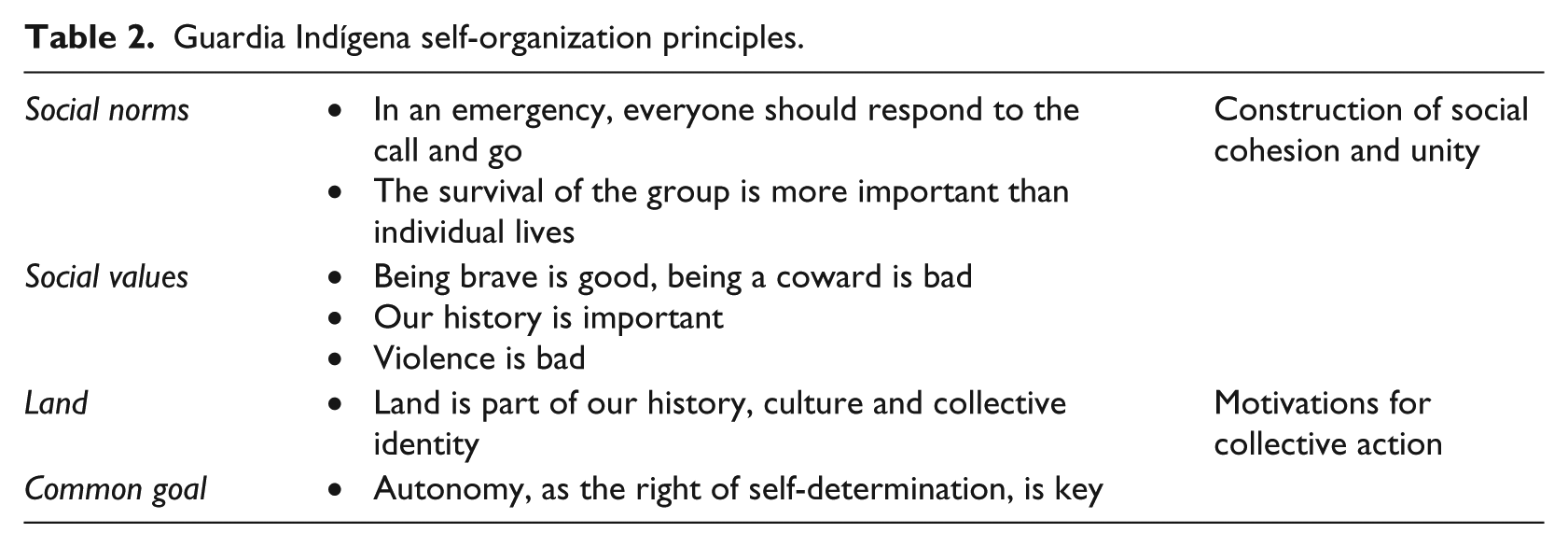
The events of 5 November 2014 illustrate the application of several social norms and values that could be translated as simple rules. Social norms refer to shared understandings about actions that are required, acceptable or forbidden in a group (Ostrom, 1999). Social values are considered the glue that makes social life possible, because they denote standards of what is good and bad, enabling quick judgements in certain situations (Oyserman, 2015). Values become norms when they guide and/or regulate or suggest a course of action (Rezsohazy, 2001). Some of the social norms identified in the guards’ responses are:
It does not matter what people are doing. In an emergency, everyone should respond to the call of the indigenous communities and authorities and go. This rule is shown in the rapid reaction of the indigenous Nasa in organizing themselves and travelling as fast as possible to the site. The rule applies even if it is not clear what the situation is and what their tasks are.
The survival of the group is more important than individual lives. This norm is evident in a leader’s assertion: ‘We are not scared by grenades. With that, you kill only five of us, and the others will catch you.’ This idea is reinforced in daily conversations when people express their willingness to die, if necessary, to achieve the group’s goals. Thus, they are willing to sacrifice themselves. In fact, in the anthem of the Guardia Indígena, which takes its main ideas from indigenous land struggles during the 19th century, one theme is repeated:
To the front companions, willing to resist To defend our rights, even if we have to die. Guard, guard! Strength, strength. For my race, for my land. Companions have fallen, but they will not defeat us. Because for every dead Indian, thousands more will be born.
Those norms are reinforced by values identified in the guards’ actions:
Being brave is good. Indigenous guards should be brave and should not be afraid about dying: ‘We are not scared by grenades.’ By being brave, they demonstrate a commitment to the group. Confronting an armed group is, then, a necessary act of bravery. In fieldwork, it was not clear whether people who died were compensated with glory or recognition. It was clear, though, that being brave was an important source of respect from others. Conversely, acting in a cowardly way was a common reason for people to be mocked or even excluded from political decisions.
The use of violence is bad, as past experiences have taught. Two values can be found here: the past is important and useful, and violence is bad. ‘We reviewed our history and concluded that it was a mistake when we took up guns, and indigenous authorities and communities decided we do not want more guns because guns are synonymous with death and we are defenders of life,’ 11 argued the coordinator of Tejido Defensa de la Vida, the branch of ACIN that manages the guards’ activities. Thus, the importance that the Nasa give to their past is consolidated in a nonviolent attitude, among other things.
These norms and values reinforce one another and help to construct social cohesion among the Nasa, promoting the capacity to act together. Either planned or unplanned, a process of collective identity reconstruction takes place, reinforced by ideas of a shared past, mentioned in previous utterances. Clearly, Nasa collective identity is not comprised of these principles only; cultural practices and cosmology play an important role that makes Nasa communities unique (for more on Nasa collective identity, see Chaves et al., 2018; Yule, 2012).
Decentralized control
As shown in the trial, the communities in the General Assembly are the supreme authority of indigenous communities in Northern Cauca. Thus, the community has enormous political power to monitor and make decisions about local situations. According to Wilches-Chaux (2005), such community power generates what is defined as distributed thinking, in which knowledge is not confined to a few people but shared among community members. Moreover, distributed thinking can generate distributed power, a political power that resides not in one or more authorities exclusively but throughout the community. This is the ideal of participatory democracy, also called community leadership (Wilches-Chaux, 2005). The role of cabildo authorities in this context is to facilitate community leadership.
The Colombian legal system, however, does not recognize the community as a rightful interlocutor; legal representation is the prerogative of the cabildos. Cabildo authorities are thus crucial in administrative decisions, managing funds, undertaking development projects, giving interviews to the media, representing people in negotiations and legal matters, translating native cultural constructions for outsiders, and resolving internal conflicts. Cabildo authorities take strategic decisions all the time, and some leaders have performed many administrative tasks. Thus, many leaders have amassed political power over the years. This type of power can be described as a practical authority, the kind of power-in-practice produced when specific actors develop competencies and win recognition within a particular policy area, enabling them to influence other actors’ actions (Abers and Keck, 2013). Hence, the practical authority of cabildo members – or leaders who are not always active cabildo members – competes with the political power of the General Assembly, and, during the fieldwork, it was observed that many tensions exist between community members and leaders.
However, as we can see in the example of the events of 5 November 2014, in emergencies the hierarchies fade away. The assumption is that, in events of high uncertainty, distributed power allows self-organization. This means that, in Nasa communities, adherence to social norms, shared values and collective goals facilitates the rapid mobilization of large numbers of people (see Table II). In this sense, guards represent a practical authority that strengthens the community’s distributed thinking. Thus, in emergencies, communities are above authorities and authorities are answerable to communities.
Guardia Indígena self-organization principles.
Indigenous Nasa understand that they are more powerful when applying distributed power. A leader explained that an organization with a few strong leaders is weak because individual leaders are easy targets and can easily be killed. 12 The solution they found was to have short governance periods, and in this way more people are empowered. However, there are tensions in implementation. In some communities, leaders do not change often; either they get re-elected or they just move to a different position in the cabildos. As a result, leaders are constantly criticized and monitored by the communities.
In this study, these dynamics are understood as a process of shifting power – more specifically, as shifts in the location of practical authority among different actors. Through this process, political power fluctuates to and from different sources. Thus, the question of who exercises political power at a particular moment depends on the place and the circumstances. Indeed, even practical authority (the power of authorities) moves from one leader to another, from leaders to the community, and vice versa, depending on the circumstances. Of course, such fluctuations in power do not occur without tension.
Organizing through interactions and feedback
To act effectively in uncertain circumstances, Nasa people need to have a network in place, an infrastructure ready. Hence, as soon as the call goes out, it reaches a large number of people, and the Guardia Indígena has the infrastructure to allow these interactions. The guards have radios and training, and they are dispersed in different villages. It could be said that the Guardia Indígena works as a decentralized network: one person calls another, who calls another, and so on. In the example examined here, the guards called people up in the mountain and managed to corner the rebels, but they also called community members from other areas, mobilizing a large number of people who arrived one after another. Moreover, shared social norms and values provide an idea of how to act at a particular juncture, making it easier for guards in an unclear situation to organize themselves through interactions instead of following instructions.
There is also constant feedback through general assemblies called to make decisions or to resolve conflicts between community members or with other communities. Emergency meetings are held during dangerous and uncertain situations. The Nasa call these meetings context analysis meetings. Guards, cabildo authorities and community members participate, and together they discuss the possible intentions behind adversaries’ actions, problems in the communities, political consequences of their own actions, and the relation between their local context and national trends. Their analyses are well informed; participants jump from local to national situations, from past to present and future events, comparing current circumstances with previous experiences. Likewise, each resguardo provides training for its guards, including workshops on indigenous history and human rights. The Guardia Indígena offers a platform, a network in which young and female indigenous people can obtain information and knowledge and participate in spaces that before were exclusive to men and elders. Finally, feedback is also obtained from the surroundings through territorial control walks, organized periodically by guards to check changes in the landscape, the presence of armed groups or new areas of illegal mining. This facilitates a permanent flow of information between the context and people’s ideas about it and actions that might be necessary.
Indigenous concepts
Indigenous Nasa frame their actions in terms of formal principles clearly expressed as unity, land, culture and autonomy. Unity refers to acting as a group, for which, as discussed, particular norms and values are important. The land is inextricably linked to their culture, history and collective identity; therefore, as expressed by the leader in the trial, all of the actions of the guards are motivated by the desire to retain their territories. The third principle, culture, refers to a particular way of living in their land, related to their beliefs, cultural practices and cosmology. The fourth principle, autonomy, is defined by Nasa as ‘people’s rights to control, watch, and organize their social and political life inside the resguardos, with guidance from cabildos and rejecting impositions from externals or outsiders’ (CMH, 2012: 194). In legal terms, autonomy has been translated into the right to self-determination. Comparison of this study’s translation of the Guardia Indígena’s actions with these indigenous concepts reveals the coherence of the study’s results. The identified principles show how these concepts are performed in a specific situation.
On concepts and equivocations
For the Nasa, concepts such as self-determination and autonomy, which they use in their discourses, may be more in tune with their own ideas than with the self-organization concept. Self-determination and autonomy are, however, also translations from Western legal systems, and these concepts can indeed explain why members of the Guardia Indígena act in a certain way. The self-organization analysis has clarified how the guards operate in concrete situations and how they manage to gain power without using violence when faced with armed groups. The results and their implications are now further analysed in relation to different fields of knowledge.
On collective identity
First, social norms and values observed in actions by the Guardia Indígena are a cornerstone of its collective identity. When indigenous individuals join the Guardia Indígena, they are expected to act in accordance with these principles. Accordingly, it could be assumed that indigenous members of the FARC have implicitly rejected indigenous political organizations and strategies and taken a different path. The fact that some members of the FARC were indigenous Nasa shows that individuals can choose some features of their indigenous identity and reject others. There are, however, some very important differences between membership in the Guardia Indígena and membership in the FARC, of which the most visible is the use of guns versus deploying nonviolent strategies. From the perspective of the indigenous organizations, people in the FARC are considered to be lost or desarmonizados, and thus are implicitly considered as having rejected their Nasa identity, while an indigenous person might still see being a member of the FARC as acceptable. The Guardia Indígena identity, meanwhile, has become a category that endows members with special political rights (e.g. land and autonomy) and constrains their forms of action (e.g. nonviolent and ecological).
Second, guards feel strong emotions associated with their identity as Nasa and guards. As explained by one informant: ‘I didn’t want to die, but it is like I rub off and se me sale el indio! Because, when we are together, we feel more indigenous.’ Statements like this suggest that acting together generates a contagious effect, which could be understood as a body response. In Spinoza’s terminology, this is called affect, understood as the capacity of the body to affect and be affected by other bodies (Viveiros de Castro, 2004). Affect is a pre-personal and pre-conscious stimulation to act that emerges at the moment of the encounter (Kaufmann, 2015, citing Deleuze and Deleuze). Therefore, it is not just being together, but confronting others together that generates the affect. This is important because collective identities imply the articulation of differences in relation to others (Escobar, 2008), including cues for an interior and an exterior common recognition (Von Busekist, 2004), which can be visible in features, practices and actions. In this sense, the Guardia Indígena identity goes beyond any conscious decision: it is also a feeling.
Third, shared norms and values help the Nasa to organize power by numbers. The strategy of constructing power by numbers is indeed very powerful. ‘The goal of having so many people is to make the enemies give up without hurting them. The strategy is to follow them until they get tired and give up, and show them that we are also powerful,’ an informant from Tacueyó explained. 13 In the example discussed in this article, the rebels gained power from their guns but, faced with 400 people, guns have limited power. First, in a symbolic way, as in the contemporary context, the use of guns and violence is not accepted as legitimate power without justification. Second, guns are powerless when there are too many people; except in very specific circumstances, it is not possible to kill them all.
Implications for peacebuilding
Dudouet (2008) defines nonviolence as a direct substitute for violent actions: it implies deliberate restraint from expected violence in a context of conflict. In this case, the actions of the Guardia Indígena satisfy that definition. Moreover, the nonviolent actions of the Guardia Indígena can be understood as a pragmatic strategy for survival in which limited violence, such as stone-throwing, is allowed (Eddy, 2014). Their nonviolent forms of self-organization would probably not have been possible without the current legal system. In this way, their nonviolence is a form of adaptation to their current complex environment (see Chaves et al., 2018). The Guardia Indígena’s mechanisms and strategies for managing violent situations in a nonviolent way have several implications for peacebuilding in Colombia.
First of all, social norms applied by the Nasa in dangerous situations have particular functions. Norms such as that everyone ‘should respond to the call’ and ‘the survival of the group is more important than that of the individual’ help to bring together a large group of people, no matter the risk. Values such as ‘guards are brave’ and ‘guards defend life’ are used to promote bravery and nonviolent actions. Consequently, norms and values create a frame of interaction in which some actions are allowed, whereas others are not. The main literature on social capital (Ostrom, 1999), though, assumes that people are rational decisionmakers. The current authors instead adhere to a critical institutionalism view, assuming that people are conscious and unconscious social agents who are deeply inserted in their cultural settings and are capable of analysing and acting upon the circumstances that challenge them (Cleaver, 2001; Giddens, 1984). Nasa individuals follow these social norms, but they can also transform them in particular contexts and act accordingly. Hence, individual guards keep their autonomy, and this represents a key difference between the Guardia Indígena and, say, a military organization.
Second, the literature defines two main types of social capital: bonding and bridging (Cox, 2009; Putnam, 2002). Bonding refers to social norms and values that allow members of the in-group to rely on one another and act together. It is especially relevant for a transitional stage of latent asymmetric conflicts, as a strategy for empowering grievance groups and, therefore, transforming unbalanced power relations (Dudouet, 2008). That is clearly visible in the actions of the Guardia Indígena. However, the literature (Cox, 2009; Putnam, 2002) shows that peacebuilding involves not only strengthening in-group ties (bonding) but also, even more importantly, strengthening relations with other groups, bridging, which refers to reinforcing empathy, interaction and co-dependence across different groups. Bonding without bridging could even be a source of conflict (Putnam, 2002). Nonviolent actions by the Guardia Indígena have improved Nasa connections with social organizations at the national and international levels, helping them to expand their networks, and are thus a type of bridging. Moreover, nonviolent strategies help Nasa people protect their land and their autonomy while maintaining their independence from the armed conflict between the guerrillas and the government. The use of nonviolence has thus become a type of legal measure that could also be viewed as bridging. Overall, nonviolent resistance is especially relevant for a transitional stage of latent asymmetric conflicts, as a strategy for empowering grievance groups and, therefore, transforming unbalanced power relations (Dudouet, 2008). Indigenous Nasa neutrality, then, represents a form of resistance that questions the political and social regime and highlights the violent ways in which the state and other groups aim to resolve the issue of public order (Arendt, 1999). To sum up, bonding makes individual connections within the group stronger and thus makes the group stronger, while bridging strengthens their legal claims. Accordingly, the nonviolent principle represents a challenge for the state and supports a step forward to peacebuilding.
Finally, this analysis shows that power fluidity, expressed in practical authority, allowed the Guardia Indígena to self-organize and act quickly in emergencies. The analysis of the confrontation with the FARC and the trial shows that the Nasa go beyond decentralized control in their actions. The focus on principles instead of on authorities and the rapid leadership changes in some of the cabildos are important factors in the promotion of distributed power, allowing fluidity of practical authority and permitting self-organization to occur in emergencies. Power fluidity, as applied in Nasa organizations, challenges Western thinking, which tends to organize the social world in dichotomous relations between individuals and society (Elias, 2000). In Nasa communities, practical authority is both centralized and distributed. This power fluidity provides possibilities for flexibility and adaptation. Likewise, the concept of everyday peacebuilding connects with debates on resilience and the ability of individuals and communities to cope with stressful situations (Kaufmann, 2015; Mac Ginty, 2014). This analysis of the way the Guardia Indígena operates (which indeed is self-defence) provides important building blocks for everyday peacebuilding. The nonviolent actions – or perhaps even nonviolent coercion – of the Guardia Indígena correct power imbalances between them and the armed groups. Studies have shown that local ownership is a precondition for sustainable peace (Cox, 2009; Kaplan, 2013; Sending, 2010). In this case, it allows the Nasa to remain independent from the violent civil war. The capture, trial and punishments examined in this article show different approaches in which the Nasa utilize their power and present themselves as independent actors rather than victims of the armed conflict. Their actions respond to their own historical analysis and interpretations and the local context. The capture represents an innovative strategy for dealing with armed groups; the trial responds to the legal framework by making use of their right to self-determination; and the punishment for the youngest responds to rooted cultural practices. These strategies represent a framework used by the Nasa to claim their territorial control and contribute to peacebuilding in such a way that they feel part of Colombian society and not dominated by hegemonic and armed groups.
This study shows the local context in its complex, contradictory, unstable and relational nature (Hirblinger and Simons, 2015), inviting stakeholders to go beyond normative thinking, showing the Nasa’s resilience practices, and thus providing new potentials for peacebuilding in Northern Cauca and Colombia. Peacebuilding is then understood as the possibility of transforming relationships among conflicting actors into more sustainable and peaceful relationships (Lederach, 1999). Equivocation implies awareness of the limitations of translating concepts and actions from other perspectives. The Nasa perspective refers to a different reality, a ‘world making’ that goes beyond the immediate struggle or war (see, for example, De la Cadena, 2010; Escobar, 2017; Viveiros de Castro, 2014). For the Nasa, peace does not mean the lack of conflict; for them, peace is related to their autonomy and their capacity to control and govern their lands. So, in some cases, nonviolent conflict is a necessary step to protect themselves from marginalization. This is important for peacebuilding, as the goal is not the absence of conflict among groups but rather the de-escalation of armed conflict to a point at which differences can be dealt with in a nonviolent way that respects people’s needs and identities. Hence, the Nasa use nonviolent self-organization to fight for a pluralist society or, as Escobar (2017) says, a society where different worlds are possible.
Conclusion
This study has described the Nasa’s everyday practices for conflict management in order to elucidate some of the theoretical and practical lessons for peacebuilding in other contexts that might be learned from these practices (see Table II). The peacebuilding initiative studied, however, does involve some limitations. Managing the unintended outcomes of Guardia Indígena actions, for instance, represents a real challenge and requires a lot of resources and energy from indigenous organizations. Top-down efforts at peacebuilding should engage with local dynamics more consciously. In the case of Colombia, where the central government has failed to provide public goods such as security, self-defence groups with characteristics similar to those of the Guardia Indígena could contribute to this issue (see, for example, Arjona, 2017; Masullo, 2015). Nonviolence, focused on defending human rights, appeared to be essential to control these self-defence groups and avoid their becoming a new source of violence and power struggles. Therefore, interventions in the post-conflict territories should facilitate and support local initiatives such as the Guardia Indígena. This can be achieved if local communities have both sufficient autonomy and support to develop their own solutions and strategies.
Of course, the nonviolent way of organizing may have been effective in this particular context because groups like the official army and the FARC care about their political image. Alternatively, the effectiveness of the Nasa’s nonviolent actions may be related to expectations. Armed groups expect people to become scared and run away when faced with danger and guns. Nasa people do not avoid conflict and danger; instead, they empower themselves against armed actors. By reacting differently, indigenous guards pose a challenge to armed groups who may be habituated to being feared and obeyed. Lastly, many studies maintain that the success of any peace agreement in Colombia will depend on access to, and control of, land. In that sense, by exercising their constitutional right to control their territories, Nasa communities are also contributing to peacebuilding.
Footnotes
Acknowledgements
The authors would like to thank the Nasa community, especially the Tejido de Defensa de la Vida of ACIN, for inspiring and allowing this research. The authors are also grateful to the three anonymous reviewers, whose insights and suggestions enabled them to greatly improve the article.
Funding
This research was possible thanks to the scholarship of Francisco José de Caldas during 2010 in Colciencias, Colombia.
