



Abstract
This paper explores the potential for Assemblage Theory to supplement current approaches to studying labor migration in law and the social sciences. Based upon a study of women's migration for garment and domestic work in India, I lay out the labor supply chain assemblage (LSCA) as a framework for understanding how workers find employment across multi-site, dynamic trajectories. Migration into temporary employment requires workers to move between jobs on an ongoing basis. Accordingly, studying labor supply chains as fluid assemblages defined by labor market conditions, component elements, and various agents provides a methodology for analyzing frequent job searches, across recruitment geographies, that include a range of recruitment actors. By accommodating temporal, territorial, and relational analysis, this approach provides insight into how labor migration processes for migrant garment and domestic workers in India articulate with the development of markets, working conditions, and social hierarchies – including on the basis of gender and caste.
Introduction
Across the globe, migrant workers are increasingly concentrated in temporary employment – including contract, short-term, and contingent work. This rise in temporary work among migrants and other workers has received significant scholarly attention (Beard and Edwards, 1995; Kalleberg, 2000; Valenzuela, 2003), with taxonomies of temporary work, classified by duration, location, and number and types of employers (Feldman, 2006). Relatedly, research on informal labor markets highlights the significance of hiring practices in developing markets and determining labor conditions (Portes, 1995; Valenzuela, 2003). Lines of foregoing research on temporary employment and hiring practices raise but do not answer myriad questions. How do migrant workers move between temporary jobs? How can we identify multi-site, dynamic labor migration processes? How are networked recruitment practices governed, including in the absence of state regulation? To address these questions, this study develops an approach to studying labor supply chains as assemblages (Deleuze and Parnet, 1987; Nail 2017), an empirically grounded methodology for understanding complex labor migration processes that cross, link, and co-exist within geographies and markets. This framework fills a gap in the literature on labor migration by revealing interrelated sites and modes of governance that shape employment outcomes for migrant workers.
My analysis of labor supply chain assemblages (LSCAs) is rooted in empirical investigation of how migrant women workers from Bihar, Chhattisgarh, and Jharkhand, India move between temporary jobs in garment and domestic work in Delhi and Mumbai. It is based on 254 interviews and 63 focus group discussions with migrant women and recruitment intermediaries across five states. By focusing on the experiences of migrant women from Scheduled Castes and Tribes, I direct attention to how gender and social identity structure labor supply chains. My focus on India provides insight into labor supply chains in a context shaped by high levels of internal migration into temporary employment; and this comparative study of placement in garment and domestic work develops the relevance of LSCAs for studying deregulated industrial and unregulated contexts. I found that in this highly informal context, employment insecurity is managed by elaborate networks of recruitment intermediaries between geographies, markets, and roles. I inductively identified labor supply chains as mobile and fluid sets of material and relational practices that can be well studied through the lens of assemblage theory.
Although they are always evolving, the defining features of assemblages include their conditions, elements, and agents (Deleuze and Guattari, 2008; Nail 2017). I identify three defining features of LSCAs into temporary work. The first, frequency, is a condition that refers to repeated engagement with a labor supply chain assemblage. The second, iteration, directs attention to repetition with variation between successive labor supply chain engagements between workers locations, recruitment intermediaries, and employers. The third, segmentation, describes discrete but linked elements of LSCAs, including processes that support migration across geographies, mobility within markets, and promotion. Frequency is a temporal condition, whereas iteration and segmentation are relational and territorial conditions. As such, studying labor supply chains as assemblages facilitates analysis that is at once temporal, territorial, and relational.
Frequency, segmentation, and iteration, in turn, direct attention to various sites of recruitment governance. These include structures of work within industries and sectors, labor supply and demand, migration trajectories, social relationships, and systems of seniority and access – including those maintained by gender, class, caste, race, nationality, and other systems of hierarchical differentiation. By bringing labor market, territorial, and social governance structures into the same analytic framework, this approach resonates with approaches to studying law and society that recognize social fields as semi-autonomous, describing the presence of multiple ordering structures within a field (Moore, 1973). The study of labor supply chains as assemblages also sheds light on the range of forces that govern worker mobility in contexts that are not controlled, or incompletely controlled, by state laws and regulations. This empirically grounded methodology has the potential to support interdisciplinary, cross-regional, and inter-sectoral scholarship aimed at understanding the recruitment processes that facilitate global employment.
Part I: Labor Supply Chains as Mobile Assemblages
Mobility is an object of study and an analytic lens to reorient our understanding of social processes (Salazar, 2018). My study of labor supply chains as mobile assemblages builds upon and contributes to scholarship on mobility that attends to the route as a unit of analysis (Gilroy, 1993; Walters, 2015). At the intersection of temporary labor markets and migration, I consider how labor supply chains define migration routes, and encompass a range of material and relational processes that facilitate worker mobility.
Labor supply chains facilitate worker mobility between junctions, including territorial, market, and work junctions (Nail, 2015). A city is a political junction, a production zone is a market junction, a work site is an employment junction, and so forth. In my account of labor supply chains, I am concerned with flows of temporary workers between junctions at various levels, including rural high migration sending areas and urban industrial hubs; production clusters and service hubs; and mobility between jobs, including promotions.
What units of analysis and theoretical frameworks facilitate understanding of how migrant workers move between temporary employment gigs across these varied junctions? A robust theoretical framework for understanding labor supply chains must have sufficient elasticity to encompass worker mobility between jobs, sectors, and geographies, as well as shifting practices. Therefore, I study labor supply chains as assemblages, referencing a concept that originated with Deleuze and Guattari's (2008) experiment in social theory that sought to overcome static social theoretical models by emphasizing movement and heterogeneity. An assemblage, by definition, accommodates a contingent, open set of actors, sites, institutions, and practices that constitutes in diverse configurations (Deleuze and Parnet, 1987; Nail 2017). For Deleuze and Guattari, assemblages facilitate understanding of fragmented mechanisms comprised of independent components – what Deleuze calls singularities – that can be combined and recombined. As such, researchers have found this concept useful in addressing problems that cannot be well accommodated within standard units of analysis (Ong and Collier, 2005; Sassen, 2008; Schuilenburg, 2015). Assemblages are constantly evolving within social and historical processes. They cannot be pinned down, but they can be defined by contextually contingent features (Deleuze, 2001: 191).
What is a contextually contingent feature? For Deleuze and Guattari, assemblages are composed of heterogeneous elements and processes, but they can still be defined by three features (Nail, 2017). The first feature, conditions, refers to networks of specific external relations that hold the assemblage together. I argue that a defining condition of LSCAs into temporary work is repeat engagement by temporary workers as they move between employment gigs, and I refer to this condition as frequency. The second feature shared by assemblages is that they are composed of concrete elements. In the context of LSCAs, I refer to these elements as segments. Labor supply chain segments operate between locations and within labor markets, aligning in distinct combinations for migrant workers seeking employment. The third feature of an assemblage is its agents. Agents do not control the architecture of an assemblage, but instead occupy mobile positions within it. Temporary workers navigate labor supply chains as agents seeking employment on a regular basis. They also engage in repeat interactions with other agents, including other workers, recruitment intermediaries, and employers as they return to familiar locations to find work. As such, I direct attention to iteration – a relational concept marking repetition with variation. (Table 1)
General features of assemblages and their particular form in LSCAs.
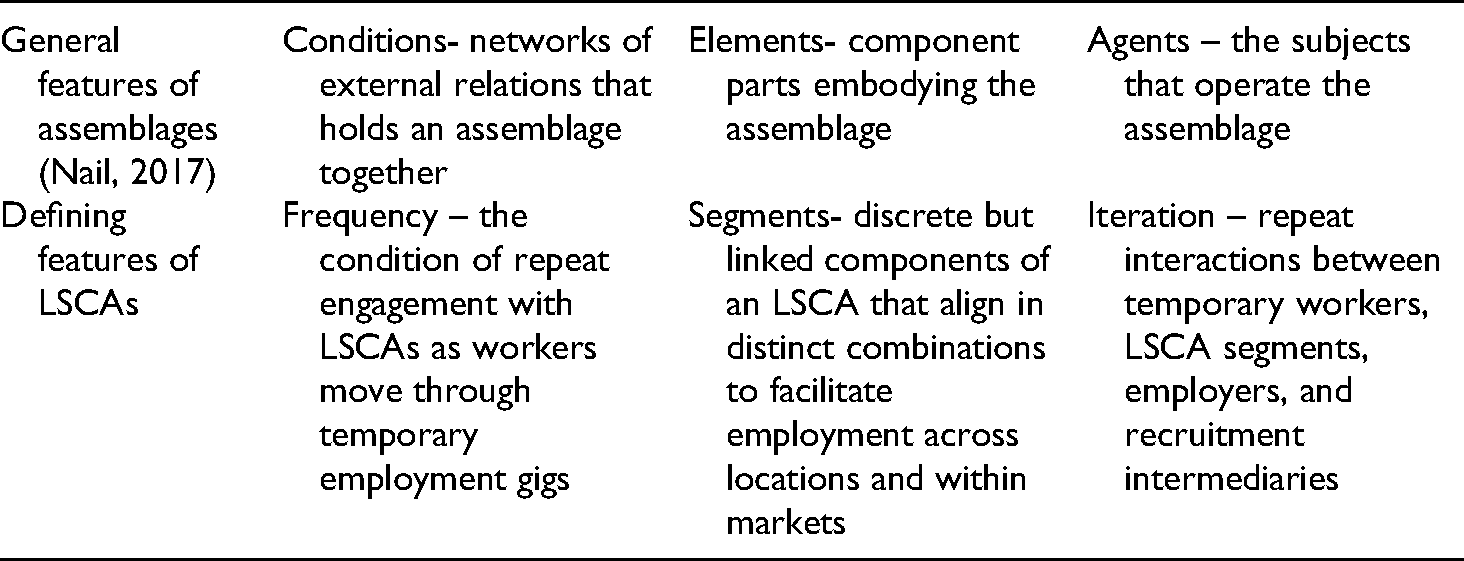
LSCAs articulate in relationship to labor market conditions. Here, I draw from Hall's (1985) conception of articulation as a connection which is positively sustained by particular processes, renewed, or alternately dissolved to make way for new connections or rearticulations. In other words, LSCAs are sustained by labor market conditions, and evolve in relationship to shifts in these conditions. Accordingly, studying labor supply chains through the analytic building blocks of frequency, segmentation and iteration facilitates research into how recruitment and placement evolves over time; how market shifts impact recruitment and placement within distinct sectors; and how shifts in recruitment trajectories evolve to encompass new frontiers for labor migration. I demonstrate the potential of this framework to support comparative analysis through my attention to LSCAs in both garment and domestic work.
Part II: Methodology
I developed my analysis of labor supply chains as assemblages by researching women's migration from Bihar, Chhattisgarh, and Jharkhand to the Delhi-NCR and Mumbai (Figure 1). I selected these locations due to high rates of migration in garment and domestic work, specifically among Dalit (Scheduled Caste) and Adivasi (Scheduled Tribe) communities. 1
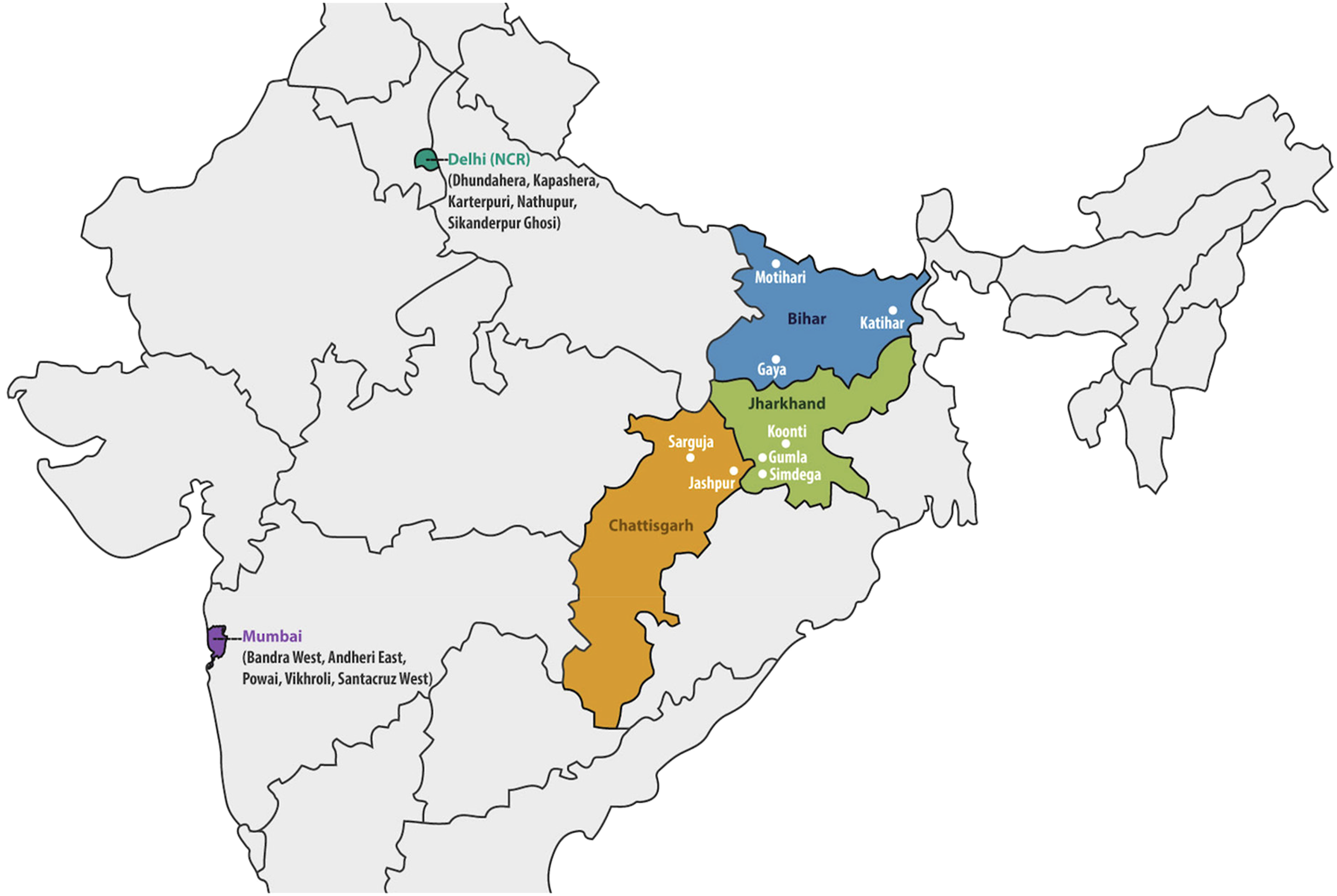
Primary data collection sites in India.
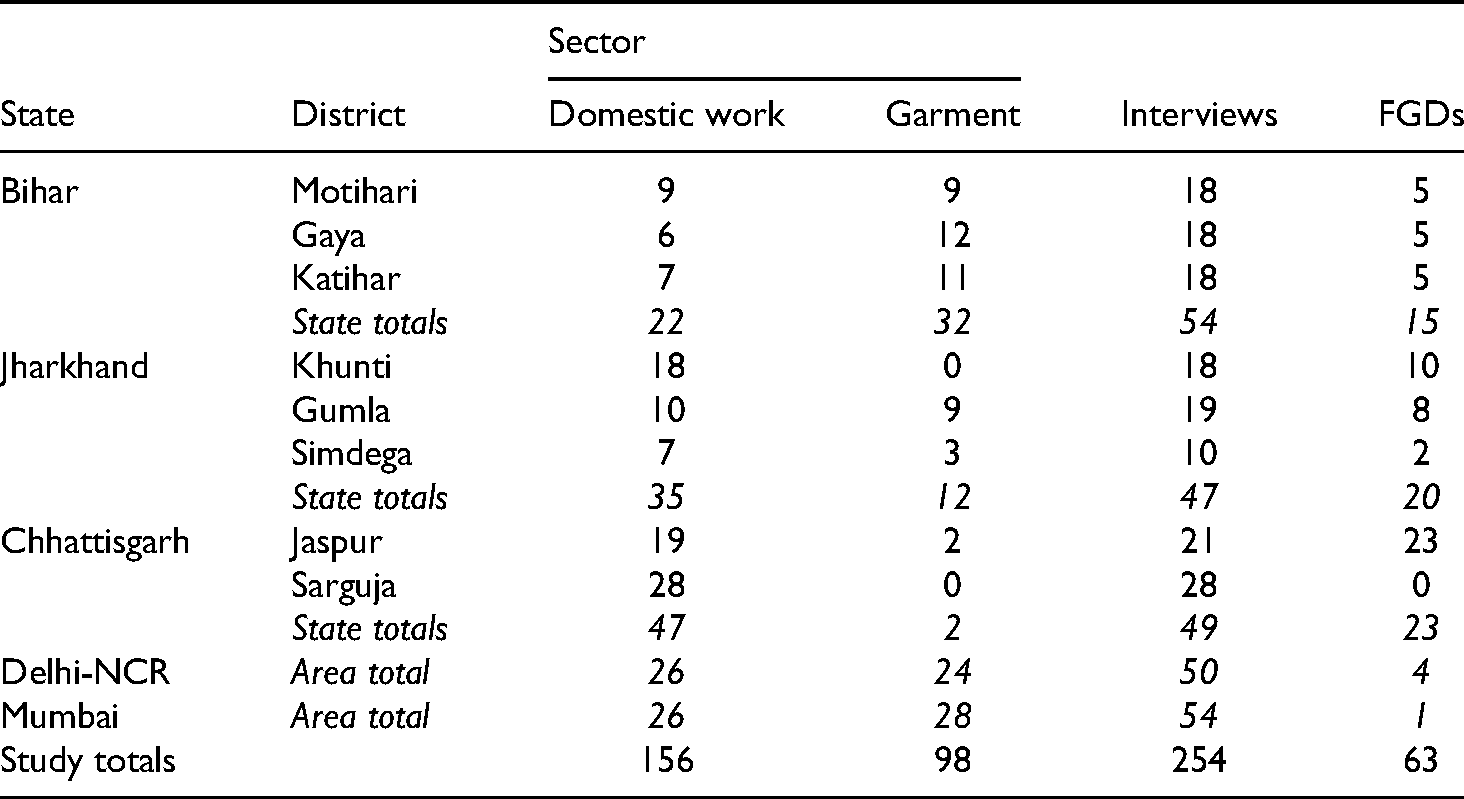
My research included a first phase of 254 semi-structured interviews with migrant women and 63 focus group discussions (FGDs) including migrant women and recruitment intermediaries (Table 2); and a second phase of unstructured interviews, case studies on well-trod labor migration routes, and interactive observation. Data collection was anchored at the Society for Labour and Development (SLD), Delhi, from August 2015–November 2016, during my time as Research Director. Our team included 15 researchers. 2 We selected migrant women respondents based on three sets of criteria: migration from target districts in Bihar, Chhattisgarh, and Jharkhand to the Delhi-NCR and Mumbai – sampling on territorial junctions; employment in garment or domestic work in Delhi-NCR or Mumbai – sampling on labor market junctions; and migration for employment between 2010 and 2015 – sampling on a temporal band.
Interview and FGD respondents by location and occupation.
I designed the first phase of data collection with an understanding that workers engage in recruitment processes at various intervals on literal journeys. In order to capture these processes across time and location, I used a semi-structured interview format to elicit information on engagement with labor supply chains at six stages. This approach supported aggregated analysis of highly varied individual experiences, and allowed me to hone in on unifying and distinguishing features of labor supply chains.
FGDs with migrant women and recruitment intermediaries, including between 3 and 8 participants, focused on cycles of seasonal migration and experiences of recruitment and placement in garment or domestic work – including positive and negative experiences, and the role of migrant diaspora communities in facilitating employment. FGDs also facilitated access to information in contexts where it was difficult to engage women in interviews due to stigma associated with migration and extended working hours. In these cases, we worked with local organizations to facilitate engagement, holding meetings at All India Democratic Women's Association (AIDWA) offices in Mumbai and SLD offices in Gurgaon. Women who felt unable to speak freely within their communities agreed to participate in confidential discussions outside the community.
To identify how social identity affects recruitment practices, we invited respondents to self-identify as members of Scheduled Castes (SCs), Scheduled Tribes (STs), and Other Backward Classes (OBCs) – three official legal classifications laid out in the Constitution of India and used by the Government to identify individuals and communities from social groups that are educationally or socially disadvantaged based upon historical legacies of discrimination and social and economic exclusion. Approximately 87% of women workers engaged in this study self-identified as SC, ST, or OBC (Table 3).
Respondents from scheduled castes, scheduled tribes, and other backward classes.
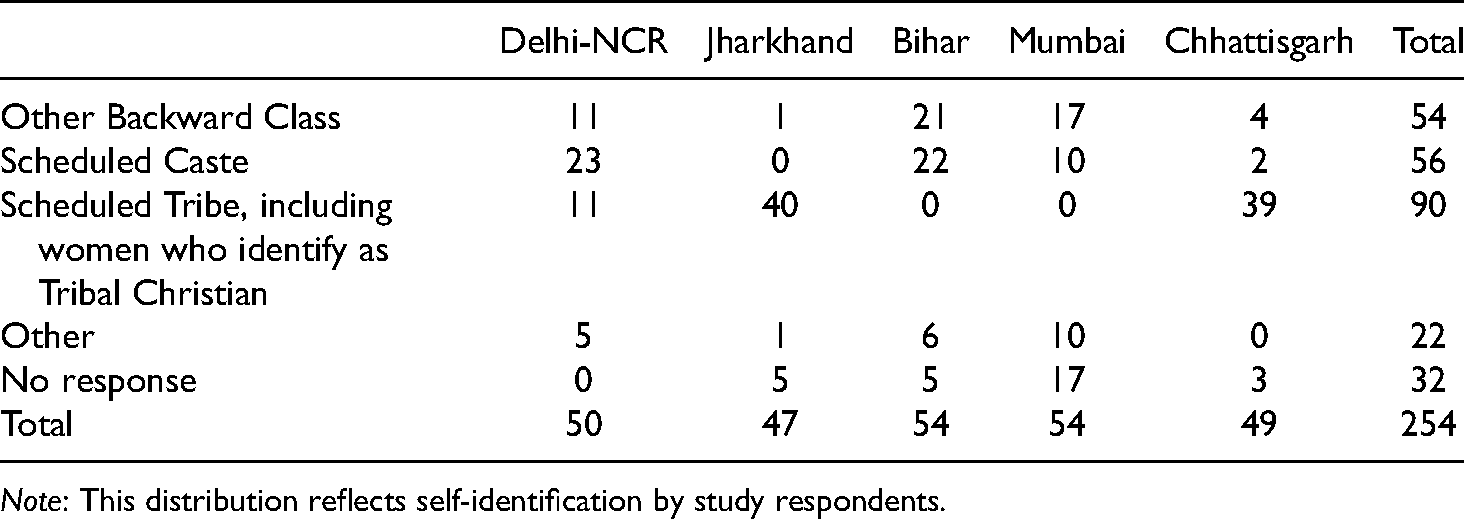
Note: This distribution reflects self-identification by study respondents.
I analyzed these materials by hand in order to identify key features of recruitment processes, as well as significant gaps in our understanding of labor migration trajectories. Notably, across sites, migrant women had difficulty recalling names and identities of employers and recruitment intermediaries. In almost all cases, workers were unable to produce documents related to either recruitment or employment. Some were reluctant to identify recruitment intermediaries since they continued to engage with them and/or related agents.
Accordingly, in order to zoom in on sometimes-fragmented snapshots of labor migration processes collected through interviews and FGDs, I directed field investigators to conduct extended unstructured interviews, develop case studies, and engage in interactive observation. For instance, researchers in Mumbai identified a public park where young women and men from Jharkhand, Chhattisgarh, Orissa, and West Bengal congregate on Sunday afternoons. Here, participant observation and unstructured engagement provided insight into labor supply chains in full time domestic work. In the garment sector, follow up investigations based upon the initial round of hand-coding included unstructured interviews with supervisors, trade union representatives, community organizers, and senior workers. Researchers, some of whom were from migrant communities and had previously been employed as garment workers, visited training centers to develop case studies.
Due to challenges in engaging recruitment intermediaries in the field, I conducted two workshops in the Delhi-NCR, co-hosted with the ILO and SLD to facilitate participation. Participants shared recruitment practices, challenges, and opportunities for advancing effective state regulations. The workshop with domestic work placement agencies included 17 participants, representing 9 agencies. The workshop with recruitment intermediaries in the garment sector had 6 participants, including a supervisor, a quality control manager, representatives from a women's empowerment platform, and an NGO that specializes in recruitment, training, and placement.
Once fieldwork was complete, I used data analysis software to hand code interviews, FGD and workshop transcripts, and investigative case studies. I tagged data sources with codes identifying the sector and type of employment in order to create data clusters: the experiences of women garment workers formed one cluster; and experiences of domestic workers formed another two clusters, divided into seeking full-time and part-time domestic work. I then coded each cluster to identify key features of labor supply chains, using the six stages laid out in the semi-structured interview as an analytic framework to identify people involved in recruitment and placement, and sites of engagement with agents and employers (particular villages, cities, towns, and locations within these territorial junctions).
In coding this rich data set, I identified labor supply chains as fragmented, shifting material and relational practices. Accordingly, I began to analyze these mobile formations as assemblages, using frameworks from Nail’s (2017) exposition of Deleuze and Guattari, and sought to identify defining conditions, elements, and agents. As I worked to understand the architecture of these mobile assemblages, I reviewed the data across clusters associated with garment and domestic work in order to identify cross-cutting characteristic features of these assemblages. From this analysis, I developed the three conceptual dimensions that organize the findings section of this paper: frequency, iteration, and segmentation.
Part III: Labor Supply Chain Architecture
The LSCAs in this study link territorial junctions, as women workers migrate from rural Bihar, Chhattisgarh and Jharkhand to the megacities of Delhi and Mumbai; and specific workplaces within cities and industrial hubs as they move between jobs within the garment and domestic work sectors. These LSCAs intersect, link, and nest in diverse configurations, crossing geographies, anchoring flexible labor markets, and conditioning movement between jobs.
My analysis attends to contextually defined features particular to LSCAs – the frequency of worker engagement with recruitment intermediaries, segmentation of the recruitment process, and iteration or repeat interactions with locations and people involved in recruitment and placement. Analysis of each of these features – frequency, iteration, and segmentation – reveals structures, sites, and relationships that govern experiences and outcomes for migrant women workers (Table 4). These include the structure of work within the garment and domestic work sectors, labor surplus and demand, and social networks and relationships that govern access to employment – including hierarchical social relationships anchored by gender, class, caste and tribal status.
LSCAs: features, units of analysis, and associated sites of governance.
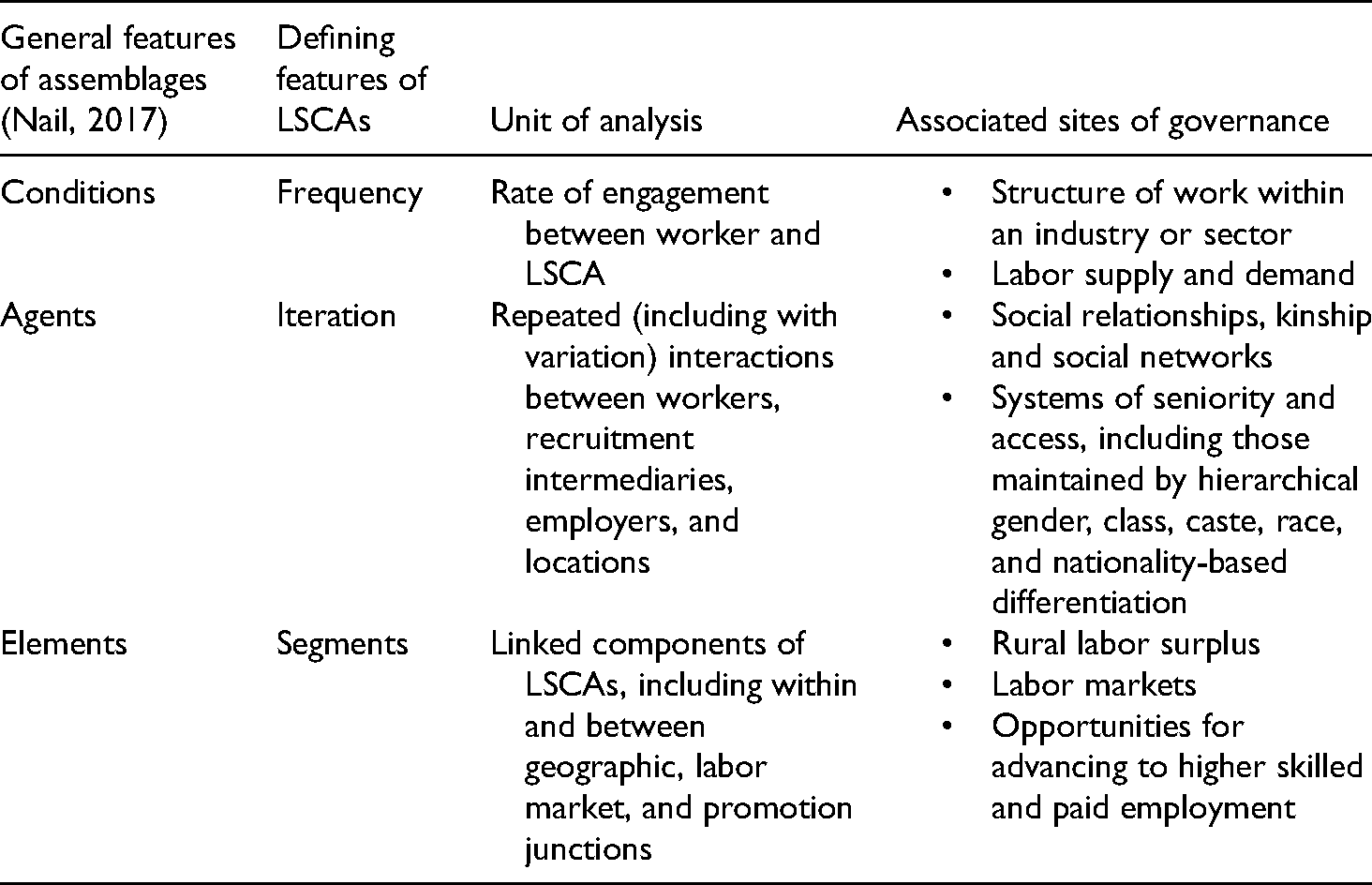
Since LSCAs articulate in relationship to labor market conditions, attention to key features of these assemblages directs attention to how they articulate with unregulated and deregulated labor market conditions in India. In bringing labor market, territorial, and social governance structures into the same framework for analysis, the LSCA is particularly well suited to grasp the range of forces that govern worker mobility in contexts that are not controlled, or incompletely controlled, by state laws and regulations.
Conditions: Frequency in High Informality Contexts
A fundamental condition defining LSCAs into garment and domestic work is regular engagement in seeking employment – which I term frequency. Women engage with LSCAs at a range of frequencies that are specific to the structures of garment and domestic work in Delhi and Mumbai, and the distribution of labor supply and demand in rural and urban India. Despite distinct patterns of engagement between sectors, both garment and domestic workers have high frequency engagement with LSCAs rooted in structures of informal work.
Engagement Frequency among Garment Workers
Temporary garment workers have high frequency engagement with LSCAs – including daily, weekly, monthly, and seasonal searches for work. Among the 99 women garment workers we engaged, the vast majority worked ten months of the year with routine retrenchment periods in July and August due to lean periods in fast fashion production cycles. Workers returned home to Bihar, Chhattisgarh, and Jharkhand during periods of unemployment and reengaged LSCAs upon returning to production hubs. Women also reported regular shifts among garment factories.
High frequency engagement with garment sector LSCAs is rooted in the structure of work within garment global value chains (GVCs) that produce for fast fashion markets. Since 2010, garment GVCs have increasingly relied on contract workers (Chan, 2013) who cost less to employ. Employment practices at the factory level are dictated by fast fashion brand business models and purchasing practices: since brands commonly release between eight and ten style seasons annually (Silliman Bhattacharjee, 2020), rapid turnover in retail stock accelerates production cycles and shortens lead time. Downward pressure on prices, combined with unpredictable seasonal variation in production, requires supplier factories to employ a flexible, low-wage work force.
This flexible industrial workforce is facilitated by the systematic deregulation of industrial production, which has unfolded amidst the broader deregulation of Indian markets beginning in the 1980s and peaking in 1991 as India pursued legal and market reforms that diminished state and federal labor regulations (Silliman Bhattacharjee, 2016). In 2009, India's National Commission for Enterprises in the Unorganized Sector (NCEUS, 2009) recognized garment workers as ‘informal workers in the formal sector’. This designation accounts for the range of temporary roles garment workers fill – including home-based work, and daily wage and contract labor in factories. On GVCs and other contingent work regimes, my findings suggest that common structures of low wage, temporary, industrial work may dictate common LSCA engagement frequencies, and attendant consequences for workers – vulnerability to hiring and firing, low wages, and no employment benefits.
Engagement Frequency among Domestic Workers
The 155 domestic workers who participated in this study engaged LSCAs less frequently and regularly than garment workers. In the Delhi-NCR and Mumbai, we identified three predominant employment modes among domestic workers: full time live-in, part time, and commercial housekeeping. Women transition between these types of work as their and employer needs evolve. Whereas garment workers reported routinized daily, weekly, and monthly engagement with LSCAs to secure factory employment, domestic workers move between employers and types of employment with less rigid but still patterned frequencies.
Domestic work in India is largely unregulated. With few exceptions, domestic workers are excluded from labor rights protection due to definitions of ‘workman’, ‘employer’, and ‘establishment’ that do not include the household as a site of employment. As such, employment conditions are in part set by the market, but are also highly contingent upon particular employers – accounting for frequent mobility between jobs for domestic workers as both employers and domestic workers seek out preferred working arrangements.
Women in domestic work described a common trajectory of migrating to urban hubs for full time live-in employment, and then transitioning to part time work. As one woman explained, increased freedom of movement and pay are significant incentives: Girls who come to Delhi for the first time prefer to work full-time and live-in to avoid lodging and food expenses. Soon enough, many realize movement is restricted and pay is scanty. Then, like me, they search for a few part time jobs. We earn the money we need without relinquishing our freedom.
Domestic workers described repeat engagement with LSCAs as they moved between full and part-time employment; or for those who remained in full-time work, between employers. Part-time domestic workers also described engagement with LSCAs as they expanded the number of households where they worked, or shifted between employers.
Like garment workers, domestic workers described gaps in employment due to transitions between employers, seasonal migration for agricultural work, and family and personal obligations. During these gaps, women report working in rural economies, including in agricultural and daily wage work. The LSCAs involved in moving between urban domestic and rural work – while outside the scope of this study – attest to the intersection and coexistence of a multitude of LSCAs in the lives of women employed in India's informal sector.
Frequent engagement with LSCAs to secure employment in garment and domestic work is driven by employment insecurity in contexts of high informality – a term that refers to labor markets and employment contexts that are not regulated by the state (Hart, 1973). Absence of state regulation and the governance conditions it creates can take varied forms – encompassing deregulation in the garment sector, a once regulated sphere going through processes that withdraw state regulation; and the unregulated domestic work sector.
The distinct engagement frequencies between workers and LSCAs in the garment and domestic work sectors articulate with corresponding distinctions in the structure of these temporary forms of work. Regular engagement frequency between garment workers and industrial LSCAs facilitates a ready pool of low wage workers that can fulfill irregular contracts, and be scaled back as demand wanes. The structure of work for garment workers is largely fixed based upon somewhat standardized production requirements among similarly positioned supplier factories with low levels of specialization, bargaining power on GVCs, and margins (Nathan et al., 2022). By contrast, women who engage LSCAs into domestic work move between not only employers, but also types of domestic work in a comparatively fluid manner.
The comparative fluidity of LSCAs in domestic work helps to account for the common trajectory among migrant women from employment in garment and other industrial work into less structured parts of the informal sector. In garment factories in India and elsewhere, women production line workers, for the most part, age out of employment by age 35. This is due to an industry preference for younger women who can sustain the rigour of meeting extremely high production targets; and who are less likely to be married and therefore more likely to submit to compulsory overtime work (Nathan et al., 2022). Mezzadri and Majumder's (2019) analysis of the life history of twenty women garment workers who are over 40-years-old documents the employment trajectory from garment factories to the informal sector in Bangalore, India. After aging out of the garment labor force, women workers took up domestic work, home-based garment work, or agricultural work.
The successive and non-linear engagement of migrant women workers with LSCAS in garment, domestic work, agricultural and other informal sectors underscores the methodological advantages of studying LSCAs as intersecting assemblages comprised of common features or building blocks. In this example, they intersect in the lives of particular women workers – seasonally, during layoffs, as they age out of industrial employment, and as they respond to domestic responsibilities. The LSCA architecture laid out in this paper provides a unifying theoretical framework for tracing the relationship between recruitment and placement processes across employment sectors, facilitating integrated understanding of complex labor migration processes.
Agents: Iteration Facilitating Employer Access to Temporary Workers
My use of the term iteration refers to interactions between workers and either locations or intermediaries that exhibit repetition with variation. I therefore differentiate territorial from relational iteration, although they may intersect. Territorial iteration on LSCAs includes return to physical recruitment sites. Relational iteration encompasses repeat relationships between workers and recruitment intermediaries. It also includes established relationships between recruitment intermediaries and employers, and personal networks that link workers to LSCAs. Of the 254 migrant garment and domestic workers engaged in this study, 76% (194) reported relying upon personal networks at some stage in the migration process or while seeking employment.
Iteration in Garment LSCAs
Relationships between workers, subagents, and production line managers within garment LSCAs may be longstanding. After gaps in employment, workers often return to work with the same line managers; and line managers are, in turn, employed directly by factories, or as subagents of large subcontractors. One worker described their relationship with these recruitment intermediaries: ‘Subagents keep details of all workers they employ. When there is an urgent assignment, the subagent will call me and other workers over the phone and ask us to work.’
If working relationships are positive, workers may move with a line manager or subagent from factory to factory. At best, these informal alignments offer workers combined benefits of flexibility, mobility, and some level of stability, including the ability to re-enter garment production after employment gaps. One worker recounted: ‘Working with a subagent there is more flexibility. You can leave, go home, come back, talk to the subagent and get re-instated.’
In addition to employing workers through line managers, large contractors also recruit workers at iterative locations, including in worker neighborhoods, at factory gates, and in labor chowk areas where daily wage workers congregate. As one woman explained: A garment production line manager will stand outside the gate with a writing pad and call out the name of a department where a worker is required. If they need more workers than they find at the gate, they may go to ‘peer baba’ [a labor chowk/recruitment site].
Many of the workers we spoke to confirmed this routine practice by large contractors of sending associated subagents to actively recruit at labor chowks and worker housing areas.
Iteration in Domestic Work LSCAs
In migration sending areas, women described learning about domestic work in urban centers from returnee migrants. In these instances, personal relationships may evolve into LSCA segments, with returnee migrants connecting potential migrants with employment opportunities informally or in the role of subagents linked to chains of recruitment intermediaries.
Even the closest forms of interpersonal iteration – relationships with family members and village networks – do not make LSCAs predictable. We spoke to 25 women who reported that they migrated through personal networks, but ultimately found employment through placement agencies, subagents, and contractors – attesting to the complexity, fluidity, and unpredictability of LSCAs. Domestic workers also draw upon kinship and professional networks in destination areas to find work. 34 of the 42 part-time domestic workers interviewed (83%) reported that kinship and social networks were integral to finding part-time domestic work.
Opportunities to engage with informal networks may emerge in public spaces. For instance, in a Mumbai suburb, researchers visited a public park that served as a social hub for domestic workers from Jharkhand, Chhattisgarh, Orissa, and West Bengal. Many women present in the park on Sundays identify as Tribal-Christians. Most are employed as live-in domestic workers and spend their weekly day off in the park following church services. A woman explained: ‘Here, I feel I am not alone in my struggle. My story is one among thousands of men and women.’ The park is at once a site of locational and interpersonal iteration that functions as a site of solidarity and clearing house for information about prospective employers. Women use information from other workers to identify prospective jobs that have been vetted by domestic workers from similar backgrounds. Facilitating employment was described as one of many forms of social capital exchanged within this informal network. Workers also described standing up for one another in times of crisis, problem solving together, and loaning or borrowing money. Like this park, women identified religious institutions as iterative locational junctions on LSCAs.
Frequency and iteration are linked conditions of LCSAs into temporary work: the frequent need to secure employment in the garment and domestic work sectors creates conditions for iterative engagement on LSCAs. In both garment and domestic work, well-trod recruitment and placement pathways facilitate employer access to a ready pool of temporary workers. In this sense, frequency and iteration articulate with labor supply and demand in India where there is a large labor reserve in the rural economy that drives workers into patterns of circular migration for even unstable employment below or just at legal minimum wages (Nathan et al., 2022).
These iterative relationships are nurtured by workers confronting the vagaries of the labor market. For migrant women, iterative engagement with LSCAs after periods of unemployment facilitates reintegration into destination area labor markets after periods of time at home. This may be particularly important for workers who migrate seasonally; and when they require extended leave to fulfill family and personal obligations. In this regard, frequency and iteration in both the garment and domestic work sectors also articulate with patriarchal structures of care work that require women workers to enter and exit labor markets with even higher frequency than their male counterparts.
Elements: Segments, Discrimination, and Barriers to Regulation
In varied combinations, segments come together to comprise LSCAs. In garment and domestic work, these recruitment segments exist, for the most part, outside regulatory frameworks and are therefore subject to alternate modes of governance. Access to particular segments is not consistent for all workers, and instead may depend upon experience, training, social relationships, and patterns of exclusion conditioned by gender, caste, race, and other modes of hierarchical differentiation. As described in the section that follows, the agents discussed in the previous section connect workers with these varied segments.
Segments in Garment LSCAs
Training segments and barriers to upward mobility
Of the 99 women garment workers interviewed for this study, 47 received training. On average, trainings ranged from 16–20 days with costs varying widely. Women workers reported engaging in training to access initial factory employment, and to shift between types of work. To this end, they trained to develop skills as quality checkers and line tailors. While training did provide some women entry, shifts from lower to higher paid employment were comparatively less frequent.
Private training centers –often referred to as ‘aadas’ or ‘learning with masterji’ – are run by well-connected former workers. These centers have as few as 8–10 trainees at one time and focus on training workers as line tailors. They typically run two-hours long and last for around 20 days. In the Delhi-NCR, migrants comprise the majority of workers in these centers. They move into factory jobs based upon referrals from the centers to contractors and line-managers within factories. It is common for training centers to take commissions, including charging workers retroactively for placement.
Company training, by contrast, takes place within factories with far greater turnover than private centers. Companies may train up to 500 workers annually, with batches of as many as 25–30 workers recruited by agents, line-managers, and even NGOs. For instance, a Delhi-NCR NGO reported identifying workers through ‘community mobilization drives’ in destination areas, reaching over 150 workers per day – predominantly from Bihar, Eastern Uttar Pradesh, and Uttarakhand. Workers interested in garment sector employment are then referred to a garment manufacturer for training. The manufacturer charges workers Rs. 300 for a 3-month training before factory placement.
Women also described training as apprentices within factories for between one and three months, contributing to production processes for severely reduced or even no wages. While some women described valuing on the job training, others reported feeling exploited and receiving even less pay than they anticipated. One woman described being promised Rs. 5300 (USD 81.55) per month for three months during factory-based training by an agent, but received Rs. 1000 (USD 15.39). A line-manager in Gurugram, an industrial hub within the Delhi-NCR, described entirely unpaid training processes: ‘Work within factories is distributed by the line-in-charge to groups of workers. New untrained workers assist the group but may not receive wages for the first 1–3 months of this period.’ Workers in Mumbai described a similar process wherein workers spend a few months working in very low skill, unremunerated or meagerly paid work before gaining acceptance of a Masterji (master tailor) that is required to advance to paid work.
These varied experiences of unpaid and underpaid training within factories is facilitated by the deregulation of industrial work in the garment sector described in previous sections. Absent adequate laws and enforcement mechanisms, remuneration, skill upgradation, and promotion are controlled at the training center and factory level, opening the door for workplace discrimination on the basis of gender, caste, and other axes of exclusion.
Gendered and caste-based exclusion in hiring and promotion
Within garment factories, workers are, for the most part employed on a contingent basis, with some exceptions. Sample tailors – responsible for making the sample approved by brands – are highly valued permanent workers. Other permanent workers include supervisors, line-managers and quality control monitors. These positions are rarely held by women (Silliman Bhattacharjee, 2020). Upward mobility for women is, for the most part, limited to movement between lower and higher skilled temporary positions: from helper or thread cutter, to line tailor or embroidery machine operator.
In both the Delhi-NCR and Mumbai, while initial garment factory employment may be secured through training centers, shifts in employment toward better jobs in terms of employment security, pay, benefits and prestige take place predominantly through line-managers, supervisors, and senior workers. In Mumbai, workers describe a process of advancement tied to gaining acceptance of the most senior workers or ‘Masterjis.’
Within this male-dominated hierarchical structure, advancement among women workers may be limited by stigma associated with entering factory employment as a daily wage worker – a common entry point for migrant women. A woman explained: ‘As daily wage workers, we face discrimination. Once you are a daily wage worker, it is very difficult to get regular employment in that factory since you are considered unskilled.’ As a result, in both the Delhi-NCR and Mumbai, the migrant women we spoke to remain concentrated in the most insecure forms of employment. This articulation of workforce composition with gender and migration status has been well documented across India, and in Cambodia, Indonesia, Pakistan, and Sri Lanka. Across these Asian countries, women workers also earn between 10 and 25 percent less than male workers for similar work (AFWA 2021).
The process of accessing promotions by gaining management acceptance also manifests in discrimination against Dalit (SC) and Adivasi (ST) workers who are concentrated in the most poorly paid jobs in the garment industry. According to data from the Government of India's Periodic Labour Force Survey, corresponding with the final year of this study (2017–2018), Dalit and Adivasi workers both earn median wages that are lower than other social groups. At the intersection of gendered and caste-based discrimination, none of the 99 women garment workers interviewed for this study had ever worked as a permanent employee and were instead concentrated in low wage positions in the production and finishing departments, involved in thread cutting and packaging. Since sampling for this study was not random, these figures cannot be considered strictly representative. However, the concentration of migrant women workers in contingent positions was widely noted among a range of study participants at the managerial level.
Gendered and caste-based governance of LSCAs by agents with authority over employment and promotion has significant implications for workplace violence. This research on labor supply chain governance intersects with my research on gender-based violence and harassment on garment production lines. In factories where majority male supervisors and line-managers determine hiring and oversee an overwhelmingly female workforce, male monopoly over authority can contribute to a culture of impunity around sexual and other forms of violence and harassment (Silliman Bhattacharjee, 2020). As such, gendered governance of LSCAs has significant implications for working conditions and workplace safety. Strengthening protection for on the job trainees under India's Apprenticeship Act, 1961 and enforcing India's Sexual Harassment at Workplace (Prevention, Prohibition, and Redressal) Act, 2013 could make inroads in both of these areas. Introduction of training certification standards for both private and company run training centers would facilitate clear pathways for advancement among women in temporary work.
Moving between factories, contractors, and challenges to unionization
Garment factories commonly hire large contractors to supply workers across a range of departments. Within one garment factory, two to three contractors may be responsible for providing workers at any given time. Since contractors typically work with multiple factories, they can facilitate consistent employment for workers, albeit at different factories. Women described engaging with large contractors in diverse configurations. They may be hired directly by large contractors or engaged by agents affiliated with large contractors. These subagents may also function as line in-charge supervisors on the factory floor. A worker explained: ‘The company pays the contractor and the contractor keeps a smaller subagent to get people into the company.’
Large contractors create the paradox of regularized LSCA segments that function to channel workers into temporary employment gigs. These LSCA segments facilitate consistent access to a flexible low wage workforce for factories and regular temporary gigs for workers, but short circuit access to employment benefits and wage increases that come with permanent positions. Trade union representatives and union affiliated workers described the negative implications of large subcontractors on freedom of association. The availability of a pool of contract workers makes it easier for garment factories to blacklist workers who attempt to unionize. By undermining freedom of association and collective bargaining, contractor segments contribute to foreclosing opportunities for worker governance on garment supply chains.
In its initial inception, India's Contract Labour (Regulation and Abolition) Act, 1970 prohibited use of contract labor in ongoing activities engaging 20 or more workers. These protections have been systematically eroded by a series of Supreme Court decisions, beginning in 2001, that stripped contract workers of labor protections and fueled informal work within the organized sector (Silliman Bhattacharjee, 2016: 17–18). Renewed labor rights protections for contract workers could advance worker governance through trade unions, and require factories to hire workers on longer term contracts. These shifts would have significant implications for LSCA frequency, and avenues for redress in cases of rights abuses.
Segments Within Domestic Work LSCAs
Based upon accounts from 113 women, this section focuses on labor supply assemblages into full-time domestic work – including segments in migration sending areas in Bihar, Chhattisgarh, Jharkhand and urban destination hubs. Their experiences revealed a pattern of engagement with four component segments: (1) initial contact with recruitment intermediaries, (2) transit for employment, (3) brief accommodation in destination areas, and (4) placement with an employer.
Complex recruitment chains
Recruitment intermediaries operate within complex recruitment chains with divided and well-defined roles. In Jharkhand, for instance, women distinguished between two types of agents. The first, referred to as sardaar or sardarni, recruit migrants from across the state and brings them to Ranchi. These agents interact directly with workers and their families, they are typically younger, and they are usually linked to a chain of agents who supervise and coordinate recruitment. From Ranchi, workers engage with a second type of agent who takes responsibility for their transportation and placement in destination areas. While these agents do not, in most cases, maintain stable employment relationships with domestic work placement agencies, informal working relations between such agents and established agencies are common.
More informal recruitment intermediaries may also play a role in personally matching workers with employers across locations. In Motihari, Bihar, men commonly migrate for employment as auto rickshaw drivers, and in this role, facilitate labor migration in domestic work. A woman explained: ‘If you are looking for a job in domestic work, you can travel with men who work as rickshaw drivers. They know areas in the city where you can find a job.’
Most full-time domestic workers spend some time within destination areas prior to placement – usually less than a week. At this stage, women may stay with yet another recruitment intermediary. Temporary accommodations in destination areas range from individual home-stays to hostel-like living where between six and eight women share a room. Larger accommodations are referred to by women workers in the Delhi-NCR as ‘office’. Workers did not report paying additional charges for accommodation, and some women received basic training in domestic work while transiting through hostels and ‘offices’.
In the final stage of placement, women are matched with employers. Many reported that the recruiting agents would sever ties with them at this stage. In other cases, recruitment intermediaries remain engaged in the employment relationship, with employers paying wages directly to recruitment agents who either pay women workers or their families, after taking a cut. Relationships between LSCA intermediaries and women workers may have significant impacts on working conditions. Women who received wages through recruitment intermediaries reported reluctance to leave employment situations for fear of losing wages – even abusive contexts, ranging from denial of food, threats from employers, confinement, and physical abuse.
Alternately, workers may also receive training and placement through small and medium-sized agencies when they first arrive in destination areas. Personnel from nine small and medium-sized agencies, described providing skill development training for domestic workers, paid for by employers and tailored to fit employer specifications. In order to effectively match workers and employers, agencies described conducting interviews, reference checks, identity proof verification, interviews with employers, and three-day trial periods to ensure a good fit between workers and employers. Some small and medium-sized agencies in Delhi also described formal contracting processes. For these services, agencies reported charging recruitment and placement fees directly to employers.
Promising sites for regulating LSCAs in domestic work include training certification standards for domestic workers, and initiatives to promote employment contracts. These approaches draw from practices modeled by recruitment agencies that provide training and place workers through formal contractual processes. Under this model, agencies charge recruitment and placement fees directly to employers, and workers benefit from compulsory leave and regular wages. The benefits accruing to workers under this longer-term placement structure contrasts with recruitment agencies that use technology to match domestic workers with employers for hourly domestic work services, and interactions with chains of unregistered agents that provide workers no avenue for relief in cases of poor employment outcomes.
Policing in train stations, criminalization, and deregulation
All 113 migrant domestic workers whose experiences inform this section traveled by train to destination areas. They described being accompanied by family members or agents for some or all of their journey. Some reported traveling with only an escort while others reported traveling with other domestic workers.
Accounts by migrant women and agents consistently identified state policing of these well-known migration rail routes in order to enforce laws criminalizing trafficking. Many women, including women who migrated voluntarily, recalled being instructed not to speak to anyone during transit to the destination area. A respondent from an NGO in Jharkhand described the common practice among labor recruiters of arranging travel for women in groups but separating them to avoid detection: ‘We were notified that 30 girls had departed by train from Ranchi. They were split up on the train so they were less visible – so it didn't look like a case of trafficking’. These accounts by migrant women workers and agents not only demonstrate awareness of policing practices, but also clear strategies to move under the radar of police.
India lacks well-defined laws governing recruitment, forging another dimension of informality for workers who migrate for employment. Contractors are subject to regulation under laws governing both contract labor and inter-state migration, but these laws are rarely enforced. 3 India's central and some state governments have also passed laws criminalizing trafficking – force, fraud, or coercion by recruitment intermediaries to obtain labor, including commercial sex. 4 Neither laws governing labor contractors nor those criminalizing trafficking regulate the legitimate functions of recruitment intermediaries. The result: entities that operate legally receive no benefit and only open themselves up to scrutiny and potential prosecution.
Criminalization of recruitment intermediaries incentivizes even legitimate recruitment actors to side-step registration, further deregulating LSCAs. Despite the Delhi High Court and Labour Department calling for private placement agencies to register, there is no reliable government data on labor recruiters focused on internal migration or the services they provide. Among 100 labor recruiters in the Delhi-NCR surveyed by the National Labor Institute, 67% claimed to be registered but only 3% held registration numbers. The remaining 33% reported being unregistered (Samantroy, 2013).
The networks of LSCA segments and agents in garment and domestic work described in this section link Dalit (SC) and Adivasi (ST) migrant women from the same high migration sending areas with employers in the same urban centers. Both sets of LSCAs include unregistered and regulated segments – including registered large contractors and placement agencies. Both sets of assemblages also include training centers that provide varied quality of skills training and play an integral role in matching workers with employers.
They are also similarly comprised of networked recruitment intermediaries, including combinations of agents that intersect with personal and professional networks, including returnee migrants, family members, neighbors, and other workers. For women who migrate for employment in garment and domestic work, this network of intermediaries plays a dual function: they play the well understood role of sourcing labor for employers; but they may also play a less well-recognized role in checking or vetting the reliability of line-managers and employer households interested in hiring workers. The second facet of this role – often ignored in discourses on human trafficking – is particularly important for the success of recruitment intermediaries who seek to establish a reputation for successful placement in order to build credibility with workers, other actors in the recruitment chain, and employers in order to attract more clients. As a result of the complex web of interactions described in this section, however, in most cases, no individual agent can independently guarantee a fair employment outcome, creating significant challenges for regulation – a process I refer to as deregulation by segmentation.
Part IV: Relevance of the Labor Supply Chain Assemblage for Studies of the Global Economy
Theorizing my investigation of internal labor migration processes for garment and domestic work in India as LSCAs provides a lens for understanding how these constellations of recruitment practices, unfolding across the same geographies, articulate with informal labor market conditions in India across two distinct poles of informal work – deregulated industrial garment work and unregulated, own-account domestic work. The structure of employment in garment and domestic work diverge significantly. Accordingly, for the most part, LSCAs in domestic work match individual workers and employers, while assemblages in the garment sector facilitate large scale, high turnover employment on industrial production lines. Despite these significant differences in the structure of employment, in both cases, women garment and domestic workers enter into gendered and hierarchical working relationships characterized by low wages, extended working hours, and low levels of job security.
In other words, despite significant distinctions between the structure of work in these sectors, similar defining features of LSCAs articulate with employment outcomes that share common deficiencies. For migrant women garment workers, processes of deregulation by segmentation and criminalization within garment and domestic work LSCAs, overlaid with their entry into unregulated and deregulated work, create labor market governance conditions where migrant women workers are held outside the bounds of legal protection at all stages of the labor migration journey. This lack of legal protection reinforces substandard working conditions and high turnover in both the garment and domestic work sector, maintaining employer access to a ready supply of low-wage migrant women workers.
Attention to frequency and iteration as defining features of LSCAs in garment and domestic work provides a framework for understanding how LSCAs articulate with labor supply and demand in India where there is a large labor reserve in the rural economy that drives workers into patterns of circular migration for unstable employment, and repeated engagement with networks of recruitment intermediaries. Frequency and iteration in both the garment and domestic work sectors also articulate with patriarchal structures of care work that require women workers to enter and exit labor markets with even higher frequency than their male counterparts.
Analysis of LSCAs in relationship to their component segments, moreover, provides a framework for understanding a wide spectrum of forces that control employment outcomes for women workers absent robust state regulation and enforcement. For instance, in the garment sector, attention to training and placement segments revealed how remuneration, skill upgradation, and promotion are controlled by senior male workers in training centers and factories, opening the door for workplace discrimination and violence on the basis of gender, caste, and other axes of exclusion. The role of large contractors that channel garment workers into temporary gigs reinforces frequency of engagement with labor supply chains, and undermines mechanisms for collective action – further consolidating risks of workplace violence. In the domestic work sector, analysis of LSCA segments provides insight into a complex web of interactions in which no individual agent can independently guarantee a fair employment outcome, creating significant challenges for regulation. As laid out in the empirical sections of this text, these insights also provide inroads into strengthening regulation at distinct sites within complex LSCAs.
While recruitment and placement processes are relevant across sectors and labor markets, a dearth off cross-cutting theoretical frameworks has largely inhibited cross-sectoral analysis of recruitment processes and their intersections. In this study, the LSCA framework lends insight into sectoral dynamics that influence successive, non-linear engagements by migrant women workers with LSCAs in garment, domestic, agricultural and other types of informal sector work in India. The real-world intersection of these LSCAs in the lives of migrant women workers underscores the methodological advantages of studying labor supply chains as assemblages that can be studied comparatively and in relationship to one another through attention to common features or building blocks. This framework, moreover, may generalize to other cases, sectors, and locations. In particular, it may prove useful in understanding iterative recruitment practices engaged by circular migrants in other contexts. It is also likely to generate insight into labor mobility across sectors in gig economies.
Finally, the LSCA has potential to guide research on the intersections between internal and international labor migration trajectories. For instance, LSCAs for garment work within India simultaneously intersect and exist discretely from LSCAS engaged by Indian workers who seek employment in the garment sector in Jordan. For male workers, these internal and international LSCAs are linked because recruitment to the garment sector in Jordan draws from established worker networks in India's garment production hubs. For women garment workers, by contrast, LSCAs in India are entirely discrete from LSCAs for garment work in Jordan because women workers under 30 are prohibited from migrating for employment to Jordan, and women workers, for the most part age out of garment sector employment by age 35. In these perpetually evolving contexts within the global economy, attention to LSCA frequency, segmentation, and iteration facilitates analysis of both converging and diverging actors, practices, sites, and institutions that link and decouple internal and international labor migration processes. The ability of assemblage theory to understand the relationship between labor migration processes across sectors, locations, and time periods makes it particularly well suited to understanding the articulation and consequences of varied forces that govern worker mobility in the global economy.
LSCAs are not the only assemblages at play in the mobility of workers across migration corridors. Instead, migration corridors are themselves assemblages, composed of heterogenous LSCA and other assemblages. In their politics of assemblages, Deleuze and Guattari delineate territorial, state, capitalist, and nomadic assemblages (2008). An assemblage cannot be singularly located in any one category. Instead, each of these types is present in every assemblage. For instance, the LSCAs for temporary work that I describe in this paper are territorial because they selectively allow some workers to enter into employment, organizing migrants into differentiated labor categories; and capitalist in their establishment of wage relations. The architecture of the labor supply chain assemblage presented in this paper, therefore, explains just some aspects of the complex of assemblages that comprise migration corridors. The LSCA, in this regard, is a preliminary building block in my broader empirically grounded project of studying migration corridors as mobile assemblages, composed of territorial, state, capitalist, and nomadic assemblages.
Footnotes
Declaration of Conflicting Interests
The author(s) declared no potential conflicts of interest with respect to the research, authorship, and/or publication of this article.
Funding
The author(s) received no financial support for the research, authorship, and/or publication of this article.
