




Abstract
While Apartheid legislatively ended in 1994, the legacy of structural discrimination still defines urban realities in South African cities. The historically white ‘old money’ Northern suburbs of Johannesburg remain an enclave of privilege where race, class and gender define the social production of space. Atop the roofs of apartment buildings in the suburbs of Killarney, Illovo and Rosebank lie ‘locations in the sky’: staff accommodation designed during Apartheid for live-in domestic workers. These structures illuminate how Apartheid spatial planning continues to shape the city and its power relations: the colonial legacy of domestic work in South Africa. Using a Lefebvrian lens, this study investigates experiences of ‘locations in the sky’, and how discrimination is enforced and experienced. Through 38 semi-structured interviews and a doctrinal legal analysis of 13 body corporate rules, various forms of discrimination are revealed. Domestic workers and residents of staff accommodation encounter physical and structural discrimination in terms of sub-par living conditions, as well as discriminatory rules. This discrimination is enforced through social power. Finally, an analysis of discrimination scenarios illustrates that discrimination is both written and enforced to varying degrees based on the unique context of each building. The findings contribute a spatial analysis of domestic work in the under-researched space of staff accommodation in apartment buildings. Documenting this discrimination provides a basis upon which to identify injustices, reevaluate rules and address discrimination, which should be of concern to apartment residents, bodies corporate, civil society organisations and urban planners as well as legislators.
Introduction
The legacy of Apartheid continues to frame the structural and social form of cities, including Johannesburg (Harrison et al., 2007). Apartheid spatial planning was a legislatively driven, intentional mode of segregation which excluded people of colour from ‘white’ urban space (Murray, 2008; Nuttall and Mbembe, 2008). Architecturally, houses in white suburbia were designed to ensure that the black employees were not visible in the white domestic imaginary (Ginsburg, 2000). While there have been attempts to undo and (re)make these modes of segregation through the Reconstruction and Development Programme (RDP) affordable housing, inclusive housing policies and public transport developments, these attempts are still confined by structures which are difficult to undo: one cannot easily move suburbs (Coetzer, 2016; Murray, 2008; Todes, 2012). Furthermore, current efforts are not entirely redistributive and restitutionary; neoliberal forces, and attempts to enclose power and wealth, mean that even new developments remain segregationist in nature (Landman, 2011). Current methods of planning – or lack thereof – mean that forms of control exist outside the bounds of state power, and sometimes the law, as citizens enclose space, power and wealth (Cock, 2019; Lemanski, 2014).
Within this landscape, domestic work traces its origins to colonial labour exploitation, reminiscent of slavery. Employers, primarily wealthier descendants of colonial settlers, engage native/migrant domestic workers who often receive low wages and, at times, lack full protection of their rights (Anderson, 2000; Mantouvalou, 2012; Nilliasca, 2011; Teixeira, 2021). While legislative efforts in 1993 through amendments to the Basic Conditions of Employment Act extended certain rights to full-time domestic workers, gaps persisted, excluding part-time workers and lacking minimum wage provisions (du Preez et al., 2010). Consequently, many South African domestic workers face precarious conditions, without contracts, leave provisions or regulated working hours. With approximately 869,000 South Africans employed as domestic workers, predominantly black women, racial discrimination remains prevalent in the sector (Geyer, 2023; Statistics South Africa, 2024).
In South African cities, domestic workers either commute far distances or reside at their workplace. Commuters utilise minibus taxis to travel into wealthier areas, while those residing at workplaces occupy back-garden rooms or dormitory-style accommodation in apartment buildings, an Apartheid design which sought to secure a cheap labour source within white-only suburbs (Ginsburg, 2000). This accommodation in apartment buildings, termed ‘locations in the sky’ (Mather, 1987: 119), is the focus of this study, often situated on the roof or as annexes to garages. Despite being a notable feature in Johannesburg’s Northern suburbs, it remains under-researched. This study aims to unveil the realities of these spaces, investigating the question of how ‘locations in the sky’ are currently utilised and experienced by domestic workers, apartment residents and others in the apartment buildings (Mather, 1987: 119). The study also investigates if discrimination is still present, and if so, how it is enforced and experienced. By identifying, understanding and documenting discrimination, this study aims to serve as an evidence base to address the issue through channels including apartment residents, bodies corporate, civil society organisations and, urban planners as well as legislators.
Locating ‘locations in the sky’ in theory
Many urban scholars utilise Lefebvre (1974) to conceptualise the city beyond structuralist notions of infrastructure (Oldfeld, 2014; Parida and Agrawal, 2023; Pieterse, 2011; Roy, 2011; Simone, 2004; Truelove, 2021). Lefebvre (1974) posits that space is socially produced, and that experiences and associations with space are defined by subtle social relationalities. Discrimination is one form of power exercised in cities. Without unpacking epistemological debates about how discrimination is theorised (Melchior, 2021), discrimination is defined as ‘treating someone differently based on characteristics such as gender, race, or religion’ (Lang and Spitzer, 2020: 68). This involves limiting the ‘right to the city’ (Beebeejaun, 2017; Kain, 2004; Parnell and Pieterse, 2010; Seekings, 2011; Zeybekoglu, 2020). These dynamics are especially present in post-colonial ‘cities of the South’ (Myers, 2020; Parnell and Oldfield, 2014).
As Lefebvre’s (1974) theorisation of space outlines, ‘planned’ urban elements influence and are influenced by the social dynamics of South Africa (Huchzermeyer, 2021). Depending on an individual’s power, derived from their race, gender and/or class, their experience of the city is as a space of either safety or danger; comfort or anxiety; inclusion or exclusion; homeliness or alienation (Doshi, 2017; Lefebvre, 1974). Urban space in South Africa is therefore continuously being transformed, not only through everyday interactions but also because of how urban citizens claim or are denied their rights to the city (Huchzermeyer, 2021).
Urban analysis often centres the city-region scale, focusing on infrastructures, housing and public space, while ‘home’ has traditionally been more relevant in psychology, gender studies and migration studies (Chapman and Hockey, 1999; Cierrad, 1999; George, 1996; Young, 1997). However, home is inherently linked to its urban surroundings. Building on her extensive work on geographies of the home, Blunt outlines an agenda of home-city geographies which conceptualises the connections between the domestic and urban (Blunt and Sheringham, 2019). This study aims to contribute to this agenda in a slightly different way: examining a quasi-space which constitutes both ‘home’ and ‘work’ for domestic workers – and within that, embeds related forms of class, gender and race inequality (Fish, 2005).
Domestic work
Due to the intimate nature of domestic work and its Apartheid history in South Africa, it evokes a paradoxical relationship between employer and employee. The profession is saturated with racism and rules which invisibilise domestic workers – wearing a uniform, addressing their employers as ‘madam’ or ‘sir’, using a service entrance, being quiet and not sitting down inside (Ally, 2011; Cock, 2011; Ginsburg, 1999) – and yet many employers regard their domestic workers as ‘part of the family’ (Anderson, 2000: 122). While this is partly due to the intimate nature of domestic work, it also serves as a mechanism of control (Light, 2008). The power asymmetries of employer–employee relationships mean that while employers may perceive their relationships to be positive and familial, domestic workers have little choice but to reciprocate, given that their livelihoods depend on it (Ginsburg, 2000).
Staff accommodation was anomalous during Apartheid because it allowed African citizens to reside in an otherwise white suburb (Davies, 1981). This means that the space has always been a site of acute segregation, while complicating the erasure of people of colour from the white imaginary of home. It also complicates the social production of space within staff accommodation, as there is an overlap of the ‘work’ and ‘home’ space (Cock, 1980). Scholarship on the staff accommodation has thus far focused on controls which enable and/or restrict domestic workers from developing their own spatial practice (Ally, 2011; Cock, 1980), as well as on the material concerns of the living conditions (du Preez et al., 2010; Ginsburg, 2000). Almost all of this focuses on the back-garden model. While Dinat and Peberdy (2007) and Jinnah (2020) provide a somewhat spatially embedded analysis of domestic work through the lens of migration, and Mather (1987: 119) references ‘locations in the sky’, there has been little academic documentation of staff accommodation in apartment buildings in South Africa and its links to urban space. It thus seems that attempts at invisibilising these spaces have worked thus far: an Apartheid modality which this study seeks to undo (Herzog, 2018).
Locating ‘locations in the sky’ in space
For the purposes of contextualising this study, the neighbourhood and apartment building level will be discussed. While Johannesburg is known as a city of economic mobility, cultural integration, spatial fragmentation and disorder, the Northern suburbs, contrastingly, present an orderly veneer of tree-lined suburbia and wealth (Ballard and Mapukata, 2022; Falkof and van Staden, 2020; Murray, 2008). The area is known as being a relatively whiter, ‘old money’ area (Table 1), with a high concentration of wealth from colonial expansion by mining randlords in the 1800s (Mabin, 2014; McKechnie, 2005: 14).
Demographic information for Killarney, Illovo and Rosebank versus national average (Statistics South Africa, 2011).
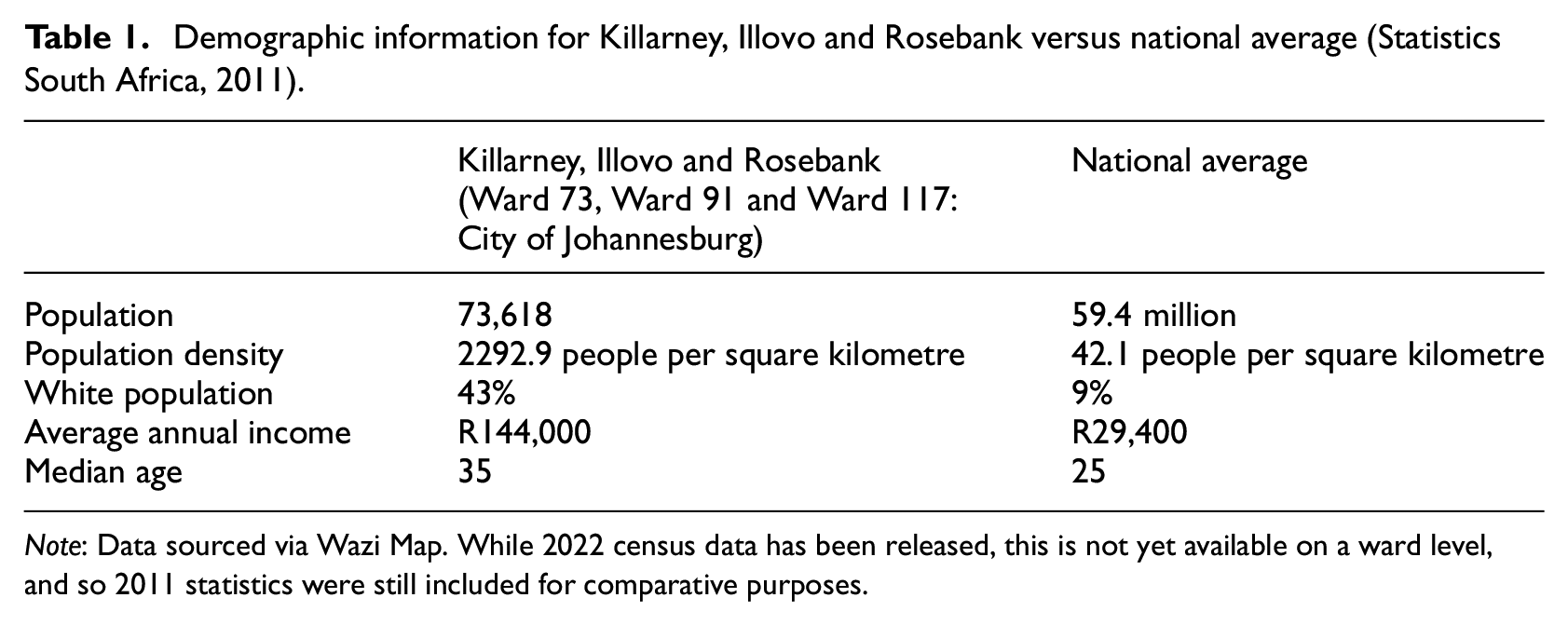
Note: Data sourced via Wazi Map. While 2022 census data has been released, this is not yet available on a ward level, and so 2011 statistics were still included for comparative purposes.
‘Locations in the sky’ are found in the apartment buildings of Killarney, Illovo and Rosebank, where proximity to transport nodes led to high-density development between the 1930s and 1960s (Mabin, 2014; Todes, 2012). While recent redevelopment of Rosebank demolished many older apartment buildings, it remains a high-density area. A neighbouring suburb, Parkwood, was included in Rosebank, as it contains apartment buildings which meet the study criteria. Figure 1 illustrates the location of these suburbs and relevant apartment buildings.
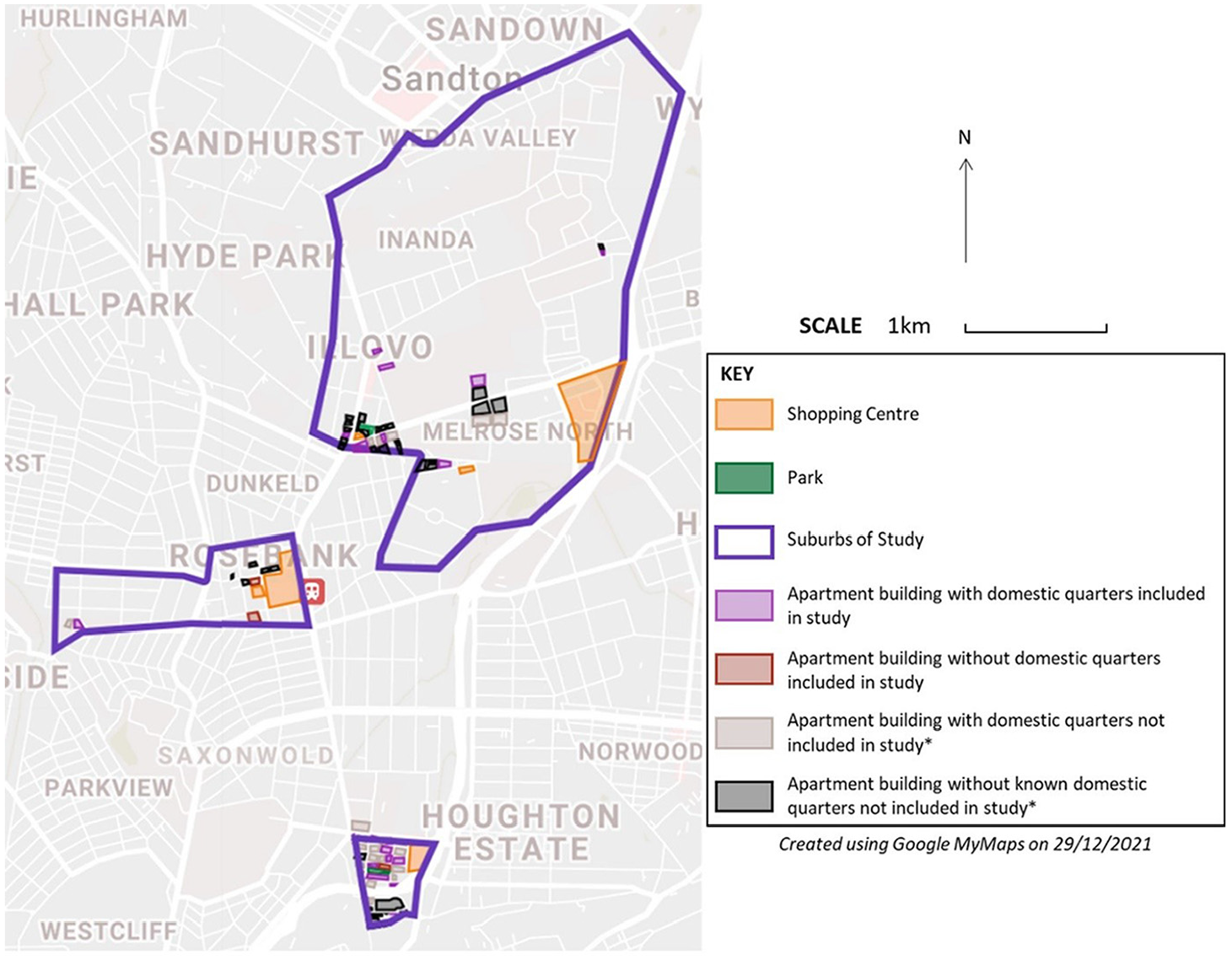
Map illustrating the suburbs of the research and apartment blocks of interest in Johannesburg.
In these buildings, the provisions for live-in domestic workers constitute one room for the domestic worker to sleep in, with communal bathroom and kitchen facilities, usually built on top of the other apartments and in many cases hidden from plain sight – alluding to the invisibility (Mather, 1987). This phenomenon of staff accommodation in apartment buildings is not unique to South Africa. There are similar structures in South American cities such as Sao Paulo, and the Chambres de Bonne of Paris (Holston, 2008; O’Sullivan, 2020). While Paris has implemented policy interventions to improve conditions since 1904, in South Africa no such legislation exists (Ginsburg, 1999; O’Sullivan, 2020).
Methodology
This study employs a qualitative approach to understand individual subjectivities of experiences, and perceptions (Morgan and Drury, 2003). The research methods included 38 semi-structured interviews and a doctrinal legal analysis of rules for 13 buildings.
Interviews aimed to unpack experiences within apartment buildings’ staff accommodation. Distinct approaches were adopted for interviewing respondent groups (Table 2) to account for unique positionalities (Rose, 1997). First, apartment residents and trustees were interviewed on Zoom between June and September 2021. This group was sampled using social media on both personal pages and neighbourhood Facebook groups, reducing sampling bias by broadening the respondent pool (Naderifar et al., 2017). Snowball sampling was then used to identify further respondents. Subsequently, domestic workers and staff accommodation residents were interviewed. Respondents were identified and invited to be interviewed by sitting in local parks and approaching people who might be domestic workers. Snowball sampling was also utilised from the apartment resident and trustee group, although power dynamics introduced possible limitations regarding the ability for the respondent to comfortably share their full experience. To mitigate this, domestic workers referred by their employer were not interviewed, but rather facilitated interviews with other domestic workers. One subject matter expert was interviewed who has conducted extensive research on staff accommodation. Interviews were transcribed and interpreted using Braun and Clarke’s (2006) six-phase framework for thematic analysis to identify topics, ideas and patterns that were commonly mentioned by respondents (Boyatzis, 1998).
Demographic breakdown of respondents by race and gender.
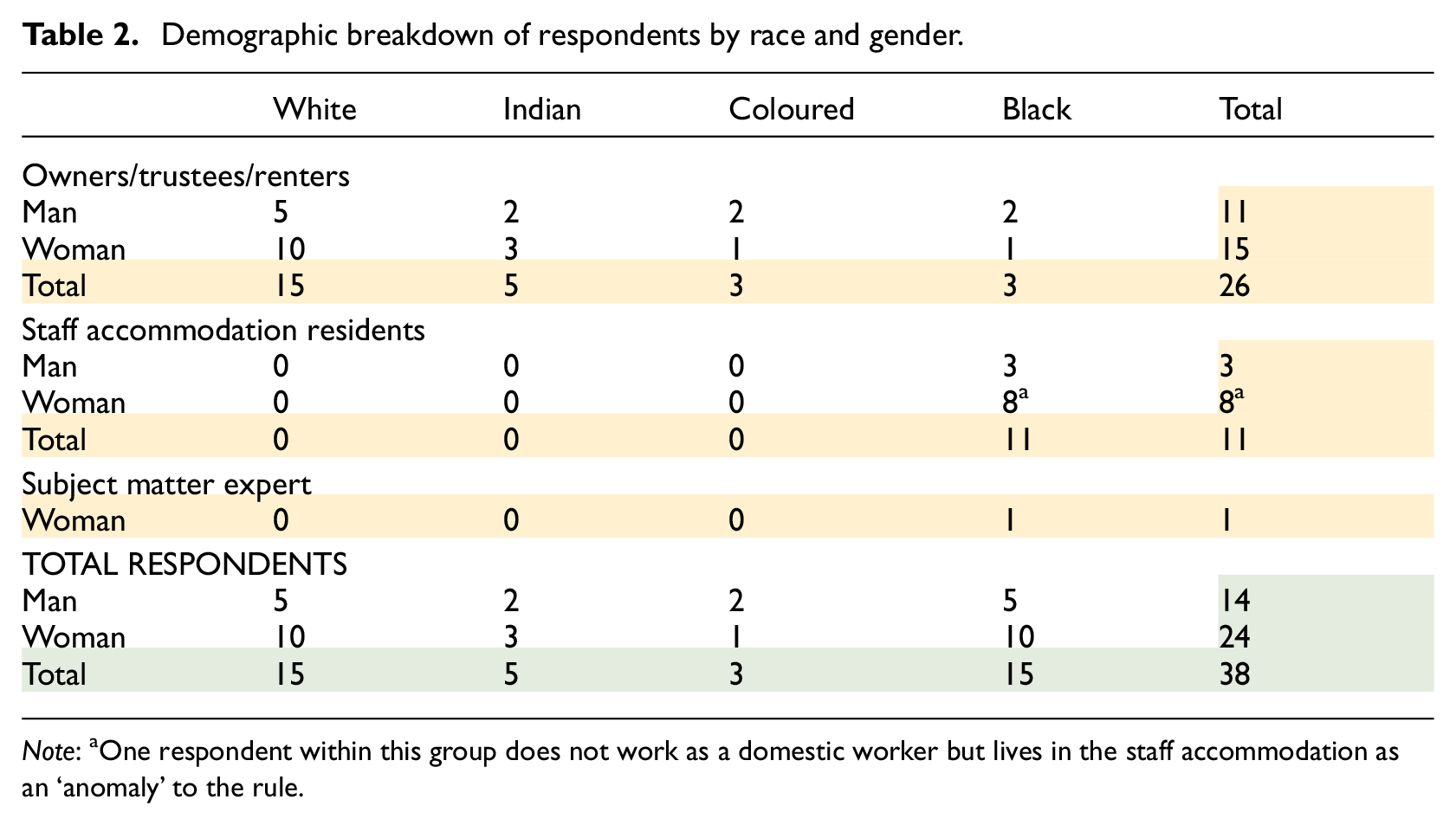
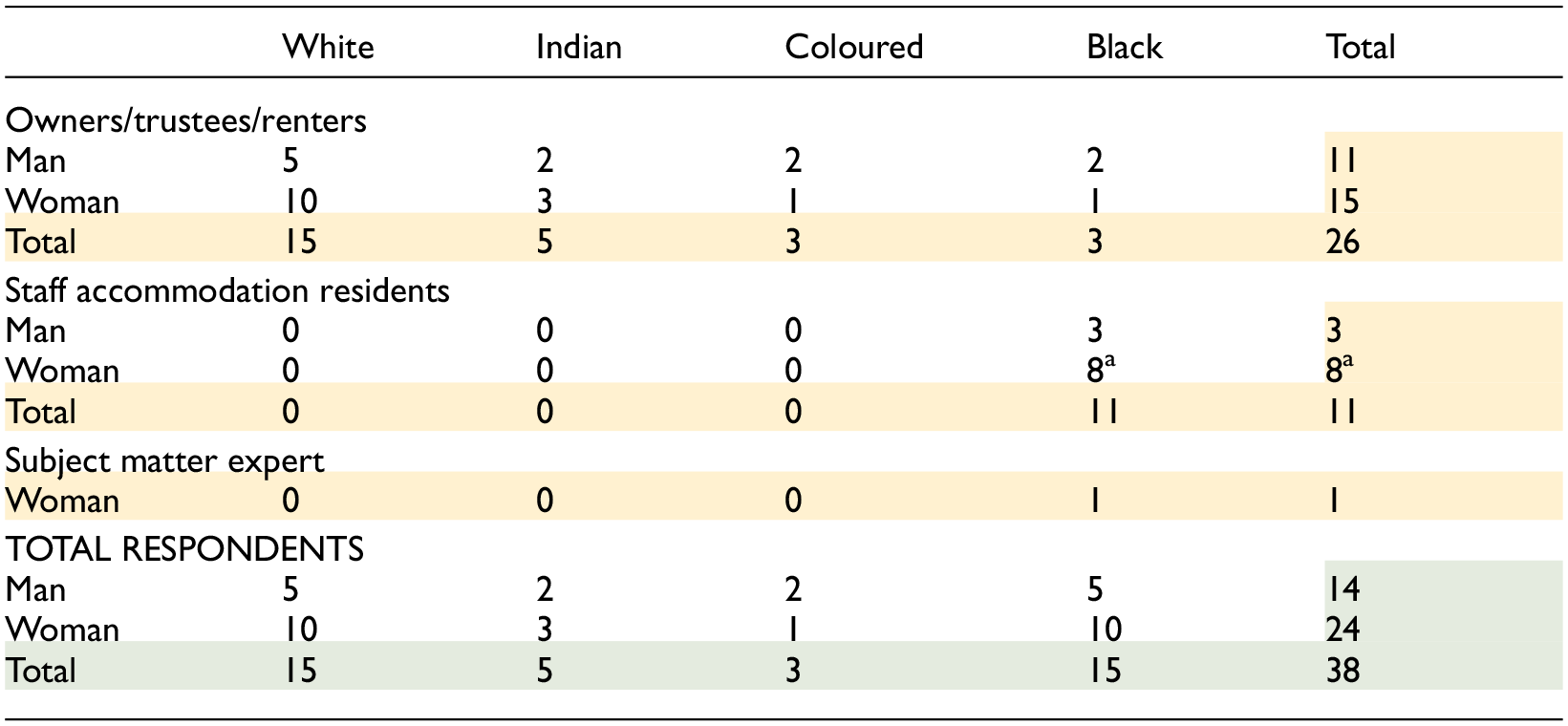
Note: aOne respondent within this group does not work as a domestic worker but lives in the staff accommodation as an ‘anomaly’ to the rule.
Doctrinal legal analysis was used to analyse body corporate rules and identify forms of discrimination. As defined by Chynoweth (2008: 29), doctrinal legal research is concerned with the legal ‘doctrines’ through an analysis of rules, looking into their ambiguities, relationships with other rules and a broader legal context. In this study, this involves analysing what rules are in place across bodies corporate in question, how these were developed and how they are applied (Hutchinson and Duncan, 2012). This methodology is primarily used to understand the legal reality in place. Thirteen sets of rules were obtained from interview respondents and through online research; each was examined for clauses on domestic workers, and pattern-matched with other sets of rules to make connections and identify difference.
Given the sensitive nature of the research, ethical considerations were especially important. Before interviews were conducted, institutional ethics clearance was obtained from the University of the Witwatersrand. When researching power and discrimination amongst vulnerable populations, it is especially important that review boards understand the contextual nuances of the research. This is the benefit of obtaining ethics clearance from a Global South institution that is familiar with the location-specific considerations (Parnell and Oldfield, 2014). All respondents were informed that their participation was voluntary and that they were able to opt out of the interview or the research at any time (Sales and Folkman, 2000). Respondents provided their written consent to participate in the study and were not given any monetary or other form of compensation for their participation. Anonymity and confidentiality were of particular importance given the precarious employment and living conditions of the domestic workers, and the links between the two (Geyer, 2023). This was achieved through securely storing interview data and removing names and identifying features in the transcription and analysis.
Results and discussion
There was no singular experience of discrimination. However, patterns emerged of different modalities, which are useful for understanding how experiences of the city and home are simultaneously shaped by the physical/structural landscape, rules and legislation and more implicit de facto forms of power. This ties to Lefebvre’s (1974) social production of space, showing how experiences of urban space are influenced by physical structures, rules which govern interactions, as well as social formations of power.
Physical and structural discrimination
Domestic workers face physical discrimination in terms of the affordability of urban living, as well as the architecture of staff accommodation. Respondents living in staff accommodation explain that it was an affordability concern, orchestrated by legacies of spatial discrimination, aligned with the theorisation of post-Apartheid urban space (Coetzer, 2016; Landman, 2011; Todes, 2012). The post-Apartheid neoliberalisation of the city has resulted in a lack of affordable housing in previously white areas, exacerbating this divide (Ballard et al., 2021; Harvey, 2008). Nine of the 11 live-in domestic workers interviewed indicated that cost was a key benefit of the staff accommodation. As a black, female staff accommodation resident indicated (13 September 2021): ‘[Living in the staff accommodation] is cheaper. It’s R500 a month, whereas before I was spending R1700 on taxis every month’.
Architecture was another form of physical discrimination: separate entrances for domestic staff, service bells in apartment rooms which had previously rung up to the kitchen or the staff accommodation, separate lifts for the apartment residents and the domestic staff, the positioning of the staff accommodation ‘out of sight’ either on the roofs or near the garages, as well as the actual design of the staff accommodation. A white female apartment tenant interviewed in Killarney described how her domestic worker is not allowed to use the residents’ lift, even if she is with the apartment resident’s daughter, as this is in the rules. This indicates that domestic workers are treated differently to other apartment residents, even if they, too, live in the building. In fact, access to the staff accommodation in the study was often precarious and dangerous, through a fire escape-style narrow staircase with gaps in between (Figure 2).
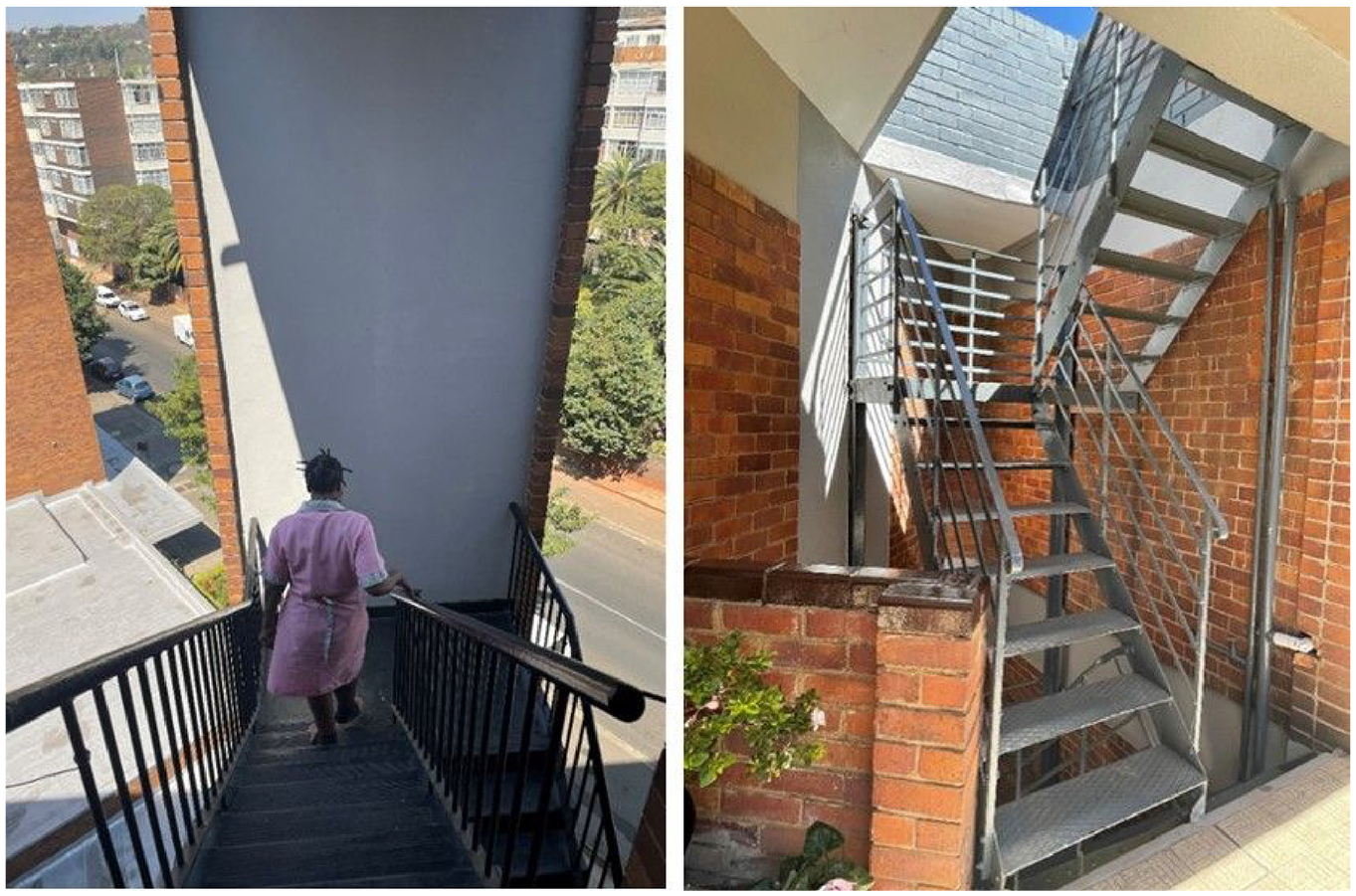
Images of staircases to the staff accommodation.
The design and location of staff accommodation is also discriminatory in nature, often inferior to the spacious apartments below. As Ginsburg (2000) explores, staff accommodation was designed to make domestic workers feel invisible in their workplace. As many respondents describe, the staff accommodation is often located next to washing lines, a visual reminder of their role. In an Illovo building, staff accommodation was in the basement and even more dehumanising, next to rubbish bins. As a tenant in an Illovo building describes (9 July 2021): ‘The first right is where the communal washing lines and domestic quarters are … But if you never have a reason to venture that side, you would never see the domestic quarters’.
Room size was mentioned by apartment residents comparing the staff accommodation to their own spacious apartments, while domestic workers often compared the space to their alternative accommodation: smaller shacks and shared rooms. Other architectural features mentioned were communal bathrooms (often overdue for repairs), and high, small windows which restrict the inhabitant from seeing outside, reminiscent of prison windows. These elements indicate that staff accommodation residents, historically black women, have been structurally discriminated against, and segregated from other apartment residents, tying into existing white imaginaries of suburbia (Fish, 2005; Ginsburg, 1999).
Rule-based discrimination
The doctrinal legal analysis focused on analysing rules which bodies corporate are required to compile and lodge with the Community Schemes Ombud Service. Twelve of the 13 sets of rules analysed were explicitly about domestic workers and staff accommodation residents, treating them differently from apartment residents. First, in almost all cases, there was a limitation of occupancy to one person per room, as most were approximately 10 m2, and children were often prohibited from residing with their parents. While the National Building Regulations (SANS Code 10400 of 1990) outline a standard occupancy limit of two people per bedroom, in some staff accommodation even this was prohibited. In the rules analysed, the same restrictions were not applied to apartment residents.
Second, the rules outlined specific restrictions for visitors to staff accommodation, with access control requirements which were not applied to apartment residents. In most cases, staff accommodation residents were required pay a fee for an overnight visitor. In some cases, rules stipulated that staff accommodation residents needed to obtain permission to have guests staying over, and there were limits on duration. Neither of these regulations were imposed on apartment residents. For example, the rules of an Illovo building state: ‘13.3. Guests [of employees] who stay over for the night must first obtain permission from the caretaker … For a stay longer than two nights, a daily levy of R30 per person … Guests cannot stay for longer than 7 days’.
A third form of rules-based discrimination was specific restrictions on the behaviour of domestic workers, often prohibiting alcohol consumption, which is not prohibited for residents of apartments. While in some buildings there were blanket noise clauses applied to all residents, in 10 of the 13 rules examined there were specific noise restrictions for staff accommodation residents. Social psychologists Talbot and Durrheim (2012) identify that stereotypical adjectives which white and Indian people use to describe black people are ‘loud’ and ‘criminal’. The mention of noise in specific relation to staff accommodation residents, in most cases black people, fits within the racist imaginary, and embeds a form of racial discrimination (Lang and Spitzer, 2020). For example, a Killarney building had blanket noise regulations which applied to all residents, but also had a specific clause about noise in the section for ‘Domestic Employees’: ‘Residents must ensure that their domestic employees do not cause undue noise on the common property or elsewhere’.
The use of communal areas, and what was concerningly termed ‘loitering’, was another behaviour-related discrimination within rules. Loitering is typically defined as remaining in a particular public place for a prolonged time, without an apparent purpose (Ahmed, 2000). Such laws are often used in vague ways to target certain individuals who are viewed as ‘undesirable’ or ‘nuisances’ in the public imaginary (Leipold, 2001). Seven of the 13 conduct rules had specific clauses which prohibited domestic workers from using common areas of the building, or being in the building lobby, garden or parking lot for no apparent ‘reason’. Apartment residents, by contrast, were often encouraged to make use of the common property for leisure purposes. This further contributes to the invisibilisation of domestic workers in these spaces, removing them from the imaginary of the apartment spaces, but also affords staff accommodation residents different rights to other residents (Ally, 2011; Cock, 2011; Ginsburg, 1999).
The last two types of discrimination involved room inspections and evictions. Clauses granted trustees the authority to inspect the rooms of staff accommodation residents without prior notice. In some building rules, eviction powers were given to the body corporate. As the subject matter expert interviewed explains, there is a conflict of rights which leads to discrimination, as the rights of domestic workers as tenants are complexly tied to their employment. This means that their housing rights are invalidated if they do not follow the rules. As Lefebvre’s (1974) framework outlines, the social production of space is developed through our associations to that space, and work and home are at odds, which complicates the urban realities of staff accommodation residents (Cock, 2011).
Discrimination through social power
While discrimination exists in physical and indisputable forms – whether it be the bricks and mortar of the buildings or the black-and-white print of the rules – a more insidious form of discrimination was also apparent. Given the inherent race, gender and class dynamics of domestic work, it is no surprise that racism was a form of discrimination experienced by staff accommodation residents (Ally, 2011). One example was that in a Killarney building, a previously homeless white woman living in a staff accommodation room (at the discretion of the body corporate chair) would use the garden, while the black staff accommodation residents did not. As a white woman renting an apartment explained (7 August 2021): Our head of the body corporate has taken pity on a white woman who became homeless and he’s let her stay on the sixth floor. She uses the garden recreationally, but she’s white. So, if a domestic worker were to go and lie in the sun and read a book, there would be a problem, but because she is still white, she can go and use the garden.
Another incident took place in a Rosebank building. One of the black building staff members using the swimming pool with his family was told to stop, even though no written rules about common space existed in this building. A white, male apartment owner in the building described (23 August 2021): One of the staff members on Christmas had his kids and his wife at the pool area and it caused a stink amongst some residents. There was outrage among some people: it became a tussle. I think he was told he shouldn’t be there, and only after it was determined that he can be there – but your party is kind of ruined by the time that’s happened.
This illustrates that social power is at play whereby mostly white apartment residents and trustees exclude black people from spaces (Van Der Westhuizen, 2017). Discrimination does not have to be written to be enacted, as the writings about poor treatment of domestic workers by Ally (2011), Bonnin and Dawood (2013) and Fish (2005) illustrate.
Racist discrimination came to the fore during the COVID-19 lockdown in March 2020, where staff accommodation residents were the target of COVID-19 ‘education’ campaigns and more severe restrictions. It was reported that the movements of staff accommodation residents were monitored more stringently. A black, female staff accommodation resident in Killarney described how she had to report her movements to the building manager, and if she was at the mall for too long she would get into trouble. In one Killarney building, posters on how to wash hands were put up in the staff accommodation but not in other parts of the building. One notable incident in Illovo involved a white body corporate trustee lining up the staff accommodation residents on the lawns to ‘teach’ them how to wash their hands. The handwashing workshop was held in an area where all the apartments overlooked, making the often-invisible staff highly visible. A resident of this building describes what they saw (9 July 2021): The trustees had a handwashing workshop where the black workers were arranged in the garden where everyone could watch. The idea that there needs to be a separate workshop on handwashing – for the people responsible for cleaning and caring everyday – was quite shocking.
As Cilliers (2020) stated in The Citizen, the woman directing the handwashing started off by calling the black female staff ‘girls’, before correcting herself and saying ‘gentlemen and ladies’. This infantilisation illustrates the patronising views that the white trustees hold, a manifestation in racist social power (Mangcu, 2003).
Discrimination scenarios: Writing versus practice
While it is evident that discrimination exists in staff accommodation, the extent and enforcement vary between buildings. Distinctions exist in the de jure written rules and the de facto experiences of people, illustrating how urban space is socially produced, with many complex intersections – thus, representing experiences through qualitative interviews is critical (Huchzermeyer, 2021).
Figure 3 indicates scenarios in which discrimination exists only in writing (A), in practice (D), in both (B) or in neither (C). There were examples of each scenario across the 26 buildings that this study covered. Typical of scenario A was where rules about alcohol or visitors were in writing but were not enforced by trustees or building managers. In many cases, this was predicated on relationships with staff accommodation residents, and how complicit they were with following other rules. For example, in one Illovo building, a staff member was permitted to have her six-year-old daughter live with her in the staff accommodation, even though rules legislated one resident per room and no children were permitted. A white, female respondent disclosing the story explains how this staff accommodation resident had worked for the building for a long time without ‘any problems’ (7 August 2021). In another Illovo building, the building manager turned a blind eye to a staff accommodation resident who was always intoxicated, despite there being alcohol restrictions in that building. The white, male building manager explained (13 September 2021): ‘Yes, [no drinking is allowed], except for [this staff accommodation resident]. There’s nothing we can do. But he doesn’t make a noise luckily. He has got a disease, but he’s been here for over 25 or 30 years’.
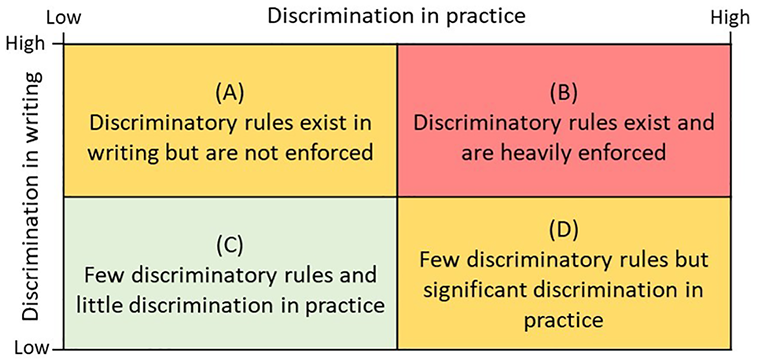
Matrix of different scenarios of discrimination in writing versus in practice.
Social relations meant that allowances were made for staff accommodation residents based on how long they had lived in the staff accommodation. Given that body corporate trustees grant themselves the power to evict residents who do not comply with the rules, long-standing residents tend to be those who obey the rules and do not disrupt the status quo. This exertion of power is an example of the superiority which Ally (2011) discusses, and illustrates the power dynamics between staff accommodation residents (and/or domestic workers) and trustees.
Contrastingly, there were also scenarios in which the rules were not specifically discriminatory but there was discrimination in practice: scenario D. This includes the staff accommodation residents being barred from using the swimming pool on Christmas Day, even though this was not in the rules. Many buildings fell under scenario B, where discrimination was rife both in writing and in practice. It was in these worst-case scenarios that the staff accommodation residents expressed that it was difficult to stay in the staff accommodation. As one black, female staff accommodation resident states (10 September 2021): They don’t let us have any visitors to stay over, and they are very strict with the rules. If I want someone to stay, I have to pay. I am not allowed to have any of my children. The conditions are bad. They have no respect for us.
Scenario C, characterised by few discriminatory rules and little discrimination in practice, was less common. However, some trustees indicated that there are efforts in motion across at least five buildings to remove the discriminatory clauses from the conduct rules. This means that, if social discrimination follows suit, there is the potential for less discrimination across apartment buildings in Illovo, Killarney and Rosebank. However, that conditionality may be difficult to achieve while racist practice is still commonplace in South African society (Seekings, 2011).
These scenarios illustrate that through a Lefebvrian lens (Lefebvre, 1974), the social production of urban space is nuanced and specific to the unique ways in which space is conceived, perceived and lived across different buildings. While this is often largely defined by the conceived space dictated by rules and architectural design, the ways in which discrimination is embodied can vary depending on social relations, unique worldviews and individual dynamics within buildings (Lang and Spitzer, 2020). Despite these distinctions, it is still useful to have a framework for understanding these modalities, in the hopes that discrimination can be identified and addressed.
Study limitations
While this study provides rich insights into the specific experiences of staff accommodation and urban realities, it also faces various limitations. Focusing on only suburbs in Johannesburg limits the generalisability of the results. Future studies could explore staff accommodation in other South African cities, providing a broader understanding of the spatial dynamics of domestic work. An international comparative analysis with similar arrangements such as in Sao Paulo might also generate more insights into trends which extend beyond the specific post-Apartheid dynamics of South Africa (Holston, 2008).
The small sample size of 38 interviews, while rich in qualitative detail, might limit representativeness, a common issue in qualitative research (Lawson, 2000). Notably, selection bias means that the most vulnerable domestic workers, who experience the harshest discrimination, were not necessarily reached (Massey, 2013). This group is often very difficult to access due to precarious working conditions, fear of retaliation from employers or distrust of researchers (Cock, 2011; Ginsburg, 1999). Reliance on snowball sampling may have inadvertently excluded individuals isolated within their community, narrowing the diversity of voices captured. As a result, findings might understate the extent of discrimination in staff accommodation. Future research could address this by incorporating outreach strategies designed to reach more hidden or vulnerable populations (Sadler et al., 2010).
How we conduct research is influenced by worldviews and privilege (Rose, 1997). While it is not possible to unpack these complexities here, it is important to acknowledge that when researching Apartheid legacies, positionality leads to unavoidable bias. The race and class differences between interviewees and interviewers (white women) may have influenced what staff accommodation residents shared, and whether their experiences of racial discrimination could be adequately captured by the writers. The use of English for interviews may have constrained participants’ ability to fully articulate their experiences, and power dynamics may have influenced how openly participants discussed sensitive issues of race and class (Rose, 1997).
The working hours of domestic workers also posed significant logistical challenges, as many participants had long and irregular schedules, often dictated by the needs of their employers. These demanding work patterns limited their availability for interviews, particularly for those employed by households requiring round-the-clock care. As a result, domestic workers with the most exploitative schedules were likely underrepresented in the study. This could be addressed in future by more co-design of research involving domestic workers, working out what timings are best for them.
These limitations are reflective of broader challenges in qualitative research within urban studies, particularly in capturing the voices of marginalised populations (Chadderton, 2011). Despite these constraints, the study offers important insights into the spatial and social dynamics of domestic work in Johannesburg.
Conclusion
This study explores the understudied ‘locations in the sky’ in the Northern suburbs of Johannesburg, investigating how spaces are experienced and whether forms of discrimination are present and enforced. Through 38 semi-structured interviews and analysis of 13 body corporate rules, it was evident across the 26 buildings that domestic workers were treated differently to apartment residents – in terms of physical elements, rules, as well as how social interactions with other apartment residents unfold. While it may appear that this discrimination is predicated on, and potentially justified by, the employment status of the resident, a more nuanced understanding of the historical context means that there are also racist, gendered and class dynamics involved (Ginsburg, 2000). Furthermore, the matrix presented distinguishes between how discrimination may exist de jure, and how it is practised de facto, resulting in different modalities of discrimination.
More needs to be done to incorporate ‘locations in the sky’ into a theorisation of Southern/African cities, and action is needed to improve the conditions in staff accommodation, and to eradicate discrimination in all its forms (Pieterse, 2011; Solidarity Center and Izwi Domestic Workers Alliance, 2021). These findings are significant for apartment residents, activists, NGOs and policymakers, who can challenge discrimination by reviewing rules and eliminating legislated biases. The Community Schemes Ombud Service can help regulate and formalise the use of ‘locations in the sky’, with trustee training focusing on equitable practices. However, advocating for change must be handled carefully, as excluding staff accommodation residents from these efforts could unintentionally perpetuate inequality. Further research is needed into the mechanisms for change in these spaces, and how staff accommodation residents can claim agency to evoke change. Ultimately, this study reveals how Apartheid’s legacy continues to shape urban space, providing a framework to address discrimination and promote justice in Johannesburg’s Northern suburbs.
Footnotes
Acknowledgements
We would like to thank Prof. Richard Ballard (University of the Witwatersrand) for his valuable insights as a co-supervisor on Annabel Fenton’s Master’s dissertation which served as the basis for this research. We thank the respondents for their involvement in the study.
Declaration of conflicting interests
The author(s) declared no potential conflicts of interest with respect to the research, authorship, and/or publication of this article.
Funding
The author(s) received no financial support for the research, authorship, and/or publication of this article.
