



Abstract
This article aims to provide a stylistically founded model of pathetic fallacy (PF hereafter). Pathetic fallacy is a Romantic literary technique used in art and literature to convey emotions through natural elements. This technique has been researched mostly from a literary viewpoint, but no linguistic model exists to define it. It is difficult to identify it precisely or consensually because definitions and uses vary, and it is often associated with other techniques (i.e. personification). Despite those inconsistencies, PF is likely to be taught as part of the Department for Education subject content in the English National Curriculum for students studying English Literature at GCSE and A Level. I thus conducted a survey of English teachers to collect data on PF, and based on their answers and suggested texts, created an updated stylistic model of PF using a combination of (cognitive) stylistic frameworks. The model defines PF as a projection of emotions from an animated entity onto the surroundings. I identify three ‘linguistic indicators’ of PF in my corpus: imagery, repetition and negation. I draw on metaphor research to further analyse the metaphorical nature of PF and its effects in texts from my corpus. Four effects of PF are identified: communicating implicit emotions, building ambience, building characters and plot foreshadowing.
Keywords
1. Introduction
Pathetic fallacy (henceforth PF) is a literary technique often associated with Romantic style and is likely taught in schools for the examination of English Literature according to the Department for Education (DfE, 2013: 5). However, there is no consensual or consistent definition of the concept: literary critics, scholars in literature and linguistics and educators discuss and analyse PF differently as demonstrated in the literature review below. These inconsistencies are problematic for the GCSE and A Levels examinations, and because it impacts PF’s significance in our understanding of literature and for readers’ (emotive) experiences of texts. This article aims to define PF by observing the literary and linguistic features that make the technique a unique type of imagery, with aims to create a stylistically informed model which answers the following research questions: • What is PF and what elements constitute it? • How is PF featured in texts? • How can PF be identified in texts? • What is the effect of PF on the reading process?
To answer these research questions, I first present the survey study conducted to collect data on how teachers view PF and to collect textual examples of PF. Based on this data, and a foregrounding analysis of the texts collected using an adaptation of Leech and Short’s ‘checklist of stylistic categories’ (2007: 60–64), I created an updated model of PF. The model is presented using a ‘prototypical’ example (Stockwell, 2002: 29–30) of PF: Jane Eyre.
2. Literature review of PF
Pathetic fallacy is a term coined by Ruskin in Modern Painters Volume III (1856/2012) in which he criticises artists and writers for using nature to portray their own emotions, and by attributing emotions to natural elements. Ruskin (1856/2012: 158) provides the following example to illustrate his argument: ‘“The cruel, crawling foam”. The foam is not cruel, neither does it crawl. The state of mind which attributes to it these characters of a living creature is one in which the reason is unhinged by grief’. However, Ruskin’s premise shows some ambiguity: what he considers to be a fallacy can either be the personification of nature, or the artists’ use of the surroundings to convey their own emotions. Although Ruskin’s explanation suggests the latter, his example suggests the former, thus generating some ambiguity in PF’s definition.
I argue that this ambiguity is the basis for the inconsistency surrounding the technique in the fields of literature, linguistics and education. Whilst some literary researchers such as Logan (1940), Young (1949), Sacks (1985), Auger (2010), Langer (2010), Ford (2011), Nishimura (2003), Thomas (1961), Cushman et al. (2012) define PF as a specific type of personification which attributes natural elements with emotions; others define the technique as a projection of emotions onto the natural world (Copley, 1937; Dick, 1968: 27–30; Ford, 1948; Gérard, 1964; Griffiths, 2004: 15; Johnson, 2012: 172; Lodge, 1992: 85, Lodge 2002:127–128; Miall, 2011: 340–342). Dick (1968: 27–30) observes that PF ‘is often interchangeable with personification’, which is mirrored in existing literature. Indeed, researchers in literary and linguistic studies consistently interchange the concepts of PF and personification or anthropomorphism. The following examples can be observed: ‘Daydreaming has been replaced by an equally imaginary personification of objects via PF’ (Al-Obaidi, 2018: 97); ‘The PF (also known as anthropomorphism) in which the speaker’s surroundings manifest her emotions’ (Al-Obaidi, 2018: 136); ‘Another important and often overlooked property of feeling is its capacity to promote what is usually termed anthropomorphism, that is, interpreting events or objects in the environment through human properties, such as feelings and intentions’ (Miall, 2011: 341); ‘[the] personifying metaphor is so consistently employed that “metaphor” almost ceases to be the appropriate term: it is as if our literal sense of the division between animate man and inanimate nature has been eliminated. […] Hence the personification of nature produces a tension between reassurance and alienation’ (Leech and Short, 2007: 160).
Each of those selected examples discusses PF in a text analysis, directly linking PF with personification and anthropomorphism, thus illustrating the inconsistencies surrounding PF.
In stylistics, PF is at times discussed under different headings. For example, Miall (2014: 428) studies participants’ reactions to Woolf’s Together and Apart and observes ‘the phrases of the story can be placed in one of two categories: either indicating a possible relationship of the two characters, or describing the setting (which includes the sky and the moon)’. This suggests that the scene’s settings and emotions are connected. Overall, Miall’s research demonstrates that participants use the surroundings to better comprehend the emotions and the characters' relationship. This coincides with PF when it is defined as a projection of emotion into the natural environment, yet Miall does not mention PF despite analysing its effect.
These inconsistencies in PF’s definition and analyses are also found in education, which is particularly problematic as PF is likely to be taught as part of the DfE subject content in the English National Curriculum for the examination of GCSE and A Level in English Literature (Department for Education (DfE), 2013: 5). The DfE does not provide a definition of the technique, leaving teachers and education boards to define it themselves. However, education boards are also inconsistent in their definition of PF. For instance, Pearson Edexcel (2015: 5) defines PF as such in their literary guide for students The use of setting, scenery or weather to mirror the mood of a human activity. Two people having an argument whilst a storm breaks out is an example. The technique is used to make sure the feelings of readers or audience are moved.
Yet, in their English Language Student Handbook, PF is defined as ‘giving human emotions to nature’ (Addison et al., 2016 for Pearson Edexcel, 2015: 259) and the phrase ‘delicious breadth of rain’ is given as an example. This definition and example portray PF as a type of personification and therefore do not match the previous definition given.
I argue that the concepts of PF, personification and anthropomorphism may overlap, but are not interchangeable. For the rest of this article, personification is defined as ‘an inanimate object, animate nonhuman, or abstract quality is given human attributes’ (Wales, 2011: 314); and anthropomorphism is the attribution of human qualities to entities (most often animals or gods), (OED, ‘Anthropomorphism’, 2021; Auger, 2010: 19). These techniques are specific types of animation, and may overlap as I demonstrate in the analysis below, but each have their own nuances, rendering them unique.
3. Methodology: survey study
To collect data on PF, I conducted a survey of English teachers, as they are more likely to be familiar with the technique due to teaching texts potentially featuring PF as part of the curriculum. The survey was distributed on Twitter through channels such as ‘Team English’ or ‘National Association for Teachers of English’ (NATE), and it was open for four weeks between January and February 2019. The survey was composed of six questions: 1. What subject do you teach? 2. At what level do you teach? 3. Define ‘PF’ in your own words. 4. Define ‘personification’ in your own words. 5. To what extent do you agree that the following stimuli feature PF? (see the list of stimuli in Appendix 1). 6. Provide an example of PF in existing literature, you can copy/paste in the box below.
I briefly review the answers to each question in this article, but for the sake of brevity, I detail my analysis of questions 3, 5 and 6 as they are the most important in developing my model of PF. Overall, the survey collected 134 responses (=100%), 85% of participants taught English (language and/or literature), and out of the 134 responses, 53% of participants taught at GCSE, 12% taught A Levels and 23% taught in Higher Education.
When asked to define PF in their own words, 53% of participants defined it as a projection of emotion onto the natural world (e.g. ‘when the description of the weather reflects the emotions of the characters’, ‘the weather is used to depict and reflect human emotions’); 36% defined it referring to personification (e.g. ‘a type of personification’, ‘use of personification to attribute human qualities to nature, often weather’); 5% defined it referring to anthropomorphism (e.g. ‘a literary device used for the anthropomorphism of inanimate objects, often by ascribing them a human emotion’). Across the varied definitions given, references to ‘weather’ or ‘nature’ were made by 79% of responses. Unsurprisingly, the inconsistencies discussed above are also present in the participants’ responses.
Conversely, question 4 asked participants to define personification in their own words, and 96% of responses define it similarly to the OED (Personification, 2021) (e.g. ‘when non-human resource objects or animals are depicted as if they had human attributes’, ‘a type of metaphor that gives something non-human human-like characteristics’). 8% of responses to question 4 mentioned animals or anthropomorphism, and 5% of responses refer to natural elements (e.g. ‘the sky smiled at me’). This indicates that the lack of clarity that surrounds PF does not extend to the concept of personification. Furthermore, the idea of nature is more associated with PF than it is with personification.
Question 5 presented a 6-point Likert scale matrix table with 15 stimuli; participants were asked to what extent did they agree/disagree that each stimulus contained PF. The list of stimuli and the table summarising the participants’ answers can be found in Appendix 1. Amongst the 15 stimuli, three featured PF: • Stimulus 1: ‘My love for Linton is like the foliage in the woods. Time will change it, I'm well aware, as winter changes the trees’ from Wuthering Heights (Brontë, 1847/2020); • Stimulus 4: ‘Joey stood at the window, looking into the distance at the burning buildings and the rain of ashes falling down. His heart stopped; he would never see Sarah again’ (my stimulus); • Stimulus 10: ‘The sun shone, the sky was bright blue when Josh came out of his meeting with a spring in his step. He had to call his mother to celebrate’ (my stimulus).
Additionally, one stimulus featured personification (stimulus 13: ‘the wind roared during Steve’s journey home’), whilst the others featured different combinations elements such as human beings, natural elements or emotions, all of which have been mentioned repeatedly by scholars analysing or discussing both PF personification. Although stimuli 4 and 10 were thought to feature PF by the majority of the participants (respectively, 54% and 67%), stimulus 1 only had 45% of participants agree that it featured PF. Moreover, stimulus 13 which contained personification was seen as an example of PF by 60% of participants, thus further highlighting the lack of consistency surrounding PF.
The last questions asked participants to provide an extract from literature which features PF, and 36 texts were provided (54 in total, some of which were repeated), and most of them are part of the English National Curriculum, which is not surprising considering the targeted participants. The list of texts can be found in Appendix 2. Overall, the answers to questions 3, 4 and 5 further demonstrated the need for such a research on PF and allowed the formulation of PF’s three criteria (defined below). Question 6 was the most crucial question as the texts suggested by participants founded the base for PF’s model to be developed.
4. A stylistic approach to analysing PF in texts
To systematically and qualitatively analyse the 36 texts provided by participants, I chose to adapt Leech and Short’s ‘checklist of linguistic and stylistic categories’ (2007: 61–64) because it is detailed and comprehensive of all levels of language, and each category is prompted with questions to help with the analysis process, thus rendering it an ideal methodology for teaching and learning. In fact, it accounts for Giovanelli’s ‘linguistic toolkit to consider in education’ (namely, lexis and semantics, syntax, pragmatics, discourse and graphology), which can assist teachers and students in their language learning (Giovanelli, 2016: 17–20).
However, I found some of those categories repetitive and in need of adapting – at least for this research on PF. For instance, in Leech and Short’s category C of figures of speech, the sub-categories ‘grammatical and lexical’ can be found, despite the fact that categories A and B, respectively, detail lexical and grammatical elements. This means that, for example, the sentence ‘the wind was despoiling’ personifies the wind through the verb ‘despoiling’ and could thus be discussed in category A under ‘verbs’ but also in category C under ‘lexical figures of speech’. Moreover, based on the analyses and the definitions of PF observed in the previous research findings and the survey, I predicted that in order to fulfil the definition of PF as a projection of emotions onto the surroundings, three key criteria needed to be present and added in the checklist: animated entity, emotions and surroundings. I also included the grammatical subcategory of negation (lexical, syntactic morphological) (see Givón, 1993; Jordan, 1998; Hidalgo-Downing, 2000a, 2000b; Nørgaard, 2007; Giovanelli, 2013); as well as the category of narrative relations and references based on Mason’s ‘narrative interrelation framework’ (2019: 21). I modified the category of figures of speech to include idiomatic expression which can contribute to the portrayal of emotions (Citron et al., 2015: 93), and to include imagery. I define imagery based on existing research linking the concept to the sense (see Halpern, 1988; Finke, 1989; Sadoski and Paivio, 2001; Boerger, 2005; Abrams and Harpham, 2005; Anderson, 2021), and by building on Dancygier’s (2014: 212) definition: ‘the text's construction of a vivid image in language which evokes a mental image in the reader's mind’, though I find the notion of ‘the text’s construction’ vague. Therefore, I draw on existing research which views imagery as a type of figurative language, which highlights the senses to enable readers’ rich and vivid mental representation of a scene. My updated checklist of stylistic categories can be observed below: A. First impressions and PF criteria 1. Presence of human beings 2. Presence of emotions 3. Presence of surroundings B. Lexical categories 1. General 2. Nouns 3. Adjectives 4. Verbs 5. Adverbs C. Grammatical categories 1. Sentence types 2. Sentence complexity 3. Clause types 4. Clause structure 5. Noun phrases 6. Verb phrases 7. Other phrase types 8. Negation (lexical, adverbial, morphological). 9. Word classes 10. General D. Figures of speech 1. Phonological schemes 2. Idiomatic expressions 3. Imagery E. Narrative relations and references 1. Intertextuality 2. Intratextuality F. Discussion of PF and interpretation
The risk of using a checklist as comprehensive as Leech and Short's is that one must select what should be included in the analysis: not every textual component is necessary for the analysis or interpretation process. In the context of this study, it would be difficult to detect linguistic characteristics that are relevant for the occurrence of PF if every aspect of the checklist was examined. As a result, rather than analysing all linguistic elements, it is essential to be selective, as Toolan suggests ‘inescapable decisions on selecting features to study - and there is no failsafe methodology. Rather, intuition, personal judgement, and subjectivity are ineradicable factors in stylistic analysis’ (Toolan, 1983: 135). To address these limitations, I applied the theory of foregrounding in combination with my checklist, which is also suggested by Leech and Short (2007: 110).
The theory of foregrounding claims that certain linguistic elements stand out against the rest of the text, and this linguistic phenomenon enables readers to perceive prominent textual features (Short, 1996: 11). Foregrounding underpins a stylistic method of analysis, encouraging us to ‘select some features for analysis and ignore others’ (Leech and Short, 2007: 55), by providing us with tools to do so. This linguistic phenomenon of foregrounding can be divided into two types: ‘deviation’ and ‘parallelism’. Deviation can occur internally, meaning it is contained within the text. For example, if a poem is written with rhymes, but the last two lines do not rhyme, then those two lines are internally deviant. Deviation can also occur externally, meaning against the language’s norm. If a poem is written in English and without verbs, such a stylistic choice is externally deviant, as the English language typically requires verbs. Lastly, repeated words or structures are foregrounded by parallelism as they created a pattern. For my analyses, I observed foregrounded features in each of the checklist’s categories that were salient to PF and the three criteria I predicted would be present in each text (animated entities, emotions and surroundings).
After each text was analysed with this method, I found that out of the 36 texts provided by participants in question 6, 31 contained PF and 5 did not because one of PF’s criteria was missing: the extracts provided for The Big Sleep (Chandler, 1939/2004), As I Lay Dying (Faulkner, 1935) and Things Fall Apart (Achebe, 1994) did not feature any emotions. The poem To the Moon (Bysshe Shelley, 1824/2020) personifies the Moon (‘companionless, lonely’). However, if the Moon is the entity feeling the emotion, it means there are no surroundings reflecting those emotions, as the Moon cannot do both. The extract provided from Ulysses (Joyce, 1920/2019) did not present clear surroundings, to the extent that without further context, it is unknown if the scene occurs indoors or outdoors. In addition to the foregrounding analyses conducted, I also cross-referenced the emotions and surroundings portrayed in each text to observe any potential patterns. As a result of those analyses, I was able to formulate the stylistic model of PF below.
5. A stylistic model of PF
I define PF as follows: a projection of emotions onto the surroundings by an animated entity. The emotions and animated entity in question can be featured implicitly or explicitly in the text. Three criteria must be present for this definition to be fulfilled: firstly, an animated entity (implicit or explicit) must be present, meaning human characters, implied authors, narrators or speakers (Eckardt, 2015: 167–168; Hühn, 2005: 152; Palmer, 2004: 16–17; Prince, 1987: 42–43), or anthropomorphised animals, which can be accounted by this criterion as long as they show signs of emotion (for instance, anthropomorphised rabbits in Adams’s Watership Down). Secondly, surroundings must be present and described richly enough for readers to perceive where the scene takes place (i.e. indoors or outdoors) and to trigger this interpretation of PF’s mirroring effect in readers. Thirdly, emotions must also be present. I define emotion as a ‘response to an event, either internal or external, that has a positively or negatively valenced meaning for the individual’ (Salovey and Mayer, 1990: 186) including mood, dispositions, preferences, personality traits, physical feelings, emotional states and affects, lasting any length of time. Emotions can be featured ‘explicitly’ or ‘implicitly’ (Palmer, 2004: 115): explicit emotions are those that are clearly expressed and do not need to be inferred; and implicit emotions are those that are not directly expressed and must be inferred through language.
When the emotions or the animated entities are implicit, the presence of context is essential to perceive PF. To ensure enough context is present to identify those criteria, I suggest using the list of prompt questions below (akin to Leech and Short’s), which englobes Meibauer (2012: 11) ‘dimensions of context’: intratextual context or ‘co-text’ (the relation between a piece of the text and the surrounding text); infratextual context (the relation between an piece of the text and the whole of the text); intertextual context (the relation between a text and other texts); extratextual context or ‘situational context’ (the relation between a text and the situation in which it was produced): • Is the scene easy to understand on its own? • Is there an animated entity present in the text explicitly or implicitly (character, narrator, speaker)? • Is the animated entity named directly or referred to by pronoun or noun? • What situation is the animated entity in? • Are any emotions expressed in the text explicitly or implicitly: are the characters displaying any emotion-specific behaviour? (For example, the phrase she cried could be considered to express emotions on the spectrum of sadness). • If there are emotions present, is it understandable as to why they are there: what led the animated entity to feel this way? • Is it identifiable whether the scene is set indoors or outdoors? • Are there any surroundings described in the scene (décor, furniture, objects, specific colours, natural elements, weather, etc.)?
The list is not exhaustive, but if the questions are answered with ‘no’ or ‘I do not know’, then more situational context is required. The missing information may be obtained from the globality of the text using the prompt questions. Furthermore, the text's cultural, social or historical context might be examined if the answers to the questions depended on it.
Based on the foregrounding analyses conducted, I observed three repeated linguistic elements in each text with PF; I refer to them as ‘linguistic indicators’ of PF, akin to Short’s ‘linguistic indicators of viewpoint’ which he defines as ‘small scale linguistic choices on the part of the author’ (1996: 263). The three linguistic indicators present in my texts are imagery (107 occurrences in 31 texts), negation (73 occurrences), repetitions (65 occurrences), as they are the elements most present in my group of 31 texts (10, 406 words total). This is crucial since PF is an implicit technique to be perceived by readers rather than a foregrounded device, and therefore, the foregrounding of these linguistic indicators of PF (and its criteria) may guide readers in their interpretation.
In the checklist’s interpretation category F, PF’s metaphorical function was discussed in the analysis process, due to PF’s extended and implicit nature. Therefore, using Conceptual Metaphor Theory (CMT) to understand the relation between PF’s criteria is useful. Conceptual Metaphor Theory claims that target conceptual domains • • •
Textual examples of these PF mappings can be found in Appendix 3. Overall, foregrounding theory could be used to identify PF’s criteria and indicators, but CMT provides a better understanding of the correspondence occurring between the emotions and the surroundings, as demonstrated above (see Appendix 3). In fact, by applying Stockwell’s idea of identifying the most salient characteristic of the source domain mapped onto the target domain (1999: 137–138), it is possible to identify why such a source domain of surroundings might be associated with a specific emotion.
Although PF’s definition and metaphorical function remain the same in texts, the overall effect of PF during the reading process can vary from scene to scene. In my texts, I observed four effects of PF. Firstly, communicating implicit emotions explicitly or in a way that readers can interpret. This is PF’s most common effect as it fulfils its definition: either the emotions are explicit and the mirroring emphasise them, or the emotions are implicit and PF allows for readers to perceive them. PF’s second effect is the building of ‘ambience’ (including suspense) in the scene, meaning the combination of atmosphere and tone (Stockwell, 2014: 365). The third effect is PF’s contribution to characterisation. Culpeper (2001) argues that characters are built through explicit cues (meaning how they are presented by themselves, narrators, other characters such as their names or descriptions) and implicit cues (inferences readers make based on conversational implicature, structure, accents, amongst others). Pager-McClymont (2021) argues that Culpeper does not discuss the impact of figurative language such as PF on characterisation and demonstrates that such techniques are in fact implicit cues of characterisation. Indeed, PF offers a mental representation of characters’ emotions, thus aligning with Abbott’s view (2008: 118) that ‘verbal narration [...] draws on figurative language, particularly metaphors. Often on the page what is internal to a character comes out in metaphorical language’. The fourth effect observed in my texts is foreshadowing in the storyline. Foreshadowing (or ‘prolepsis’ (Genette, 1983: 67)) hints at forthcoming events in the plot, and this temporal manipulation of discourse can generate anticipation and suspense (Bae and Young, 2008: 157). There are two ways in which foreshadowing can be featured in a text: implicitly (meaning readers understand its occurrence in retrospect), and explicitly, with partial information, obliging readers to fill in knowledge gaps in their mental representation of the narrative and draws attention to a specific event in the plot (Bae and Young, 2008: 157). At times, foreshadowing occurs through symbols (referents standing in place of another concept, (Wales, 2011: 408–409)), as I demonstrate below.
These effects can occur on their own or simultaneously in passages. The model presented so far remains hypothetical as no examples of an application were provided. Therefore, the following section applies this stylistic model of PF to the text suggested most often by participants: Jane Eyre.
6. Prototypical example: Jane Eyre
Jane Eyre (Brontë, 1847/2007) is a ‘prototypical’ example of texts with PF, meaning it is a ‘cognitive reference point’ amongst other texts (Stockwell, 2002: 29–30). Indeed, not only was the text most often associated with PF by the survey participants, it is also Romantic, as is PF (Siddall, 2009: 36–37). The passage selected to demonstrate how the text analysis methodology and the model of PF described can be applied is from chapter 23 of the novel. Jane and Mr. Rochester declare their feelings for one another and get engaged under a chestnut tree when a storm interrupts them. The next day, Jane contemplates the damage caused by the storm: But what had befallen the night? (1) The moon was not yet set, and we were all in shadow: I could scarcely see my master’s face, near as I was (2) And what ailed the chestnut tree? (3) It writhed and groaned; while wind roared in the laurel walk, and came sweeping over us. (4) […] But joy soon effaced every other feeling; and loud as the wind blew, near and deep as the thunder crashed, fierce and frequent as the lightning gleamed, cataract-like as the rain fell during a storm of two hours’ duration, I experienced no fear and little awe. (5) Mr. Rochester came thrice to my door in the course of it, to ask if I was safe and tranquil: and that was comfort, that was strength for anything. (6) Before I left my bed in the morning, little Adèle came running in to tell me that the great horse-chestnut at the bottom of the orchard had been struck by lightning in the night, and half of it split away. (7) […] I faced the wreck of the chestnut-tree; it stood up, black and riven: the trunk, split down the centre, gasped ghastly. (8) The cloven halves were not broken from each other, for the firm base and strong roots kept them unsundered below; though the community of vitality was destroyed - the sap could flow no more: their great boughs on each side were dead, and next winter's tempests would be sure to fell one or both to earth: as yet, however, they might be said to form one tree - a ruin, but an entire ruin. (9) (Brontë, 1847/2007, my numbering).
1
6.1. First impressions and criteria of PF
My first impression of the passage is that the environment, particularly the weather, and the chestnut tree are essential elements of the description, along with Jane’s emotions. 2 This passage is a perfect example of Romanticism, as it features wild natural elements and strongly expressed emotions, which are key to the Romantic genre (Jeffries, 1993: 6; Siddall, 2009: 36–37).
The three criteria of PF I identified are present: animated entities are here humans as illustrated by the personal deictic terms ‘Mr Rochester’, ‘Jane’, ‘Adele’. The surroundings are represented by natural elements (‘wind’, ‘rain’, ‘chestnut tree’). There are two types of emotions presented: Jane’s and Mr Rochester’s affection is explicitly expressed (‘joy’, ‘safe’, ‘tranquil’, ‘no fear and little awe’), which contrasts with the more negative mood of the scene expressed implicitly through negation (‘crashed’, ‘groaned’, ‘wreck’, ‘gasped ghastly’).
6.2. Lexical categories
6.2.1. Nouns
The lexical field of emotions can be observed: ‘joy’, ‘every other feeling’, ‘fear’, ‘awe’, ‘safe’, ‘tranquil’, ‘comfort’, ‘strength’. The lexical field of weather elements is also featured: ‘wind’, ‘thunder’, ‘rain’, ‘lightning’, ‘winter’s tempest’. These lexical fields are foregrounded by parallelism as they create themes throughout the extract, highlighting how Jane feels about Mr Rochester and building the surroundings, thus contributing to PF overall.
The noun ‘chestnut tree’ or ‘tree’ or ‘it’ in reference to the ‘chestnut tree’ is repeated in the passage (sentences 3, 4, 7, 8 and 9). This repetition is foregrounded by parallelism, as it creates a recurring focus point throughout the text. This prevalence of the chestnut tree as opposed to other natural elements described shows its uniqueness in the storyline, and the importance it has for Jane, as I discuss below.
6.2.2. Adjectives
The lexical field of separation is present in the extract, as shown by the adjectives and adjectival phrases: ‘riven’, ‘cloven halves’, ‘broken from each other’, ‘unsundered’ and ‘split’. This lexical field is foregrounded by parallelism and provides a recurring theme of separation. Those adjectives are used to describe the chestnut tree, which has been ‘struck by lightning’, showing how prevalent the tree is in the storyline. The tree foreshadows the future of the relationship between Jane and Mr Rochester: they got engaged under the tree, which could mean that the tree is a symbol of their relationship. As soon as they declared their feelings for one another, a storm hit, splitting the tree in half. The fate of the tree foreshadows the fate of the relationship between Jane and Mr Rochester: they will soon be separated. The relationship (which entails emotions), is projected onto the symbolic chestnut tree, thus fulfilling the definition of PF, and its effect to foreshadow what is on the verge of happening in the storyline.
6.2.3. Verbs
In sentence (4), the chestnut tree is given the action of ‘groaned’; and the wind is given the action of ‘roared’. Those actions are human attributes as they require a voice, and therefore, these verbs personify those natural elements. The personifications are foregrounded by external deviation and shed light on the vehemence of the surroundings.
6.3. Grammatical categories
6.3.1. Sentence types
Sentence (1) ‘But what had befallen the night?’ and sentence (3) ‘And what ailed the chestnut tree?’ are the only two rhetorical questions in the extract and are therefore foregrounded by internal deviation. Both questions mention the environment: ‘night’ and ‘chestnut tree’, which contributes to the development of the surroundings in the scene and of PF overall. Those two rhetorical questions signpost to readers what they should focus on specifically in the storyline: the events of the night and the chestnut tree. The night in question is crucial in the story: Jane and Mr Rochester get engaged, under the chestnut tree. The signposting of the importance of the chestnut tree in the plot with this rhetorical question hints at its symbolic nature.
6.3.2. Clause structure
In sentence (6), a recurring structure is foregrounded by parallelism: ‘that was comfort, that was strength for anything’. The two clauses are separated by a comma and both have the structure of ‘that was’ followed with an emotion. Both clauses are independent, and their juxtaposition indicates that the meaning of both clauses is of the same level of importance, and as per the ‘parallelism rule’ (Short, 1996: 14–15), can be linked in meaning. The parallel structure of those juxtaposed clauses illustrates Jane’s feelings for Mr Rochester, and therefore fulfils one of the criteria in my model of PF.
6.3.3. Noun phrases
There are four complex noun phrases composed of four words or more: ‘that the great horse-chestnut at the bottom of the orchard’ (sentence 7), ‘the wreck of the chestnut-tree’ (sentence 8), ‘the community of vitality’ (sentence 9) and ‘one tree - a ruin, but an entire ruin’ (sentence 9). Each refers to the chestnut tree and is therefore foregrounded by parallelism, as they create a pattern of how the tree is presented: with complex noun phrases. Moreover, it contributes to developing the surroundings of the scene, and to PF overall.
The noun phrase ‘one tree - a ruin, but an entire ruin’ (sentence 9) is also significantly structured: it mirrors the state of the tree. Indeed, ‘one tree’ represents the trunk of the tree, which is described as being a ‘firm base and strong roots’ earlier in the paragraph. ‘One tree’ is followed by a dash, thus showing a contrast and separation with the rest of the phrase. The rest of the phrase ‘a ruin, but an entire ruin’ follows, and is combined of two clauses separated by a comma. Therefore, the overall noun phrase includes a base, and two elements separated by a comma, just like the tree is composed of a firm trunk and two split halves. This syntactic iconicity (Jeffries, 1993: 110–112, Pager-McClymont, 2021) is foregrounded by parallelism as the phrase mirrors the physical state of the tree. This draws attention to the current state of the tree and contributes to the visual presentation of the surroundings, thus contributing to PF.
6.3.4. Verb phrases
In sentence (8), the subject of the alliterated verbal phrase ‘gasped ghastly’ is ‘the chestnut tree’. ‘Gasped’ requires the ability to breathe, and ‘ghastly’ suggest the ability to feel unwell, pale or fear. Those are human qualities attributed to an inanimate object: this personification is foregrounded by external deviation. The personification brings focus to the tree and contributes to the PF criterion of surroundings. It could also indicate that to Jane, the chestnut tree is not just any tree: it has sentimental value and a bigger role in the plot than other trees.
6.3.5. Negation (lexical, adverbial, morphological)
Lexical negation is prevalent with terms such as ‘ailed’, ‘wreck’, ‘ghastly’, ‘broken’, ‘destroyed’, ‘dead’ or ‘ruin’. There is also adverbial negation: ‘not’, ‘no’; as well as morphological negation with ‘unsundered’. The recurrence of the negation is foregrounded by parallelism as it contributes to the portrayal of the negative events that have happened to the tree, and it could be considered to hint to the forthcoming negative events such as the characters’ separation or Thornfield burning down.
6.4. Figures of speech
6.4.1. Phonological schemes
In sentence (5), the verb ‘crashed’ is associated with the noun ‘thunder’. ‘Crashed’ is an onomatopoeia, which is foregrounded by external deviation. It conveys the sound of the thunder and provides a phonetic representation of the weather for the reader. In this scene, the onomatopoeia contributes to setting the scene and the environment, and further contributes to the criterion of surroundings in the definition of PF.
6.4.2. Imagery
Sentence (5) features the adjectival phrase ‘cataract-like’ which is used to describe and compare the lightning’s light to a vision with cataract. This is simile is foregrounded by external deviation. It provides a visual representation of the lightning, and therefore contributes to the representation of the surroundings and the ambience they create, which is a key criterion in my model of PF.
6.5. Discussion of PF and interpretation
The three criteria of PF are present in the text and the weather mirrors Jane’s feeling of sadness when she realises that the chestnut tree under which she got engaged to Mr Rochester has been split in half by lightning. The prevalence of negation in the surroundings’ description builds a tensed and negative ambience, hinting at the negative events forthcoming and preparing readers for this twist. The negative ambience aligns with Jane’s sadness, which is not explicitly stated, but can be inferred through the PF featured, thus showing the effect it has on the reading process. The rain and the storm are then the source domain, and Jane’s sadness is the target domain, creating the metaphor
However, the most interesting effect of PF features in this passage is the foreshadowing of upcoming plot twists through the symbolism of the chestnut tree, which is described as having kept strong roots and base, but its branches and top of the trunk have been split in half. The chestnut tree is a symbol for Jane and Mr. Rochester’s relationship, and it is given a specific description and the use of personification draws the reader’s attention to it. The tree’s fate mirrors Jane and Mr Rochester’s relationship: their strong bond with one another is symbolised by the untouched tree trunk. Nonetheless, events are about to happen in the story which will separate them, and this is represented by the rest of the tree and branches split in half. This foreshadowing gives the reader a warning of what is on the verge of happening in the plot. Indeed, the wedding preparation does not run smoothly, and Jane is more and more ill-at-ease with curious events happening at Thornfield. On the day of the wedding, she finds out that Mr Rochester is already married, forcing Jane to leave Thornfield. Both characters will go their separate ways and face their own difficulties before being reunited, and even then, the conditions are not ideal as Mr Rochester is blind and handicapped from a fire that burned down Thornfield.
In this example, PF is implicit in the text and foreshadows upcoming plot twists. Overall, the chestnut tree is the focus of this extract and the embodiment of PF: it stands for the surroundings and symbolises Jane’s emotional state and their relationship. In fact, the chestnut tree is referred to later on in the novel (chapter 37) when Jane and Mr Rochester are reunited, and Rochester declares ‘I am no better than the old lightning-struck chestnut-tree in Thornfield orchard, and what right would that ruin have to bid a budding woodbine cover its decay with freshness?’, to which Jane replies ‘you are no ruin, sir—no lightning-struck tree: you are green and vigorous’. This highlights the symbolic nature the chestnut tree holds in the couple’s relationship. In this instance of PF, the characters’ relationship is the target domain and the chestnut tree is the source domain, thus generating the cross-domain mapping
7. Discussion
The development of this PF model showed the distinction between PF and the concept of personification: the presence of personification as a type of imagery foregrounds certain of PF’s criteria (usually presence of surroundings) to render them more obvious to readers. Furthermore, both techniques are rhetorical tropes linked to the notion of energia (see Cave, 1976; Silva Rhetoricae, 2007; ‘Energy’ OED, 2022) as they provide readers with vivid and rich mental representation of the scene, particularly elements linked to pathos (characters’ emotions). Despite those similarities and complimentary effects, PF and personification are not one, and the same and hold their own nuances, as shown in the analysis above. The analysis also demonstrated how the methodology and model put forth could be applied to fully observe the metaphorical function and effects of PF on narratives. The creation of this model is based on an original methodology: it is participant-informed as it was created based on a survey study, but more importantly, it is also reader-informed as the survey participants provided the texts to analyse (and thus would have read them).
This approach also stemmed from a real educational need beyond identifying a gap in knowledge, and thus, the inconsistency surrounding the concept directly impacts teachers and students, and one could wonder how such inconsistencies impact students’ grades. Indeed, as part of the teaching of English Literature and its analysis, the DfE’s English literature GCSE subject content and assessment objectives states that students should use ‘linguistic and literary terminology for such evaluation (such as, but not restricted to, phrase, metaphor, meter, irony and persona, synecdoche, PF)’ (DfE, 2013: 5, my emphasis). I aimed with this model to be as inclusive as possible to account for a wide range of texts, so teachers could potentially adapt it to the classroom. This PF model could be used in that regard because it provides a guided process to approach varied texts (i.e. canonical, fiction, plays and poetry), and it allows for two crucial elements of students’ analysis: firstly, it is flexible enough to allow students to discover the text and to identify what is most interesting about it on their eyes, which is likely to give them a more pleasurable experience when reading and interpreting. Mason and Giovanelli (2021: 13–14) explain there can be very different and equally legitimate purposes for studying different works in different ways […] we advocate for more nuanced reflections about the most valuable approaches to a particular text at a particular time, and discussion of how the delivery of a specific unit or course matches and supports intended aims.
This model of PF and the suggested updated checklist of stylistic tools could be used for teaching and learning purposes, although it would need to be adapted into a more student-friendly resource. Secondly, as argued by Mason and Giovanelli (2021) or Giovanelli and Mansworth (2021) (amongst others), emotions are at the core of the reading process, and PF as a technique foregrounds characters’ emotions to allow readers’ to have a rich mental representation of it, and to potentially trigger an emotional reaction (such as empathy) in readers, particularly in light of its other effects (foreshadowing, characterisation, building ambience) as they contribute to readers’ entertainment.
However, the model also has some limitations. It was created on a limited number of texts (36). Therefore, the findings could be argued to not be fully representative of texts featuring PF, or to do so in a limited way. Additionally, the model remains theoretical as it has yet to be tested by other analysts or teachers, and it was only tested on literary monomodal texts. To remedy these limitations, future research is needed to increase the number of texts (monomodal and multimodal), the model it is tested on and confirm the identified patterns, as well as possibly observe new ones. The model would also need to be tested in a school setting, asking teachers’ opinion on how it could be trialled in a classroom and comfortably used by students. More research is needed to fully uncover the inconsistencies that surround PF, but I argue that this research is one step in this direction.
8. Conclusion
This article detailed the methodology employed to create an updated model of PF based on existing literature and a survey of English teachers. Drawing on foregrounding theory, CMT and adapting Leech and Short’s checklist of stylistic categories (2007: 60–63), I analysed 36 texts which enabled me to observe patterns and create this model. The analysis of Jane Eyre exemplified how the model can be used to identify the technique, its criteria and indicators, but also the overall effects it can have on the storyline. PF’s conceptual mappings give readers a mental representation of characters’ emotions, and it also contributes to building those characters and ambience. In certain instances, such as the example of Jane Eyre discussed above, PF can foreshadow what is to come and does so through symbolism. This shows that PF is not only an aesthetic Romantic technique, but its metaphorical function is crucial on readers’ perception of plots and characters as it is a medium to communicate emotions. This model of PF could be a way to address some of the inconsistencies surrounding the concept, particularly in Education.
Footnotes
Declaration of conflicting interests
The author(s) declared no potential conflicts of interest with respect to the research, authorship, and/or publication of this article.
Funding
The author(s) received no financial support for the research, authorship, and/or publication of this article.

Notes
Appendices
Appendix 1
Selected textual examples of PF mappings for the master metaphors EMOTION IS NATURAL FORCE, EMOTION IS VERTICAL ORIENTATION and EMOTION IS COLOUR TONE.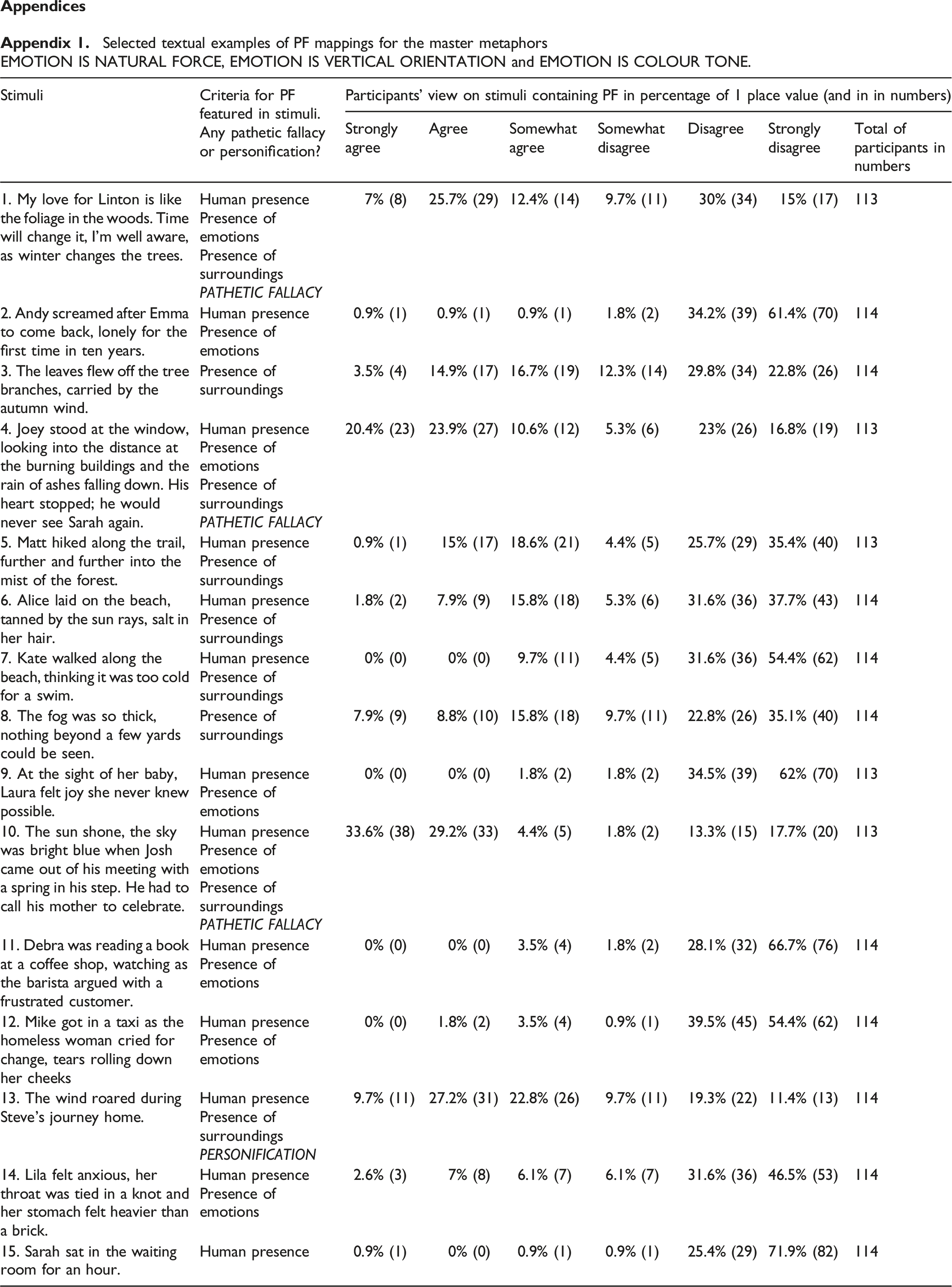
Stimuli
Criteria for PF featured in stimuli.
Participants’ view on stimuli containing PF in percentage of 1 place value (and in in numbers)
Strongly agree
Agree
Somewhat agree
Somewhat disagree
Disagree
Strongly disagree
Total of participants in numbers
1. My love for Linton is like the foliage in the woods. Time will change it, I’m well aware, as winter changes the trees.
Human presence
7% (8)
25.7% (29)
12.4% (14)
9.7% (11)
30% (34)
15% (17)
113
Presence of emotions
Presence of surroundings
PATHETIC FALLACY
2. Andy screamed after Emma to come back, lonely for the first time in ten years.
Human presence
0.9% (1)
0.9% (1)
0.9% (1)
1.8% (2)
34.2% (39)
61.4% (70)
114
Presence of emotions
3. The leaves flew off the tree branches, carried by the autumn wind.
Presence of surroundings
3.5% (4)
14.9% (17)
16.7% (19)
12.3% (14)
29.8% (34)
22.8% (26)
114
4. Joey stood at the window, looking into the distance at the burning buildings and the rain of ashes falling down. His heart stopped; he would never see Sarah again.
Human presence
20.4% (23)
23.9% (27)
10.6% (12)
5.3% (6)
23% (26)
16.8% (19)
113
Presence of emotions
Presence of surroundings
PATHETIC FALLACY
5. Matt hiked along the trail, further and further into the mist of the forest.
Human presence
0.9% (1)
15% (17)
18.6% (21)
4.4% (5)
25.7% (29)
35.4% (40)
113
Presence of surroundings
6. Alice laid on the beach, tanned by the sun rays, salt in her hair.
Human presence
1.8% (2)
7.9% (9)
15.8% (18)
5.3% (6)
31.6% (36)
37.7% (43)
114
Presence of surroundings
7. Kate walked along the beach, thinking it was too cold for a swim.
Human presence
0% (0)
0% (0)
9.7% (11)
4.4% (5)
31.6% (36)
54.4% (62)
114
Presence of surroundings
8. The fog was so thick, nothing beyond a few yards could be seen.
Presence of surroundings
7.9% (9)
8.8% (10)
15.8% (18)
9.7% (11)
22.8% (26)
35.1% (40)
114
9. At the sight of her baby, Laura felt joy she never knew possible.
Human presence
0% (0)
0% (0)
1.8% (2)
1.8% (2)
34.5% (39)
62% (70)
113
Presence of emotions
10. The sun shone, the sky was bright blue when Josh came out of his meeting with a spring in his step. He had to call his mother to celebrate.
Human presence
33.6% (38)
29.2% (33)
4.4% (5)
1.8% (2)
13.3% (15)
17.7% (20)
113
Presence of emotions
Presence of surroundings
PATHETIC FALLACY
11. Debra was reading a book at a coffee shop, watching as the barista argued with a frustrated customer.
Human presence
0% (0)
0% (0)
3.5% (4)
1.8% (2)
28.1% (32)
66.7% (76)
114
Presence of emotions
12. Mike got in a taxi as the homeless woman cried for change, tears rolling down her cheeks
Human presence
0% (0)
1.8% (2)
3.5% (4)
0.9% (1)
39.5% (45)
54.4% (62)
114
Presence of emotions
13. The wind roared during Steve’s journey home.
Human presence
9.7% (11)
27.2% (31)
22.8% (26)
9.7% (11)
19.3% (22)
11.4% (13)
114
Presence of surroundings
PERSONIFICATION
14. Lila felt anxious, her throat was tied in a knot and her stomach felt heavier than a brick.
Human presence
2.6% (3)
7% (8)
6.1% (7)
6.1% (7)
31.6% (36)
46.5% (53)
114
Presence of emotions
15. Sarah sat in the waiting room for an hour.
Human presence
0.9% (1)
0% (0)
0.9% (1)
0.9% (1)
25.4% (29)
71.9% (82)
114
Texts provided by participants in response to question 6.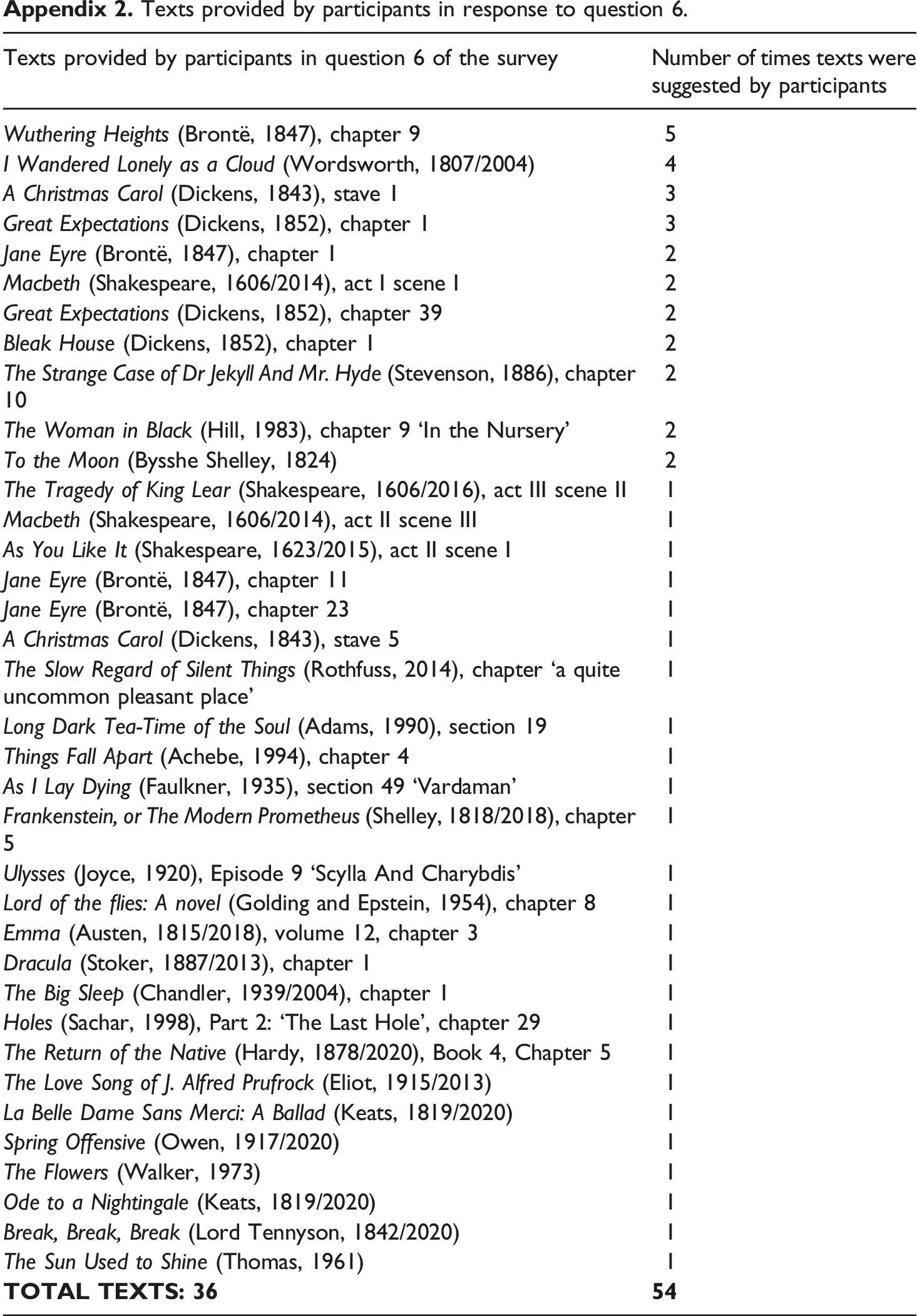
Texts provided by participants in question 6 of the survey
Number of times texts were suggested by participants
Wuthering Heights (Brontë, 1847), chapter 9
5
I Wandered Lonely as a Cloud (Wordsworth, 1807/2004)
4
A Christmas Carol (Dickens, 1843), stave 1
3
Great Expectations (Dickens, 1852), chapter 1
3
Jane Eyre (Brontë, 1847), chapter 1
2
Macbeth (Shakespeare, 1606/2014), act I scene I
2
Great Expectations (Dickens, 1852), chapter 39
2
Bleak House (Dickens, 1852), chapter 1
2
The Strange Case of Dr Jekyll And Mr. Hyde (Stevenson, 1886), chapter 10
2
The Woman in Black (Hill, 1983), chapter 9 ‘In the Nursery’
2
To the Moon (Bysshe Shelley, 1824)
2
The Tragedy of King Lear (Shakespeare, 1606/2016), act III scene II
1
Macbeth (Shakespeare, 1606/2014), act II scene III
1
As You Like It (Shakespeare, 1623/2015), act II scene I
1
Jane Eyre (Brontë, 1847), chapter 11
1
Jane Eyre (Brontë, 1847), chapter 23
1
A Christmas Carol (Dickens, 1843), stave 5
1
The Slow Regard of Silent Things (Rothfuss, 2014), chapter ‘a quite uncommon pleasant place’
1
Long Dark Tea-Time of the Soul (Adams, 1990), section 19
1
Things Fall Apart (Achebe, 1994), chapter 4
1
As I Lay Dying (Faulkner, 1935), section 49 ‘Vardaman’
1
Frankenstein, or The Modern Prometheus (Shelley, 1818/2018), chapter 5
1
Ulysses (Joyce, 1920), Episode 9 ‘Scylla And Charybdis’
1
Lord of the flies: A novel (Golding and Epstein, 1954), chapter 8
1
Emma (Austen, 1815/2018), volume 12, chapter 3
1
Dracula (Stoker, 1887/2013), chapter 1
1
The Big Sleep (Chandler, 1939/2004), chapter 1
1
Holes (Sachar, 1998), Part 2: ‘The Last Hole’, chapter 29
1
The Return of the Native (Hardy, 1878/2020), Book 4, Chapter 5
1
The Love Song of J. Alfred Prufrock (Eliot, 1915/2013)
1
La Belle Dame Sans Merci: A Ballad (Keats, 1819/2020)
1
Spring Offensive (Owen, 1917/2020)
1
The Flowers (Walker, 1973)
1
Ode to a Nightingale (Keats, 1819/2020)
1
Break, Break, Break (Lord Tennyson, 1842/2020)
1
The Sun Used to Shine (Thomas, 1961)
1
Appendix 3
Stimuli and the criteria or PF/personification they feature, and participants’ answers to question 5 matrix table with 6-point Likert scale.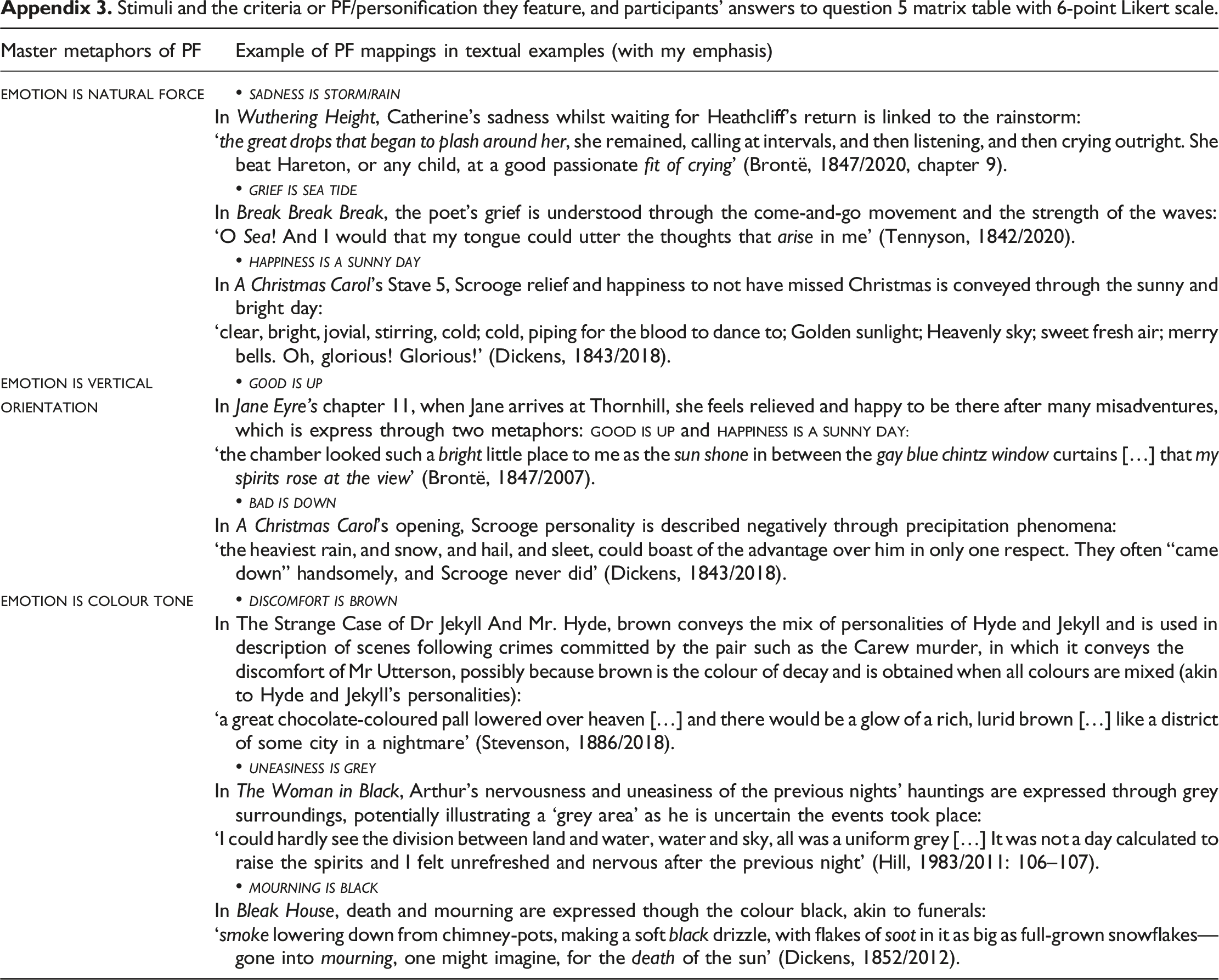
Master metaphors of PF
Example of PF mappings in textual examples (with my emphasis)
•
In Wuthering Height, Catherine’s sadness whilst waiting for Heathcliff’s return is linked to the rainstorm:
‘the great drops that began to plash around her, she remained, calling at intervals, and then listening, and then crying outright. She beat Hareton, or any child, at a good passionate fit of crying’ (Brontë, 1847/2020, chapter 9).
•
In Break Break Break, the poet’s grief is understood through the come-and-go movement and the strength of the waves:
‘O Sea! And I would that my tongue could utter the thoughts that arise in me’ (Tennyson, 1842/2020).
•
In A Christmas Carol’s Stave 5, Scrooge relief and happiness to not have missed Christmas is conveyed through the sunny and bright day:
‘clear, bright, jovial, stirring, cold; cold, piping for the blood to dance to; Golden sunlight; Heavenly sky; sweet fresh air; merry bells. Oh, glorious! Glorious!’ (Dickens, 1843/2018).
•
In Jane Eyre’s chapter 11, when Jane arrives at Thornhill, she feels relieved and happy to be there after many misadventures, which is express through two metaphors:
‘the chamber looked such a bright little place to me as the sun shone in between the gay blue chintz window curtains […] that my spirits rose at the view’ (Brontë, 1847/2007).
•
In A Christmas Carol’s opening, Scrooge personality is described negatively through precipitation phenomena:
‘the heaviest rain, and snow, and hail, and sleet, could boast of the advantage over him in only one respect. They often “came down” handsomely, and Scrooge never did’ (Dickens, 1843/2018).
•
In The Strange Case of Dr Jekyll And Mr. Hyde, brown conveys the mix of personalities of Hyde and Jekyll and is used in description of scenes following crimes committed by the pair such as the Carew murder, in which it conveys the discomfort of Mr Utterson, possibly because brown is the colour of decay and is obtained when all colours are mixed (akin to Hyde and Jekyll’s personalities):
‘a great chocolate-coloured pall lowered over heaven […] and there would be a glow of a rich, lurid brown […] like a district of some city in a nightmare’ (Stevenson, 1886/2018).
•
In The Woman in Black, Arthur’s nervousness and uneasiness of the previous nights’ hauntings are expressed through grey surroundings, potentially illustrating a ‘grey area’ as he is uncertain the events took place:
‘I could hardly see the division between land and water, water and sky, all was a uniform grey […] It was not a day calculated to raise the spirits and I felt unrefreshed and nervous after the previous night’ (Hill, 1983/2011: 106–107).
•
In Bleak House, death and mourning are expressed though the colour black, akin to funerals:
‘smoke lowering down from chimney-pots, making a soft black drizzle, with flakes of soot in it as big as full-grown snowflakes—gone into mourning, one might imagine, for the death of the sun’ (Dickens, 1852/2012).