




Abstract
This paper builds on Pager-McClymont’s model of pathetic fallacy to show how its converse can equally impact narratives and readers’ or viewers’ perspective of texts. The link between pathetic fallacy and its converse is established, and an identification method is provided. Examples from literature and multimodal texts are provided to explore how the converse of pathetic fallacy is featured in texts and the effects it can have on narratives, especially characterisation. With the use of Conceptual Metaphor Theory, findings show that the mappings
1. Introduction
Pathetic fallacy (henceforth PF) has received varied definitions and has been interpreted in different ways by literary scholars and linguists since the term was coined by John Ruskin in Modern Painters vol. III (1856/2012: 154–158), where he criticises writers and artists for attributing feelings to natural elements and for manipulating nature to depict their own emotions. Ruskin (1856/2012: 158) uses the example of ‘“The foam is not cruel, neither does it crawl”. The state of mind which attributes to it these characters of a living creature is one in which the reason is unhinged by grief’. However, there is some ambiguity in Ruskin's premise: the personification of nature or the artists' use of the environment to express their own feelings might both be considered fallacies in his view. In Pager-McClymont (2021, 2022), I point out the discrepancies in PF’s definitions by sources, as well as the lack of consistency in defining the terms within the same sources, linking it to Ruskin’s ambiguous essay. Stemming from this research is a stylistic model of PF to remedy the discrepancies and lack of consistency that surrounds the concept of PF. An emerging part of this model of PF is its converse. In this paper, I explore how the converse of pathetic fallacy (henceforth CoPF) fits within the stylistic model of PF developed by Pager-McClymont, (2021), with the aim to answer the following research questions: • RQ1. What is CoPF and how can it be identified in texts? • RQ2. How does CoPF impact the readerly experience? • RQ3. What do PF and its converse have in common? How can they still be processed as distinct metaphors?
To answer these questions, I first provide an overview of Pager-McClymont (2021, 2022) model of PF. I then define CoPF and showcase how it fits within the existing PF model, followed by examples from literature (Lolita) and multimodal texts (Addams Family Values).
2. Stylistically informed models of pathetic fallacy and its converse
This section situates how CoPF as a literary technique in its own right fits within my existing stylistic model of PF.
2.1. Pager-McClymont (2023) stylistic model of pathetic fallacy
In Pager-McClymont (2021), I developed a model of PF using an interdisciplinary approach. The need for an updated and systematic model of PF stemmed from education, as the concept of PF is included in the English National Curriculum (Department for Education, 2013a, 2013b), and thus likely taught in schools. As such, this model was built on data collected when surveying English teachers, and when asked to define pathetic fallacy in their own words, 53% (n = 134) defined it as a projection of emotion onto the natural world, and 36% defined it as a type of personification. The technique is not defined by the DfE, leaving teachers and education boards to define it themselves. The way the education boards define PF, however, varies as well. For example, Pearson Edexcel (2015: 5) defines PF in their literary guide for students as follows: ‘The use of setting, scenery or weather to mirror the mood of a human activity. Two people having an argument whilst a storm breaks out is an example.’ Yet, in their English Language Student Handbook, PF is defined as ‘giving human emotions to nature’ (Addison et al. for Pearson Edexcel, 2015: 259) and the example ‘delicious breadth of rain’ is provided. Both the example and definition portray PF as a form of personification which does not match the previous definition given, further exemplifying discrepancies surrounding the concept.
To analyse texts and build my model of PF using a bottom-up approach, I used foregrounding theory (Leech, 2008; Miall and Kuiken, 1995; Van Peer, 2007). Foregrounding theory underpins how elements of language stand out against the rest of the text, and this can be achieved through repetition (lexical repetition or syntactic repetition – i.e. parallelism), through external deviation against the norm of the language (here the English language), or through internal deviation from the text’s own established patterns. Foregrounding theory is also used below to analyse CoPF.
Overall, I define PF as a projection of emotions onto the surroundings by an animated entity. The emotions and animated entity in question can be featured implicitly or explicitly in the text. For this definition to be fulfilled, three criteria must be present: firstly, an animated entity (implicit or explicit) must be present, meaning human characters, implied authors, narrators or speakers (Palmer, 2004: 16–17), or anthropomorphised animals, which can be accounted by this criterion as long as they show signs of emotion (for instance anthropomorphised rabbits in Adams’s Watership Down, (Pager-McClymont, 2023b)). Secondly, surroundings need to be described richly enough for readers to discern how and where scenes occur (i.e. indoors or outdoors), and to trigger an interpretation of PF’s mirroring effect in readers. Thirdly, emotions must also be present. Emotion can be defined as a ‘response to an event, either internal or external, that has a positively or negatively valenced meaning for the individual’ (Salovey and Mayer, 1990: 186) which includes mood, preferences, personality traits, dispositions, emotional states and affects, physical feelings, lasting any length of time. Emotions can be ‘explicitly’ or ‘implicitly’ featured in texts (Palmer, 2004: 115): emotions that are clearly expressed are explicit and do not require inferring; and implicit emotions are those that are not directly expressed and must be inferred through language.
I also identified (at least) three ‘linguistic indicators’ of PF akin to Short’s ‘linguistic indicators of viewpoint’ which he defines as ‘small scale linguistic choices on the part of the author’ (1996: 263). In the case of PF, these indicators are imagery (tropes, figures of speech, etc.), repetition (of lexis or syntax), and negation (lexical e.g. sombre; syntactic e.g. not; morphological e.g. misleading). An example of text analysis showcasing the indicators can be read in Section 3.1. Additionally, I have so far identified six effects that PF can have on narratives: 1. Foreshadowing, 2. The explicit communication of emotions that may otherwise not be perceived by readers, 3. Building characters, 4. Building ‘ambience’ (Stockwell, 2014: 365), 5. Generating humour Pager-McClymont (2023a), 6. Impact on readers’ empathetic response
1
to texts as specific PF instances afford empathy depending on underlying conceptual metaphor, textual context, and correspondence with readers’ experiential background (Stradling and Pager-McClymont, 2023).
PF is an extended metaphor (meaning that it occurs across any length of text), and can thus be discussed in terms of Conceptual Metaphor Theory in which one conceptual domain
2.2. Towards a model of the converse of pathetic fallacy
This section presents the connections between CoPF and PF based on the brief synthesis of my stylistically informed model of PF introduced in Section 2.1. In Pager-McClymont (2021), I introduce the idea of the ‘converse of pathetic fallacy’, which I define as texts where all three criteria are featured explicitly, and yet PF is not present due to a clear and foregrounded contrast between the emotions expressed and the surroundings described. CoPF requires four criteria to be present for its definition to be fulfilled: presence of animated entities, presence of emotions, and presence of surroundings, akin to PF’s criteria. However, an additional criterion is required for CoPF to occur: a foregrounded contrast between the emotion and surroundings depicted. This last criterion can be labelled as a form of ‘gradable opposition’, as Jeffries (2010: 22) explains: more clearly central as a category of opposites, the gradable antonyms are by far the most common of the conventional opposites in English, including such text-book favourites as hot-cold , long-short and good-bad. These opposites are in neither a mutually exclusive nor a mutually dependent relationship.
Jeffries argues that such a type of opposition can at times be implicit, especially when featured in more literary or poetic texts ‘where the creation of opposition is more subtle because it is less clearly challenging to the status quo’ (Jeffries, 2010: 57). This is particularly salient to CoPF because the foregrounded opposition between the surroundings and emotions is required for the metaphor to be fulfilled. Furthermore, CoPF also shares PF’s linguistic indicators (namely imagery, negation, repetition), in addition to its own: a foregrounded contrast between lexical field of emotion and lexical field of surroundings.
To facilitate the identification of PF or its converse in text, I developed a method, which I call the ‘Identification Method of PF and its Converse’ (IMPFC), as shown in Figure 1. Flow chart of the identification method of PF and its converse (IMPFC).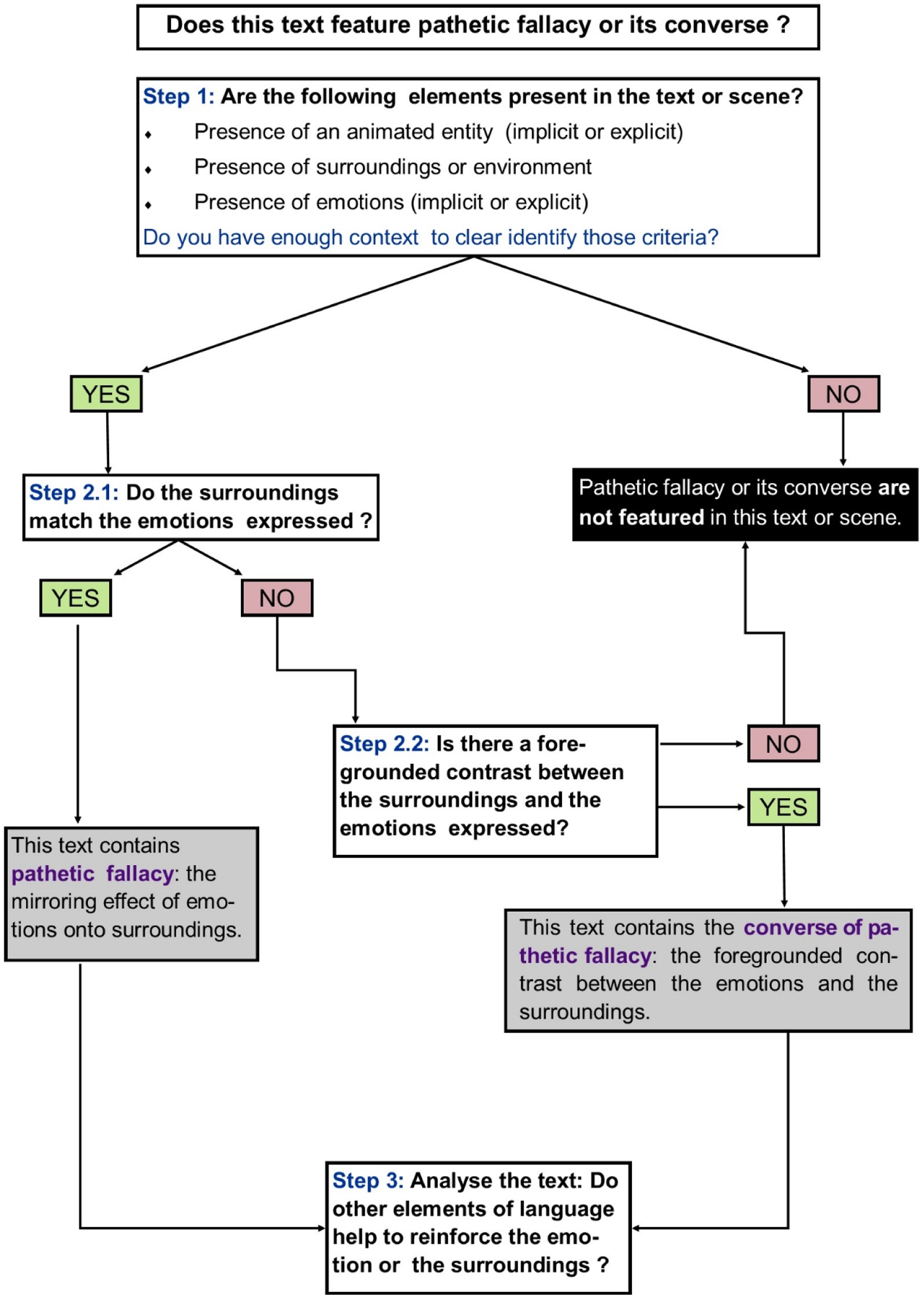
This method shows the step-by-step process with guiding questions to aid in the observation of PF through its criteria and mirroring effect, and of its converse by stressing the clearly foregrounded opposition between surroundings and emotions. The method also indicates that it is possible for readers to perceive PF and its converse in texts without the need for an analysis to be conducted, which might be useful in an educational setting.
In the research which introduced this method and CoPF, only one effect is discussed in an analysis of an extract from chapter 1 of The Wonderful Wizard of Oz (Baum, 1900/2008): the character-building effect of CoPF. Indeed, the opposition between the chaos of Dorothy’s house in the air due to a tornado contrasts against Dorothy’s calm reaction, which conveys her courageous nature. However, in this paper, I illustrate that CoPF has other effects on narratives, such as building ambience (Stockwell, 2014: 365), generating humour, akin to PF itself. Furthermore, I show that CoPF can also be found in multimodal texts, rendering it a multimodal metaphor. In terms of metaphor studies, CoPF’s master metaphor mappings can be labelled as
3. Analysing the converse of pathetic fallacy
This section provides two examples of CoPF in literature and multimodal texts. The first analysis explores how PF and its converse are both featured in Nabokov’s Lolita and the effect they have, along with the potential impact for using both techniques within the same narrative. The second analysis focuses on CoPF in film, namely Addams Family Values, with the aim to explore how CoPF can be featured as a multimodal metaphor. These two texts were chosen as examples because one is literary, and one is multimodal, in addition to being different in themes and effects, as the analysis demonstrates below. The aim is to evidence that my stylistic model of PF and CoPF is widely applicable.
3.1. The converse of pathetic fallacy in literature: Lolita
Lolita was first published in 1955 in France, written by Russian-American author Vladimir Nabokov after several rejections (Whiting, 1998: 834). The book is renowned for its contentious themes of paedophilia (Green, 1966; Patnoe, 1995; Tamir-Ghez, 1979; Whiting, 1998), as well as alienation (Helgeson, 1989; Kargar, 2016), persuasion and morality (Green, 1966; Tamir-Ghez, 1979), and duality (Patnoe, 1995).
In the novel, the protagonist, a middle-aged literature professor who goes by the name Humbert Humbert, is infatuated with Dolores Haze (nicknamed Lolita), a 12-year-old girl. He marries her mother, Charlotte Haze, with the goal to stay close to Lolita and become her stepfather. After Charlotte’s death (potentially at the hand of Humbert), he kidnaps Lolita and abuses her sexually. The narration is unreliable as Humbert switches from first-person to third-person point of view, particularly when taboo passages of the narrative take place, potentially distancing himself from the paedophilic nature of those events (Moore, 2001; Phelan, 2007). In this section, I analyse two extracts from the novel: one from part 1/chapter 13 featuring PF, and one from part 1/chapter 18 featuring CoPF.
The extract below from part 1/chapter 13 details Humbert and Lolita sat on a sofa together, her legs are on his lap as she reads and listens to music. Humbert takes advantage of their physical contact, which leads him to masturbate without Lolita realising his action (at least according to him). With the deep hot sweetness thus established and well on its way to the ultimate convulsion, I felt I could slow down in order to prolong the glow. Lolita had been safely solipsized. The implied sun pulsated in the supplied poplars; we were fantastically and divinely alone; I watched her, rosy, gold-dusted, beyond the veil of my controlled delight, unaware of it, alien to it, and the sun was on her lips, and her lips were apparently still forming the words of the Carmen-barmen ditty that no longer reached my consciousness. Everything was now ready. The nerves of pleasure had been laid bare. The corpuscles of Krause were entering the phase of frenzy. The least pressure would suffice to set all paradise loose (Nabokov, 2000: 60).
PF’s criteria are present in the extract: Humbert (and Lolita) are the animated entities, Humbert’s positive emotions and physical reactions are described, for instance: ‘fantastically and divinely’, ‘delight’, ‘pleasure’, ‘paradise’. The extract is in the first-person narration, and Humbert uses several euphemisms (a type of imagery, which is one of PF’s linguistic indicators) to convey his paedophilic action, erection, and ejaculation: ‘the ultimate convulsion’, ‘prolong the glow’, ‘implied sun pulsated’, ‘the nerves of pleasure had been laid bare’, ‘entering the phase of frenzy’, ‘set all paradise loose’. Furthermore, some terms have scientific connotations (i.e. ‘pulsated’, ‘nerves’, ‘the corpuscles of Krause were entering the phase’, ‘pressure’, ‘solipsized’, the latter being made-up). These euphemisms and use of scientifically oriented terms potentially convey that Humbert is distancing himself from his actions, due to their taboo nature, particularly when contrasted with terms that allude to childhood such as ‘rosy’, ‘sweetness’, or ‘the Carmen-barmen ditty’ in reference to Lolita’s reading. Humbert suggests that Lolita is oblivious to what is happening (‘Lolita had been safely solipsized’, ‘unaware of it, alien to it’), and he suggests that the action described occurred naturally without any forethought, and that Lolita is safe in his presence: ‘beyond the veil of my controlled delight’, ‘safely’, ‘no longer reached my consciousness’. However, the sentence that follows states ‘Everything was now ready’, which implies some form of premeditation to put a sequence of event in place as means to an end – here, Humbert’s masturbation. This contrast and the distance he attempts to place using scientific terms can be interpreted as a way to rationalise his action, and to appear more redeemable in readers’ eyes.
Although the surroundings of the room in which the action takes place are not richly described, the ambience of the action is described by Humbert using light and bright terminology: ‘glow’, ‘gold-dusted’, ‘sun’, the latter being repeated (repetition is one of PF’s linguistic indicators). Terms linked to religion and heaven are also used: ‘divine’ and ‘paradise’, which are likely to trigger a mental representation in readers of bright or light colours when reading the scene. As such, Humbert’s positive emotions and physical reaction (target domain) are associated with bright surroundings (source domain), and this instance of PF in Lolita’s chapter 13 can thus be expressed through the cross-domain mapping
On the other hand, Lolita’s part 1/chapter 18 features CoPF. In this chapter, Humbert and Lolita’s mother, Charlotte Haze, have recently got married whilst Lolita was sent to summer camp. The scene describes Humbert and Charlotte’s life as newly-weds: I simply can’t tell you how gentle, how touching my poor wife was. At breakfast, in the depressingly bright kitchen, with its chrome glitter and Hardware and Co. Calendar and cute breakfast nook (simulating that Coffee Shoppe where in their college days Charlotte and Humbert used to coo together), she would sit, robed in red, her elbow on the plastic-topped table, her cheek propped on her fist, and stare at me with intolerable tenderness as I consumed my ham and eggs. Humbert’s face might twitch with neuralgia, but in her eyes it vied in beauty and animation with the sun and shadows of leaves rippling on the white refrigerator. My solemn exasperation was to her the silence of love. My small income added to her even smaller one impressed her as a brilliant fortune; not because the resulting sum now sufficed for most middle-class needs, but because even my money shone in her eyes with the magic of my manliness, and she saw our joint account as one of those southern boulevards at midday that have solid shade on one side and smooth sunshine on the other, all the way to the end of a prospect, where pink mountains loom (Nabokov, 2000: 77).
CoPF’s criteria are present in the text: Humbert and Charlotte are the animated entities, and their emotions and attitudes are described. Humbert’s emotions are portrayed as negative: ‘poor’, ‘twitch with neuralgia’, ‘exasperation’, ‘depressingly’, ‘intolerable’, ‘loom’; whereas Charlotte’s attitude is described as positive and loving: ‘gentle’, ‘touching’, ‘tenderness’, ‘impressed her’, ‘shone in her eyes with the magic of my manliness’. The focus of the scene is on Humbert’s emotions as he is the protagonist, and this is a first-person narrative – although there is a sense of unreliable narration with the third-person viewpoint present in the sentence ‘Humbert’s face might twitch with neuralgia’. The surroundings of the scene are described positively: ‘bright kitchen, with its chrome glitter and Hardware and Co. Calendar and cute breakfast nook’, ‘the sun and shadows of leaves rippling on the white refrigerator’. Furthermore, in Humbert’s inner monologue, he compares Charlotte’s views of their finances to ‘southern boulevards at midday that have solid shade on one side and smooth sunshine on the other’ and ‘where pink mountains loom’. The emphasised terms are likely to trigger a mental representation of bright, light colours and overall positive ambience of the scene. However, this differs from Humbert’s negative emotions, and as such, the fourth criterion of CoPF is present.
The linguistic indicators of CoPF are equally featured. Negation is prevalent lexically (i.e. ‘poor’, ‘depressingly’, ‘neuralgia’, ‘exasperation’, ‘small’, ‘loom’), syntactically (i.e. ‘can’t’, ‘not’) and morphologically (i.e. ‘intolerable’). Additionally, imagery is also present in the extract: oxymorons such as ‘depressingly bright’, ‘intolerable tenderness’, or the sentence ‘my solemn exasperation was to her the silence of love’ equates Humbert’s negative emotion to Charlotte’s view of it in an oxymoronic manner. These oxymorons are used to convey Humbert’s negative attitude towards his new wife and daily life, particularly because Lolita is not a part of it as she is away at camp. Humbert distances himself from Charlotte’s view of events, implying that her views are simple-minded and oblivious to reality. This is achieved for example through the use of third-person as mentioned above, or in the phrase ‘simulating that Coffee Shoppe where in their college days Charlotte and Humbert used to coo together’, the term ‘simulating’ clearly conveying the fictional aspect of the statement. The use of comparison also illustrates Humbert’s implicit commentary on Charlotte’s views of reality: ‘my small income added to her even smaller one impressed her as a brilliant fortune; […] even my money shone in her eyes with the magic of my manliness’. This comparison is followed by figures of speech to attempt to describe how Charlotte might consider their finances: ‘she saw our joint account as one of those southern boulevards at midday that have solid shade on one side and smooth sunshine on the other, all the way to the end of a prospect, where pink mountains loom’. The description through figures of speech is farfetched, mirroring Humbert’s opinion of Charlotte’s mind: he views her as ignorant or delusional. This is contrasted with how Humbert’s actions and views are grounded in reality expressed through basic declarations such as ‘I consumed my ham and eggs’. This could be Humbert’s way as an unreliable narrator to convince readers of the validity of his point of view, as opposed to Charlotte’s, particularly in light of the paedophilic actions he has already committed so far in the narrative (such as in chapter 13).
In terms of metaphor mapping for CoPF in this extract, Humbert’s negative emotions and dissociation are the target domain, and the positively light and bright surroundings described are the source domain. Thus, CoPF’s cross-domain mapping is in this instance
In this passage, the effect of CoPF is that it contributes to both Humbert’s and Charlotte’s characterisation. Characterisation is ‘the cognitive process by which readers comprehend fictional characters. In effect, characterisation is the process of forming an impression of a character in your head as you read’ (McIntyre, 2014: 159). CoPF foregrounds emotions, and as Palmer (2004: 113) argues, ‘the presentation of emotion plays a vital part in the creation of a character’. To explore how CoPF can be character-building, I use Culpeper’s model of characterisation (2001) which draws on literature, psychology, stylistics, and cognitive studies. The model combines ‘bottom-up’ processes (taking cues from the text itself to trigger our impression of characters) and ‘top-down’ processes (how our prior knowledge informs our impression of characters). Textual cues of characterisation can be explicit (how the character is directly presented by themselves or other characters or narrator, i.e. name, description) or implicit (inferences readers make based on the text, i.e. conversational implicature and structure, accent and dialect, visual features). In Pager-McClymont (2021, 2022), I argue that figurative language such as PF is an implicit cue of characterisation because it provides readers with a rich mental representation of characters’ emotions. In this paper, I argue that it is also the case for CoPF, particularly because it further foregrounds characters’ emotions, as it is the case here: Humbert finds his life with Charlotte unbearable and views it as a means to an end (to get closer to Lolita), and the bright and light settings that would in other contexts be perceived positively are here described negatively, which also builds ambience. Interestingly, it means that if Charlotte’s viewpoint is the focus of analysis, this passage then features PF with the mapping
This section demonstrated how one narrative can feature PF and its converse in different scenes, as well as how PF and its converse can be present within the same passage when focusing on different characters’ perspectives. The aim of this section was to show that Pager-McClymont’s (2021, 2022) model of PF could be adapted in the analysis of CoPF. In the next section, I explore how CoPF can be a multimodal metaphor and the effect it has on film.
3.2. The converse of pathetic fallacy in multimodal texts: Addams Family Values
Addams Family Values (Sonnenfeld, 1993) is the sequel to The Addams Family (Sonnenfeld, 1990), itself based on the television series of the same name (David, 1964). The main characters are Morticia and Gomes Addams, parents to Wednesday and Pugsley (and later baby Pubert). Secondary characters are Lurch (the family’s butler), Uncle Fester (Gomes’s brother), and Thing (an animated hand). The premise of the films and series is that the family lives in a sombre and spooky mansion, they embrace the macabre, dark humour, and strange customs while endearing audiences with their love for one another and unconventional lifestyle. In Addams Family Values, Wednesday and Pugsley are sent to summer camp, and their arrival is the scene under study.
Transcript for scene “arrival at Camp Chippewa”, Addams Family Values (Sonnenfeld, 1993).
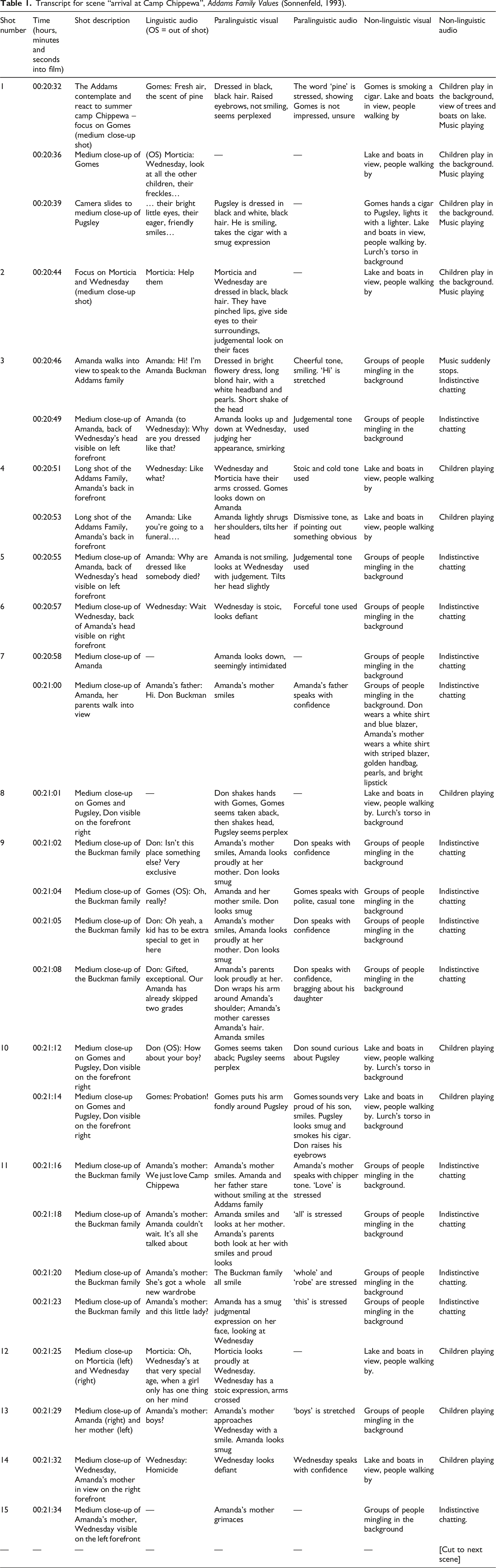
Camp Chippewa has bright surroundings: it is sunny, people wear mostly bright summer clothes; and pine trees, boats on lake can be observed. Adults mingle cordially, whilst children play with enthusiasm. The main animated entities I focus on in this analysis are the Addamses, (particularly Wednesday). They start mingling with the Buckmans because of their daughter Amanda approaching them. The Addamses are wearing black clothing, and have paler and duller complexions, as opposed to the Buckmans who are wearing lighter colours (Amanda wears flowery pastel colours on her dress) and their skin seems rosier, brighter. The Addamses’ appearance is foregrounded by external deviation compared to the others present and the surroundings, and this is signposted by Amanda’s questions in shots 3–4 ‘Why are you dressed like that? […] Like you’re going to a funeral’ and shot 5 ‘Why are dressed like somebody died?’. There is thus a clear foregrounded opposition between what the Addamses look like and the expected portrayal of characters going to summer camp ready for warm weather and typical brighter summer colours. The Addamses are not only out of place physically in the scene, but also emotionally: they are uncomfortable and ill-at-ease in the setting. This is conveyed by Gomes’s tone when he says ‘pine’ in shot 1, or in Morticia’s advice to Wednesday ‘look at all the other children, their freckles, their bright little eyes, their eager, friendly smile. Help them’ (shots 1–2), illustrating that these bright attributes are perceived negatively by the Addamses. Wednesday’s reluctance and discomfort to being forced to join the camp is also emphasised by her stoic and cold tone in shots 4, 6 and 14, and all of what she says revolves around the idea of death (‘homicide’). On the other hand, the Buckmans and Amanda seem to fit in at the camp and describe it positively: ‘Isn’t this place something else? Very exclusive’ (shot 9) or ‘we just love Camp Chippewa’ (shot 11). This showcases a foregrounded opposition between what one would expect as summer camps typically portray happy and keen children, and how the Addamses actually react. Indeed, not only do they view it negatively, but Wednesday would prefer to be spending her time engaging with death and murder rather than being at the camp. Overall, the three criteria of CoPF are thus present: animated entities (the Addamses), the surroundings (summer camp), and emotions (discomfort).
(Linguistic) 2 indicators of CoPF are also featured in the scene. Repetition is present through parallelism of shots: there is a mirroring between the Buckmans and the Addamses, as shown by shots 12 to 15, interchanging between medium close-up shots of Amanda and her mother with medium close-up shots of Morticia and Wednesday. This is also present between shot 10 (focus on Don bragging about Amanda skipping two grades) and shot 11 (focus on Gomes bragging about Puglsey’s probation). These parallel shots further stress the opposition between the Buckmans and the Addamses. Additionally, Amanda’s questions ‘why are you dressed like somebody died?’ and ‘why are you dressed like you’re going to a funeral’ both revolve around Wednesday’s outfit, which not only further foregrounds it against the rest of the settings, but is also a repetition, as well as being a form of imagery as it includes similes. Negation is thus present in the scene through the Addamses’ attitude and discomfort, it is also conveyed by the Buckman’s reactions to the Addamses. In shot 10, Gomes brags about Pugsley’s probation leading Don to raise his eyebrows is disbelief. In shot 15, Amanda’s mother grimaces as a response to Wednesday defiantly saying that she has ‘homicide’ on her mind as a young girl.
CoPF in this scene is used to stress how out of place the Addams family is at the camp: not only do they feel ill-at-ease themselves, but they are also perceived as not fitting in by others such as the Buckmans, making them also uncomfortable. In this scene, there are two main effects of CoPF: characterisation, and generating humour. As discussed above, CoPF is an implicit cue of characterisation because of the emphasis it creates on characters’ emotions, and in this scene, the Addamses’ discomfort and feeling of being out of place are rendered even more obvious because of the clear opposition their attitude has against the rest of the scene, and the Buckmans. Indeed, the Addamses (particularly Wednesday) are not only presented as physically dark through their clothing and duller complexion, but what they consider to be good concepts to think about such as probation or homicide is also dark and macabre. As such, CoPF in this instance has two cross domain mappings:
The opposition between the Addamses’ positive views on sombre notions such as homicide or probation in a children’s summer camp settings is unexpected and thus foregrounded by external deviation. Marszalek (2020) provides a model of humour in novels and short stories, which I argue can equally be applied to multimodal texts. The model is based on ‘stabilizing’ cues which ‘signal amusement and stabilize our experience of comedy’ as well as ‘distance us from the narrative world to encourage a detached, playful, sometimes mocking towards the world’ (Marszalek, 2020: 6). On the other hand, ‘destabilizing’ cues ‘signal non-humorous emotions that destabilize our experience of comedy’ and they ‘lead us to immerse ourselves in the narrative world and form feelings and attachments for entities’ (Marszalek, 2020: 7). Those cues are discussed in terms of modes and moods, characterization, and structure. In light of the arrival at Camp Chippewa scene analysed, destabilizing cues are most salient, as they can disrupt positive mood in narratives through what Marszalek refers to as ‘dark elements’, meaning serious subjects in comic narratives (here reference to death and probation), thus generating dark humour. Dark humour ‘arises directly in response to precarious, dangerous and/or traumatic situations or incidents. Importantly, dark humour does not necessarily make fun of (i.e. ridicule or disparage) tragic situations, even if it is inspired by them and relevant to them’ (Dynel and Poppi, 2018: 384). Marszalek (2020: 61–62) explains: Dark elements can affect our experience of humorous narrative worlds by temporarily shifting the mood to a more serious one, or alternatively, by enhancing the humorous mood by creating dark humour. These techniques, although they were said to evoke contrasting emotional responses (negative emotion versus amusement), can nevertheless be seen to be linked to the idea of complex humorous responses, as they rely on destabilizing, negatively charged elements being introduced to worlds which are otherwise stabilized as largely positive.
This is particularly salient to humour in content related to the Addams Family, as illustrated in the analysis above. The characters’ positive attitude towards death (natural or criminal), torture, macabre and other dark concepts are destabilising elements that contrast with a typically positive situation, such as sending children to summer camp. This shows that the mappings
4. Other examples
Overall, findings in this paper indicate that CoPF has opposite metaphorical mappings than that of PF despite having similar effects on narrative such as characterisation, generating humour, or building ambience, as exemplified in the analyses above. In the introduction of CoPF’s model, it was stated that the master mapping for this metaphor are
Additionally, Addams Family Values features the mapping
Another example of CoPF can be found in the musical Singin’ in the Rain (Donen and Kelly, 1952). Indeed, in Pager-McClymont (2021, 2022), I argue that the metaphor I’m singin’ in the rain […], What a glorious feeling, I’m happy again! I’m laughing at clouds So dark up above, The sun’s in my heart […] Come on with your rain, I’ve got a smile on my face!
In the song, terms such as ‘rain’, ‘dark’, and ‘clouds’ which are typically perceived negatively (or as bad) are linked to the positive feeling of happiness expressed (‘glorious feeling’, ‘happy’, ‘laughing’, ‘smile’). As such, the cross-domain mapping
5. Discussion and conclusions
To conclude, this paper presents a stylistically informed model of CoPF by providing a definition (texts where all three criteria are featured explicitly, and yet PF is not present due to a clear and foregrounded contrast between the emotions expressed and the surroundings described), as well as linguistic indicators (imagery, repetition, negation). The definition requires four key criteria to be present: presence of animated entity, presence of emotion, presence of surroundings, and (gradable) opposition between surroundings and emotions. An identification method of PF and its converse (IMPFC) is provided to guide analysts of any level to identify whether a text features PF and/or its converse, the results of which can be confirmed through text analysis as exemplified in Section 3 in literature, as well as film. The overall effect CoPF has on readerly experience is that it can build characters and ambience, as well as generate humour. The opposition between the surroundings and emotions creates a foregrounded contrast which further emphasises characters’ emotions in a specific environment, and as such allows for a rich mental representation of the scene for readers.
It was demonstrated that CoPF is an emotion metaphor with the master mappings
Footnotes
Declaration of conflicting interests
The author(s) declared no potential conflicts of interest with respect to the research, authorship, and/or publication of this article.
Funding
The author(s) received no financial support for the research, authorship, and/or publication of this article.
