



Abstract
Many people in many cultures have a spiritual connection with nature. Research is beginning to reveal the implications of this “ecospiritual” orientation for two great challenges of our times: preserving the well-being of the natural environment and of ourselves. This article provides an overview of the current research on ecospirituality, with a focus on its role in supporting, and sometimes inadvertently hindering, environmental preservation and human well-being.
If you have ever walked among the soaring spires of an old-growth forest or gazed upward at the countless stars on a cloudless night, you may have felt like you were in the presence of something sacred. You would not have been the first. Many people worldwide experience a spiritual relationship with nature. It manifests in Hindu beliefs about shared divine origins of all living things (Selin, 2003), in Barasana origin myths about Amazonian ancestors traveling the Vaupés River at the beginning of time (Davis, 2009), and in the mystic ambitions of Californian soul surfers seeking spiritual enlightenment at sea (Taylor, 2009). The common thread that connects these culturally distinct and richly structured beliefs is the perception of nature as a spiritual resource—that is, ecospirituality (Billet et al., 2023; Suganthi, 2019).
Ecospirituality is pervasive and has important implications not only for human interactions with the natural environment but also for well-being. Some of those implications are straightforward, but some are not. This article provides an overview of recent research on ecospirituality, with a focus on its unique implications for environmental preservation and human well-being.
Ecospirituality: What It Is and Where It Comes From
Many people have proenvironmental attitudes, identify as environmentalists, or feel so connected to the natural world that they perceive a kinship with animals and plants (Mayer & Frantz, 2004). But these attitudes, identities, and connections do not, by themselves, equate to ecospirituality. An additional ingredient is required: spirituality.
To be spiritual is to have an impulse to connect directly with something sacred. Spiritual experiences are prototypically accompanied by a sense of absorption in something that transcends the properties of the physical world and emotions such as wonder and awe (Fuller, 2007). These feelings can be experienced in nonspiritual contexts, such as being awestruck by a work of art, but they take on the character of a spiritual experience when paired with perceptions of being in the presence of the supernatural or the sacred (Keltner & Haidt, 2003). When a spiritual impulse is directed toward nature—when nature itself is perceived to be not merely good but truly sacred—it is ecospirituality. Religion, which cultivates spirituality through institutionalized beliefs and practices, can provide a route through which spiritual impulses are directed toward nature. Indeed, elements of ecospirituality can be found in many early religious traditions. Vedic seers celebrated the untamed forests in their hymns, the Buddha spoke of compassion for all sentient beings, and early Islamic theologians such as Al-Ghazali taught that all creation is part of God’s plan and should be cherished. But just as people can be spiritual but not religious (Mercadante, 2014), they need not be religious to perceive nature as sacred and experience an awe-inspiring spiritual connection to it.
Although ecospiritual beliefs are found in many populations worldwide, people differ in the extent to which they are themselves ecospiritual. Billet et al. (2023) created and validated a short self-report measure that is useful for assessing these individual differences and for testing hypotheses within and across cultures. The items on this measure were designed to tap into two key components of ecospirituality: beliefs about the spiritual qualities of nature, and transcendent spiritual experiences in nature (Table 1). The overall measure of ecospirituality correlates moderately positively with measures of conceptually related constructs (e.g., connectedness to nature, spiritual beliefs more generally), but notably, it is only weakly related to religiosity. Across samples from the United States, Canada, the United Kingdom, and Singapore, individuals reported high levels of ecospirituality. These diverse samples represent varied cultural traditions with different theological depictions of the spiritual connections between humans and the natural world (e.g., Christians, Muslims, Buddhists, Taoists). Even atheists who disavow spirituality more broadly reported fairly high levels of ecospirituality, above the scale midpoint (Billet et al., 2023).
Short Self-Report Measure of Ecospirituality (Billet et al., 2023)

Note: Respondents rate agreement with each item on a scale from 1 (strongly disagree) to 7 (strongly agree). Validation results (Billet et al., 2023) show an underlying two-factor structure: Items 1 through 4 assess explicit appraisals of nature’s spiritual or sacred qualities and load highly on one factor, whereas Items 5 through 8 assess transcendent experiences in nature and load highly on another factor. Corresponding four-item subscale scores are strongly positively correlated (across three samples from three countries, correlations ranged from .48 to .57; Billet et al., 2023). When all eight items are combined into one overall measure of ecospirituality, it has high internal reliability (across eight samples from four countries, mean Cronbach’s α = .89; Billet et al., 2023).
Why are ecospiritual beliefs so common? One explanation emerges from research on the origins of supernatural beliefs more generally (White et al., 2021). Humans have a tendency toward anthropomorphism—to perceive faces in the clouds and hear voices in the wind and to attribute human-like desires and intentions and complex cognitive abilities to nonhuman things (e.g., plants; ojalehto et al., 2017). Just as this cognitive tendency may contribute to cultural beliefs about supernatural beings (Guthrie, 1993), it may also predispose people toward spiritual conceptions of the natural world. Empirical research supports this view. For example, in an analysis of the ethnographic record across 114 geographically and culturally diverse societies, Jackson et al. (2023) found that people commonly explain consequential natural phenomena, such as diseases and droughts, as the actions of spiritual agents. Note, however, that although anthropomorphism may facilitate the perception of a connection with nature, it does not, by itself, imply a belief that nature is sacred. (People’s pets are often imbued with human-like qualities without necessarily being perceived to be sacred.) The implication is that the recurrent human tendency toward anthropomorphism may be a necessary but not sufficient part of the explanation for widespread ecospiritual beliefs.
A complementary explanation for the prevalence of ecospiritual beliefs is that social learning and selective transmission processes—the processes that govern cultural evolution—may have favored ecospiritual beliefs because they helped communities grapple with the challenges of natural-resource management (Preston & Baimel, 2021). Societies are prone to overextract resources—with potentially disastrous consequences for the environment and their inhabitants (Diamond, 2005; Kashima, 2020). Ecospiritual beliefs can combat this problem by assigning sacred value to natural resources, allowing societies to ritualistically demarcate access to and usage of those resources. For example, the Q’eqchi’ people in the highlands of Guatemala prohibit the exploitation of certain forest species that are believed to host local forest spirits (Atran et al., 2002), and Hindu water temples in Bali coordinate irrigation usage among local rice farmers, effectively solving a complex multiparty cooperation dilemma (Lansing, 2012).
Implications for Environmental Preservation
These observations suggest that ecospiritual belief systems may function as a kind of informal “environmental protection agency” and that the effects of ecospirituality on a person’s concern for the natural environment and its preservation may be psychologically distinct from the effects of related constructs such as proenvironmental attitudes and identities. There are at least two psychological pathways through which ecospirituality may have these distinct effects.
One pathway is through the moralization of nature. Ecospiritual individuals not only have more positive attitudes toward nature but also feel a moral obligation to care for it. In one study (Billet et al., 2023, Study 1), participants placed specific kinds of natural entities (e.g., oceans, deserts, mountains, old-growth forests) within a set of concentric circles representing different degrees of moral obligation. People who scored low on ecospirituality perceived natural entities to fall outside of their inner moral circle—approximately equivalent to the status they accorded to a foreign citizen. In contrast, ecospiritually minded people perceived these natural entities to fall closer to their inner moral circle, approximately equivalent to how they perceived a neighbor (Fig. 1).
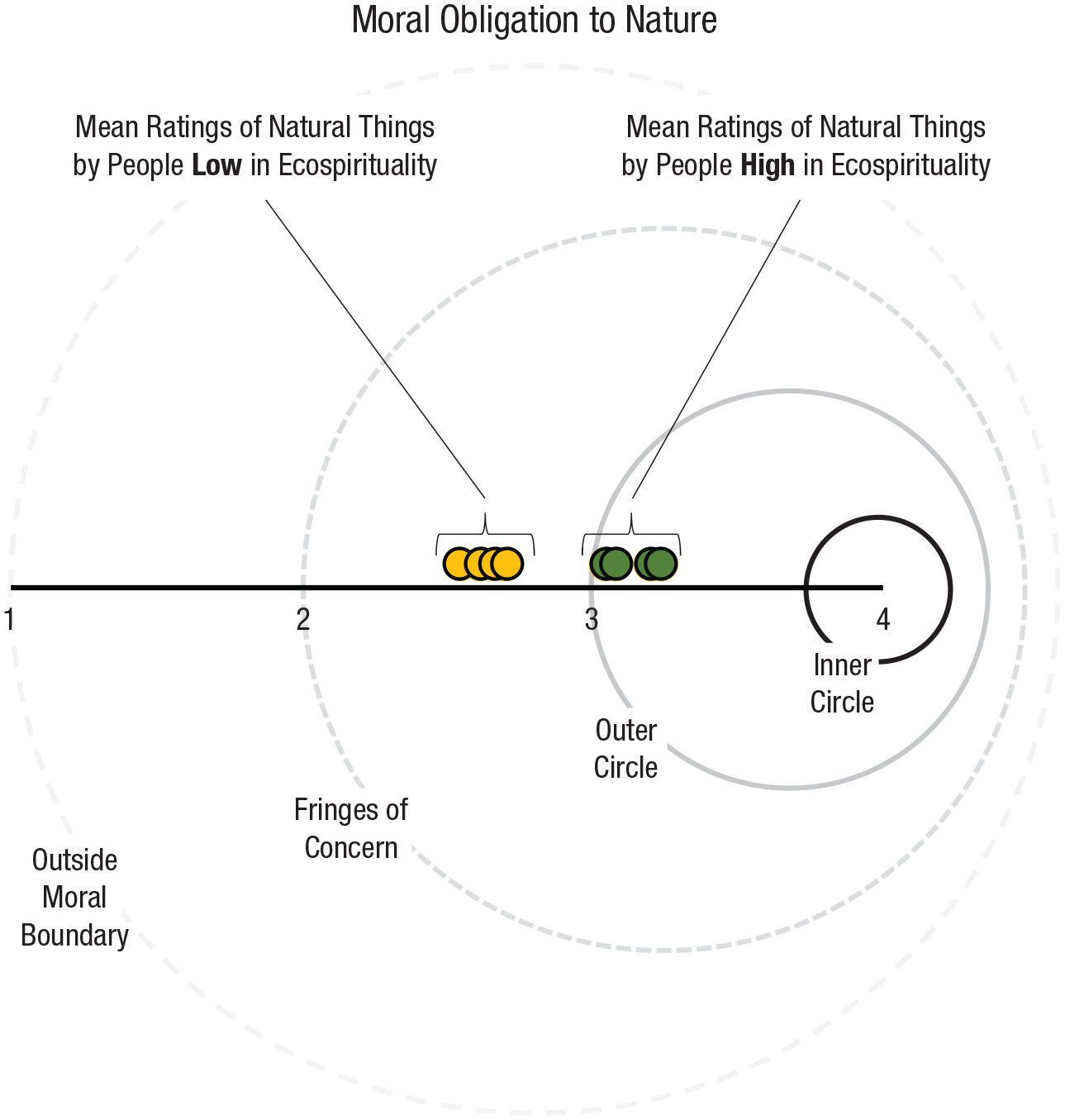
Ecospirituality and the moralization of nature. Participants from the United States, Canada, and Singapore were asked to consider specific people (e.g., close friend, foreign citizen) as well as specific kinds of natural things (e.g., oceans, old-growth forests) and to locate each person or thing within a set of concentric circles representing four different levels of moral obligation: “You have a moral obligation to ensure their welfare and feel a sense of personal responsibility for their treatment” (inner circle); “You are concerned about their moral treatment, but your sense of obligation and personal responsibility is greatly reduced” (outer circle); “You are not morally obligated or personally responsible for their moral treatment” (fringes of concern); and “Feeling concern or personal responsibility for their moral treatment is extreme or nonsensical” (outside moral boundary). Based on Billet et al. (2023), this figure summarizes results from the U.S. sample (N = 493) and depicts mean responses to four specific natural things—deserts, mountains, oceans, and old-growth forests—by people who scored either low (−1 SD) or high (+1 SD) on ecospirituality. Means show that people low in ecospirituality perceived natural things to be outside the outer circle of moral obligation (approximately equivalent to their moral obligation toward a foreign citizen); in contrast, people high in ecospirituality perceived natural things to be inside that circle of moral obligation (approximately equivalent to their moral obligation toward somebody from their neighborhood). Samples from Canada and Singapore showed similar patterns of results.
Another pathway is through gratitude, a key emotion driving people to care for nature (Tam, 2022). Ecospiritual individuals are more likely to view nature as a gift-giving spiritual agent, inspiring gratitude, and in turn, concern, for its preservation. This analysis is supported by results from two studies conducted in two different cultural contexts (White & Billet, 2024). One study—conducted in Singapore—showed that individuals’ ecospirituality score strongly predicted their gratitude toward nature, which partially mediated the positive relation between ecospirituality and environmental citizenship behaviors (e.g., signing petitions or engaging in protests in support of environmental protection).
Some people have such high moral regard for nature, they consider it to be sacred in the sense of possessing “transcendental significance that precludes comparisons, trade-offs, or indeed any mingling with secular values” (Tetlock, 2003, p. 320). Just as a parent may view the life of their child to be priceless, highly ecospiritual people may view nature as having value that transcends any benefit—no matter how great—that might be gained from its exploitation. Billet et al. (2023) reported results from multiple studies supporting this hypothesis. In one study, participants were asked to specify a minimum amount of economic benefit that might justify the environmental damage associated with a new industrial construction project. Results showed that, in contrast to people who held an instrumental view of nature (i.e., people who accorded value to nature because of the benefits it provides), ecospiritual people were more likely to opt out of this task by choosing an option labeled “No amount is acceptable – On principle, I would never even consider this trade-off.”
The linkage between ecospirituality and moralization of nature is not attributable to other constructs related to ecospirituality. In multiple studies, samples, and countries, ecospirituality mattered above and beyond its associations with environmental attitudes, environmentalist identity, and religiosity. To illustrate, one study (Billet et al., 2023, Study 2) presented participants with images depicting degraded natural habitats and examined the extent to which people perceived this destruction as a moral transgression. When the degradation of nature was the direct result of human actions (e.g., clear-cutting), both stronger proenvironmental attitudes and greater ecospirituality had statistically independent effects in predicting harsher moral judgments, but when the degradation of nature was the result of natural causes (e.g., volcanic eruption), only ecospirituality—but not proenvironmental attitudes—still predicted harsher judgments. These results are consistent with the psychology of sacred values (damage to something sacred is a moral insult regardless of reason or cause) and highlight the unique role that a spiritual perspective on nature may have in predisposing people to preserve it.
Even if ecospirituality predisposes people toward environmental preservation, it may sometimes have behavioral consequences that, from a pragmatic perspective, are at odds with those preservationist goals. One such consequence is the refusal to compromise even when it is the optimal approach. One study, conducted with (strongly proenvironment) Green Party supporters in Canada and the United Kingdom, found that ecospiritual participants were more likely to vote unconditionally for Green Party candidates—to favor those candidates even when they had no hope of winning an election (Billet et al., 2023, Study 5). This kind of unconditional voting is consistent with the belief that environmental preservation is a sacred value. Expressing one’s values through this uncompromising voting style may be emotionally rewarding (like always supporting your favorite sports team, even when they are having a poor season) and can signal one’s commitment to the wider public (Aldrich et al., 2018). But in the context of elections with three or more candidates, it risks splitting the proenvironmental vote among candidates from competing parties, with the unintended consequence that political parties with platforms hostile to the environment may win elections.
Additionally, some ecospiritual beliefs may hinder environmental preservation not through specific actions but through optimistic inaction instead. Sachdeva (2017) reported results from two experiments conducted in India showing that when the Ganges River was explicitly framed as a sacred (rather than a secular) resource, Hindu participants consequently perceived the river to be less polluted and at lower risk of environmental degradation—perceptions that may tacitly undermine motivation for intervention. The ironic implication is that a spiritual perspective on the Ganges (e.g., the belief that it has spiritual powers for self-purification; Sachdeva, 2017) may contribute to its simultaneous status as a sacred entity and also one of the most polluted waterways on the planet.
Implications for Well-Being
Just as ecospirituality is important to environmental preservation, it may also have important linkages with human health and well-being. Many studies have shown that exposure to nature and green spaces reduces stress, elicits positive emotions, and enhances well-being (Hartig et al., 2014). Several studies have suggested that these benefits may accrue especially when people feel truly absorbed in and connected to their natural surroundings (Capaldi et al., 2017). It is likely that more highly ecospiritual people experience a greater sense of absorption in nature and, therefore, benefit more from their exposure to nature. Support for this hypothesis comes from evidence that mystical experiences in natural environments predict psychological well-being (Snell & Simmonds, 2015) and that the relationship between exposure to nature and psychological well-being is partially mediated by self-reported spirituality (Kamitsis & Francis, 2013).
Additional evidence comes from research specifically on awe—an emotional experience that typifies a spiritual perspective on nature and that can have positive consequences for well-being (e.g., Anderson et al., 2018; Liu et al., 2023). For example, Anderson et al. (2018) found that the experience of awe uniquely accounted for the well-being benefits that accrued from exposure to nature. One longitudinal study assessed the emotional experiences and well-being of 124 people (military veterans and youth from underserved communities) who took part in a truly immersive nature experience: a whitewater rafting trip. Results showed that the experience of awe during the rafting trip—above and beyond the experience of other positive emotions—predicted increased well-being 1 week later. An additional longitudinal study by Anderson et al. (2018) provided further evidence that the experience of awe in nature enhances well-being. For 14 consecutive days, participants completed a daily diary reporting on their experiences that day, as well as measures of positive emotions (including awe) and life satisfaction. They also completed baseline and follow-up measures of well-being. Results showed that writing more about experiences in nature predicted greater feelings of awe, which predicted higher life satisfaction, which in turn predicted increased well-being (Anderson et al., 2018). These correlational results are complemented by experimental evidence. In one experiment (Joye & Bolderdijk, 2015), participants were randomly assigned to view either images depicting nature in fairly mundane ways or in ways that inspired awe. Results showed that awe-inspiring images of nature had a greater impact on positive mood—which, according to a large body of research (Di Pompeo et al., 2023), has beneficial effects on health and well-being.
These results provide indirect evidence that ecospiritual people are especially likely to be receptive to the well-being benefits of nature. However, ecospirituality may also increase the risk of negative psychological outcomes in response to the degradation of the natural environment. Climate change has disproportionately affected the natural ecologies inhabited by many Indigenous communities within which ecospiritual perspectives are culturally important. According to a systematic review of the relevant literature, these climate-change-related shocks are costly to the mental-health outcomes within those communities (Middleton et al., 2020). Other research too has drawn attention to costs to mental health—including a kind of “ecological grief”—that people may experience as a result of climate change and environmental degradation more generally (Cunsolo & Ellis, 2018).
Ecospirituality is characterized by an abiding personal connection to nature—as indicated by a moral obligation to protect nature and by a sense of “oneness” with nature (Billet et al., 2023). Consequently, it is possible that highly ecospiritual people may be especially prone to ecological grief and, more generally, may be more at risk for the negative mental-health effects associated with the ongoing ecological crisis. It will be important for future research to systematically examine the different ways in which ecospirituality may promote or undermine well-being and how those effects might vary depending on context and culture.
Directions for Future Research
Human populations inhabit many different kinds of natural ecologies worldwide, from humid jungles to treeless tundra. The specific features of these local ecologies—resource availability, predation risk, and biodiversity—shape cultures and cultural belief systems (Sng et al., 2018). Once formed, cultural belief systems affect many additional aspects of human cognition. The implication is that although ecospirituality may be widespread worldwide, ecospiritual beliefs are likely to manifest differently in different cultural contexts. Even the emotional experiences associated with ecospirituality may differ cross-culturally. Some Christian cultures promote high-arousal positively valenced emotions such as elation and euphoria, whereas Buddhist cultures more commonly promote low-arousal emotions such as peace and tranquility (Tsai et al., 2007). Existing research on ecospirituality has been conducted primarily in cultures with a substantial Christian influence and has focused on emotions such as wonder and awe. It will be useful for future research to examine the possibility that people in other cultures may experience somewhat different ecospiritual emotions, which may have distinct consequences for cognition, behavior, and well-being. If indeed ecospirituality manifests differently in different cultural contexts, it will also be useful to develop additional tools (e.g., additional methods for assessing ecospiritual beliefs and experiences) that are sensitive to those cultural differences.
In the empirical research reviewed above, ecospirituality has been conceptualized as a psychological construct—defined by the beliefs and experiences of individuals—and operationalized accordingly. Ecospirituality can also be conceptualized as a population-level construct defined by collective behavior, cultural traditions, and institutions. These traditions and institutions can vary dramatically across populations, shaping individual conceptions of ecospirituality. Consider the U.S. National Parks system informed by the American transcendentalists’ admiration of wild spaces; ecosystem regeneration efforts by organizations such as the Pachamama Alliance, inspired by the Indigenous spirituality of the Achuar people in the Ecuadorian Amazon; or Balinese water temples steeped in the Hindu notions of reciprocity with local deities. As these cases illustrate, it is not only the contents of individuals’ ecospiritual beliefs and experiences that matter but also the larger historical, socioecological, and cultural evolutionary trajectories that vary across societies. Our understanding of ecospirituality and its implications will become more complete if we complement the tools of the psychological sciences with additional concepts and methods from disciplines such as cultural evolution, anthropology, sociology, economics, and history.
Environmental preservation is politicized in some countries, such as the United States, typically leading to stronger support for environmental preservation efforts among political liberals (Birch, 2020). But the correlation between political conservatism and ecospirituality is nearly zero (Billet et al., 2023). In fact, even in the United States, people who identify with the conservative Republican Party are, on average, as ecospiritual as those who identify with the liberal Democrat Party (Billet et al., 2024). Thus, the spiritual view of nature represents a rare point of agreement between people across a political landscape that has become increasingly polarized. This has intriguing implications. For instance, environmental legislation might attract more bipartisan support—and be more likely to become law—if framed in a way that more explicitly highlights the spiritual significance of nature. It may be worthwhile for future research to examine whether ecospirituality can provide a useful common ground within politically polarized discourse on the environment and its protection.
Ecospirituality may also have additional practical and policy applications. Research shows that sacred natural sites outperform nonsacred sites regarding biodiversity preservation (Zannini et al., 2021). In one study, researchers investigated biodiversity preservation in Australia, Brazil, and Canada—three of the world’s largest countries by landmass. Areas managed by Indigenous communities (in which ecospirituality is culturally normative) had equal or higher biodiversity than areas protected by governments at a far greater cost (Schuster et al., 2019). The evidence from these studies suggests that ecospirituality might be usefully harnessed in the service of conservation biology.
There are also potential applications to urban design. By 2050, it is estimated that 68% of the world’s population will be living in urban environments, 1 intensifying the need to design cities that provide people with access to nature in ways that improve lives. An understanding of ecospirituality—and the important role of nature in serving people’s spiritual needs—may be an invaluable resource for urban planners. More generally, the scientific study of ecospirituality can provide insights that may be uniquely useful for ongoing efforts to enhance human well-being and to maintain—in the face of increasingly urgent challenges—the well-being of our natural environment.
Recommended Reading
Anderson, C. L., Monroy, M., & Keltner, D. (2018). (See References). One of several articles that empirically documents a positive relation between the emotional experience of awe in nature—an experience emblematic of ecospirituality—and personal well-being.
Billet, M. I., Baimel, A., Sahakari, S. S., Schaller, M., & Norenzayan, A. (2023) (See References). Empirical article that describes a new measure assessing individual differences in ecospirituality and reports the results of five studies documenting the unique relation between ecospirituality and moral concern for nature.
Milfont, T. L., Duckitt, J., & Cameron, L. D. (2006). A cross-cultural study of environmental motive concerns and their implications for proenvironmental behavior. Environment and Behavior, 38(6), 745–767. Cross-cultural study that documents three distinct motives for environmental preservation: biospheric, egoistic, and altruistic.
Selin, H. (2003). (See References). Edited volume with chapters dedicated to diverse conceptions of nature worldwide.
