



Abstract
Environmental and mental-health problems intersect unpleasantly in climate anxiety, yet they may share a common salve via connecting with nature. We review research on nature relatedness (people’s subjective sense of connection with nature) that shows clear positive links with well-being and efforts toward environmental sustainability. Beyond correlations, some experiences in nature increase nature relatedness, well-being, and sustainability, as demonstrated by experiments and large community intervention studies. These desirable outcomes are facilitated by active participation, mindful awareness, savoring, and reflecting on meaningful aspects of nature. Future research can extend these promising suggestions and improve applications with long-term, preregistered, randomized controlled trials that include more diverse participants. Still, nature relatedness can already assist applied efforts toward sustainability and well-being.
Society faces many challenges, with environmental and human mental health as pressing and linked examples. Nature can be a source of health, wealth, enjoyment, and fulfillment; yet it is also finite, and overexploitation threatens the ecosystems that support well-being. The consequences of climate change are particularly salient, including psychological repercussions such as eco-anxiety (i.e., worry about environmental challenges). A growing body of research on nature relatedness, people’s subjective sense of connection with nature, suggests a hopeful nexus whereby processes that foster nature relatedness may also improve environmental health and human happiness. Nature relatedness clearly correlates with both well-being and sustainable behaviors, and there are promising paths to increasing all three simultaneously.
Describing Nature Relatedness
Nature includes both noxious and pleasant elements, yet the pleasant parts are more common in people’s experience and more prototypical in their minds. The biophilia hypothesis (Wilson, 1993) suggests that people have an innate need to affiliate with life and the life-like parts of nature and to respond with emotional intensity to important environmental features. This need nudged our ancestors toward places that supported flourishing (e.g., with fresh water and food; Wilson, 1993). Biophilia is commonly invoked to explain the benefits of (healthy) nature (i.e., satisfying the need). This mirrors suggestions from clinical psychology that evolutionarily recurrent threats such as snakes and spiders may more easily produce phobias and rapid fear conditioning (Öhman & Mineka, 2001). Both ideas suggest that evolutionary history guides people’s emotional responses to natural elements; however, the positive features are encountered more frequently. Other theories suggest more specific or competing mechanisms to explain nature’s benefits (e.g., attention restoration, stress reduction, or that the ease with which people process nature stimuli produces positive emotions). Despite nuanced differences, they all share the broad idea that human minds are attuned to healthy natural environments (see Gaekwad et al., 2022). Even with differing explanations, research clearly suggests that spending more time near (healthy) nature predicts better physical health, clear thinking, social cohesion, and happiness (Barragan-Jason et al., 2023). Experiments that manipulate nature exposure (e.g., via walks or videos) support the idea that nature can cause prosocial, attention, and mood benefits (Barragan-Jason et al., 2023). More naturalistically, a systematic review found that nature and physical activity were the contexts most associated with momentary well-being in smartphone studies that tracked people through daily life (de Vries et al., 2020). Nature’s many salutary effects are at least consistent with the idea that it is satisfying a basic biophilic need.
Strong nature relatedness represents the subjective experience of having met biophilic needs (e.g., finding healthy nature often), with some theorists suggesting that nature relatedness is a basic psychological need itself (Baxter & Pelletier, 2019). Nature relatedness includes an emotional bond between oneself and the natural world (feeling connected), as well as a deep cognitive understanding of one’s interconnectedness with the rest of nature (even the unpleasant parts) in large ecosystems. Nature-related people also tend to notice and spend more time in nature, yet nature relatedness is distinct from mere nature contact and defined more by the psychological connection. As a personality feature, nature relatedness is best viewed as part of the self-concept, that is, feelings and beliefs about the self or one’s identity (Nisbet et al., 2009). Like most aspects of personality, it seems moderately heritable (Chang et al., 2022) yet still amenable to change, both as momentary variations in expression/experience and longer term personality development.
A metaphor with interpersonal relationships is also helpful in defining nature relatedness; closeness varies, and strong relationships connote caring and interdependence. One measure of nature relatedness adapts the Inclusion of Other in Self measure of intimacy to assess the interconnectedness between individuals and nature (instead of another person; see Schultz, 2001, and Fig. 1). This pictorial format can be easily adapted to assess short-term variations in nature relatedness (i.e., states) by adjusting instructions, unlike most other measures that use phrasing implying longer term averages or proclivities (traits). For example, the Nature Relatedness Scale rates people’s responses to statements such as “My relationship to nature is an important part of who I am” (Nisbet & Zelenski, 2013). Nature relatedness is very similar (perhaps equivalent) to other concepts and measures with names such as “environmental identity,” “connectedness with nature,” “commitment to nature,” “emotional affinity toward nature,” and so on (see Chawla, 2020; Tiscareno-Osorno et al., 2023).
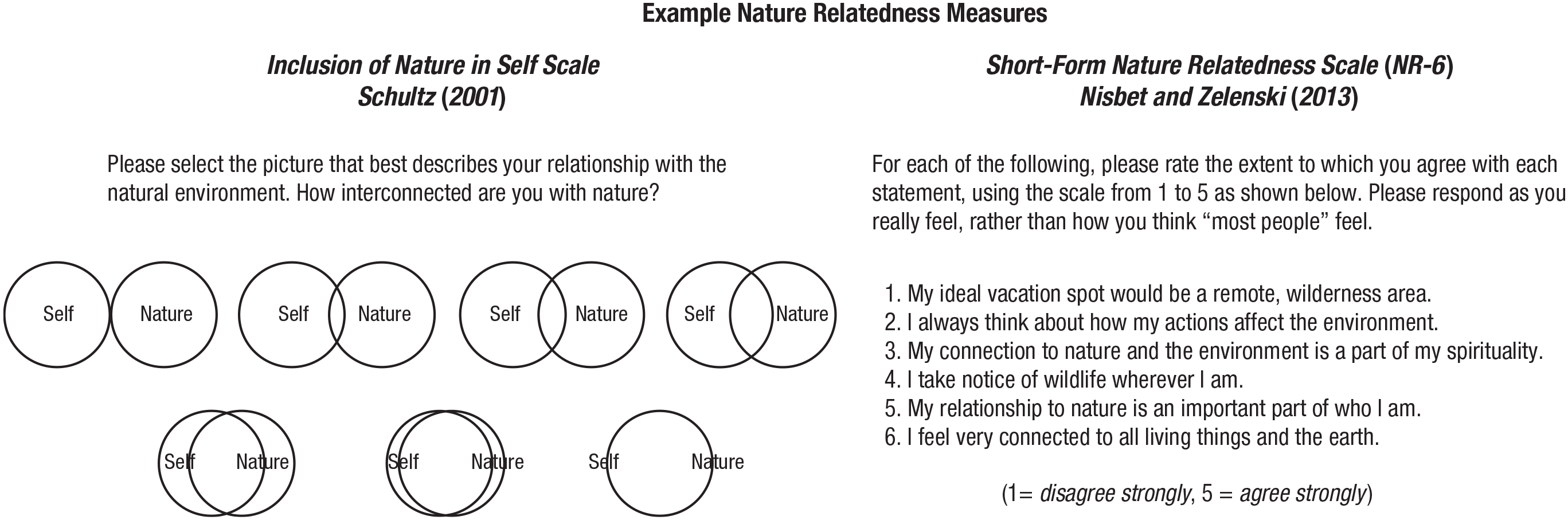
Example nature relatedness measures. The Inclusion of Nature in Self Scale (left) can be adapted to measure momentary variations by adding the following clarification to the instructions: “How interconnected are you with nature right now?” The short version of the Nature Relatedness Scale (left; cf. 21 items in the full version) is best used to assess a relatively stable sense of a nature-related self-concept.
Most research on nature relatedness has been conducted in economically advantaged societies, yet the concept applies broadly. The basic idea seems universally understood, but a cultural lens may help frame this aspect of the self-concept. Some Western ideas (e.g., human exceptionalism, capitalism) often contrast with more nature-related worldviews in Indigenous traditions. For example, a community-developed measure of Anishnaabe Indigenous Identity includes items about local medicines, harvesting, crafting, language, and culture, and it correlates strongly with nature relatedness (Mamaweswen Niigaaniin & MacNeill, 2022). More comprehensively, the 2021 Gallup World Poll asked “How often do you feel emotionally connected to nature?” in representative samples of most nations. Nature relatedness was nearly universally understood, with only 1.2% refusing to answer or indicating that they “don’t know” (Passmore et al., 2023). Moreover, 71% of people answered “always” or “often,” suggesting that most people see themselves as quite connected, although with substantial variation within nations and across national averages (see Fig. 2). The poll also revealed positive correlations between nature relatedness and well-being indicators in most nations (sustainability was not assessed).
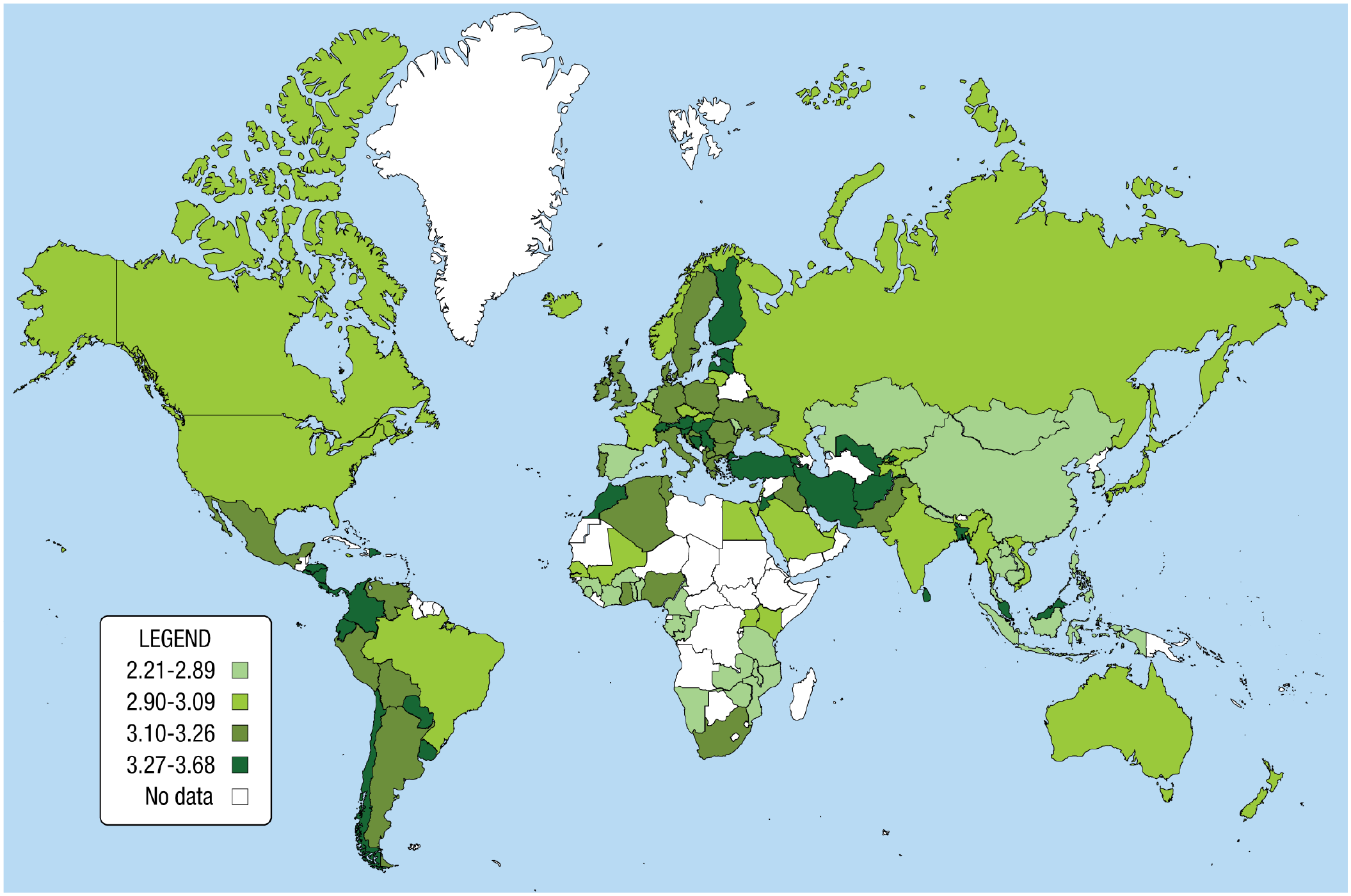
Average levels of nature relatedness by nation. The colors represent quartiles of national averages from the item “How often do you feel emotionally connected to nature?” from the 2021 Gallup World Poll. Darker colors represent higher scores, and the numbers correspond to averages on a scale from 1 to 4 (1 = never, 2 = rarely, 3 = often, and 4 = always). No data are available for nations without color, and missing data were more prevalent than in most previous years because of pragmatic challenges from the continuing COVID-19 pandemic. Adapted from Passmore et al. (2023).
We speculate that nature relatedness may be salient as an individual difference in some contemporary societies because it is declining. Recent systematic reviews have lamented the limited data available yet cautiously concluded that experience with nature and subjective nature connections seem to be decreasing in many (not all) places, and with better data in wealthy, industrialized societies (Cazalis et al., 2023; Soga & Gaston, 2023). For example, people increasingly live in cities with less access to healthy and varied nature, and nature themes are decreasing in cultural products such as songs, books, and films—including those aimed at children—over recent decades. Apart from trends over time, people in many developed nations now spend very little time outdoors or in nature (e.g., MacKerron & Mourato, 2013). Limited experience with nature likely impairs subjective connections, and it may also explain why people tend to underestimate how much of a mood boost will result from a short nature walk when forecasting mood before the walk (Nisbet & Zelenski, 2011).
Nature Relatedness and the Happy Path to Sustainability
Much research on nature relatedness is guided by the idea that it promotes a “happy path to sustainability” that goes through nature. That is, spending time in nature fosters happiness and subjective connections, and strong connections promote care that is expressed as proenvironmental behavior, which in turn further strengthens the subjective connections and motivates more time spent in nature. These are cyclical processes that unfold over time, and a single study cannot confirm them all. Nonetheless, narrower studies across the social and biological sciences largely support the guiding ideas. Again, nature exposure produces happiness, and nature relatedness is linked to both happiness and sustainability. Meta-analyses that combine the results of many studies find strong correlations between sustainable behaviors and nature relatedness, and experiments that manipulate state nature relatedness show a small positive average effect on sustainability (MacKay & Schmitt, 2019). Across studies, sustainable behaviors range from broad self-reports of behaviors and future intentions (e.g., avoiding flights, purchasing recycled goods, political activism) to laboratory observation and simulations (e.g., volunteering for a river cleanup, fishing sustainably in a virtual ocean). Although momentary and longer term nature relatedness may differ, the experiments argue for a plausible causal path from nature relatedness to sustainability. Nonetheless, a limitation of many experiments is that they attempt to boost momentary nature relatedness via exposure to nature, and it is possible that nature exposure itself produces proenvironmental inclinations independent of subjective connections per se (e.g., via good moods, or concern for natural beauty, even if not feeling connected). On the other hand, as an individual difference nature relatedness predicts some sustainable behaviors even after accounting for proenvironmental attitudes, suggesting that the unique element of subjective closeness with nature may prompt extra motivation and enduring biospheric values (i.e., to protecting nature for its own sake; Martin & Czellar, 2017).
Many proenvironmental behaviors are correlated positively with happiness (e.g., Krumm, 2024), contrary to framings by some politicians and corporations that emphasize the costs of sustainable choices. Nature relatedness may help explain this link because meta-analyses also suggest robust, yet modestly sized, positive links between nature relatedness and well-being in both children and adults (Barrable et al., in press; Pritchard et al., 2020). Still, the causality could work in either direction. That is, it may be that nature-related people are happier (e.g., because of time spent in nature) and adopt more proenvironmental behaviors because they care about the environment; nature relatedness may be the common cause of both happiness and sustainability. Alternatively, perhaps proenvironmental behaviors promote happiness (prosocial behaviors often do), and by adopting more proenvironmental behaviors, highly nature-related people reap happiness benefits.
In any case, the positive links between nature relatedness and well-being span many indicators. Specific measures include the components of subjective well-being (life satisfaction and positive emotional balance) and broader eudaimonic indicators, including autonomy, personal growth, meaning, authenticity, vitality, self-acceptance, and so on (Pritchard et al., 2020). Given the conceptual overlap between nature relatedness and social connections, we wondered whether the well-being links might be spurious, driven by the clear link between good social relationships and well-being. However, nature relatedness predicts well-being even after statistically controlling for bonds with friends and family, country and culture, and common social measures such as loneliness, belongingness, and attachment styles (Passmore et al., 2023; Zelenski & Nisbet, 2014).
Other proenvironmental constructs range from relatively neutral beliefs about the importance of environmental protection to unpleasant eco-emotions (e.g., anxiety, anger, guilt) that can cause impairment at high levels. Because they are often negatively correlated (or uncorrelated) with happiness, eco-anxiety and proenvironmental attitudes do not seem like plausible alternative explanations for the links between happiness and nature relatedness. Rather, unpleasant eco-emotions may work against well-being for highly nature-related people, diminishing what might otherwise be a stronger positive link (e.g., if the natural environment was unthreatened). Said another way, nature relatedness paradoxically correlates positively with both eco-anxiety and general well-being; this may be akin to the mixed distress and warmth of being in a close relationship with a person who is unwell. On balance, it seems that highly nature-related people do things to overcome unpleasant eco-emotions because general well-being remains high. We speculate that their tendencies to spend time in nature and act sustainably may boost positive emotions and help nature-related people actively cope with unpleasant eco-emotions (Lutz et al., 2023).
Determining the causal direction between nature relatedness and happiness is difficult because experiments often use nature exposure to manipulate state nature relatedness (Sheffield et al., 2022). Nature exposure typically causes pleasant moods. Therefore, experiments remain ambiguous about whether state nature relatedness causes better moods, good moods cause relatedness, or both are distinct, simultaneous consequences of nature exposure. Additionally, many experiments are brief, whereas meaningful changes in happiness and sustainability need to be long term and likely require more intensive intervention. Fortunately, some research has taken a longer view by considering sources of nature relatedness and applications aimed at increasing it.
Fostering Nature Relatedness, Happiness, and Sustainability
The roots of nature relatedness often develop in childhood via positive nature experiences. Despite cultural trends that work against connection, many nature-related parents and organizations provide pleasant and educational nature experiences that promote nature relatedness. Chawla’s (2020) review of techniques suggests, for example, directly immersing children in nature at their own pace, providing a variety of ways to interact with nature (e.g., via art, gardening, observing and recording, caring for animals), and encouraging nature experiences that prompt curiosity, empathy, care, understanding, challenge, and enjoyment. Although nature relatedness tends to dip during adolescence, early nature experiences are often recalled as a source of adult connection. A rare longitudinal study found that children who spent more time outdoors at age 6 increased their proenvironmental behavior over the next 12 years, as did those who had mothers with proenvironmental attitudes (Evans et al., 2018). Nonetheless, a nature-deprived childhood does not preclude developing a strong connection later. For example, a study of Australian adults found that the amount of current nature contact predicted higher nature relatedness regardless of recalled childhood nature experiences, which also positively and independently predicted higher nature relatedness (Cleary et al., 2020).
Most efforts to increase nature relatedness across lab experiments, longer term interventions, and nature-informed therapies use contact with nature. Still, this includes a wide variety of contexts and techniques that vary in effectiveness (Lengieza & Swim, 2021; Sheffield et al., 2022). Physical contact with nature includes wilderness vacations, rural areas, urban parks and gardens, house plants, pets, and noticing things such as birds, water, or vegetation almost anywhere. Zoos and aquariums typically provide educational content along with nature contact. Environmental education may increase nature relatedness, be it via forest schools in nature or in traditional classrooms that provide only virtual representations. More generally, virtual nature can increase nature relatedness, yet most comparisons suggest weaker effects than physical-nature contact (Lengieza & Swim, 2021; Mayer et al., 2009). Future research may discover which natural environments are more conducive to boosting relatedness, yet it is likely more important how people interact with nature.
Nature often prompts interest, fascination, and engagement, yet intentional efforts can boost its effects on relatedness and mood. For example, students assigned to walk across campus outdoors (park-like setting) reported higher state nature relatedness than others assigned indoor walks (via tunnels); still, adding mindfulness prompts to the outdoor walks further increased state nature relatedness (Nisbet et al., 2019). Similarly, asking people to reflect on emotions, meaning, and compassion during nature walks produced more nature relatedness than walks without prompts (Lumber et al., 2017). Beyond momentary effects, 2-week intervention studies that ask participants to write about emotionally evocative elements in nature have found higher well-being and connection (broadly, e.g., to nature, other people, the universe, etc.) compared with control groups, even when participants did not report spending more time in nature (e.g., Passmore et al., 2022). Other approaches, such as guided imagery and meditation, have produced increases in nature relatedness with minimal or merely imagined nature exposure. For example, with a single photo to indicate a natural environment, participants who reflected on a meaningful, growth, or fun future experience reported more state nature relatedness than others randomly assigned to reflect on how the experience would be planned; the meaning and growth prompts were particularly effective (Lengieza, 2024). In sum, even without (much) nature contact, taking an intentional approach to mental immersion, savoring, appreciating, and enjoying nature seems to facilitate a sense of nature relatedness.
Some nonprofit nature initiatives have succeeded by recommending nature activities and increased contact. For example, the David Suzuki Foundation’s 30 × 30 Nature Challenge in Canada asks people to spend 30 min in nature daily for 30 days, similar to the Wildlife Trusts’ 30 Days Wild program in the United Kingdom that omits a time recommendation. Assessments of these initiatives suggest that nature relatedness, well-being, environmental concern, and conservation behaviors (e.g., growing bird- and insect-friendly plants, volunteering) all increase over the month (e.g., Nisbet, 2015; Richardson et al., 2016). The programs do not have control groups and include self-selected participants; still, they suggest that simple instructions may be enough to encourage some people down the happy path to sustainability.
Looking Forward
We have argued that increasing nature relatedness can foster well-being and sustainability. Although research supports this idea, caution is warranted. Regarding well-being, the benefits of nature relatedness currently outweigh the likely costs (e.g., eco-anxiety), yet this balance may shift if environmental problems worsen. Additionally, solving environmental problems will clearly require systemic changes beyond the capabilities of any individual. Behaving in environmentally friendly ways requires opportunity (e.g., efficient products and transportation infrastructure) and can be hindered by barriers and collectively determined social norms. Some environmental challenges may be best addressed by policy (e.g., carbon taxes or private-sector incentives). Nonetheless, we argue that more nature-related communities will help press for these systemic changes.
Future research on nature relatedness can improve on existing work (see Tiscareno-Osorno et al., 2023). Increasing the diversity of participants will help determine the useful breadth of our suggestions, and deeper explorations of possible culture-specific conceptualizations of nature relatedness could suggest the value of either many nuanced measures or a single consensus definition. Additionally, better understanding the reasons for national differences in nature relatedness (see Fig. 2) may also help reveal previously overlooked sources that could be targeted in new interventions or policies. Clarifying which findings apply to short-term variations or long-term tendencies (only) is also important, and momentary nature relatedness measures lack formal validation. The most useful applications will promote nature relatedness that persist over time, yet longitudinal studies are rare. There are challenges in determining appropriate control conditions, and the lack of large, preregistered, randomized controlled trials remains a clear gap. Caution is warranted in translating results from short-term experiments to more enduring change, and for both successes and failures. Even when immediate effects are elusive, it remains possible that repeated experiences accrete into enduring self-concept changes that could foster well-being and sustainability. We also encourage creativity in developing new techniques. For example, our ongoing research suggests that the character strengths of appreciation of beauty and love of learning may combine well with a compassionate approach to nature. Additionally, many nonprofits and practitioners are already promoting nature relatedness with promising techniques ripe for formal assessment. Finally, research might explore which features of natural spaces are most conducive to developing nature relatedness and whether they are best experienced alone or with others given trade-offs between feeling safe and ease of contemplation. Even with these gaps, we already see strong potential for nature relatedness to help with the pressing issues of well-being and environmental sustainability.
Recommended Reading
Bodnar, S. (2023). Introduction to the special issue: A collaborative definition of ecotherapy. Ecopsychology, 15(3), 206–213. https://doi.org/10.1089/eco.2023.0022. Introduces a special issue with articles about using nature in psychotherapy and using psychotherapy to mend strained human-nature relationships.
Chawla (2020). (See References). Covers quantitative and qualitative work on children’s connections with nature and coping with environmental problems.
Lengieza and Swim (2021). (See References). Focuses on paths to nature relatedness that span individual differences, situational contexts, and internal states.
Nisbet et al. (2009). (See References). Describes the theoretical background of nature relatedness, defines the construct, and introduces a questionnaire measure.
Tam, K.-P. (2013). Concepts and measures related to connection to nature: Similarities and differences. Journal of Environmental Psychology, 34, 64–78. https://doi.org/10.1016/j.jenvp.2013.01.004. Reviews multiple measures of nature relatedness and compares their predictive power in empirical studies.
