



Abstract
Environments shape people, and at the same time, people are attracted to environments that fit their characteristics because fit facilitates the achievement of people’s desired life outcomes, such as relationship satisfaction, work success, and well-being. In this article, we outline how persons and environments can fit, the relevance of fit and misfit for different life outcomes, and the benefits and pitfalls of different (mis)fit measures. We propose three directions for future research: (a) the use of both subjective and objective (mis)fit measures; (b) the consideration of complex dynamics between person and environment characteristics via pathways through multiple biological, experiential, behavioral, and social layers across the life span; and (c) the integration of insights from different disciplines, including psychology, sociology, neuroscience, and genetics, to move the field forward.
Keywords
People seek out or create environments that fit their characteristics because fit facilitates the fulfillment of basic needs and the achievement of desired life outcomes (Van Vianen, 2018). For example, people’s career success depends not only on their individual characteristics but also on the characteristics of the job that should ideally fit their personality, interests, and skills (e.g., Denissen et al., 2018). Similarly, leisure activities positively affect well-being, in particular when they fit a person’s interest profile, whereas leisure activities that do not fit a person’s interests can even have detrimental effects on their well-being (Schulz et al., 2018). Overall, there is growing evidence that, beyond the main effects of person and environmental characteristics, the fit between persons and environments plays a critical role in predicting relevant outcomes in virtually all life domains. In this article, we review the literature on person-environment fit, discuss challenges in measuring fit, and offer directions for future interdisciplinary research on this topic.
How can Persons and Environments Fit?
Person-environment fit (PE fit) has been defined and measured in several ways (Rauthmann, 2021). In this review, we focus on an outcome-based definition of PE fit as the optimal compatibility between individuals and their outer world as a key factor in facilitating desired outcomes (e.g., work success and satisfaction, social reputation and integration, physical and mental health). This definition of PE fit includes the compatibility between specific personal characteristics (e.g., a specific trait, skill, or disorder) and various aspects of the environment (e.g., physical, social, or cultural). It also includes the compatibility between constellations of personal characteristics (e.g., an individual’s personality trait profile) and the environment (e.g., the partner’s personality trait profile). The environment contains several transient, constant, and recurring aspects of the surrounding world that interact with an individual’s characteristics to give rise to certain behaviors and outcomes. These environmental aspects can be, for example, other individuals, immediate situational stimuli, or the physical living conditions and broader societal or cultural contexts.
There are different types of PE fit. First, supplementary fit, or person-environment congruence, refers to a type of fit where personal and environmental characteristics are similar. For instance, romantic partners who share certain personality characteristics have been hypothesized to be more satisfied in their relationships and stay together (“birds of a feather flock together”). Some studies indeed reported that partners who were more congruent in certain traits were less likely to separate (e.g., Rammstedt et al., 2013), whereas evidence for congruence effects on relationship satisfaction has been more mixed (van Scheppingen et al., 2019; Weidmann et al., 2023). Notably, studies that focused on strict congruence effects (i.e., only congruence predicts; shown in Fig. 1a) may have underestimated potential fit effects in the presence of main effects of the person and (or) environment (Humberg et al., 2019). For example, Weidmann et al. (2023) found significant congruence effects of spouses’ open-mindedness on relationship satisfaction when modeled with the positive main effects of each spouse’s open-mindedness score (see Fig. 1b).
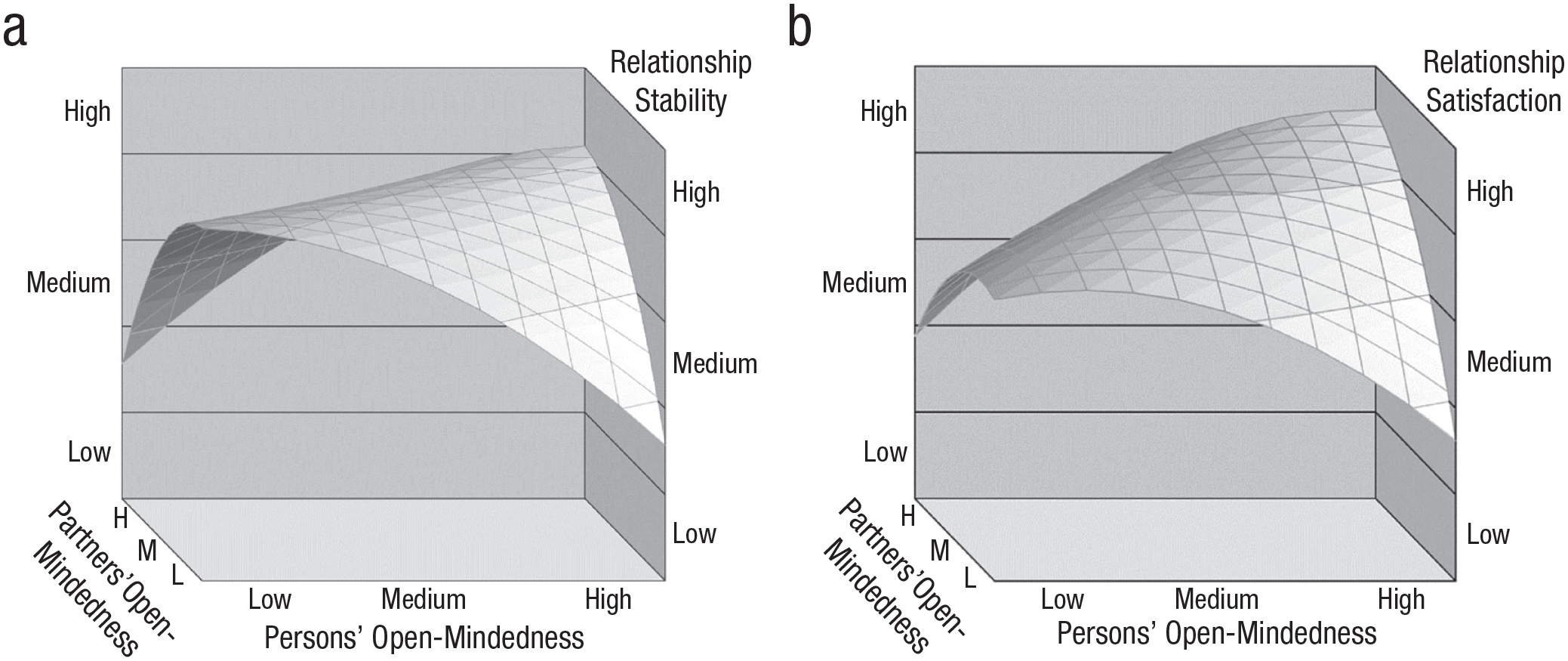
Surface plots demonstrating examples of fit-outcome relationships: higher outcome levels (here, relationship quality and satisfaction) when personal(ity) traits and environmental characteristics are congruent (here, partners’ open-mindedness). Response surface plotting from http://public.kenan-flagler.unc.edu/faculty/edwardsj/: Figure 1a exemplifies strict congruence effects of partners’ open-mindedness on relationship stability, whereas empirical polynomial regression parameters for Figure 1b are taken from Weidmann et al.’s (2023) Supplementary Tables 5 and 6 (bX = .082, bY = .124, bX2 = –.075, bX*Y = .118, and bY2 = –.057).
Second, complementary PE fit refers to a type of fit where personal and environmental characteristics are opposite but compatible (“opposites attract”). For example, a submissive partner may be more attracted to a dominant partner and vice versa (Jozifkova, 2018). There appears to be substantial variation in correlations between partners across characteristics (Horwitz et al., 2023). Multiple traits may be both complementarily and supplementarily relevant for mate choice, relationship satisfaction and stability, and reproductive success. Moreover, a fit in certain relevant variables may compensate for potential misfits in other domains and vice versa. This may result in substantial fit variance and accounts for small normative and not particularly robust associations between partners’ (dis)similarity in specific characteristics and their relationship quality in previous research.
The Dynamic Nature of Person-Environment Fit
PE fit is not static but malleable to the degree that personal and environmental characteristics change over time (Vleugels et al., 2023). The dynamic nature of PE fit has important implications for people’s attempts to create and maintain fit. Specifically, it suggests that people can strive to achieve or improve fit, but it also implies that PE fit has to be continuously restored or renewed over time. As such, changing conditions of the environment and the active and self-determined role of individuals have to be considered in understanding PE fit as a product of fitting processes.
There are at least three mechanisms of how PE fit can arise. Kandler and Rauthmann (2022) described these as tendencies to sort into or evoke better-fitting environments and avoid nonfitting ones (attraction), create new or modify existing environments to facilitate fit (construction), and react in accordance with or adjust to environmental demands to increase fit (conformation; see Fig. 2). For the fit of a couple’s characteristics, for instance, attraction seems to be a more relevant mechanism than conformation for relationship stability (Rammstedt et al., 2013). These three mechanisms coexist and appear similarly relevant for nonhuman species and organisms (Trappes et al., 2022). They can account for stability and change in individuals’ traits and characteristics of their environments.
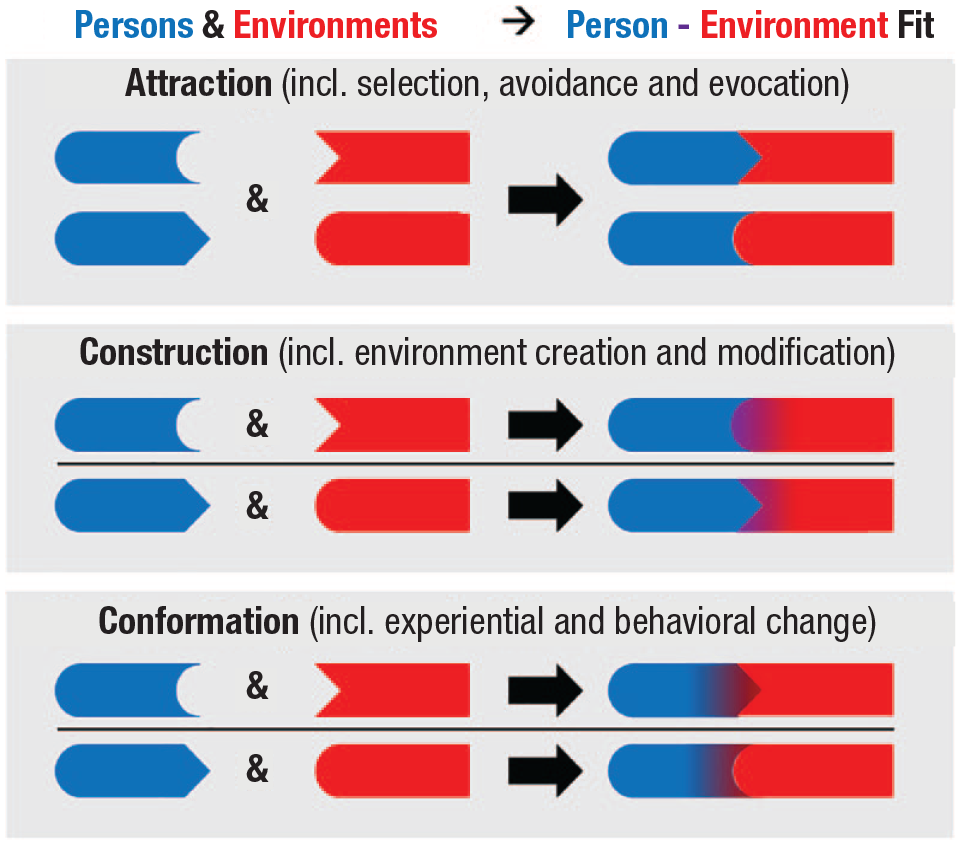
Core mechanisms of how person-environment fit emerges: attraction refers to the sorting into fitting environments, construction refers to the creation or modulation of environments, and conformation refers to the adjusting to environments.
Relevance of Person-Environment Fit and Misfit
As we have outlined, the fit between specific characteristics in couples can have positive consequences (e.g., relationship satisfaction and reproductive success), whereas misfit can lead to separation. The effects of PE fit extend well beyond the relationship domain. For instance, there is a broad literature on the role of PE fit in the work domain. A review by Van Vianen (2018) showed that PE fit in the work context predicts career outcomes (e.g., job success and satisfaction) in addition to person and environment components (e.g., job qualifications and demands). Moreover, particularly desirable outcomes were achieved when both PE fit and the relevant personal attributes were high (“gain fit” in Fig. 3). Finally, this review also showed that person-environment misfit (PE misfit) reduced desired outcomes (“nongain misfit”), with more detrimental effects for individuals with lower levels on the relevant personal characteristics (“loss misfit”).
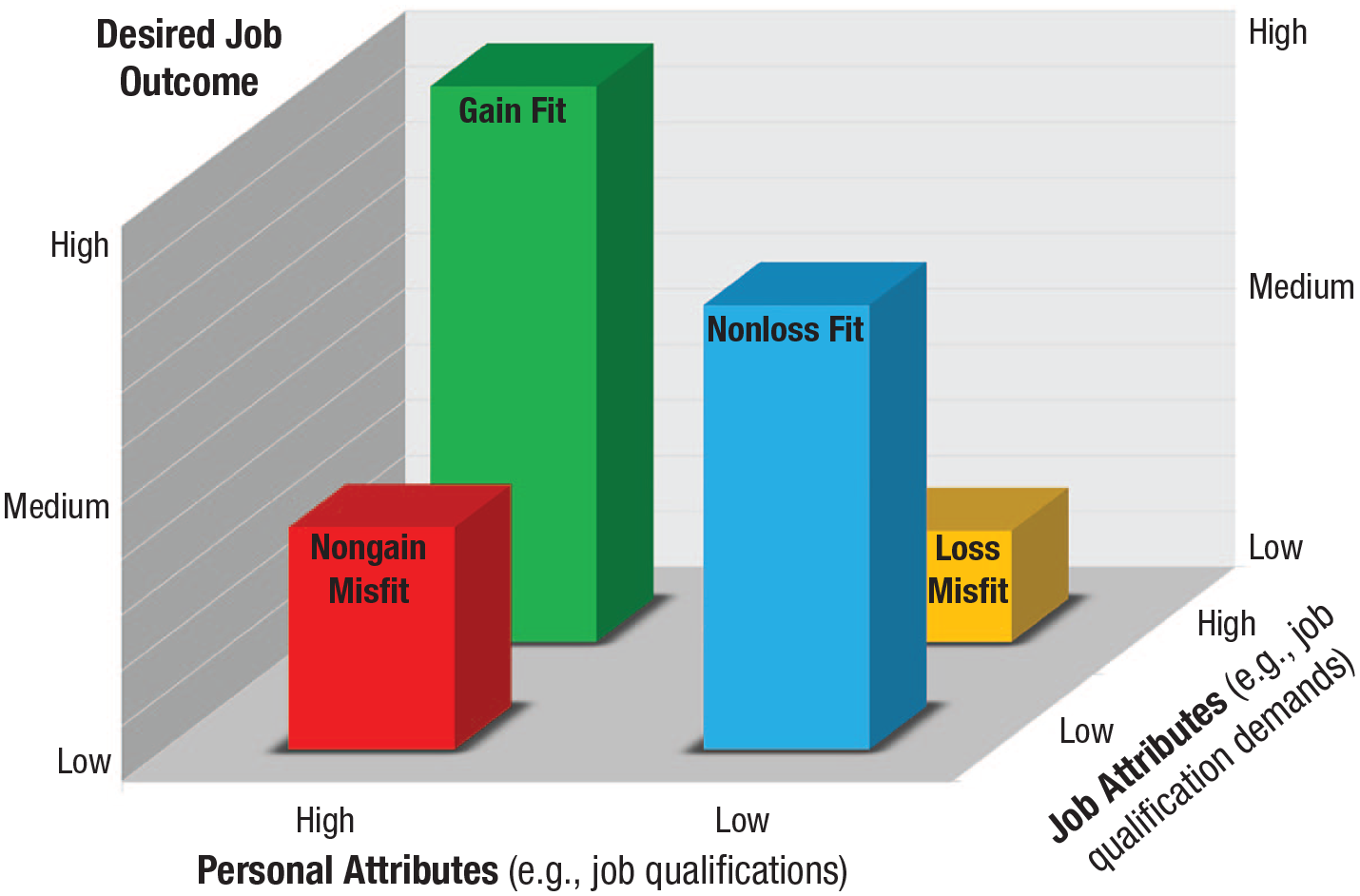
Bar chart demonstrating desired job outcomes for different person-job fit and misfit constellations based on the review by Van Vianen (2018).
There is also growing evidence for the effects of fit between persons and their extended living environments, including people’s residential or broader cultural context (e.g., Gebauer et al., 2020). For example, Jokela et al. (2015) found that people who lived in neighborhoods that matched their personality traits reported higher life satisfaction than those in nonmatching environments.
While PE fit seems relevant for several positive outcomes, such as job success and satisfaction with life and social relationships, PE misfit can predict negative consequences. It can lead to psychological strain (e.g., dissatisfaction, worrying, restlessness, mental disorders), physical strain (e.g., elevated blood pressure, gastrointestinal problems), and behavioral strain (e.g., health risk behaviors), which can increase morbidity and mortality risk (Edwards & Cooper, 2013). Moreover, dysfunctional fitting mechanisms can lead to dysfunctional congruence in terms of supplementary misfits, with negative consequences for individuals. Specifically, maladaptive thoughts, feelings, motives, and behaviors that do not fit relevant environmental conditions and opportunities can increase the risk for psychopathological symptoms (Hopwood et al., 2022). For example, people with high levels of neuroticism (i.e., emotional lability) may view themselves and the world more negatively, thereby perceiving and evoking more negative reactions from their environments, which may, in turn, exacerbate their negative feelings and increase their risk for depressive symptoms (Kandler & Ostendorf, 2016).
However, misfit or the subjective perception of misfit does not inevitably lead to negative consequences. Misfit may signal discomfort, potentially putting individuals into a state of alertness, whereas fit may generally not be salient to individuals (Vleugels et al., 2023). The experience of misfit may force people to modify and change their environmental or personal characteristics to increase or restore PE fit. In that sense, the subjective monitoring of PE misfit may serve as an essential self-regulatory mechanism to attain and stabilize fit, which may, in turn, entail higher person-to-environment adjustment and well-being (Rauthmann, 2021).
Benefits and Pitfalls of Different (Mis)Fit Measures
The psychological relevance of PE misfit monitoring calls for direct measurements of perceived PE misfit over time. This repeated self-report measure, in addition to and independent of person and environment measures, may help researchers to examine the situational dynamics of when, under which conditions, and why misfit perceptions arise and how long they are tolerated before reaching a threshold for a need of action to restore fit. Such a measure requires a conscious reflection on misfit as perceived lack of fit, deviation from fit, or simply mismatch perception without reference to fit. A challenge in developing valid subjective self-report measures is that a person’s characteristics are inextricably interwoven with subjective measures of misfit. For example, a negatively perceived fit may reflect a person’s negative emotionality rather than objective fit characteristics (Kandler & Ostendorf, 2016). That is, misfit perceptions may be biased and confounded with personal(ity) characteristics and with a desired outcome and, as such, reflect people’s general satisfaction with their environment (Edwards et al., 2006). These limitations must be considered when attempting to quantify persons’ perceived PE (mis)fit.
An alternative to individual evaluations of PE (mis)fit is to measure the difference between personal and environmental characteristics, expressed as difference scores, profile similarities, or polynomial regressions with response surface plot analyses (Humberg et al., 2019; Rauthmann, 2021; see also Fig. 1). Studies using these indirect fit measures found that (in)congruence between people’s perceived personal and environmental characteristics predicts several important life outcomes. For example, the supplementary fit of perceived academic demands and self-rated abilities explains academic success and study satisfaction better than perceived abilities alone (Bohndick et al., 2018). However, this strategy is not without limitations. People’s subjective assessments of their personal characteristics can be biased because of, for instance, impression management, self-deception, or different response styles. Similarly, subjective ratings of environmental conditions and situational circumstances may be filtered by a person’s psychological interpretation (e.g., valence, controllability, importance, and predictability). To the degree that subjective assessments of personal and environmental characteristics are biased or confounded, they may produce over- or underestimations of actual PE (mis)fit.
Studies using other data sources beyond or in addition to self-reports are needed to better distinguish between the person and the environment in measures of PE (mis)fit (Rauthmann & Sherman, 2023). Disentangling a person’s characteristic empirically from measures of this characteristic in different contexts (adaptations) and situations (states) on the basis of repeatedly captured multiple data sources (e.g., self-reports, informant reports, observations, and tests) may be one way to identify a valid characteristic of the person (trait) to approach valid assessments of PE (mis)fit (Kandler & Rauthmann, 2022).
Assessing the genetic constitution of an individual for a measured characteristic could be another valuable strategy. In recent years, molecular genetic studies, particularly genome-wide association studies, have identified thousands of genetic factors that vary among humans and are significantly associated with personal characteristics and life outcomes (e.g., Okbay et al., 2022). As each of these (common) genetic variants typically has only a small effect on complex personal characteristics, sets of genetic variants can be combined into so-called polygenic scores (PGS) to explain a larger proportion of variance in these characteristics than single genetic variants (Lewis & Vassos, 2020). PGS can be used as additional, individual predictors in PE fit research. For the use of PGS in that way, it is important to note that environmental confounding of PGS should be considered and that the accuracy and generalizability of any PGS need to be validated across multiple data sources (Burt, 2023). Similarly, physiological measures, such as magnetic resonance imaging of brain activity and structures (Sudimac et al., 2022), could be used as more objective measures of personal characteristics in measures of actual PE fit.
Individual differences in experienced environments, such as intra- and extrafamilial contexts, are also influenced to some degree by genetic factors and thus confounded with person differences, such as personality traits or psychopathology (Kandler et al., 2021; Mönkediek, Schober, et al., 2023). To reduce the confounding effects of personal characteristics, researchers have begun to assess environmental variables through multiple perspectives (Zapko-Willmes et al., 2018). A second strategy involves focusing on environmental variables less confounded with people’s subjective perception, such as people’s residential location characteristics (Jokela et al., 2015). Geographic information system (GIS) data extracted from addresses (Kühn et al., 2017) and data obtained from geographical ecological momentary assessments (GEMA) based on the locations that individuals spend time in over the day (Kirchner & Shiffman, 2016) have emerged as more objective measures of the environment, which can be used in more objective PE (mis)fit measures.
Person-Environment Interplay and Fitting Processes
Even with objective measures, personal and environmental characteristics are interwoven and depend on each other in complex ways. Individuals tend to select themselves into, evoke, or create environments that (complementarily or supplementarily) fit their genetic predispositions and avoid those that do not fit, and they can modify environments or change themselves to increase fit (Fig. 2). It is to be expected not only that individuals with different genetic predispositions find themselves in different environments but also that these environments, in turn, reinforce the effects of initial genetic differences. The latter reflects a dynamic interplay (i.e., transaction) between genetic and environmental factors that could explain why personal(ity) differences increase from childhood to adulthood, because as children grow, they gain more and more autonomy, with increasing opportunities to actively shape and regulate their own development (Kandler et al., 2019, 2021).
The selection of fitting environments, the avoidance of nonfitting environments, or the creation, modification, and modulation of environments to increase fit are possible only when there are environments to choose from or opportunities to change environments (Trappes et al., 2022). For example, the optimal expression of the same genetic predispositions of individuals (e.g., personality traits or cognitive abilities) in their environments depends on the extent to which these environments limit expression or allow for adaptation and individual unfolding (Gottschling et al., 2019; Kandler et al., 2019; Mönkediek, Diewald, et al., 2023). When opportunities are limited, or when individuals do not see options of choice or construction of environments, they may adjust their characteristics to their prevalent environment to maintain fit.
Particularly in adulthood, social demands may set strong normative standards for certain patterns of thoughts, feelings, and behaviors in normative life contexts, such as doing a good job or being a good partner, parent, or neighbor. These standards may lead to increased conformation and thus account for mean-level trends toward social desirability. This adjustment tendency to social demands, on the one hand, and the tendency toward self-expression by picking and constructing fitting niches, on the other hand, may counterbalance each other and could result in the well-known finding that individual differences stabilize in adulthood (Bleidorn et al., 2022; Kandler & Rauthmann, 2022). However, this has yet to be examined.
Future Directions for Person-Environment (Mis)Fit Research
In this review, we discussed only a few relevant examples of the effects of PE (mis)fit on individual outcomes. Despite its broad relevance, no consensus exists regarding the conceptualization and measurement of PE (mis)fit. Existing measures suffer from different limitations and typically do not account for the fact that people and their environments can interact and transact in complex ways over time. Accordingly, we close this article with three recommendations for future research.
First, the combination of subjective and objective PE (mis)fit measures promises several benefits over existing measures. For instance, Edwards and colleagues (2006) outlined different approaches to investigate the subjective experience of PE fit. Each of them can be differently relevant for individuals’ desired life outcomes. As subjective fit may not necessarily represent actual PE (mis)fit, studies should also use more objective fit measures. These measures might include the person’s genetic makeup and measures of environments unbiased by the individuals’ personal views, such as GIS and GEMA data. Both objective and subjective measures and their deviations may be relevant in their own particular way to predict life outcomes.
Second, future PE (mis)fit research should consider the dynamics and dependencies of persons and environments via multiple pathways through multiple layers, ranging from the molecular microlevel (i.e., the genome) via physiological, behavioral, and experiential layers to the environmental macrolevel (e.g., culture) and back (see Fig. 4). From the bottom up, genetic differences may expose people to certain environments via physiological and behavioral differences, which may, in turn, shape their thoughts, feelings, and motivations (Kandler et al., 2021). From the top down, recent studies have identified signatures of environmental factors on the molecular epigenetic layer (e.g., Czamara et al., 2021). These epigenetic change patterns are mainly driven by combined effects and interactions of genetic factors and individuals’ environments. The signatures and consequences can be studied as specific kinds of PE (mis)fit, for example, in polynomial regressions with response surface plot analyses. Although individual (including genetic, physiological, experiential, and behavioral) and environmental (including physical, social, and cultural) factors are multifaceted, multilayered, complexly interwoven, and thus hard to disentangle, it is crucial to understand their functional as well as dysfunctional interplay, which can foster or hinder desired life outcomes (Hopwood et al., 2022; Kandler & Rauthmann, 2022). For this purpose, different fit mechanisms (see Fig. 2) should be investigated together with environmental constraints, individual resources, and developmental phases of persons over the life span.
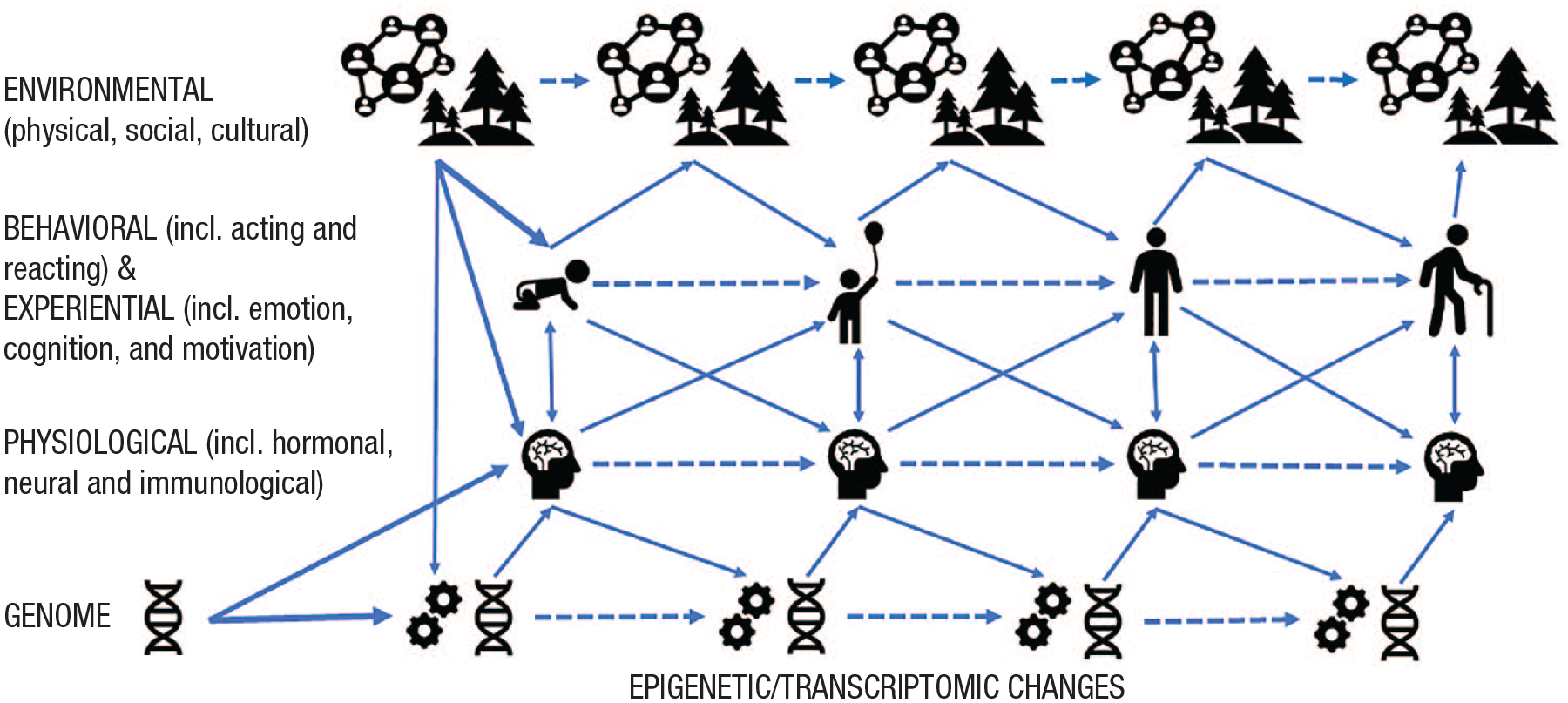
A multilayered pathway model of multiple person-environment interplays underlying potential fitting mechanisms across the life span.
Third, research on PE (mis)fit would benefit from an interdisciplinary perspective. Different psychological subdisciplines, such as educational, organizational, or personality psychology, have investigated PE (mis)fit in a rather parallel and independent manner. However, PE (mis)fit research from different fields can enrich each other. Moreover, we argue that the psychological view can benefit immensely from adding genetic, neurological, and sociological perspectives. Unraveling the multilayered dynamics between individuals and their environment across the life span and how these affect individual life outcomes requires experts from several different disciplines to realize genetically informative and environmentally sensitive research designs. It will help to shed light on how PE fit can be optimized by considering physical, psychological, and social (re)sources to foster people’s well-being and quality of life in different life areas, addressing several sustainable development goals of the United Nations (https://sdgs.un.org/goals).
Recommended Reading
Kandler, C., & Rauthmann, J. F. (2022). (See References). A theoretical paper providing formally defined characteristics of persons, environments, and person-environment units as central elements of studying person(ality)-environment fit outlined as most relevant for understanding an individual’s uniqueness.
Sudimac, S., Sale, V., & Kühn, S. (2022). (See References). An empirical example of how more objective measures of the physical environment can affect brain activity and, in consequence, physical and mental health.
Trappes, R., Nematipour, B., Kaiser, M. I., Krohs, U., van Benthem, K. J., Ernst, U. J., Gadau, J., Korsten, P., Kurtz, J., Schielzeth, H., Schmoll, T., & Takola, E. (2022). (See References). A presentation of a conceptual framework that distinguishes three mechanisms of organism-environment fitting as evolved mechanisms.
Van Vianen, A. E. (2018). (See References). A comprehensive and critical review of the basic tenets of fit theory and fit measures in the work context.
Vleugels, W., Verbruggen, M., De Cooman, R., & Billsberry, J. (2023). (See References). A comprehensive and systematic overview of nonstatic workplace person-environment fit research.
Transparency
Action Editor: Robert L. Goldstone
Editor: Robert L. Goldstone
Declaration of Conflicting Interests
The author(s) declared that there were no conflicts of interest with respect to the authorship or the publication of this article.
