



Abstract
Inequality is perpetuated, in part, by the psychological and behavioral tendencies that arise from the social context of inequality. Cognitive biases lead most people to see themselves as middle class, even when that perception does not align with economic reality. Those who perceive themselves as economically advantaged tend to view inequality as fair and legitimate, often dismissing proponents of redistributive solutions as ill-informed. And unequal contexts increase risky behaviors that can be profitable to some but are more likely to be costly for most. This research program suggests an inequality cycle, in which inequality experienced today tends to reproduce itself.
Keywords
It comes as no surprise to most people that poverty is associated with health and social problems, such as shorter life expectancies, higher rates of crime, drug abuse, and mental illness. Indeed, the poorest countries in the world suffer much more from these problems than wealthier nations. But what many find surprising is that, among wealthy developed countries, income inequality is an even stronger predictor of these problems than income per person (Elgar & Aitken, 2011; Subramanian & Kawachi, 2004). Because of this relationship, moderate-income countries such as Spain, Austria, and Italy fare better on these metrics relative to richer but more unequal countries such as the United States and the United Kingdom (for a review, see Pickett & Wilkinson, 2015).
Economic inequality (the size of the gap between the richest and poorest in a society) has continued to grow in advanced economies around the world since the 1970s (Piketty et al., 2018). Given all the negative outcomes associated with high inequality, why do citizens not demand changes toward greater equality (Horowitz et al., 2020)? Our research program suggests that high levels of economic inequality are maintained, in part, by psychological and behavioral processes that tend to keep unequal systems in place. Understanding the psychological reactions people have to inequality helps to make sense of why many people would benefit from reducing inequality but relatively few demand change. Many of those psychological reactions are rooted in social comparison.
Inequality and Social Comparison
People often make social comparisons to judge whether they have enough money, a nice enough car, or a big enough house. These might be measured objectively in dollars, horsepower, or square feet, but there is no metric that can tell us whether what we have is enough. For that, we compare to other people. Classic research on social comparison suggests that whenever standards of evaluation are lacking or ambiguous (as is usually the case for questions of having enough or being good enough), people compare to others to evaluate their own standing (Festinger, 1954).
When we compare to others, we do not do so randomly. Instead, people demonstrate two consistent tendencies in whom they compare with. First, they prefer to compare to others who are similar rather than dissimilar to them because similar others are more informative. Comparisons to similar others are especially likely when people want informative feedback. Second, people tend to compare upward, to those who have more, rather than downward. Upward comparisons can feel aversive, but they can be motivating to work harder and, as we discuss below, to make different kinds of decisions. Upward social comparisons are especially likely in competitive or achievement-related situations. These two tendencies can be in tension because those who have much more than the person making comparisons are likely to be less similar to them. Nonetheless, much research suggests that both tendencies coexist (statistically speaking, they are independent main effects).
The degree of inequality in an environment sets the context in which social comparisons take place. When inequality is high, there is a greater gulf between the targets of upward versus downward comparisons (see Fig. 1). In a society with high income inequality, both kinds of comparisons have important psychological implications for psychological reactions to inequality.
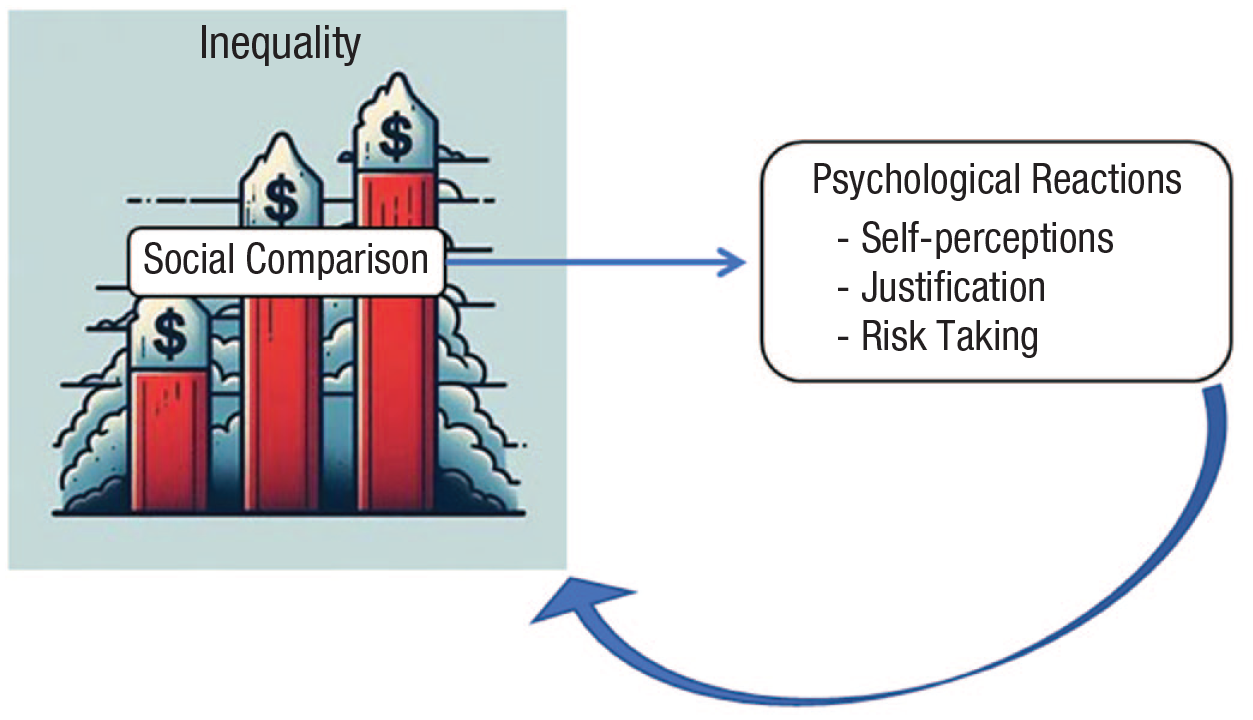
The level of inequality in a social context changes the kinds of social comparisons that people make, which changes how people perceive themselves, justify inequality, and make risky decisions.
The Middle-Class Illusion
What social class would you say you belong to? More than 80% of Americans claim to be middle class; only a small percentage consider themselves to be upper or lower class (Pew Research Center, 2015). The same pattern is found if respondents are asked to subjectively rate their income or socioeconomic status (SES): Ratings form a bell curve, with most people together in the middle and only a small fraction at the upper and lower ends. This pattern is interesting because real income distributions are nothing like bell curves. Most of the income goes to a tiny fraction of the population, whereas the vast majority of earners are clumped together near the bottom of the income distribution. Another interesting finding about subjective perceptions of SES is that they are only weakly correlated with objective indicators such as income and education (Galvan et al., 2023). This means that many people who are objectively relatively wealthy feel poor whereas many people who are objectively poor feel that they are not. Why are subjective perceptions so unlike actual income distributions?
In the General Social Survey, American participants were asked to rate their family income on a scale from “far below average” to “far above average.” When we analyzed these data, we found that results formed a bell curve, with most respondents rating themselves “average” (Jackson & Payne, 2021). When the same participants were asked what their actual family income was in dollars, the results were highly skewed, with a small fraction earning incomes that were many times greater than the median earner (see Fig. 2).
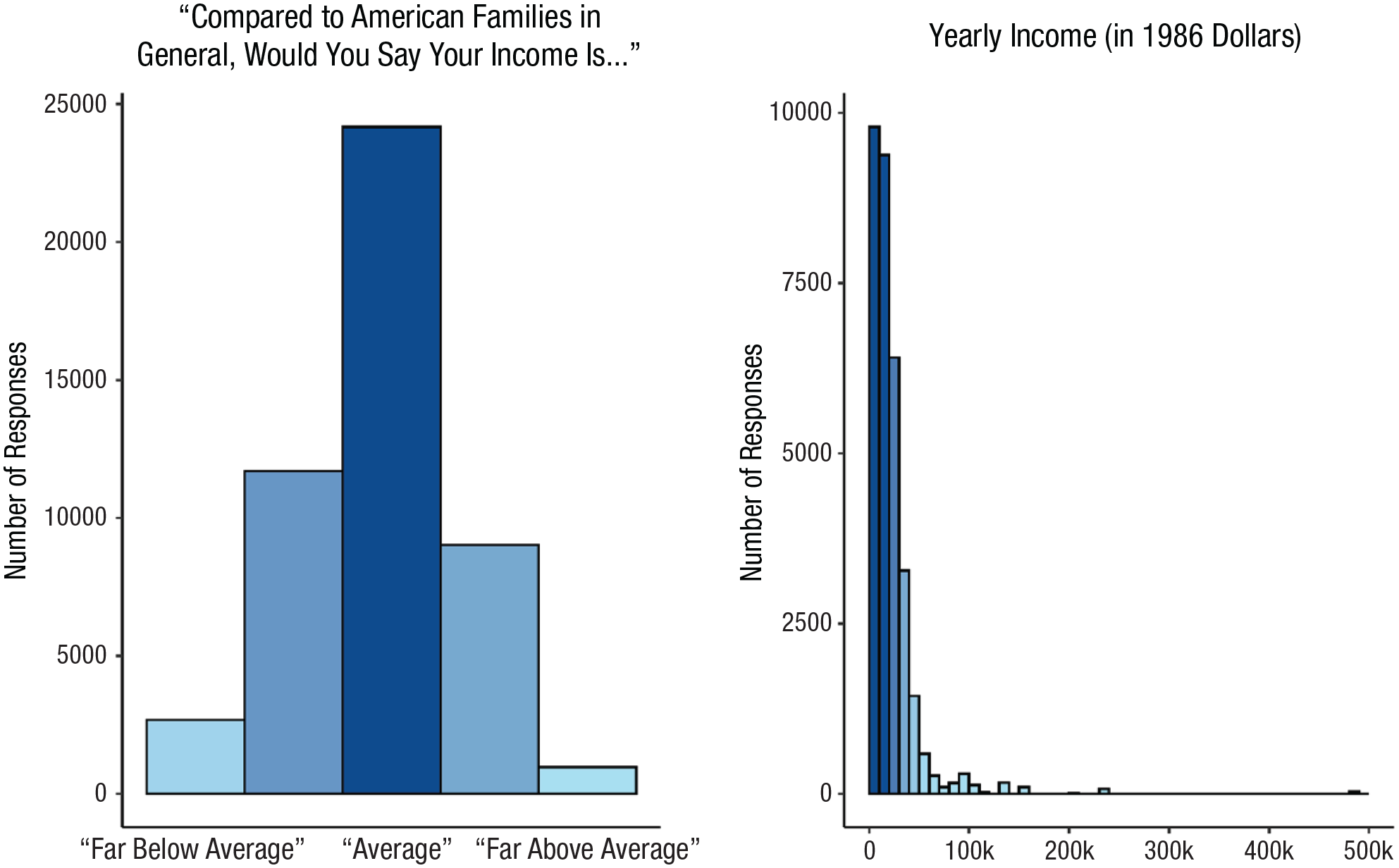
Distributions of subjective (left) and objective (right) income. Source: General Social Survey (N = 53,474).
Our research suggests that this illusion may be driven, in part, by selective social comparisons (Jackson & Payne, 2021). In one experiment, we assigned participants an “income” in the form of points that could be converted into small amounts of real money at the end of the study. Participants were assigned one of three values: a “low” bonus (20,346), a “medium” bonus (33,875), or a “high” bonus (60,452), corresponding to the first tertile, median, and third tertile of the real distribution of U.S. income in dollars, respectively. We asked participants to view a series of bonuses that other players had earned and then asked them after each trial to subjectively rate their own bonus on a scale from “very low” to “very high.”
In one condition, we showed participants a representative sample of other players’ points from the whole income distribution. In this condition, their self-ratings were fairly accurate and correlated significantly with their actual point values. When they compared to others who earned more, they felt they had less, and when they compared to others with less, they felt they had more. But in daily life, people do not compare to representative samples of people. Whether through homophily, or externally imposed economic segregation, people are often in contact with others who are similar to themselves (Festinger, 1954).
When we showed participants in another condition a biased sample of point values that were similar to the participants’ own value, their self-ratings became much less tied to reality. Most participants rated themselves as average, and subjective ratings were uncorrelated with actual point values. Selective social comparisons to similar others help explain why most people feel middle class, even though real incomes are highly skewed. And among those who do not feel “average,” similar numbers feel above versus below average. As we see next, perceiving oneself as economically above or below average has important consequences for how people feel about changing inequalities.
Inequality and Its Justification
Whenever there are unequal resources, there are diverging self-interests. The wealthy have an interest in maintaining the unequal system that benefits them, whereas the poor have an interest in changing that system. Thinkers have worried about the ways in which class conflict may undermine democracy at least since Aristotle. In the United States, increases in economic inequality over the last several decades have been strongly correlated with increases in political polarization (McCarty et al., 2016). This association suggests another route by which psychological processes may perpetuate inequality. Increasing inequality may contribute to polarized political attitudes, which reduce consensus and increase gridlock and political conflict.
We investigated the psychological link between SES and ideological and political preferences across four studies (Brown-Iannuzzi et al., 2015). In a correlational study, we found that when participants perceived themselves as having a high SES relative to others, they were less supportive of redistributive policies. Highlighting the psychological nature of this effect, it was subjective perceptions, not actual incomes, that predicted attitudes toward redistribution.
To examine the causal nature of this relationship, we conducted a series of experiments using manipulation of perceived SES. In some experiments, participants completed a questionnaire that ostensibly assessed their discretionary income, which we used to provide them with randomized false feedback indicating that they had either less or more discretionary income compared to “similar others.” In other experiments, they made investment decisions and were told that they earned more or less than most other participants. Across all studies, those in the “high perceived SES” condition reported more conservative attitudes and expressed lower levels of support for redistribution compared with those in the “low perceived SES” condition. Participants in the high-SES group tended to believe that they deserved their higher earnings because they worked harder and were more skilled compared with the low-SES group. Most strikingly, the participants in the high-SES group also reported an increased sense that the American economic system as a whole was fairer relative to participants in the low-SES group.
Perceptions of SES not only shift political attitudes but also change how we view those who disagree with us. In follow-up studies (Brown-Iannuzzi et al., 2021), we replicated the finding that high-SES manipulations reduce support for redistribution. More importantly, we found that assigning participants to a high-SES position led them to believe that their own views were more objectively correct. Naive realism—in which people tend to assume they see the world as it really is, neglecting the fact that our perceptions are filtered through a variety of perceptual, cognitive, and motivational processes—is a well-established phenomenon (Ross & Ward, 1996). Naive realism leads people to assume that anyone who disagrees with them must be uninformed, incompetent, or biased.
In our studies, we found that high perceived SES magnified naive realism about political views. In an analysis of nationally representative data from the American National Election Studies, we found that individuals who rated themselves high in subjective SES were more likely to describe members of the opposing political party as incompetent, irrational, and biased. This association held even after controlling for objective income and education, suggesting that subjective perceptions of SES play an important role.
Using the same experimental investment paradigm as in our earlier studies, we found that participants in the high perceived SES conditions had greater certainty in their own attitudes and rated other participants who disagreed with them as biased, ignorant, or intellectually less competent. Most alarming, we found that high-SES conditions even changed whose votes participants thought should count. When we asked participants to vote on redistributive rules for future versions of the experiment, participants in the low perceived SES group indicated that all participants’ votes should be given equal weight. Those in the high-SES condition, in contrast, said that the votes of people who disagree with their own (objectively correct and unbiased) opinion should be counted less. Thus, participants randomly assigned to the high-SES condition came to believe that they earned their advantaged outcomes, that earnings should be less subject to redistribution, and that the votes of the (ignorant and biased) people who disagree with them could be safely ignored. These studies suggest that where people perceive themselves in an unequal system not only leads to different political views but also may contribute to the increasing intolerance of those with dissenting opinions, particularly by those at the top.
Inequality and Risk Taking
The studies just described explored how finding oneself on the top or the bottom of an unequal distribution shapes perceptions. Other studies suggests that even when holding one’s own resources and status constant, the degree of inequality in the context around us also has psychological consequences. Past research suggests that people tend to make upward rather than downward comparisons, especially in contexts that are competitive or oriented around achievement (Suls & Wheeler, 2012). When inequality is high, the gap between the rich and the poor is larger. For this reason, if people compare upward, they are likely to feel they need more money to be satisfied when inequality is high compared with when it is low. We tested the hypothesis that high inequality would increase perceived needs, as well as the risks people are willing to take to meet those higher needs.
In one set of studies, we asked participants to play a gambling game in which they decided between high-risk, high-reward bets versus low-risk, low-reward bets (Payne et al., 2017). Prior to playing, participants were presented with one of two distributions of winnings among prior participants in the game. In the high-inequality condition, the top third won much more money than the bottom third, who made almost nothing. In the low-inequality condition, participants were shown a relatively flat distribution, in which the top third won only slightly more than the bottom third. Across three experiments, we found that, relative to those in the low-inequality condition, participants in the high-inequality condition felt they needed to earn more money to be satisfied, and they made more risky bets to try to achieve that standard.
The experiments suggest that unequal contexts can cause changes in people’s decision-making, but they do not necessarily capture the way that inequality and risky behavior are experienced in everyday life. In other studies, we found evidence that the link between inequality and risk taking extends beyond the laboratory. We compared the level of income inequality across the 50 U.S. states to behaviors in everyday life. To measure economic risk taking, we measured the frequency of Google searches in each state for terms such as “lottery ticket,” “payday loan,” and “win money.” We found that people in high-inequality states searched for more risky economic behaviors in their daily lives.
Risk taking is not inherently beneficial or harmful; the outcomes depend on the decision environment. Risking money in casinos or lotteries is not generally a winning strategy because the odds are against the risk taker (i.e., the expected utility is low). In contrast, risking money in a diversified portfolio of stocks is often very profitable (the expected utility is high). When we examined the latter kind of investments, we found a very different relationship to inequality. High-inequality states had lower rates of searching for ways to build wealth, such as “saving,” “investing,” and “retirement account.” Thus, high inequality was associated with greater risk taking, but only with risk taking of a less profitable kind.
There is a reinforcing relationship between inequality and risky economic behavior. Both risk and inequality are kinds of variance. High-risk, high-reward decisions result in big wins or big losses, whereas low-risk, low-reward decisions result in less extreme outcomes. In our studies, participants in highly unequal contexts make riskier decisions, which means some people win big and others lose big. In this way, inequality in the context may perpetuate the inequality of outcomes.
Conclusion
Discussions of inequality often focus on differences between rich and poor individuals. This individual focus leads to explanations based on what the rich do differently from the poor and too often leads to blaming the poor for their impoverished circumstances. Our experimental approach highlights the ways in which unequal contexts affect everyone in them. The average person, when immersed in an environment of high inequality, comes to think and act differently than a person in a lower inequality environment.
The cyclical nature of inequality and behavioral responses to it suggests that the harms associated with inequality that we reviewed at the outset of this article could be reduced by changing both inequality in the context and psychological reactions. Reducing inequality in macroeconomic systems requires a policy response. Changing maladaptive behavioral responses, in contrast, may require psychological interventions.
The middle-class illusion, for example, may be counteracted by encouraging people to interact with and compare to a wider, more representative range of people that may be less like themselves. The tendency to justify one’s own socioeconomic position and disregard the perspectives of others may be limited by helping people to take the perspective of those in different economic positions. And the tendency to take risks when inequality is high might be mitigated by encouraging a wider range of social comparisons, including downward comparisons. Shifting the focus away from social comparisons entirely to important values rather than how much other people have (Cohen & Sherman, 2014) is another way to increase autonomy and reduce the power of unequal social contexts on behavior.
Recommended Reading
Goya-Tocchetto, D., & Payne, B. K. (2022). How economic inequality shapes thought and action. Journal of Consumer Psychology, 32, 146–161. Describes the ways in which inequality shapes decision-making in greater depth than the current article.
Payne, B. K. (2017). The broken ladder: How inequality affects the way we think, live, and die. Viking. Deep dive into how inequality shapes our world, psychology, health, and politics.
Sapolsky, R. (2018, November 1). How economic inequality inflicts real biological harm. Scientific American. https://www.scientificamerican.com/article/how-economic-inequality-inflicts-real-biological-harm. Outlines how inequality affects health.
