



Abstract
This article introduces ecological active learning, a developmental framework that focuses on children’s ability to adapt and tailor their active-learning strategies to the particular structure and characteristics of a learning environment. Results of seminal studies indicate that efficient, adaptive search strategies emerge around 3 years of age, much earlier than previously assumed. This work highlights the importance of developing age-appropriate paradigms that capture children’s early competence to gain a more comprehensive and fair picture of their active-learning abilities. Also, it offers a process-oriented theoretical framework that can accommodate and reconcile a sparse but growing body of work documenting children’s active and adaptive learning. Three of the most promising avenues for future research on children’s ecological active learning are discussed.
Keywords
At the very beginning, we are all babies. We look around, listen more or less casually to the surrounding voices and noises, approach the people we like and avoid what we find scary, touch and lick everything we can get our hands on, move stuff from one place to another and then back for the sake of it, and point, babble, and shortly thereafter start shooting questions as if there were no tomorrow. Then, somehow, over just a couple of decades, babies turn into Quentin Tarantinos, Stephen Hawkings, Madonnas, Simone Bileses, Frida Kahlos, and Nelson Mandelas; into researchers and plumbers, artists and engineers, soccer players and video gamers; and into you and me.
Humans are arguably the only known systems that reliably develop into intelligent, sentient agents through playful exploration (Tenenbaum et al., 2011). Decades ago, Piaget (1936/1952) theorized that children’s exploration may be triggered and driven by a mismatch between what is expected and what is observed, which creates the discomfort of uncertainty. This cognitive disequilibrium prompts children to resolve the discrepancy between what they (think they) know and what they encounter by searching for additional data, testing their hypotheses, and adapting or developing new conceptual structures that better accommodate the new information. Indeed, much of the research on cognitive development in the past decade has been fueled by the metaphor of the “child as a scientist” (see Gopnik, 1996) and has provided robust evidence that children are not only curious and adventurous explorers but also purposeful, systematic, and effective information gatherers and active learners from a very early age.
Emergence and Early Developmental Trajectory of Active Learning
Even 6-month-olds prefer to explore objects that violate their expectations (see Stahl & Feigenson, 2015). Infants show the most attention to situations of intermediate visual complexity, supposedly to avoid wasting cognitive resources trying to process overly simple or overly complex events (Kidd et al., 2012), and this attentional capture has been recently characterized in terms of information gain. With increasingly fine-grained motor skills and greater familiarity with the environment around them, preschoolers spontaneously engage in systematic hypothesis-testing behavior, looking for the causes underlying observed violations of their expectations and exploring confounded or ambiguous evidence (see Cook et al., 2011; Schulz & Bonawitz, 2007). This observed increasing sensitivity to the structure and characteristics of the surrounding environment is echoed in work on children’s selective trust, which suggests that children leverage what they know about other people to make informed decisions about whom to learn from. For example, 3- and 4-year-olds more faithfully and persistently imitate the actions of someone who claims to be knowledgeable and intentionally demonstrates how to achieve a goal, compared with someone who communicates ignorance or accidentally achieves a goal (e.g., Bonawitz et al., 2011). Also, from 3 to 5 years of age, children become increasingly able to direct their questions more to individuals who are knowledgeable, are accurate, and have relevant expertise than to individuals who are naive, are inaccurate, or have irrelevant knowledge (see De Simone & Ruggeri, 2022). Finally, when seeking help, children also consider the process of other individuals’ learning; that is, they prefer to learn from successful active learners (i.e., those who have independently discovered the solution to a previous problem), rather than from people who have learned through instruction or observation, but only when the current problem is novel, yet related to the problem the active learners were able to solve (Bridgers et al., in press).
A More Pessimistic Perspective on Children’s Early Active-Learning Competencies
However, other findings draw a less optimistic picture, tracing instead a much more protracted developmental trajectory in which children show mature active-learning patterns only by late childhood or later. For example, some research has indicated that children do not begin to systematically generate from scratch (as opposed to identify) the most effective questions until age 7, and that they do not demonstrate robust adult-like inquiry patterns until closer to age 10 (see Ruggeri & Feufel, 2015). These results are in line with those from the decision-making literature suggesting that children’s predecisional information search is exhaustive (i.e., they query all the available pieces of information, even if irrelevant), unfocused, and unsystematic until age 10 or even later (see Betsch et al., 2018; Davidson, 1991, 1996; Mata et al., 2011), and with some results from educational research indicating that 6- to 12-year-olds often fail to demonstrate mastery of the most basic scientific-inquiry skills (e.g., Klahr et al., 1993).
I believe that these studies (including some of my own!) may have failed to capture children’s early learning competence. First, most of the paradigms previously implemented likely were too complicated or abstract for children to understand, relate to, or care about (see the review in Ruggeri & Katsikopoulos, 2013). Second, some of the instructions, stimuli, and tasks used required advanced math skills or verbal competencies that just cannot be expected to be mastered until late childhood. Finally, the experimental designs did not always take into account that children (and children of different ages or socioeconomic status) may bring to a task assumptions that are different from those expected and that potentially lead them to apply an unexpected, yet ecologically effective, default strategy for active learning. For example, children may ask a question intended to confirm or rule out a hypothesis that they believe is more likely than others, even though the researchers assume that all the considered hypotheses should be considered equally likely (see Bramley et al., 2022; Ruggeri & Lombrozo, 2015). Also, compared with adults, children may have altogether different ways to represent the presented stimuli (see Jones et al., 2021), and how the stimuli are represented may even differ across children.
The Ecological Active-Learning Framework
To reconcile the seemingly contradictory perspectives reviewed above and capture children’s early active-learning competence, it is crucial, on the one hand, to design child-friendly, age-appropriate, and assumptions-transparent paradigms and, on the other hand, to focus on children’s adaptiveness, rather than on their effectiveness and success as measured against adults’ default and performance. That is, one must acknowledge that the effectiveness and efficiency of children’s (or adults’, for that matter) information-search and hypothesis-testing strategies, such as question asking and active exploration, cannot be measured in absolute terms. Rather, the effectiveness and efficiency of these strategies depends crucially on the characteristics of the task at hand and the available resources, as well as on the learner’s prior knowledge and expectations. In the remainder of this article, I focus on what I deem to be one of the most crucial aspects of learning, ecological active learning: the ability to actively explore and learn by recognizing and exploiting the ecology—the particular structure and characteristics—of a learning environment. To maximize the efficiency and effectiveness of their learning, children must detect (and, potentially, actively discover) these characteristics and dynamically adapt their exploratory and learning strategies to those characteristics.
The ecological active-learning framework is closely related to the research on bounded and ecological rationality (see Todd et al., 2012), with which it shares the understanding of rationality as a match between the mental abilities of a subject and the structure of the environment in which the subject acts—the two blades of a pair of scissors, as described metaphorically by Simon (1990). The ecological active-learning framework is the first to apply this perspective to the investigation of the emergence and developmental trajectory of information-search and active-learning strategies across the life span. This framework suggests that learning strategies are not good or bad a priori, but rather are like tools in a toolbox: No strategy is suitable for all problems, just as different tasks call for different tools. Even more important, it implies that children, who have limited cognitive and computational resources, can be successful—and potentially as successful as, or even more successful than, adults—by recognizing the statistical structure of the environment and then exploiting that structure by promptly adapting their information-search and learning strategies to it.
Imagine Toma, a little blue monster who was late for school yesterday. Why? Suppose you have four possible reasons for Toma’s lateness: He woke up late, he could not find his jacket, he could not find one sock, or his skateboard was broken. These hypotheses are known to be equally likely to be correct—their probabilities follow what is referred to as a uniform distribution. To find out why Toma was late by asking as few yes-or-no questions as possible, you could ask, “Is it because he couldn’t find something?” This is a good question because whatever the answer, you will be able to rule out two of the four given hypotheses. This question-asking strategy is referred to as constraint seeking and is aimed at reducing the space of possible hypotheses by testing features that are shared by multiple hypotheses. Now, imagine that the same four reasons for Toma’s lateness are considered, but this time, they are not equally likely to be correct. Suppose you know that Toma was out partying until late last night and that Toma’s dad, who usually wakes him up in the morning, is out of town. These circumstances will probably make you think that one of these hypotheses is more likely than the others: Toma was probably late because he woke up late. In this case, the probabilities follow what is known as a skewed distribution. Now, to find out why Toma was late for school, it makes sense to test the most likely hypothesis directly (e.g., “Is it because he woke up late?”) because it offers a pretty reasonable opportunity for a quick win. This question-asking strategy is referred to as hypothesis scanning.
Because constraint-seeking questions are able to rule out multiple hypotheses at each step of the search process, they have been traditionally considered better than hypothesis-scanning questions. However, as illustrated by this example, that is not always the case: Different kinds of questions are differentially informative depending on the likelihood distribution across the given hypotheses, and this observation can be generalized to all sorts of information-search and learning strategies. This differential informativeness can be precisely calculated and formalized within computational frameworks, for example, in terms of expected information gain, which represents the reduction of entropy, that is, the reduction of uncertainty as to which hypothesis is correct (see Shannon, 1948).
Are Children Ecological Active Learners?
Seven- to 10-year-olds generate different types of questions—hypothesis scanning and constraint seeking—depending on the likelihood distribution of the hypotheses under consideration. That is, they are more likely to ask constraint-seeking questions when faced with problems presenting a uniform distribution, but more likely to ask hypothesis-scanning questions that target the most likely solution when faced with problems presenting a skewed distribution. Not only do children adapt their questions to the probability distributions of the considered hypotheses, but they do this as promptly as adults (Ruggeri & Lombrozo, 2015).
In contrast, the questions asked by 4- and 5-year-olds are often not the most efficient available (see Ruggeri et al., 2021). The act of asking questions has two components: a generative component, which refers to the ability to come up with reasonable questions from scratch, and a selection component, which refers to the ability to select the best among self-generated or given alternative questions. By isolating the selection component from the generative component of question asking, my colleagues and I found that 5-year-olds were already able to identify the most efficient of two given questions (Ruggeri et al., 2017).
In this study, 4- and 5-year-old children were presented with a storybook describing the reasons why the monster Toma had been late for school on several days, as in the example given above. Children in the uniform condition learned that Toma had been late equally often for different reasons, whereas children in the skewed condition learned that Toma had often been late for one particular reason (e.g., on 5 of 8 days, he was late because he woke up late; see Fig. 1). The children then learned that Toma was late yet again, and two of Toma’s monster friends could each ask one question to find out why. The children were asked to indicate which of the friends would find out first why Toma was late again—that is, which friend asked the most informative question. In both conditions, one of the friends asked a constraint-seeking question (e.g., “Was there anything you could not find when coming to school?”), whereas the other friend asked a hypothesis-scanning question (e.g., “Was your bicycle broken?”). In both conditions, the majority of children correctly selected the monster asking the more informative question, regardless of the question type: In the uniform condition, 70% of the children selected the monster who asked the constraint-seeking question, and in the skewed condition, 73% of the children selected the monster who asked the hypothesis-scanning question. These results suggest that, despite not being able to generate the most effective questions from scratch, preschoolers already have the computational foundations for developing successful question-asking strategies: They adapt their reliance on different kinds of questions to the hypothesis space presented; that is, they are ecological active learners.
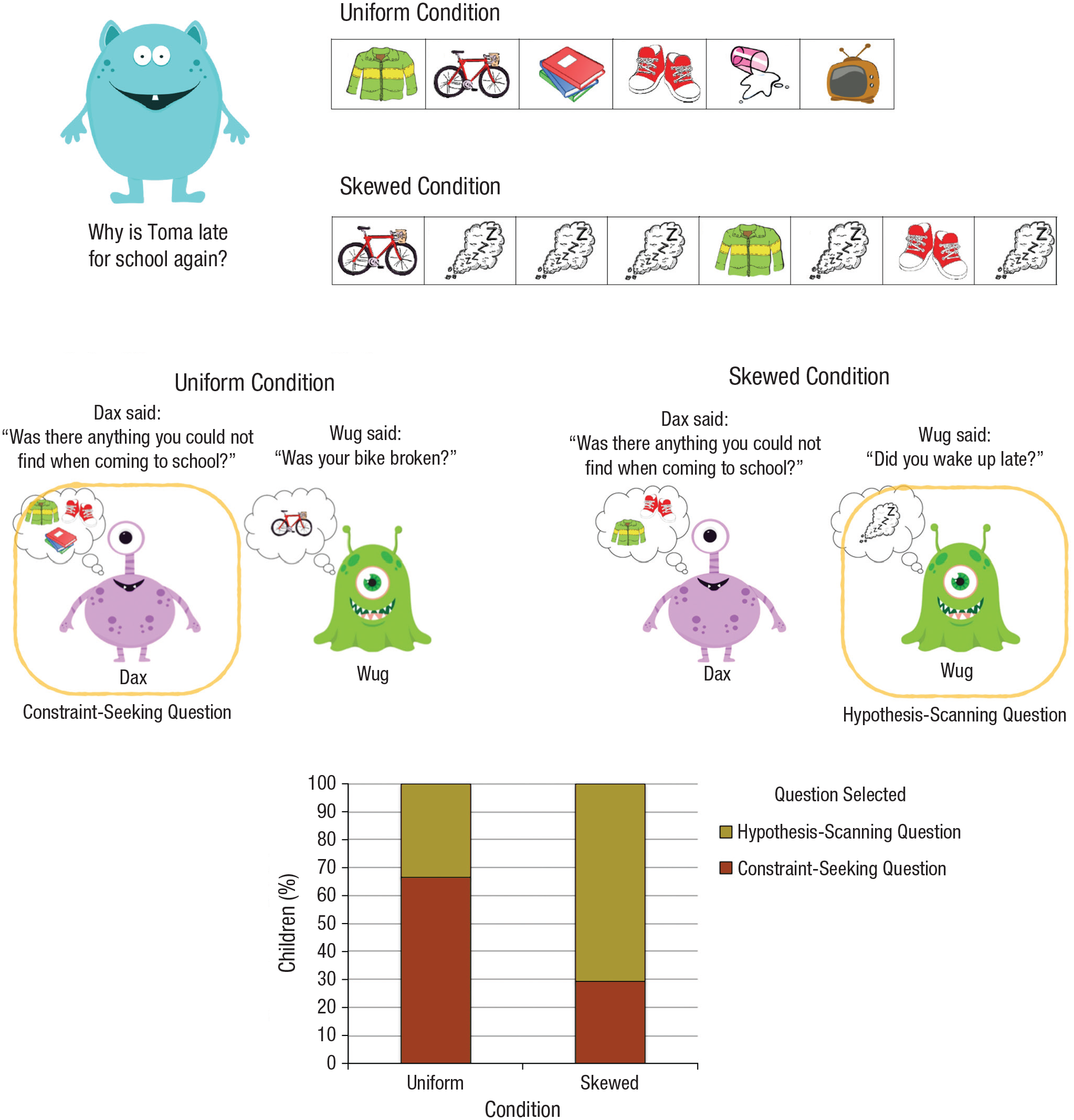
Stimuli and results from Study 1 in Ruggeri et al. (2017). Four- and 5-year-old children were presented with a storybook illustrating the reasons why Toma had been late for school over several days. They were then told that Toma was late again and that two friends asked him questions to find out why. The children were asked to indicate which friend would find out first why Toma was late again—that is, which friend asked the more informative question. As illustrated in the top panel, children assigned to the uniform condition were read a book in which Toma had been late on each of the previous days for a different reason, whereas children assigned to the skewed condition were read a book in which Toma had often been late because he woke up late. The middle panel shows the questions asked by Toma’s friends in each condition: One friend asked a constraint-seeking question targeting multiple hypotheses, whereas the other friend asked a hypothesis-scanning question targeting a single hypothesis. The bottom panel shows the percentage of children in each condition who selected each friend as the one who would be first to find out why Toma was late again. In the uniform condition, the constraint-seeking question was more informative, whereas in the skewed condition, the hypothesis-scanning question was more informative.
By implementing a nonverbal version of this same paradigm, my colleagues and I were able to demonstrate that even 3- and 4-year-olds are already able to adapt their exploratory strategies to the statistical structure of a given task (Ruggeri, Swaboda, et al., 2019). In this study, children had to find an egg-shaped shaker hidden in one of four small boxes, which were in turn contained in two larger boxes (Fig. 2). They were allowed to open only one large box, but they could shake the large boxes first, if they wanted to. Crucially, before this test, the children learned either that the egg was equally likely to be found in any of the four small boxes (uniform condition) or that it was most likely to be found in one particular small box (skewed condition; see Fig. 2). Results showed that preschoolers as young as 3 successfully tailored their exploratory actions to the different likelihood distributions: Compared with children in the skewed condition, who had a strong intuition as to where the egg would be hidden, children in the uniform condition were more likely to shake a large box first. This way, they could hear which large box contained the small box with the egg without risking opening the wrong large box.
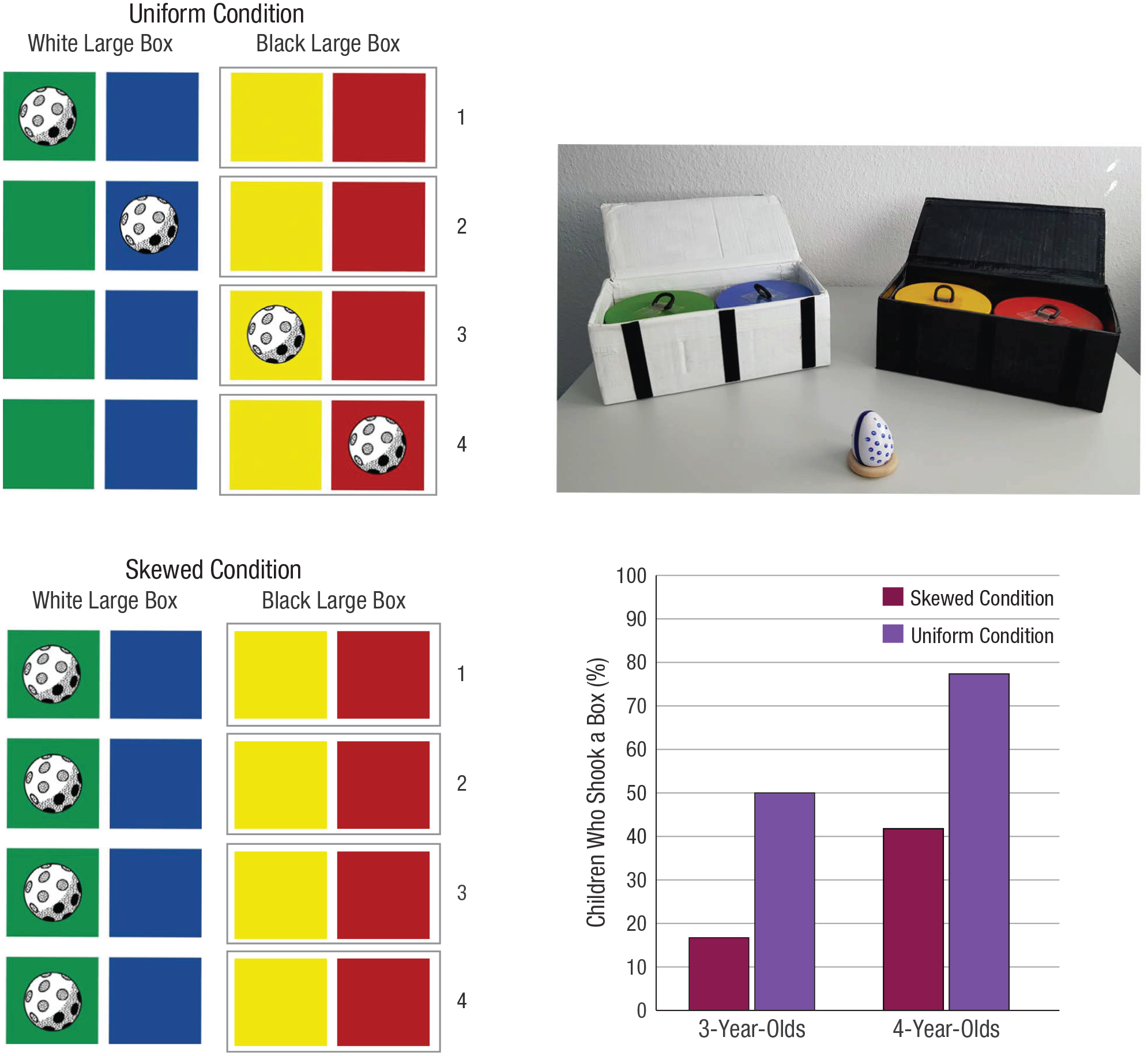
Experimental setup, design, and results from Ruggeri, Swaboda, et al. (2019). In the training phase, an egg-shaped shaker was placed four times into one of four small boxes (green, blue, yellow, and red) contained in two larger boxes (white and black). After each placement, the children were asked to retrieve the egg and use it to activate a light-up toy. As illustrated in the left panel, either the egg was always hidden in the same small box (skewed condition), or it was hidden in a different small box each time (uniform condition). The experimental setup is shown at the top right. The graph at the bottom right shows the percentage of children in each condition who shook one or both large boxes before deciding which one to open.
Overall, this series of studies demonstrates that efficient, adaptive search strategies emerge much earlier than previously assumed (see Betsch et al., 2018; Davidson, 1991, 1996; Klahr et al., 1993). Thus, the findings highlight the importance of developing child-friendly, age-appropriate, and assumptions-transparent paradigms that are able to capture children’s early competence, to gain a more comprehensive and fair picture of their active-learning abilities. Also, this work offers a computationally grounded theoretical framework that, by focusing on the adaptiveness of children’s learning strategies, rather than on their performance as measured against adults’, can accommodate and reconcile a growing, but still sparse and sometimes contradictory body of work documenting the developmental trajectory of active learning.
Future Directions
This focus on ecological active learning provides a novel perspective on cognitive development that challenges a simple data-driven view of knowledge acquisition and change, in which children’s learning is only a function of their casual observations and the teaching of other people. Instead, thanks to the integration of developmental and computational methods, this work sheds new light on the mechanisms underlying and driving developmental trajectories in exploration, casting children as motivated and curious learners who are hungry for information in their environment but also sensitive, selective, effective, and—above all—adaptive. Among the many exciting avenues of future research that this perspective opens, three appear to me to be particularly promising.
First, research on ecological active learning has focused on identifying key developmental differences in the efficiency and adaptiveness of children’s search, highlighting three important sources of developmental change: an increasing ability to recognize and exploit the abstract, hierarchical structure of the hypothesis space (Jones et al., 2021), increasingly sophisticated verbal abilities and vocabulary (Ruggeri & Feufel, 2015), and a growing ability to implement efficient rules to decide when to stop searching for more information (Ruggeri et al., 2016). However, it is not yet known why these changes occur, or what task-related, cultural, environmental, or individual factors (e.g., differences in cognitive abilities, vocabulary, motivation, personality, education, parenting style) drive developmental changes in active learning, how these factors interact with each other, or how their relative importance changes with age.
Second, research has suggested that motivation to learn can modulate learning success. For example, infants learn better when they are more interested in what they are learning about (see Ackermann et al., 2020). But what do children find interesting? What is motivating? As noted above, infants’ attention peaks in situations presenting “just the right amount” of complexity (the Goldilocks effect; Kidd et al., 2012). More recent work has established an association between infants’ expectation to receive information and neural markers—such as electroencephalogram theta oscillations—traditionally associated with reward processing (Begus & Bonawitz, 2020), thus suggesting that the intrinsic drive to seek information is perceived as a rewarding experience itself. In general, it is still quite unclear what mechanisms and factors drive and modulate children’s attention, persistence, and desire to learn or their willingness to change and adapt their learning strategies.
Third, how can these results from the research on active and adaptive learning inform the development of successful educational interventions aimed at supporting and boosting children’s ecological active learning? Previous attempts to explicitly improve children’s active-learning strategies, for example, by teaching them how to generate effective constraint-seeking questions, achieved only moderate success (see Courage, 1989). Most children did not improve their performance, and the modest training benefits, when present, did not generalize to other sets of stimuli or domains and were no longer apparent just a few days later. However, recent work has demonstrated that it is possible to support children’s question-asking performance even without extensive training. For example, prompting them to explain previous observations (e.g., “Why do you think these treats gave Toma a tummy ache, and not these?”; see Ruggeri, Xu, & Lombrozo, 2019) can promote the identification of features that apply to multiple objects, thus supporting more effective question asking (see also Ruggeri et al., 2021). Moreover, children’s performance can be enhanced by designing environments that allow them to actively control the learning experience (e.g., what to study, when, and for how long), which can lead to enhanced learning from age 7 years until adulthood (Fig. 3; Ruggeri, Markant, et al., 2019).
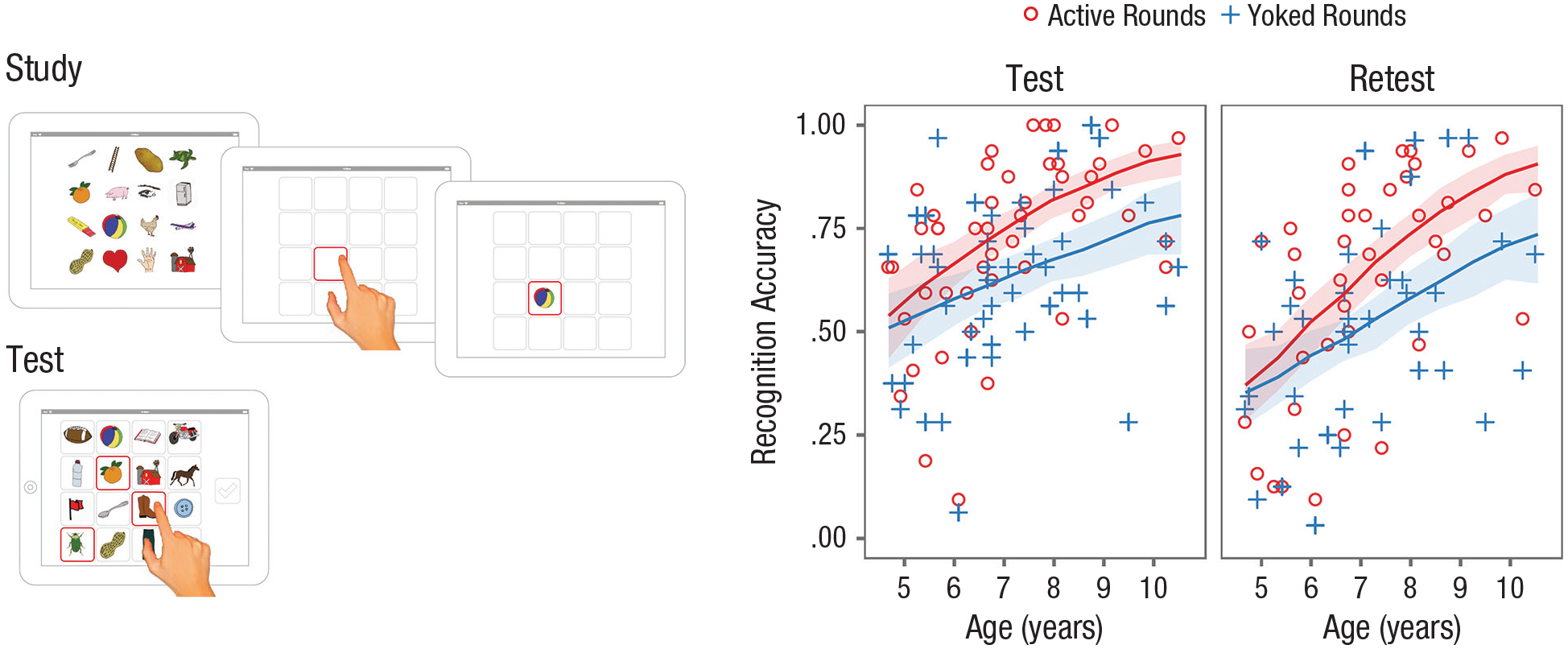
Experimental design (left) and results (right) of Study 1 from Ruggeri, Markant, et al. (2019). Each of four study rounds began with all objects displayed for 2 s. The objects then disappeared behind occluders. After that, in the active rounds (illustrated here), participants selected an object to study by touching its location on the screen, which caused the appearance of a red frame around that location, followed by the object hidden behind the occluder there. Participants could decide for how long to study the object before closing the occluder again and moving to the next object they wanted to study. In the yoked rounds, participants saw a red frame appear in one location, followed by the object hidden behind the occluder in that location, which they had to touch on the screen as quickly as possible. During each test block, participants selected from among a set of distractors the objects that they recognized from the study phase. The graphs show recognition accuracy for objects studied in the active and yoked rounds as a function of participants’ age, in the test administered immediately after the study phase and in the retest administered about 1 week later. Circles and crosses indicate individual participants’ accuracy, solid lines are fitted regression lines, and shaded regions indicate 95% confidence intervals.
Improving children’s ecological active learning at an early age, which requires deeply understanding its mechanisms at both the individual and the developmental level, has the potential to accelerate the development of their general information-search strategies and problem-solving skills, supporting their school performance and, most important, their later independent learning, critical-thinking skills, and capability for responsible citizenship. For example, interventions of this kind can support children’s competence in evaluating the accuracy, completeness, and reliability of information and information sources (e.g., identifying fake news). Ecological active learning may also be the key to understanding, assessing, and fostering children’s preparedness, that is, their ability to face uncertain—unpredicted or unpredictable—future challenges, from adapting to a dynamic job market, to studying a new subject, to facing a world pandemic.
Recommended Reading
Butler, L. P., Ronfard, S., & Corriveau, K. H. (Eds.). (2020). The questioning child: Insights from psychology and education. Cambridge University Press. A book that offers a rich, interdisciplinary overview of what is known about the role of question asking in cognitive development.
De Simone, C., & Ruggeri, A. (2022). (See References). A book chapter that reviews and discusses the latest results from developmental, cognitive, computational, and educational research on children’s exploration and information search, examining the various forms active learning can take across the life span.
Saylor, M. M., & Ganea, P. A. (Eds.). (2018). Active learning from infancy to childhood: Social motivation, cognition, and linguistic mechanisms. Springer. https://doi.org/10.1007/978-3-319-77182-3. A book that reviews and discusses previous work and perspectives on the emergence and early development of active learning.
