




Abstract
Recent evidence suggests that children play an active role in their own learning in many domains, yet the study of language development typically casts children as passive recipients of adult guidance. We argue that this approach overlooks language learning as a fruitful domain in which to explore children’s active, self-directed learning. Specifically, children seize language-learning opportunities and actively select the linguistic information they want to receive, thereby enhancing their own learning. We suggest that reframing the child as an active language learner generates novel explanations for key phenomena in language development, and generates complex, ecologically valid test contexts for researchers interested in rational accounts of learning.
Keywords
Children are famously scrappy learners. And yet, research on how children learn language—a complex social system that they are highly motivated to master— often casts children as passive recipients of language “input” and guidance from adults. The idea that children learn language passively might be intuitive, given that adults often appear to be teaching children to talk by engaging them with simplified, exaggerated speech (Soderstrom, 2007). Moreover, the public sphere is rife with media promoting child-directed language, including messages that liken talking to children to feeding them (“language nutrition;” Zauche et al., 2017). We argue that this emphasis on children’s “receipt” of adult language overlooks language development as a fruitful domain in which to reveal children’s self-directed learning. In this review, we show how adopting a view of children as active language learners can yield new insights and research directions. 1
We define active, or self-directed, language learners as learners who seize language-learning opportunities and who select the linguistic information they want to receive in order to enhance their own language learning 2 (cf. Gureckis & Markant, 2012). Prior research shows that children demonstrate active learning in diverse ways from early in life. Infants attend to things in the world based on their novelty, complexity, and learnability (e.g., Gerken et al., 2011; Kidd et al., 2012; see also Silvia, 2006). Toddlers explore unfamiliar objects to reduce uncertainty (e.g., Sim & Xu, 2017a). Preschoolers conduct impromptu experimental tests of their causal hypotheses (Cook et al., 2011; Sim & Xu, 2017b), and school-age children ask increasingly strategic questions to determine the cause of an event as they mature (Ruggeri & Lombrozo, 2015). Yet this active child learner—so central to research programs in causal and ecological learning—has remained largely absent from research in language development. How might children’s evident prowess at directing their own learning in nonlinguistic domains translate to language?
The social nature of language knowledge makes it an especially interesting target of self-directed learning. In experimental demonstrations of children’s self-directed learning about causation, often what is noteworthy is that children generate evidence (e.g., of how a novel toy works) without input from other people, and independently test their own hypotheses (Cook et al., 2011; Sim & Xu, 2017b). Language learning, by contrast, does not lend itself to such solitary discovery and validation. That is, children cannot “teach themselves” language: Children cannot independently generate their languages’ labels for dogs by spending enough time alone with their family pets. And to confirm that the words they have discovered are the right ones, children must attend to how other people use and respond to the words. Thus, because languages are culturally transmitted systems of communication, there are limits on what children can independently learn of them.
Even though language can be learned only via exposure to other people’s usage of it, children nevertheless have a role in selecting among different potential sources of learning. After all, children are exposed not only to language directed to and customized for them but also to language between familiar adults and between strangers, to language to and from other children, and to language on the television, on the radio, or over the phone. Children cannot attend to all of these potential language sources all of the time, which raises the question of how they distribute their attention across them.
Thus, language development might actually be a good place to look for naturalistic evidence of self-directed learning. Even infants grasp the utility of linguistic communication (Martin et al., 2012; Vouloumanos et al., 2012), which suggests that children are intrinsically motivated to learn language to communicate from early in life. Moreover, language development is robust: Children learn their native language (or languages) across diverse contexts, from environments where the majority of the language around them is simplified and child-directed, to environments where language between other people dominates instead (Hoff, 2006; Schieffelin & Ochs, 1987). One reason that children successfully learn across these different contexts may be that they play a driving role in the learning process, adapting their strategies to leverage available sources of language input and seeking out further relevant linguistic information as needed (cf. Bloom, 2000). For example, children learn by “tuning in” to other-directed language in their environments, revealing one way in which they seize available language-learning opportunities. That children also preferentially attend to some sources of language over others reveals a way in which they select the linguistic information they want to receive, in order to enhance their own language learning. Finally, because children are surrounded by competent language users, they can also use other people to elicit new language data and to selectively test their linguistic hypotheses. In this article, we review emerging evidence for these signatures of active language learning and illustrate how adopting a view of the child as an active language learner can provide insight into basic questions about how language development unfolds and about what language input is most effective for learning. We focus on the child’s developing lexicon as a measure of active language learning for two reasons: First, word forms are largely arbitrary conventions (i.e., they must be learned); second, although some of the words that children know (e.g., “boo-boo”) likely come from language directed to them by caregivers, others (e.g., profanity) are likely picked up from language directed to other people (i.e., words can serve as traces of learning environments). In what follows, we review how children actively learn language by (a) deploying their attention to effective sources of linguistic information, (b) tuning in to ambient other-directed language, (c) eliciting language input from knowledgeable interactants, and (d) evaluating evidence that bears on their linguistic hypotheses (see Fig. 1).
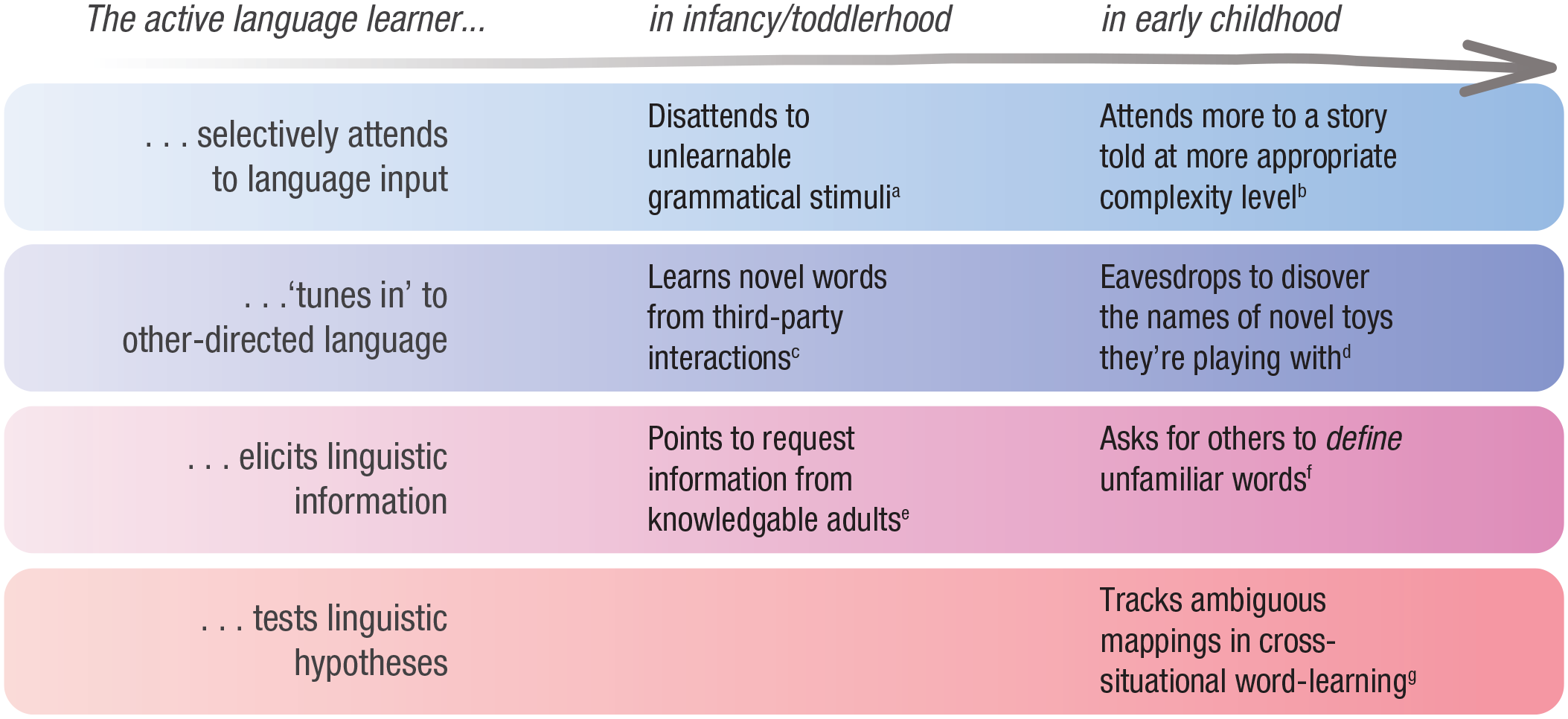
The state of the evidence for self-directed language learning from infancy through early childhood. aGerken et al., 2011; bFoushee et al., 2022; cFloor & Akhtar, 2006; dFoushee et al., 2021; eBegus & Southgate, 2012; fChouinard et al., 2007; Jimenez et al., 2018; gZettersten & Saffran, 2021.
Children Efficiently Allocate Attention Among Potential Sources of Language Input
Take a scenario that might be familiar: After you have just finished reading the same story aloud for the 12th time, your 3-year-old listener cries, “Again! Again!” Research linking children’s attention to stimulus “learnability” raises the possibility that a child’s asking to hear the same story again and again might be a sign that there is still something in it for the child to learn.
Do self-directed language learners select the language data they receive so that their learning will be efficient? In two experiments supporting this idea, Gerken and colleagues (2011) showed that the amount of attention infants paid to artificial language stimuli in the lab depended on the learnability of the grammar. The learnable stimuli conformed to a discoverable grammatical pattern—that is, previous samples of same-age infants had been able to learn the critical rule (or one just like it) for predicting whether or not novel test stimuli were grammatical. In contrast, the unlearnable stimuli either lacked sufficient cues for learners to be able to predict future grammaticality (based on data from previous samples) or evinced conflicting grammatical rules, making prediction impossible. Seventeen-month-old infants listened longest to the subjectively learnable artificial language stimuli.
More recently, we directly tested the link between preschoolers’ learning from spoken language input and the amount of attention they directed to it (Foushee et al., 2021). Children (4–6 years old) listened to a story narrated at either a simple level (with largely familiar words) or a complex level (with relatively later-acquired words) while an eye tracker captured their visual attention to a storybook display. The looping audio narration for each page automatically advanced to the next page if the child lost interest in the story and instead attended to an on-screen distractor (three penguins continuously jumping rope). We expected that a given objective degree of complexity should be experienced differently by children of different ages because of their different levels of linguistic competence, and hypothesized that the children’s attention to the storybook would reflect the narration’s subjective complexity (i.e., how understandable or learnable the language was for them). Thus, we expected that the relative attention children paid to the complex versus the simple speech (indexed by how long they looked at and listened to the storybook in the two conditions) would vary with their age. This is in fact what we found: When the speech was complex, older children were more likely than younger children to continue listening to the page narrations. The opposite was true in the simple condition, in which younger children—for whom the speech was likely at a “just right” level of complexity—were more likely to continue listening. This is the pattern of results we would expect if children’s attention to spoken language is responsive to how much they can learn from it. Indeed, individual children’s story comprehension and learning of novel words—tested after the story—were positively correlated with their attention to the speech.
This study provides suggestive evidence that children selectively attend to linguistic information in order to enhance their own learning. A strong interpretation of the results is that children deliberately switch their attention from spoken language input when their learning rate falls below some threshold. Alternatively, children’s attention to spoken language may merely reflect whether they comprehend it, such that they can be lured away by a distractor when the language goes over their heads (though we note that this does not explain why, when listening to the simple speech, older children were more likely than younger children to stop listening).
Children Learn From Ambient Language in the Absence of Adult Guidance
The Internet is awash with vivid displays of children’s self-directed language learning: The query “where did my toddler learn to swear?” returns millions of search results, and clips of young children showing surprisingly perfect mimicry of adult verbal behavior (e.g., the choreography of a domestic quarrel, a grown-up’s phone voice) regularly go viral. In such instances, children evince language knowledge that is unlikely to have come from child-directed language but rather was most likely learned by overhearing.
In a recent study, we assessed whether preschoolers spontaneously tune in to naturalistic other-directed language. The children in this study (3–6 years old) had the opportunity to learn facts about and labels for a set of objects as they played with them, across experimental conditions that differed in how much self-directed information gathering was required to learn the facts and labels (Foushee et al., 2021). In the pedagogical (passive-learning) conditions, an experimenter taught the children a label and fact associated with each object, explicitly cuing their attention to the object and its properties as it was discussed. The experimenter used the same script in the overhearing (active-learning) conditions, this time while talking on the phone at a distance from the children, and looking at neither them nor the objects (Fig. 2a). 3 Our results show that the children’s ability to coordinate their attention between the overheard speech and the objects was correlated with their age, such that older children showed significantly better learning of both words and facts in the overhearing conditions (Fig. 3). Strikingly, children of ages 4.5 to 6 learned the labels for four novel objects as well from overheard speech as from pedagogical, child-directed speech (Fig. 3).
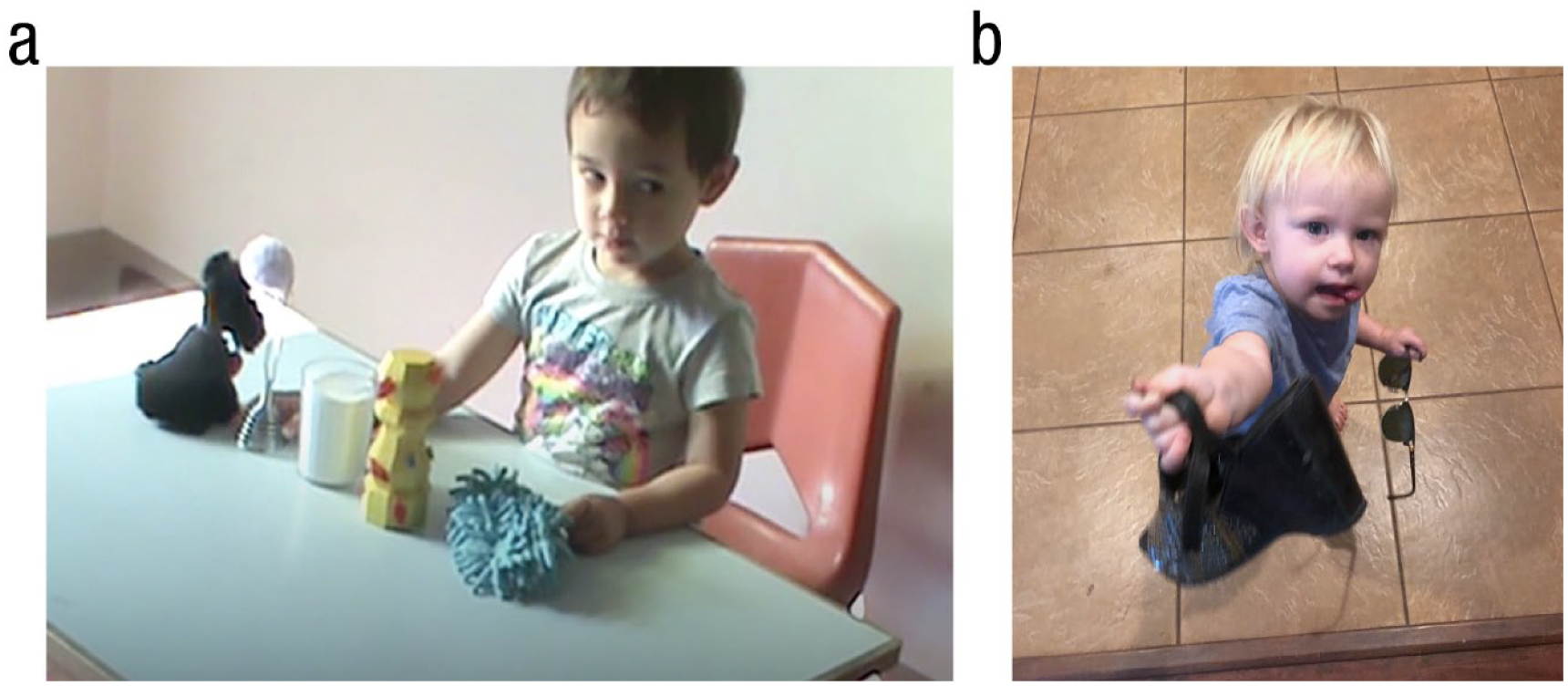
Self-directed learning behaviors in language development. The child on the left discreetly attends to the experimenter’s phone conversation (taking place out of frame to the right) to learn the names of and facts about the novel set of toys before him. The child on the right brings a heeled shoe to her caregiver, who labels and discusses it.
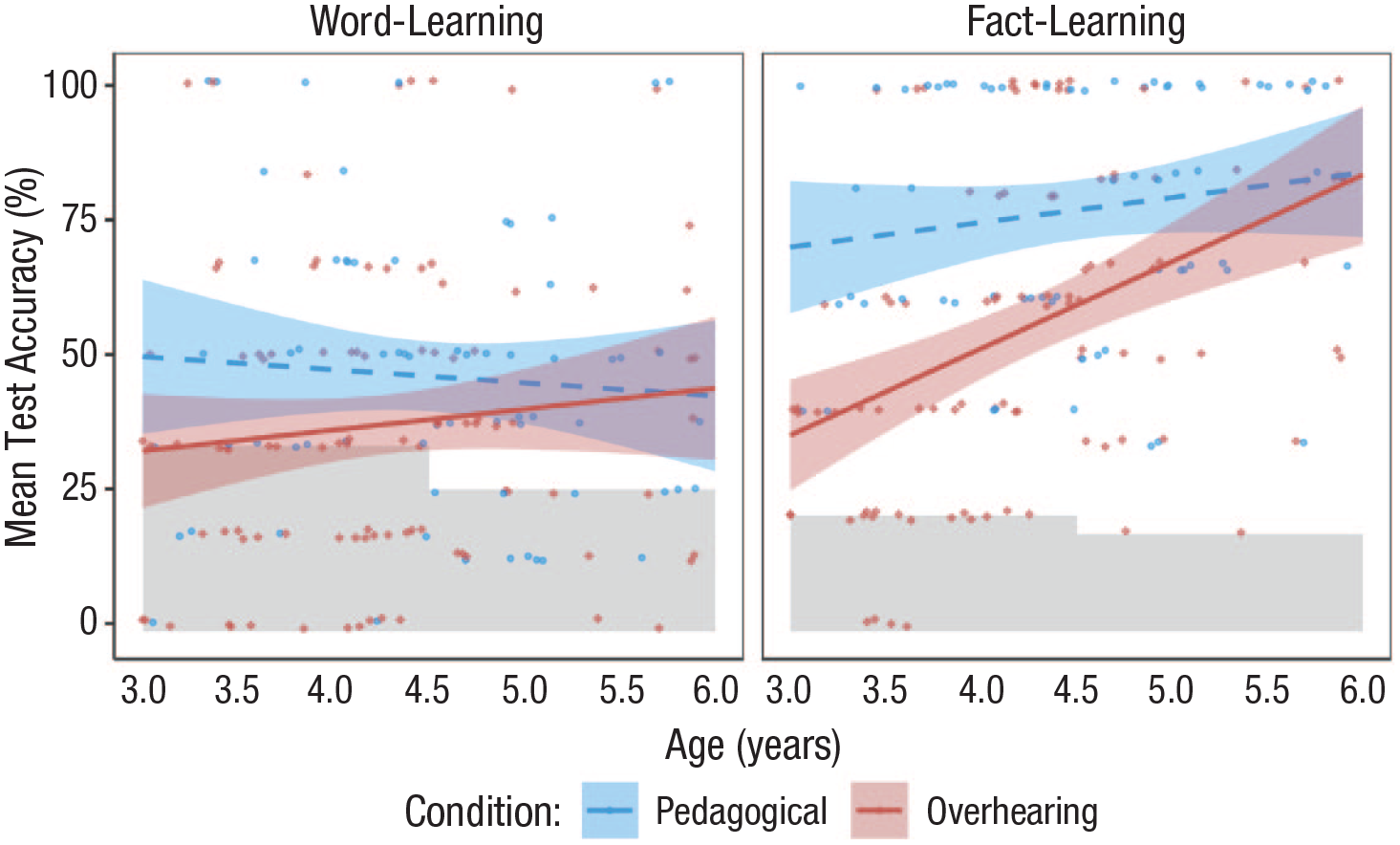
Age effect in Foushee et al. (2021): mean test accuracy for two types of novel linguistic information corresponding to a set of unfamiliar toys: labels (e.g., “pimwit”; left panel) and facts (e.g., “the one my sister loves”; right panel). The gray shading indicates levels of accuracy at or below chance. In this experiment, 3- to 4-year-olds heard three novel words and five facts, and 4.5- to 6-year-olds heard four novel words and six facts. The plotted points are results for individual children; plotted lines are linear regression lines with shading to indicate the standard error.
Together, the studies reviewed to this point may help resolve an apparent paradox in the language-development literature: Although even toddlers are able to learn new words from other-directed language in experimental studies under simplified conditions (e.g., Floor & Akhtar, 2006), there is surprisingly little evidence that children learn words from other-directed language in their natural language environments (e.g., Shneidman & Goldin-Meadow, 2012). As active learners “in the wild,” children may monitor all potential sources of language in order to learn most efficiently. In contexts where simplified child-directed language is available, children may be less likely to attend to and learn from other-directed language that is relatively complex. However, in contexts where child-directed language is rare, children may adapt by attending to and learning more through overhearing (e.g., Tsethlikai & Rogoff, 2013). This hypothesis may help explain how children appear to reach linguistic milestones on similar timetables across environments that vary in their proportions of child-directed and other-directed language (Casillas et al., 2020; Foushee & Srinivasan, 2023).
Children Elicit Labels From Adults
A toddler waddles over carrying an unfamiliar object (Fig. 2b) and produces some variant of “What’s this?” The caregiver replies with a label. As conventions, words have value only to the extent that they are agreed upon by other people: Thus, a child who wants to be able to talk about “these things I just found” will need others’ help to find the right words.
Experimental and observational evidence both illustrate how children expand their vocabularies by eliciting linguistic information from the people around them. Laboratory studies show that infants use pointing to request information from knowledgeable adults (Begus & Southgate, 2012; Lucca & Wilbourn, 2019) and that preschoolers know both when they do not know what something is called (Lipowski et al., 2013) and whom to explicitly ask (Koenig & Harris, 2005). Indeed, many of the questions that pepper children’s early language productions are requests for linguistic information: For example, an analysis of four children’s spontaneous speech found that between 28% and 65% of the questions the children asked between their first and second birthdays were requests for labels (Chouinard, 2007). Children’s active role in language learning may partly explain why the onset of locomotion often coincides with a marked increase in vocabulary growth (He et al., 2015; Walle & Campos, 2014; though see Moore et al., 2020). With a newfound visual perspective, greater autonomy, and freer hands, walkers encounter new and different things to name and elicit verbal responses from caregivers by sharing objects with them (Karasik et al., 2011, 2014). Note, however, that the connection between walking and vocabulary growth remains speculative: Unlike the evidence regarding infants’ pointing gestures (Begus & Southgate, 2012; Lucca & Wilbourn, 2019) and children’s question-asking (Chouinard, 2007; Jimenez et al., 2018), the evidence that walkers intentionally share objects with caregivers to elicit information—as opposed to merely attention—remains inconclusive.
Children Test and Refine Their Hypotheses About Word Meanings
Children use other, more capable language users not only to get new words, but also to refine their hypotheses about words’ meanings. Consider, for instance, the 4-year-old who in 2020 asked, “Is coronavirus really popular right now?” The question seems aimed at triangulating a new word’s meaning: “What does ‘coronavirus’ refer to, such that all adults are suddenly talking about it?”
Children seek linguistic information from the social world in a way that implicitly reflects their relative certainty. They recruit help with defining or interpreting words explicitly (Jimenez et al., 2018), as in the question about coronavirus, but they also engage in subtler information-seeking behaviors: For example, preschool-age children (2–5 years old) were found to scan an adult experimenter’s face more when the experimenter made a referentially ambiguous request (e.g., asking the child for the “modi” when two novel objects were present) than when the experimenter’s request was unambiguous (e.g., asking for the “modi” when a novel object and a familiar object were present; Hembacher et al., 2020).One-year-olds in a similar task even knew whose face to scan when they were unsure about labels (namely, the experimenter who had previously known what things were called, rather than one who was previously ignorant; Bazhydai et al., 2020). 4 Additional evidence of how young children monitor and reduce their uncertainty about word meanings comes from a cross-situational word-learning experiment in which children (3–8 years old) saw both novel and familiar object-word pairings. Some of the novel object-word pairings were ambiguous (i.e., the same two novel objects always co-occurred with the same two novel words), whereas others could be disambiguated via an inference (e.g., given the words “leemu” and “dog,” “leemu” must refer to the nondog object). When later given the opportunity to learn more about specific objects, the children preferentially chose to sample referents whose labels had remained ambiguous, and the older children were especially likely to do so (Zettersten & Saffran, 2021). Thus, learners track not only their hypotheses about potential word meanings, but also the strength of their evidence, and actively seek additional information to reduce their uncertainty.
Discussion
In the preceding sections, we have reviewed how an active-learning framework can be extended to explain children’s remarkable success at learning language. Here, we list several key remaining questions that we hope will inform future research:
How can the mechanisms of self-directed learning in language development be characterized? What do children track to guide their attention? For example, do they rely more on familiarity, or how well they can predict what will come next, or on how simple the structures are? Do children exploit similar signals in other domains?
What is different between how an infant and how a preschooler direct their own language learning? What are the relevant developmental processes influencing children’s self-directed learning capabilities? For example, how do developments in working memory come into play?
Is children’s allocation of attention rational? Is it possible to build computational models specifying the optimal allocation of individual children’s attention, given the goal of learning language?
Where can active learning of other aspects of language knowledge be observed? We have focused on the utility of active learning for acquiring the lexicon, but there are no doubt analogies for grammar learning. For example, is there some just-right level of syntactic complexity that best captures the attention of children at a given stage of language development?
How does affect intersect with cognitive motivations for language learning? One promising research area concerns how children’s lexical development reflects their interests (e.g., dinosaur-loving children learn many dinosaur names; Mani & Ackermann, 2018). According to functional accounts of emotions (Barrett & Campos, 1987), children’s attention to fruitful learning opportunities may be driven by a positive affective experience, rather than some metacognitive insight.
Conclusion
In our view, there is great potential in a research program at the intersection of active learning and language development—especially one with an eye toward ecologically valid demonstrations of children’s abilities. Diverse empirical questions lie at this intersection. As this review illustrates, reframing the child as an active language learner introduces novel explanations for phenomena in the development of language. At the same time, using language as a test domain for formal rational-learning accounts can provide researchers with complex learning tasks that make sense to children and are informative regarding how they navigate the daily complexity of early life. Finally, applying the active-learning framework to language development presents an opportunity to make psychological science more inclusive: The one-on-one pedagogical contexts that research and public policy tend to emphasize represent only a sliver of the language-learning contexts that young children from different households and cultures experience over the course of the day. That children across diverse milieus become capable adult language users may be explained by children’s active role in getting the linguistic information they need.
Recommended Reading
Bloom, L. (2000). (See References). A chapter focusing on the agency and action of the developing child in the process of word learning.
Gureckis, T. M., & Markant, D. B. (2012). (See References). A theoretical review of work in cognitive science and machine learning regarding situations in which learners control the information they experience.
Saylor, M. M., & Ganea, P. A. (Eds.). (2018). Active learning from infancy to childhood: Social motivation, cognition, and linguistic mechanisms. Springer. An edited volume of research on the role of active learning in cognitive and linguistic development.
Footnotes
Acknowledgements
We thank the children whose communicative curiosity and hunger inspired this article (including Willa Evelyn Castro, D.J. Angle Davis, and the children in the Early Childhood Education Program at the University of California, Berkeley), and the adults whose thoughtful engagement and feedback refined its ideas and written form (among them, Susan Goldin-Meadow, Azzurra Ruggeri, Martin Zettersten, Ben Whitney, the members of the Berkeley Writing Group—Stephen Ferrigno, Mariel Goddu, Brian Leahy, Benjamin Pitt, Joshua Rule—and two anonymous reviewers).
Transparency
Action Editor: Robert L. Goldstone
Editor: Robert L. Goldstone
