




Abstract
The ubiquity of digital devices has made it feasible to assign different tasks and levels of support to different learners, also in the classroom. Ideally, this is done with the help of formative assessment software or intelligent tutoring systems. However, personalized assignment of tasks and support levels by a teacher or teaching agent has limitations and is only one path to successful personalization. Self-regulated learning and adaptable learning activities, such as generative learning strategies and differentiating tasks, are promising paths to personalization, too, and combine well with personalized assignment. Initial examples of such combinations are presented. I argue that, in order to be maximally effective, different paths to personalized education need to be combined. This combination promises to boost both immediate learning outcomes and successful learning in the long term, and it is facilitated by recent advances in artificial intelligence.
Keywords
Every day Julia uses an app on her smartphone to help her learn Spanish. To make it easier for her to memorize vocabulary, the app offers various activities. Sometimes Julia has to read the correct translation several times. On other occasions, she must select the correct translation from a list of possible translations. On yet other occasions, she must infer the meaning of Spanish words from the context. With which learning activity does Julia learn best?
Even though finding the best learning strategy is a standard goal of psychological research on learning and instruction, the answer is not straightforward. In a recent study, colleagues and I compared several learning activities and found that different activities are best for different students, depending on their learner characteristics and, relatedly, their diligence in performing the activity on a given day (Biedermann et al., 2023). Consequently, the activity that works best for a particular student on one day might not work on another day. In other words, there is considerable variability in which activity works best: The same activity works better for some learners than for others, and even for the same learner, which strategy works best may change over time.
In this article, I briefly outline paths that psychological research on learning and instruction has taken to deal with the enormous variability between and within learners in order to promote learning success for all children. The key outcome variable addressed here is thus the acquisition of domain-specific knowledge. The acquisition of metacognitive skills is also taken into account, as it plays an important role in the long-term promotion of the acquisition of domain-specific knowledge. The main message is that the paths to more personalized education have mostly been taken in isolation from each other and that there is untapped potential in combining them.
The Promise of Personalized Education
The promise of personalized education is that the variability between and within learners can be embraced to improve education for all learners (Corno, 2008; Dumont & Ready, 2023; Pane et al., 2015). Psychological research on this topic has long called for tailoring instruction to individual learners, taking into account their characteristics and learning prerequisites (Cronbach, 1957; Vygotsky, 1978). Whether referring to zones of proximal development (i.e., an individual’s competences that are currently in a state of formation; Vygotsky, 1978) or adaptive teaching (Corno, 2008), the goal is usually to adapt instructional parameters to the relevant characteristics of a specific learner at a specific point in time (Tetzlaff et al., 2021). Instruction with such adaptations is thought to improve students’ learning outcomes and well-being more than instruction without such adaptations. By ensuring that all children benefit from the instruction, more personalized education could make a strong contribution to reducing inequalities in educational achievement.
Initial evidence that personalization improves learning outcomes has been provided in work on one-on-one tutoring. Learning gains in one-on-one tutoring with expert human tutors were found to be substantially higher than in various forms of group instruction (Bloom, 1984; Cohen et al., 1982). In one-on-one settings, a teacher has more opportunities and more information to adapt the instructional approach to individual learners. This allows teachers to better adapt feedback and task difficulty to students’ momentary cognitive and affective states (Lehman et al., 2008; Merrill et al., 1995). Therefore, the reported high learning gains under one-on-one tutoring serve to illustrate the potential of personalization. The practical impact of research on tutoring has been limited by class sizes and teacher training, however.
Personalized assignment of tasks and support levels
Computer programs were developed to scale up the beneficial effect of one-on-one tutoring to larger groups of learners. A prime example is intelligent tutoring systems (ITSs), which are learning technologies that were initially developed to adapt tasks and support levels to students’ momentary states via a learner model (Corbett, 2001; VanLehn, 2011). Most ITSs focus on modeling students’ knowledge, and some incorporate an additional characteristic, such as current affect (e.g., D’Mello & Graesser, 2013). They have been shown to lead to learning gains approaching those of one-on-one tutoring and far exceeding “regular” group instruction, even when deployed outside of the laboratory (Koedinger et al., 1997; VanLehn, 2011). In sum, the success of one-on-one tutoring and ITSs suggests that personalizing education can strongly boost the effectiveness and efficiency of knowledge acquisition.
In the classroom, formative assessment (also called curriculum-based measurement) is a promising approach to realize personalization. Students regularly take short computerized tests (e.g., on reading comprehension), the results of which are presented to teachers in a way that makes it easy for them to monitor students’ progress against a criterion or class average. Such comparisons enable teachers to implement combinations of group- and individual-focused instruction. Formative assessment generally has a positive impact on student learning, with substantial heterogeneity in effect sizes (Jung et al., 2018; Kingston & Nash, 2011). This heterogeneity is understandable because the effectiveness of formative assessment depends on whether and how teachers use the information provided to adapt instruction to their students. Hence, teacher experience and support are key determinants of the effectiveness of formative assessment (Jung et al., 2018).
In summary, personalized assignment of tasks and support levels promises to scale up the beneficial effect of tutoring to larger groups of learners. A key element of both ITSs and formative assessment is that repeated adaptations are made on the basis of the learner’s momentary state, as opposed to one-time adaptions based on traits. There is good reason to suggest that it is this repeated, data-driven adaptation of instruction that renders personalized approaches superior to regular classroom instruction (Tetzlaff et al., 2021).
Challenges in personalized assignment of tasks and support levels
If we assume that repeated adaptation to students’ momentary states is the key to effective personalization, the question becomes to what states? Both ITSs and formative assessment focus primarily on modeling learners’ momentary knowledge and skills. The literature on human tutoring, however, suggests that highly skilled human tutors consider many learner states simultaneously (e.g., their knowledge as well as their current affect, attention, and motivation; Lehman et al., 2008). The requirements to measure many different learner characteristics simultaneously place an inherent limit on how many learner characteristics can be considered by ITSs and formative assessment tools—let alone by a teacher standing in front of 30 students. Furthermore, it is unclear which learner characteristics beyond knowledge are the most relevant to assess for a particular person in a particular context. Therefore, it is questionable whether the effectiveness of a highly skilled human tutor in a one-on-one setting will ever translate to larger groups of learners.
A different, more fundamental, argument that can be made against assigning “optimal” tasks to learners in a data-driven way is that this strongly constrains their development of agency for their learning as well as of their self-regulated learning skills. Both are highly important for successful learning in the longer term, as they allow learners to personalize their own learning (Brod et al., 2023). This leads to a paradoxical situation: Self-regulated learning skills in particular need to be practiced, but they are also a prerequisite for effectively personalizing one’s own learning. So, in the short term, allowing students to practice their self-regulated learning skills by giving them control over their learning process means to sacrifice learning effectiveness (Corbalan et al., 2010). In the longer term, however, this may be necessary for students to become successful lifelong learners. It thus becomes clear that personalized assignment of tasks and support levels without any choice options for students cannot be the only path to embrace learning variability and promote students’ learning success.
The Multiple-Paths-to-Personalization View
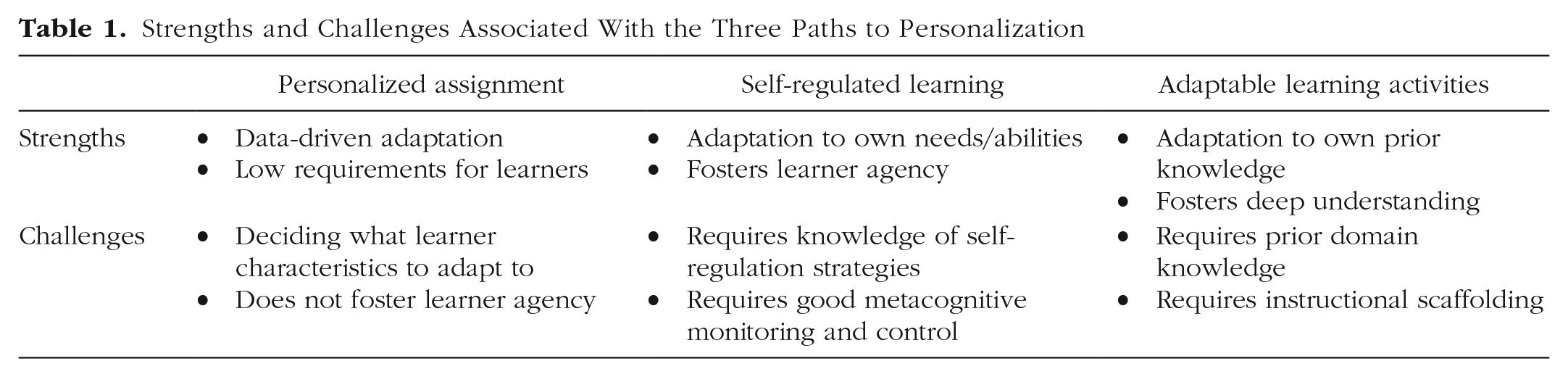
There is a need for additional paths to personalized instruction. Two of these paths are (a) handing over control to learners by letting them self-regulate their learning and (b) using adaptable learning activities that the learners can perform according to their current knowledge, skills, and preferences. I will briefly describe both approaches. The main point, however, is that they combine well with personalized assignment of tasks and support levels and together provide a promising path to successful personalization (see Fig. 1 and Table 1).
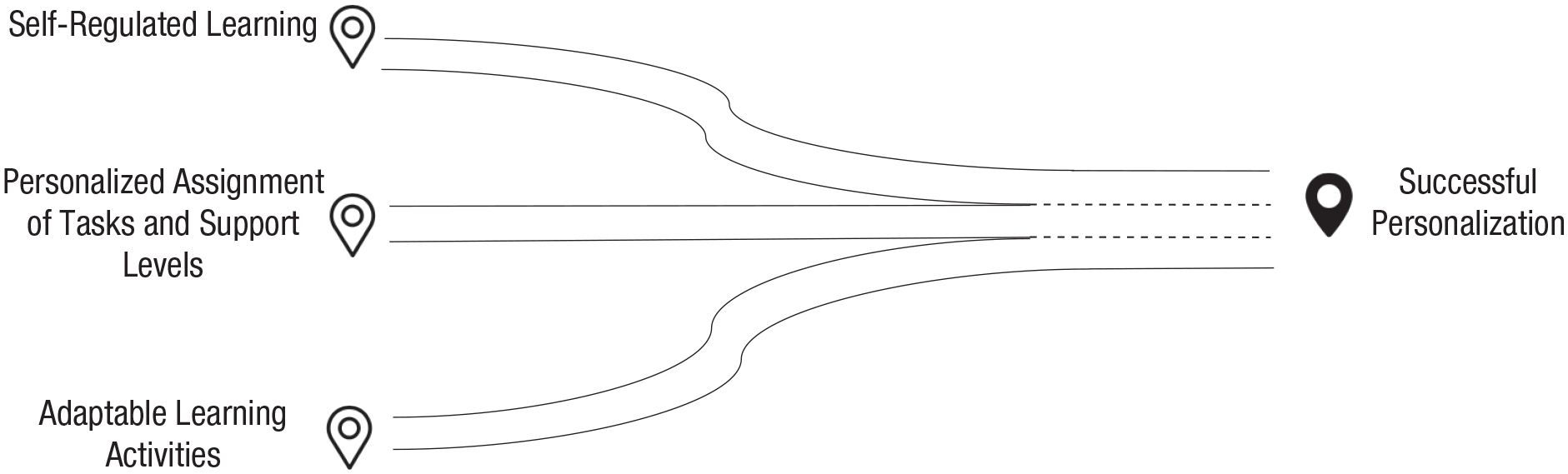
Multiple paths to personalization.
Handing over control to learners so that they can choose, for example, which tasks to work on and when to work on them, evades the problem of optimal task assignment. Instead of assigning tasks to students, they can self-regulate their learning to fit their needs. This form of personalization is particularly prominent in digital learning environments and was inspired by discovery learning approaches in classroom instruction (McLoughlin & Lee, 2010). It can be argued that learners know themselves better than a teacher or even a tutor ever could, and therefore they should be in the best position to select tasks and learning strategies that fit their current needs and preferences. However, research on self-regulated learning has accumulated substantial evidence that learners often do not know how to self-regulate their learning well because of insufficient metacognitive knowledge and skills (Bjork et al., 2013). For handing over control to be successful, it is, thus, crucial to first train students’ self-regulated learning skills and later to provide scaffolding to support their application (Butler, 2002). If successful, students would be in a position to effectively self-individualize their learning.
Adaptable learning activities, such as differentiating tasks or generative learning activities, evade the problem of assigning the right difficulty level by using tasks or techniques that can be worked on in different ways; that is, learners can engage with them according to their current knowledge, skills, and preferences. Differentiating tasks are tasks or questions that have multiple solutions and can be worked on at different difficulty levels, such as finding different solutions for a mathematical equation (Bardy et al., 2021). Generative learning activities, such as generating an explanation or a concept map, require learners to go beyond the provided material and to actively make sense of the material themselves, using their prior knowledge and skills. If successful, the learners thereby automatically adapt the task to their needs and effectively integrate the learning material with their existing knowledge (Fiorella, 2023; Lachner et al., 2022). However, these activities also place high demands on the learners and thus tend to be more effective for older students with higher knowledge and skills (Brod, 2021). Furthermore, there is still a teacher or teaching agent needed to assign students the appropriate tasks and to provide scaffolding so that the tasks are carried out effectively.
In sum, self-regulated learning and adaptable learning activities can evade some of the problems that go along with personalized assignment of tasks and support levels. However, it becomes apparent that all paths to personalization have their strengths as well as associated challenges and that none of them can be the only path. I think that a combination of these paths could be fruitful for both research and educational practice. This is clearly not a completely new idea, however. Teachers have long combined different forms of personalization (e.g., forming groups based on student’s ability, which then self-organize), albeit with mixed success (Corno, 2008). Likewise, some ITSs have been designed to support self-regulated learning or included prompts to engage in generative learning activities (see Roll et al., 2014). I will give examples of such combinations in the next section.
Toward hybrid approaches
ITSs have repeatedly integrated elements of self-regulated learning (see Azevedo & Aleven, 2013). For example, Azevedo and colleagues (2012) showed that an ITS that supported self-regulatory processes by providing prompts to monitor developing understanding of the topic and feedback on the use of these processes led to faster learning than an ITS that did not. Corbalan and colleagues (2010) found that shared control of task selection, where an ITS made a preselection and a human learner made the final choice, led to better learning outcomes than full system control. Other research has combined ITS and adaptable learning activities. Aleven and Koedinger (2002) showed that an ITS that additionally asked learners to provide explanations (i.e., explain their problem-solving steps) led to better-integrated knowledge than an ITS that did not require learners to engage in such a generative learning activity. In sum, these examples illustrate that combining personalized assignment of tasks and difficulty levels with elements of self-regulated learning or adaptable learning activities can lead to better learning outcomes than personalized assignment alone.
Very recently, an ITS was presented that includes all three pathways proposed in this manuscript. Nagashima and colleagues (2023; see also Nagashima, 2022) developed the Diagram Choice Tutor, an ITS for algebra learning, in which students can repeatedly choose to see help in solving an equation in the form of a visual representation (i.e., diagrams depicting possible next steps). If they choose to see the diagrams, they are asked to self-explain which diagram represents the best next step in solving the equation. Thus, the Diagram Choice Tutor combines all three paths to personalization discussed in this manuscript: (a) It models learners’ knowledge and assigns tasks and difficulty levels based on this learner model, (b) it allows learners to self-regulate one aspect of their learning—whether or not they want to receive help in the form of diagrams—and (c) it encourages learners to engage in self-explaining, an adaptable, generative learning activity. Evidence for the effectiveness of the individual paths and features has been provided (see Nagashima, 2022), but, to my knowledge, no study has yet examined the effectiveness of the Diagram Choice Tutor as a whole compared with control conditions to test the effects of combining the three paths.
To conclude, there are already some examples of hybrid approaches to personalization, suggesting that a combination of the different paths to personalization is doable. However, it is currently largely unclear how exactly a combination of the three paths affects learning outcomes: Is their effectiveness independent of each other, or do they interact, and can their combination thus lead to superadditive effects? Do they also promote students’ learning success in the long term? To answer these questions, a systematic examination of how best to combine the different paths to personalization is necessary.
Conclusion
There are multiple paths to successful personalized education; it is not just a matter of assigning different tasks or different levels of support to different learners. In particular, self-regulated learning and adaptable learning activities are promising paths and combine well with computer-assisted approaches, such as ITSs. Combining these different paths is particularly promising because the different paths can compensate for some of each other’s weaknesses (see Table 1). Moreover, a combination of paths promises to resolve a well-known paradox related to self-regulated learning: Self-regulated learning skills need to be practiced, but they are also a prerequisite for effectively personalizing one’s own learning, so to practice them is to sacrifice effective personalization. A combination in which a teacher or teaching agent makes a preselection of tasks that can be worked on at different difficulty levels and the learner makes the final task selection offers a way out of this paradox (Corbalan et al., 2010). In sum, a combination of the different paths promises to boost both immediate learning outcomes and successful learning in the long term. Future research is needed to empirically test this assertion.
Strengths and Challenges Associated With the Three Paths to Personalization
Combining the different paths to personalization is also timely because it can be facilitated by recent advances in artificial intelligence, such as conversational interfaces. Although chatbots have already been used several times for personalized assignment of tasks and levels of support (see Wollny et al., 2021), recent advances in large language models, such as GPT-4, could support the other paths in parallel. In addition to personalized assignments, the chatbot could, for example, suggest generative learning activities to students, generate questions and tasks that can be completed in different ways, and provide instructions on how to carry them out. And it could support students’ self-regulated learning behavior by providing personalized feedback on students’ goals and plans and by showing the alignment between their goals and their actions (see Lin, 2023). Overall, large language models can promote a combination of the different paths by not only providing personalized tasks but also generating new tasks and new forms of feedback.
In conclusion, to achieve the goal of truly personalized education, we need to not only assign different tasks and levels of support to different learners but also empower learners to effectively manage their own learning and foster their use of learning activities that promote deep understanding. Combining the different paths to personalization outlined in this manuscript is a promising way to achieve this goal. However, it is currently largely unclear how they are best combined and whether this combination indeed promotes students’ learning success in the long term. Research on how best to combine the different paths is clearly needed and is in itself an exciting path forward.
Recommended Reading
Brod, G., Kucirkova, N., Shepherd, J., Jolles, D., & Molenaar, I. (2023). (See References). Argues for the need to take into account students’ agency when designing educational technology.
Fiorella, L. (2023). (See References). Provides a framework of generative learning activities.
Nagashima, T., Zheng, B., Tseng, S., Ling, E., & Aleven, V. (2023). (See References). Presents an example of combining all three paths to personalization.
Tetzlaff, L., Schmiedek, F., & Brod, G. (2021). (See References). Provides a framework of personalized education at different timescales.
