



Abstract
Understanding people’s movement patterns has many important applications, from analyzing habits and social behaviors, to predicting the spread of disease. Information regarding these movements and their locations is now deeply embedded in digital data generated via smartphones, wearable sensors, and social-media interactions. Research has largely used data-driven modeling to detect patterns in people’s movements, but such approaches are often devoid of psychological theory and fail to capitalize on what movement data can convey about associated thoughts, feelings, attitudes, and behavior. This article outlines trends in current research in this area and discusses how psychologists can better address theoretical and methodological challenges in future work while capitalizing on the opportunities that digital movement data present. We argue that combining approaches from psychology and data science will improve researchers’ and policy makers’ abilities to make predictions about individuals’ or groups’ movement patterns. At the same time, an interdisciplinary research agenda will provide greater capacity to advance psychological theory.
Mobility has a wide theoretical purchase because of its centrality to what it is to be in the world. (Cresswell, 2011, p. 55)
Movement, or mobility, is fundamental to everyday living. 1 People and groups—from commuters, tourists, asylum seekers, refugees, and crowds to entire armies— are constantly on the move. These movements can affect individuals, group dynamics, societies, and the global environment. Impacts have become magnified as the ways and means by which people move have developed rapidly following advances in transportation and technology and the globalization of organizations. Over the past few decades, recognition of the importance of migration has also become more prevalent (a change commonly referred to as the mobilities turn; e.g., Sheller & Urry, 2006). As a result, human movements are now widely studied across many disparate disciplines (e.g., urban and transport studies, human geography, sociology, and psychology). This work is providing insights for practical applications in, for example, logistics, transportation, and public health and is helping to unravel social and psychological issues that pertain to intergroup relations, inequality, segregation, emotions, and identity (e.g., Cresswell, 2011).
Simultaneously, the use of digital devices and associated services has increased substantially, connecting individuals to one another and automatically recording interactions, tasks, and movements. Smartphones and wearable technologies track people’s geographic coordinates via GPS, as well as their physical activity, such as speed of walking and rotation (via accelerometers and gyroscopes). People may also reveal information about their location and movements (both directly and indirectly) via online interactions in the form of posts, photographs, and location-based services (e.g., Uber, Google Maps, and online dating; see Fig. 1 for an overview of digital data related to human movement patterns, some challenges presented by these data, and potential solutions for these challenges). Although these data have become invaluable to data scientists seeking to create statistical models and algorithms that predict behavior, there is scarce use of digital movement data in psychology. We argue that such data can create new opportunities to study human behavior in natural contexts and can inform the development and testing of psychological theories.
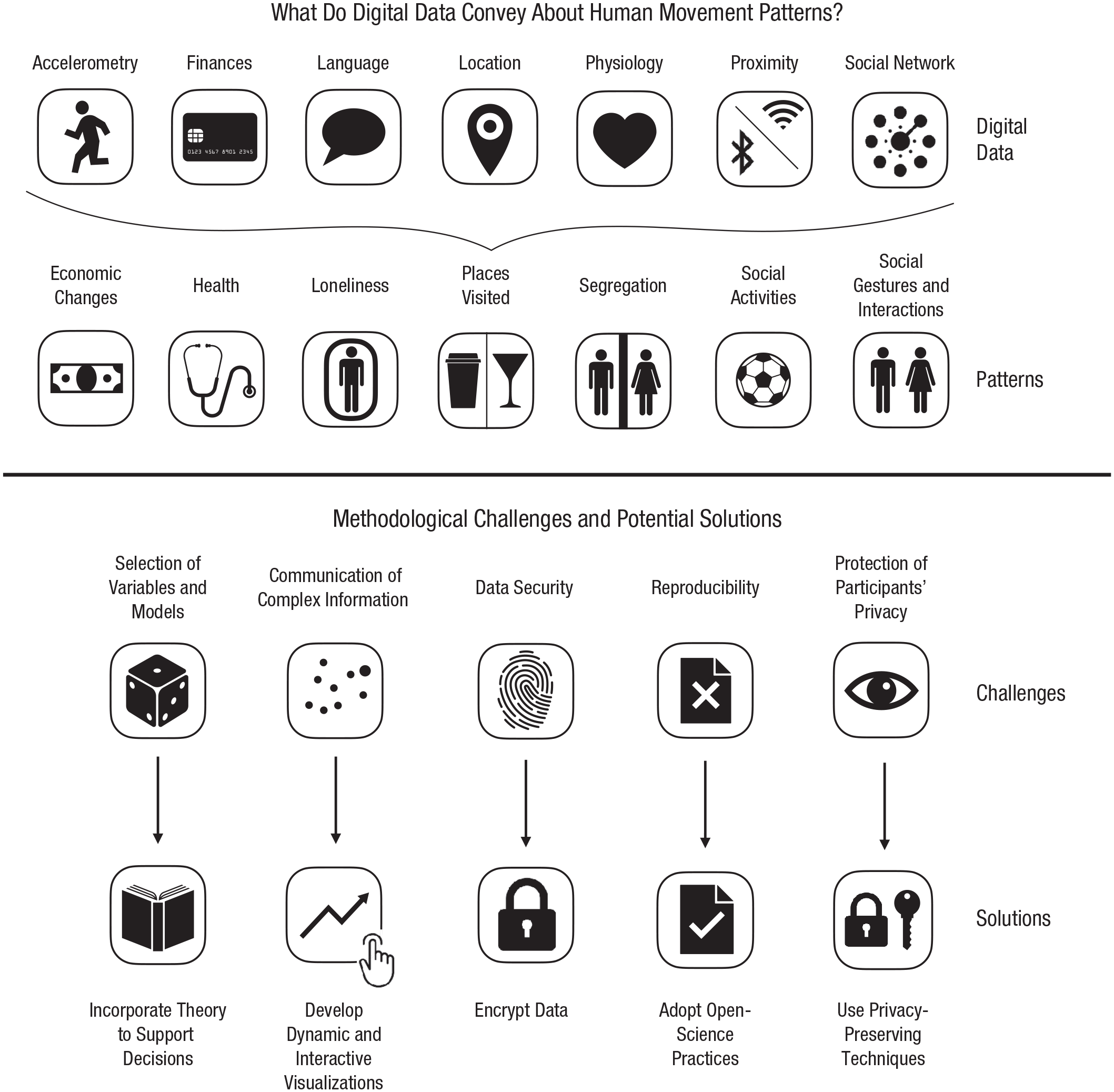
Infographic displaying examples of types of digital data that relate to human movement patterns and some key solutions for challenges presented by these data.
Typically, psychologists use theories to explain why people have specific cognitions, emotions, and attitudes and engage in certain behaviors. In quantitative studies, psychologists tend to use these theories to select variables a priori. For example, intergroup-contact theory suggests that encounters with out-group members can improve attitudes toward those same groups (e.g., Kim & Wojcieszak, 2018). This same theory can then be used to justify the operationalization of independent variables (e.g., social proximity) and dependent variables (e.g., perceived threat). In contrast, data scientists typically use data-driven approaches to examine the relationship between variables (known as features) without any preconceptions about the extent to which those data may provide meaningful insights about people’s behavior. For example, they may explore whether someone’s phone-call records can predict his or hers movements around a region (e.g., Song et al., 2010). In other words, data scientists focus on predicting rather than explaining behavior (Hinds & Joinson, 2019; Yarkoni & Westfall, 2017). If data scientists considered using theory to inform the design of algorithms and the selection of data, they could increase the explanatory power of their findings. Conversely, if psychologists combined traditional methods with data-science approaches, their theories might have greater predictive abilities. In both cases, such work could feed back into theory development.
Recent research has started to demonstrate this potential. Psychological theory has informed the use of digital movement data (in data-science studies), and digital movement data have informed the testing of theory (in psychology studies; see Table 1 for an overview). In the following sections, we highlight some examples and discuss how future research could benefit from interdisciplinary research that capitalizes on new methods.
Examples of Research That Has Combined Psychological Theory and Digital Movement Data
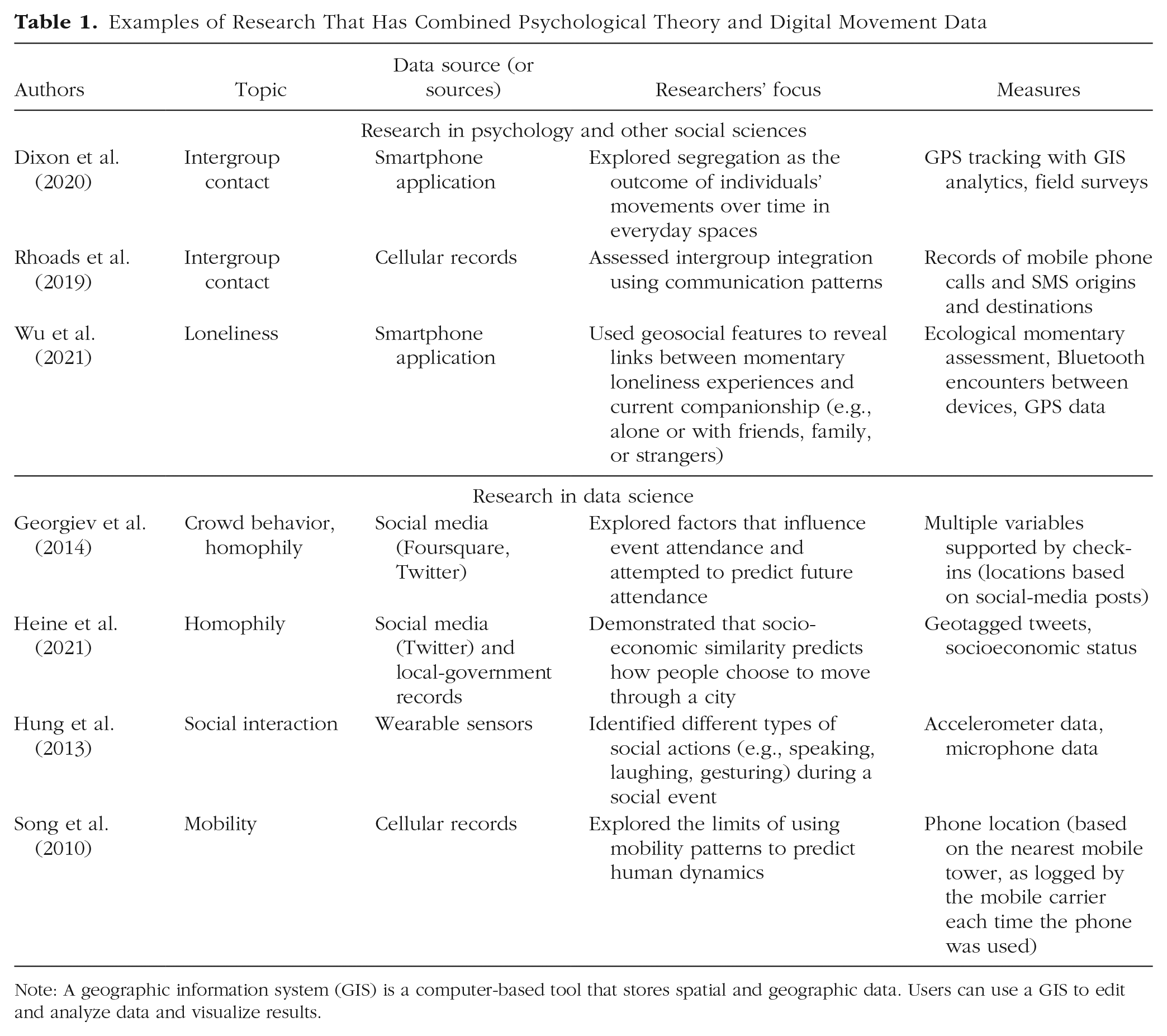
Note: A geographic information system (GIS) is a computer-based tool that stores spatial and geographic data. Users can use a GIS to edit and analyze data and visualize results.
How the Use of Mobilities Data Has Been Informed by Psychological Theories, and Vice Versa
Although detailed explanations of how digital data relate to psychological phenomena are rare, data-science researchers are increasingly using psychological theories to guide their investigations. For example, theories of social identity (Tajfel & Turner, 2001) and collective action (e.g., the elaborated social-identity model; Drury & Reicher, 2000) predict that when individuals adopt the collective identity and norms of a social group, this may affect their movements (e.g., their attendance at concerts, social gatherings, and protests). Inspired by this research, Georgiev et al. (2014) found that when individuals used social media to share information confirming their location and arrival at a specific event (also known as a check-in), it was possible to use this information to predict their future attendance at other events, including football matches, festivals, and conferences. However, the findings did not provide insight into the group or collective phenomena underlying individuals’ movement patterns. Future research could use check-in or GPS data to develop a more complex understanding of how movements and technology interact with psychological phenomena relating to identity and groups. For example, researchers could quantify crowd movement to test key propositions of the elaborated social-identity model (Drury & Reicher, 2000). Specifically, one might hypothesize that shared social identities between responders and members of the public will result in reciprocal behaviors during mass emergencies (Carter et al., 2020; Drury & Reicher, 2000). Modeling patterns of movements of in-group and out-group members around particular places (e.g., as measured by check-in or GPS data) may contribute insights into how changing perceptions of the intergroup dynamic affect the norms of intergroup behavior.
Other researchers have been motivated by sociological and psychological theories to study people’s movements around cities to gain insights on inequality, segregation, and socioeconomic similarities across different neighborhoods. For instance, the theory of homophily states that people who share characteristics (e.g., age, sexuality, hobbies) tend to connect and interact with each other online and to congregate offline (“birds of a feather flock together”; e.g., McPherson et al., 2001). Inspired by this theory, Heine et al. (2021) used geotagged tweets of residents in Stockholm to analyze how their movements around the city connected them to different neighborhoods. The authors found that the socioeconomic similarity of neighborhoods in Stockholm (i.e., similarity in residents’ income, education level, and immigration history) could predict how individuals moved through those areas (i.e., residents of socioeconomically similar neighborhoods were likely to adopt similar movement patterns throughout the city).
Further work in the United States has highlighted that income inequality is also prevalent at a more granular level, which is reflected in mobility patterns at the street level (e.g., a designer shop that attracts high-income customers may be next door to a coffee shop that attracts customers from diverse backgrounds; see the Atlas of Inequality project: https://inequality.media.mit.edu). Whereas these studies are predominantly data driven and describe mobility patterns, in future work researchers could not only delve deeper and describe mobility patterns further, but also clarify how people’s movements vary as a function of individual differences (e.g., personality) and the environment (e.g., rural or city). Research exploring the mechanisms underlying different types of segregation and inequality could be used to develop interventions that reduce inequality. For instance, such research might investigate how movement data relate to (and provide insights on) acculturation, the process of cultural and psychological change caused by intercultural contact between individuals and groups (e.g., Berry, 2005).
Recent research in psychology has highlighted the benefits of testing psychological theory with digital movement data. For example, intergroup-contact theory proposes that contact with out-group members can reduce intergroup prejudice (e.g., Allport, 1954; Hässler et al., 2020). In a study of residents’ movements around Belfast, Dixon et al. (2020) found religious segregation in GPS data: Catholics and Protestants made limited use of facilities and pathways located in out-group areas (see the Supplemental Material available online). By pairing the GPS data with surveys exploring residents’ experiences of intergroup contact, Dixon et al. found that willingness to use out-group spaces was associated with both positive and negative experiences of intergroup contact, and that these associations were partially explained by residents’ perceptions of threat and anxiety about crossing sectarian lines. This work is particularly novel because intergroup-contact theory informed the selection and use of GPS data. At the same time, GPS data provided an opportunity to test intergroup-contact theory—and provided direct evidence of behavior, so that the researchers did not have to rely on self-report alone (e.g., Davidson et al., 2021).
Further, the opportunities to explore psychological theory with digital movement data and to use psychological theory to inform data-science studies are not limited to the contexts and types of data we have just outlined. Other examples in Table 1 reveal that digital movement data (obtained via accelerometers) can be used to study micro aspects of individuals’ movements, such as whether a person is laughing, speaking, drinking, or gesturing when conversing with other people in social situations (Hung et al., 2013). Movements at a population level can also be followed. For example, Salah and colleagues (2019) tracked the migration of Syrian refugees to Turkey. Insights gained from studies such as these have the potential to inform fields beyond psychology, such as time geography, which examines how people distribute their activities across space and time (Miller, 2017), and crisis informatics, which considers how people use technology and geospatial data to coordinate response efforts in emergencies and disasters (Palen & Anderson, 2016). Future research in aligned areas could have further applied impact by informing policy on matters relating to migration, economic inequalities, disaster management, health care, and education. In the following section, we explain how the adoption of interdisciplinary methodologies could help to facilitate these and related advances.
Methods: Challenges and Opportunities When Working With Movement Data
Interdisciplinary work that combines methodological techniques from psychology and computer science will help researchers realize the potential of digital movement data to further understanding of psychological phenomena. However, integrating different methods remains challenging, particularly if researchers are unfamiliar with new methods.
The techniques that can be used for such studies can be categorized as passive (requiring very little or no participant engagement) or active (requiring participation at regular intervals). Both passive and active approaches can be used with smartphones, which offer a convenient way to capture digital data relating to behaviors and contexts that could not be captured at scale otherwise. For instance, the automated collection of GPS data is ideal for studying human movements in outdoor spaces and over geographic distances. Although GPS signals are often not available inside a building, smartphones can switch to other available sources that also report location, such as Wi-Fi or mobile network signals; however, both of these alternatives are generally less accurate than GPS alone (e.g., Geyer et al., 2019). Proximity to other people or places can instead be inferred using other systems, including Bluetooth and radio-frequency identification (RFID) tags (e.g., Elmer et al., 2019).
Of course, GPS and proximity data streams can be switched off by participants. Also, they are not useful for analyzing social interactions in real time or micro aspects of an individual’s movement (e.g., posture or gestures). Researchers might consider using accelerometers or gyroscopes to capture the latter; these devices are cheap, unobtrusive, and (unlike cameras or microphones) resistant to noise, visual obstructions, and other forms of environmental interference (see Hung et al., 2013). Several accelerometers are required to record posture and gestures across the whole body, but some technology (e.g., sociometric badges) can measure basic changes in posture via a single device. The challenge with accelerometers and gyroscopes is that crowded settings can sometimes interfere with their performance, and any glitches with the functioning of the sensors can cause them to fail or produce inaccurate data. In addition, researchers often still need to observe participants. Subjective and objective measures of synchronous interaction (e.g., coding behavior by observing videos vs. using objective data from accelerometers) are often weakly correlated (e.g., Taylor et al., 2021). Ramseyer and Tschacher (2011) argued that objective measures are limited to measuring dynamic synchrony (i.e., the coordination of movement) and therefore overlook both the “static” mirroring of specific gestures and the subjective impressions (the holistic synchrony) that judges may use to guide their coding.
Active approaches for studies combining psychology and digital movement data include questionnaires, which enable researchers to analyze key constructs such as personality, attitudes, and feelings and to explore how they relate to human movements and predict future behaviors. However, questionnaires are often administered retrospectively, and the choice of questionnaire or questions in some areas can affect the conclusions drawn (e.g., Hässler et al., 2020). Walking interviews (which involve walking with participants and interviewing them) provide a way to capture participants’ thoughts and experiences in real time as they move around a particular environment, so that they are less likely to provide the “right” answer (e.g., see Evans & Jones, 2011). The challenge is that they are constrained by time, distance, and physical mobility: The places must be walkable, and the participants must be able to physically walk (or move around) those areas.
Researchers could also consider using social-media data or experience-sampling methodologies (also via smartphones) to gain additional context regarding people’s movements. For instance, social-media posts, photographs, and network data can provide details on an individual’s feelings, activities, and places visited, and also indicate if the individual is alone or with others (e.g., Wu et al., 2021). Indeed, such data may convey location information in the absence of GPS data (e.g., a photograph may reveal information about places and activities), or they may convey raw location data in the form of geotags on posts and check-ins. On the other hand, participants may not post at or check in to every location visited (and they may be highly selective, communicating only places of interest or those that are popular). Combining questionnaires, interviews, or social-media data with digital data collected via smartphones, wearables, and so forth can therefore be a powerful way to investigate the psychological processes underlying individuals’ movements (e.g., Dixon et al., 2020).
New tools
Embracing new technologies, data types, and methodologies is likely to require training in areas such as statistics, machine learning, and data visualization. However, a growing number of smartphone applications and platforms, some of which have been developed by psychologists, provide support for the collection and analysis of movement and location data. For instance, unforgettable.me is an experience-sampling platform that can collect image, GPS, accelerometry, and audio data via an app, as well as source data from social media, wearables, and other devices (Dennis, Yim, et al., 2019); Contact Logger is an application that allows participants to record interpersonal and intergroup encounters alongside their location (Keil et al., 2020); and PEG LOG is an Android application that passively records individuals’ locations longitudinally (Geyer et al., 2019).
Communicating findings from multiple types of data derived from large, complex data sets remains challenging—particularly when researchers want to integrate insights from multiple disciplines. Visualizations can be an ideal way to communicate findings to broader academic disciplines and communities, as well as to policy makers and members of the public. Researchers could consider using dynamic visualizations (i.e., those that are animated or interactive) to communicate findings about people’s movement patterns. Static visualizations, such as bar or line graphs, can be limited in the quantity and type of information that can be presented and can be problematic for projects involving large and complex data sets with multiple dimensions (Weissgerber et al., 2015). Dynamic visualizations are powerful because they can overcome these issues by showing people’s movements over time. In turn, this can also help identify appropriate statistical analyses and support dissemination activities (e.g., Ellis & Merdian, 2015). A prominent example of a dynamic visualization is Dixon et al.’s (2020) animation highlighting the segregation between Catholics and Protestants as they moved around Belfast over a 2-hr period (see the Supplemental Material). The Atlas of Inequality website (https://inequality.media.mit.edu) also showcases an excellent example of an interactive visualization. Users can navigate a city’s map, zooming in on different cities, streets, and places to view their economic inequality.
Balancing privacy and ethical concerns with open-science practices
The use of the methods we have reviewed entails challenges relating to privacy and ethics. Whereas collecting data through smartphone applications or wearable devices involves direct interaction with participants and allows informed consent to be obtained, collecting large volumes of social-media data is usually done without a participant’s awareness, and it is often not possible to obtain consent given the number of people whose data are being collected. In such instances, researchers must ensure that data are anonymized and identifying information is removed.
Researchers must also remain mindful of collecting, analyzing, and storing digital data in an ethically appropriate manner, as the use of digital data generates opportunities for data misuse. For instance, the smartphone applications designed to track and trace the spread of COVID-19 have incited fears over the potential for mass surveillance, and many people have questioned how these data will be safeguarded against misuse or hacking, and what these applications could mean for human rights and freedom of movement (e.g., Norton Rose Fulbright, 2021).
At the same time, researchers are increasingly being encouraged to upload their data to open repositories and adhere to open-science principles. Although such practices are intended to improve the quality and ethical conduct of research, they are often in direct conflict with the need to preserve people’s privacy (Dennis, Garrett, et al., 2019). Researchers must find ways to balance these requirements. For example, the notification drawers of smartphone tracking apps can provide permanent reminders explicitly stating that data collection is ongoing (e.g., Geyer et al., 2019). A complementary approach could involve geofences (virtual perimeters that define geographic locations, e.g., a city center) that trigger alerts when someone enters or exits a specific area. Geofences could help preserve participants’ privacy by restricting data collection to particular areas. Another solution is to use differential privacy, a computational approach that describes information about groups within a data set but withholds information about specific individuals (Dennis, Yim, et al., 2019; Dwork, 2008). (See Dennis, Garrett, et al., 2019, for further recommendations regarding data sharing and open-science practices.)
Looking ahead: a prosperous future
As the use of technology continues to evolve, individuals’ movement behaviors—ranging from small-scale behaviors such as posture and body language to movements across cities, countries, and continents—are increasingly being embedded in (and tracked by) devices. Digital data offer new possibilities to advance understanding of human behavior. The psychologists leading some of this work confirm that it is possible to test existing theories and seek new explanations of psychological phenomena by combining new technologies with an interdisciplinary perspective. By continuing to exploit these opportunities, psychologists will play an increasingly important role in addressing the challenges associated with studying and understanding human movements now and in the future.
Recommended Reading
Dixon, J., Tredoux, C., Davies, G., Huck, J., Hocking, B., Sturgeon, B., Whyatt, D., Jarman, N., & Bryan, D. (2020). (See References). Provides an excellent example of a study using GPS and geographic information system (GIS) analytics to study how individuals’ movement patterns relate to intergroup contact.
Geyer, K., Ellis, D. A., & Piwek, L. (2019). (See References). Introduces a smartphone application that logs and stores location data that can be used in psychological research.
Keil, T. F., Koschate, M., & Levine, M. (2020). (See References). Introduces a smartphone application that enables the recording of interpersonal and intergroup encounters in public and private spaces.
Salah, A. A., Pentland, A., Lepri, B., & Letouzé, E. (Eds.). (2019). (See References). Details methods for using big data on movement patterns and describes a series of studies in which digital data were used to explore Syrian refugees’ patterns of movement and segregation in Turkey.
Ziepert, B., de Vries, P. W., & Ufkes, E. (2021). “Psyosphere”: A GPS data-analysing tool for the behavioural sciences. Frontiers in Psychology, 12, Article 538529. https://doi.org/10.3389/fpsyg.2021.538529. Introduces a tool that can be used to analyze GPS tracks and their relationship with different behavioral variables, such as fear, self-focus, and contemplation.
Footnotes
Acknowledgements
The authors would like to thank John Dixon for his valuable comments on an earlier version of the manuscript and for providing the visualization included in the Supplemental Material.
Transparency
Action Editor: Robert L. Goldstone
Editor: Robert L. Goldstone

Notes
References
Supplementary Material
Please find the following supplemental material available below.
For Open Access articles published under a Creative Commons License, all supplemental material carries the same license as the article it is associated with.
For non-Open Access articles published, all supplemental material carries a non-exclusive license, and permission requests for re-use of supplemental material or any part of supplemental material shall be sent directly to the copyright owner as specified in the copyright notice associated with the article.
