




Abstract
The present investigation brings to the readers three new hybrid higher-order shear deformation theory (HSDT) models and analyses the functionally graded material (FGM) plates. The major objective of this work is to develop three HSDTs in a unique formulation by polynomial–hyperbolic–exponential and polynomial–trigonometric forms, propose the three new HSDT models, investigate the effect of thickness stretching by considering a quasi-three-dimensional theory and analyse the free vibration of isotropic and FGM monolayer and sandwich (symmetric as well as non-symmetric, with hardcore as well as softcore) plates to demonstrate the models ability. Therefore, the Hamilton’s principle is exploited to develop equations of motion based on a displacement field of only five unknowns, of which three of them distinguished the transverse displacement membranes through the plate thickness (bending, shear and stretching displacements). In addition, the analytical solutions are found by applying the Navier approach for a simply supported boundary conditions type. The theory also considered that transverse shear deformation effect satisfied the stress-free boundary conditions on the plate-free surfaces without any requirement of shear correction factors. The used mechanical properties followed the power law and the Mori–Tanaka scheme distributions through the plate thickness. The determined results explained the effects of different non-dimensional parameters, and the proposed HSDTs predict the proper responses for monolayer and sandwich (symmetric as well as non-symmetric, with hardcore as well as softcore) FGM plates in comparison with other different plates’ theories solutions found in the literature references, thus the reliability and accuracy of the present approach are ascertained. It is obtained that the present formulations of polynomial–hyperbolic–exponential and polynomial–trigonometric forms can be further extended to all existing HSDTs models, for numerous problems related to the shear deformable effect.
Keywords
Introduction
Functionally graded materials (FGMs) are a new generation of the composite materials (ceramic/metal) that were developed by a Japanese material scientists group from National Aerospace Laboratories in 1984, as a means of preparing thermal barrier materials. 1 These materials have been given great popularity in the design, fabrication and development research fields, after the first national project entitled ‘Research on the Basic Technology for the Development of FGMs for Relaxation of Thermal-Stress’, because of their considerable thermal and mechanical capabilities. 2 –12 Their richer compositions of ceramic qualified them to be used in sectors of extremely high temperature, such as aeronautical structures, space aircraft and nuclear enclosures. The used FGM plates and shells avoid several problems in classical composite materials, especially during dynamic or cyclic loadings, such as the delamination problem. However, they are subjected to the vibration problem. As a result, these problems have been treated by many analytical and numerical studies based on different plate theories that were developing in three phases, which are the classical plate theory (CPT), the first-order shear deformation theory (FSDT) that requires a shear correction factor, as well the higher-order shear deformation theory (HSDT) that includes a shear deformation effect, such as the sinusoidal higher-order shear deformation theory (SSDT), which was used by a two-dimensional (2D) HSDT derived by Matsunaga. 13 He analysed the free vibration problem by a method of power series expansion of displacements components, and a set of fundamental dynamic equations, for rectangular FGM plates with simply supported edges. Belabed et al. 14 presented a hyperbolic HSDT with the stretching effect to predict free vibration responses of FGM plates. They indicated that the thickness stretching effect for thick plates is important. It is noticed that Talha and Singh 15 presented an HSDT for an investigation of the free vibration problem and made a special modification in the transverse displacement in conjunction with finite element models. The obtained results employed a continuous isoparametric Lagrangian finite element with 13 degrees of freedom per node. They used the FGM plates with different boundary conditions. A new HSDT developed by Ait Atmane et al. 16 studied free vibration resting on Winkler–Pasternak elastic foundations analysis of FGM plates. Whereas the higher-order shear and normal deformable plate theory studied by Qian et al. 17 used the meshless local Petrov–Galerkin method. The theory investigated both of the free and forced vibrations analyses of a thick rectangular elastic FGM plate. They used only the Mori–Tanaka homogenization technique to calculate the effective material modules. Younsi et al. 18 developed a new 2D and quasi three-dimensional (quasi-3D) hyperbolic HSDT for the analyses of free vibration problem of FGM plates, and the used displacements field included undetermined integral terms. A new quasi-3D hyperbolic HSDT for the free vibration analysis of functionally graded plates is developed by Hebali et al. 19 Zaoui et al. 20 studied the free vibration of FGM plates resting on elastic foundations based on quasi-3D hybrid-type HSDT. A new SSDT developed by Thai and Thuc 21 analysed the vibration of FGM plates. It can be seen that Neves et al. 22 studied a quasi-3D SSDT for the free vibration problem analysed for FGM plates. A new HSDT developed by Thai and Kim 23 analysed the free vibration problem of FGM plates with simply supported edges. Abedalnour et al. 24 developed a new quasi-3D trigonometric HSDT and a new displacement field that introduced undetermined integral variables for the free vibration analysis of FGM plates with simply supported edges. A quasi-3D SSDT developed by Neves et al. 25 analysed the free vibration problem of the FGM plates. A new quasi-3D hyperbolic HSDT was developed by Neves et al. 26 for the free vibration analysis of FGM plates with simply supported edges. Thai et al. 27 proposed a new inverse tangent shear deformation theory for the free vibration analysis of laminated composite and sandwich plates. In addition, two new shear deformation theories for the free vibration analysis of FGM made of isotropic and sandwich plates are presented by Thai et al.. 28 Nguyen-Xuan et al. 29 presented a new fifth-order shear deformation theory for composite sandwich plates and the free vibration analysis of rectangular and circular plates investigated for different boundary conditions. Thai et al. 30 derived a quasi-3D shear deformation theory for free vibration analysis of multilayer functionally graded graphene platelet-reinforced composite microplates. A new shear and normal deformations theory for the free vibration of FGM isotropic and sandwich plates is presented by Thai et al.. 31 Based on an HSDT, Thai et al. 32 presented a non-classical model for the free vibration analysis of FGM isotropic and sandwich microplates. Nebab et al. 33 used an HSDT to predict the free vibration of the FGM plate. A novel quasi-3D HSDT constructed from a novel seventh-order shear deformation is proposed by Nguyen et al. 34 to investigate the free vibration responses of rectangular and circular FGM microplates. Bennoun et al. 35 developed a new quasi-3D HSDT for the free vibration analysis of FGM sandwich plates. Zaoui et al. 36 proposed a new hybrid 2D and quasi-3D HSDT (exponential–trigonometric), for the free vibration analysis of FGM plates, resting on elastic foundations. An HSDT was studied by Belkhodja et al. 37 for the free vibration analysis of FGM plates with simply supported edges. A new hyperbolic HSDT is presented for the free vibration analysis of FGM sandwich plates by El Meiche et al. 38
The present study developed three new hybrid quasi-3D and 2D HSDTs (polynomial–hyperbolic–exponential) and (polynomial–trigonometric) for the free vibration problems analysis of square and rectangular FGM monolayer and sandwich (symmetric as well as non-symmetric, with hardcore as well as softcore) plates with simply supported edges. The selected displacements field included the transverse shear deformation effect that satisfied the stress-free boundary conditions on the plate free surfaces, and only five unknowns, which three of them characterized the bending, shear and thickness stretching transverse displacement membranes through the plate thickness. The mechanical properties are continuously varied through the plate thickness as the power-law (P-FGMs) and the Mori–Tanaka scheme (MT-FGMs) distributions. Moreover, the produced five equations of motion were obtained from Hamilton’s principle and were solved by the Navier approach for simply supported boundary conditions. Furthermore, a richer study investigated several parameters effects such as the geometric ratios (the side-to-thickness ratio, the aspect ratio as well the thickness ratio for symmetric and non- symmetric, with hardcore as well as softcore sandwich plates), the volume fraction index, the frequency modes and the materials properties on the natural frequencies. Finally, analytical solutions were obtained and numerical results were validated by comparisons with others plates’ theories solutions found in the literature references to verify the accuracy and the efficiency of the present theories.
The theoretical formulation
An accurate and efficient theoretical formulation is achieved for the FGMs by a developed architecture of design, processing and evaluation. 1 Thus, the used architectural design is a monolayer (single-layer) and sandwich (symmetric as well as non-symmetric, with hardcore as well as softcore) plates of the dimensions indicated as length (a), width (b) and uniform thickness (h) as shown in Figures 1, 2 and 3, respectively. The thickness evolution follows the z-coordinate (z-axis) perpendicular to the rectangular Cartesian coordinates (0, x, y) defined in the plate median plane, 37 and all in-plane edges of the plate are parallel to x and y axes as well as the bottom and top plate faces are at the plate extremities z = ±h/2, with respect to the coordinates h1 and h4.

The FGM plate geometric model. 37 FGM: functionally graded material.

The FGM sandwich plate geometric model (type A). FGM: functionally graded material.
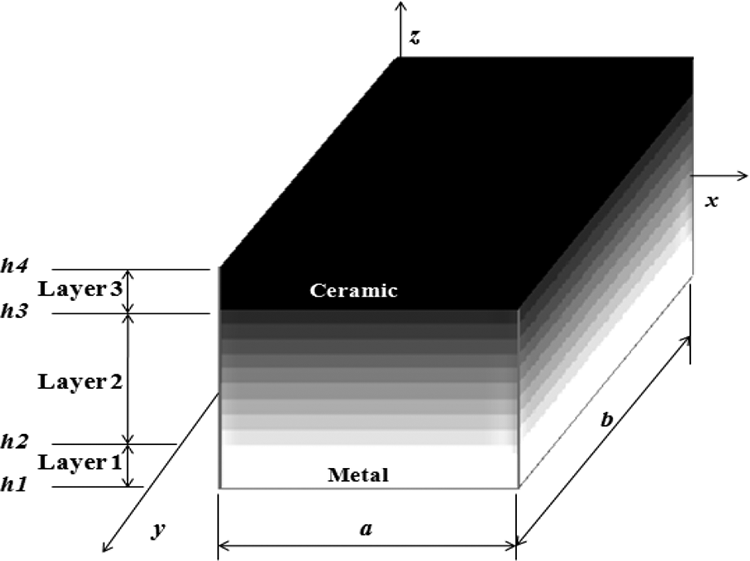
The FGM sandwich plate geometric model (type B). FGM: functionally graded material.
The sandwich plates (symmetric as well as non-symmetric, with hardcore as well as softcore) are composed of three elastic isotropic homogeneous and anisotropic microscopically heterogeneous layers (Figures 2 and 3): Layer 1 is a bottom face layer (z∈[h1, h2]); layer 2 is a median core layer (z∈[h2, h3]); and layer 3 is a top face layer (z∈[h3, h4]), where h2 and h3 are the vertical coordinates of the two median interfaces (Figures 2 and 3).
Therefore, the plates were characterized by geometric ratios such as the side-to-thickness ratio (a/h), the aspect ratio (a/b)
37
and the thickness ratio. The ratio (a/h) specifies three plate thicknesses that are a thick plate (with a low ratio values such as (a/h = 2,
For structural and functional uses, FGM concept can be applied to several materials. 1 However, the studied FGM plate was made from a graded mixture of only two different materials, a metal (aluminium: Al) and a ceramic (alumina: Al2O3 or zirconia: ZrO2), of mechanical properties grouped in Table 1.
The material properties of metal and ceramics.

The mechanical properties of the FGMs
FGM compositions gradually change, resulting in a corresponding modification in the effective mechanical properties, 1 they although heterogeneous are idealized as continue through the plate thickness (z-axis), smoothly with respect to the spatial coordinates. 39 Contrary to a discrete model, the mechanical properties are assumed to be graded by simple continuous material distributions neglecting the microstructure of the plate. 37,40 The mechanical properties are the Young’s modulus, the Poisson’s ratio and the density, were described from homogeneous plate theories, after homogenized the FGM plate with their effective modules. 37,40
The Young’s modulus
The Young’s module (E(z)) can be expressed by the rule of mixture and follows the mathematical formulation that describes the power-law, 41 and the Mori–Tanaka scheme, 42,43 according to the equation (1):

where E(n) , V(n) , (n = 1,2,3) denotes the effective material property and the volume fraction function of layer (n), respectively. For the monolayer plate (n = 1), Ec and Em are the Young’s moduli of the upper (ceramic) and lower (metal) FGM plate faces, respectively. The volume fraction of the ceramic material (Vc ) is defined in equations 2 (a–d):
For monolayer plate:
Type P-FGMs:

Type MT-FGMs:

For sandwich P-FGM plate:
Type A:

Type B:
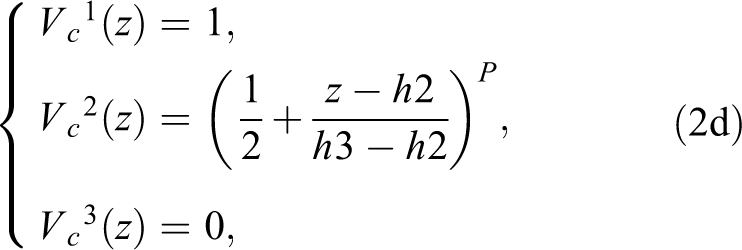
where the positive volume fraction index (p) specifies three plate types, namely the homogeneous ceramic plate (p = 0, extremely stiff), the FGM plate (p∈]0,∞[, there is the stiffer P-FGM plates (p∈]0,1[), the moderately stiff P-FGM plates (p = 1) as well as the softer P-FGM plates (p∈]1,∞[) and the metal plate (p→∞, extremely soft), 37 as well FGM distributions profiles through the plate thickness z∈[-h/2, h/2] only, follow the volume fractions (Vc ), continuously and gradually varied as a function of the position (z-coordinate), as presented in Figure 4 (a) and (b). 37

Ceramic material volume fraction: (a) the power law profile
The Poisson’s ratio
When the Poisson’s ratios (ν (z)) of the ceramic and the metal are nearly equal, the Poisson’s ratio is considered constant because there is no significant difference between obtained results, and it has no significant effect on the FGM plate. 43,44
The density (the mass density)
The effective density (ρ(z)) is estimated only by the power law with Voigt’s mixtures rule 45 as:

The kinematics, the strains, the stresses and the energies study of the present new HSDTs
The kinematics
The present developed HSDTs is a combination of both the procedure were developed for monolayer plates by Belabed et al., 14 with the used point displacements field extended as the bending (wb ), the shear (ws ) and the stretching (wst ) transverse displacement membranes through z-axis, and with only five unknowns (significantly facilitated engineering analyses) as well as the procedures of sandwich (symmetric as well as non-symmetric, with hardcore as well as softcore) plates developed by El Meiche et al., 38 written as:


where u0 and v0 are, respectively, the axial displacements over the x and y Cartesian coordinates axes on the plate median plane. The developed new hybrid (polynomial–hyperbolic–exponential) and (polynomial–trigonometric) shape functions (f (z)) are presented in Table 2, with several other shape functions derived by others researchers illustrating the transverse shear strains and tangential stresses effect nonlinear distribution through the FGM plates thickness (h) 37 and specifies three plates theories displacements field that are the CPT with (f (z) = 0), the FSDT 42 with (f (z) = z), else the HSDT. Numerical examples are given to show high accuracy of the proposed method in Tables 3 to 8, approved the novelty, simplicity and effectuality of these new HSDTs and shape functions.
Shape functions form of different higher-order shear deformation theories.

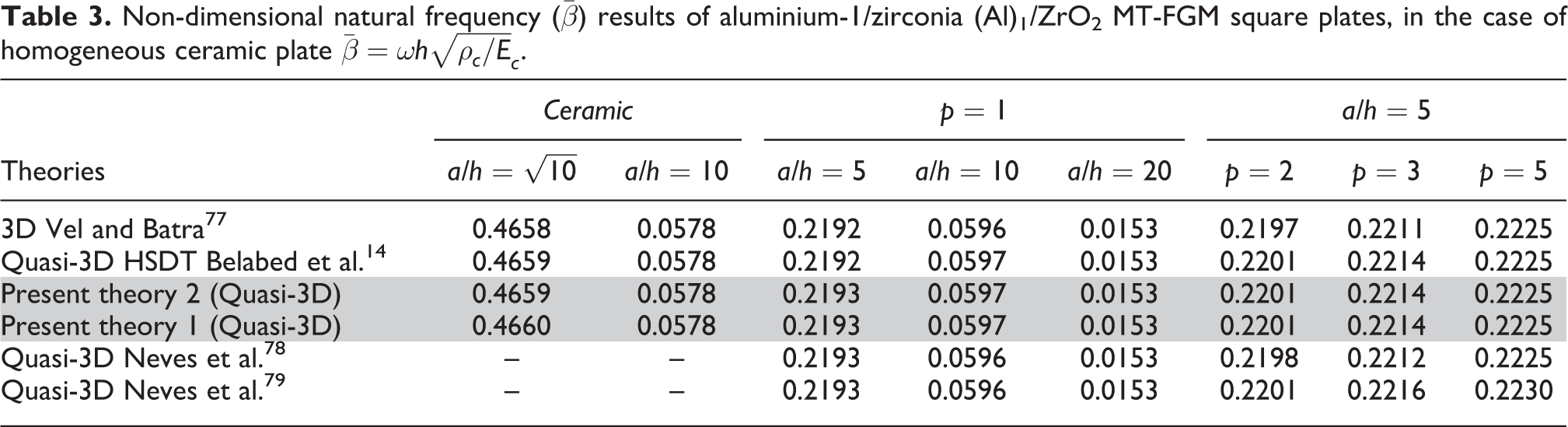
Non-dimensional natural frequency (
Non-dimensional fundamental frequency (
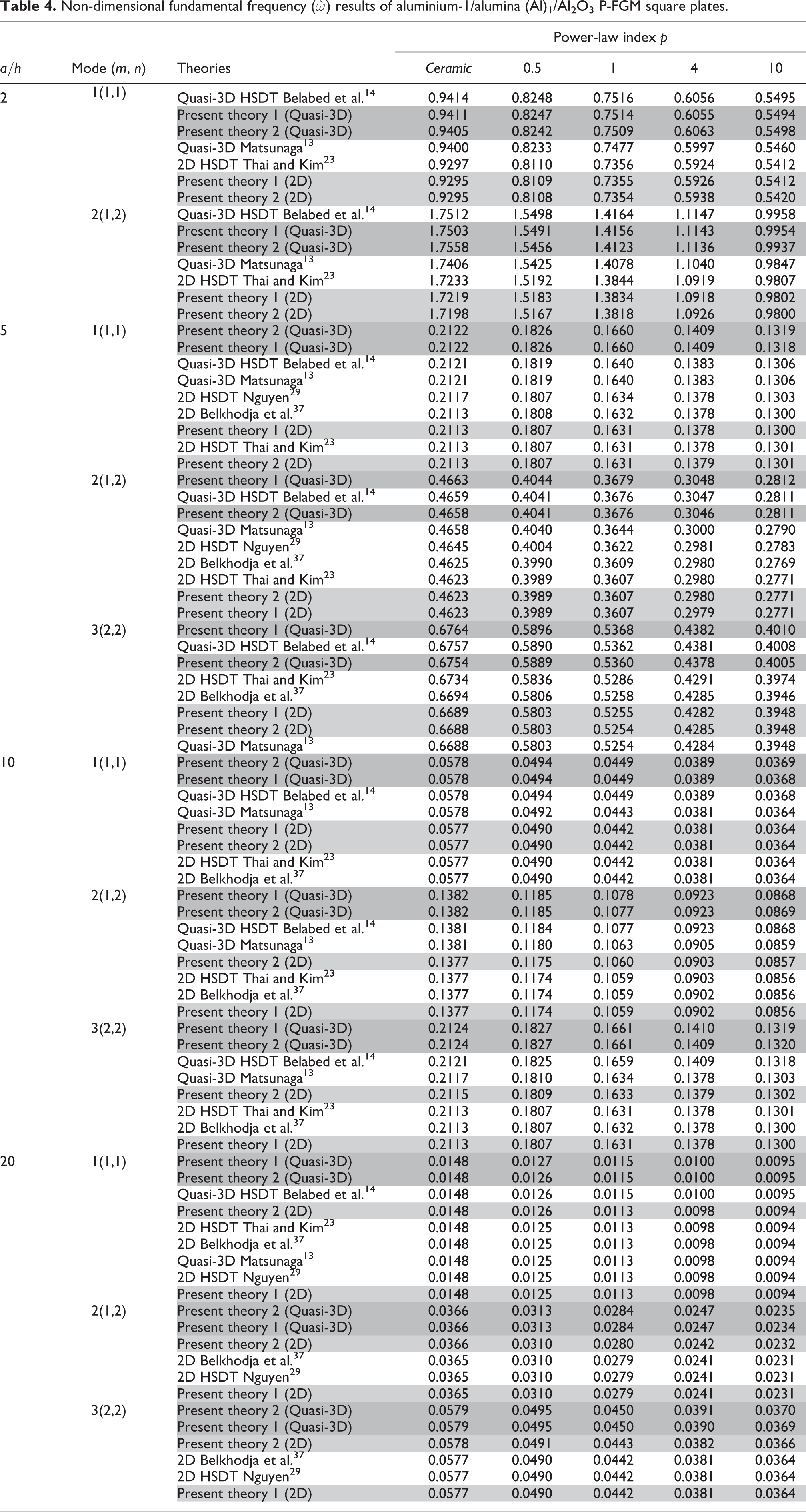
Non-dimensional fundamental frequency (

Non-dimensional natural fundamental frequency parameter (
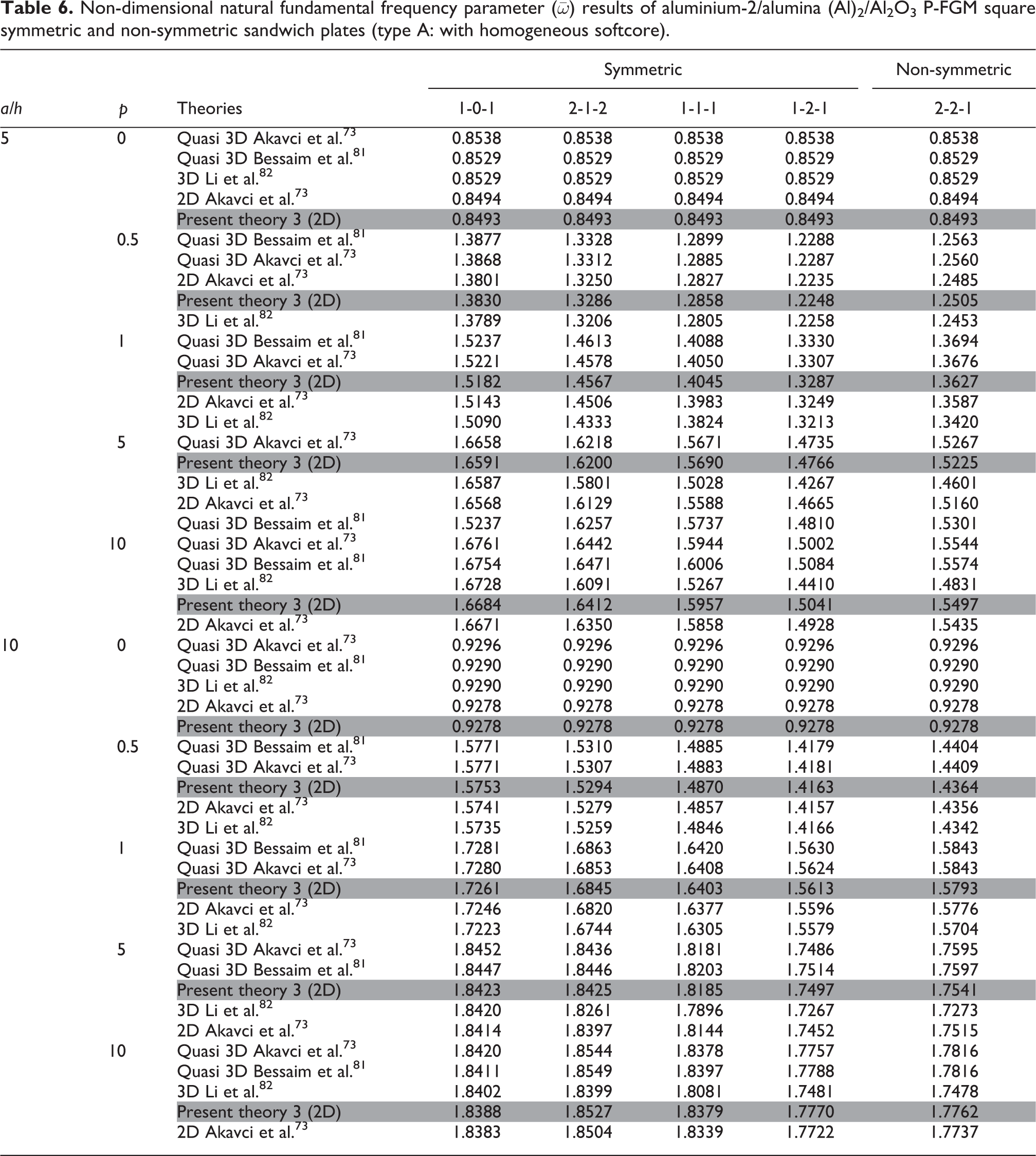
Non-dimensional natural fundamental frequency parameter (
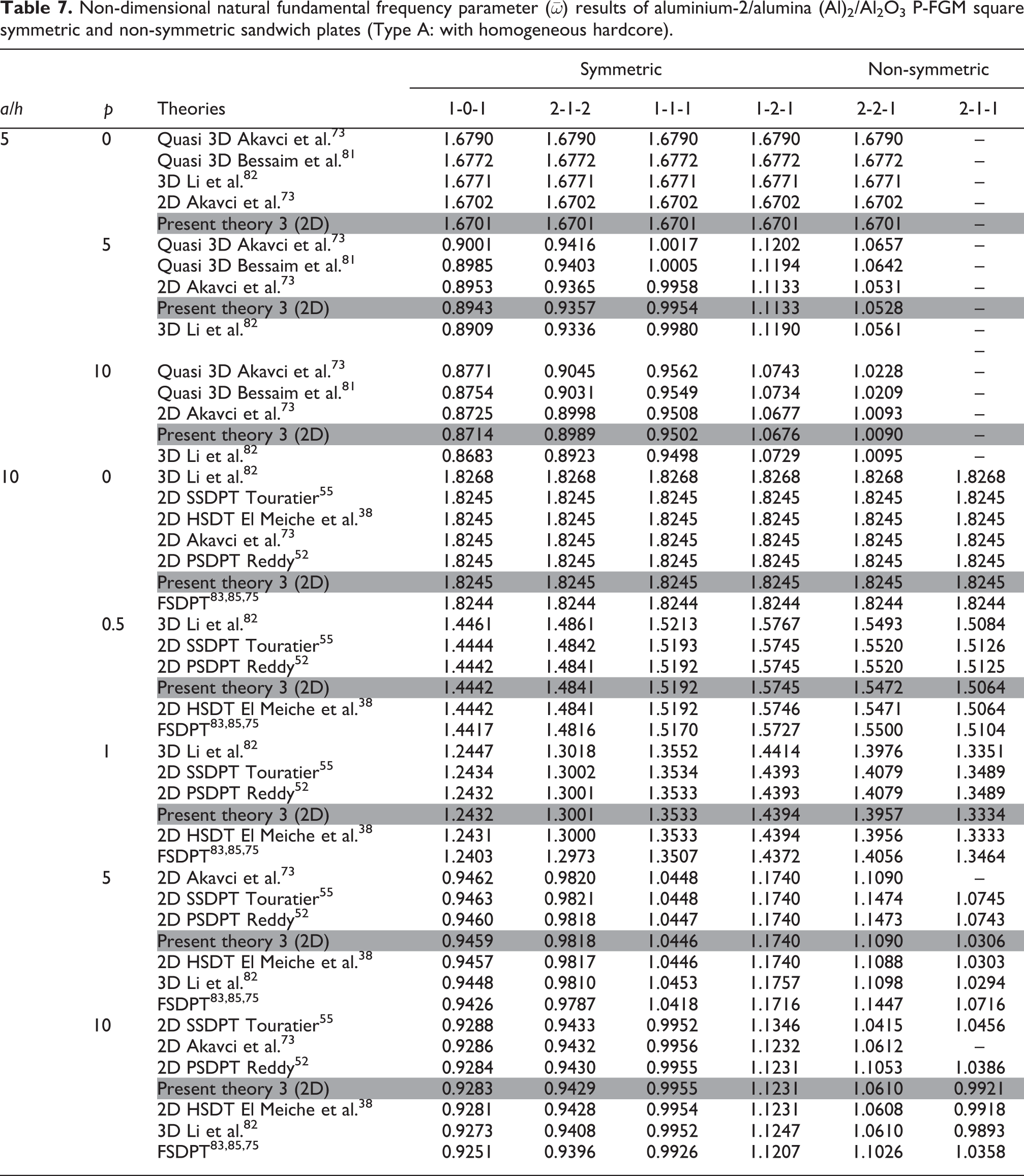
Non-dimensional natural fundamental frequency parameter (

The thickness stretching transverse displacement (wst ) is defined as

where an additional term of transverse displacement component ϕ accounts for the normal deformation effect (stretching effect), and the function g (z) describes thickness stretching effect distribution through the plate thickness and also the transverse shear stress distribution through the same thickness that satisfied and fulfilled the stress-free boundary conditions, as a parabolic variation, as well as it is set to zero at the plate extremities (top and bottom plates surfaces) z = ±h/2. 37

The strains
The linear strains field is determined by the linear elasticity theory application based on the displacements field (4) derived as

and

The stresses
The constitutive relations (stress–strain relations) described the linear mechanical behaviours of the FGM plates, and the linear stresses field are written in terms of the stiffness matrix as

where the stiffness matrix includes stiffness coefficients, which are defined for 2D HSDT (∊z = 0) as


Hence, for 3D and quasi-3D HSDT (∊z ≠ 0) are given as



The energy principle
The equations of motion are determined for deformable bodies by the Hamilton’s principle that is formulated as

where t′ denotes a time period as well δU and δK are, respectively, the strain energy and kinetic energy variations of the FGM plates.
The strain energy
The strain energy (energy of internal loads) variation is calculated in equations (13) as follows, without the stretching effect (ϕ = 0):

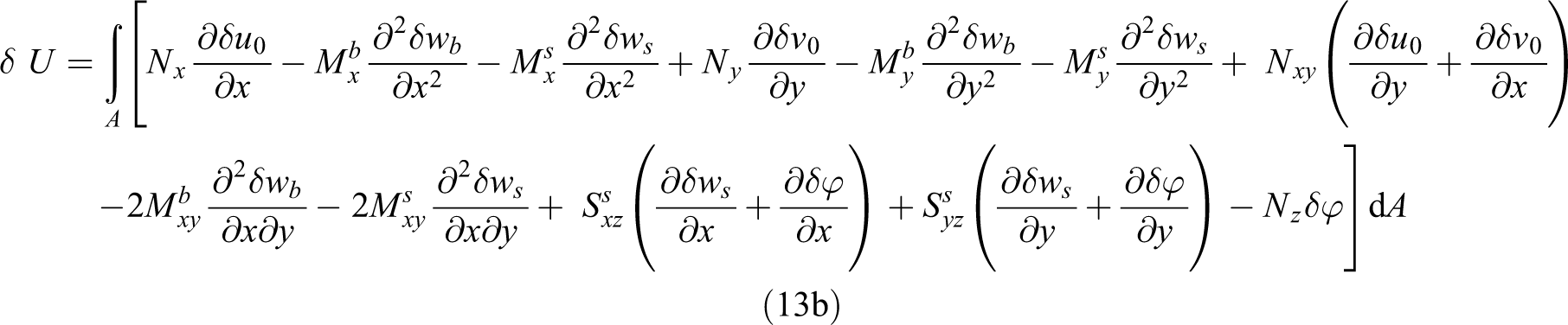
where A, V and N, M, S denote, respectively, the section, the volume and the stresses resultants that are defined as in equations (14), without the stretching effect (Nz = 0):

The kinetic energy
The kinetic energy variation is determined as in equations (15), without the stretching effect (ϕ=0):


where the dot-superscript convention indicates the differentiation with respect to the time variable (t), the terms Ii
, Ji
and Ki
denote the moments of inertia that are expressed as in equations (16), without the stretching effect

The equations of motion:
The five equations of motion are found by substituting the energies variations (13 and 15) in the Hamilton’s principle (12), then collecting the coefficients δu0
, δv0
, δw0
and δ
ϕ together, after integrating by parts every found term, they are appropriate to the five unknowns of the displacements field and the constitutive equations. The first equation of motion system is expressed in terms of displacements and strains as in equations (17), without the stretching effect (Nz
= 0), (ϕ = 0),





where
When the stresses field (10) is substituted into the first stresses resultants (15), the second ones (18) are presented as a function of strain as in equations (18), without the stretching effect (Nz = 0), (ϕ = 0), (P, Pa, T, Ta )=0:

where the stiffness coefficients for quasi-3D HSDT (∊z ≠ 0) areas in equations (19), without the stretching effect (P, Pa, T, Ta )=0:


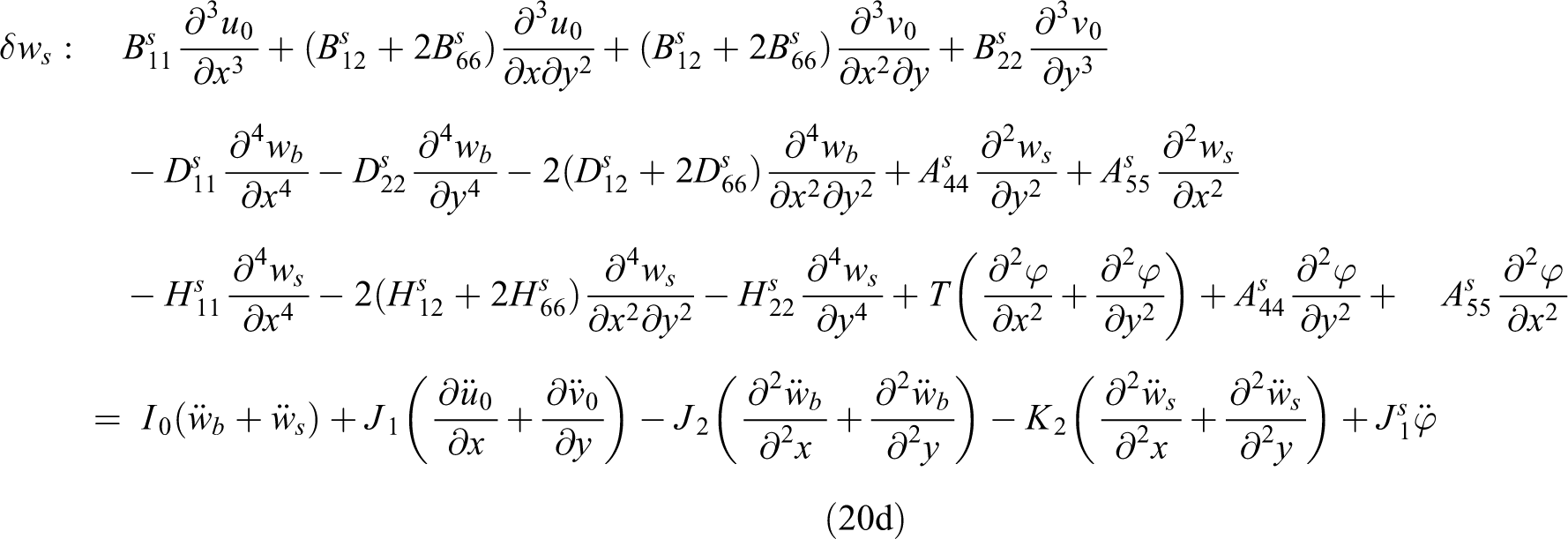
By substituting the stresses resultants (18) into the first equations of motion system (17), the following simplified system is found as in equations (20), without the stretching effect (Nz
= 0), (ϕ = 0), (P, Pa, T, Ta
) = 0



Navier approach for simply supported plates
In general, plates are classified in accordance with the used support type. Thus, in the present study, the following boundary conditions form for simply supported plate edges is imposed at the plate side edges as:


The Navier approach for simply supported boundary conditions is used to find analytical solutions of equations (20). The Navier approach solutions are partial differential equations in terms of displacements functions that satisfy the equations of boundary conditions (21), expressed by the following double-Fourier series for the plate with shear deformation model as in equations (22), without the stretching effect (ϕ = 0):

where Umn , Vmn , Wbmn , Wsmn and Φ mn are arbitrary determined parameters subjected to the conditions that the solution in (22) satisfies equations of motion (20), ω is the eigenfrequency associated with (m, n)th eigenmode of the plate for the free vibration analysis, λ = mp/a, µ = np/b.
The double-Fourier series of displacements form (22) are substituted into the equations of motion system (20), and after some derivations and simplifications, the following equivalent system is obtained as in equations (23), without the stretching effect (Nz
= 0), (ϕ = 0), (P, Pa, T, Ta
)=0


where the matrix [A] is
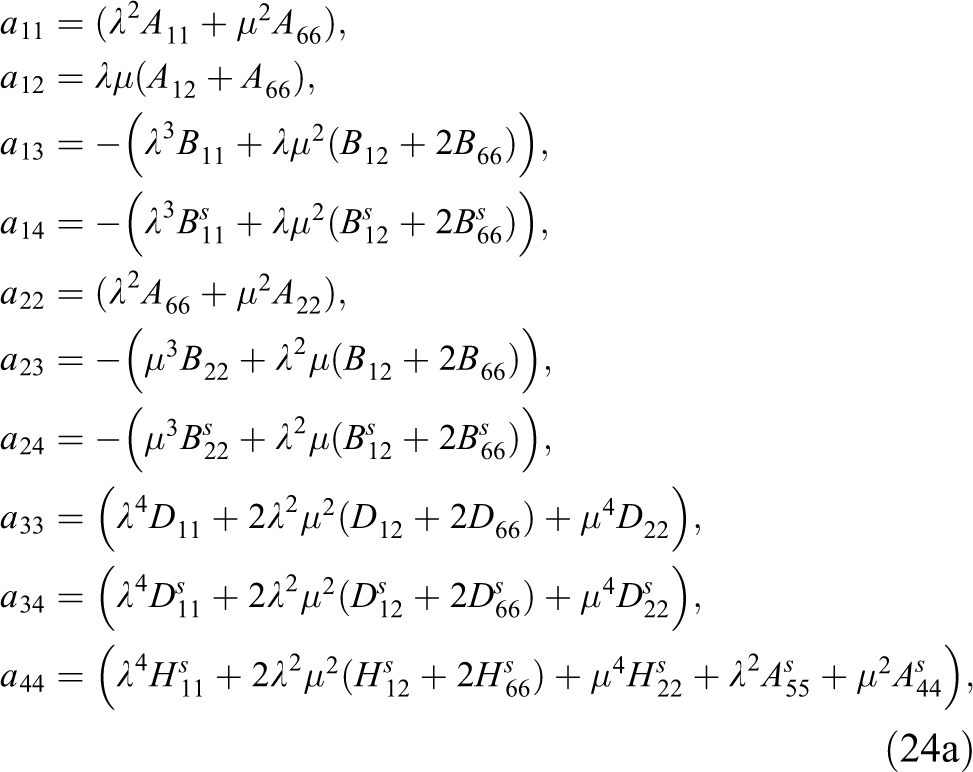
For the additional stretching effect

As well the matrix [M] is
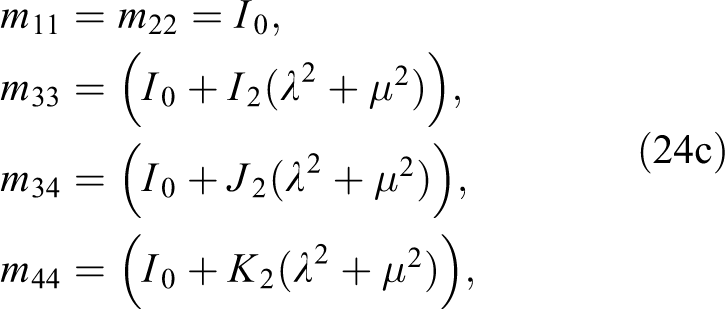
For the additional stretching effect

Numerical examples, results and discussions
The present theory accuracy, novelty, simplicity and effectuality are evaluated for the free vibration analysis (the plate is not subjected to external loads) of both the square and rectangular, aluminium-1/alumina (Al)1/Al2O3 and aluminium-1/zirconia (Al)1/ZrO2 P-FGM and MT-FGM monolayer plates in Tables 3
to 5 as well as square aluminium-2/alumina (Al)2/Al2O3 P-FGM sandwich (symmetric as well as non-symmetric, with hardcore as well as softcore) plates in Tables 6
to 8 with simply supported edges. The obtained results were determined from the new developed hybrid HSDTs (polynomial–hyperbolic–exponential), (polynomial–trigonometric) and Belabed et al.,
14
El meiche et al.
38
theoretical formulation models. Many numerical examples investigated the different non-dimensional parameters effects such as the volume fraction index (p), the geometric ratios (a/h, a/b), the thickness ratio, the frequency modes (m, n) and the materials properties on the non-dimensional free vibration fundamental and natural frequencies (
For this study, the used matrices general form (23) analysed the free vibration problem as well the resulted non-dimensional mathematical relations are listed as:
For P-FGM and MT-FGM monolayer plates:

For P-FGM sandwich plates

where ρ0 = 1 kg/m3 and E0 = 1 GPa
Example 1. The natural frequency (
Example 2. The fundamental frequency (
Example 3. The fundamental frequency (

Non-dimensional fundamental frequency (
Example 4. The fundamental frequency (
It should be noted that the obtained results are in very good agreement with all the mentioned theories solutions, especially with Akavci et al.
73
and El Meiche et al.
38
solutions even for thin and stiffer P-FGM plates, where (
Example 5. The fundamental frequency (
The 2D HSDT 3 results are in well agreement with all the presented theories solutions, especially with El Meiche et al. 38 and Akavci et al. 73 where the calculated maximum errors are, respectively, 3.0967% and 3.1729%. These are an insignificant values obtained for ((m, n) = (1,4)) and non-symmetric sandwich plates (2-2-1). The 2D HSDT 3 results are important for the frequency mode ((m, n) = (4,4)).
Example 6. The fundamental frequency (
The 2D HSDT 3 results are in good agreement with all the presented theories solutions, especially with Akavci et al. 73 where the calculated maximum errors is 0.7513%, this is a negligible value obtained for (a/h = 5, p = 10, and non-symmetric sandwich plates (1-2-1)).
Conclusion
The developed three hybrid quasi-3D and 2D HSDTs analysed the free vibration problem of the isotropic, the MT-FGMs and P-FGMs, monolayer and sandwich (symmetric as well as non-symmetric, with hardcore as well as softcore) plates with simply supported edges, the theory investigated the displacements field of five unknowns, in which the transverse displacement membranes are the bending, the shear and the stretching through the plate thickness. The stretching displacement is in terms of the transverse shear deformation and stress that satisfied the stress-free boundary conditions on the plate free surfaces. The appropriate equations of motion are extracted from the Hamilton’s principle and are solved by the Navier approach. The study of several parameters effects such as the volume fraction index, the geometric ratios, the frequency modes, and the materials properties on the natural frequencies are analysed. The proposed model reliability and accuracy, novelty, simplicity and effectuality of these new HSDTs are ascertained by comparisons of the calculated results with others plate theories solutions found in the literature references. As a conclusion, these theories are appropriate, simple, accurate and effective, as well as it gave the following results: It is obtained that the present formulations of polynomial–hyperbolic–exponential and polynomial–trigonometric forms can be further extended to all existing HSDTs models for numerous problems related to the shear deformable effect. The obtained results are in good agreement with the different others quasi-3D and 2D HSDT solutions in many cases that confirms the theory convergence.In the P-FGM plates, the ( The increase in the fundamental frequencies ( Furthermore, there is always a little difference between the quasi-3D results curve and the 2D results curves except for homogeneous ceramic plate (p = 0), where the quasi-3D results curve is underestimated in comparison with others ones and the reason is the stretching effect that is clear for softer and thick plates.
Footnotes
Acknowledgement
The authors thank Professor B Achour for their help and Editorial Office team and the reviewers for their valuable comments.
Declaration of conflicting interests
The author(s) declared no potential conflicts of interest with respect to the research, authorship, and/or publication of this article.
Funding
The author(s) received no financial support for the research, authorship, and/or publication of this article.
