An exponential-trigonometric higher order shear deformation theory (HSDT) for bending,free vibration,and buckling analysis of functionally graded materials (FGMs) plates
Open accessResearch articleFirst published online 2020
An exponential-trigonometric higher order shear deformation theory (HSDT) for bending,free vibration,and buckling analysis of functionally graded materials (FGMs) plates
Two assumptions have been made based on by this proposed theory, which come from recently developed exponential–trigonometric shape function for transverse shear deformation effect and a simple higher order shear deformation theory for plate, based on a constraint between two rotational displacements of axis parallel to the plate midplane, about the axes x, y Cartesian coordinates system, which caused fewer unknown number. For the application of this method, a displacement field extended as only bending membrane for transverse displacement is used, a governing equations of motion as a result are determined according to Hamilton’s principle, and simplified using Navier analytical solutions, as well as the transverse shear stresses effect that satisfied the stress-free boundary conditions on the simply supported plate free faces as a parabolic variation along the thickness are taken into account. A functionally graded materials plates are chosen for the parametric study, where the plates are functionally graded continuously in materials through the plate thickness as a function of power law or exponential form. The aim of this study is to analyze the bending, free vibration as well as the buckling mechanical behaviors, where the results are more focused on the investigation of different parameters such as the volume fraction index, geometric ratios, frequency modes, in-plane compressive load parameters and material properties effects on the deflection, stresses, natural frequencies, and critical buckling load, which are validated in terms of accuracy and efficiency with other plate theories results found in the literature.
The FGMs characterized by attractive mechanical properties, in which varied continuous gradation of materials, allows for a structurural arrangement to move from complete ceramics on a surface to the entire metal on the other one, which becomes a solution to avoid the problem of inhomogeneous stresses distribution (stresses concentration) and the displacement discontinuity, which generate interface problems in composite materials with fiber. Consequently, FGMs are alternative materials widely used in several industries such as aerospace, nuclear reactor, optical, civil engineering, biomechanical, automotive, electronic, chemical, and mechanical industries,1–3 and recently, FGMs find their applications in micro- and nanodevices.4–7 The investigation on FGMs under bending (static), buckling (static), and vibration (dynamic) permits to study the mechanical behaviors of these structures, by various developed mathematical and analytical models. Consequently, Zenkour8 studied the bending problem with transverse load on isotropic inhomogeneous rectangular plate using two-dimensional (2-D) trigonometric and three-dimensional (3-D) elasticity solutions, based on small-strain linear elasticity theory and the Ritz method with Chebyshev displacement functions. The vibration problem of FGMs plates with multitude boundary conditions are studied by Uymaz and Aydogdu.9 Carrera et al.10 evaluated the thickness stretching effect in single-layered and multilayered FGMs structures, with various plate and shell models and grading variable rates are implemented using Carrera’s unified formulation. Wu and Li11 used the Reissner’s mixed variational theorem using third-order shear deformation theory (TSDT) for the static analysis of simply supported multilayered FGMs plates under mechanical loads. A new hyperbolic higher order shear deformation theory (HSDT) has been used in the investigation of buckling and free vibration analysis of thick FGMs sandwich plates by El Meiche et al.12 A new exact closed-form procedures for free vibration analysis of thick FGMs rectangular plates with simply supported two opposite edges based on the Reissner–Mindlin first shear deformation theory (FSDT) and the Reddy’s TSDT have been implemented by Hosseini-Hashemi et al.13,14 Thai and Choi15 have extended the four-variable refined theory of Shimpi16 to the buckling analysis of FGMs plates subjected to in-plane loading. Then, Bachir Bouiadjra et al.17 analyzed the thermal buckling of thick FGMs rectangular plates with the same plate theory. A hyperbolic HSDT predicting bending and free vibration responses of FGMs plates, including a composed transverse displacement to bending, shear, and thickness stretching parts, has been presented by Belabed et al.18 A novel quasi-3-D trigonometric shear deformation plate theory with novel displacement field including undetermined integral variable terms and stretching effect to analyze the free vibration of FGMs plates resting on elastic foundation has been proposed by Abualnour et al.19 Analytical solutions of the static governing equations for FGMs plates subjected to transverse bi-sinusoidal and distributed loads are obtained by a new trigonometric HSDT developed by Mantari et al.20,21 Zenkour22 analyzed bending responses of FGMs plates and symmetric and nonsymmetric FGMs sandwich plates with a refined TSDT in the presence of transverse shear and normal deformations. Meziane et al.23 developed a refined shear deformation theory to study free vibration and buckling of exponentially graded materials (E-FGMs) sandwich plates under various boundary conditions. An inverse trigonometric shear deformation theory to predict bending, buckling, and vibration of simply supported isotropic and sandwich FGMs plates has been proposed by Nguyen et al.24 Taibi et al.25 studied the thermomechanical behavior in static bending and thermal buckling of nonsymmetrical thick FGMs sandwich plates resting on two-parameter foundation with a new refined plate theory. Nguyen26 studied the effect of various well-known parameters on the bending, buckling, and vibration of FGMs plates using a new hyperbolic HSDT. Sofiyev27 used a higher order shear deformation shell theory to investigate dynamic instability of E-FGMs single-layer and sandwich cylindrical shells under static and time-dependent periodic axial loadings. Barati et al.28 have employed a refined four-variable plate theory to examine the buckling behavior of functionally graded piezoelectric plates with porosities. A new hyperbolic HSDT based on the 3-D elasticity theory is used to study the static, free vibration, and buckling of simply supported FGMs sandwichs plates on elastic foundation by Akavci.29 Zaoui et al.30 presented a new quasi-3-D hybrid-type sinusoidal and parabolic HSDT to investigate the free vibration of FGMs plates resting on elastic foundation. A new shear deformation plate theory was developed by Meksi et al.31 to illustrate the bending, buckling, and free vibration responses of FGMs sandwich plates. Younsi et al.32 analyzed bending and free vibration with 2-D and quasi-3-D hyperbolic HSDT of FGMs plates, with displacement field including undetermined integral terms. Guerroudj et al.33 developed a quasi-3-D hybrid-type trigonometric and polynomial HSDT and analyzed the free vibration of FGMs plates on elastic foundation with thickness stretching effects. An hybrid-type quasi-3-D HSDT, which includes both shear deformation and thickness stretching effect for static and dynamic analysis of FGMs beams and with only three unknown, has been presented by Meradjah et al.34 A new hybrid-type quasi-3-D HSDT for FGMs shells studied bending analysis with six unknowns and stretching effect, under transverse load has been formulated by Mantari.35
The aim of this investigation is to analyze the bending, free vibration, and buckling mechanical behaviors of square and rectangular FGMs plates as power (P-FGMs) and exponential (E-FGMs) function, characterized the materials properties and distributions, of the following metallic and ceramics couple combinations, aluminum/alumina (Al/Al2O3), aluminum/zirconia (Al/ZrO2), and aluminum/silicon carbide (Al/Sic), continuously varied through the plate thickness. This theory is a combination of recently developed exponential–trigonometric shape function for transverse shear deformation effect and developed displacement fields of four unknowns. Analytical solutions for equations of motion are obtained based on Hamilton’s principle and Navier-type solutions that satisfied the simply supported boundary conditions, and the stress-free boundary conditions on the plate free surfaces. Parametric studies of the volume fraction index, geometric ratios such as side-to-thickness ratio and aspect ratio, frequency modes, in-plane compressive load parameters, and material properties effects are evaluated on the deflection, stresses, natural frequencies, and critical buckling load using nondimensional relations. Numerical examples are compared and validated using several and different theories found in the literature.
Materials and methods
Theoretical formulation
In this study, FGMs plates are considered with length (a), width (b), and uniform thickness (h), the evolution of the thickness follows the coordinate z-axis perpendicular to the plate midplane defined by Cartesian coordinates system (x, y) as shown in Figure 1. Three geometric ratios characterized the plates are used, as the side-to-thickness ratio (a/h) (defined thick plate with lower ratio value, moderately thick plate with medium ratio value and thin plate with highest ratio value), the aspect ratio (a/b) (defined square plate (a/b = 1), and rectangular plate (a/b ≠ 1)) and through thickness materials distribution (z/h). The plates are made as a couple mixture of one metal (Al) and one ceramic (Al2O3, ZrO2, or Sic) as shown in Table 1, according to a defined volume fraction, and as a result to material properties, which varied continuously through the plates thickness, estimated by continuous model, which neglects the microstructure and takes into account the continuous distribution of the FGMs, the material properties are described from homogeneous plate theories, after homogenized their effective modules, such as the Young’s modulus, the Poisson’s ratio, and the mass density.26 The Young’s modulus (E(z)) has been estimated by the power law in equation (1),36,37 described the distribution profile of P-FGMs plate, or according to an exponential form in equation (2),38,39 described the distribution profile of E-FGMs plate, which can be written as follows:
where c and m designate the ceramic and metal plate parts, respectively. Vc(z) is the volume fraction of the ceramic material given by the equation below as
where p indicates a positive volume fraction index specifies the distribution profile of the material in the FGMs plates thickness z ∈[−h/2, h/2], when (p = 0) or (p→∞), respectively, the plate is completely from ceramic, homogeneous and stiffer or completely from metal and extremely softer, else the plate is FGMs.
The FGMs plate geometric model.
Metal and ceramics material properties.
Materials
Material properties
Young’s modulus (GPa)
Mass density (kg/m3)
Poisson’s ratio
Metal
Aluminium (Al)
70
2702
0.3
Ceramic
Zirconia (ZrO2)
151
3000
0.3
Alumina (Al2O3)
380
3800
0.3
Silicon carbide (SiC)
420
3210
0.3
The Poisson’s ratio ν(z) is considered constant,40 because it has no significant effect on the FGMs plates, and the mass density ρ(z) is estimated using the power law as
Kinematics and deformations
The displacement field of this HSDT can be presented following similar procedures as given by Nguyen,26 as
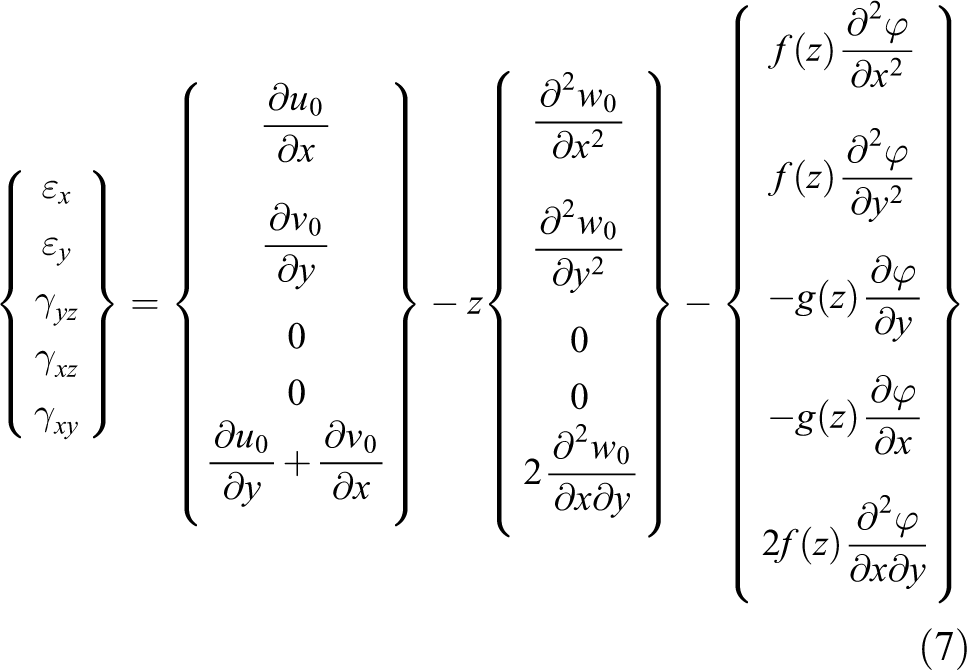
where u, v, w, u0, v0, and w0 are axial displacement function follows the Cartesian coordinate axes (x, y and z), the displacement field has five unknowns, three of them are displacements of the plate midplane u0, v0, w0, and two displacements θx and θy are rotations of axes parallel to the midplane around y and x rectangular Cartesian coordinates system, respectively. The rotational displacements are reduced to a single unknown by making and .41 The function f(z) represents the exponential–trigonometric shape function for transverse shear deformation distribution along the thickness (h), developed by Zaoui et al.,42 which is shown in equation (6a). The shear deformation effect becomes less effective and even neglected in a relatively large region, for thin plates with larger (a/h) ratio. Furthermore, the transverse shear stresses through the thickness are presented in term of the shape function derivative g(z) and have a parabolic pace satisfying the stress-free boundary conditions at the plate faces (z = ±h/2).
Applying the linear elasticity theory, the linear strain field is produced from the displacement field of equation (5) by derivation as follows:
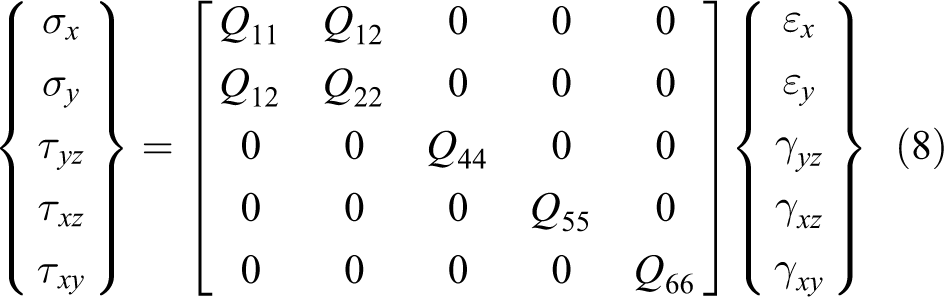
where the FGMs plates stress–strain relations are presented as
where Q(z) are the stiffness coefficients, written as
Equations of motion
The equations of motion appropriate to the displacement field and the constitutive equations are determined for deformable bodies using the Hamilton’s principle, which comes as
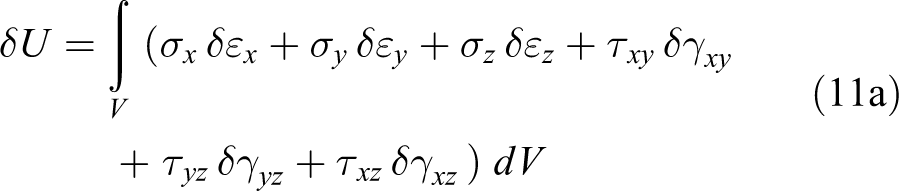
where T denotes a period of time and δU, δV, and δK are the variation of the plate strain energy, work done by external load, and kinetic energy, respectively.
The strain energy (energy of internal load) variation is calculated by the equations below as
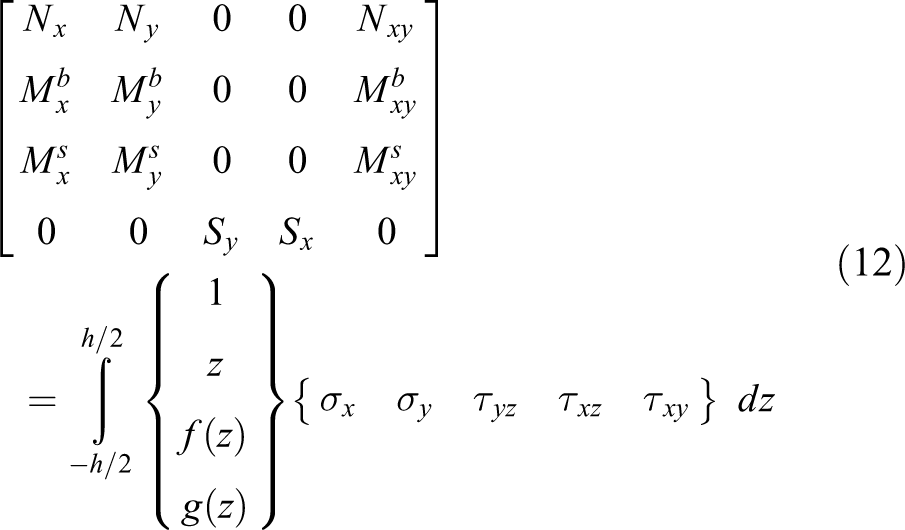
where A denotes a section and N, M, and S are the stresses resultants defined as
The variation of work performed by external loads is written as
where is an in-plane compressive load; it is assumed that the plate is subjected to axial compressive load in two directions, as mentioned below
where and γ is the nondimensional load parameter, defined as three in-plane load types: axial compression-tension load (γ = 0), uniaxial compression load (γ = 1), or biaxial compression load (γ = −1), and q is the transverse mechanical sinusoidal load, which follows the plate transversal direction.
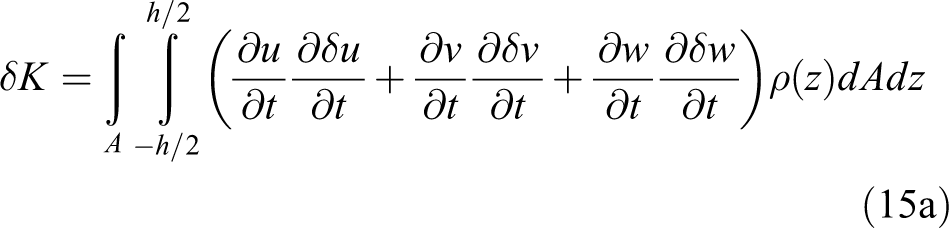
The kinetic energy variation is determined by the following integral as
where Ii, Ji, and Ki are the moments of inertia expressed as
The equations of motion are found by substituting equations (11), (13), and (15) in equation (10), integrating by part every term, than collecting the coefficients δu0, δv0, δw0, and δφ as follows
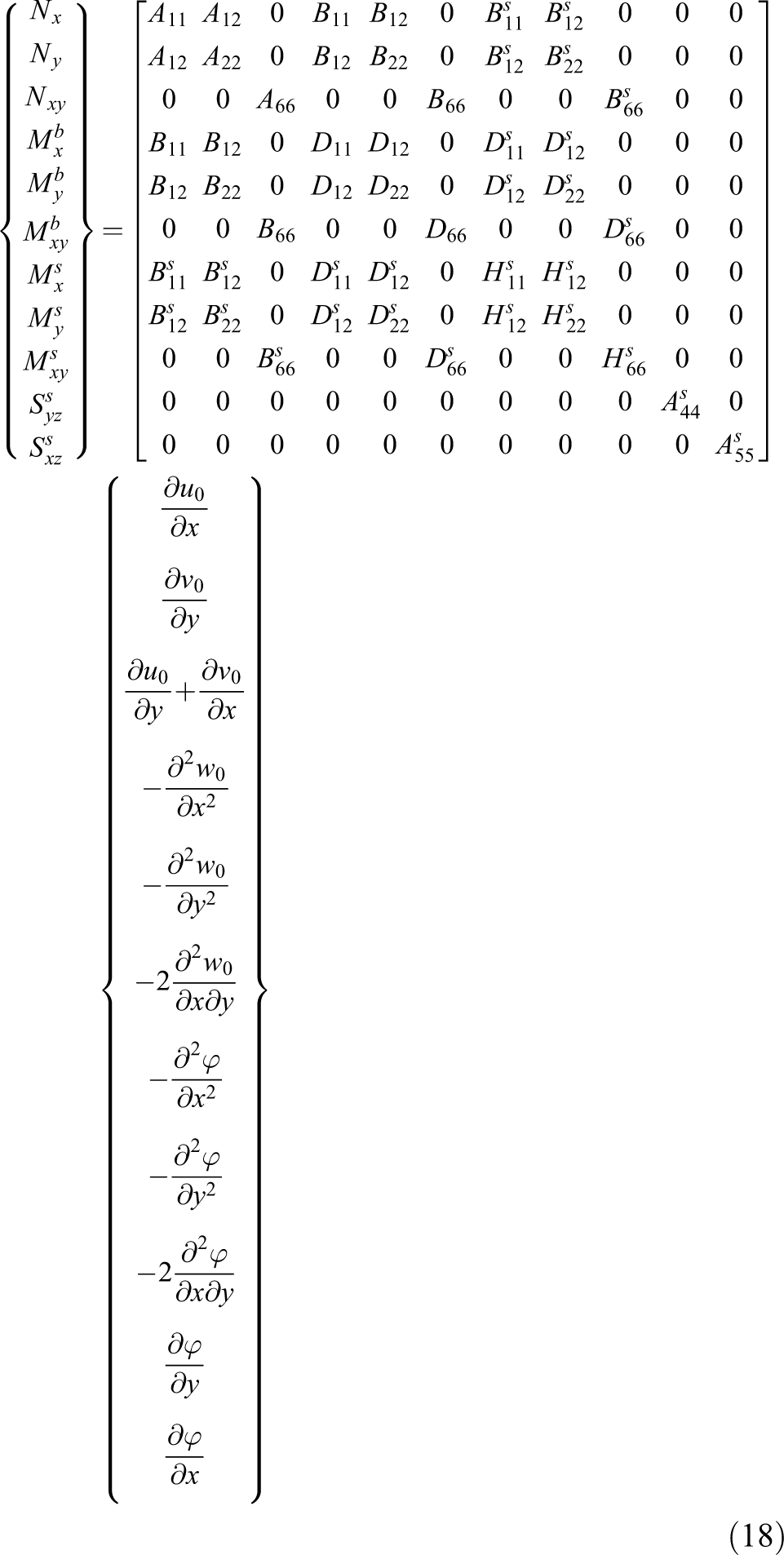
The stresses resultants are obtained as a function of strains, and the transverse shear forces found from the constitutive equations, while substituting equation (7) into equation (8), then into equation (12), the following reduced and compact form is obtained
where A, B, D, Bs, Ds, Hs and As are FGMs plate stiffness parameters, given as
The following equations of motion can be expressed and simplified in terms of displacement field by substituting equation (18) into equation (17), as follows
Analytical solution of Navier
The procedure of Navier solutions is used to obtain analytical solutions that are the partial differential equations in functions of displacement and expressed by double Fourier series for the shear deformation model, which is developed in this plate theory, satisfies the simply supported boundary conditions and equations of motion, written as
where ω is the natural frequency of the plate free vibration, Umn, Vmn, Wmn, and φmn are undetermined parameters, , and , m and n defined the first three modes (m, n) of frequency as 1(1,1), 2(1,2), and 3(2,2). The transverse load q is also represented by double Fourier series as
where the coefficient Qmn is given below for some typical loads as
Substituting equations (20) (21a), and (21b) into equation (19), the following equivalent system is obtained
where
The equation system (22) represents the general form to analyze the problem of bending, free vibration, and buckling mechanical behaviors in the FGMs plate subjected to transverse loads (q) and compressive loads (N0) in the plane.
Results and discussion
Consider a FGMs plate, varied in the gradation of materials as a power function with a power law (P-FGMs), or as exponential function (E-FGMs), which characterized the materials distribution, and depending on a varied volume fraction index (p), defined stiffer FGMs plate with lower index (p) values, and softer FGMs plate with highest index (p) values, of varied dimensions shown in Figure 1, the distributed materials varied as the following metallic and ceramics couple combinations, aluminum/alumina (Al/Al2O3), aluminum/zirconia (Al/ZrO2), and aluminum/silicon carbide (Al/Sic), of material properties collected in Table 1 and subjected to variable loads. The results of the present parameters variation effected on the nondimensional deflections, the normal and tangential stresses, the natural frequencies, and the critical buckling load of FGMs plates are compared and validated using several numerical examples of different theories found in the literature, using nondimensional relations, listed as
Numerical examples and bending analysis results
The present theory accuracy is evaluated for bending problems analysis of Al/Al2O3 FGMs plate, only subjected to sinusoidal load (q), and neglecting the in-plane compressive load as well as the kinetic energy (omitting the matrix (M)) in equation (22).
P-FGMs plates
Example 1. The present theory validity in predicting bending responses is verified in Table 2, for stiffer, softer, moderately thick, and square Al/Al2O3 P-FGMs plate, graded in materials as a power function with a power law of equation (1), by examining the nondimensional values of in-plane axial displacement , deflection (transverse displacement) value in the plate center, in-plane normal stress , in-plane shear stress , and transverse shear stress . The obtained nondimensional results are validated with solutions given by different theories as the HSDT, TSDT, quasi-3-D theory, as well as those predicted by sinusoidal shear deformation theory (SSDT). It should be noted that the results showed good agreement with different theories solutions, especially with HSDT of Thai and Kim45 and Wu and Li,11 where solutions are very close to each other, even if the index (p) values grows larger, where the values of and becomes more significant for the FGMs plates, unlike values which decreased, as well as and values present a peak of minimum and maximum value for (p∈ [2,4]), respectively. The rate of error is independent of this value profile. For instance, the nondimensional values ,, , and produce a maximum rate of error of 0.102%, 0.041%, 0.116%, 1.926% and 0.018%, which is negligible compared with Thai and Kim45 theory results as (p = 8) and (p = 4), respectively. The visualization of nondimensional values in terms of through thickness distribution (z/h), is shown in Figure 3(a) to (d), for ceramic homogeneous, stiffer FGMs (p = 1) and softer FGMs (p = 20) plate, compared with those implemented by Nguyen.26 Again, a good correlation between results is found in all cases except for , confirming the present theory accuracy in predicting bending responses of FGMs plates. It can be observed that becomes more significant for the softer FGMs plate bottom part (from (z/h = 0.16) toward (z/h = −0.5)). The fact that the bending compressed the plate ceramic top part and stretched the metal bottom part, and are of negative values on the top ceramic part from (z/h = 0.12) and (z/h = 0), for (p = 20), (p = 1) and (p = 0), respectively. However, an inverse mechanical behavior is observed for , where the negative values are obtained in the plate bottom part. The stresses and are sensitive to the index (p) variation. Thus, the current results are slightly overestimated, visualized as a small difference between paces (see Figure 2(d)); this might be due to an important reason of the presence of various displacement models and their corresponding number of unknowns, the shape function accuracy, the boundary conditions and the significant thickness stretching effect, for thick plates, which is presented in 3-D and quasi-3-D theories, which provide good result prediction, as considered by Wu and Chiu.44 The maximum rate of error is achieved for (p = 2) and (p = 8) as 9.928%, 1.892% and 3.003%, which is even insignificant, compared with results implemented by Wu and Chiu,44 quasi-3-D Carrera et al.10 and HSDT Nguyen,26 respectively.
Variation of nondimensional (a) in-plane displacement , (b) in-plane stress , (c) in-plane shear stress , and (d) transverse shear stress through the aluminum/alumina (Al/Al2O3) plate thickness.
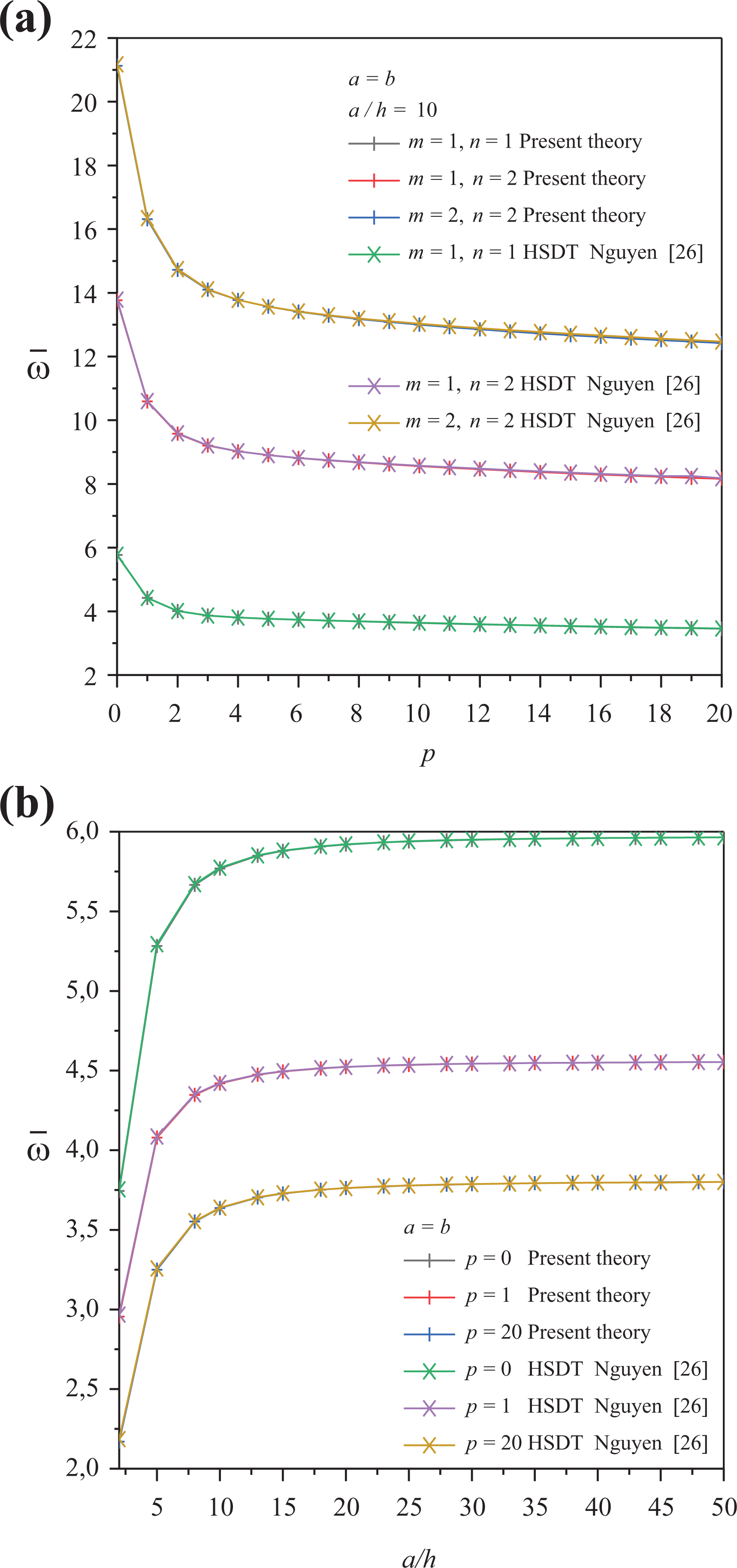
Effect of (a) the volume fraction index (p) and (b) side-to-thickness ratio (a/h) on the nondimensional natural frequency () of the aluminum/alumina (Al/Al2O3) plates.
Nondimensional displacements and stresses of aluminum/alumina (Al/Al2O3) moderately thick (a/h = 10) square plates.
The maximum peak is located in the median plane for homogeneous plates, or trends to move slightly toward the top surface, and will possess an asymmetrical profile across the FGMs plate thickness for larger values of index (p). Thus, becomes less important than and as 8 and 4, 12 and 2, 23 and 4 times lower for the indexes (p = 0), (p = 1), (p = 20), respectively.
E-FGMs plates
Example 2. For this example in Table 3, the deflection results are presented for stiffer, thick, square, and rectangular Al/Al2O3 E-FGMs plates, which is a FGMs plate, graded in materials as an exponential function with exponential form of equation (2). A comparison between the calculated results and those given by HSDT,21,26,45 3-D, and quasi-3-D solutions8,46 are carried out. It is clear that the present theory provide good results as compared to the HSDT21,26,45 and slightly overestimates results with 3-D and quasi-3-D solutions,8,46 which might be due to different conditions as mentioned earlier for Table 2. It can be seen that, for the E-FGMs plates, values becomes more important with the decreases of both the index (p) and the ratio (a/h) values, as well as the increases of ratio (b/a) values. Thus, the maximum rate of error is 2.315%, 2.306%, and 0.64%, which is insignificant obtained for very thick (a/h = 2), square plate as well (p = 1), (p = 1.5), and (p = 0.1), compared with Mantari et al.,21 Thai et Kim,45 and Nguyen,26 respectively.
Nondimensional deflection of aluminum/alumina (Al/Al2O3) E-FGMs square plates.
HSDT: higher order shear deformation theory; 3-D: three-dimensional.
Numerical examples and free vibration analysis results
In this part, the present theory accuracy is also evaluated for free vibration analysis of both Al/Al2O3 and Al/ZrO2 FGMs plates as the power law. Thus, the vibration problem is achieved by omitting the transverse load (q) and neglecting the in-plane compressive load in equation (22).
Example 3. The nondimensional natural frequencies results are presented in Table 4, for different homogeneous, stiffer, softer, thick, moderately thick, thin, and square Al/ZrO2 FGMs plates, and compared with those generated by 3-D theory9 based on 3-D plate model, and with HSDT.26 It should be noted that the obtained results are in good agreement with the reference solutions even for thin (a/h = 100), stiffer ceramic homogeneous plates, where becomes important. The maximum rate of error between the present model and Uymaz and Aydogdu9 is 2.977% of insignificant value, for (a/h = 5, p = 1), this error is reduced in comparison with the Nguyen,26 in the order of 0.755% for (a/h = 2, p = 10).
Nondimensional fundamentals frequencies ( of aluminum/zirconia (Al/ZrO2) square plates.
HSDT: higher order shear deformation theory; 3-D: three-dimensional.
Example 4. The first three modes of nondimensional free vibration fundamental frequencies are computed in Table 5, for different homogeneous, stiffer, softer, thick moderately thick, thin, square, and rectangular Al/Al2O3 FGMs plates under various frequency modes, and the results are in good agreement, compared with HSDT solutions of Nguyen,26 the maximum rate of error between both theories is 0.71%, a negligible error, signaled for thick, softer FGMs (p = 10), square plate with third mode. It is to highlight that values increases with the decrease of the index (p) values and the increase of both ratios (a/h), (a/b) and frequency modes values, which are presented clearly in Figure 3, where the highest values are obtained from Figure 3(a), illustrated for moderately thick plates; for stiffer FGMs plate and highest frequency mode, the values reduction are greater for stiffer FGMs plates (p < 2), then pace has a trend to stabilize as the plate becomes softer; and are obtained from Figure 3(b) for thin, stiffer homogeneous ceramic plate, the reason is that the thin plate with big ratio (a/h) values, make the shear deformation effect becomes less effective, as well as the stiffer plate with the small index (p) values, makes the ceramic volume fraction and the elasticity modulus values increase, and consequently the plate becomes ceramic as the ceramic content increases. values increase greatly for the ratio range (a/h∈[2,10]), then pace has a trends to stabilize, which is even proved in Figure 4 as a 3-D diagram presented an interaction between the index (p), the ratio (a/h), and fundamental frequency , using the current theory. Again, values increases with the decrease of the index (p) values and the increase of the ratio (a/h) values.
Effect of the side-to-thickness ratio (a/h) and the volume fraction index (p) on the nondimensional fundamental frequency () of aluminum/alumina (Al/Al2O3) square plates.
Nondimensional natural frequencies ( of aluminum/alumina (Al/Al2O3) square plates.
Example 5. The first three nondimensional free vibration fundamental frequencies are calculated in Table 6, to verify the results accuracy, for different homogeneous, stiffer, softer, thick, moderately thick, thin, and square Al/Al2O3 FGMs plates under various frequency modes. The obtained results are compared with different theories as the quasi-3-D theory,47 TSDT,14 FSDT,13 as well the HSDT solutions,26,45 where the agreement is very well, the maximum rate of error is 0.111% and 0.705%, which is even negligible, for (p = 4, a/h = 10, mode 2) and (p = 10, a/h = 5, mode 3), compared with Hosseini et al.,14 Thai et Kim,45 and Nguyen,26 respectively. As long as the plate becomes thinner, the shear deformation effect becomes less significant, the results become less significant and almost identical, which presented more accuracy. It is to highlight that values increases with the decrease of the index (p) and (a/h) ratio values, as well as the increase of frequency modes values toward the third one.
The first three nondimensional frequencies ( of aluminum/alumina (Al/Al2O3) square plates.
The three natural frequency types (, and ) increase in values by increasing and decreasing the ratio (a/h) values (the trends of the results are shown in Tables 4 to 6), corresponding to the nondimensional relations of each one, which are proportional and inverse proportional to the ratio (a/h), respectively.
Numerical examples and buckling analysis results
The buckling response of Al/Al2O3 and Al/SiC FGMs plates, as the power law, which depends on the volume fraction index (p), and subjected to different in-plane compressive load depends on the parameters (γ), has been evaluated by omitting transverse sinusoidal load (q) and the kinetic energy (omitting the matrix (M)). Thus, the plate is only subjected to in-plane compressive load N0 in equation (22).
Example 6. The present theory accuracy in predicting the critical buckling loads values are highlighted in Table 7, for different homogeneous, stiffer, softer, thick, moderately thick, thin, square, and rectangular Al/Al2O3 FGMs plates, under various in-plane compressive loads. As it is observed from the table, the results are in good agreement, compared with HSDT15,26 solutions, where the maximum rate of error is 1.053% and 0.209%, insignificant error obtained for (γ = −1, b/a = 1, a/h = 5, p = 10) and (γ = −1, b/a = 1, a/h = 5, p = 2), respectively. It is to highlight that values increases with the decrease of both index (p) and parameters (γ) values as well the increase of both ratios (a/h) and (b/a) values, presented clearly in Figure 5, for rectangular plates, where it can be observed that the higher values are obtained from Figure 5(a) illustrated with thick plates, for stiffer FGMs plate with biaxial compression load, the values reduction are greater for stiffer FGMs plates (p < 2), then, pace has a trend to stabilize as the plate become softer; and are obtained from Figure 5(b) illustrated for uniaxial compression load, for stiffer homogeneous ceramic plate and highest ratio (a/h), for the reason mentioned before in example 4, and that’s way values increase slightly with the increase of the ratio (a/h) values, especially for (a/h∈]2,10[), then, pace has a trend to stabilize. Otherwise, the same mechanical behavior is observed for both and for the variation of index (p), ratio (a/h), frequency modes (m, n), and parameter (γ), and consequently, the interaction between them is clear in Figure 6.
Effect of (a) the volume fraction index (p) and (b) side-to-thickness ratio (a/h) on the nondimensional critical buckling load () of aluminum/alumina (Al/Al2O3) plates.
Effect of the critical buckling load () on the nondimensional fundamental frequency () of aluminum/alumina (Al/Al2O3) plates.
Nondimensional critical buckling loads ( of aluminum/alumina (Al/Al2O3) plates.
Example 7. The critical buckling load effect on the fundamental frequency values variation are presented in Table 8; for different homogeneous, stiffer, softer, moderately thick, and square Al/SiC FGMs plates under various frequency modes and in-plane compressive loads, the results are compared with HSDT26,15,48 and FSDT.49 It can be noticed that a close agreement between the results are found for all cases, the maximum rate of error is 5.233%, 4.931%, 5.101%, and 4.912%, which is insignificant for homogeneous ceramic plate under second frequency mode and biaxial compression load, in comparison with all theories, respectively. It is to highlight that values increases with the decrease of both index (p) and parameter (γ) values, which are presented clearly in Figure 6, for rectangular, moderately thick plate; Figure 6(a) is illustrated for homogeneous ceramic plate and Figure 6(b) for softer FGMs plate. It can be seen that the same mechanical behaviors are observed for and , and for any in-plane compressive load; which either the and highest values are found while the other one is null (at zero coordinate), for rectangular, homogeneous plates and biaxial compression load; and the smallest values (characterized the wicked plates), where the plate does not support buckling, are those for FGMs plate and uniaxial compression load, the FGMs plate had a significant effect in buckling, and leads to a reduction of 36.81% in the and 71% in the compared to an homogeneous ceramic plate, as well an inverse mechanical behavior is signaled for negative values of , for Figures 6(a-b). An inverse relationship regroups the with values; When the first increases, the second decreases considerably, and vice versa.
An HSDT is used for bending, free vibration, and buckling analyzes of FGMs plates. The theory is a combination of recently developed exponential–trigonometric shape function for transverse shear deformation effect and developed displacement fields of four unknowns, without thickness stretching effect, and simply supported boundary conditions, satisfying the stress-free boundary conditions on the plate free surfaces. Equations of motion are extracted from Hamilton’s principle and solved via Navier-type solution. The effects of several parameters as the volume fraction index, geometric ratios, frequency modes, in-plane compressive load parameters, and material properties on the deflection, stresses, natural frequencies, and critical buckling load are analyzed. The accuracy of the proposed model is checked by comparing the calculated results with other plate theories found in the literature. As a conclusion, this theory is appropriate, simple and accurate, given the following results:
The obtained results are in good agreement and closer to different HSDT results in many cases, which defined the theory convergence.
For the E-FGMs plates, values becomes more important with the decrease of both the index (p) and the ratio (a/h) values, as well the increases of ratio (b/a) values. However, for the FGMs plates, values increase as the index (p) values increase.
For the FGMs plates, values increases with the increase of the index (p) values. However,, , , , and values increase with the decrease of the index (p) values.
, and values increase by increasing and decreasing the ratio (a/h) values, corresponding to the nondimensional relations of each one, which are proportional and inversely proportional to the ratio (a/h), respectively. Thus, and values increase with the increase of the frequency modes values.
values become less important than and as 8 and 4, 12 and 2, 23 and 4 times lower, for the indexes (p = 0), (p = 1), (p = 20), respectively.
The same mechanical behaviors are observed for both and , and for any in-plane compressive load; which either the and , highest values are found while the other one is null (at zero coordinate), for rectangular, homogeneous plates, and biaxial compression load; and the smallest values, are those for FGMs plate and uniaxial compression load; the FGMs plate had a significant effect in buckling, and leads to a reduction of 36.81% in the and 71% in the compared to an homogeneous plate.
An inverse relationship regroups the with the values. When the first increases, the second decreases considerably, and vice versa. The and values reduction are obvious for stiffer plates with (p < 2) and thick to moderately thick plate with (a/h∈]2,10[). Then, and paces show a trend to stabilize after this values.
Footnotes
Declaration of conflicting interests
The author(s) declared no potential conflicts of interest with respect to the research, authorship, and/or publication of this article.
Funding
The author(s) received no financial support for the research, authorship, and/or publication of this article.
ORCID iD
Yamna Belkhodja
References
1.
MantariJLGuedes SoaresC. A trigonometric plate theory with 5-unknowns and stretching effect for advanced composite plates. Compos Struct2014; 107: 396–405.
2.
TounsiAHouariMSABessaimA. A new 3-unknowns non-polynomial plate theory for buckling and vibration of functionally graded sandwich plate. Struct Eng Mech Int J2016; 60(4): 547–565.
3.
IssadMNFekrarABakoraA, et al.Free vibration and buckling analysis of orthotropic plates using a new two variable refined plate theory. Geomech Eng Int J2018; 15(1): 711–719.
4.
Hanifi Hachemi AmarLKaciATounsiA. On the size-dependent behavior of functionally graded micro-beams with porosities. Struct Eng Mech Int J2017; 64(5): 527–541.
5.
KaramiBJanghorbanMShahsavariD, et al.A size-dependent quasi-3D model for wave dispersion analysis of FG nanoplates. Steel Compos Struct Int J2018; 28(1): 99–110.
6.
HouariMSABessaimABernardF, et al.Buckling analysis of new quasi-3D FG nanobeams based on nonlocal strain gradient elasticity theory and variable length scale parameter. Steel Compos Struct Int J2018; 28(1): 13–24.
7.
Hanifi Hachemi AmarLKaciAYeghnemR, et al.A new four-unknown refined theory based on modified couple stress theory for size-dependent bending and vibration analysis of functionally graded micro-plate. Steel Compos Struct Int J2018; 26(1): 89–102.
8.
ZenkourAM. Benchmark trigonometric and 3D elasticity solutions for an exponentially graded thick rectangular plate. Arch Appl Mech2007; 77(4): 197–214.
9.
UymazBAydogduM. Three-dimensional vibration analyses of functionally graded plates under various boundary conditions. J Reinf Plast Compos2007; 26(18): 1847–1863.
10.
CarreraEBrischettoSCinefraM, et al.Effects of thickness stretching in functionally graded plates and shells. Compos B Eng2011; 42(2): 123–133.
11.
WuCPLiHY. An RMVT-based third-order shear deformation theory of multilayered functionally graded material plates. Compos Struct2010; 92: 2591–605.
12.
El MeicheNTounsiAZianeN, et al.A new hyperbolic shear deformation theory for buckling and vibration of functionally graded sandwich plate. Int J Mech Sci2011; 53: 237–247.
13.
Hosseini-HashemiSFadaeeMAtashipourSR. A new exact analytical approach for free vibration of Reissner–Mindlin functionally graded rectangular plates. Int J Mech Sci2011; 53: 11–22.
14.
Hosseini-HashemiSFadaeeMAtashipourS. Study on the free vibration of thick functionally graded rectangular plates according to a new exact closed-form procedure. Compos Struct2011; 93(2): 722–735.
15.
ThaiHTChoiDH. An efficient and simple refined theory for buckling analysis of functionally graded plates. Appl Math Model2012; 36(3): 1008–1022.
16.
ShimpiRP. Refined plate theory and its variants. AIAA J2002; 40(1): 137–146.
17.
Bachir BouiadjraMHouariMSATounsiA. Thermal buckling of functionally graded plates according to a four-variable refined plate theory. J Thermal Stress2012; 35(8): 677–694.
18.
BelabedZHouariMSATounsiA, et al.An efficient and simple higher order shear and normal deformation theory for functionally graded material (FGM) plates. Compos B Eng2014; 274: 283–260.
19.
AbualnourMHouariMSATounsiAAdda BediaEAMahmoudSR. A novel quasi-3D trigonometric plate theory for free vibration analysis of advanced composite plates. Compos Struct2018; 184: 688–697.
20.
MantariJLOktemASSoaresOG. Bending response of functionally graded plates by using a new higher order shear deformation theory. Compos Struct2012; 94(2): 714–723.
21.
MantariJLOktemASSoaresOG. Bending analysis of thick exponentially graded plates using a new trigonometric higher order shear deformation theory. Compos Struct2012; 94(6): 1991–2000.
22.
ZenkourA. Bending analysis of functionally graded sandwich plates using a simple four unknown shear and normal deformation theory. J Sandwich Struct Mater2013; 15(6): 629–656.
23.
MezianeMAAHadj HenniATounsiA. An efficient and simple refined theory for buckling and free vibration of exponentially graded sandwich plates under various boundary conditions. J Sandwich Struct Mater2014; 16(3): 293–318.
24.
NguyenVHNguyenTKThaiHT, et al.A new inverse trigonometric shear deformation theory for isotropic and functionally graded sandwich plates. Compos B Eng2014; 66: 233–246.
25.
TaibiFZBenyoucefSTounsiA, et al.A simple shear deformation theory for thermo-mechanical behaviour of functionally graded sandwich plates on elastic foundations. J Sandwich Struct Mater2015; 17(2): 99–129.
26.
NguyenTK. A higher-order hyperbolic shear deformation plate model for analysis of functionally graded materials. Int J Mech Mater Des2014; 11(2): 203–219.
27.
SofiyevAH. Influences of shear stresses on the dynamic instability of exponentially graded sandwich cylindrical shells. Compos B Eng2015; 77: 349–362.
28.
BaratiMRSadrMHZenkourAM. Buckling analysis of higher order graded smart piezoelectric plates with porosities resting on elastic foundation. Int J Mech Sci2016; 117: 309–320.
29.
AkavciSS. Mechanical behavior of functionally graded sandwich plates on elastic foundation. Compos B Eng2016; 96: 136–152.
30.
ZaouiFZTounsiAOuinasD. Free vibration of functionally graded plates resting on elastic foundations based on quasi-3D hybrid-type higher order shear deformation theory. Smart Struct Syst Int J2017; 20(4): 509–524.
31.
MeksiRBenyoucefSMahmoudiA, et al.An analytical solution for bending, buckling and vibration responses of FGM sandwich plates. J Sandwich Struct Mater2017; 21: 1–31.
32.
YounsiATounsiAZaouiFZ, et al.Novel quasi-3D and 2D shear deformation theories for bending and free vibration analysis of FGM plates. Geomech Eng Int J2018; 14(6): 519–532.
33.
GuerroudjHZYeghnemRKaciA, et al.Eigen frequencies of advanced composite plates using an efficient hybrid quasi-3D shear deformation theory. Smart Struct Syst Int J2018; 22(1): 121–132.
34.
MeradjahMBouakkazKZaouiFZ, et al.A refined quasi-3D hybrid-type higher order shear deformation theory for bending and free vibration analysis of advanced composites beams. Wind and Struct Int J2018; 27(4): 269–282.
35.
MantariJL. Refined and generalized hybrid type quasi-3D shear deformation theory for the bending analysis of functionally graded shells. Compos B Eng2015; 83: 142–152.
36.
ReddyJN. Analysis of functionally graded plates. Int J Numer Methods Eng2000; 47: 663–684.
37.
ZaouiFZHanifi Hachemi AmarLYounsiA, et al.Free vibration analysis of functionally graded beams using a higher-order shear deformation theory. Math Model Eng Probl2017; 4(1): 7–12.
38.
MantariJSoaresCG. Generalized hybrid quasi-3D shear deformation theory for the static analysis of advanced composite plates. Compos Struct2012; 94(8): 2561–2575.
39.
ThaiHTKimSE. A simple higher-order shear deformation theory for bending and free vibration analysis of functionally graded plates. Compos Struct2013; 96: 165–173.
40.
TounsiAHouariMSABenyoucefS, et al.A refined trigonometric shear deformation theory for thermoelastic bending of functionally graded sandwich plates. Aerosp Sci Technol2013; 24(1): 209–220.
41.
ThaiHTNguyenTKVoTP, et al.Analysis of functionally graded sandwich plates using a new first-order shear deformation theory. Eur J Mech2014; 45: 211–225.
42.
ZaouiFZOuinasDTounsiA. New 2D and quasi-3D shear deformation theories for free vibration of functionally graded plates on elastic foundations. Compos B Eng2019; 159: 231–247.
43.
ZenkourAM. Generalized shear deformation theory for bending analysis of functionally graded materials. Appl Math Model2006; 30: 67–84.
44.
WuCPChiuKH. RMVT-based meshless collocation and element-free Galerkin methods for the quasi-3D free vibration analysis of multilayered composite and FGM plates. Compos Struct2011; 93(5): 1433–1448.
45.
ThaiHTKimSE. A simple higher-order shear deformation theory for bending and free vibration analysis of functionally graded plates. Compos Struct2013; 96: 165–173.
46.
MantariJSoaresCG. Generalized hybrid quasi-3D shear deformation theory for the static analysis of advanced composite plates. Compos Struct2012; 94(8): 2561–2575.
47.
MatsunagaH. Free vibration and stability of functionally graded plates according to a 2D higher-order deformation theory. Compos Struct2008; 82: 499–512.
48.
BodaghiMSaidiAR. Levy-type solution for buckling analysis of thick functionally graded rectangular plates based on the higher-order shear deformation plate theory. Appl Math Model2010; 34: 3659–3673.
49.
MohammadiMSaidiARJomehzadehE. A novel analytical approach for the buckling analysis of moderately thick functionally graded rectangular plates with two simply-supported opposite edges. Proc Inst Mech Eng Part C2010; 224(9): 1831–1841.