




Abstract
This article proposes a basalt fiber-reinforced plastic–bamboo (BFRP-bamboo) composite beam consisting of BFRP sheet and laminated bamboo, aiming at fully utilizing advantages of bamboo and BFRP to improve the mechanical behavior of the laminated bamboo beam. A two-step test program is involved: (1) double shear test for bonding behavior between the BFRP and laminated bamboo and (2) loading test for mechanical behaviors of both laminated bamboo and BFRP-bamboo composite beams. Parameters affecting the bonding behavior are firstly concluded as the coated surface resin, types of bonding materials, and interfacial treatment. Then, the failure patterns of both laminated bamboo and BFRP-bamboo composite beam are discussed based on experimental observations. Key mechanical indexes, including the yield force, yield displacement, ultimate load, ultimate displacement, ductility, and stiffness, are analyzed based on load–displacement curves of tested specimens. Besides, theoretical analyses of bearing capacity of the BFRP-bamboo composite beam, featured as fracture failure, are conducted.
Introduction
Bamboo, as a conventional structural material, 1 has always been utilized in building local houses in China. 2 It is convenient to obtain raw bamboo material locally, which has advantages including saving costs, environmental friendliness, and recyclability. 3 –5 However, the mechanical properties of the raw and unprocessed bamboo material are in large discreteness. 6 Many inevitable defects can also be found in unprocessed bamboo material, which results in a poor durability. 7 –9 Several key points are summarized for the structure using the unprocessed bamboo: (1) the structure built with unprocessed bamboo are commonly low-tech with large material variation 10 ; (2) the dimensions and types of the raw bamboo are limited, which largely restricts its development in structure; and (3) the function of the heat preservation and insulation is unsatisfactory because of the gaps existing between the unprocessed bamboo. It is obvious that the modern processing methods are of important necessity to be adopted to improve the mechanical performances of the raw bamboo to satisfy requirements of modern structures.
To utilize the advantages of the raw bamboo and improve its material stability and performance, the modern bamboo structure 11,12 has been developed based on new bamboo engineering materials, modern production, and building methods during recent years. Kinds of bamboo engineering material have been proposed and studied, which is beneficial to reduce the material discreteness and enlarge practical applications of the bamboo. 13 By recombining and recomposing the raw bamboo material, types of bamboo engineering material can be achieved, which are featured as bamboo plywood, 14 –16 laminated bamboo, 17,18 and reconstituted bamboo. 19,20 The existing researches showed that the bearing capacity, stiffness, ductility, and fatigue performance of the bamboo engineering materials are required to be further improved. In the serviceability limit state, the bearing capacities of the bamboo engineering materials are usually controlled by the stiffness not strength, which demonstrates a low material utilization ratio and restricts the structural applications of the bamboo engineering material.
To compensate for shortcomings of the single material, different types of materials can be combined together to achieve acceptable performance. In wooden structures, the carbon fiber-reinforced plastic (FRP) 21,22 and glass FRP 23 have been adopted to strengthen the wood beam. Furthermore, Wei et al. 24 studied a new type of bamboo scrimber which were strengthened by the FRP sheets embedded in the internal tensile region. Inspired by the researches on FRP strengthened wood/bamboo structures, this article proposes a basalt FRP-bamboo (BFRP-bamboo) composite beam consisting of BFRP sheet and laminated bamboo beam, which aims at improving the mechanical behavior of the laminated bamboo beam. In the proposed BFRP-bamboo composite beam, the BFRP sheet is externally bonded at the bottom of the bamboo beam. To have a deeper understanding of the proposed BFRP-bamboo composite beam, a series tests were conducted which contains tests on the bonding behavior between the BFRP and laminated bamboo, mechanical behaviors of the laminated bamboo beam, and the BFRP-bamboo composite beam. Based on the strain distribution and the force equilibrium, the theoretical derivations related to the flexural strength was carried out, the accuracy of which was also confirmed.
Preliminary tests on bonding behavior between BFRP sheet and laminated bamboo
Material test
A series of material coupon tests were conducted to study the basic material behaviors of the laminated bamboo and the BFRP sheet. Based on the material test results, the following expressions were proposed for the laminated bamboo.


where σc and σt are the compressive and tensile stresses, respectively; εc and εt are the compressive and tensile strains, respectively; Ec and Et are the elastic compressive and tensile moduli, respectively; εe equal to 0.3εp is the yield compressive strain; εcu equal to 1.3εp is the ultimate compressive strain; σp is the maximum compressive stress and εp is the corresponding strain at σp ; and εtu is the ultimate tensile strain. The ultimate tensile and compressive stresses of the laminated bamboo are 129.05 and 98.18 MPa, respectively. The elastic modulus and ultimate tensile strain of the laminated bamboo are 13294 MPa and 1.05%, respectively.
Besides, based on the coupon test on BFRP sheet, the ultimate tensile stress and the elastic modulus of the BFRP sheet are 1752.4 and 73,871.3 MPa, respectively. The ultimate tensile strain of the BFRP sheet is 2.37%.
Parameters’ selection
The good bond behavior between the BFRP sheet and laminated bamboo is essential in guaranteeing the mutual work, which aims at fully utilizing material advantages of both BFRP and laminated bamboo.
Until now, no tests have been conducted to investigate the BFRP-bamboo bond behavior; and therefore, it is of necessary to carry out preliminary tests to have a deep understanding of BFRP-bamboo bonding behavior. The bonding material aims at forming an effective and stable BFRP-bamboo interface to transfer shear and normal forces between the BFRP sheet and laminated bamboo, the quality of which decides the working performance of the BFRP-bamboo composite beam. In the reinforcement of concrete structure using FRP, one layer of resin is usually coated to the concrete surface to help achieve better bonding. However, the laminated bamboo employed in this article, featured as high compactness, was fabricated under hot-pressing consolidation process, which made it difficult for the resin to permeate into the laminated bamboo. The effect of the coated resin on the BFRP-bamboo bonding is required to be evaluated. The interfacial treatment also affects the adhesion between surfaces of BFRP sheet and laminated bamboo.
Based on discussions mentioned above, several experimental parameters, including the bonding material, the resin coated to the laminated bamboo, and the interfacial treatment, were considered in the present study.
Bonding test protocol
A total of four BFRP-bamboo double shear specimens were prepared for preliminary tests on bonding behavior between BFRP and laminated bamboo, experimental parameters of which are listed in Table 1. As shown in Figure 1, two laminated bamboo blocks with dimensions of 230 mm in length, 120 mm in width, and 20 mm in height were bonded together by one layer of BFRP sheet. The width and length of the BFRP sheet were 30 and 60 mm, respectively. Two kinds of impregnating resins, working as bonding materials, from different local companies were adopted herein, which were named as San You and Phoenix.
Details and test results of BFRP-bamboo double shear specimens for preliminary tests.

BFRP: basalt fiber-reinforced plastic.
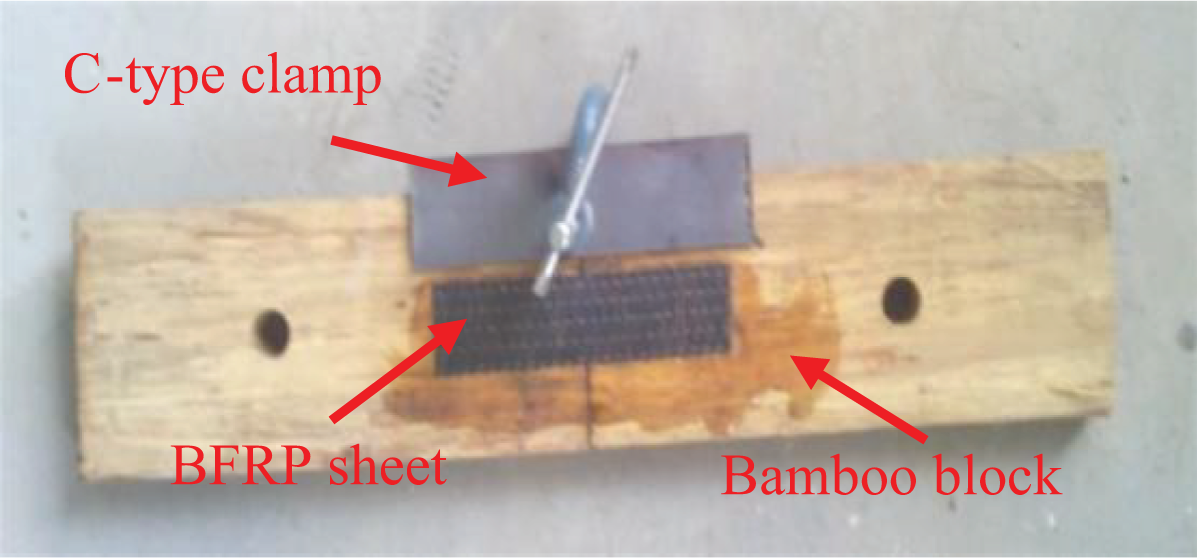
Test specimen for bonding behavior.
The main preparation processes of the BFRP-bamboo double shear specimen, taking specimen D2 as example, was summarized as follows: (1) using acetone to clean the surface stain; (2) coating resin to the surface of the bamboo; and (3) applying the bonding material and connecting two bamboo blocks with the BFRP sheet. Besides, a C-type clamp was used to avoid the relative movement between two bamboo blocks, as shown in Figure 1.
The double shear test of BFRP-bamboo specimen was carried out under the SANS electronic universal testing machine, as shown in Figure 2. The displacement–control loading pattern was adopted, with a displacement rate of 2 mm/min.
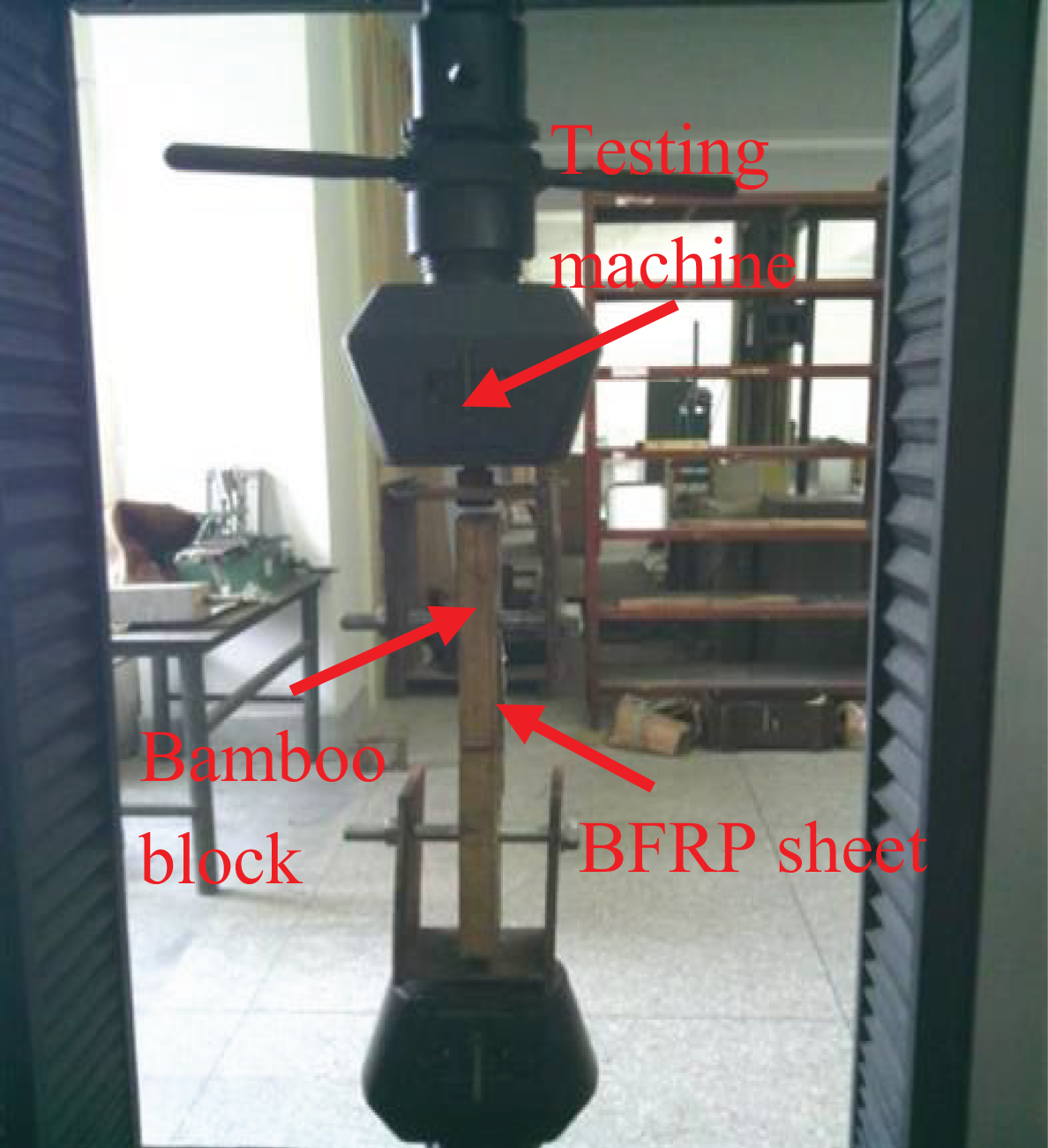
Double shear test setup.
Test results and discussions of double shear test
Failure modes
Test results of the BFRP-bamboo double shear test are listed in Table 1. In the initial loading stage, no significant change was observed, and a slight noise was heard when the load was about 70–80% of the ultimate load. The specimen failed quickly after the ultimate load.
Based on experimental observations, the failure modes of the BFRP-bamboo specimens can be categorized into two types: (1) the bond failure between surfaces of BFRP sheet and bamboo block, as shown in Figure 3(a). The failure surface was smooth with sporadic bamboo crumbs. (2) The fracture of BFRP sheet depicted in Figure 3(b), which demonstrated the good bonding between the BFRP and bamboo.

Failure modes of BFRP-bamboo specimens under double shear test. (a) Bond failure and (b) fracture of BFRP sheet. BFRP: basalt fiber-reinforced plastic.
Effect of experimental parameters
By comparing test results of specimen D1 with interfacial treatment and specimen D3 without interfacial treatment, it is found that the ultimate load of the former was almost the same with that of the latter, as listed in Table 1. The failure modes of both specimens D1 and D3 were the same, featured as the fracture of BFRP sheet. It is concluded that the interfacial treatment almost had no effect on the ultimate load and failure mode of the BFRP-bamboo composite specimen.
In the comparison between specimen D2 with coated resin and specimen D3 without coated resin on the surface of the laminated bamboo block, the ultimate load of the former was smaller than that of the latter, which demonstrated that the coated resin was bad for the bonding behavior of the BFRP-bamboo specimen. It is difficult for the laminated bamboo block with high compactness to be permeated by the surface resin; and therefore, the bonding effectiveness was reduced by the coated surface resin. Based on test results of specimen D3 applied with bonding material San You and specimen D4 applied with bonding material Phoenix, the ultimate load obtained from D3 was 40.2% larger than the ultimate load obtained from D4. It is concluded that the bonding material San You should be more suitable for the bonding between the BFRP sheet and the laminated bamboo block.
Test on BFRP-bamboo composite beam
Experimental program
Based on results of the preliminary test, the bonding material San You and the interfacial treatment were adopted for the BFRP-bamboo composite beam without coated resin on the surface of the laminated bamboo beam. To investigate the mechanical performance of the BFRP-bamboo composite beam, different dimensions of the beam and different layers of the BFRP sheet were taken into consideration. Details of tested BFRP-bamboo composite beams are listed in Table 2. The cross section of the BFRP-bamboo composite beam in series A was designed as 50 × 100 × 2000 mm3 and that in series B was 50 × 150 × 3000 mm3. No BFRP sheet was bonded to the laminated bamboo in specimens A0 and A1, but one layer and two layers of BFRP sheets were employed in specimens A1, B1 and specimens A2, B2, respectively.
Details of BFRP-bamboo composite beams.

BFRP: basalt fiber-reinforced plastic.
The photo of the representative tested specimens is shown in Figure 4. The BFRP-bamboo composite beam specimen installed in the test setup was loaded under three points of division loading pattern, as shown in Figure 5. A preloading with the load amplitude of 1 kN was applied to the composite beam to check the workability of the testing machine and the installation of the specimen. Then, a load-controlled loading pattern was adopted with an increment of 1 kN for each load amplitude. When the applied load approximated the estimated ultimate load, the load-controlled loading was transferred to the displacement-controlled loading with a displacement rate of 2 mm/min.

Photo of the tested specimen.

Test setup.
Strains of the laminated bamboo and BFRP sheet and deformations of the mid-span of the BFRP-bamboo composite beam were monitored during the loading histories. The typical measurement layout of strain gages and displacement transducers is shown in Figure 6. All strains and displacements were collected by TDS-530.
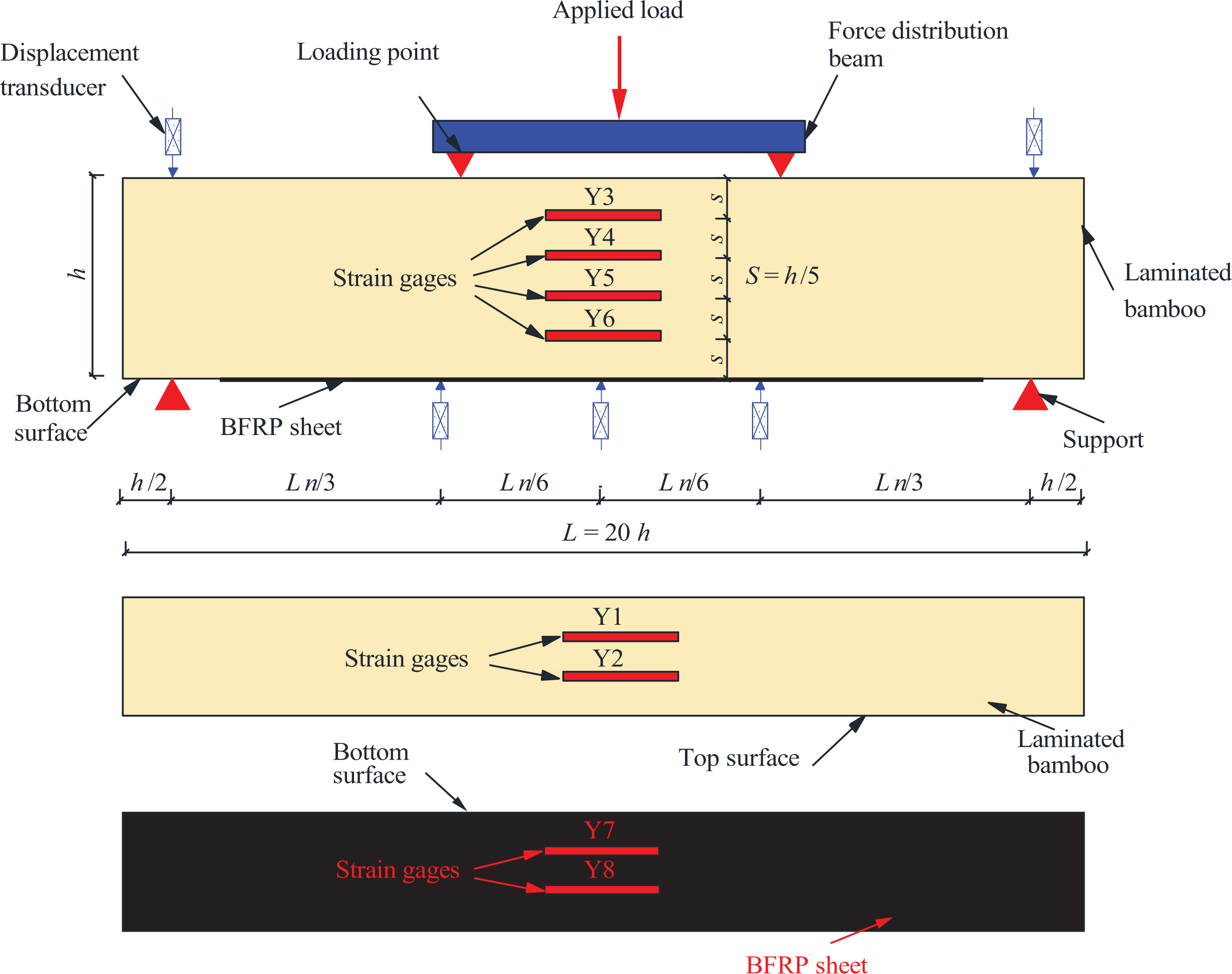
Measurement layout.
Test results and discussions
Experimental observations and failure modes
1. Specimen A0 (50 × 100 × 2000 mm3, no bonded BFRP sheet) and specimen B0 (50 × 150 × 3000 mm3, no bonded BFRP sheet):
The deformation of the beam increased gradually at the initial loading stage in specimen A0. Then, a significant deformation shown in Figure 7(a) was observed after the estimated proportional limit. When the applied load was around 18.8 kN, the initiation of the crack depicted in Figure 7(b) was observed at the bottom surface of the beam corresponding to the position of the loading point and a small noise caused by the fracture of bamboo fibers was heard. With the development of the applied load, the cracks gradually became larger (see Figure 7(c)), which resulted in the delamination of bamboo fibers in Figure 7(d). The failure of the laminated bamboo beam was achieved at the ultimate load of 21.4 kN. The experimental phenomenon of the specimen B0 was similar to specimen A0. However, the specimen B0 had a larger ultimate load of 25.5 kN compared with specimen A0, due to the bigger cross section. 2. Specimen A1 (50 × 100 × 2000 mm3, one layer of bonded BFRP sheet) and specimen A2 (50 × 100 × 2000 mm3, two layers of bonded BFRP sheets):

Experimental observations of specimen A0: (a) significant deformation of the composite beam, (b) cracks initiated at the bottom surface, (c) cracks developed at the bottom surface, and (d) delamination of bamboo fibers.
Similar to specimen A0, the deformations of both specimens A1 and A2 gradually increased until a significant deformation was observed around the estimated proportional limit. As shown in Figure 8(a), the fracture of the bamboo fibers and the BFRP sheet in specimen A1 was observed at the same time when the applied load was around 24.4 kN. In specimen A2, the debonding of the bamboo fibers and the BFRP sheet was found at the ultimate load of 26.70 kN, while the bamboo fibers fractured but no fracture of the BFRP sheets was observed, as depicted in Figure 8(b). 3. Specimen B1 (50 × 150 × 3000 mm3, one layer of bonded BFRP sheet) and specimen B2 (50 × 150 × 3000 mm3, two layers of bonded BFRP sheet):

Experimental observations of specimens A1 and A2: (a) fracture of laminated bamboo and BFRP sheet in specimen A1 and (b) delamination between BFRP sheets and laminated bamboo in specimen A2. BFRP: basalt fiber-reinforced plastic.
Similar to specimen B0, the deformations of both specimens B1 and B2 gradually increased before the estimated proportional limit. With the further increase of the applied load, the out-of-plane deformation of the specimens B1 could be observed in Figure 9(a). The out-of-plane instability was finally observed until the applied load reached 24.99 kN. It is obvious that the bamboo fibers on the side surface of the specimens B1 fractured due to the out-of-plane deformation, as shown in Figure 9(b). For specimens B2, the fracture of bamboo fibers was observed at the applied load of 24.00 kN, with a small noise. Then, both of the laminated bamboo and BFRP sheet fractured at the ultimate load of 28.40 kN, regarded as the failure of the composite beam.

Experimental observations of specimens B1: (a) out-of-plane deformation and (b) fracture of bamboo fibers on the side surface.
Based on the experimental observations discussed above, the failure characteristics of the laminated bamboo beam and the BFRP-bamboo composite beam can be summarized as follows:
For laminated bamboo beam
As shown in Figure 7(b) and (d), two main types of cracks were observed in the laminated bamboo beam, which were the tensile crack and shear crack. The tensile crack was resulted from the fracture of the bamboo fibers at the ultimate strain and the shear crack initial from the loading point and developed into the pure bending part of the composite beam, namely the part between two loading points, caused by both bending and shear forces.
For BFRP-bamboo composite beam
As shown in Figures 8 to 10, three main types of failure patterns of the BFRP-bamboo composite beam were concluded as: (1) the fracture of laminated bamboo fibers and BFRP sheet at the same time; (2) the debonding of the laminated bamboo and the BFRP sheet; and (3) the out-of-plane instability. In the first failure pattern, the tensile force of the BFRP sheet suddenly increased due to the fracture of the bamboo fibers reaching its ultimate strain, which resulted in the fracture of BFRP sheet at the same time. Even if the ultimate tensile strain of the BFRP sheet is larger than that of the bamboo fiber, the fracture of the BFRP sheet and bamboo fibers still occurred almost at the same time, which was regarded as the ideal failure of the BFRP-bamboo composite beam. Besides, the out-of-plane instability of the BFRP-bamboo composite beam in the third failure pattern was caused by the initial geometrical imperfection, making the composite beam underdeveloped. Such failure pattern of the composite beam should be purposely avoided; and therefore, the lateral supports are recommended to prevent the possible out-of-plane deformation.

Experimental observations of specimens B2: (a) fracture of laminated bamboo fibers and BFRP sheets in specimen B2 and (b) local enlarged drawing. BFRP: basalt fiber-reinforced plastic.
Load–displacement curves
The load–displacement curves of all BFRP-bamboo composite beam specimens are shown in Figure 11, where the abscissa is the displacement monitored from the middle-span of the specimen and the ordinate is the load applied by the testing machine. It is obvious that three stages can be determined for both the laminated bamboo beam and the BFRP-bamboo composite beam, names of which are the initial linearly elastic stage, nonlinear stage, and abrupt failure stage, respectively. The applied load increased almost linearly with the development of mid-span displacement at the initial linearly elastic stage. Then, the nonlinear relationship was achieved before the sudden failure of the specimen.

Load–displacement curves of the BFRP-bamboo composite beams: (a) series A and (b) series B. BFRP: basalt fiber-reinforced plastic.
Test results of all BFRP-bamboo composite beam specimens are listed in Table 3, which include the yield force, yield displacement, ultimate force, ultimate displacement, and ductility. The yield displacement and yield force are calculated based on the average values obtained from the equivalent elastoplastic energy method 25 and R.Park method. 26 The ultimate displacement is the displacement corresponding to the ultimate load and the ductility is defined as the ratio of the ultimate displacement to the yield displacement.
Test results of all composite beam specimens.a
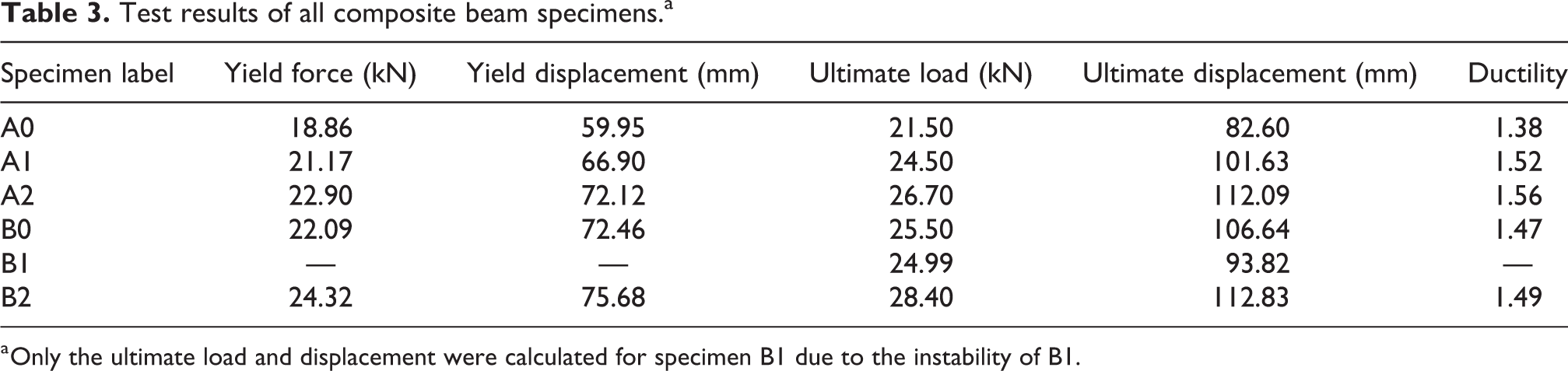
a Only the ultimate load and displacement were calculated for specimen B1 due to the instability of B1.
As shown in Figure 11 and Table 3, it is obvious that the yield force of specimen A1 with one layer of BFRP sheet and specimen A2 with two layers of BFRP sheets increased 12.2% and 21.4%, respectively, compared with specimen A0 without BFRP sheet. The improvements in the ultimate loads of specimens A2 and A1 were, respectively, 14.0% and 24.2% compared with the ultimate load of specimen A0. It is obvious that both the yield load and the ultimate load increased with the layer of the BFRP sheet. In terms of yield displacement, the yield displacements of specimens A1 and A2 are 66.90 and 72.12 mm, which are 11.6% and 20.3% larger than the yield displacement of the specimen A0. Besides, the ultimate displacements of specimens A1 and A2 are 23.0% and 35.7% larger than that of the specimen A0, respectively. It is found that both the yield displacement and the ultimate displacement also increased with the layer of the BFRP sheet.
The similar situation was observed in the variation of the yield force of specimens in series B. Comparing specimen B2 with two layers of BFRP sheets and B0 without BFRP sheet, the ultimate load of former was 11.9% larger than that of the latter. However, the ultimate load of the specimen B1 failing due to instability was even smaller than that of specimen B0. The yield displacement and ultimate displacement of the specimen B2 is 4.4% and 5.8% larger than those of the specimen B0, respectively.
The ductility of specimens A1 and A2 with BFRP sheet was significantly better than the ductility of specimen without BFRP sheet, but the ductility between specimens A1 and A2 was similar. The ductility improved about 10.1% and 13.0% in specimens A1 and A2 due to the existence of BFRP sheet compared with the specimen A0. However, the improvement of the ductility was only 2.6% caused by more layers of BFRP sheet, comparing specimens A1 and A2. It is concluded that the BFRP-bamboo composite beam had better ductility than the laminated bamboo beam without BFRP sheet when the beam dimension was 50 × 100 × 2000 mm3. In series B, the improvement in ductility became not significantly enough when the beam dimension became larger. Besides, by comparing specimens A0, B0 and specimens A2, B2, it can be seen that both yield force and ultimate force increased with the increasing dimension of the beam.
To have a deeper understanding of the stiffness variation between the laminated bamboo beam and composite beam with different layers of BFRP sheets during the whole loading history, the displacements of tested specimens under different loading levels were compared. As shown in Figure 11, at the initial loading state, the stiffness of the laminated bamboo beam was only slightly smaller than that of the BFRP-bamboo composite beam, which meant that the BFRP sheet in the composite beam contributed little to the stiffness. However, in the nonlinear stage, the displacement of the BFRP-bamboo composite beam was significantly less than the displacement of the laminated bamboo beam under the same loading level. The stiffness in the nonlinear stage was largely improved by the existence of the BFRP sheet, and obviously, two layers of BFRP sheets better increased the stiffness of BFRP-bamboo composite beam than one layer of BFRP sheet.
Flexural demand
As shown in Figure 12, the cross-sectional moment in the pure bending part of the test specimen, namely the part between two loading points, is obtained as follows:

Moment distribution of the tested specimen.
where Ln
is the span length of the tested specimen, P is the applied load, and b and h are the width and height of the specimen, respectively. Furthermore, the ultimate flexural strength of the BFRP-bamboo composite beam can be calculated based on equation (4), the calculation results of which are listed in Table 4.
Mechanical properties related to the flexural behavior.

where Pu is the ultimate load.
Load–strain analysis
The load–strain curves obtained from strain gages attached on the top and bottom surface of the tested specimens are shown in Figure 13, and locations of strain gages are shown in Figure 6.

Load–strain curves for: (a) A0, (b) A1, and (c) A2.
For specimens in series A at the failure point, the average strains obtained from the strain gages Y1 and Y2 attached on the top surface were −1.18%, −1.92%, and −2.38%, respectively. The negative sign means the compressive strain. The compressive strain of the specimen A1 increased around 62.7% compared with specimen A0, and the compressive strain of the specimen A2 improved around 101.7% compared with specimen A0. It is obvious that the BFRP-bamboo composite beam has better ability to utilize the compression performance of the bamboo fibers due to the existence of the BFRP sheet.
Strains under different loading levels obtained from strain gages of Y3 to Y6 (see Figure 6) are shown in Figure 14. The linear strain distribution along the beam height was found in the tested specimens during the whole loading histories, which demonstrated the plane cross section of the beam was achieved. Furthermore, the positions of the neutral axis of the tested specimens under different loading levels were calculated based on the strain distribution depicted in Figure 14, and the calculated results are listed in Table 5. It can be seen that the neutral axis of the BFRP-bamboo composite beam moved down with the development of the applied load. This phenomenon was explained as the contribution of BFRP sheet in sustaining the tensile stress. Comparing specimens A1, A2 and specimens B1, B2, it is concluded that the layer of the BFRP sheet had significant effect on the position of the neutral axis, and the neutral axis would move downward with the increasing layer of the BFRP sheet.

Strain distributions along beam height under different loading levels: (a) A1, (b) A2, (c) B1, and (d) B2.
Positions of neutral axis under different loading levels.

Theoretical analyses of BFRP-bamboo composite beam
Based on the experimental discussions above, the theoretical analyses of the ultimate bearing capacities of the BFRP-bamboo composite beam were conducted based on the following points: (1) the strain distribution of the beam accords with the plane section assumption based on the strain analysis in ‘Load–strain analysis’ section and (2) the elastic tensile modulus of the laminated bamboo is the same with the elastic compressive modulus.
Based on the failure pattern of the fracture of laminated bamboo fibers and BFRP sheet observed in specimens A1 and B2 and strain distributions along beam height depicted in Figure 14, it can be concluded that the ultimate tensile stress was achieved at the bottom surface and the compressive stress on the top surface was larger than the yield stress but smaller than the ultimate compressive stress. The strain distribution at the failure point for the BFRP-bamboo composite beam is thus shown in Figure 15. The following equation can be obtained based on the force equilibrium condition at the cross section.

Strain and stress distribution of the cross section at the failure point.
where σtu and σcu are the ultimate tensile and compressive stresses of the laminated bamboo, respectively; b is the width of the beam; h 1, h 2, and h 3 are shown in Figure 15; and Tf is the tensile force sustained by BFRP sheet. No relative slide exists between the BFRP sheet and the laminated bamboo in specimens featured as fracture failure. Therefore, Equations (7) and (8) are achieved.


where εf is tensile strain of the BFRP sheet; σf is tensile stress of the BFRP sheet; Ef is tensile modulus of the BFRP sheet; E is modulus for both tension and compression of the laminated bamboo; bf is the width of the BFRP sheet; and tf is thickness of the BFRP sheet. From the similar triangle, the ratio of σtu to σcu is same with the ratio of h 1 to h 2. By making σtu /σcu = β and Efbftf /Ebh = λ, the values of h 1, h 2, and h 3 can be expressed in the following equations.



The sum of the moments caused by the internal and external forces on the neutral axis is zero, and thus the ultimate flexural strength of the BFRP-bamboo composite beam is obtained as follows:

The corresponding load applied by the testing machine expressed in equation (13) can be calculated based on equation (5).
The ultimate bearing capacities of the BFRP-bamboo composite beams, featured as fracture failure, calculated from the above derivations and test results are listed in Table 6. The difference between the analytical and experimental results was less than 8%, which showed a good prediction of the bearing capacity from the theoretical derivation.
Comparisons between test results and analytical analyses.

Conclusions
In the present study, the bonding behavior between the BFRP and the laminated bamboo was studied through four bonded bamboo specimens under double shear test. Besides, two laminated bamboo beams and four BFRP-bamboo composite beams in all were tested to investigate the mechanical behaviors and develop high-performance bamboo composite structure. Design parameters, including the layer of the BFRP sheet, dimensions of the beam, were compared to provide an effective way to fabricate the composite beam. The main results are summarized as follows:
Based on the double shear test on the bonded bamboo specimens, the bonding behavior between the BFRP and laminated bamboo is proved to be related to the coated surface resin, types of bonding materials, and interfacial treatment. The surface resin decreases the bonding behavior due to the high compactness of the laminated bamboo, and the interfacial treatment can slightly improve the bonding behavior. The recommended bonding material is further provided for the BFRP-bamboo composite beam.
Based on test results of the BFRP-bamboo composite beam, three types of failure modes are concluded: the fracture of laminated bamboo fibers and BFRP sheet, the debonding of the laminated bamboo and the BFRP sheet, and the out-of-plane instability.
The yield force, yield displacement, ultimate load, ultimate displacement, ductility, and stiffness of the tested specimens are highly related to the layer of the BFRP sheet and the dimension. All parameters increase with the increase of the layer of the BFRP sheet.
The plane section assumption for the tested specimens is confirmed based on the strain distribution along the beam height. The neutral axis of the BFRP-bamboo composite beam moves down with the application of the BFRP sheet. Besides, theoretical derivations of the BFRP-bamboo composite beam failing due to fracture have been conducted based on the plane section assumption, the accuracy of which is checked.
Footnotes
Declaration of conflicting interests
The author(s) declared no potential conflicts of interest with respect to the research, authorship, and/or publication of this article.
Funding
The author(s) disclosed receipt of the following financial support for the research, authorship, and/or publication of this article: This work was financially supported by the Integrated Key Precast Components and New Wood-bamboo Composite Structure (2017YFC0703502).
