




Abstract
This article reviews the progress that has been made in the development of cell therapies for the repair of nervous system damage caused by strokes, since the first report on the use of cell transplants in animal models of ischemic brain injury in 1988. At that time neural progenitor cells derived from fetal brain tissue were used as sources of cells to replace specific subsets of neuronal cells that were lost in various regions of the brain following experimentally induced strokes. Since 1988, cells from other sources, such as embryonic stem cells and inducible pluripotent stem cells, have been investigated for their ability to replace neuronal cells and repair the damaged brain. Most recently, mesenchymal stem cells and cord blood stem cells have been studied for the ability to modulate the immune system and ameliorate the neuropathology and neurological deficits associated with experimental stroke. The preclinical investigation of different cell therapy approaches for treating stroke during the past three decades has now led to many ongoing clinical trials, with the clinical evaluation of stem cell therapies for stroke now involving global participants.
Introduction
Each year across the world 15 million people suffer a stroke, resulting in 5 million deaths and another 5 million people suffering from permanent disabilities. In the United States alone, stroke is the leading cause of long-term disability, reducing mobility in over half of stroke survivors over the age of 65. This amounts to around $34 billion spent each year treating the effects of stroke through health care services and medical therapies 1 .
As treatments are explored to try and restore function and health to those affected, stem cell therapies have arisen as a leading candidate among researchers for the effective treatment of the consequences of stroke. Over the last 13 years since 2005, research into cell transplantation to treat ischemic brain injury has increased significantly and continues to steadily increase each year. Interrogation of PubMed using the keywords: “cell transplantation and ischemic brain injury” found that almost one-quarter of all research articles on this topic have been published between 2015 and 2018 (Figs. 1 and 2).

Annual number of studies published on the use of cell transplantation for neural repair in experimental stroke since 1988.

Annual number and percentage of studies published on the use of cell transplantation for neural repair in experimental stroke since 1988.
The first published study regarding this topic was released in 1988, when Farber et al. 2 examined the feasibility of transplanting cells in order to repair lesions resulting from ischemic strokes. In their study “Neural transplantation of horseradish peroxidase-labeled hippocampal cell suspensions in an experimental model of cerebral ischemia” horseradish peroxidase was used to label cell suspensions from the hippocampus of fetal rats in order to track their progress once transplanted into the hippocampus of rats following ischemic episodes. The results of this study helped determine the ideal placement for donor cells within the hippocampus, as well as indicating which cytotoxicity factors may influence the overall survival of the transplanted hippocampal cells. Ultimately this article concluded that further research into the field was warranted, and paved the way for the cell transplantation breakthroughs that came after.
The following year, Tønder et al. 3 published their report on “Neural grafting to ischemic lesions of the adult rat hippocampus,” which explored the possibility of grafting CA1 pyramidal hippocampus cells from fetal rats into ischemic lesions of adult rats. The brains were examined for morphology, as well as intrinsic and extrinsic connections. Robust nerve fiber connections were made with the host brain in rats that were treated 1 week after ischemic attacks, and the transplanted cells were able to incorporate into the surrounding brain tissue. This built upon the previous study to provide a solid groundwork for successful transplantation research.
As stem cell transplantation studies found positive effects on recovering function within ischemic stroke models, several sources of stem cells were explored. By the mid 2000s, four main cell sources were being intensively investigated for their feasibility as transplant sources. Neural progenitor cells were being used for cell replacement and growth factor-secreting cells were being used for their trophic effects, and varieties of stem cells such as mesenchymal stem cells (MSCs), and stem cells derived from bone marrow and umbilical cord blood were investigated.
Neural progenitor cells were among the first stem cell sources used for transplantation to treat ischemic deficits. Though most neural progenitors are only capable of dividing a limited number of times, their ability to differentiate into neuronal and glial cell types made them an obvious candidate for transplantation.
Another cell source for neural repair in stroke models is that of growth factor-secreting cells. The trophic effects of these cells are used to stimulate growth and neurogenesis within the brain to recover from injury. Sources such as brain-derived neurotrophic factor (BDNF)-secreting neural stem cells, as well as glial cell line-derived neurotrophic factor (GDNF) and vascular endothelial growth factor (VEGF)-secreting cells, are used to promote the growth and survival of neuronal cells that contribute to the recovery of function within the stroke models.
The advantage of using MSCs is that they are multipotent stromal cells, derived from tissue. They can differentiate into several cell types and have been found to exhibit immunomodulatory properties, making them ideal for transplantation therapies 4 . MSCs can also be derived from bone marrow and umbilical cord blood, where they are abundant in an undifferentiated state 5 . Recognition that MSCs and stem cells derived from umbilical cord blood downregulate the infiltration of immune cells that traffic to the ischemic brain 6,7 has been a major change in our conceptual model of the mechanisms of actions exerted by these cells. Initial studies using stem cells were based on the assumption that these stem cells differentiated into neural cells to replace lost cells within the central nervous system following stroke. Our current understanding of the immunomodulatory effects of MSCs and cord blood-derived stem cells has provided a new framework in which to move forward in the application of these types of stem cells for treating ischemic brain injury.
In 2005, one-quarter of published studies relied on neural stem cells, while MSCs and bone marrow/cord blood-derived stem cells also each made up one-quarter of the research projects. The remaining 25% of published manuscripts were split evenly between growth factor-secreting cells and various other sources of cell transplantation, each occurring only once (Fig. 3).

Types of cells used for transplantation for neural repair in experimental stroke in 2005.
Moving forward, in 2010 most research projects involving neural repair in stroke focused on bone marrow, mesenchymal, and neural stem cells almost equally (Fig. 4). Around this time, studies regarding bone factor-secreting cells were less numerous than studies of other sources of cell transplantation, which were garnering more attention due to their promising efficacy. With 89 manuscripts published that year regarding cell transplantation and ischemia, stem cell transplantation was studied widely across the world and was the focus of a significant effort. The largest number of published manuscripts in one year came in 2013 with 130, and the bulk of the cell transplantation sources remained largely with bone marrow-derived stem cells. By 2018 there was a decrease in papers published on stroke and neural repair and the distribution of the cell sources compared with 2017 (63 papers vs. 108), but this may just reflect a general oscillation of publications in this area of research since 2013. The type of cells used for treatment in experimental stroke in 2018 was dominated by MSC transplantation (Fig. 5). 2018 also produced a number of publications exploring the use of dental pulp stem cells (DPSCs) in neural repair. These cells are taken from the soft tissue within teeth and show promise in their ability to self-renew and form neural-like cells 8 .
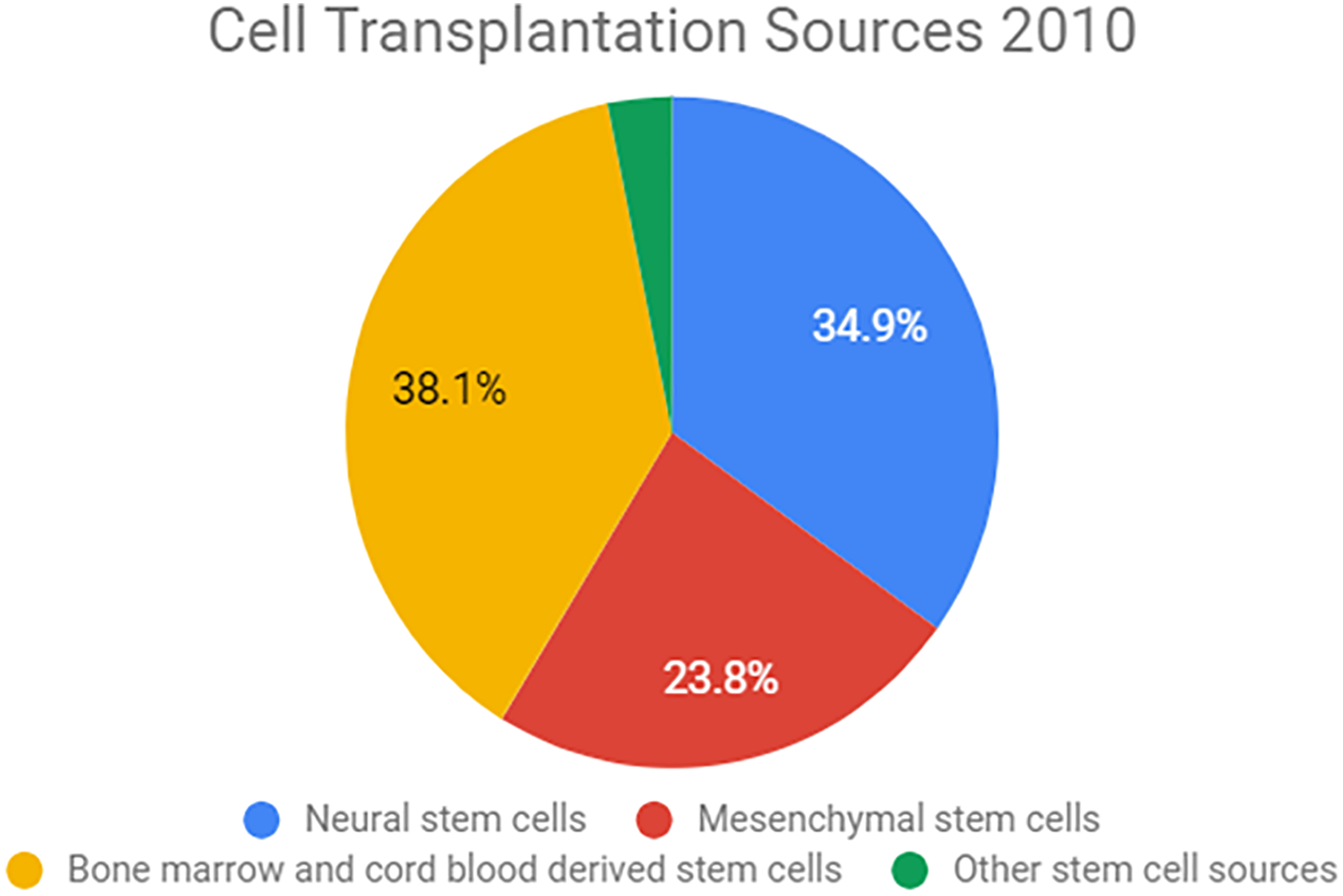
Types of cells used for transplantation for neural repair in experimental stroke in 2010.
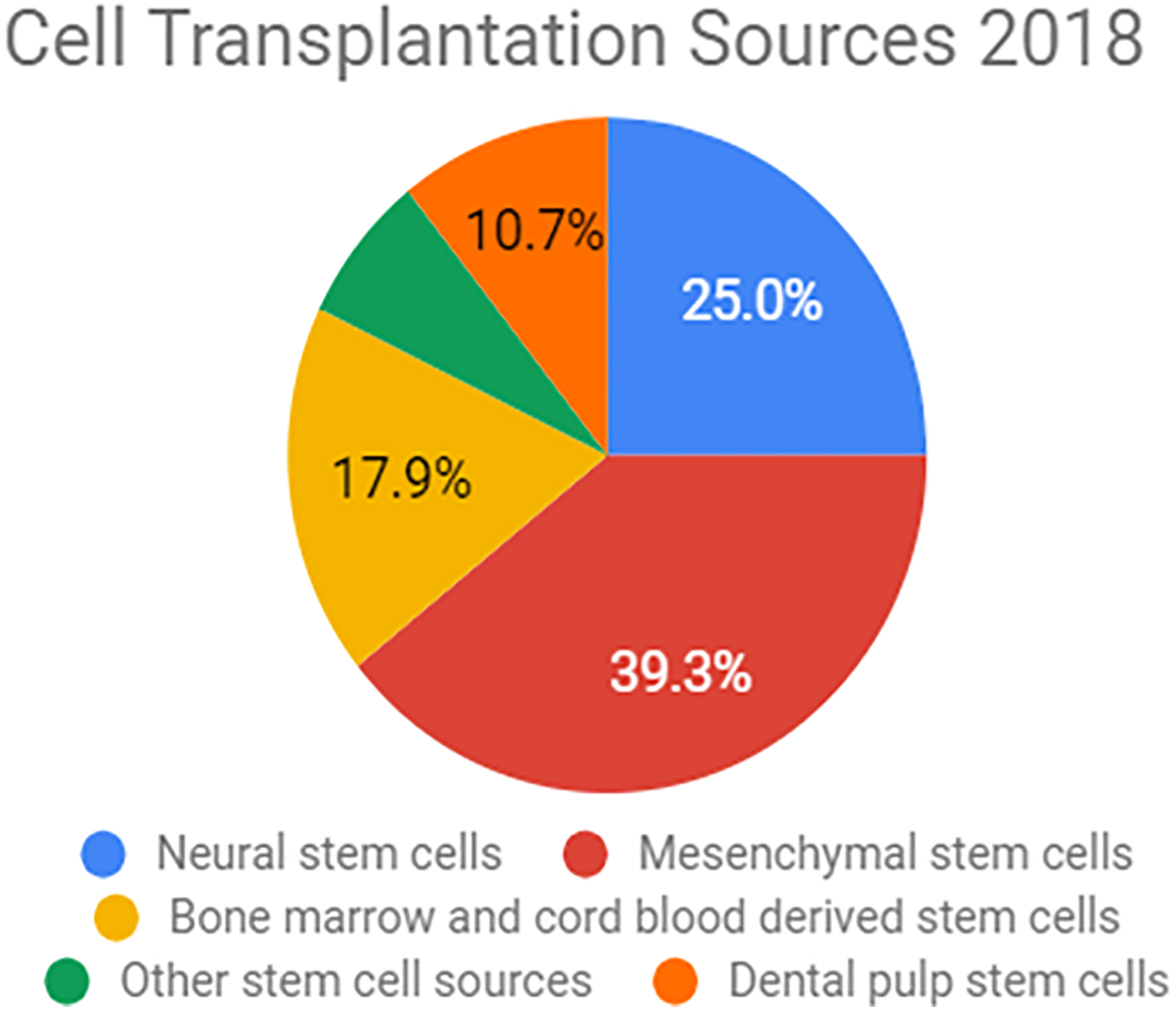
Types of cells used for transplantation for neural repair in experimental stroke in 2018.
Since 2005, the majority of studies related to neural repair in stroke have come from China, Japan, and the United States. In various years one of the three countries would account for the highest number of publications in this field, although that mark often changed from year to year. Korea also produced a large number of publications, as well as Germany and the United Kingdom (Fig. 6).

Annual percentage of publications on cell transplantation in stroke by different countries of origin for years 2000 to 2018.
In recent years, a growing number of studies have explored embryonic stem cell (ESC) and induced pluripotent stem cell (iPSC) approaches to stem cell transplantation. Stem cells derived from embryos have a high proliferation ability and can differentiate into a range of cell types 9 . iPSCs are the result of reprogramming somatic cells into a pluripotent state, allowing for the full range of differentiation found in ESCs 10 . The ability to proliferate into neuronal cells, among others, make ES and iPS cells a prime candidate for cell transplantation therapies, and many of the cell lines used in the publications referenced in this review were derived from ESC and iPSC lines.
As cell transplantation therapies continue to be investigated and new cell sources discovered, clinical trials are taking place. Trials range from testing the feasibility of cell transplantation in the human body as it relates to ischemic stroke, to phase III trials focusing on the efficacy of treatment in humans (Table 1). In the upcoming years the results of these clinical studies will be greatly anticipated, given the decades of preclinical studies evaluating different types of cells for neural repair in stroke which have laid the foundation for these current clinical studies.
Clinical Trials Using Cell Transplantation to Treat Ischemic Stroke.

Footnotes
Declaration of Conflicting Interests
The author(s) declared no potential conflicts of interest with respect to the research, authorship, and/or publication of this article.
Funding
The author(s) received no financial support for the research, authorship, and/or publication of this article.