



Abstract
In the context of science communication, complexity is often reduced. This study employs a 2 × 2 experimental design (N = 432) to investigate how two factors, namely the communication of complexity (reduced vs not reduced) and the provision of suggestions for concrete action (suggested vs not suggested), influence individuals’ productive engagement with the socio-scientific topic of sustainable energy. Measured variables include topic-specific intellectual humility, judgements of source trustworthiness, willingness to act, anxiety, and hope. As expected, communication of complexity led to higher topic-specific intellectual humility, higher epistemic trustworthiness and higher anxiety. When a concrete action was communicated, participants reported lower topic-specific intellectual humility. Participants’ willingness to act was not significantly affected by the experimental manipulation. The results of the study imply that the communication of complexity does not hinder people’s productive engagement with science.
1. Introduction
Science is essential to solving complex and ill-structured problems, such as mitigating the climate crisis. However, these challenges cannot be adequately and fully addressed through a simple application of a scientific algorithm because socio-scientific issues are also inherently uncertain and context-dependent (Zeidler et al., 2019). Given these realities, it is neither productive to believe that science will easily solve all our problems, nor that science cannot make a valuable and significant contribution. The present study explores how to communicate these tensions to the public.
There is a long tradition of theoretical and empirical research on how to best conceptualise public perception and understanding of science. That is, from the 1950s on, there were attempts to focus on the public’s rather fact-based knowledge (or ignorance) about particular scientific topics. Such attempts can be summarised as belonging to the deficit model of science communication, assuming that if the public knew enough science, it would accept it (e.g. see Simis et al., 2016; Suldovsky, 2016 for critiques on the deficit model). However, the linear and unidirectional relationship between the public’s literacy and the acceptance or rejection of scientific expertise cannot be fully confirmed in science communication research. While some studies support the idea that providing more information can help transform people’s attitudes (e.g. Ranney and Clark, 2016), there are also studies that question this relationship. Bolsen et al. (2015) even found a reverse relationship between factual knowledge and being sceptical regarding the existence and anthropogenic nature of climate change, pointing to an ideological divide among segments of the public. Rabb et al. (2021) bring into play the role of a sense of understanding, which might influence individuals’ position regarding climate change rather than the level of actual knowledge. In a set of experiments, they found that people report a higher understanding of controversial issues when they believe that experts understand them. Furthermore, the more individuals overestimated their knowledge, the more likely they are to hold extreme positions.
The aforementioned research sets the foundation for the question posed in this article: the challenge of how to inform the public about science. For instance, in the domain of energy transition, evidence-based policies rely on the assumption that what is known with a large enough agreement is implemented and adapted when new information arises. When such transformations happen in societies, understanding and support of the public are needed (Cologna and Oreskes, 2022). Therefore, individuals may be required to grapple with a degree of complexity (Kienhues et al., 2020). While we adopt a somewhat top-down perspective based on the reality of laypeople’s limited understanding of science (Bromme and Goldman, 2014), we do not rely on the assumption that more factual knowledge leads to higher acceptance. On the contrary, there is something about the virtue of understanding that neither one’s own knowledge nor the knowledge in our society is finite and absolute, a characteristic that is well reflected in intellectual humility (e.g. ‘an understanding that knowledge is limited’; Leary et al., 2017). We investigate whether topic-specific intellectual humility is an important variable to consider when trying to understand people’s engagement with topics outside of their own expertise. Understanding the limits of one’s own knowledge may also entail a critical acknowledgement of the epistemic authority of science (Mede and Schäfer, 2020) and serve as a ground for making informed trustworthiness judgements (Hendriks et al., 2015).
The dangers of (over)simplifying
Within science, simplification is a common strategy for coping with inherent complexity, that is, scientific models are commonly employed to represent complex and uncertain reality in a logical, interpretable and understandable manner (Potochnik, 2017). Simplifications can also be useful in science communication. For instance, a study by Li and Molder (2021) showed that familiarity with the ‘flatten the curve’ infographics (a simplified illustration of how protective measures support the health system capacity) is positively related to people’s trust in science. Clear and accessible argumentation – used as a rhetorical strategy – can be persuasive (Albarracín, 2002).
Simplification in science communication also has its drawbacks. When science-based recommendations are communicated in high-controlling language (as opposed to low-controlling language), the perceived freedom of individuals may be threatened (Bilfinger et al., 2023). Furthermore, presenting scientific information as too easy and simple may have adverse effects on learning and reasoning (Winter et al., 2015). In the context of science communication, simplification often involves omitting details about the methodology, results and uncertainties (Groboljsek and Mali, 2012; Molek-Kozakowska, 2017). Popular press articles often include information about the author and the practical implications of the study but rarely explain the process of conducting science (Zimmerman et al., 2001). Scharrer et al. (2017) bring to attention the problem of easiness in the popularised science domain. In a series of empirical studies, they showed that participants presented with simplified but fictitious information, assume they have considerably more knowledge than participants presented with complex but fictitious information. People who report having more subjective knowledge about scientific topics find it more difficult to tolerate complexities in the form of disagreements between experts (Dieckmann et al., 2017). The experience of fluency while processing information induces feelings of confidence and a feeling of knowing/understanding that is not reflected in actual knowledge gains (Finn and Tauber, 2015).
Complexity can be daunting
When scientific information is too complex, however, and the complexity is not reduced, this can trigger feelings of anxiety in individuals (Muis et al., 2021). Studies have shown that consistent with the ‘mitigation overload’ theory, being presented with a larger amount of relatively easy suggestions for combating the climate crisis (compared with a smaller amount) leads to lower feelings of self-efficacy (Andrews et al., 2022). Furthermore, a study by Vaupotič et al. (2022) showed that participants who were presented with the same factual information reported higher topic-specific intellectual humility and lower willingness to act when they read that an expert took a stance on the issue of nuclear power. This may imply that two-sidedness, without a clear position, can lead to less willingness to act. Indeed, opponents of anthropogenic climate change often use the ‘too complex to understand’ argument to exaggerate the uncertainties of climate science (Moser and Dilling, 2007). Riggs et al. (2022) were able to show that combining scientific jargon with simplified graphics can alleviate the difficulty of processing expert language.
Effects of complexity communication have not been extensively investigated. Yet, implications can be drawn from the comprehensive research on uncertainty communication. Gustafson and Rice (2020) published a review paper on the positive and negative effects of communicating uncertainty, which explores various types of communicated uncertainty (e.g. knowledge limitations, measurement error, disagreement among scientists, tentativeness). While individuals view disagreement in a negative light, they tend to be more tolerant towards methodological uncertainty. However, these aspects can hardly be investigated in isolation. While scientific evidence comes with epistemic authority and epistemic uncertainty, it is also limited by the contextual intricacies of implementation (Suldovsky et al., 2018).
With respect to complexity, some view it as the degree of length and detail (Browning et al., 2018), while others describe it as a system that is unpredictable, uncontrollable and cannot be fully described (Heylighen et al., 2006). In the present study, complexity was adapted as an umbrella term describing how science can provide answers that are complex, bounded by context and not completely predictable – in contrast to simple and straightforward answers. As uncertainty is, in part, a consequence of the extreme complexity of the targeted phenomenon (Kampourakis and McCain, 2019), the two were not clearly separated.
Individuals’ engagement with complexity
In the present study, we were interested in individual engagement with scientific information beyond scientific reasoning and conceptual understanding. Namely, we were interested in individuals’ topic-specific intellectual humility, willingness to act environmentally friendly, epistemic trustworthiness judgements, and emotions of anxiety and hope.
Topic-specific intellectual humility
The interest in the construct of intellectual humility lies in its potential as an antidote to overconfidence resulting from too simplified perceptions of knowledge (Porter et al., 2022b). In the past years, several philosophical accounts of intellectual humility have been proposed, such as limitations owning (Whitcomb et al., 2017), having a low concern for intellectual status (Roberts and Wood, 2003), and being sensitive and respectful to the intellect of others (Priest, 2017). However, psychological accounts of intellectual humility are either multidimensional or metacognitive (see Porter et al., 2022a for a review).
A previously found positive relationship between intellectual humility and behaviours indicative of productive engagement with science, such as motivation to learn, seeking out information and openness to the opposing view, illustrates the importance of intellectual humility in the context of laypeople’s engagement with science (Bowes et al., 2021; Krumrei-Mancuso and Rouse, 2016; Leary et al., 2017). To our knowledge, only a few empirical studies have thus far found that intellectual humility can be induced through experimental manipulation. First, presenting people with a growth mind-set of intelligence (one’s intelligence is not fixed and can grow) as opposed to a stable mind-set of intelligence (one’s intelligence does not change) results in a higher intellectual humility (Porter and Schumann, 2018). Second, facing participants with the reality that their answer to a survey question is incorrect likewise leads to higher intellectual humility (Koetke et al., 2023; Krumrei-Mancuso and Newman, 2020). Finally, reading a more two-sided text rather than a one-sided text expressing an expert’s stance leads to higher topic-specific intellectual humility (Vaupotič et al., 2022). Based on these findings, we assume that people’s topic-specific intellectual humility can be experimentally induced (at least short-term) as a result of the text material that individuals engage with. The present study adopted a metacognitive view characterised by appropriate recognition, productive handling, and awareness of one’s own knowledge limits, but with a focus on a specific topic (Hoyle et al., 2016). We used a state-based rather than a trait-based approach to measuring and defining intellectual humility. Generally, we expect that communicating complexity can work against people’s overconfidence in their own knowledge. Furthermore, we wish to investigate the impact of providing a solution against the background of complexity communication. We formulated the following hypothesis regarding people’s intellectual humility:
Hypothesis 1 (H1). When complexity is not reduced, people’s topic-specific intellectual humility is higher. When a concrete action is additionally provided, topic-specific intellectual humility is higher in the ‘complexity not reduced’ condition in comparison to the ‘complexity reduced’ condition.
Willingness to act environmentally friendly
Pro-environmental attitudes are a stronger predictor for pro-environmental behaviour than knowledge (Frantz and Mayer, 2009). Nonetheless, some studies indicate that people’s reported willingness to act can be, to some degree, triggered by how science is communicated to them (Fortner et al., 2000; Van der Linden et al., 2015) and are open to the epistemic authority of scientists, especially when their views align (Kotcher et al., 2017; Vaupotič et al., 2022). Regarding people’s willingness to act, we formed the following hypothesis:
Hypothesis 2 (H2). When a concrete action is communicated, people’s willingness to act is higher. When no concrete action is communicated, and complexity is not reduced, willingness to act is the lowest.
Epistemic trustworthiness
A common strategy for dealing with complex scientific information is to trust scientists (Hendriks et al., 2015). More trust in science is, for instance, positively related to pro-environmental behaviour (Cologna and Siegrist, 2020). Previous research has dealt with how communication about the nature of science, such as scientific uncertainty (Van der Bles et al., 2020), two-sided scientists’ messages (Mayweg-Paus and Jucks, 2018), communication focused on replication (Hendriks et al., 2020) and self-correction (Altenmüller et al., 2021) affects perceived trustworthiness of scientists. While some empirical studies have shown that communicating epistemic uncertainty has no negative effect on perceived trustworthiness. (Van der Bles et al., 2020), other empirical studies have shown positive effects on the trustworthiness of scientists (Hendriks et al., 2023; Janssen and Jucks, 2023). Moreover, solution communication may positively affect the perceived benevolence and integrity of scientists (Cologna et al., 2021). We formed an open research question about communicating complexity and potential solutions:
Research Question 1 (RQ1). How does the communication of complexity and suggestion of concrete actions affect people’s trustworthiness judgements (expertise, integrity, benevolence)?
Anxiety and hope
Emotions are a motivator for human behaviour and play an important role in decision-making (Loewenstein and Lerner, 2003). Emotions can be mediators between the way information is communicated (such as focused on the threat or loss) and perceived (Nabi et al., 2018), and explain more variance in predicting climate change risk perception than cognitive and socio-demographic characteristics (Van der Linden, 2015). Finally, emotions play a role in the depth of learning and elaboration; when students engage with complex information, their emotional reactions depend on their epistemic beliefs (Muis et al., 2021). Namely, more sophisticated epistemic beliefs (e.g. understanding that scientific knowledge is complex and uncertain) are related to less anxiety when dealing with complex information. As emotional reactions may be an important indication for behavioural action as well as for perception of science, we formulated the following research question about communicating complexity and potential solutions:
Research Question 2 (RQ2). How does the communication of epistemic complexity and suggestion of concrete actions affect people’s emotions (anxiety and hope)?
Present study
In the present study, we used an example of science communication about transitioning from fossil fuels to sustainable energy sources to reduce the negative impact of the energy sector on the climate crisis. The text explained how scientific modelling is used to inform how to tackle this challenge. To test our hypotheses, we conducted a 2 × 2 experimental design study. The first factor was labelled complexity communication (reduced vs not reduced), and the second was labelled concrete action (suggested vs not suggested). Interactions of these two factors would indicate whether communicating about a concrete action can remedy the potential risk/liability of communicating complexity.
We were interested in the impact of these two factors on people’s topic-specific intellectual humility, their willingness to act environmentally friendly, their trustworthiness judgements, and their emotional reactions (anxiety, hope). Furthermore, we included the strength of people’s prior views about sustainable energy as a covariate for predicting topic-specific intellectual humility McElroy-Heltzel et al. (2019). We also included the measured participants’ perceived personal responsibility for combating the climate crisis due to its previously found high correlation with measures of intention for climate-friendly behaviour (Harland et al., 2007).
Please note that the study was conducted after the Russian invasion of Ukraine in February 2022 and before Russia’s move to sharply reduce supplies of gas to Germany in June 2022. Prior to running the data analysis, we pre-registered our hypotheses and research question. 1 The study was pre-registered prior to the data collection: https://archive.org/details/osf-registrations-msfc9-v1. For the details on the data, R code and all materials used in the survey, please see our OSF folder: https://osf.io/83xsd/.
2. Methods
Participants
Altogether, 478 participants took part in the online survey. All participants gave consent at the beginning and at the end of the survey. Because of a false response to either of the two attention checks, we excluded 12 participants. Participants took, on average, 13 minutes and 12 seconds (SD = 6 minutes and 30 seconds) to complete the survey. We excluded participants who took less than 5 minutes and 30 seconds (13 participants) or more than 30 minutes and 42 seconds to complete the survey (12 participants). 2 After the exclusion criteria, we were left with a final sample of 441 participants, out of which 203 were female, 230 were male, six described themselves as diverse, and two preferred not to answer. All participants were German. They were aged between 18 and 69 (M = 30.4, SD = 9.3) and relatively more educated than the German average, with 53.3% of participants holding a university degree, 27.5% holding a high school degree, 11.2% holding a professional degree and 8.0% holding a secondary school degree or primary school degree. The distribution across experimental groups was approximately equal, and the sample size was sufficiently high to find small to medium significant effects; the calculation was done using G*Power.
Procedure
Participants were recruited through Prolific, a participant pool for research in the social and behavioural sciences; they were paid 3.9 euros for their participation. They were informed that the study was about a scientific topic and that their task was to read a text and then respond to items, capturing their opinions, views, and feelings about that topic. The experiment did not include any deception, the data was fully anonymised, and participation was completely voluntary. Participants were asked to give informed consent at the beginning and again at the end of the survey. In the first part of the survey, participants reported their perceived responsibility for combating climate change and their prior views on sustainable energy. Then, they proceeded with reading one of the four versions of the science news text. After reading the text, participants responded to the survey measures in the following order: emotions about the text, topic-specific intellectual humility, willingness to act and Muenster Epistemic Trustworthiness Inventory (METI). In total, we included two attention check items (e.g. Please respond to this item with ‘fully agree’). In the last part of the survey, participants answered the manipulation checks and reported their gender, age and highest achieved education, and answered the open qualitative question: ‘In what ways are you willing to support the transition to renewable energy, and how can science help you do that?’ The open question was not analysed for the purpose of this scientific article.
Materials
Science news article
The content of the text was partly adapted from an online article about the future energy system provided by the researchers of the German Federal Ministry for Economic Affairs and Climate Action. It described how modelling can be used to plan how sustainable energy sources can be implemented into the energy system to achieve net-zero carbon dioxide emission. While the same factual information was presented, the texts differed in (1) the degree to which epistemic complexity was reduced and (2) whether or not concrete actions were suggested or not. Consequently, participants read one of the four versions of the text that differed along with the factors of epistemic complexity (reduced vs not reduced) and concrete actions (suggested vs not suggested). When epistemic complexity was not reduced, the text explained that the models do not directly represent reality, that not all variables can be known, and that the changes in the dynamic system cannot be fully predicted; when the complexity was reduced, the epistemic nature of modelling was not elaborated on, and the content was presented in a simplified manner. When concrete actions were suggested, the text included information about concrete steps that can be taken to support a net-zero carbon dioxide emission (e.g. build more wind and solar plants, save energy by keeping the heating lower); when they were not suggested, these concrete steps were simply left out. The text material is included in Supplemental Material 1.
Measures
Topic-specific intellectual humility
We used the topic-specific intellectual humility scale developed by Hoyle et al. (2016) that measures participants’ topic-specific acknowledgement and attendance to one’s own knowledge limitations regarding a specific topic. Currently, this is the only available measure for topic-specific intellectual humility with appropriate measurement invariance and interpersonal variance across different domains (see McElroy-Heltzel et al., 2019 for the measure evaluation). Since the measure correlates with general humility and dogmatism (negative correlation), an item measuring the strength of prior beliefs was included as well. Nine items answered on a 7-point Likert-type scale from ‘fully agree’ to ‘fully disagree’ result in a single factor measure (McDonald’s ω = .86). Example items from the Topic-specific intellectual humility scale are: ‘It is quite likely that there are gaps in my understanding about the transition to renewable energy’ and ‘When it comes to my views about the transition to renewable energy, I may be overlooking evidence’.
Willingness to act
Participants’ intention to adopt actions that support the implementation of sustainable energy sources was measured using eight items on the 7-point Likert-type scale from ‘very unlikely’ to ‘very likely’. The items were adapted from other similar measures intended for capturing people’s willingness to act in the context of supporting climate-friendly action (e.g. Tobler et al., 2012). We specified the targeted behaviour and action in the context of saving energy and adopting sustainable energy sources. The internal consistency for the items was very good at McDonald’s ω = .85. Example items are: ‘I am in favour of building wind power plants in my neighbourhood’ and ‘I am willing to lower the heating temperature of my apartment by one degree Celsius in winter’.
Anticipatory emotions
Participants’ emotions regarding the content of the text about the future sustainable energy strategy were measured using the anticipatory emotions scale (Folkman and Lazarus, 1985). According to their theory, emotions are experienced in a context-dependent manner and triggered by a specific stimulus. For the experience of threat emotions, participants reported to what extent they felt worried, fearful, and anxious (McDonald’s ω = .82); for the experience of challenge/hope emotions, participants reported to what extent they felt confident, hopeful, and eager (McDonald’s ω = .84). Participants’ responses regarding the strength of the emotions were given on a 7-point Likert-type scale from ‘fully agree’ to ‘fully disagree’.
Epistemic trustworthiness
Participants’ epistemic trustworthiness was measured using the METI (Hendriks et al., 2015). We asked participants to rate the authors of the text on the dimensions of expertise (six items), integrity (four items), and benevolence (four items). The ratings were given on a 7-point scale that is comprised of opposite word pairs (e.g. competent – incompetent, honest – dishonest, moral – immoral). The internal consistencies measured with McDonald’s ω were very good for expertise, integrity, and benevolence at respectively .95, .9 and .88.
Additional measures
We measured participants’ perceived personal responsibility for combating climate change and used it as a covariate for predicting participants’ willingness to act. The two items described the extent to which participants felt personally responsible for combating climate change and were measured on a scale from 1 ( ‘fully agree’) to 7 ( ‘fully disagree’). The internal consistency was sufficiently high (McDonald’s ω = .82). Furthermore, we measured the strength of their prior beliefs about sustainable energy to control for the salience of their views. We used two items on a scale from 1 (‘fully agree’) to 7 (‘fully disagree’) that yielded a McDonald’s ω of .76. Furthermore, we also measured to what extent participants were aware of the communicated complexity by asking the question. We asked them to rate the following statement on a scale from 1 to 7 (‘fully agree’ to ‘fully disagree’): There is a single simple solution to the problem of future sustainable energy.
3. Results
In the following section, we report the results of the study. See Table 1 for descriptive statistics of our dependent variables.
Means and standard deviations of measured variables split by experimental conditions.
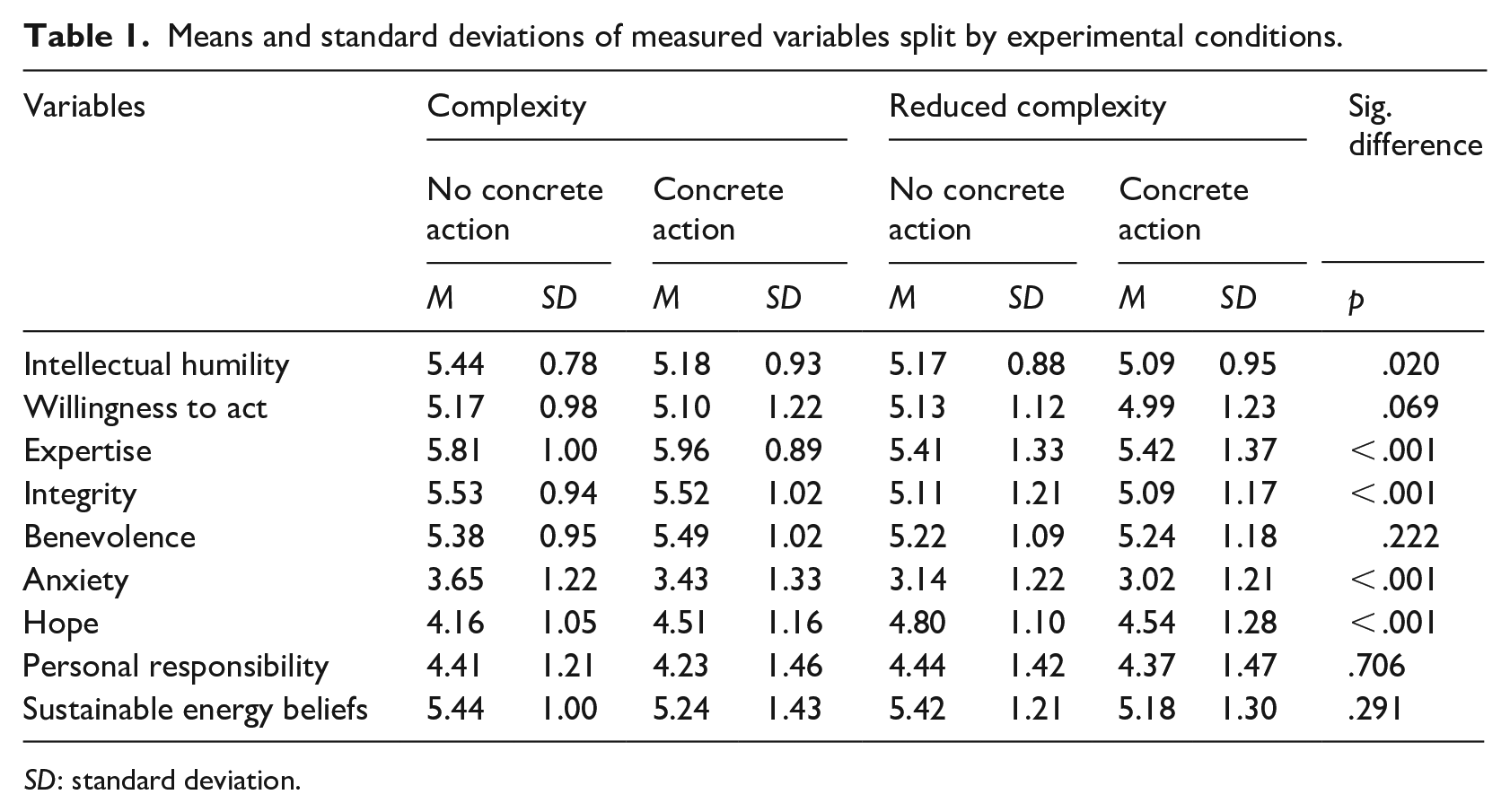
SD: standard deviation.
Preparatory analyses
We ran several tests to make sure that the assumptions for running our analyses are met. A linear model with experimental conditions as the independent variable and our covariates did not yield a significant difference either for perceived responsibility for combating climate change (R2 = −.002, F(3,428) = 0.666, p = .572) or for the strength of prior belief about sustainable energy (R2 = .008, F(3,428) = 1.255, p = .289). Furthermore, participants in the reduced complexity condition (β = −.445, p < .001, η2 = .14, 95% CI (0.09, 0.19)) and in the solution condition (β = −.445, p < .001, η2 = .14, 95% CI (0.09, 0.19)) agreed significantly more with the statement ‘There is one simple answer to the question of how the transition to renewable energy should take place’. Furthermore, 87.5% of participants reading about concrete actions reported that a concrete solution was indeed provided.
We investigated our hypothesis and research questions by fitting a general linear model using independent factors as predictors (dummy variables) and dependent variables as outcomes. To determine the statistical significance of the effects, we used the threshold of p < .05; for independent factors, the size of the effects was interpreted with a generalised eta squared (small = .02, medium = .13, large = .26; Olejnik and Algina, 2003). The data and the code are openly available at https://osf.io/83xsd/. The table with Fixed Effects Parameters is included in Supplemental Material 2.
Correlations between measured variables
To better understand how different variables relate to each other, we first summarise all correlations in Table 2.
The correlational matrix between measured variables.
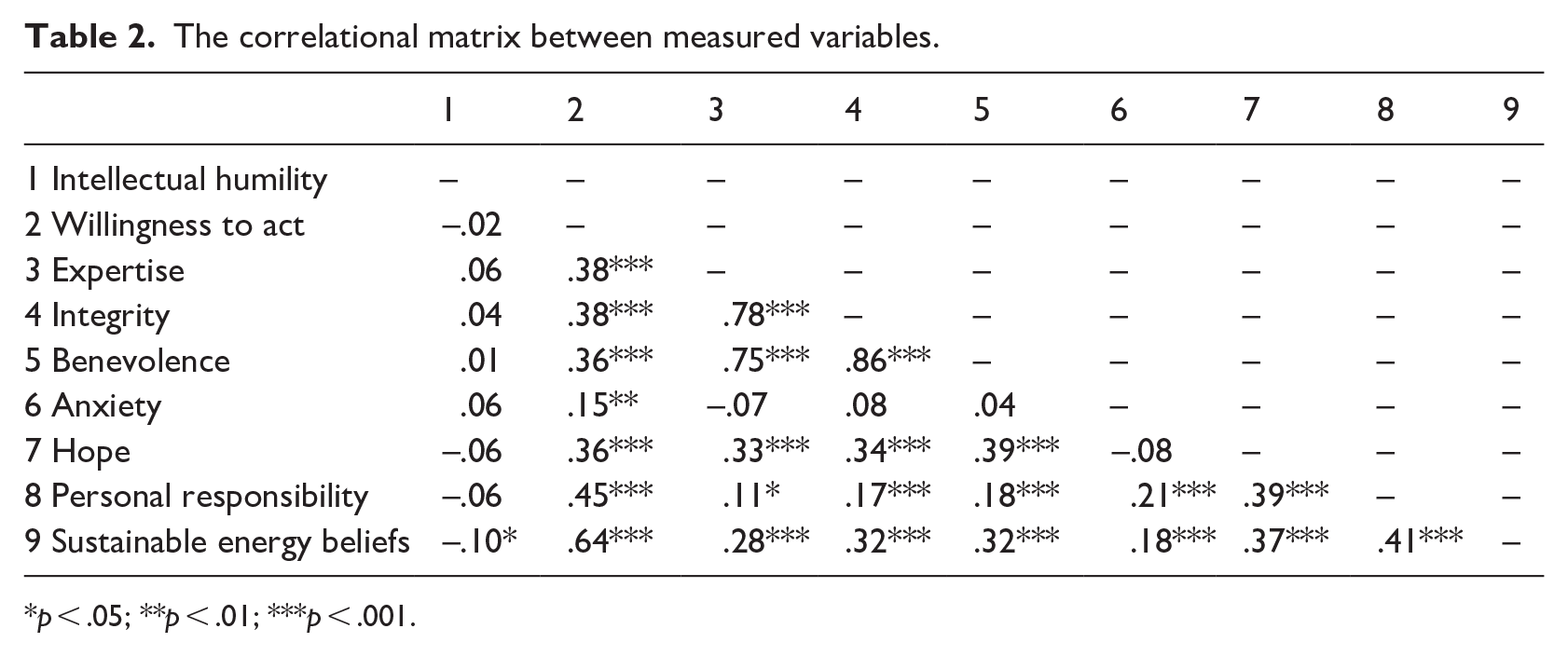
p < .05; **p < .01; ***p < .001.
Intellectual humility
Intellectual humility was significantly higher when complexity was not reduced (β = −.091, p = .031, η2 = .01, 95% CI (0.00, 0.03)) and when a solution was not communicated (β = −.092, p = .029, η2 = .01, 95% CI (0.00, 0.03)). The interaction did not yield significance. The strength of prior beliefs about sustainable energy was negatively but not significantly related to intellectual humility (r = −.10, p = .06).
Willingness to act
Neither the communication of complexity nor a concrete action significantly affected participants’ willingness to act. There was a strong and significant correlation between participants’ perceived personal responsibility for combating climate change and their willingness to act (r = .45, p < .001 η2 = .20, 95% CI (0.15, 0.25)).
Trustworthiness
Across all three dimensions, the communication of complexity was positively related to perceived trustworthiness: expertise (β = −.235, p < .001, η2 = .04, 95% CI (0.01, 0.07)), integrity expertise (β = −.235, p < .001, η2 = .04, 95% CI (0.01, 0.07)), and benevolence expertise (β = −.099, p = .049, η2 = .00, 95% CI (0.00, 0.03)). For all three dimensions, communication of a concrete action did not affect trustworthiness, nor were there interaction effects between the manner of communicating complexity and whether a concrete action was suggested.
Anxiety and hope
When complexity was not reduced, participants’ anxiety was significantly higher (β = −.231, p < .001, η2 = .03, 95% CI (0.01, 0.07)), while communicating a concrete action did not have a significant effect on participants’ anxiety. With regards to hope, we found a main effect of communicating complexity ((β = −.156, p = .004, η2 = .02, 95% CI (0.01, 0.05)), in the sense that a reduction of complexity triggered hope. However, we also found an interaction effect of reducing complexity and communicating a concrete action (β = −.152, p = .005, η2 = .02, 95% CI (0.01, 0.04)). Namely, when complexity was not reduced, and no concrete action was communicated, hope was the lowest; however, when complexity was reduced but also no concrete action was communicated, hope was the highest (t (428) = 4.136, p < .001).
4. Discussion
Summary of results and hypotheses
In the present study, we investigated the effects of communicating complexity by presenting participants with different levels of communicated complexity (reduced vs not reduced) about the topic of transition to renewable energy. In addition, participants either read or did not read suggestions of concrete actions to be taken based on science. The aim of the study was to investigate how engagement with different versions of the text affects participants’ topic-specific intellectual humility, willingness to act, epistemic trustworthiness judgements and feelings of anxiety and hope. In line with H1, we found that communication of complexity in comparison to the reduction of complexity led to higher topic-specific intellectual humility (low effect size). As expected, when a concrete action was not communicated, topic-specific intellectual humility was higher (low effect size). However, we did not find a significant interaction effect. These findings imply that combining complexity communication with a suggestion of a concrete action did not significantly moderate the effect on people’s topic-specific intellectual humility. According to H2, we expected that individuals’ willingness to act would be significantly positively affected by the reduction of complexity and suggestions of concrete actions; however, we could not find evidence for this hypothesis based on our data. As anticipated, reported personal responsibility for combating climate change was the most important predictor of participants’ willingness to act with a high effect size. Regarding trustworthiness (RQ1), we found that across all three dimensions of trustworthiness judgements, participants gave significantly higher ratings when complexity was not reduced. While the effect size for expertise and integrity was high, the size of the effect for benevolence was rather small. Finally, regarding feelings of hope and anxiety (RQ2), we found that complexity indeed caused more anxiety than reduced complexity (medium effect size). The relationship between independent variables and hope was unexpected: hope was the lowest when complexity was not reduced, and a concrete action was not suggested, and the highest in the reduced complexity condition without a concrete action suggested (small effect size).
How are laypeople affected by complexity communication and concrete action suggestions?
Revealing that science cannot provide a single, simple solution seems to lead to a higher perception that one’s knowledge has limits, in a similar way that getting feedback that one was wrong, learning about the growth mind-set of intelligence, or reading two-sided information, can increase (domain-specific) intellectual humility (Koetke et al., 2023; Porter and Schumann, 2018; Vaupotič et al., 2022). Furthermore, this finding reflects that laypeople make judgements about their own knowledge based on how experts communicate what they know (Rabb et al., 2019). The effect sizes for intellectual humility outcomes were relatively small; however, considering the scarcity of experimental studies trying to increase intellectual humility, our results importantly reaffirm that state-based topic-specific intellectual humility in science communication can be increased. Focusing on other issues and contexts (formal and informal education, policy communication, risk communication) would provide information on the robustness of these effects. Namely, communicating about a lesser well-known topic may more potently change individuals’ views and perceptions because their pre-existing beliefs may be weaker. Finally, topic-specific intellectual humility seems relatively unrelated to other dependent variables (low correlations with trustworthiness or willingness to act). Having awareness of limits surrounding one’s own knowledge may, therefore, be a relatively independent but important variable in understanding individuals’ engagement with science.
Communicating complexity also had a positive impact on scientists’ perceived expertise, integrity, and benevolence. Scientists are generally relatively trusted in comparison to other sources of knowledge (Janssen et al., 2021), and communicative science features, for instance, signalled through complexity, can be a valuable heuristic for making trustworthiness judgements (Thomm and Bromme, 2012). To our knowledge, this is one of the first studies relating complexity communication with trustworthiness judgements; however, many parallels can be drawn from studies focusing on uncertainty communication, where similar positive connections have been found, especially regarding technical uncertainty (Gustafson and Rice, 2020). Our results also suggest that communicating complexity does not harm scientists but actually leads to greater trustworthiness.
With regard to emotional reactions, we found that complexity communication may be related to higher anxiety. While anxiety can be a driving force of action, hope may be more productive in the context of environmental-friendly action (Geiger et al., 2019). Based on our data, participants felt the least hope when complexity was communicated to them and when no concrete action was suggested. Interestingly, hope was the highest when complexity was reduced, and no concrete actions were mentioned. Thereby, knowing the actions that need to be taken to transition to renewable energy does not necessarily induce hope. Due to the small effect size and lack of theoretical background, this causal relationship should be investigated further. Future empirical and theoretical trajectories could try to scrutinise the link between specific features of science communication (for instance, communicating complexity) and willingness to act because of changes in other variables (mediation through trust, intellectual humility, and emotions). Contrary to our hypotheses, willingness to act was not significantly affected by either the way complexity was communicated or by concrete actions being suggested. As observed in other studies, prior beliefs and pro-environmental attitudes are among the strongest predictors of pro-environmental behavior (Klöckner, 2013). One reason for the lack of effect might have been the familiarity with the topic, so neither the urgency nor the suggested actions were new to participants. A similar explanation can be provided as to why the communication of concrete actions did not significantly affect most of our dependent variables (except a small significant effect on topic-specific intellectual humility). Actions such as building energy-efficient houses, switching to electrical energy suppliers, supporting the construction of solar panels and wind turbines as well as generally saving energy, were probably not surprising for the participants.
Our study provides some general insights into how people’s perceptions of their own knowledge and trustworthiness are influenced by communicating the complexity of addressing real-life issues like energy transition. Future studies could focus on specific aspects of complexity, such as system complexity or limitations of transdisciplinary solutions. However, a more general understanding that scientific knowledge is bounded, complex, and limited may hold greater significance for public engagement than understanding specific aspects of complexity.
Limitations
Our empirical findings can hardly be generalised across different domains in topics. The more we approach issues where specific social structures, norms, physical infrastructure or current historical events play an important role in people’s perceptions, the less we can claim that our results have the same implications for other socio-scientific topics. Nonetheless, public engagement with science may be the most meaningful to study in exactly such contexts; the public is actually required to make decisions and to act on issues such as energy and climate change mitigation (Feinstein, 2011). The present study has adopted a common way of measuring intellectual humility; however, critics have pointed towards the shortcomings of intellectual humility scales. Namely, people who are actually intellectually humble may not see themselves in such a way or really care about it (Priest, 2017). An alternative way of measuring intellectual humility could be through semantic approaches (see Christen et al., 2019). Importantly, willingness to act is not the same as actual behaviour. While empirical studies often rely on measures such as ours to predict how people may act in real life, there may be a gap between reporting and actual behaviour (e.g. Gifford et al., 2011). Finally, it is important to acknowledge that our sample may be slightly biased towards individuals who appreciate science. This bias is due to the fact that, on average, our participants were more educated than the general population in Germany. In addition, we collected our data through the Prolific participant pool, which may further contribute to the bias. Outsourcing data collection to platforms like Prolific has its limitations, including the potential for obtaining a sample that is more knowledgeable than the general population and more likely to use various social media platforms (Tang et al., 2022). These factors can impact how people engage with scientific information, as participants in our study may already hold more pro-environmental beliefs and have less absolutistic views about science.
Implications and conclusion
Understanding the constraints of science – features such as complexity, uncertainty and the limits of translating science into specific actions or policies – may be useful when engaging with challenges such as climate change. Our findings imply that communicating complexity increases people’s topic-specific intellectual humility and the perceived trustworthiness of experts. Research on laypeople’s perception of science often focuses on misconceptions of science or distrust in scientists; however, ours and other similar studies (e.g. Altenmüller et al., 2021; Rabinovich and Morton, 2012) show that in many cases, individuals can grapple with the complexity and uncertainties of science. Furthermore, it also seems that communicating complexity does not have a detrimental effect on people’s willingness to act in an environmentally friendly way, even when there is no clear solution provided. Highlighting the importance of virtues such as intellectual humility may contribute to how people can productively deal with their own knowledge limits as well as the limits of scientific knowledge.
Supplemental Material
sj-docx-1-pus-10.1177_09636625241227800 – Supplemental material for Complexity appreciated: How the communication of complexity impacts topic-specific intellectual humility and epistemic trustworthiness
Supplemental material, sj-docx-1-pus-10.1177_09636625241227800 for Complexity appreciated: How the communication of complexity impacts topic-specific intellectual humility and epistemic trustworthiness by Nina Vaupotič, Dorothe Kienhues and Regina Jucks in Public Understanding of Science
Footnotes
Acknowledgements
The authors thank Kristin Wilhelm and Rüya Cakir for their research assistance.
Declaration of conflicting interests
The author(s) declared no potential conflicts of interest with respect to the research, authorship and/or publication of this article.
Funding
The author(s) disclosed receipt of the following financial support for the research, authorship and/or publication of this article: The research was supported by the German Research Foundation (DFG) in the frame of the Research Training Group GRK 1712 ‘Trust and Communication in a Digitised World’ provided to the third author.

Supplemental material
Supplemental material for this article is available online.
Notes
Author biographies
References
Supplementary Material
Please find the following supplemental material available below.
For Open Access articles published under a Creative Commons License, all supplemental material carries the same license as the article it is associated with.
For non-Open Access articles published, all supplemental material carries a non-exclusive license, and permission requests for re-use of supplemental material or any part of supplemental material shall be sent directly to the copyright owner as specified in the copyright notice associated with the article.
