



Abstract
This study investigates how scientific knowledge is politicized on Twitter. Identifying discursive modes of online politicization and analyzing how they relate to different online issue publics allows us to weigh in on the scholarly debate about when the politicization of science on social media becomes problematic in a democratic context. This is a complicated question in “knowledge societies” where increasing science–politics confluence means that some degree of politicization is necessary for science–informed policymaking and (online) public debate. We look at how pandemic science was politicized through becoming discursively linked with an already highly politicized science issue on Twitter, namely, climate change. Our mixed-methods analysis demonstrates that some politicizations of science seek to contest science-informed policy while others are better characterized as ideological science rejection. We argue for the advantages of this approach of identifying science rejection over approaches that seek to distinguish information from dis-/misinformation.
Keywords
1. Introduction
This study examines how the politicization of science takes shape on Twitter. Amid the corona pandemic, public contestations of scientific knowledge and expertise about the COVID-19 virus became highly politically charged. This included a boom in online communication about the virus ranging from unintentionally misleading information to elaborate conspiracy theories. Scholars have raised special attention for the role of social media platforms in these developments (Nguyen and Catalan-Matamoros, 2020; Yang et al., 2021), with some arguing that in the context of today’s changing media landscape, platforms are an important driving force behind the weakening authority of scientific knowledge that enters the public domain (Brossard and Scheufele, 2022).
Recent dis-/misinformation scholarship has investigated the effects of information defined as “deviating from factility” in the context of the coronavirus pandemic (Hameleers et al., 2023). Yet, the scientific nature of expert knowledge about COVID-19 poses an additional challenge for approaches that address the online spread of information that is (in part or whole) deceptive or untrue. That is, science is reliant on not only evidence, agreed-upon facts, and articulating consensus claims, but also upon ongoing debate, reasoned disagreement, and competing interpretations between experts. Hence, some have warned against a trend in dis/misinformation scholarship that “assumes that ‘false’ science-related claims are easily identifiable” (Krause et al., 2022). The inherently open-ended character of the scientific enterprise as an unfinished project of truth-seeking necessarily implies uncertainty, tentativeness, and partiality. As such, it is not always immediately self-evident on which basis the spreading of science dis-/misinformation ought to be distinguished from the dissemination of dissenting scientific views. Acknowledging this complexity makes it important to examine how science is politically contested on social media, through which discursive strategies, and within which online publics. Hence, in this article, we seek to tease out the discursive facets of how scientific knowledge and expertise about the corona virus became politicized on Twitter. The main question we address is, when does online deliberation about science involve a healthy degree of politicization, and what, in contrast, constitutes an excessive, poisonous dose of online politicization?
The context we examine is the Dutch national Twittersphere. This choice is a corrective to an overwhelming overall emphasis in the social media scholarship on the US context, one that may not help to properly theorize social media platforms’ effects on political discussion in European countries and other settings where commercial media is still less dominant than public service broadcasting (Kubin and Von Sikorski, 2021). We limit our investigation to the Twitter platform as it is more politically oriented than other popular platforms; within the Dutch national setting as in many others, the platform has found a “niche as a communication channel for politicians, journalists, and politically engaged citizens” (Bakker et al., 2021). 1 It is in this context of public social media participation that the article seeks to investigate how different forms of online science politicization can be identified and discursively distinguished from one another, and how they can be related to (distinct or overlapping) social media publics.
In the following section, we further embed the empirical investigation within the communication, media studies, and philosophy of science scholarship. We then outline our method and explain how we study online science politicization through a focus on how COVID-19 came into connection with another, already highly politicized science-informed policy issue, namely, climate change. After outlining our iterative, quantitative–qualitative approach, we then present the study’s findings in an interlinked, mixed-methods analysis that includes a user network analysis, discursive analysis, and URL link analysis. Finally, we present the discussion and conclusion, highlighting the implications of our argument with relation to the scholarly discussion about online science dis-/misinformation.
2. Public engagement and online science politicization
It is not always clear how we should distinguish science dis-/misinformation from dissenting scientific views. This problem has led some scholars to argue for a less bounded and more open-ended definition of dis-/misinformation; one that acknowledges that scientific knowledge is tentative by definition but also recognizes that in science some issues are more “settled” than others (Vraga and Bode, 2020). While this perspective offers a sophisticated approach to defining science dis-/misinformation, scientific uncertainty can, itself, be misused, manipulated, and indeed politicized. In fact, some scholars see the politicization of science, as such, as the undermining of scientific claims by exploiting or exaggerates uncertainties that are inherent to scientific knowledge production (Bolsen and Druckman, 2015; see also Oreskes and Conway, 2010). However, it is not only those who seek to undermine scientific expertise who politicize science; science politicization has also been discussed in relation to the increased partisanship of scientists (Post and Ramirez, 2018), a development arising from scientists’ fears about politically motivated public misuse of their communication of scientific uncertainty and nuance (Maier et al., 2016; Post, 2016; Tøsse, 2013). We must therefore understand politicization of science as a broader problem arising not strictly from malicious practices, but from the need for public engagement with, contestation over, and deliberation about scientific knowledge in increasingly participation-oriented media spheres.
In this broader sense, the politicization of science has been discussed as a structural shift in which science and politics have become more tightly bound up with one another in the “knowledge society” (Weingart, 1999). As natural scientific expertise becomes further embedded within, for instance, public health and environmental policymaking, the changing relationship between science and politics feeds an increase in politically motivated contestation of scientific claims. Therefore, the problem cannot be formulated as one primarily caused by attacks launched (by the political left and/or right) against science’s unchanging claim to objective truth, as some framings suggest (see Otto, 2016). Rather, we must understand how the increasingly close relationship between science and politics raises new problems and potentials for public perception of, communication about, and trust in science within scientifically advanced democracies.
In an influential account of science politicization that acknowledges the necessity of some blurring between science and society, Pielke (2007) highlights how some degree of politicization of science is inevitable and even important, as the political process offers a way to resolve public disagreement/conflict about science-informed decision-making based on the articulation of public values. In this perspective, it is an excess of politicization that poses a problem for both sound science and political decision-making, and not the merging of politics with science, as such. Theoretically, this excess of politicization is just as much a problem for policymaking as a reliance on scientific expertise that eliminates the need for politics; that is, excess politicization is just as problematic as excessive de-politicization of scientific knowledge, also known as scientism, tech-solutionism, or technocracy (see also Jasanoff, 1994). As such, the politicization of science and the scientization of politics are flip-sides of the same problem, since, according to Pielke (2007), the two mutually reinforce each other as one creates the conditions for the other’s problematic rise. 2 A healthy degree of politicization fosters democratic deliberation by facilitating public disagreement over how to societally implement and give value to knowledge from particular areas of science.
In order to avoid excessive politicization, democratic debate and disagreement over policy is considered to require at least some basic agreement about facts (Rekker, 2021). Without this basic common ground, public participation is more likely to reflect slippage into challenging the epistemic authority of scientific knowledge, as such, and thus epistemic relativism, rather than being a public contestation of interpretations about, or value assigned to, scientific knowledge. Rekker (2021) describes such science denial as “ideological science rejection” and discusses how it manifests on four levels of abstraction: disputing specific scientific claims, disputing particular research fields, disputing science as a whole, and/or disputing science as a system belonging to a cultural elite. While these levels are not strictly separated (and can influence one another), it is noteworthy that rejection of science as a whole and rejection of science as an elite cultural system are thought to be most strongly associated with populism and right-wing political ideology (Rekker, 2021). As this study is most interested in a more general form of science rejection that crosses the boundaries of a single issue/scientific field, the conceptualization of a more general science rejection will serve as the most relevant analytical guide for how we distinguish between different modes of online politicization. 3
In focusing on Twitter, we are wary of assuming the platform’s uniform polarizing influence on public debate, as scholars have pointed out the significant divergences between degrees of political polarization on Twitter across countries (Urman, 2020). We are also careful not to assume that discourse mediated by the Twitter platform represents the entirety of Dutch societal debate. We heed the important warning that attempting to establish with certainty whether social media research examines the dynamics of a controversial issue or, rather, studies the influence of the platform, itself, is futile; we always do both at the same time (Marres and Moats, 2015). Hence, without claiming a strict separation from the influence of the Twitter environment, this study seeks to reveal what the selected issue overlap can tell us about modes of political participation around science. Considering that contestation of science is always situated within a relevant societal and institutional setting, our analysis sheds light on how Dutch political Twitter discourse takes shape with relation to science within a nationally and temporally delimited setting.
3. Materials and methods: An iterative approach to tweet data analysis
Our approach focuses exclusively on Twitter because the platform makes vast amounts of user data more readily retrievable than other platforms, facilitating focused investigation of specific issues/themes through keyword-based data search. This is stated with the caveat that the Twitter terms of service are subject to change, hence these research affordances are true of the period of data collection. The stark differences in platform research affordances and user cultures makes any straightforward cross-platform comparison impossible, hence, we limit our scope to one platform. In order to narrow down and operationalize online science politicization, we focus on the overlap that emerged on Twitter between the long-politicized issue of climate change and the much more recently politicized issue of the COVID-19 virus. This focus supposes that where these two issues merge, we will find actors and networks that are actively engaged in (general) politicizations of science. We assume this because, first, the history of scientific knowledge about climate change has reflected increased public communication, contestation, and political polarization (Bolin, 2007), producing relatively distinctive discursive repertoires, categories, and terms for the politicization of science by different actors. Second, tracing how epistemic authority is framed across two issues better enables us to understand how scientific expertise is more generally engaged with (compared with expertise limited to a single science-related topic). Understanding this more general dynamic helps fulfill the purpose of focusing more closely on the public status of science as an issue that produces its own “issue publics” (Kim, 2009), rather than on the specific interests, stakes, or values at play in public controversies that are specific to the respective topics of COVID-19 and climate change.
Our analysis follows a stepwise process, guided by large-scale data analysis within an iterative research design; we combine a network analysis of Twitter user connections with a discursive analysis of tweet content, supplemented by analysis of in-tweet URL analysis. This approach allows us to reach increasing levels of analytical depth and complexity through consecutive iterations. In the first step, we assembled a database of tweet data collected between 15 April 2021 and 20 June 2021 by using two lists of search terms related to the two key issues (climate change and the COVID-19 pandemic) that were as generic as possible without being so general as to cause a loss of focus or important contestations at stake. The data collection period represents a time far enough from the beginning of the pandemic’s outbreak in early 2020 to allow for a degree of coherent political discourses to form around the issue, and a period still early enough for the issue to draw a high degree of active participation as this period coincided with the third wave in the Netherlands. The data were collected using the Twitter Streaming API. The keyword (not hashtag) lists used were “covid,” “covid-19,” “corona,” “coronavirus,” “inenting,” “vaccinatie,” “coronavaccin” for COVID-19, and “klimaat,” “klimaatverandering,” “klimaatcrisis” for climate change.
Each of the users included in the dataset had tweeted about both these issues (using at least one of the keywords pertaining to each issue) within the period of data collection. These users had also tweeted at least 10 times within the period in question. This selection allowed us to define a convergence between the two issues, comprising actors who were regularly engaged in one or both issues on the platform during the period studied. Investigating this area of issue convergence allowed us to delve into the discursive relationship between the two science-oriented issue discussions without focusing on any subset of political actors, a priori. The dataset this collection method yielded comprised 1,826,596 tweets by a total of 171,626 users, and included data on which user accounts follow other users. The user network was then visualized with Gephi (Bastian et al., 2009), meaning that each of the users was potted as a node connected to others by lines. This allowed us to identify four main clusters of users within the network (see Figure 1). The lines between users/nodes in the visualization signify which accounts followed which others. The clusters identified correspond with certain political characteristics, which we outlined in the first, descriptive, step of the analysis.
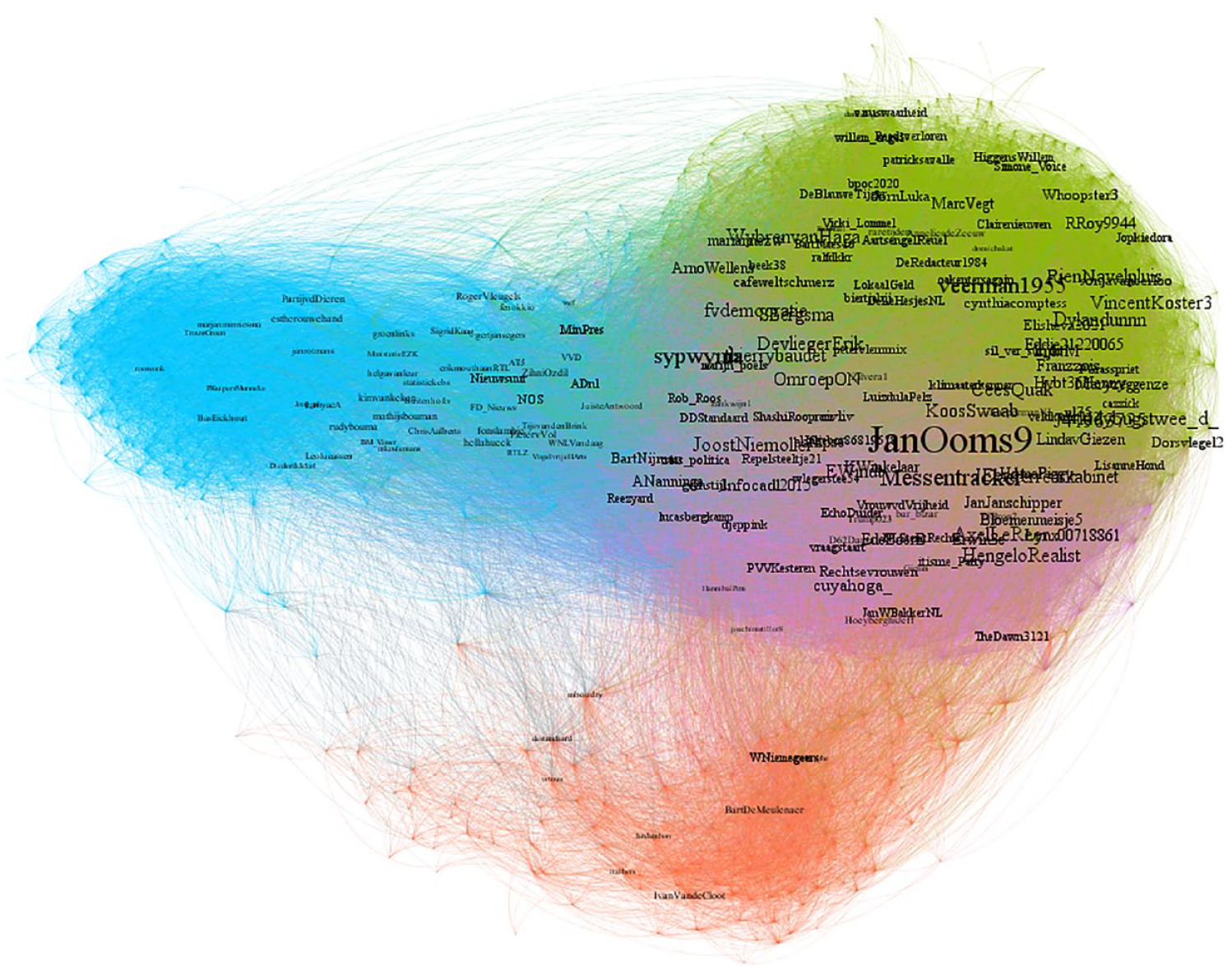
Network visualization of which active Twitter users within our dataset follow other users. Visualization was produced in Gephi, using ForceAtlas2 spatializing algorithm. Visible labels are users’ Twitter handles. Please see online version for colour figure.
4. Results and analysis: Step 1—identification of clusters
The first cluster (253 nodes) is shown in blue and is primarily characterized by mainstream press and broadcast outlets in the Dutch media sphere such as NOS, Nieuwsuur, ADnl, and FD_Nieuws. These comprise some of the key legacy news channels/publications in the Dutch journalistic arena. This cluster also includes the accounts of the (liberal party) Prime Minister and center-left political party representatives such as Sigrid Kaag (of the democrat party, D66) and figures from the Animal Party (PvdD). The top three most important users in this cluster (those with the highest numbers of followers) are NOS, Mark Rutte, and Nieuwsuur. We call this cluster Cluster 1: mainstream press/politics.
The second cluster (198 nodes) is shown in purple and is characterized mainly by accounts of right-wing political figures such as Annabel Nanninga (leader of the JA21 party, an offshoot of the right-wing populist, Eurosceptical FvD party) and Ton van Kesteren (a representative in the Dutch Senate for the PVV, a nationalist right-wing populist party). Based on a cursory assessment of account details, this cluster primarily comprises the accounts of right-wing citizens that appear to share strong anti-EU and anti-migration stances. The top three most-followed accounts in this cluster are popular right-wing blog GeenStijl, Annabel Nanninga, and columnist and author Syp Wynia, who publishes “climate skeptical” perspectives. We call this cluster, Cluster 2: right wing politics.
The third cluster (134 nodes) is shown in green and borders strongly on Cluster 2. It is characterized by alternative media accounts, Blauwe Tijger and Café Weltschmerz, which were important outlets for conspiracy theories about the coronavirus. It also includes some right-wing political figures/parliamentarians such as Thierry Baudet and other FvD members/representatives who have been vocal opponents of the government’s corona measures. In addition, it includes activist organization, Viruswaanzin (later known as Viruswaarheid), a key voice in opposing the government’s pandemic measures, and a group that subscribes to some of the conspiracy theories spread through alternative media outlets. Users with the top follower-counts within this cluster are Thierry Baudet, the FvD party’s account, and Marianne Zwagerman, author and columnist for the tabloid paper, De Telegraaf. We call this cluster, Cluster 3: alternative media and conspiracy theory politics.
The fourth cluster (66 nodes) is a network of authors and professionals with public profiles who tweet about the issues of climate, corona, and other environmental and societal policy concerns. The content of their views appears to have relatively little in common with one another. Since this cluster cannot be said to constitute a coherent political cluster, we omit it from further analysis, focusing instead on the first three clusters mentioned.
5. Results and analysis: Step 2—focusing on tweet content
In the second step of the analysis, we built on this user network analysis by isolating and analyzing tweet content of each network of the three main user clusters. To narrow our focus for this task, we looked at the overlap between the use of climate-related keywords and Covid-related keywords by zooming in on tweet content that mentioned one or more of our chosen keywords related to both issues within the same tweet. We then studied the content of these tweets in order to:
Analyze how and how often users within each cluster discursively made the connection between the two issues (climate change and corona) within their tweets, and which users did so;
Analyze whether, and in which ways, these tweets included references to science and/or scientific knowledge;
Analyze the links or secondary references included in the tweets, and what kind of information sources they referred to;
Identify any specific terminology associated with how scientists, scientific knowledge, and/or scientific institutions are discursively engaged that appears as particular to each of the clusters.
By doing this, we were able to establish (1) the discursive strategies used to engage with the epistemic authority of scientific experts per cluster, including both their rhetorical strategies and their epistemic claims, and (2) the kind of information sources and knowledge claims being presented as part of each discursive strategy typically used within each cluster. We established the latter by looking not only at tweet content per cluster but also looking at how different clusters use (share) information sources, specifically URLs. We first aggregated all links shared by users per cluster and extracted the domains (each domain represents a website or source). The top domains (in terms of number of times linked in tweets) were then plotted per cluster. In the final step of the analysis, we used the cluster-specific political terminology that we identified in point 4., above, to return to the wider dataset and investigate how prevalent the use of a key term that emerged from the discursive analysis was within each cluster. This was done through keyword search of the whole tweet database. The outcomes of this analytical step are also discussed in the section that follows.
6. Discussion: Understanding the politicization of the climate-corona convergence on Twitter
Having identified the abovementioned user clusters, we now relate and compare them. With 253 nodes, Cluster 1: mainstream press/politics, is significantly larger than all others. However, as is evident in Figure 1, there is a strong degree of inter-connection between the two right-wing political clusters (Cluster 2: right wing politics and Cluster 3: alternative media/conspiracy theory politics), as well as a relative disconnection of both from the mainstream cluster. The cumulative presence of the two right-wing user clusters (total 332) makes up slightly more than the number of accounts as the mainstream cluster (253). Hence, for the period studied, the convergence between the two issues includes a split between user networks associated with center/liberal/left politics, on one hand, and right-wing politics, on the other hand, with a slight preponderance of right-wing political networks. In what follows, the analysis of tweet content at the issue overlap within tweets takes the themes and patterns emerging in each cluster in turn. 4
Cluster 1: Mainstream press/politics
Within this cluster, only 30 tweets mentioned keywords pertaining to both issues within a single tweet. The vast majority of these were retweets of other tweets without the addition of new content. Ultimately, only seven original tweets connected the two issues within this cluster, produced by only five users. As such, this cluster’s user engagement does not reflect a strong discursive link between the two issues of climate and Covid; this becomes even more pronounced through the later comparison with the other clusters. The discursive links being made here between the two key issues in question can be categorized in one of two ways.
First, there is explicit or implicit criticism of those thought not to be taking both the pandemic and climate change crises seriously enough. For instance, the second most retweeted tweet in this cluster was posted by user, @miekevanstigt on 9 May 2021, the account of the writer and columnist, Mieke van Stigt, stating: “the sky is full of planes again, there’s one after the other. Corona and climate be damned, apparently.” This expresses a sentiment of disappointment about the lack of policy interventions to curb air travel for both health and environmental reasons during this pre-vaccine period. Other individual tweets made similar complaints about those who “think that Covid is a mild flu or that climate change doesn’t actually exist.” This was tweeted by @willemhazenberg, the account of green energy advocate Willem Hazenberg, in response to a parliamentarian and Christian party (ChristenUnie) leader, Gert-Jan Segers, who had tweeted about having been vaccinated himself but supporting freedom of choice for vaccination. Another user tweeting about both issues proclaimed their support for a particular political party (PvdD, the Animal Party) due to climate change and animal rights, but expressed doubt about the party’s stance on corona policy due to its supposed support for “herd immunity” (“kudde-immuniteit”). This tweet responded to a series of tweets using the hashtag #TegenGecontroleerdVerspreiden (#AgainstControlledSpread). These tweets can be characterized as rhetorically connecting the two issues in question as policy issues, and addressing policy concerns directly or indirectly to political decisionmakers, elected representatives, and policymakers on these issues.
Second, tweets in this cluster connected the two issues within single tweets through what can be characterized as a “climate skeptical” discourse. The most frequently retweeted tweet here (17 times) was posted by @fmeeus1, the account of Ferdinand Meeus, who describes himself with the bio: “Doctor of Science (Chemistry, Photophysics, Photochemistry). Member of KU Leuven Alumni. IPCC expert reviewer. Climate realist. Climate change is of the ages.” Meeus has over 20,000 followers and is a user to whom we return in the discussion of the other clusters, where his tweets are also prominent. His highly retweeted tweet (see Figure 2) draws attention to a statement made by EU President, Ursula von der Leyen, at a press conference at the 2021 Global Health Summit in Rome. It states: “EU President Ursula literally says climate change is a cause of corona virus pandemic at the Global Health Summit conference . . . I have no words. What a lie and scandalously deceptive false message. Fake News.”
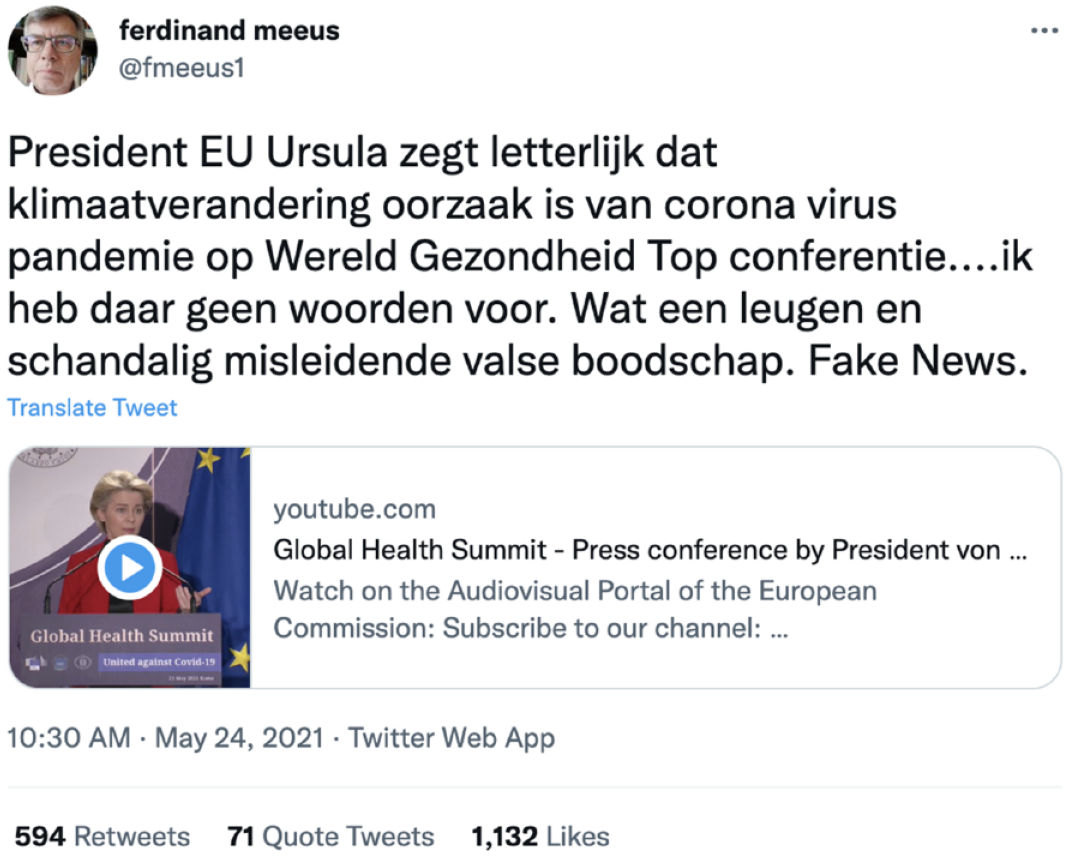
Tweet translation: EU President Ursula literally says that climate change is the cause of the Coronavirus pandemic at the World Health Summit . . . I have no words. What a lie and scandalously misleading false message. Fake News.
Via a link the tweet plays a YouTube video from the European Commission’s channel in which Von der Leyen stands at a lectern in front of the EU flag and beside Mario Draghi, former European Central Bank President and Italian Prime Minister, and delivers her closing message of the summit, which includes the following statement: The G20 acknowledges that the loss of biodiversity and the expansion of human activity into nature and wildlife bring us pandemics. It is a big step forward for the evidence-based, One Health approach . . . With this, the G20 commits to set up early warning information, surveillance and trigger systems.
This event, public figure, and statement is the focus of the other tweets partaking in the climate skeptical discourse in this cluster. The only other link posted in this set of tweets is to an opinion piece published on the blog Opiniez: Politiek en Maatschappij (Opinionz: Politics and Society), which presents itself as publishing “accessible and non-politically correct articles about topical themes” that “take a critical stance towards the words and actions of politicians and self-proclaimed experts and mainstream media.” The article in question 5 is authored by Ferdinand Meeus and focuses on the Von der Leyen speech, stating: “Sadly, in her enthusiasm for fearmongering and alarmism, she said things that have no basis in scientific literature.” The author goes on to claim that the statement is “taken up by the mainstream media without criticism.” Despite its relatively limited presence in the cluster (with concentration around a single tweet), this content nevertheless sets the discursive tone for a certain kind of dissent that is expressed in the issue network more generally: rather than articulating disagreement with policy, we see these users contesting science, a strategy we investigate further in the discussion of the following two clusters.
Cluster 2: Right-wing politics
The second cluster contained a high degree of discursive overlap between the two issues within single tweets, with 146 tweets mentioning keywords related to both issues. Among these tweets we no longer see the discourse of political opposition to government decisions and policymakers connecting the two issues, as we saw in Cluster 1. Instead, we see much more of the climate skeptical discourse joining the two issues. Key user, Ferdinand Meeus, emerges again with an exceptionally high degree of being retweeted due his statements on the same Von der Leyen speech event identified above. A few key users follow suit, making the same basic objection to the specific claim in the Von der Leyen speech. With a total of 126 of the 146 tweets in this cluster’s overlap making the same statement, the issue clearly dominates this area of participation, and warrants deeper investigation.
“Ursula von der Leyen blames COVID-19 pandemic on climate change” states a tweet that links to the Meeus article also mentioned in Cluster 1. “Ursula von der Leyen sees a connection between climate change and COVID-19. Exceptionally one-sided and misleading” reads another highly retweeted tweet. The assertions in the tweets take for granted that Von der Leyen’s statement is inaccurate. The opinion article by Meeus is the only content where the objection is elaborated. However, the article focuses on illustrating what the author considers to be generally wrong with the claims of climate change policy advocates by using the example of polar bears’ habitat. He states that while photos have surfaced of sick and dying polar bears—and this has been used as evidence to claim that climate change is responsible for their numbers dwindling due to habitat destruction—the fact is that polar bear numbers are growing. As sole evidence for this claim, the author presents an unannotated photograph of a group of healthy polar bears and a link to a report produced by the Global Warming Policy Foundation (GWPF), a lobby group 6 that was started up in the aftermath of “climategate,” the high profile email hack at the University of East Anglia’s Climatic Research Unit. 7 The GWPF drew controversy in 2021 when a group of more than 70 scientists requested that the United Kingdom’s Charity Commission withdraw its status as an educational and charitable organization in the Register of Charities due to the scientific inaccuracy and societal harm of the content of the organization’s reports and activities. 8
Another recurrently retweeted tweet (13 of the 146 tweets) here connects the two issues by claiming that both issues represent “conspiracies.” User, @irEnriqueCortes, responsible for the original tweet, has over 11,000 followers and repeatedly retweets tweets by corona conspiracy accounts/figures such as Stichting Gezond Verstand and Willem Engel, that emerged as the Dutch government’s main pandemic policy opponents. The tweet in question simply states: “Conspiracies that can’t bear the light of day [read: conspiracies that are so reprehensible that they must stay hidden]: 9 Omtzigt, 10 Great Reset, Climate, Migration, Vaccinations.” This is a rhetorical link that hinges neither on the science behind both issues, nor on any articulated opposition to political or policy positions taken by authorities on the issues, but more of a paranoid, general distrust of unnamed conspiratorial powers. This is a theme to which we return in the discussion of the third main cluster in the section that follows.
Similar to Cluster 1, additional references to information sources do not generally appear in the tweet data. There is one link to a mainstream news site’s article (NU.nl) about the origins of the recent rise of the right wing (and article the user has objections to), and there is a tweet image used as apparent reference material in one case. The image (Figure 3) is supposedly of an email to Anthony Fauci, immunologist and US presidential advisor, explaining that the coronavirus was a “man-made virus” and offering a “method” for how to (re)create it as a “bioweapon.” The hashtag #FauciEmails is predominantly used in tweets discrediting Anthony Fauci on Twitter more generally, often in conjunction with calls for this expert’s imprisonment. This discourse of science distrust aligns with a known conspiracy theory about the hidden interests behind Fauci’s policy advice as a medical expert (Xu et al., 2023), which is another point that returns and is elaborated upon in the final cluster’s analysis.
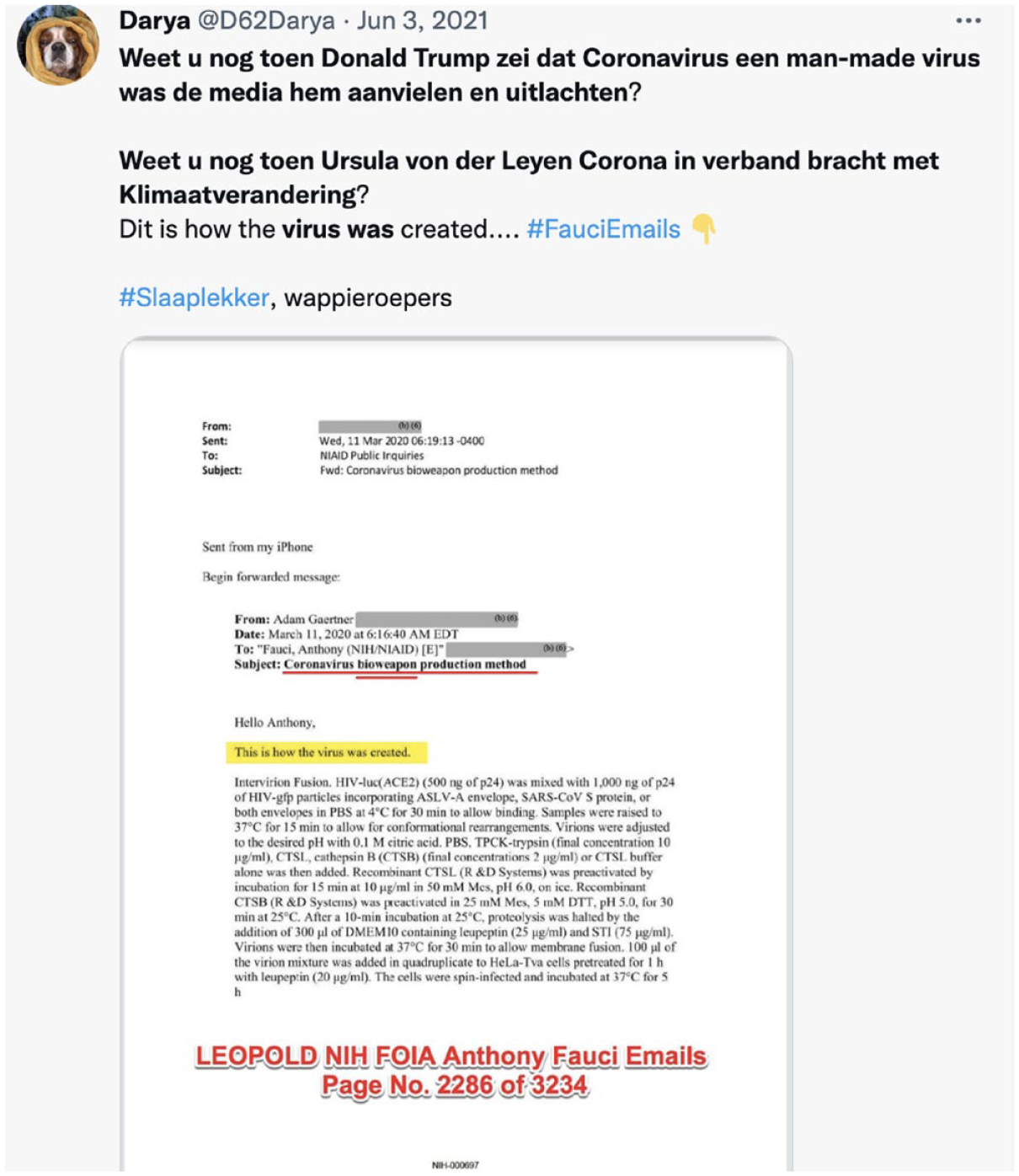
Tweet translation: Remember when Donald Trump said Coronavirus was man-made and the media targeted and ridiculed him? / Remember when Ursula von der Leyen related corona to climate change? / This is how the virus was created . . . #FauciEmails / #Sleepwell, “wappieroepers” [wappie is the term in Dutch that refers in a derogatory way to pandemic denialists. Wappieroepers refers to those who use the term wappie about their opponents.]. Image: An apparent document addressed to Anthony Fauci, explaining a process by which the coronavirus was produced as a “bioweapon.”
In this cluster, the language used to frame scientific experts repeatedly terms them as “alarmist scientists” (“alarm wetenschappers” or “klimaat alarm wetenschappers”). This terminology accompanies a discursive representation of scientific experts as figures who are biased and/or intentionally misleading the public. This term seems to have carried over from the issue of climate change to Covid, and appears in a tweet by Ferdinand Meeus, a previously mentioned active user, who is vocal on both topics. Notably, Meeus apparently distinguishes this category of “alarmist” scientists from scientists in general, as he makes repeated references to scientific research published in academic journals (by posting screenshots of papers as images in his tweets rather than using hyperlinks to the documents—often a deliberate practice to make it more difficult to see/check the original source). The image of certain scientists as alarmist is reinforced by other repeated tweets in the in-tweet overlap that mention the term “climate hysteria” (klimaathysterie”) when speaking about the position of those who warn of the consequences of climate change. This framing posits the level-headed rejection of emotional overreaction and a claim to alternative scientific views against the assertions of “alarmist” science that projects the negative consequences of anthropogenic climate change.
Cluster 3: Conspiracy theory politics
Cluster 3 features 147 tweets mentioning both climate and Covid, the highest number of such tweets in a cluster. It is noteworthy that 125 of these tweets are retweets of tweets about the Von der Leyen statement that were predominantly posted by key users identified in the right-wing cluster (a higher proportion than in the other clusters). There are also 12 retweets of the tweet by @irEnriqueCortes linking the two issues via an explicit claim that both constitute conspiracies. Figure 4. shows an example of one of the tweets that appear in this cluster for the first time.
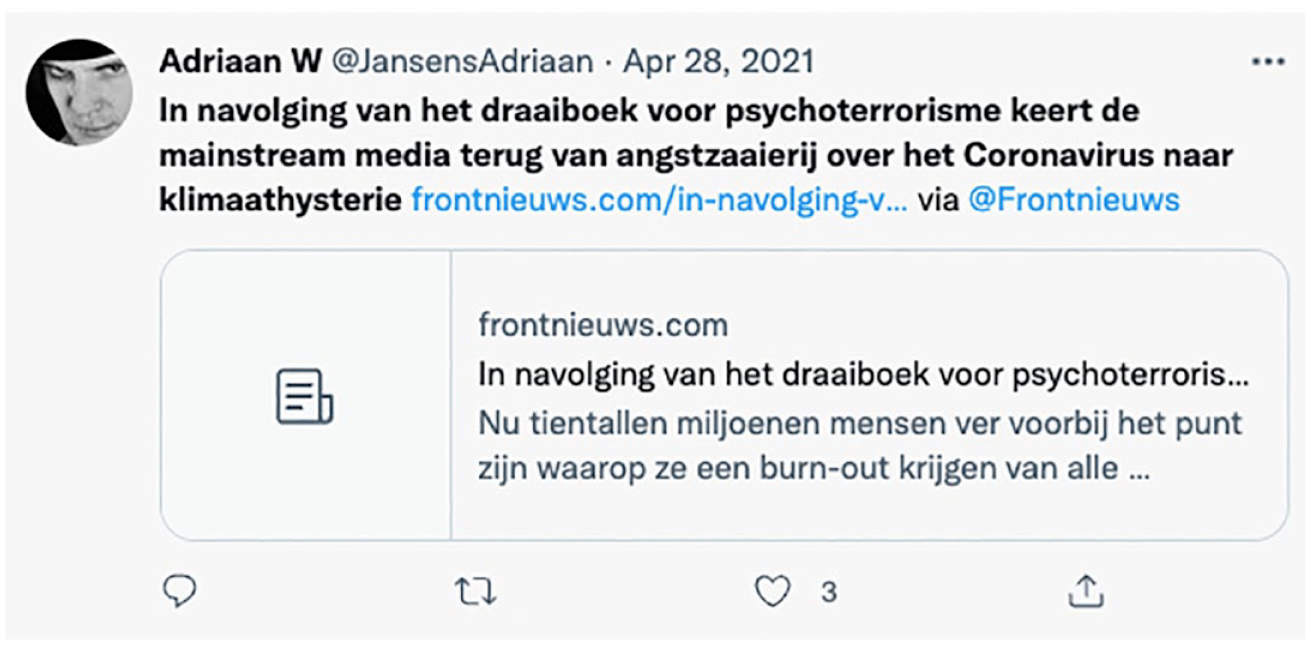
Tweet translation: In accordance with the psychoterrorism playbook, the mainstream media has turned from fearmongering about Coronavirus back to climate hysteria.
This tweet includes a link to a site presenting itself as an “alternative news” site, one that claims to be responding critically to the mainstream media. The connection between the two issues made by user, @JansensAdriaan, is—similarly to one of the rhetorical connections found in the right-wing politics cluster—framed as opposition to the “hysteria” and “fearmongering” that is claimed to exist in the mainstream media about both the coronavirus and climate change. This tweet presents claims about negative consequences of climate change and corona as “a recipe for psycho-terrorism,” a tactic that is claimed to be used and reused by authorities in the cases of both issues. Interestingly, in another one of the tweets that are unique to this cluster, mention of a similar media bias is contrasted with scientific authority. For example, one user tweets a response to a photo posted in May 2021 of snowfall in the Netherlands (an unusual weather event that the tweet claims shows counterevidence for “#globalwarming”). The response expresses agreement and ridicules the claim (purportedly made by an unidentified other person) that this weather event was caused by the pandemic measures, specifically, the fact that global air travel was restricted during the lockdowns. “Read some scientific articles instead of the party magazine of the Green Left party” the user rhetorically instructs their opponent. Party propaganda is contrasted with scientific knowledge in order to claim an alternative interpretation of a notable local weather event that discounts climate change. Yet, no alternative expert knowledge is referenced.
In another rhetorical reference to scientific expertise, one user tweets that the “conclusion that climate change is the cause of Covid-19” was arrived at by “Robert Bayer, Research Associate at the University of Cambridge” but that, in contrast, “scientists, worldwide, who have earned their stripes, are not being listened to.” These other invoked scientists apparently disagree with the one named. In the longer thread within which this tweet was a response, an article from a science news site was linked 11 in a tweet saying, “if only it were true that it was Ursula von der Leyen who made this up,” referring to the claim that climate change caused the pandemic. The tweet then added, #scientism, a hashtag that is typically seen to be used to tag tweets rejecting policies such as face mask directives on the grounds that they constitute a perceived overextension of scientific authority into individual freedoms. This hashtag is potentially interesting for future research on different modes of science contestation. The tweet that started this thread was one posted by Viruswaarheid (or Virustruth, mentioned earlier). The tweet by @viruswaarheid posts an image of Meeus’ widely retweeted tweet (without identifying him as the source) about the Von der Leyen speech, and adds: “which climate could she be referring to here? The fact-free one?”
Users in this cluster are signaling that established scientific authorities and mass media outlets, across issues, have a general tendency to ignore and/or misrepresent scientific knowledge and the facts of the matter. The rhetorical invocations of intra-scientific disagreement also imply that, where such disagreements exists, they should be assumed to stem from untrustworthiness of established scientific authorities. This aligns with previous research findings on laypeople’s perceptions about why disagreements between scientists occur, which has shown that prior “worldview orientations and perceptions of the general credibility of science seem to be the strongest drivers of perceived reasons for dispute, over cognitive/knowledge factors” (Dieckmann and Johnson, 2019: 18). Here, in the cases where science is discursively engaged with, users reject science that is represented as informing policy or is mobilized by political figures. However, while the content of their statements discursively discredits the scientific expertise/experts upon which policymakers’ decisions rely, it does not present dissenting scientific knowledge or publicly amplify alternative expert views. Non-rhetorical references to the supposedly silenced scientific voices are lacking, and there is no alternative epistemic claim made about the content of the issues. Rather, a broad rhetorical appeal is made to the public to be wary of the overreach of scientific authorities into policy.
While presenting itself as revealing excessive politicization of science on the part of the scientists that inform policy, the discursive strategy mobilized in this cluster can be said to perpetrate a form of science denialist politicization by rejecting relevant expert knowledge based on a general distrust. We suggest that a form of ideological science denial is taking place on the part of users adhering to right wing and conspiracy theory politics, a form of participation that strongly aligns with “the Plandemic conspiracy theory” (Xu et al., 2023: 3677), according to which the coronavirus outbreak was a planned result of collusion between scientists such as Anthony Fauci, politicians, and a global elite in the interest of the commercial medical industry (Big Pharma). The main claim is about the untrustworthy character of scientists who gain visibility in media and politics rather than any competing knowledge claims about the nature of the pandemic or climate change. Remarkably, the discursive strategy presents the science denial that the users participate in as an ostensible corrective to the excessive science politicization of policymakers and their science advisors.
The language of countering a declared climate and corona alarmism is recurrent in the right wing and alternative/conspiracy clusters, specifically around the term, “alarm.” This finding prompted us to conduct a keyword search of the whole tweet database in order to see which cluster was using this terminology (“alarm”) the most within their tweets. We found this term used exclusively within Cluster 2: right-wing politics (744 mentions) and Cluster 3: conspiracy theory politics (573 mentions); Cluster 1: mainstream press/politics did not use this term, at all (0 mentions). This shows a consistent rhetoric of casting scientific expertise that supports policy measures as suspect on the grounds that it takes an “alarmist” point of view, a politically motivated strategy that has carried over from climate science to pandemic science.
Links
An important part of the dominant rhetorical strategy evident in the science denialist discourse we identified was the framing of the scientific knowledge that informed policy measures as biased. The biased knowledge was claimed to be just one scientific perspective among others that was given unwarranted precedence above others by the mainstream media. In the final step of the data analysis, we investigated the sources that the different clusters of users referred to most in their tweets by looking at hyperlinking practices (URLs) of all users per cluster (see Figure 5). Plotting these links shows that users in Cluster 1 predominantly linked to mainstream media channels (both national and local/regional journalistic sites) and an official government site. These websites make up the lion’s share of the links tweeted within this cluster. Perhaps unsurprisingly, there is a clear contrast between this pattern and the linking practices of Clusters 2 and 3. Users in Cluster 2: right-wing politics predominantly link to blogs and political opinion sites. These are sites that, in turn, receive very few links from Cluster 1 users.
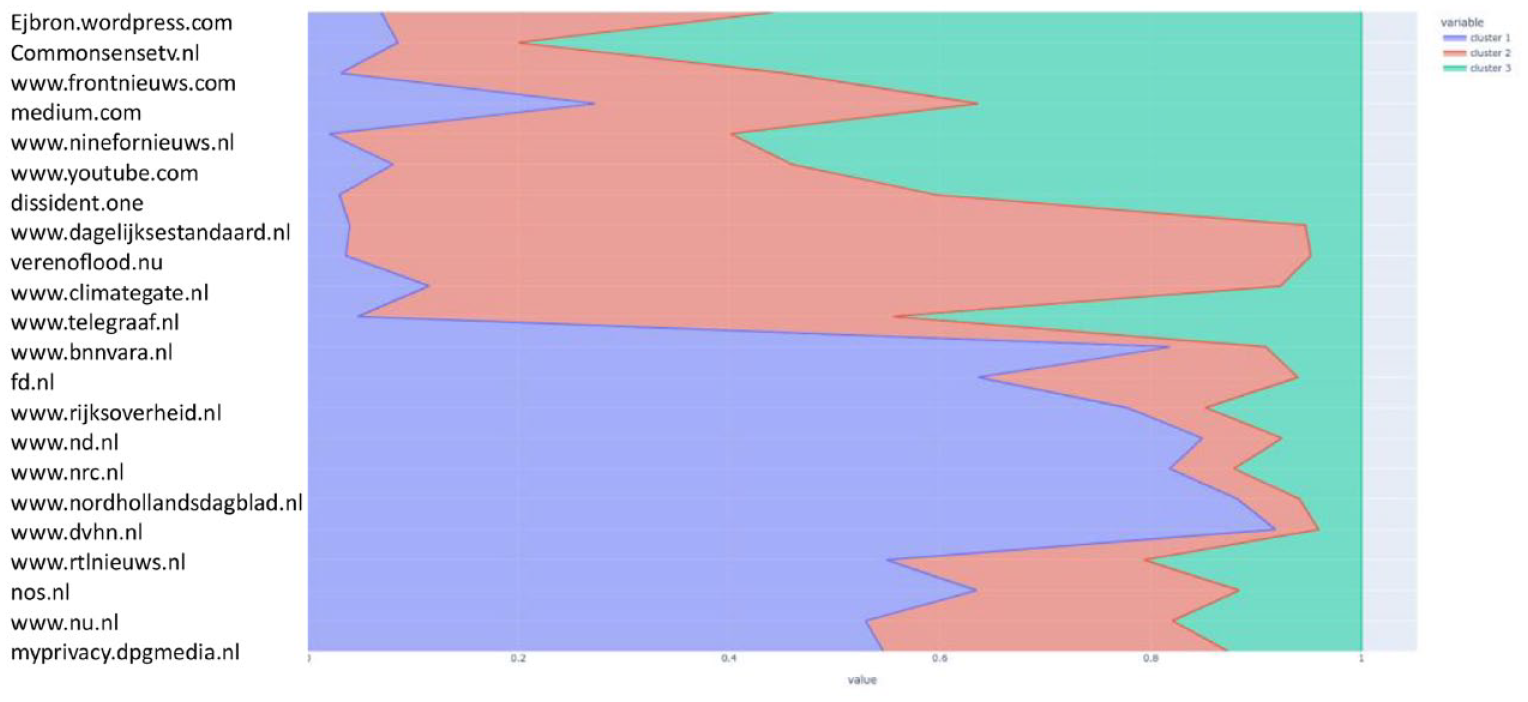
Key: Cluster 1: purple; Cluster 2: red; Cluster 3: green (numbers correspond with cluster numbers as defined on pages 9–10). Of the websites listed on the vertical axis, the bottom half of the list approximately are sites of national mainstream press and broadcast media outlets and government websites, including nu.nl, nos.nl, rtlnieuws.nl, rijksoverhied.nl, nrc.nl, and fd.nl. The approximate upper half of the sites listed on the vertical axis are alternative news sites, right wing political websites, climate denialist blogs and other profiles on blog platforms, and YouTube. These include frontnieuws.com, climategate.nl, dagelijkskestandaard.nl, and medium.com. Please see online version for colour figure.
Finally, users from Cluster 3: alternative media/conspiracy theory politics primarily link to the domain of two sites: the “alternative news” website, Nine for News, and social media platform, YouTube. The former promotes a range of conspiracy theories about Dutch and international organizations (as well as compiling dossiers covering UFOs, chemtrails, and the paranormal) and introduces its content as antithetical to that of the “mainstream media,” because, as the site states, “as you undoubtedly know, the Mainstream Media (MSM) mostly tell you the opposite of what is really going on.” The distribution of linked sources suggests not only that a clear rift exists between the basic facts accepted within clusters (especially between the mainstream versus the other political clusters). It also offers further support for our argument that while there is a rhetorical strategy of pushing for the inclusion of greater scientific diversity, little to no scientific disagreement is evident on the level of epistemic claims. Rather than any competing claims to dissenting scientific knowledge, at the heart of the dominant contestations waged against politically authorized science, we see only denial and distrust.
7. Conclusion: Political contestation versus ideological rejection of science
In our attempt to move beyond distinguishing online information from dis-/misinformation, we have analyzed how science is politicized by distinguishing the different epistemic claims and rhetorical strategies used within social media publics. In addressing our research question about when public deliberation about science can be said to involve a healthy degree of politicization, and when it comes to constitutes an excessive or poisonous dose of politicization, we have demonstrated how the politicization of science at the convergence between COVID-19 and climate science on Twitter involves the dominant presence of what can be termed ideological science denial. Indeed, in some clusters within the relevant issue public, politicization of science was almost exclusively oriented toward generating a general distrust toward established science advisors, policymakers, and journalists/media outlets. There, climate and corona were also discursively linked in ways that reflected a strong ideological connection between science rejection and right-wing politics. This is also in line with previous research findings that demonstrate the relationship between political partisanship and trust in science (McCright et al., 2013). In contrast, other contestations that mentioned how authorities should take the climate and corona crises (more) seriously involved problematization of the government’s general policy framework (i.e. containment versus mitigation strategic framework), and included both left- and right-wing politicizations.
Notably, what we identified as science rejection was not presented as such, rhetorically, by its proponents. Rather, they presented this as a rejection of the ostensibly excessive politicization of science by policymakers and media. This position was articulated via allegations that political authorities and mainstream media outlets were responsible for silencing dissident scientists, tainting scientific claims with bias and emotion, and perpetrating scientism. What allowed us to nevertheless define this form of politicization as denialism rather than contestation was, first, that it invariably expressed a general distrust and rejection of authorized science and institutionalized expertise despite the many differences between the two science-informed issues (i.e. different levels of scientific uncertainty, differences in how much firsthand experience the general public has with the consequences of climate change versus the corona pandemic, the different sectors of policymaking responsible for intervention measures). Second, while this mode of politicization rhetorically claimed to voice scientific dissent (rather than contestation over values or significance of scientific claims), neither the tweet content nor the sources linked bore this out by advancing alternative expert sources.
Rather than deliberative sense-making around competing epistemic claims that vie for public authorization, the denialism we see involves the rhetorical supposition of dissent in the absence of an alternative epistemic claim. We see this strategy as facilitating institutional distrust rather than public contestation, and we suggest that this feature of denialism can be taken as a basis for distinguishing between legitimate (democratic) contestation from sewing epistemic distrust toward science. The potential problems with making a separation between legitimate and illegitimate public science dissent have been highlighted in depth by science studies scholars and need not be rehashed here (see de Melo-Martín and Intemann, 2018; Goldenberg, 2022 [2021]). Yet, even if we heed their warnings to stop short of disqualifying one kind of politicization as out-of-bounds in democratic public discourse, our analysis nevertheless shows how distinguishing between different kinds of politicization is important if we want to better understand the divergent processes by which science politicization takes place within online publics. Indeed, we have shown how these divergences correspond to how political networks are formed on social media platforms.
At the same time, we saw that political networks were not strictly separated from one another; politically-defined clusters saw similar responses across clusters, with tweets by the same key actors traveling across all three clusters through retweeting practices. As such, right-wing politicization enjoyed a degree of mobility across networks and into the mainstream political discourse via influential users promoting a science denialist discourse. In fact, denialism overshadowed the other forms of politicization, suggesting that genuine objections to scientism and political contestation of the values behind policymaking—both of which are important for democratic deliberation and public sense-making around science—can be drowned out by denialist discourse. This argument was, of course, based on the findings generated by looking at the co-occurrence of the two issues of climate and COVID-19 within tweets, which made up a small proportion of the clusters; further research might instead approach the overlap of two such issues in different ways, including looking at the issue keywords appearing in separate tweets by the same users and therefore larger numbers of tweets. Such future research on science denialism in social media environments may also consider investigating other national/linguistic contexts for comparison, examining different issue overlaps than coronavirus and climate, and studying other social media platforms.
Footnotes
Funding
The author(s) disclosed receipt of the following financial support for the research, authorship, and/or publication of this article: The authors received financial support from the Horizon 2020 research project “Policy, Expertise and Trust in Action” (PERITIA) (Grant Agreement No. 870883).
