




Abstract
Retracted COVID-19 articles have circulated widely on social media. Although retractions are intended to correct the scientific record, when trust in science is low, they may instead be interpreted as evidence of censorship or simply ignored. We performed a content analysis of tweets about the two most widely shared retracted COVID-19 articles, Mehra20 and Rose21, before and after their retractions. When Mehra20 was seen as a politicized attack on Donald Trump and hydroxychloroquine, its retraction was broadly shared as proof that the article had been published for political reasons. However, when Rose21 was seen as evidence of vaccine harm by vaccine opponents, its retraction was either ignored or else framed as a conspiracy to censor the truth. These results demonstrate how retractions can be selectively used by scientific counterpublics to reframe the regulation of science as evidence of its institutional corruption.
1. Introduction
In September 2021, a MedRvix preprint claimed that COVID-19 vaccines would cause acute heart disease in 1 out of every 1000 vaccinations (Kafil et al., 2021). This claim, however, came from a calculation error that caused a 25-fold overestimation of the incidence rate; with the error corrected, there was actually a decrease in heart disease among the vaccinated. Two weeks after the article’s first appearance, the authors withdrew the article and issued a public apology. Despite this, the popular podcast host Joe Rogan would later repeat the figure, uncritically, to his audience of over 20 million listeners (Qiu, 2022). And on social media, a vocal minority of posts would claim that the article’s retraction was actually evidence of a conspiracy to censor the truth about COVID-19 vaccines.
This article is one of over 400 research articles about COVID-19 that were either retracted from publication or withdrawn from preprint servers due to serious research or publishing errors (Oransky, 2020). By violating research norms, many of these articles were able to fabricate novel or controversial findings that received more academic citations and media attention than non-retracted COVID-19 research (Taros et al., 2023). Retracted COVID-19 research has jeopardized public health efforts by supporting untested treatments (Samaha et al., 2021), casting doubt on the effectiveness of face masks (Bae et al., 2020), and claiming that 5G radio towers transmit COVID-19 (Fioranelli et al., 2020).
In addition to their flawed findings, an article’s retraction can also cause harm by damaging public trust in science. Scientific retractions, by their nature, reveal the gaps between scientific norms and scientific practice. Because of this, they generate a unique set of concerns when they are translated into public science. When trust in science is high, retractions can be read as evidence that the scientific process is working as intended (O’Brian, 2020). However, in the context of politicization and conspiratorial belief, prominent retractions may instead be interpreted as evidence of scientific incompetence or censorship (Hilgard and Jamieson, 2017; Peterson et al., 2022). The circulation of retracted articles can thus spread misinformation and undermine public trust in science (Fowler and Gollust, 2015; Southwell et al., 2022).
This may be especially true of retractions shared on social media, which often get more attention than non-retracted articles, especially before their retraction (Peng et al., 2022; Serghiou et al., 2021). However, attention alone cannot explain why these articles are shared. When a widely publicized article is retracted, it may be desirable to have the retraction broadly shared in order to correct the record. However, if a retraction-sharing post merely repeats the findings without mentioning the retraction, or if it frames the retraction as proof of a conspiratorial plot, then the corrective function of a retraction is directly undermined. Accordingly, the rhetorical context of a retraction is crucial to understanding their impact on public health and trust in science.
To this end, our study performed a close reading of English-language tweets for two retracted COVID-19 articles frequently discussed on social media in order to analyze how their publication and retraction were variously received. The first article we analyzed, Mehra20, was published on the subject of hydroxychloroquine harms and retracted due to evidence of data fabrication. While the retraction silenced the uncritical discussion of its findings, it also appeared to vindicate the belief that the article had been published in order to malign hydroxychloroquine and its most prominent supporter, Donald Trump. The second article, Rose21, was published about vaccine harms and withdrawn for undisclosed reasons. As a result, the retraction was either ignored or framed as an attempt to censor the truth of its findings, which had been widely shared by vaccine opponents.
These divergent responses highlight important differences in the attitudes and tactics of their publics. When Donald Trump publicized hydroxychloroquine as a COVID-19 cure, prominent public health officials countered that the drug had not undergone proper medical evaluation to confirm its efficacy (Blevins et al., 2021; Crowley et al., 2020). Consequently, the public that initially shared Mehra20 could accept the retraction, trusting that even if one article was retracted, scientific sentiment was on their side. Vaccine opponents, however, have maintained their opposition to vaccines despite the preponderance of research supporting vaccines in the scientific community and the retraction of the most visible research against vaccines (Wakefield et al., 1998). Many have resolved this apparent dissonance by maintaining that the scientific record around vaccines has been manipulated (Farhart et al., 2022; Pertwee et al., 2022). By accepting this conspiracy, the public that shared Rose21 as evidence of vaccine harms were able to reject the judgment of the retraction.
By situating social media attention to retracted articles in the broader politicization of science, our research shows how conspiracy can be used to undermine both the publication of disfavored findings and the retraction of favored findings. Moreover, by framing science’s essential procedures as politically corrupted, conspiracies about retracted articles can distort the public’s view of both individual scientific issues and science as an institution. These findings highlight the precarity of science in the context of politicized scientific distrust. They also underscore the importance of transparency in the conduct of retractions.
2. Background
Politicization and the pandemic
From energy policy to public health, the politicization of science has threatened social progress on a range of issues. When scientific research is translated for public audiences, science communicators use frames, or broadly resonant storylines, in order to establish its significance for their audiences (Nisbet, 2009). Politicization occurs when science communicators use frames that emphasize the inherent uncertainties or disunities in the scientific process (Bolsen and Druckman, 2015). By framing science as a contest between equally valid interests, politicized framings of science encourage members of the public and policymakers to make scientific decisions based on partisan cues rather than scientific advice (Druckman and McGrath, 2019).
The COVID-19 pandemic exemplified this politicization. Throughout the pandemic, conservative figureheads and their audiences attempted to show that the consensus health recommendations of the public health community were not natural truths, but ideological commitments. To do so, they circulated counter-consensus science, including scientific publications, social media posts from heterodox scientists and physicians, and homegrown data visualizations, as evidence of dueling consensuses within COVID-19 relevant science (Beers et al., 2023; Harris et al., 2024; Lee et al., 2021). In the United States, those exposed to politicized messages underestimated the benefits of health measures like lockdowns, masks, and vaccinations, with misperceptions highest among conservatives and religious groups (Druckman et al., 2021; Motta et al., 2020; Motta and Stecula, 2023).
Beyond the consequences for COVID-19 health outcomes, politicization also contributed to a decline in scientific trust more broadly. Politicized science communication increasingly takes place in online communities, such as Twitter/X, whose viral and interactive affordances have brought science uncomfortably close to public interests (Fähnrich et al., 2020; Walter et al., 2022). By sharing and consuming the same counter-consensus scientific outputs from a position of perceived scientific subordination, covid skeptics formed scientific counterpublics, or networks mobilized in opposition to the institutional form of science (Hess, 2011; Mede and Schäfer, 2020; Warner, 2002). These groups have exploited the perceived gaps between scientific values and scientific practice in order to reject the cultural authority of science (Harambam and Aupers, 2014). By questioning the motivations of scientists and their research, politicized discussions in counterpublics can directly undermine the claims of objectivity and disinterestedness that sustain the cultural authority of science (e.g. Merton, 1938).
Retractions in the context of politicization
Retractions play a critical role in maintaining scientific credibility. By repudiating problematic articles that violate academic norms, retractions work to assure the public that the scientific record can be trusted (Barbour et al., 2019; Gieryn, 1983). The ability of retractions to serve this function, however, depends crucially on the extent of public trust in science. Retractions, like the publication process more generally, are not usually conducted in the public eye. Instead, they are deliberated in the technical sphere of scientists, publishers, and editors (Goodnight, 1982). In the process of a retraction, these actors exercise their subject matter expertise in deciding whether a norm violation has occurred, and if so, whether it is severe enough to warrant retraction (Barbour et al., 2019). However, although retraction determinations are informed by subject matter expertise and institutional norms, they are not objective determinations. The distinction between a correctible data discrepancy and a retractable error is, ultimately, a matter of judgment.
Once an article is retracted, it is communicated to the public through a retraction notice. The Committee on Public Ethics (COPE) guidelines specify that a retraction notice should “clearly state the reasons for retraction” and be “freely available to all readers” (Barbour et al., 2019). This emphasis on clear communication underscores the fact that a retraction must be known and agreed with to be effective. By itself, a retraction is simply a declarative statement. It is not punitive per se and it does not ordinarily remove the article from circulation. Instead, a retraction is made to matter by its contexts of citation, or the various articles, media, and public conversations in which a scientific article is referenced (Latour, 1987). The academic community and the informed public must decide how to interpret a retraction.
The retraction notice functions as an argument that the fact-finding deliberation that has occurred in the technical sphere is sufficient to call for a retraction. But it is up to the scientific community and the public to decide whether this judgment is correct, and under conditions of politicization, this judgment is increasingly likely to be questioned. Because retractions make the findings of an article less certain, they may also jeopardize the basis of support for a larger political issue. If the subject of a retracted article has been politicized, then the public whose position was weakened by the retraction may believe that scientists have erred in issuing a retraction. On the other hand, if an article criticized by a public is not retracted, then they may instead argue that the article’s failure to be retracted is itself an error. Thus, by increasing partisan investment around scientific issues, politicization may cause invested publics to reject the judgment of a retraction.
In addition, politicization increases the likelihood that uncertainty about an article’s publication or retraction will be resolved through conspiracy. Psychological research indicates that conspiracy theories may be adopted to resolve the cognitive dissonance caused by ideologically incongruous scientific findings (Douglas et al., 2017; Lewandowsky et al., 2013). For instance, vaccine opponents have rejected the credibility of vaccines by claiming that vaccine research is controlled by profit-seeking pharmaceutical companies (Harambam and Aupers, 2014; Jamieson, 2021). Similarly, when a controversial scientific article is later retracted, supporters of the article may also write off the retraction as motivated by political, rather than scientific, interests.
Research question
As we have argued, scientific retractions can be a vulnerability to science at a time of politicized scientific distrust; first, by exposing normative gaps in science, and second, by undermining the basis of support for a politicized issue. But these outcomes are not inherent in the mere fact of retraction. Instead, they become more or less likely depending on the purposes for which retractions are cited in public discourse. Accordingly, retractions can be variously positioned as proof that science is “self-correcting” or that science is “broken” depending on their public framing (Hilgard and Jamieson, 2017). Taking public discussions on Twitter/X as our context, we ask,
RQ. How is politicization reflected in, and furthered by, public discussions of controversial scientific articles and their retraction?
In the following section, we outline the methodological approach we use to answer this question.
3. Methodology
Materials
Our study analyzed a corpus of 1723 posts on Twitter/X, collected between 1 February 2020 and 1 June 2023, that contain hyperlink references to one of two retracted articles. Retracted articles were identified using a public list compiled by Retraction Watch, a watchdog organization that reports on retracted and withdrawn scholarly research (Oransky, 2020). There were 366 articles listed as retracted at the time of data collection. For each article, relevant metadata were obtained using the publicly available database of articles maintained by The Center for Scientific Integrity (2018). We used this data to determine when an article was retracted and to match online attention to a retracted article with the attention given to its retraction notice. We also followed the guidelines of Retraction Watch in choosing not to exclude articles that were issued a “withdrawal” rather than a “retraction,” since these labels have been inconsistently used by publishers and generally refer to the same practice (Oransky, 2020).
From the initial list of retracted articles, we selected the two articles that received the most article-sharing posts as measured by Altmetric, namely Mehra20 and Rose21. In addition to satisfying the criterion of receiving pronounced attention, the two articles also represented different subject areas, allowing for a cross-subject comparison. Moreover, since these articles were both published for roughly 2 weeks before their retraction, we were able to control for variance in the time to retraction. The characteristics of these two articles are elaborated in Table 1.
Characteristics of top articles.
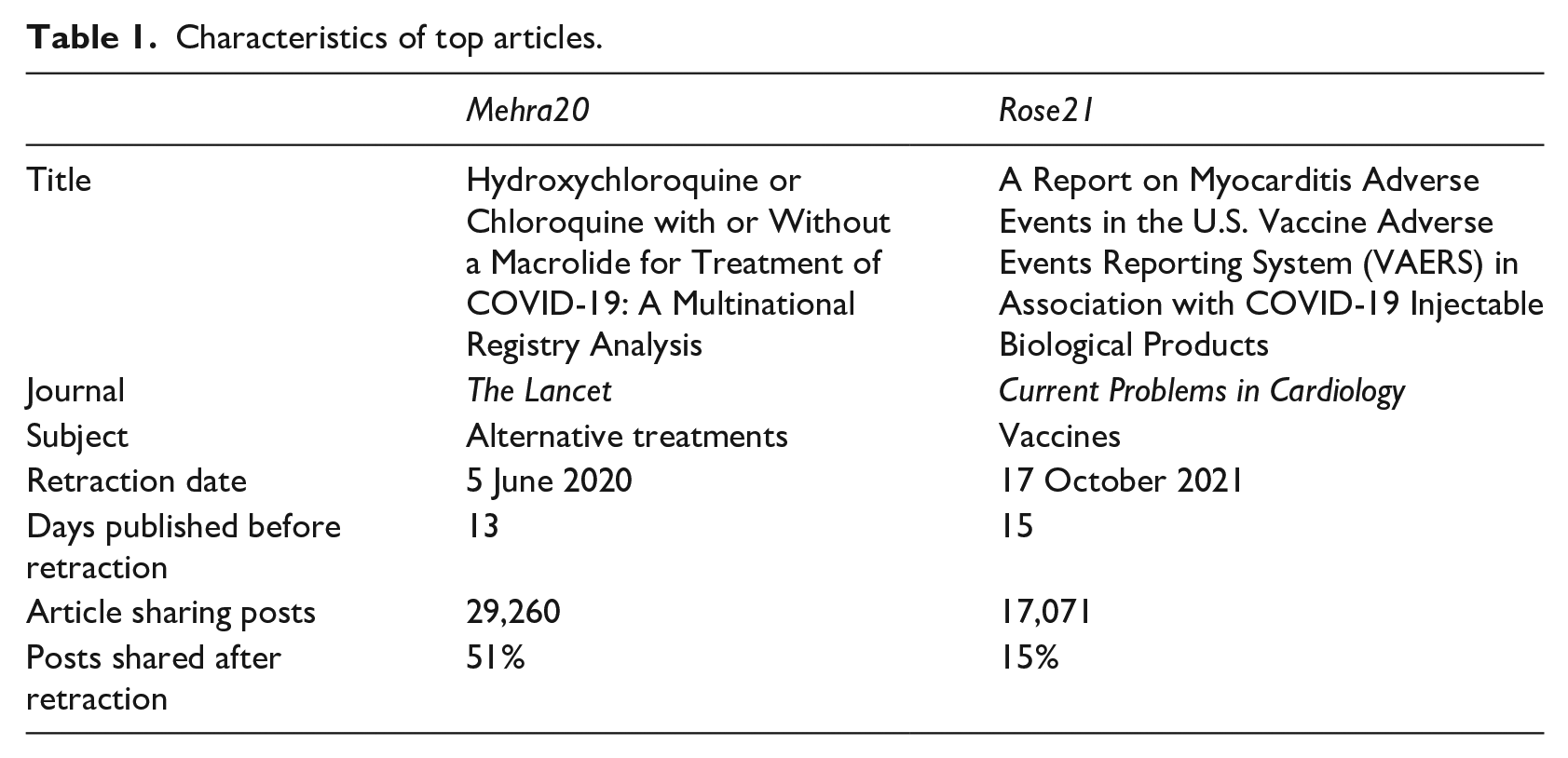
We then used the Altmetric Fetch API, provided through a data sharing agreement with the company Altmetric, to find social media mentions of these articles (Altmetric, 2023). Altmetric tracks public mentions of posts on a variety of media platforms, including social media and news articles. Because more than 95% of the English-language posts about the retracted articles available through Altmetric were posted on a single platform, Twitter/X, we limited the scope of our analysis to this particular platform. For Twitter/X, Altmetric does not include the full text of the Twitter posts in their data. We retrieved these using the Twitter Academic API, v.2. This API has since ceased to be operational.
The initial corpus of posts contained 46,331 posts, including both retweets and non-English language posts. We excluded the 42,921 retweets present within this corpus because they do not substantively differ from the original post that they amplify. In addition, we only included the English posts in our analysis. With retweets and non-English language posts removed, our final corpus of posts contained 1723 posts. Of these, 1232 posts mentioned Mehra20 and the remaining 491 posts mentioned Rose21.
Methods
We analyzed the articles’ discussions using a manual content analysis. Content categories were created by the first author based on a grounded theory approach to social media content (Charmaz, 2014). This approach situated article-sharing posts in the broader literature about the rhetorical features of scientific publications that may become salient within scientific controversies, including the motivations of scientific actors and the validity of their findings (Callon and Law, 1982; Fahnestock, 1986; Latour, 1987; Simon, 2001).
All posts were coded by two external coders, who were tasked with determining whether a post discussed any of the following four topics: findings and implications (κ = 0.85), methodological flaws (κ = 0.88), motivation for publication (κ = 0.75), and motivation for retraction (κ = 0.78). Topics were treated as inclusive codes, meaning that a given post could have up to four topics. The first author acted as a tiebreaker in cases of disagreement. Cohen’s kappa was used to measure the agreement between coders for each attribute. The overall agreement among coders (κ = 0.84) indicates substantial agreement.
To substantiate our analysis, this article includes the text of several article-sharing posts chosen from the corpus of posts we reviewed. All included posts were publicly available at the time of data collection and retrieved in accordance with the terms of agreement for the Twitter Academic API, v.2. In addition, in keeping with more rigorous Internet ethics protocols, we selected post information according to a stratified risk assessment framework that balanced users’ risk of personal identification against their reasonable expectations of privacy (Heise et al., 2019). Posts from verified accounts, or public figures with “blue checks,” were deemed to have lower expectations of privacy, and we therefore included their posts without anonymization. Every post included in this category came from an account with more than 30,000 followers at the time of data collection. Next, we anonymized posts from unverified accounts whose profiles did not contain personally identifying information. Finally, we did not include posts from unverified accounts whose profiles contained personally identifying information.
4. Findings
Mehra20
Published in the prestigious journal The Lancet, Mehra20 stands out for the remarkable attention that it received in mainstream and social media. Based on observational data, the findings of Mehra20 indicated that hydroxychloroquine, which was being considered as a viable treatment for COVID-19 in several countries, was associated with an increase in acute heart and liver conditions, without having any notable treatment effect on COVID-19 (Mehra et al., 2020). These findings had an immediate impact on health policy, prompting the World Health Organization (WHO) to suspend testing of the drug and the French government to reverse a ruling that had allowed hospitals to prescribe hydroxychloroquine for COVID-19 (Offord, 2020). Although the WHO eventually resumed testing once the article was retracted, the delays in the trials affected the course of the testing (Offord, 2020).
Pre-retraction
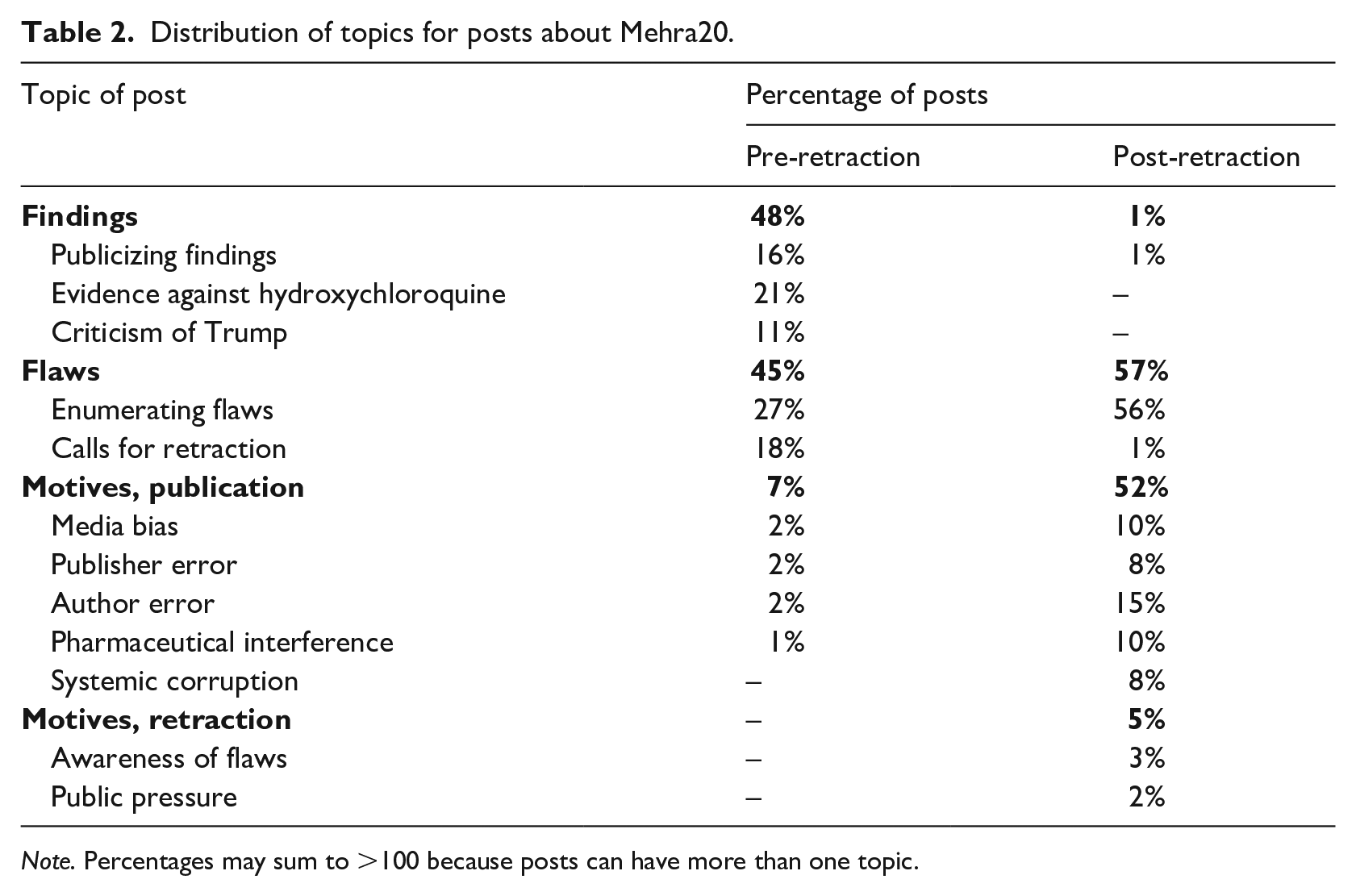
In the first 2 days after its publication, posts about Mehra20 generally assumed the article’s findings were valid and shared them uncritically. About 48% of pre-retraction posts uncritically shared the article’s central findings (Table 2). Of these, some 21% focused solely on the negative implications for using hydroxychloroquine as a COVID-19 treatment, while 11% saw it as evidence of Donald Trump’s error in promoting the drug, with one poster claiming, “Trump is guilty of reckless endangerment and wrongful death.”
Distribution of topics for posts about Mehra20.
Note. Percentages may sum to >100 because posts can have more than one topic.
By contrast, 45% of pre-retraction posts highlighted the article’s flaws, criticizing its non-transparent data, study design issues, and potential data fabrication (Table 2). Although initially outshined by the uncritical discussion of its findings, the article’s flaws became the central focus of the discussion once several prominent scientists joined the discussion. One outspoken voice was the French scientist Didier Raoult, who pioneered the use of hydroxychloroquine to treat COVID-19 (Sayare, 2020). On 29 May, Raoult posted an open letter to the editors of The Lancet, signed by around 100 medical scientists, that enumerated the article’s flaws. The letter circulated widely on Twitter/X across multiple languages and revived interest in the article. By this point, posts about the article’s flaws had become ubiquitous, and 18% of pre-retraction posts explicitly called for the article’s retraction (Table 2).
Post-retraction
These calls were answered when The Lancet retracted Mehra20 on 4 June 2020, 6 days after the open letter circulated. News of the retraction corresponded with the highest peak in attention to the article on Twitter/X. Post-retraction, only 1% of posts still considered the article’s findings credible, indicating the retraction effectively delegitimized the original article (Table 2). By contrast, 57% of post-retraction shares focused on the paper’s flaws, and 52% speculated about the ulterior motives of those involved in publicizing it. Blame was directed at the article’s authors, The Lancet, and the media, with 10% of posts targeting the latter (Table 2). In one of the most retweeted posts on the subject, the conservative political commentator and FOX News host, Laura Ingraham, claimed the media had given disproportionate coverage to the article in order to undermine Trump: New [sic] anchors avoiding Lancet’s Retraction of its negative Hydroxychloroquine study. Media gleefully trumpeted it a few weeks ago in effort to smear Trump. (Laura Ingraham, 2020)
Although Ingraham’s post was posted only 9 hours after the article’s retraction, many news outlets did eventually cover the retraction, and Mehra20 received approximately twice as many news articles after its retraction (Altmetric, 2023).
Invoking the Big Pharma conspiracy theory, 10% of posts asserted, without evidence, that pharmaceutical companies had sponsored the article to discredit hydroxychloroquine, positing that the drug’s effectiveness and low cost threatened profits from experimental treatments. Eight percent of posts extended blame to the broader “medical establishment” rather than just the article’s authors, reflecting a tendency within conspiratorial thinking to conflate individual actors with institutions they represent (Neville-Shepard, 2018). According to one poster, @realDonaldTrump makes the ugly more visible. How far the elites have been corrupted. Harvard, Lancet, WHO, all too willing to lie, censor, smear & suppress for predatory Big Pharma agenda. CDC, NIH, NIAID, FDA all captured agencies, Mussolini’s corporatism with revolving doors.
Today, Mehra20 serves as an unfortunate reminder of the damage that a high-profile retraction can do to trust in science. Although the peak of the media coverage of the retraction only lasted a couple of days, the article has continued to receive bursts of Twitter/X attention well past its retraction.
Rose21
Rose21 was published in Current Problems in Cardiology in October 2021, roughly a year and half after the retraction of Mehra20. At the time of writing, Rose21 has a higher Altmetric count than every retracted COVID-19 article except for Mehra20 (Altmetric, 2023). In their article, co-authors Jessica Rose and Peter McCullough examined the US Vaccine Adverse Events Reports System (VAERS), a database for self-reported injuries sustained after vaccination, and found that myocarditis rates were significantly higher than expected for those who received the COVID-19 vaccination (Rose and McCullough, 2021). However, because VAERS entries are not verified and can be submitted at any point after a vaccination, VAERS is not intended to be used for establishing vaccine-related causality (Dusto, 2022). This fact did not prevent the article from being published, but likely contributed to its retraction 2 weeks later.
Pre-retraction
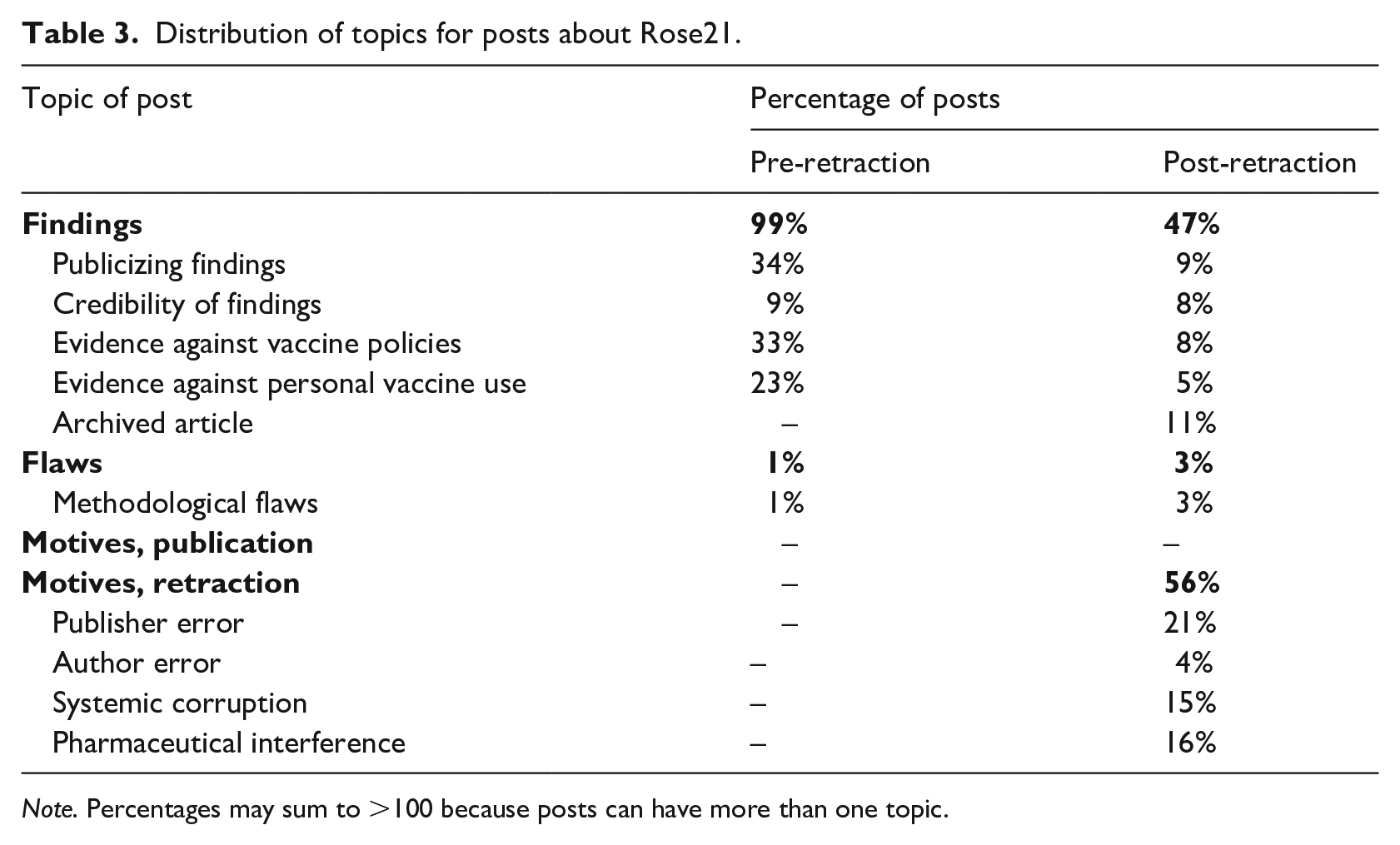
Rose21 received immediate attention from vaccine skeptical Twitter/X users upon its publication. Unlike Mehra20, which had a steady stream of critical attention before its retraction, only around 1% of pre-retraction posts about Rose21 mentioned any flaws (Table 3). In the 9% of posts where the article’s credibility was discussed, users pointed to the fact that the article had been peer-reviewed as proof of its validity (Table 3).
Distribution of topics for posts about Rose21.
Note. Percentages may sum to >100 because posts can have more than one topic.
With its findings and credibility established, users began discussing the implications of the article’s findings for personal and public policy. About 23% of posts cited the findings to justify avoiding vaccination, especially for children (Table 3). In addition, 33% of posts shared the article in posts calling for an end to vaccination policies (Table 3). These posts were sometimes found in the replies to posts from prominent public figures. For example, one user directed a post at British government officials, questioning their continued vaccine rollout despite the reported risks.
While these posts did not generally receive responses from the account they were directed at, they were sometimes replied to by other users, thus opening up space for further deliberation about COVID-19 vaccines. The positioning of the article, unsurprisingly, centered this discussion on the harms, rather than the benefits, of these vaccines. Altogether, article-sharing posts of Rose21 helped cement it as a strong warrant for the anti-vaccination position.
In the absence of arguments against its scientific credibility, some assumed the article would have a significant effect on vaccine policy. As one post confidently asserted, “By rights this should bring the whole thing down.”
Post-retraction
However, 2 weeks after the article’s publication, users began to post that the article was no longer available on the journal’s website. As reported by Retraction Watch, around 15 October, the publishers had issued the article a “temporary removal” which replaced the article with the following boilerplate text: The Publisher regrets that this article has been temporarily removed. A replacement will appear as soon as possible in which the reason for the removal of the article will be specified, or the article will be reinstated.
Unlike most retractions, the article’s unusual “temporary removal” did not provide any further context for the actual reason for the removal. In fact, even when the article was permanently removed a week later, the publishers did not publish an official retraction notice explaining the retraction. Left to speculate about the reasons for the retraction, 21% of posts attributed the retraction to an act of censorship on behalf of the article’s publisher, Elsevier, while only 4% saw the retraction as the legitimate result of author error (Table 3).
The censorship framing was encouraged by the article’s co-authors, who had not been informed of the removal and did not agree with it (Oransky, 2021). Author Jessica Rose described the retraction as an act of political censorship in separate posts on Twitter/X, while author Peter McCullough explicitly blamed the retraction on the influence of the “Biopharmaceutical complex” on the micro-journalism platform Substack (McCullough, 2023). Within the context of the Big Pharma conspiracy, the authors’ protests helped position them as outlaws facing off against the corrupt establishment (Sloop and Ono, 1997). For those sympathetic to the findings of the original article, these protests reinforced the belief that the article was retracted for political reasons.
The censorship frame, accordingly, sustained a public discussion that may have actually strengthened support for the findings of the original article. The implicit assumption in censorship discourse is that an institution is unlikely to invest the resources to censor something unless it is worth it to do so (Moore, 2016). Thus, when framed as censorship, the withdrawal of Rose21 may have been interpreted as proof that the article was correct. As one user opined in a post critical of the withdrawal, “They only silence the truth.”
5. Discussion
By analyzing the discussion of the two most prominent retracted COVID-19 articles on Twitter/X, we have shown how the online discussion of retracted articles can reflect and contribute to politicized discourses around science. Below, we describe three important take-aways of these discussions for understanding the politicization of science.
Politicization undermines the scientific record and its corrections
For both articles, considerable public discussion imagined that scientific actors were colluding with elite government and corporate actors in order to hide fundamental truths about the pandemic from the public. However, there was a key difference in how this conspiracy frame was deployed. When the publication of the article was seen as a politicized attack against Donald Trump, as in Mehra20, the article’s retraction did little to quell this suspicion. Users instead pointed to the media framing of the retraction, its publication in a top-tier journal despite apparent flaws, and the article’s role in delaying administrative approval of hydroxychloroquine as evidence of collusion between scientists, pharmaceutical companies, and political actors. On the other hand, when the publication of the article was widely supported, as with Rose21, its retraction was instead seen as evidence of political interference. By interpreting the article as a forbidden truth that the establishment attempted to censor, the article’s supporters, and even its authors, were able to frame the article’s retraction as evidence that its findings were actually correct.
By showing how the same conspiracy trope can support opposing conclusions about scientific outcomes, these cases illustrate the flexibility of politicization in undermining science. Politicized health research can affect a range of commercial and personal interests. For those who are invested in a politicized scientific topic, scientific articles can help establish a logically coherent position. As a result, the publication of a disfavored article, or the retraction of a favored one, may weaken certain positions and produce a state of cognitive dissonance in their supporters (Lewandowsky et al., 2013). Conspiracy theories provide a flexible rhetorical device for sidestepping these challenges to motivated reasoning (Douglas et al., 2017). When the findings are inconvenient to an actor’s interests, they can utilize the conspiracy to discredit published research. On the other hand, when the findings are supportive, they can instead use conspiracy to legitimize retracted research.
There is a second danger here. Because conspiracies are self-reinforcing, encounters with a compelling conspiracy may be the catalyst for a deeper engagement with conspiracy thinking in general (Douglas et al., 2017; Sutton and Douglas, 2020). The Big Pharma conspiracy, for instance, implicates not just a specific scientist or publisher, but the whole institution of science for enabling corruption (Romer and Jamieson, 2020). If the public invested in a retracted paper sees the retraction as politically motivated, they may be more willing to believe that science as a whole is corrupted. As a result, retractions can become a mechanism through which the politicization of science can result in a larger erosion of trust in science, with consequences for democratic and scientific outcomes alike.
Politicization benefits scientific counterpublics
This study also provides deeper insight into how the politicization of science may disproportionately benefit scientifically marginal positions. Rose21 and Mehra20 were highly shared by vaccine opponents and hydroxychloroquine opponents, respectively, yet these two groups responded to their article’s retraction in distinct ways. For Rose21, vaccine opponents rejected the retraction by questioning its validity or dismissing it entirely. If politicization affected these groups equally, then similar patterns should have persisted for Mehra20. We might have expected that some hydroxychloroquine skeptics would continue to circulate the article’s findings, while others would frame the retraction as censorship by hydroxychloroquine manufacturers. In fact, however, once the article was retracted, its findings virtually ceased to be shared on Twitter/X, and we could not find any posts that contested the retraction.
These differences can be explained in part by the asymmetries in the scientific attitudes of vaccine opponents and hydroxychloroquine opponents. Vaccine opponents have sometimes justified their fringe scientific positions by articulating a populist critique of science as politically corrupted by elite interests (Davis, 2019; Mede and Schäfer, 2020). This argument affords vaccine opponents a privileged rhetorical position by allowing them to reject the vaccine consensus without needing to reject all vaccine research (Harambam and Aupers, 2014). When a scientific study challenges their position, they can dismiss it as politically motivated. However, if it supports their position, they can accept the research as the rare case of a rogue insider who is willing to “tell it like it is.” Thus, when Rose21 was published, vaccine opponents largely accepted the findings of vaccine harms and dismissed its retraction as an attempt at censorship.
Hydroxychloroquine opponents, on the other hand, did not have this luxury. Opposition to hydroxychloroquine as a COVID-19 treatment was vocalized by many public health experts, who largely rejected off-the-shelf treatments in favor of preventive measures, including social distancing and face masks. Accordingly, the slogan “we believe in science,” popular in Democratic campaigning, signaled support for specific COVID-19 public health measures based on trust in science as an institution. This position assumes that while science may not always get it right, the procedural norms of science, such as peer-review and retractions, ensure that errors are rare and correctable (Merton, 1938). The distinctiveness of these practices has contributed to making science a privileged authority for making claims about the world (Gieryn, 1983). At the same time, however, they prevent science supporters from dismissing inconvenient retractions without undermining the basis of this authority. This may explain why hydroxychloroquine critics accepted the retraction of Mehra20 despite initial support for its findings.
In short, while both sides of a politicized issue can have belief-affirming articles retracted, scientific counterpublics are able to employ tactics that reduce the legitimacy of the retraction, while there is a clear cost to doing so for those whose positions generally align with scientific expertise. This provides further support for seeing the politicization of science as the strategic privileging of anti-science interests rather than a contest in good faith (Oreskes and Conway, 2010).
Transparent retractions are essential
Finally, our study underscores the need for publishers to be transparent with the public when conducting retractions. Although retraction guidelines advise publishers to clearly describe the reasons for an article’s retraction and avoid removing the original article (Barbour et al., 2019), some publishers have skirted these norms by calling an article’s unexplained removal a “withdrawal” instead of a “retraction.” However, as our analysis of Rose21 shows, these opaque retraction policies can erode scientific trust. Although Rose21 had legitimate flaws that may have merited retraction, because these flaws were not communicated with the public, opponents of the retraction were able to attribute conspiratorial motivations to the article’s removal.
To mitigate public suspicion, two practices are essential. First, retraction notices should clearly articulate the transgression that motivated the article’s retraction. Because conspiracy theories provide broad, internally consistent explanations, they are often adopted to fill the epistemic void left behind by unexplained phenomena (Douglas et al., 2017). Thus, providing a plausible explanation for a retraction can eliminate a central motivation for conspiratorial explanations. And second, barring exceptional circumstances, retractions should not remove the original article. Although retracted articles can act as a source of misinformation, once an article has entered the public record, it is imprudent to attempt to remove it. When framed as politically motivated, article removals can be seen as an act of political censorship and subsequently erode scientific trust.
Limitations
While this study provides valuable insights into the politicization of retractions, several limitations should be acknowledged. First, our research focuses exclusively on a single social media platform. As a result, it is difficult to ascertain whether the patterns we observed are due to content level features, such as the articles’ subject and the nature of its retraction, or attributes of the platform, including the affordances of the platform or its user demographics. Second, we analyzed two of the most widely discussed retracted articles on Twitter/X. However, most retractions do not receive much discussion on social media, politicized or otherwise. Finally, because we only collected posts that hyperlinked to an article or its retraction, our analysis may have missed content features found in posts that did not use article hyperlinks.
While these limitations affect the generalizability of our findings, they do not detract from the study’s value as an analysis of how politicization is reflected in, and furthered by, public discussions of retractions. To better understand the prevalence of politicized retractions, future research should measure public attention to retractions across a larger corpus of articles and a broader range of platforms. Our study aids this effort by detailing the relevance of certain variables, namely the political salience of a retracted article’s subject and the transparency of its retraction, to public discussions of science. Future studies of retractions would be wise to also consider other measures, including the amount of time before an article is retracted and the number of social media shares an article receives before retraction.
6. Conclusion
Retractions have a precarious position in a politicized communication environment. When properly administered and communicated, retractions can help ensure the legitimacy of the scientific record. However, when improperly communicated or distorted, they can produce new doubts about its legitimacy. Accordingly, the scientific community cannot afford to treat retractions as a trivial matter. Whether science is seen as “self-correcting” or “broken” depends in part on how the public understands retractions.
Footnotes
Acknowledgements

Funding
The author(s) disclosed receipt of the following financial support for the research, authorship, and/or publication of this article: This research was partially funded by NSF Career Grant IIS-1943506.