



Abstract
Political actors pay attention to newspapers because they stimulate them to address a topic, reflect public opinion, provide feedback to their decisions, and help them to generate effective messages. Previous surveys showed that this is true for scientific issues. It follows that the newspaper coverage of scientific issues should appear as politically oriented, as observed regarding climate change. Here, we tested this prediction regarding educational neuroscience. This scientific issue is interesting because it implies no major economic interest and because the relevance of neuroscience regarding teaching in the classroom is still highly controversial. As hypothesized, we observed that the French press appeared strongly polarized: the right-leaning press was mostly favorable to educational neuroscience, whereas critical opinions were mainly found in the social-democrat press. Although the relevance of neuroscience toward teaching was rarely discussed in scientific arguments, political actors often invoked educational neuroscience in the press to legitimate their decision.
Keywords
1. Introduction
Aim of the study
Neuroscience attracted increasing attention in mass media during the last two decades (O’Connell et al., 2011; O’Connor et al., 2012; Racine et al., 2010; van Atteveldt et al., 2014). Indeed, neuroscience advances raise high expectations in society concerning major societal issues such as mental health, brain achievement, and education. Several academic studies showed that most media documents about neuroscience advances were too optimistic (Lehmkuhl and Peters, 2016; Racine et al., 2005, 2010; Sumner et al., 2016) and that many were frankly misleading (Bourdaa et al., 2015; Gonon et al., 2011, 2012; O’Connor and Joffe, 2014; Paylor et al., 2014). This gap between neuroscience observations and their representation in mass media is reminiscent of the media coverage of global warming (Bolsen and Shapiro, 2018). Academic studies on this latter topic showed that its media coverage strongly depended on the political orientation of each news outlet (Bolsen and Shapiro, 2018; Chinn et al., 2020; Merkley and Stecula, 2018). However, to our knowledge, the political polarization of the media coverage of neuroscience-informed issues has not yet been explored. Here we investigate, using quantitative content analysis, the polarization of French newspaper articles dealing with educational neuroscience.
A scientific controversy: Neuroscience relevance regarding teaching in the classroom
Since the mid-1980s, there is a growing interest in the claim that neuroscience can improve school education. This claim often stems from an extensive definition of educational neuroscience that includes adjacent, but distinct, disciplines such as cognitive psychology and behavioral sciences. When educational neuroscience is strictly defined as the observation of brain functioning by means of neuroscience tools (mostly brain imaging and electrophysiology), specialists are much more skeptical about its relevance for teaching. According to Bowers (2016a, 2016b), there is no current example of neuroscience motivating new and effective teaching methods. Brain changes associated with learning might be interesting for neuroscientists, but are irrelevant, while cognitive psychology is the most relevant discipline to improve teaching (Bowers, 2016a, 2016b). Horvath and Donoghue (2016) argued that a prescriptive educational neuroscience is a practical and philosophical impossibility due to incommensurability between non-adjacent disciplines: neuroscience and experimental teaching (Horvath and Donoghue, 2016). Even the proponents of educational neuroscience acknowledge, after a systematic review of the literature, that the search for improved teaching methods requires interdisciplinary approaches combining neuroscience with cognitive psychology, behavioral sciences, and experimental teaching (Feiler and Stabio, 2018). In the particular case of reading, cognitive and behavioral sciences have provided detailed answers to many questions about how children learn to read and how they can best be taught (Castles et al., 2018). Brain-imaging studies described tentative neuroanatomical models of reading-related activities in children and adults (Martin et al., 2015) but cannot answer how to teach them.
The French political context
Until May 2017, France was a majoritarian democracy where two major parties alternately formed the national government: a conservative party and a social-democrat party (named the socialist party) (Vliegenthart et al., 2016). After his election on 7 May 2017, Emmanuel Macron recruited his ministers from the conservative party, the socialist party, and among technical experts not previously elected under the banner of any political party. Jean-Michel Blanquer belonged to this third group and served as education minister from 17 May 2017, to 20 May 2022. However, he previously exerted important functions at the Ministry of Education in 2006 and 2007, when Gilles De Robien was the education minister of a conservative government. From 2000 to 2020, 10 education ministers succeeded one another. Four belonged to social-democrat governments, five to conservative ones, and one, Jean-Michel Blanquer, to Emmanuel Macron’s government. This government was close to neoliberal views concerning the economy as asserted by the fact that the first minister and the minister of economy came both from the conservative party. Thus, it can be classified as a center-right government.
The political orientation of the French press is more complex. National news outlets, daily newspapers, and weekly magazines alike can be classified as conservative, centrist, or social democrat. Outside these three groups, we also considered, at the extreme left, the daily newspaper published by the communist party (L’Humanité). This classification was stable during the two decades of our study. The regional press is closer to the conservative party than to the socialist party, but its political orientation is not clear enough to be considered.
Theoretical background: The concept of medialization
The concept of medialization encapsulates the changes in political processes that have occurred over recent decades in democratic societies. It theorizes the increasing orientation of politics and other actors toward the mass media (Peters et al., 2008b; Petersen et al., 2010). Several authors have looked at medialization with respect to science (Peters, 2012; Peters et al., 2008b; Weingart, 1998). As outlined by these authors, the concept of medialization postulates a mutual and increasing orientation from science toward the media and reciprocally. Surveys of journalists and scientists, including neuroscientists, have documented their growing cross-influence (Allgaier et al., 2013; Peters, 2012; Peters et al., 2008a).
Interactions between scientists and journalists represent one side of medialization. On the other side, the interactions between politicians and journalists about scientific topics have been less explored, although modern governance increasingly depends on scientific advice. A survey of political actors showed that they are increasingly sensitive to scientific issues covered by mass media (Petersen et al., 2010). Among all mass media, the interviewees rated national newspapers and news magazines as the most important for them (Petersen et al., 2010). Petersen et al. (2010) identified five functions of science-based media: (1) by highlighting scientific issues of interest for the public, mass media set the political agenda, (2) political actors pay attention to mass media because they reflect public opinion, (3) media provide feedback to political actors about their decisions and discourses, (4) political actors draw from media coverage scientific arguments to generate effective messages, and (5) mass media provide scientific information to political actors. Although science is supposed to be politically neutral, when considering that political actors must adapt their decisions and discourses in the media to the perception and preference of their voters, it follows that the media coverage of at least some scientific issues should be politically polarized. Actually, the conservative press differs from the social-democrat press about certain scientific issues (e.g. global warming). Here, we investigate the coverage by the French Press of educational neuroscience to test whether this coverage was politically oriented.
Research questions
Our main hypothesis is that the media coverage of educational neuroscience is politically polarized. This polarization might be linked to the political leaning of each news outlet, to the political context, or both. Thanks to our longitudinal study we explored the possible influence of the political context over two decades. We collected all French press articles evoking neuroscience, and mentioning the name of each education minister from March 2000 to February 2020. Using this main database, we tackled the following research question:
RQ1: Did the time distribution of press articles referring to educational neuroscience depend on the political orientation of each education minister?
Our main database suffered from a possible bias because the name of each education minister was used as a keyword to collect relevant press articles. Therefore, we built a secondary database about a specific domain of educational neuroscience: the teaching of reading. Indeed, since the 1970s, the French press reflected on a debate about two methods for teaching reading: the “global” (word) method and the syllabic method. For this data collection, we combined the same keywords related to neuroscience with keywords about this specific debate. Therefore, this secondary database was neutral toward political orientation and was also used to answer the same research question (RQ1).
Our hypothesis posits that the opinions about educational neuroscience expressed in press articles depended on the political orientation of each news outlet. This content analysis was separately conducted through articles included in both databases.
RQ2: Did the share of articles favorable, balanced, or critical toward educational neuroscience depend on the political orientation of each news outlet?
The study by Petersen et al. (2010) about the relationship between political actors and the press led us to elaborate on two additional questions. First, we explored the agenda setting using both databases:
RQ3: Who among scientists, journalists, and political actors triggered surges in the press coverage of educational neuroscience?
Second, we investigated the possible feedback of the press on the messages delivered by political actors. To this aim, we analyzed the interviews given by each education minister to the press.
RQ4: Do arguments and tones about educational neuroscience evolve with time within successive interviews given by each education minister?
2. Method
Selection of newspapers and news magazines
We used the Europresse database to collect articles in seven national daily newspapers (Le Monde, Le Figaro, Les Echos, La Croix, Libération, Aujourd’hui en France and L’Humanité), in three national weekly news magazines (Le Point, L’Obs and L’Express), and in 10 regional dailies (Ouest France, Sud-Ouest, La Voix du Nord, Le Parisien, Le Télégramme (Brest), Le Progrès (Lyon) La Nouvelle République, La Montagne, La Dépêche du Midi, L’Est Républicain). We selected these news outlets because they have the largest audience in each category, with one exception. Indeed, although its audience (37,905) is much lower than for the other news outlets (at least 78,000), l’Humanité was included in our search because it represents the only national newspaper at the extreme left of the political spectrum (this newspaper is published by the French communist party). Moreover, because they are not accessible via Europresse, we were not able to collect articles from two regional newspapers with a medium audience (Le Dauphiné Libéré (169,494) and Les Dernières Nouvelles d’Alsace (124,771)). Besides L’Humanité, the audience of the six national newspapers ranged from 78,034 (Aujourd’hui en France) to 424,085 (Le Monde). The audience of the three news magazines ranged from 170,673 (L’Express) to 272,842 (Le Point) and that of the regional daily newspapers from 106,791 (L’Est Républicain) to 626,643 (Ouest France).
For each news outlet, we considered printed articles and articles published online on their websites. When similar articles were published in printed form and online, we considered both because, in almost all cases, their title, publication date, and length differed. Europresse provided both printed and online articles for all news outlets except for L’Humanité and four regional newspapers (La Dépèche du Midi, L’Est Républicain, La Nouvelle République and Le Progrès).
These national news outlets cover the whole political spectrum: the conservative wing (Aujourd’hui en France, Les Echos, Le Figaro, L’Express, Le Point), the center (La Croix, Le Monde), the social-democrat wing (Libération, L’Obs), and the extreme “left” (L’Humanité). Other political extremes are only voiced by short-lived news outlets with a small audience and were not archived by Europresse. Finally, because the political orientation of the regional press is less clear, it was not considered here.
Selection of press articles referring to educational neuroscience
In each newspaper, we searched for articles mentioning the name of the education minister (e.g. “Jean-Michel Blanquer”) and mentioning the keywords “neuro*” or “cerveau*” (“cerveau” means “brain”). For each education minister, the search was restricted to the time period of his or her ministerial function, with one exception. Jean-Michel Blanquer started his role on 17 May 2017, and was still in place in May 2022. However, we decided to end our data collection on 20 February 2020, because at this date the French press started to focus on the COVID-19 pandemic. Therefore, for Jean-Michel Blanquer, we only collected articles published from 17 May 2017, to 20 February 2020. With this search procedure we collected 985 press articles. The relevance of each article was manually checked. Articles mentioning either “neuro*” or “cerveau*” in a context not related to teaching were discarded. For example, in an article about a news story we found the expression “le cerveau de la bande” (i.e. “the gang’s ringleader”). Press articles only mentioning the prefix “neuro*” in a word indicating a medical specialty (e.g. neurologist) were also discarded.
For each education minister, the number of press articles referring to educational neuroscience was expressed in relative terms, that is, as a fraction of the whole number of articles mentioning the name of the minister. We had to take into account that the time period of each ministerial role varied from 5 to 34 months. Moreover, during the 2000s, the Europresse database effectively archived the French national press daily and weekly alike, but only five newspapers of the regional press. For example, in the worst case, “La Dépêche du Midi” had only been archived since January 2014.
Because cognitive psychology is relevant to teaching, we also considered press articles published during the same time periods, mentioning the name of the same ministers and the keyword “cogniti*,” but in which the keywords “neuro* or cerveau*” were not mentioned. This search retrieved 205 press articles. The relevance of each article was manually checked. We only considered articles mentioning the keyword “cogniti*” in an expression about any type of cognitive sciences (e.g. “psychologie cognitive,” “les sciences cognitives”) in the context of teaching. We discarded press articles where the keyword “cogniti*” appeared (1) in an expression meaning a skill or a capability (e.g. “capacitiés cognitives des élèves”), (2) in the name of a laboratory or institution, or (3) to specify the field of competence of a scientist (e.g. “professeur de sciences cognitives”).
Selection of press articles referring to the teaching of reading
We collected via Europresse all articles published from 27 March 2000 to 20 February 2020, containing the same keywords about educational neuroscience (neuro* or cerveau*) and keywords related to the syllabic and “global” methods of teaching reading (syllabique* or “méthode globale” or “méthodes globales” or “approche globale” or “approches globales”). The relevance of each article was manually checked, and we only included articles linking educational neuroscience and the teaching of reading. This search retrieved 147 articles of which 100 were already included in the main database because they also mentioned Gilles De Robien or Jean-Michel Blanquer.
Delineating opinions about educational neuroscience
Some press articles were so neutral and vague that it was not possible to identify any opinion about educational neuroscience. However, most press articles expressed, at least implicitly, an opinion about educational neuroscience. We classified these opinions in three categories: (1) mostly favorable, (2) mostly critical, and (3) balanced opinion (i.e. both favorable and critical opinions were expressed in the same article). An opinion about educational neuroscience was judged as favorable when we found a claim stating that neuroscience can inform teaching and providing that this specific claim was not questioned elsewhere in the same article. Articles expressing such a claim and questioning teaching methods or minister’s decisions, but not the relevance of the neuroscience argument, were still considered as favorable to educational neuroscience. These criteria were detailed and exemplified in Table 1. Their relevance was tested by the collaborative coding of the 26 press articles published during Gilles De Robien’s ministry, through discussion between the three authors. Thus, a final classification was reached (see Supplemental Material).
Criteria about opinions expressed by press articles concerning educational neuroscience.
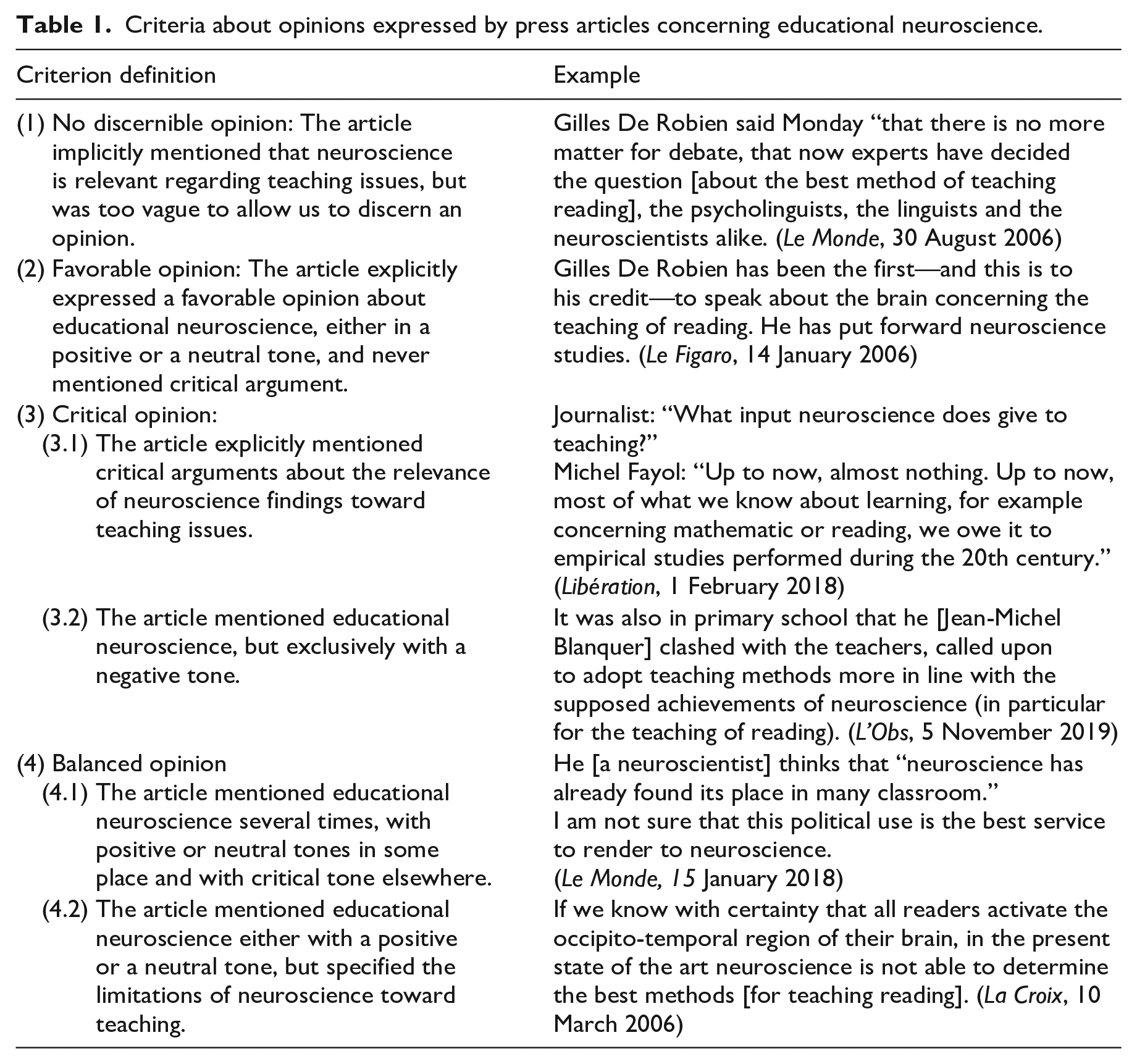
Concerning the opinions expressed by the 279 press articles published during Jean-Michel Blanquer’s ministry, the robustness of their coding was tested by a double-coding procedure (Sim and Wright, 2005). One author (F.G.) coded the 279 articles and the others independently coded 103 articles (M.P.) and 176 articles (C.B.). Coding agreements were assessed by calculating the weighted Cohen’s kappa coefficient using the “GraphPad” calculator set to four categories ordered by their logical distance: (1) favorable opinion, (2) unclear opinion, (3) balanced opinion, and (4) critical opinion. For the 103 articles coded by F.G. and M.P. and the 176 articles coded by F.G. and C.B., the weighted kappa coefficient reached 0.63 and 0.68, respectively. These values denote “a substantial agreement between coders” (Sim and Wright, 2005). Moreover, observed discrepancies between coders justified the use of a weighted kappa coefficient. Indeed, no disagreement about critical versus favorable opinions was observed among the 279 opinions tested. Finally, all discrepancies between coders were resolved by discussion to establish the final classification given in Supplemental Material.
Concerning the secondary database about the teaching of reading, the same procedure was used to classify the 47 articles that were not already included in the main database. Two authors (C.B. and F.G.) independently coded the opinions expressed in these 47 articles. The agreement between both coders was substantial (weighted kappa coefficient: 0.69). Discrepancies were resolved by discussion to establish the final classification given in the Supplemental Material.
3. Results
Number of press articles mentioning neuroscience in the context of teaching
We collected, via Europresse, 985 press articles mentioning the name of an education minister and the keywords “neuro*” or “cerveau*.” Among them, only 341 articles mentioned either keyword in a context related to teaching and were considered for further investigation (Table 2).
Number of press articles mentioning educational neuroscience.
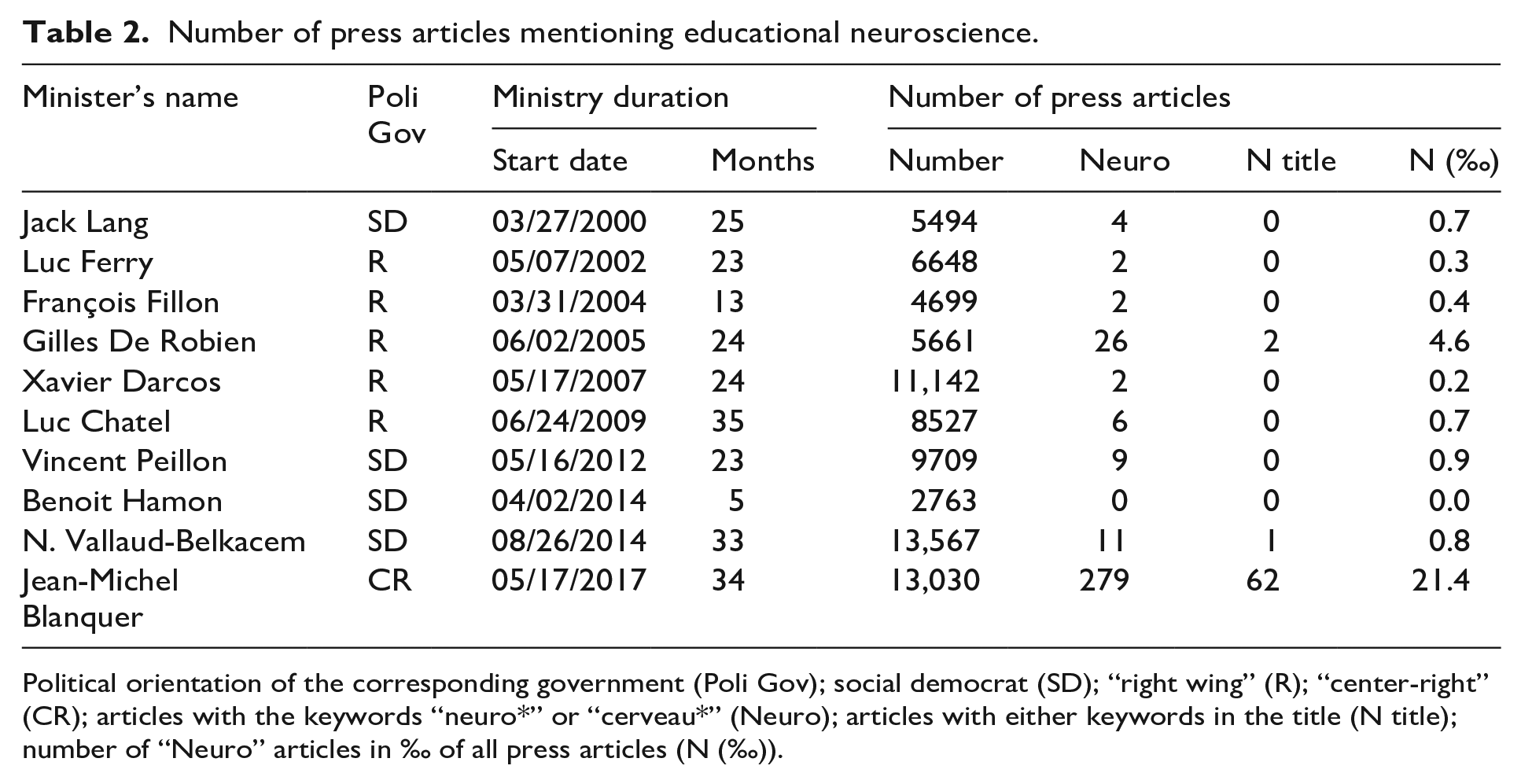
Political orientation of the corresponding government (Poli Gov); social democrat (SD); “right wing” (R); “center-right” (CR); articles with the keywords “neuro*” or “cerveau*” (Neuro); articles with either keywords in the title (N title); number of “Neuro” articles in ‰ of all press articles (N (‰)).
Among the press articles mentioning the name of each minister and published when he or she managed the education ministry, few articles mentioned neuroscience in the context of teaching methods, except for two ministers: Gilles de Robien and Jean-Michel Blanquer (Table 2). The first one belonged to a conservative government, and the second to a “center-right” one. All four social-democrat education ministers and the four other conservative ministers were not associated with a significant number of press articles mentioning educational neuroscience (Table 2). When a press article mentioned “neuroscience” or “cerveau” in its title, this indicated that the article was strongly focused on educational neuroscience. Such articles almost only appeared during Jean-Michel Blanquer’s ministry (Table 2).
The same uneven distribution was also observed in the secondary database about the teaching of reading. Indeed, during Gilles De Robien’s ministry, we collected 30 articles, while during the 5 years preceding it, we only found four articles. Similarly, during Jean-Michel Blanquer we collected 90 articles, whereas for the 10 years between both ministries, we found only 23 articles.
The number of press articles mentioning educational neuroscience and published during Jean-Michel Blanquer’s ministry was sufficient to investigate its time evolution from May 2017 to February 2020 (Figure 1). During this period of 34 months, the whole number of articles mentioning Jean-Michel Blanquer per month ranged from 161 to 577, and, among them, the number of articles with the keywords “neuro*” or “cerveau*” ranged from 0 to 30 (Figure 1). As expected, the number of press articles peaked at each September (month numbers 5, 17, and 29), the start of the school year. A fourth peak (month number 9) appeared in January 2018 (Figure 1). The fourth peak was triggered by Jean-Michel Blanquer’s decision, announced on 24 November 2017, to create a Scientific Council of National Education and to appoint a prominent neuroscientist, Stanislas Dehaene, as its president. This event triggered a peak of press articles mentioning either “neuroscience” or “cerveau” in their title (Figure 1).
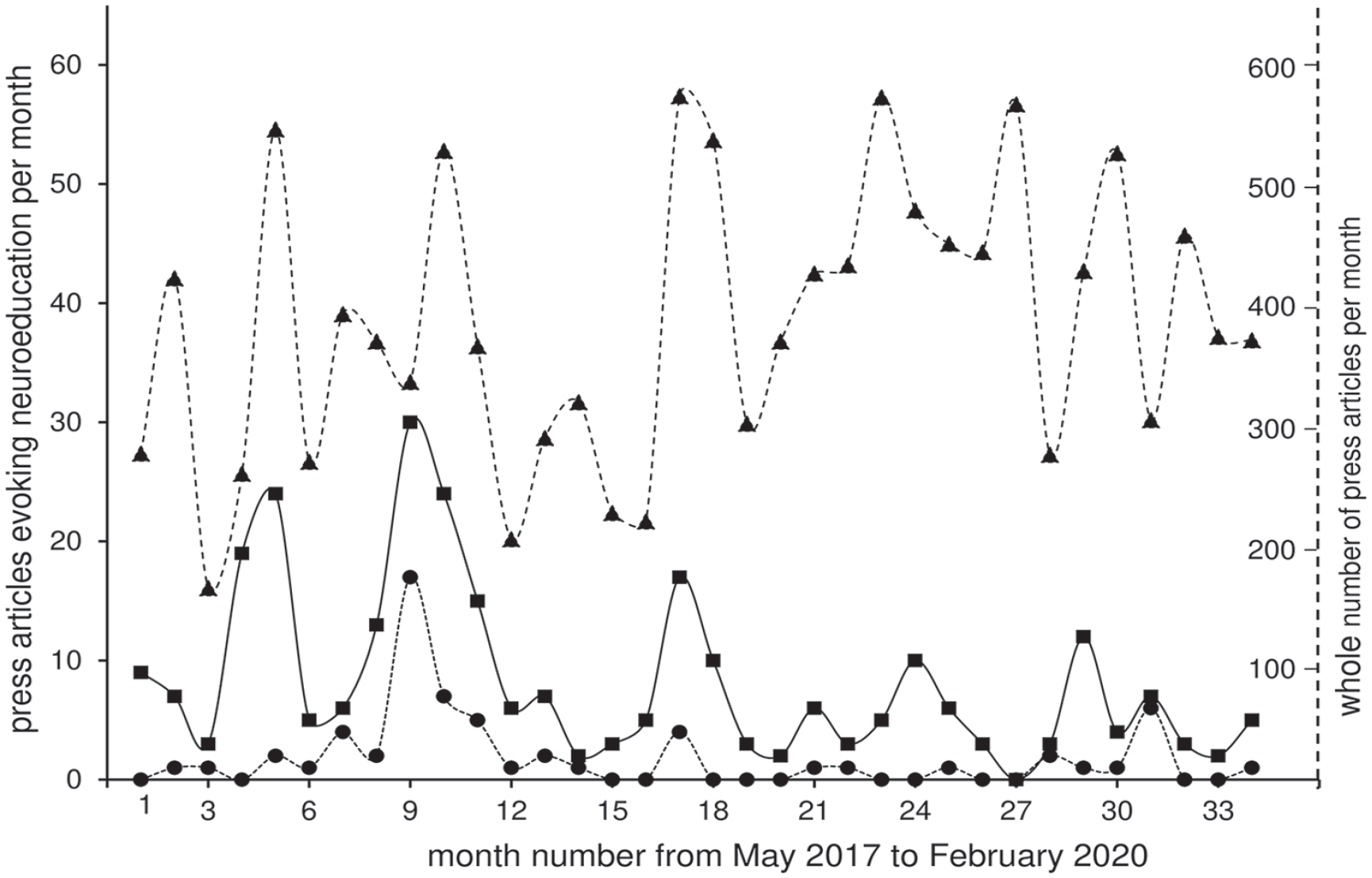
Time evolution of the number of press articles mentioning educational neuroscience during Jean-Michel Blanquer’s ministry.
Number of articles mentioning cognitive sciences but not neuroscience
We collected via Europresse 205 press articles mentioning the name of an education minister and the keyword “cogniti*” but not the keywords “neuro*” or “cerveau*.” Among them, only 34 articles were dealing with any type of cognitive science in a context of teaching and were considered for further investigation. Among these 34 articles, 28 were published during Jean-Michel Blanquer’s ministry and of those, 19 were published in 2017, 10 in 2018 and only one in 2019. Thus, although specific referral to cognitive sciences is much more appropriate concerning school education than referring to neuroscience, it marginally occurred in our database compared to educational neuroscience. Therefore, articles referring to cognitive sciences, but not to neuroscience, were not further considered, except for two articles publishing Jean-Michel Blanquer’s interviews in November and December 2017.
Opinions about educational neuroscience during Gilles De Robien’s ministry (2005–2007)
Of the 5,661 press articles mentioning Gilles De Robien, 26 also mentioned educational neuroscience. All but one of these 26 articles closely linked neuroscience with the teaching of reading. Indeed, in December 2005 the minister reopened an old controversy about two methods for teaching reading. According to him “the brain is organized in such a way that the syllabic learning is better” (Sud Ouest, 8 December 2005). This reference to educational neuroscience was vigorously applauded by the right-leaning press. For example, Le Figaro entitled its article: “Gilles De Robien has been the first to talk about the brain for the teaching of reading” (14 January 2006). Twelve out of 19 articles published by the right-leaning press, the centrist press, and the regional press expressed a favorable opinion about educational neuroscience, whereas five articles were vague, two were balanced, and none was critical. In contrast, the opinions expressed by six of the seven articles of the social-democrat press were more nuanced (three favorable articles, two balanced, and one critical).
Opinions about educational neuroscience during Jean-Michel Blanquer’s ministry (2017–2020)
Among the 279 press articles mentioning Jean-Michel Blanquer and educational neuroscience, 79 closely linked neuroscience with the teaching of reading. Another major theme that emerged among these 279 press articles was related to the Scientific Council of Education. Since its creation by Jean-Michel Blanquer, on 24 November 2017, 78 press articles commented on it.
Altogether, among the 279 press articles mentioning Jean-Michel Blanquer and educational neuroscience, 225 expressed an opinion about it, whereas 54 were vague. The tone of these opinions strongly depended on the political leaning of each news outlet. Indeed, national newspapers and magazines with a “right” leaning mostly supported a positive opinion about educational neuroscience, whereas, at the extreme left, none of the 17 articles published by L’Humanité supported it (Table 3). The centrist and social-democrat press expressed more diverse opinions as well as the regional press (Table 3).
Educational neuroscience in press articles during Blanquer’s ministry.
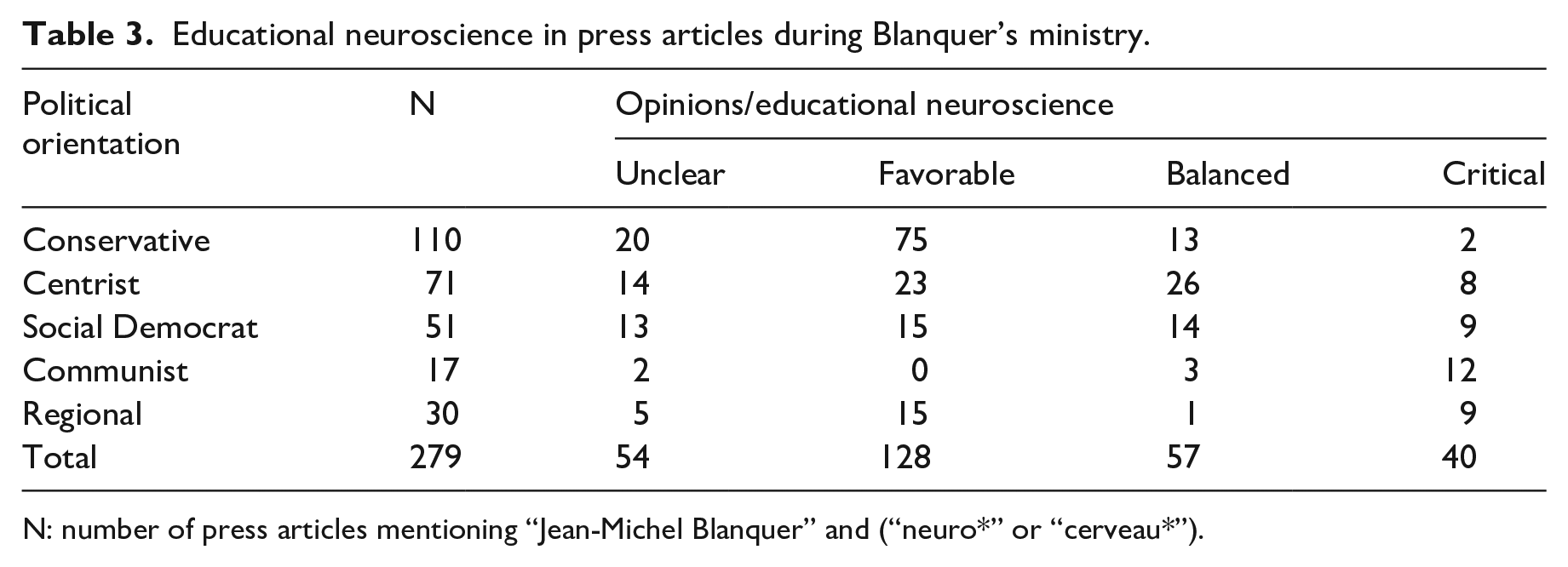
N: number of press articles mentioning “Jean-Michel Blanquer” and (“neuro*” or “cerveau*”).
The strength of the link between the political leaning of the national press (four modalities) and the tone of the opinion about educational neuroscience (three modalities) was assessed using statistical tests. Regional newspapers were not considered because their political orientation was not as explicit as that of the national press. When only considering the conservative, centrist, social-democrat, and communist news outlets, the three opinions were unevenly distributed between the four types of newspapers classified according to their political orientation (Kruskal–Wallis test: p < 0.00001). To examine the link between the political orientation and the opinion distribution, we used pairwise comparisons between two political orientations. We observed that the opinion distributions of the centrist and social-democrat press did not significantly differ (2 × 3 Chi2 test). Because this test is not valid for small numbers of observations, for other pairwise comparisons we had to consider only favorable versus balanced plus critical opinions (2 × 2 Chi2 test). Accordingly, the opinion distribution of the conservative press significantly differed from that of the centrist press (p < 0.0001) and from that of the social-democrat press (p < 0.0001). Finally, the opinion distribution of the communist press significantly differed from that of the conservative press (p < 0.0001), the centrist press (p = 0.0016) and the social-democrat press (p = 0.0049) (2 × 2 Fisher test).
Opinions about educational neuroscience applied to the teaching of reading
Table 4 shows the distribution of articles between the different political leaning of each news outlet and the opinion expressed in each article as unclear, favorable, balanced, or critical toward the relevance of neuroscience for the teaching of reading. As for the main database, the three expressed opinions depended on the political leaning of the conservative, centrist, and social-democrat press (3 × 3 Kruskal–Wallis test: p = 0.00002; Table 4). The same trend was observed whether each article mentioned the name of the minister or not (Table S1 in Supplemental Material). The same uneven distribution was also observed when only considering the 30 articles published during Gilles De Robien’s ministry (Table S2 in Supplemental Material) or the 90 articles published during Jean-Michel Blanquer’s ministry (Table S3 in Supplemental Material).
Educational neuroscience and the teaching of reading from 2000 to 2020.
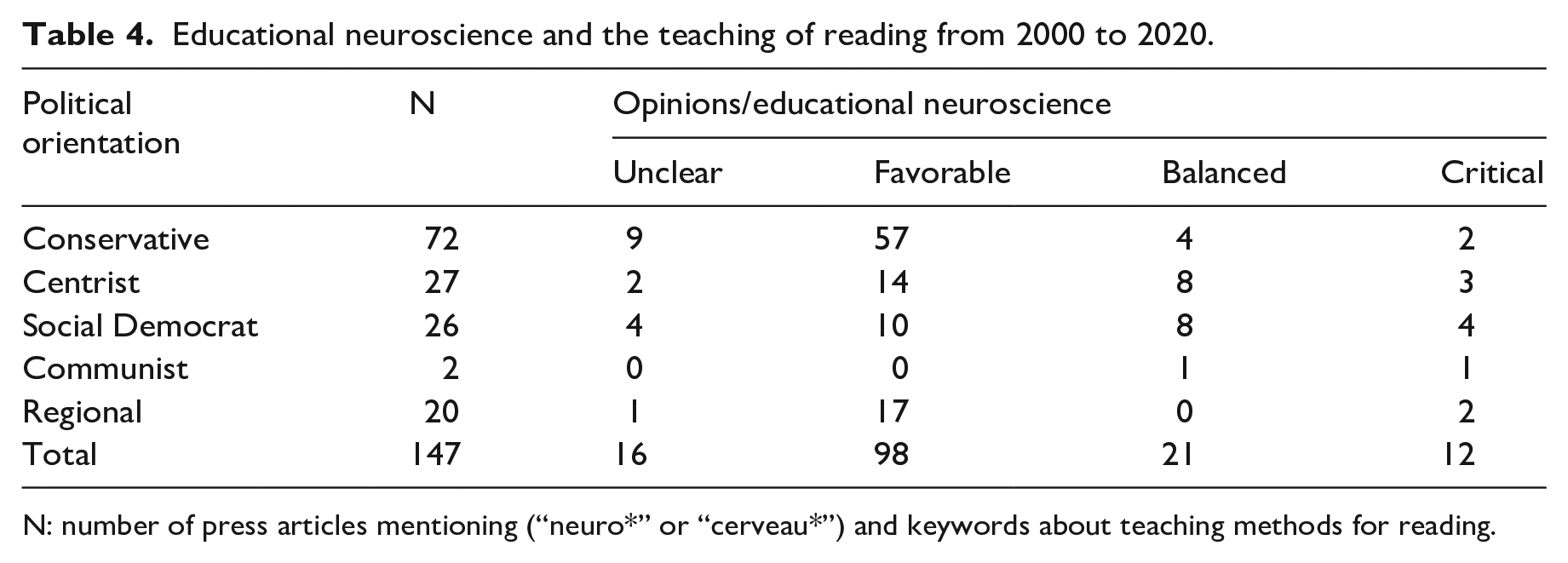
N: number of press articles mentioning (“neuro*” or “cerveau*”) and keywords about teaching methods for reading.
Educational neuroscience in Gilles De Robien’s own words
On 8 December 2005, Gilles De Robien gave an interview to a conservative newspaper. In this interview, he raised a neuroscience argument which, according to him, demonstrates that the syllabic method for teaching reading was better. He said: “Neuroscientists explain that the brain area that decodes the language, is not that which identifies images.” Two months later Gilles De Robien gave another interview to a conservative newspaper. He also published two opinion articles, one in a socialist newspaper on 28 February 2006, and one in a conservative newspaper on 2 March 2007, that is, at the end of his ministry. Beside this initial interview, in his three subsequent talks the minister asserted that his decision in favor of the syllabic method was based on “scientific research about brain functioning,” but he did not elaborate on the scientific evidence. Therefore, in Gilles De Robien’s own words, the call to neuroscience seems an argument of authority, and we observed no change in minister’s discourse all along the 2 years of his ministry.
Educational neuroscience in Jean-Michel Blanquer’s own words
Our databases included 10 interviews given by Jean-Michel Blanquer to the press and two texts written in his own hand. These 12 articles were mainly published by the conservative press (9/12). During the first week of his ministry, Jean-Michel Blanquer already gave two interviews in which he briefly asserted that he would build on neuroscience to recommend the best teaching methods. He also claimed: “We must go ahead in the light of sciences and experiences as other countries. School education is not a matter of political left or right” (Le Figaro, 4 September 2017). During the start of the school year, i.e. from 17 August to 19 October 2017, Jean-Michel Blanquer gave five interviews that included similar assertions, although sometimes in a more precise form. For instance, in an interview published in a social-democrat magazine on 24 August 2017, Jean-Michel Blanquer said: For [the teaching of] reading, we will rely on neuroscience findings, therefore on an explicitly syllabic teaching and not on the whole-language approach, which everyone now admits had results that are anything but convincing.
In these seven interviews, Jean-Michel Blanquer provided no scientific evidence in support of his view that neuroscience can inform teaching, and his tone was very assertive. It is of note that during this initial phase of his ministerial post, that is, from 17 May to 18 October 2017, the date of his seventh interview, the number of press article expressing a favorable opinion about educational neuroscience exceeded that of articles expressing a critical or balanced opinion (33 versus 18, respectively).
On 24 November 2017, Jean-Michel Blanquer announced that he would create on January 2018 a Scientific Council of Education which would be led by Stanislas Dehaene, a prominent neuroscientist. This announcement was widely commented upon and sometimes criticized by the press. For example, on 28 November 2017, the centrist newspaper Le Monde cited a public letter to Jean-Michel Blanquer that was published by 60 professionals and scientists: In the permanent dialogue that the school must maintain with [scientific] research, no discipline can legitimately impose itself on others, and none should be ignored.
On 10 January 2018, in an interview with Stanislas Dehaene, Jean-Michel Blanquer clarified the aims and composition of the Scientific Council of Education. He also sharply answered his opponents by pointing out that, besides neuroscience, several disciplines, including philosophy, were represented in this council.
From 10 January to 14 February 2018, criticisms about educational neuroscience became more numerous and specific, as exemplified in an article published in a social-democrat newspaper (Libération) on 1 February 2018: Journalist: “What input does neuroscience give to teaching?” Michel Fayol (a professor of cognitive psychology and member of the Scientific Council of Education): “Up to now, almost nothing. Up to now, most of what we know about learning, for example concerning mathematics or reading, we owe to empirical studies performed during the 20th century.”
On 14 February 2018, Jean-Michel Blanquer replied to these criticisms in an interview given to a conservative magazine (Le Point): Journalist: “In order to reform national education, you seem to rely heavily on neuroscience.” Jean-Michel Blanquer: “I never claimed that cognitive science would be the be-all and end-all of progress in education. Those who say this, wrapping themselves in a pseudo-humanistic posture, are dishonest.”
Finally, in 2019 the number of press articles expressing a critical or balanced opinion about educational neuroscience (30 articles) exceeded that of favorable articles (24 articles). In January 2020 Jean-Michel Blanquer published a book of conversations with a French philosopher. Extracts from this book were quoted in a conservative magazine (Le Point, 2 January 2020). In one extract the minister was even more defensive: Jean-Michel Blanquer: “I am struck by the neo-obscurantism which is observed today as soon as neuroscience is mentioned. I am also struck by the tensions that arise in the face of neuroscience advances. Each time I speak to a neuroscientist or a cognitivist I rather perceive humility on his part . . . They are only at the beginning of a path, certainly promising, but which remains largely to be explored.”
These observations suggest that Jean-Michel Blanquer paid attention to the opinions expressed by the press about educational neuroscience and adapted his discourse to reply to his opponents. It is of note that the three articles in which Jean-Michel Blanquer expressed his opinion with a defensive tone, were published in conservative news outlets.
Two of Jean-Michel Blanquer’s interviews (Le Point, 19 October 2017 and Le Monde, 13 December 2017) mentioned cognitive sciences but not neuroscience. The tone of both articles was assertive with no attempt to elaborate on the scientific evidence. Six other interviews and one text mentioned both cognitive sciences and neuroscience. For example, in the extract of the book cited by Le Point on 2 January 2020, Jean-Michel Blanquer wrote: Today, the complex understanding of the human being can advance thanks to cognitive sciences. They are the opposite of reductionism. No reasonable person can claim that brain imaging provides all the answers.
As illustrated earlier, Jean-Michel Blanquer’s discourse did not differentiate cognitive sciences from neuroscience. This observation further suggests that, in his discourse, the call to neuroscience was an argument of authority.
4. Interpretations
RQ1: Did the time distribution of press articles referring to educational neuroscience depend on the political orientation of each education minister?
From March 2000 to February 2020 most press articles related to educational neuroscience and included in our main database were published during Gilles De Robien’s or Jean-Michel Blanquer’s ministries, i.e. during a conservative and a center-right government, respectively. The same uneven distribution was also observed with the secondary database focused on the teaching of reading. It is of note that Jean-Michel Blanquer was the assistant director of Gilles De Robien’s ministerial cabinet in 2006 and 2007. Moreover, when Jean-Michel Blanquer created the Scientific Council of Education in December 2017, he called Stanislas Dehaene at its head. According to the Figaro (3 December 2017), Stanislas Dehaene and Jean-Michel Blanquer met together at Gilles De Robien’s ministry in 2006.
Bearing in mind the close relationship between Gilles De Robien and Stanislas Dehaene, and the fact that, during Gilles De Robien’s ministry, educational neuroscience was put forward about a single controversial issue concerning the teaching of reading, the political use of educational neuroscience might, at least partly, result from circumstances. During both conservative ministries that occurred in the wake of Gilles De Robien’s ministry, this controversy calmed down, and this might explain why educational neuroscience faded away in the press from 2007 to 2012.
In contrast, the fact that the three education ministers belonging to a social-democrat government between 2012 and 2017 refrained from using this neuroscience rhetoric, might result from a more deliberate choice. Indeed, French primary and secondary teachers mostly voted for social-democrat governments and, according to the press, most of their unions questioned the relevance of educational neuroscience, especially regarding teaching methods of reading. Therefore, it is likely that social-democrat ministers did not put forward educational neuroscience to avoid fostering discontent among their voters. Finally, during Jean-Michel Blanquer’s ministry, educational neuroscience resurfaced in the press in association with several other issues, apart from the teaching of reading, such as the systematic use of cognitive tests during the first year of the primary school or the teaching of mathematics to preschoolers. This wider referral to neuroscience, both in qualitative and quantitative terms, suggests a quite deliberate use of this discourse. Altogether, our answer to the first research question is nuanced: the discourse about educational neuroscience did differ in terms of size and content during these 10 ministries, and these differences likely depended both on circumstances and on the political leaning of each education minister.
RQ2: Did the share of articles favorable, balanced or critical toward educational neuroscience depend on the political orientation of each news outlet?
Both during Gilles De Robien’s and Jean-Michel Blanquer’s ministries the conservative press mostly expressed favorable opinions about educational neuroscience, whereas the centrist press and the social-democrat press were less favorable, and mostly expressed either balanced or critical opinions. Similar distributions were observed both in the main database and in that focused on the teaching of reading. Several articles published by the social-democrat or the centrist press interpreted the claim that neuroscience can inform the teaching of reading as “an argument of authority.” According to Le Monde (10 May 2018), it is “a political resource” for a conservative minister, which is effective “by two ways: by getting on teachers’ unions bad side and getting public opinion on his good side.” Indeed, during Gilles De Robien’s ministry, the conservative press vigorously applauded this communication strategy, whereas a few articles, mostly published by the social-democrat press, questioned it. This might explain the reappearance of the same communication strategy during Jean-Michel Blanquer’s ministry. Indeed, both ministers, having been preoccupied with issues of teaching methods, may have found, in the use of the educational neuroscience argument, a communication tool that allowed them to side with natural sciences while sending their opponents (unions, politicians and teachers) back to the camp of anti-science obscurantists. Altogether, quantitative and qualitative observations clearly support our hypothesis: the press coverage of educational neuroscience was strongly oriented by political preferences, especially regarding the rhetoric about the teaching of reading.
Agenda setting (RQ3)
Petersen et al. (2010) hypothesized that mass media set the political agenda by highlighting scientific issues of interest to the public. Concerning the coverage of educational neuroscience by the French press, we observed the opposite. From 2000 to 2020, the first article surge was triggered on 8 December 2005, by an interview given by Gilles De Robien to a conservative newspaper. Likewise, the time distribution of press articles during Jean-Michel Blanquer’s ministry reveals a prominent peak triggered by the minister’s decision to create a Scientific Council of Education. Conversely, between both ministries, that is, from 2007 to 2017, none of the five ministers announced to the press a decision supported by a neuroscience argument and, during this decade, the press published only 28 articles about educational neuroscience. Therefore, concerning the media coverage of educational neuroscience in France, political actors mainly set the agenda. This is in line with the fact that the number of press articles per year on this topic strongly depended on the political context.
Media feedback to political actors (RQ4)
During Gilles De Robien’s ministry, the press was mostly favorable to the minister’s view about the relevance of neuroscience toward the teaching of reading. Therefore, it is not surprising that we observed no change in minister’s discourse all along his ministry. In contrast, Jean-Michel Blanquer’s discourse about the relevance of educational neuroscience clearly evolved. During the first 6 months of his minister, his seven interviews were very assertive. However, after November 2017, when he announced the creation of the Scientific Council of Education, the press became more critical about educational neuroscience and Jean-Michel Blanquer explicitly replied to these criticisms with a defensive tone. Moreover, these replies were published in the conservative press and this might represent a minister’s attempt to keep support from his own political camp.
5. Discussion
Previous studies have shown that the press coverage of some scientific issues depended on the political context and on the political orientation of each news outlet. The most deeply investigated case is the media coverage of global warming (Chinn et al., 2020; Schmid-Petri, 2017; Schmid-Petri et al., 2015). Recently, the media coverage of the COVID-19 pandemic was also shown to be highly polarized (Hart et al., 2020; Mach et al., 2021; Motta et al., 2020). Misinformation was more prevalent, and the scientific quality was poorer in right-leaning news outlets than in mainstream ones (Mach et al., 2021; Motta et al., 2020).
Global warming and the COVID-19 pandemic are scientific issues that impact the whole world and involve immense financial interests. In contrast, the financial interests at stake concerning educational neuroscience seem incommensurably smaller. Therefore, at first glance, there is no reason to believe that neuroscience is linked to any specific political leaning. As exemplified by Jean-Michel Blanquer’s interviews, this supposed neutrality is appealing to political actors. Indeed, “since it is still generally assumed that science is independent of interests and oriented toward the common good, references to science-based media coverage can potentially increase the legitimacy of political argumentation” (p. 877) (Petersen et al., 2010). However, some philosophers suggested that the neuroscience discourse delivered to the lay public promotes a “neuronal self” that easily fits with a neoliberal vision of the subject (Joldersma, 2016; Pitts-Taylor, 2010). This vision naturalizes the reproduction of social inequalities, including for educational achievement, while obscuring its structural causes (Pitts-Taylor, 2019). Therefore, the rhetorical use of educational neuroscience by two right-leaning ministers might result from circumstances and from their neoliberal leaning.
Because the press provided them positive feedback, both ministers extensively used this neuroscience-based rhetoric. During Jean-Michel Blanquer’s ministry, when this feedback became less positive, the minister still vigorously defended his point of view. It seems that educational neuroscience was too appealing to him and his voters. This seductive allure of neuroscience has been already pointed out (Fernandez-Duque et al., 2015; Weisberg et al., 2008; Weisberg et al., 2015), including in the context of educational topics (Im et al., 2017). According to Fernandez-Duque et al. (2015), this seductive allure “may stem from the lay belief that the brain is the best explanans for mental phenomena” (p. 926).
The seductive allure of neuroscience has been already pointed out in US and UK press articles evoking neuroscience technologies, including brain imaging (Racine et al., 2010). According to this qualitative analysis, “education and healthcare are key targets of neuro-policy, including claims that neuroimaging results inform policies and social practices” (p. 729). These attempts to put forward brain imaging to justify political decisions are especially appealing when neuroscience results are described in neuro-realist and neuro-essentialist ways (Racine et al., 2005, 2010). Indeed, a neuro-realist reporting of brain-imaging researches “can make a phenomenon uncritically real, objective or effective in the eyes of the public” and reinforces a neuro-essentialist conception that hastily equates subjectivity and personal identity to the brain (Racine et al., 2005). In line with this previous study, our corpus of press articles abounds in examples of neuro-realist and neuro-essentialist interpretations. Our study also confirms that education is an important target of neuro-policy, i.e. an attempt to use neuroscience results to promote political decisions (Racine et al., 2005).
6. Conclusion
The present study is a case study investigating the press about a single scientific issue, educational neuroscience, in a single country. Therefore, the tentative generalization of our study should be considered with caution. Nevertheless, our case study is interesting in three aspects. First, it is a longitudinal study for two decades, second, the scientific issue investigated here is not politically oriented by major financial interests, and third, this scientific issue is still hotly debated in the academic community.
Two conclusions can be drawn from the present study. The first one directly stems from the important study by Petersen et al. (2010): according to their survey, political actors use the press to convey their science-based arguments and to test how they are received by their voters. Here, we investigated the possible expression of this assertion in the French press and our observations clearly support it: The discourse about educational neuroscience is strongly oriented by the political context and by the political leaning of each news outlet. Therefore, our study further supports the concept of medialization of science at the level of the relationship between political actors and mass media (Petersen et al., 2010).
Our second conclusion is ethical. According to our observations, some French political actors put forward educational neuroscience to legitimate their decisions, although they never justify this emphasis with valid scientific evidence. Most press articles expressing opinions either favorable or critical, about the relevance of educational neuroscience, infrequently debated its scientific validity based on scientific arguments. This lack of meaningful debate and the overselling of educational neuroscience might lead in the long run to disappoint the actors in the field of teaching. This might inadvertently extend their distrust to all types of scientific approaches regarding teaching. In other words, this undue use of educational neuroscience by political actors to legitimate their decisions might have counterproductive consequences.
Supplemental Material
sj-docx-1-pus-10.1177_09636625231183650 – Supplemental material for The political leaning of the neuroscience discourse about school education in the French press from 2000 to 2020
Supplemental material, sj-docx-1-pus-10.1177_09636625231183650 for The political leaning of the neuroscience discourse about school education in the French press from 2000 to 2020 by Cédric Brun, Marie Penavayre and Francois Gonon in Public Understanding of Science
Footnotes
Funding
The author(s) disclosed receipt of the following financial support for the research, authorship, and/or publication of this article: Marie Penavayre has been supported by a grant from the Agence Nationale de la Recherche (grant no. ANR-18-FRAL-0003-01).

Supplemental material
Supplemental material for this article is available online.
Author biographies
References
Supplementary Material
Please find the following supplemental material available below.
For Open Access articles published under a Creative Commons License, all supplemental material carries the same license as the article it is associated with.
For non-Open Access articles published, all supplemental material carries a non-exclusive license, and permission requests for re-use of supplemental material or any part of supplemental material shall be sent directly to the copyright owner as specified in the copyright notice associated with the article.
