




Abstract
This study examined how and whether Japanese research organizations adapt their communications outputs and practices to the media’s requirements in a media landscape that has frequently been described as “cartelized.” A survey and subsequent in-depth interviews with communications and public relations departments at Japanese research organizations showed that universities and government-funded research institutions employ outputs expected by the media, such as issuing press releases and using fax machines for dissemination. The adoption of media-imposed requirements appears to meet the dual interests of Japanese research organizations and established media. The results suggest that press clubs, one manifestation of an information cartel, are an indicator of how research organizations orient to the media at the organizational level. The findings add a non-Western perspective to the current literature of science medialization.
1. Introduction
Social science and the communications literature describe science’s adaption to mass media criteria as a form of “science medialization” (Rödder, 2011; Weingart, 1998, 2012). According to previous analyses, science’s orientation to the media can occur at various levels: at the individual level between interactions of scientists and journalists, at the organizational level between research organizations and mass media, and at the scholarly communication level when scientific knowledge is presented through academic journals. However, hitherto the findings are primarily based on observations made in European countries or organizations. Exploring how science orients to mass media in other cultural contexts can offer a different perspective to the study of science medialization. Here we examine the interactions of Japanese research organizations (universities and government-funded research institutions) with domestic mass media, in light of the Japanese media environment that has been dubbed the “information cartel” (Freeman, 2000).
The coupling of science and mass media is termed as “science medialization” (Rödder, 2011; Weingart, 1998, 2012). Media is giving increased attention to scientific issues and science is increasingly adopting the media requirements, formats, and practices in its communication with society. This article focuses on the latter form of science medialization and the term “science” will refer to the research enterprise that encompasses the individual (e.g. researchers), organizations (e.g. research organizations), and systems (scholarly publication, research community) that are related to the production of knowledge. The previous literature argues that mass media is still an important vehicle for shaping public opinion. The relationship between science and media has become tighter as scientists, research organizations, and scientific journals attempt to justify their activities and obtain public support through mass media (Marcinkowski et al., 2013; Weingart, 2012). For example, at the individual level, earlier research found barriers between the interactions of scientists and science reporters (Dunwoody and Ryan, 1985). A more recent study that examined the interactions of scientists and journalists across five countries suggests that these have become more frequent, and similar findings have been reported globally (Massarani and Peters, 2016; Peters et al., 2008). Case studies of the Human Genome Project and cold fusion research, among others, have also shown how scientists staged and promoted their achievements utilizing mass media-oriented criteria (Franzen et al., 2012; Hilgartner, 2012; Rödder, 2009, 2012).
At the organization level, three indicators of science’s orientation to the mass media have been suggested based on surveys and interviews with biomedical researchers and public information officers across multiple countries. These indicators are institutionalization, professionalization, and strategic utilization of media communications (Peters, 2012). Peters (2012) notes how it is now common for research organizations to have public relation offices or communications departments to facilitate and mediate the interactions of scientists and journalists. These institutions also provide training programs for scientists to improve their communications with journalists. With regard to professionalization, public relations and communications departments at universities and research institutions have become increasingly staffed with professionals who have public relations or journalistic backgrounds (Autzen, 2014; Borchelt, 2008; Weitkamp and Eidsvaag, 2014) and there are signs of a professional identity growing among public relations officers working at these organizations. These professionals create press releases or relay journalistic requests to scientists and are often the ones that initiate the scientist and journalist interactions from within research organizations (Peters, 2012). In terms of strategic utilization of media communications, scientists’ research achievements are used as resources to establish a brand for the organization, to garner certain political outcomes such as securing research funding and hosting research facilities, and to educate the public on certain scientific issues (Peters, 2012). While indications of science’s orientation to the media at the organizational level have been suggested in the form of institutionalization, professionalization, and strategic utilization of media communications, it is worth asking whether there are other indicators of science’s orientation to media at the organization level. An examination of the science–media relationship outside the typical context of the science medialization literature could provide new insights. This study examines the interactions between Japanese research organizations, namely, universities and government-funded research institutions, and Japanese domestic media to explore whether Japanese research organizations adopt requirements of domestic media practice and institutions in their media relations efforts.
Japan is a modern democracy similar to the United States or the European Union (EU) countries, where the mass media assume a central communication function in society (Weingart, 2012). Television, newspapers, and web-based news media are the primary sources where the Japanese public obtains daily news (Nihon Shinbun Kyokai (NSK), 2019). The circulation and revenues of newspapers are steadily declining, yet the two daily national papers, The Yomiuri Shimbun and The Asahi Shimbun, are the top two most circulated newspapers in the world (Dentsu Media Innovation Lab, 2019).
One prominent distinction between the Japanese and Western media landscapes is the cartelization of news by the state and established media outlets. The Japanese media landscape has frequently been described as “cartelized” by political scientists such as Freeman (2000). News items are often provided exclusively to select media outlets, benefiting both the state and these providers through the selective channeling and cartelization of information. One of the enablers of this information cartel are kisha kurabu (press clubs). Press clubs are unique institutional mechanisms that allow reporters working at traditional media such as broadcasting corporations and newspapers to get firsthand and exclusive access to news items. “Press clubs are autonomous organizations for news gathering and reporting comprised of journalists who continuously report on public bodies and related institutions,” according to Japan’s Newspaper Publishers & Editors Association, Nihon Shinbun Kyokai (NSK, 2006). Cutting-edge newsgathering, such as press conferences and distribution of press releases, takes place at these press clubs, which number at least 800 across Japan, in places like the cabinet office, the Diet, ministries, courts, police headquarters, local government bodies, industry groups, and even universities (Amano and Hashiba, 2008; Freeman, 2000). Press club member media outlets will assign reporters to these press clubs around the nation. For a long time, press club membership was only granted to NSK-member companies, that is, established Japanese newspapers, broadcasters, and news agencies (Freeman, 2000). Membership has now been granted to “reporters dispatched by media outlets equivalent to members of the NSK and [press clubs] are open to international media” (NSK, 2006). However, in reality Japanese press clubs still have the reputation of discriminating against international reporters and freelancers (Reporters without Borders, 2019), allowing only established domestic media outlets to access news items. Magazine journalists, political and religious publications, and tabloid newspapers still cannot become press club members (Gamble and Watanabe, 2004). Moreover, existing press club members decide whether a media outlet seeking membership can join the club or not (Inoue, 2011; Kelly et al., 2002) and press club memberships are granted to media outlets and not to individual journalists. In this context, Kawai (1987) notes that short and concise breaking news-type stories are reported by press club member media outlets. Such reporting triggers non-press club member media outlets to report on the same story in more depth as feature-type stories (Figure 1).
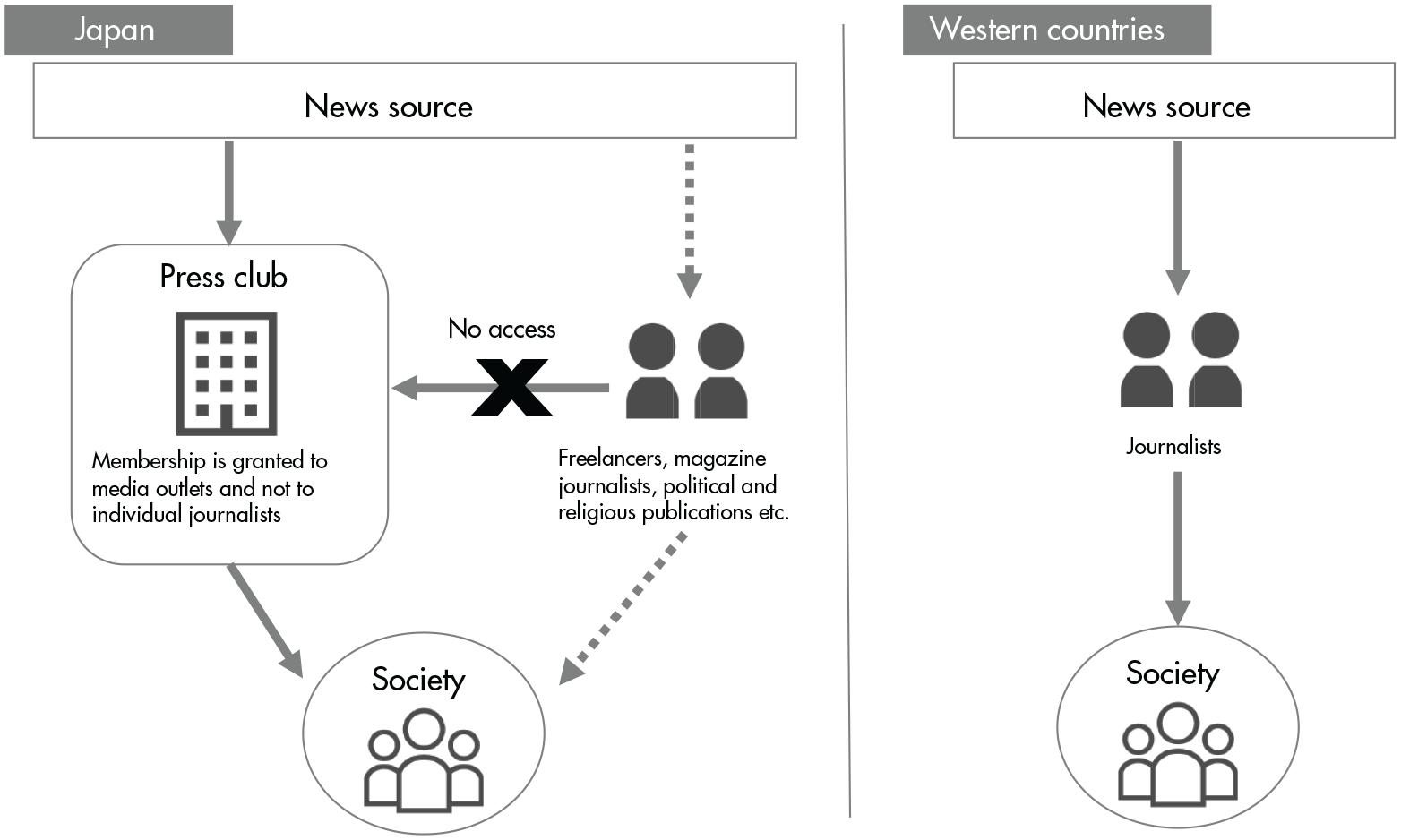
A diagram illustrating how news items flow from the news source to media in Japan and Western nations. In Japan, news items are primarily provided to press clubs where membership is limited to media outlets and not to individual journalists. Memberships are held by certain established media. Reporters working for non-mainstream media, such as freelancers, magazine journalists, political, and religious publications or tabloid newspapers, cannot join press clubs and therefore do not have firsthand access to news items. In contrast, in many Western nations news items are provided directly to journalists and disseminated widely. The solid arrows denote primary flow of information while the dotted lines denote secondary flow.
It is typical for a Japanese press club to have physical space, a press room, at the news source. In the press room, each media outlet is provided a separate cubicle with some desks, chairs, bookshelves, and a pigeon box, and services such as free access to photocopy and fax machines (Amano and Hashiba, 2008; Freeman, 2000). In the press room there are also bulletin boards where upcoming press conferences, briefings, or lectures are announced, which only club member reporters can attend. The bulletin boards are also a place where press releases are posted; these events and news items initiate news gathering activities such as setting up interviews, doing background research, and writing articles at the club-furnished desks (Segawa, 2017). The press room is the home base of reporters on assignment at press clubs. In addition, some clubs even provide permanent staff to assist in administrative work at the press room (Freeman, 2000). Press clubs are an institutional mechanism that makes it possible for the source and the media to form an information cartel.
In the context of this information cartel, the relationship of research organizations such as Japanese universities and research institutions and media outlets is unexplored yet highly interesting, particularly in the extent to which Japanese research organizations adapt to the requirements of journalistic institutions and practices of domestic media through the press club framework. While this study is limited in scope to a single nation, Japan, the results open a new angle in the literature and study of science medialization, an area of growing interest within science communication. The unique media landscape of Japan may provide potential indicators of science’s orientation to media at the organizational level.
2. Research questions
Previous studies of the public engagement activities of European research institutions found that they adapt to various journalistic requirements of their domestic media landscape (Entradas and Bauer, 2016; Neresini and Bucchi, 2010). Universities and research institutions may engage in a variety of media efforts, such as pitching to the media, providing experts available for interviews, creating blogs and social media, issuing press releases, and organizing press conferences. Given the previous findings that cartelization of information between the state and the media is made possible by press clubs (Freeman, 2000), the current study explores whether Japanese universities and research institutions are influenced by press club practices and requirements. Distributing press releases is the most popular form of information distribution to press clubs in Japan. In addition, in Japan, universities and government-funded research institutions are supervised by the state. The number of Japanese-language press releases issued by Japanese universities has been steadily increasing over the past decade (Nishizawa and Sun, 2017). These observations lead to questions about the usage and distribution of press releases by Japanese research organizations in their interaction with domestic media. More specifically,
RQ1. Is issuing of press releases the favored method of information distribution by Japanese universities and research institutions?
RQ2. Is there a preferred destination (i.e. press clubs) and delivery method of press releases by Japanese universities and research institutions and what are the underlying reasons for the preferences?
RQ3. Are previously identified indicators of science’s orientation to media, that is, institutionalization and professionalization (Peters, 2012) observed at Japanese research organizations?
3. Methods
This study was conducted in two parts. In the first part, a survey was used to capture the scope of Japanese-language press release use at Japanese universities and research institutions, and to examine whether indicators of science’s orientation to media (including and not limited to institutionalization and professionalization), were observable. An email request to participate in an online survey was sent to communications or public relations departments at 350 Japanese universities (national, public, and private) and government-funded research institutions in the first week of September 2017. Universities and research institutions were identified by two lists each compiled by the Ministry of Education, Culture, Sports, Science and Technology (MEXT, 2016) and the Ministry of Internal Affairs and Communications (2016). The requests were sent to the listed organizations whose contact addresses were publicly available, excluding smaller sized private universities with fewer than five faculties. Respondents were given 3 weeks (4–29 September 2017) to complete the survey. The survey consisted of 22 items related to the use of press releases, including organizational structure, staffing, frequency and procedures of creating and issuing press releases, delivery of press releases, and barriers to media efforts (for details see Supplemental material). Chi-square tests were used for statistical analyses to examine whether significant differences could be found in the number of survey replies we received from the Japanese research organizations.
The second part of the study consisted of in-depth interviews with six universities that participated in the online survey, to examine the underlying motivations and reasons for choosing to distribute the press releases to local press clubs and whether the distribution methods were influenced by press club expectations, and to further explore the interactions of communications staff with journalists. Organizational structure, press release production, goals and expectations of issuing press releases, destination and distribution of press releases, and interaction with local press clubs and reporters were the primary topics that were inquired during the interview (for details see Supplemental material). The universities that participated in the interview all issued press releases and represented a geographic diversity across Japan: two Tokyo-based universities, two in a large city comparable to Tokyo and another two in rural areas. The six informants were heads and/or members of the communications and public relations offices and interviews were semi-structured, in-person, lasting 1–1.5 hours. Interviews were conducted in Japanese at the respondents’ workplaces between December 2017 and February 2018. Recordings of the interview were transcribed and then analyzed using computer software (ATLAS.ti, 2013; Dowling, 2008). Institutions and informants were anonymized for analyses and reporting of results.
4. Results
A total of 182 responses were obtained, at a response rate of 52%. Two of the submitted responses did not have usable data and were omitted from the analysis. Out of the remaining 180 responses, 71 came from national universities (response rate: 82.6%), 39 from public universities (49.4%), 43 from private universities (38.4%), and 15 from research institutions (39.1%). Response rates were significantly different between institution types (χ2 = 45.3, df = 3, p < .01). Post hoc analysis on the adjusted residuals with Bonferroni correction revealed that there was an overrepresentation of national universities (p < .01), even though 112 invitations were sent to private universities and 86 to national universities. Overrepresentation of national universities can be attributed to the fact that the survey invitations were sent from the author’s organization which has strong ties to national universities.
Virtually all Japanese universities and research institutions engaged with domestic media through press releases (97.2%). On average, universities and research institutions issued 61 press releases in the 2016 academic year from April to the following March (range = 0–601, median = 38). About 10% of these press releases were also accompanied by a press conference (M = 6.8, range = 0–120, median = 2). Press releases covered not only research activities but also university management, student activity, and other topics. Among organizations that made use of press releases, a majority issued press releases for research-themed news (79.1%). The mean number of research-specific press releases was 19 per year (range = 0–231, median = 7).
A majority of research organizations distributed their research-themed press releases to press clubs (75.4%). The most popular press club was the local press club (56.7%), followed by the MEXT press club in Tokyo (26.7%). Other press clubs included Kagakukishakai, a Tokyo-based science press club for trade magazines and newspapers (18.9%) and university press clubs (11.7%). About one-third of universities and research institutions distributed their press releases directly to journalists (26.7%) and a similar proportion (27.2%) sent out their press releases to commercial wire services, local media, and local outposts of national newspapers and broadcasting companies (Figure 2). Taken together, these results suggest that Japanese research organizations use press releases as their main communication tool to interact with the media via press clubs.
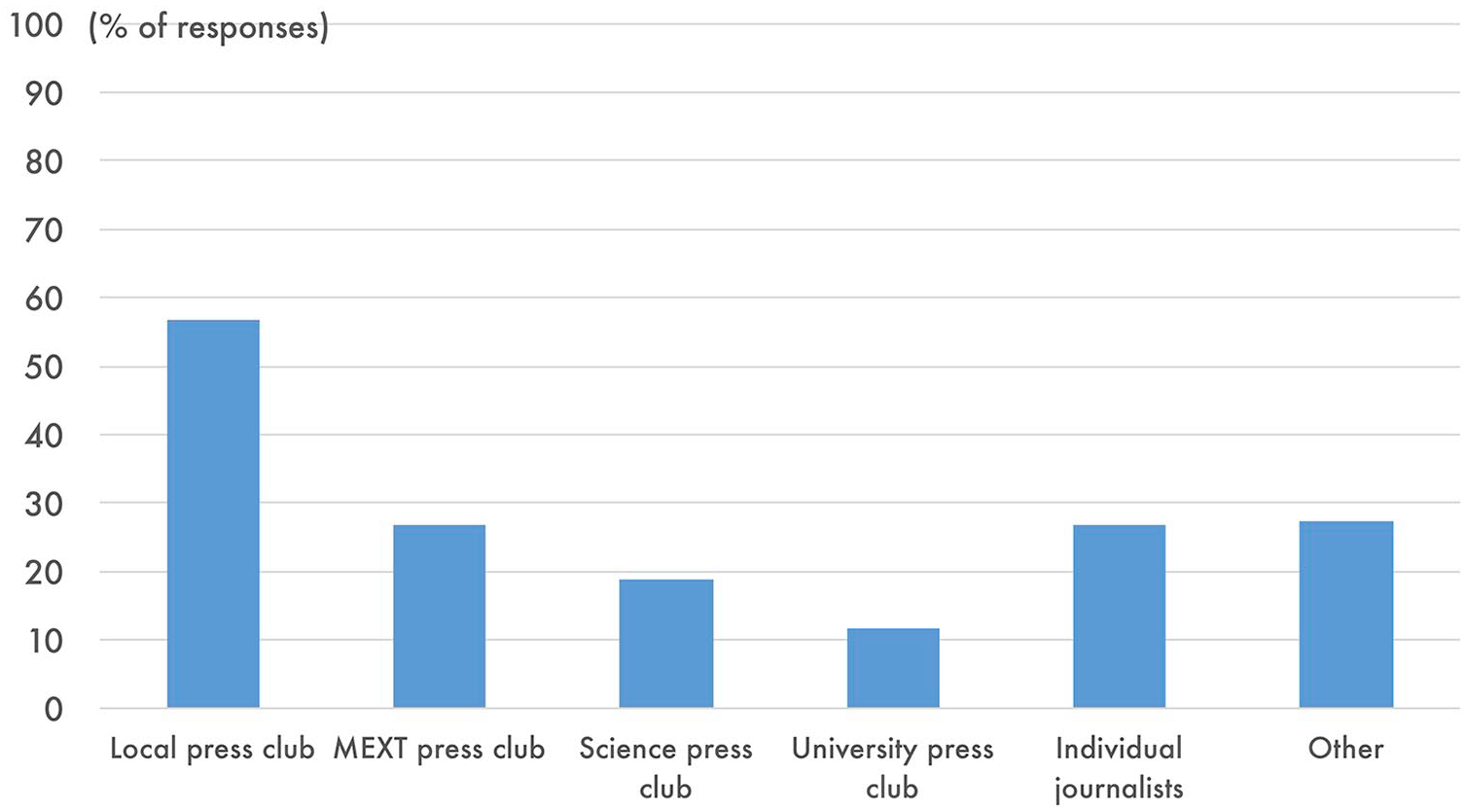
Responses to the survey question, “To whom do you normally distribute your research-themed press releases?” (Translated).
The distribution methods of press releases were also probed, since this could also be influenced by press club requirements. Fax machines were the most popular distribution tool for research-related press releases (63.3%). Delivery of printed press releases to journalists’ press club pigeon boxes was the second most popular method (46.7%). Use of email for distribution was less common (36.7%) and pinning of releases to the press club bulletin boards was even more infrequent (6.1%). Other distribution methods (22.2%) included postal mail, in-person delivery, and posting on the organization’s website.
We measured the institutionalization indicator in terms of whether research organizations had internal rules or arrangements about issuing research-themed press releases and whether templates were used when drafting a research-related press release. A majority of organizations had no internal rules or arrangements (76.7%) and more than half of the organizations did not offer templates for staff (60.0%). Professionalization was measured with regard to whether communications or public relations departments had professional staff working on press release production. Almost none (only 7.2%) of the research organizations employed professional writers or graphic designers to work on press release production. A press release was likely to be written by the researchers themselves (60.0%) compared with press officers at the head office (5%) or faculties (15%). Neither institutionalization nor professionalization was confirmed.
The results of the survey highlight that press releases are a popular form of information distribution to domestic media and they are primarily delivered to press clubs, more specifically to local press clubs, using fax machines (RQ1 and part of RQ2). In contrast, institutionalization and professionalization, both indicators of science medialization, were not observed among Japanese research organizations (RQ3).
The second part of this study, interviews with staff or heads of university communications or public relations offices, provided several insights into the underlying motivations and reasons for adopting press club conventions by research organizations. The interviews also revealed that the reliance on fax machines for press release delivery is part of adapting to press club requirements. (The following quotes are translations from spoken Japanese. Names of local cities, media outlets and press clubs are redacted when a university could be identified. The university names have been labeled as “University A” through “University E” to distinguish the interview quotes.)
Interviews suggest that fax machines are used in combination with other methods of delivery, but most distribution is still very analog and reliant on paper: We leave paper copies of the press release in the pigeon boxes of our press club members and also fax the release. (University A communications staff) . . . we print out the press release for the number of media outlets registered with the press club and deliver it to the club . . . we fax and email a notice that announces in advance that there will be a press release coming out. . . . The notice is about one page long and will be issued about two days before the distribution of the press release. (University B communications staff)
Note that the press releases are being delivered to press clubs and this is in agreement with the survey results. Moreover, the delivery method of press releases is chosen to meet the requests of each of the press clubs (i.e. local and Tokyo): We were requested by our local press club to send our press releases via fax and email. We would send a one-page paper that spells out the title of the press release via fax and the entire press release via email. But at the end of January [2018] we received a notification from the press club saying please send the releases via email only . . . A decision was made to only use fax machines when there was urgent news to communicate. (University C communications staff) . . . we send our press releases to our local club via email, but have been told by the MEXT press club and science club to deliver a printed copy to the clubs, . . . so our Tokyo office staff will print out the releases and will deliver them in person . . . almost every day. (University C communications staff) We are not sure how effective the delivery of press releases to journalists’ pigeon boxes is. . . . We inquired and according to the administrative staff [at the press club in Tokyo] there is no difference [between faxing or delivering the press release to the pigeon boxes] so we just use fax. (University D communications staff)
The high usage of fax machines for press release distribution has a strong link to where the releases are delivered, namely, press clubs. Faxed press releases are pinned up on the bulletin boards of press rooms and copies are distributed to the pigeon boxes of member media outlets by a press club administrative staff. Considering that faxed releases are black and white, one of the interviewed universities either mailed or delivered full-color releases to the clubs. Another university commented that fax was their primary distribution method, because they issued many press releases every day and considered emails risky for embargo breaks. Universities on the whole chose distribution methods that meet media needs, but also adjusted their methods according to the circumstances.
There are certain procedures that must be taken for delivering the press release to press clubs: We have been requested to make a phone call for the delivery of our press releases to the [MEXT] press club. . . . So we phone the club on the day of delivery and notify them beforehand. (University C communications staff)
If an organization issues press releases daily, then the communications staff will need to notify the press club every day via phone. These notifications prevent the press club staff from overlooking incoming faxes and serve to keep track of visitors to the club. This is another example of how Japanese research organization adapts to press club requirements.
In line with the survey results, all of the interviewed universities delivered press releases to their local press club (for the universities located in Tokyo, they delivered their press releases to Tokyo clubs, which were counted as their local club) and emphasized the importance of keeping good relations with local journalists: Because we are a university located in [. . .] city, we are always aware that we need to be mindful of our local reporters . . . as a rule of thumb, we wouldn’t send our press releases just to the Tokyo press clubs. (University C communications staff) All of the media outlets that assign reporters to the MEXT press club also post their reporters in our [local] press club. Distributing the press releases to our local press club will cover all of the MEXT press club member media outlets. We have our own relationships with the local reporters and if we start distributing the press releases to the Tokyo clubs, media outlets would have no good reason to assign their reporters to our local press clubs. We’d like to keep a good relationship with our local reporters and give precedence to them. (University B communications staff)
Being mindful of the local reporters and not sending press releases solely to the Tokyo press clubs appears to reflect some self-censorship on the part of the public relations or communications offices. When asked if they had received complaints from the local reporters for sending their press releases to Tokyo press clubs, some interviewees flatly denied this, “No, I haven’t” (University E head of communications): I’ve been working in this department for three whole years, but I don’t recall receiving such complaints. When we send our press releases to Tokyo clubs, we make a note to the local press club that we are sending the same release to the Tokyo club. This hasn’t raised any issues amongst the local reporters. (University C communications staff)
While others remarked that, “if the local reporter has a science beat there is the sense that the local reporter would like to be informed first and foremost” (University B communications staff).
The idea behind distributing press releases to local press clubs is that most major media outlets have a reporter on assignment at a local press club. These journalists will report to the main office in Tokyo where news is gathered for creating national broadcast or print editions. However, in some regions the scheme appears to be faulty: I had an occasion to speak with people like, for example, the editorial writer of Yomiuri [newspaper] based in Tokyo. According to the writer, the ideal flow of information is for the local reporter to discover the news value of the research and relay that to Tokyo . . . but I don’t think that scheme is working. (University E head of communications)
Part of the reason for local research news not reaching Tokyo is that reporters stationed at the local press club are responsible for covering a variety of local news in addition to research-related stories. Moreover, local reporters are rarely science beat reporters: Reporters of our local press club cover all sorts of local news; not just research news in this region. For example, when there was flooding, the reporters were all gone to cover that story and they couldn’t cover any research news. That sort of situation lasted for about six months. (University B communications staff) Reporters of Asahi, Mainichi and Yomiuri [newspapers] are science journalists and NHK [TV], Chunichi, Sankei [newspapers] and Jiji [news agency] are police reporters and . . . also Kyodo [news agency]. Some of the journalists report about business and local politics at the city council too. I think it’s only Asahi and [. . .] [local newspaper] that have a dedicated reporter to cover news from our university. (University A communications staff) . . . a bureau chief of Kyodo [news agency] on assignment at [. . .] [local press club] visited us and we had a conversation. The bureau chief mentioned that there’s no point sending the releases to our local club, because none of the reporters assigned to the local club have the capacity to report on research. (University F communications staff)
In light of these observations, when a science reporter is assigned to a local press club, universities become keen to harness strong ties with the reporter because a science reporter, as opposed to a general assignment reporter, will more likely be able to understand the significance of a research story, and communications and public relations staff expect that the chances of their university’s research being covered will thus increase: For our purposes we appreciate a science reporter being assigned to our local press club. While such a journalist is on assignment at our local press club, we feed as much information as we can, because it’s a win-win situation for both parties. (University B communications staff)
These interviews portray a situation in which Japanese universities have adapted to the requirements of press clubs, regarding the delivery and distribution methods of press releases. Moreover, glimpses are observable of what Freeman (2000) alludes to as a reciprocal relationship that meets the dual interests of the source and reporter.
5. Discussion
In this study, we explored, via survey and in-depth interviews, whether Japanese research organizations adapt to the requirements of domestic media practice and institutions in their media relations efforts. We focused on the use of press releases by Japanese research organizations to explore whether their media efforts are influenced by press club expectations. While media in Japan assume a central communication function in society much as they do in Western societies, information cartelization is much more widespread and accepted. This unique and less well-known science–media relationship can provide a new perspective on science medialization, a field that has mostly been based on findings from Western societies.
The primary finding was that Japanese research organizations adapt to domestic media requirements by issuing press releases to local press clubs to communicate their research news. In addition, the popular use of fax machines to deliver press releases complied with the expectations of the press clubs, reinforcing the observation of science’s compliant orientation to media in Japan.
These findings suggest that there are certain benefits for research organizations to adopt press club requirements. The majority of Japanese universities and research institutions send their press releases to press clubs, more specially to their local press club rather than to the MEXT press club or the science press club, both in Tokyo. This is because major newspapers, broadcasters, and news agencies station reporters in these local outposts, with the expectation that they will relay news to the head offices in Tokyo. In this respect, forming a good relationship with the local press club reporter or the club becomes important for the communications and public relations offices, who refrain from bypassing the hierarchy to reach Tokyo-based reporters or Tokyo press clubs. Local press club reporters are also frequently generalists, so when a science beat reporter is assigned to a local press club, it is in the interest of the communications or public relations office to foster a mutually beneficial relationship with the reporter. This is particularly true because the quantity of newspaper coverage by domestic media is still used to measure the success of Japanese research organizations by the government (Japanese science reporter, personal communication, 9 November 2017).
Japanese universities and research institutions employ fax machines widely to distribute press releases. This is not surprising given that media outlets, universities, households, and large companies in Japan still retain fax machines and they are regularly used in business contexts (Fackler, 2013). However, it must be noted that the use of fax machines was in combination with other methods such as email and in-person delivery to pigeon boxes. Some universities have recently shifted their primary form of communication from fax machines to email. What is important here is that these delivery methods as well as the shift from one method to another often comply with the practices of press clubs. This is another example of how the organization responds in a way that is in the interest of both the communications or public relations offices and the media outlet; it is in the interest of the communications and public relations offices to gain coverage by mainstream media for their research outputs, shifting their distribution method to what is most convenient for the receiving end, that is, the press club reporters of established domestic media. In this regard, press clubs have a remarkable influence on the way a university communications and public relations office communicates its news and research outputs to the media. It is of note that the communication tools (fax machines, in-person delivery, notification calls) employed by the communications or public relations offices are old-fashioned and could be upgraded to digital tools for efficiency. How these forms of communication are perceived by the individual press-club-registered journalists are one of the questions we are addressing in a follow-up study.
The Japanese media’s “information cartel” (Freeman, 2000) is also evidenced in the current study, which revealed a reciprocal relationship between the public relations and communications offices of research organizations and the press-club-registered media. The findings suggest that press clubs, one manifestation of an information cartel, is a potential indicator of science’s orientation to the media at the organization level. It is also worth noting that the “medialization of science” theory (Weingart, 1998, 2012) was originally conceived with the media’s news selection criteria in mind and not with respect to the interaction methods between science and the media, such as press clubs and press releases. However, we believe that the form of interaction will have a direct or if not indirect influence on the content of the science news being communicated by media outlets. We suggest that the Japanese press club system and club-related practices are a form of science’s orientation to media expectations and these findings add a new perspective to the debates of science medialization and demonstrate the value of examining a non-Western context in the field of science communication.
The news reporting mechanism in Japan assumes that non-press club member media outlets will obtain news items based on the reporting of press club media outlets for their stories (Kawai, 1987). However, to what extent this model holds true for science-related stories originating from Japanese research organizations is questionable. The survey results show that there are communication offices that directly send their releases to media outlets or journalists and not to press clubs. Moreover, a weakening of the information cartel in Japanese research institutions’ press conferences has been observed recently. For example, the Japan Aerospace Exploration Agency livestreamed their press conference on the Hayabusa2 spacecraft in February 2019 (https://youtu.be/1GNcqpzX3Yk), as did the High Energy Accelerator Research Organization in March 2019 when they updated the press on the International Linear Collider project (https://youtu.be/SbpS8TjdDkI). Questions were restricted to attendees onsite, but the use of public livestreaming may be a sign that at least press conferences are opening up and the information cartel is being bypassed. While the current study focused on the dynamics of Japanese research organizations and press club member media outlets, future investigation focusing on the science reporting of Japanese reporters, especially of non-press club reporters, is warranted for a comprehensive picture of how science news is delivered to the public via various media outlets in Japan.
Second, institutionalization and professionalization, indicators of science’s orientation to media, were not observed in this study. While Peters (2012) gives examples of institutionalization as the presence of public relations or communications offices within the research organization and/or providing training programs for scientists, we measured the indicator in terms of whether there were internal rules or arrangements about issuing press releases and whether press release templates were offered to staff. Institutionalization refers to implementations within organizations that catalyze the contact between scientists and media. Since we focused on research organizations’ use of press releases, we considered internal guidelines and documents that help to create a press release within an organization as a form of institutionalization. Professionalization was measured in terms of whether research organizations had experienced staff. The lack of institutionalization and professionalization is understandable in a context in which press offices and communications departments are only considered as messengers for media outlets. Without any professional training or background in science or journalism, “staff find it uncomfortable to edit press releases drafted by researchers,” as one interviewee mentioned in the in-depth interview. Japanese research organizations seem to have adopted the most superficial media requirements (i.e. preference for press release distribution via fax machines) related to the operation of press clubs. The survey results showed that press releases are mostly written by researchers themselves. Since researchers are not trained to write journalistically, Japanese press releases do not in fact conform to journalistic standards of format and content. A handful of Japanese research organizations have started to hire “science communicators” who have experience in journalism, public relations, or research to improve the press releases and media relations. It will be worth another study to see how the situation develops in Japanese research organizations.
The findings of this study are not without limitations. Although this study improves our understanding of science’s orientation to the media at the organization level, the cartelization indicator may not be applicable to the interactions of organizations and press clubs in other parts of the world, because we examined specific samples and systems. The press club structure, while present in other countries, does have notable differences in Japan. For example, press club membership in Western countries is granted to individual reporters, while in Japan membership is granted to media outlets. In addition, press clubs in western societies seem to have an emphasis on socializing and community building rather than gathering news items. While there could be other media institutions and practices that facilitate the cartelization of information much comparable to Japanese press clubs, extrapolation of the current findings to science–media interactions that involve press clubs requires caution.
We did not directly measure “strategic use of media communications,” one of the indicators of science medialization at the organization level (Peters, 2012), in the survey. However, the in-depth interviews did touch on the objectives and goals of press release distribution and responses to this question may provide some insight about the indicator. “Raising visibility [of the university]” was the most common response, especially among smaller or rural universities. Interviewees expected that increased visibility would “facilitate industry-academia collaborations,” “increase [external] funding,” and “attract good students and faculty.” Whether such goals have been achieved and to what extent are interesting questions that could be addressed in future studies.
This study explored science medialization from the viewpoint of the communications and public relations offices. As an ex-science journalist, Segawa (2017) notes that there is a tendency of Japanese mainstream media such as newspapers, TV broadcasters, and news agencies to rely on the announcements made by authorities such as the government and the scientific community for their reporting. This tendency is reinforced by the pressure to avoid being scooped, resulting in close relationships between the source and the reporter and homogeneous coverage of news. For a full picture of the interactions between communications officers and journalists, examining the journalist’s perception would be of benefit to understand domestic media’s appetite for science as well as the reciprocal relationship between research organizations and domestic media. This will no doubt be a fruitful topic for future research in Japan.
6. Conclusion
In conclusion, this study sheds new light on the indicators of science’s orientation to the media at the organization level. We found Japanese universities and research institutions adopted domestic press club requirements such as issuing press releases and using fax machines for delivery. Adopting these requirements meet the dual interests of the communications or public relations staff and the journalist in a media environment where information is cartelized. In contrast, institutionalization and professionalization, two indicators of science’s orientation to the media at the organization level, were not observed. Press clubs, one manifestation of an information cartel, are a potential new indicator of science’s orientation to the media, which is reported here for the first time in a non-Western context.
Supplemental Material
sj-pd-1-pus-10.1177_0963662520972269 – Supplemental material for The press club as indicator of science medialization: How Japanese research organizations adapt to domestic media conventions
Supplemental material, sj-pd-1-pus-10.1177_0963662520972269 for The press club as indicator of science medialization: How Japanese research organizations adapt to domestic media conventions by Ayumi Koso in Public Understanding of Science
Footnotes
Acknowledgements
The author thanks Dr Amanda Alvarez of RIKEN, Japan, for her insightful comments and editing to improve the manuscript, and two anonymous reviewers for their suggestions.
Funding
The author(s) disclosed receipt of the following financial support for the research, authorship, and/or publication of this article: This work was supported by JSPS KAKENHI Grant Number JP16K16305.

Supplemental material
Supplemental material for this article is available online.
Author biography
References
Supplementary Material
Please find the following supplemental material available below.
For Open Access articles published under a Creative Commons License, all supplemental material carries the same license as the article it is associated with.
For non-Open Access articles published, all supplemental material carries a non-exclusive license, and permission requests for re-use of supplemental material or any part of supplemental material shall be sent directly to the copyright owner as specified in the copyright notice associated with the article.
