




Abstract
Degrowth research critiques the ideology of growth but does not explain how degrowth values gain public traction and turn into a new ideology. This article shows that degrowth values emerge from the contestation of institutions that maintain the growth imperative and the proposition of new institutions embodying alternative values. First, the article problematises the (counter)hegemonic challenge posed by degrowth, explaining why degrowth research needs to question the institutions that influence social practices. Second, it conceptualises degrowth as a double movement of contestation and proposition that works within and against the ideological apparatus sustaining the growth imperative. The historical struggle to save the Lutkemeerpolder in Amsterdam – the last remaining agricultural land in the city – shows how a degrowth ideology developed through the contestation of the institutional apparatus sustaining the growth of the airport-related industry. This struggle unfolded into a wider movement that has proposed new institutions embodying degrowth values such as commoning and conviviality.
Introduction
‘There is a simple theoretical distinction between alternative and oppositional, that is to say between someone who simply finds a different way to live and wishes to be left alone with it, and someone who finds a different way to live and wants to change the society in its light’ (Williams, 1980: 138).
Researchers typically define degrowth as a transition to a postcapitalist society that reduces the economy's consumption of resources and energy in a fair manner, affecting both social systems and personal beliefs (see e.g. Schmelzer et al., 2022; Schmid, 2019). Degrowth envisions a society that puts at its centre a set of ‘values’ that is radically different from that of a growth-led economy: sufficiency instead of accumulation, feminism instead of patriarchy, care (of the self and others) instead of exploitation, conviviality instead of competition, (direct) democracy instead of hierarchy, autonomy instead of heteronomy, commoning instead of privatisation, post-humanism instead of anthropocentrism, decolonisation instead of imperialism and money-free versus money fetishism (see Buch-Hansen and Nesterova, 2023; Nelson, 2022; Paulson and Büchs, 2022; Savini, 2023; Sekulova et al., 2013).
This definition of degrowth as a society with a radically different set of values has made it increasingly popular among grassroots movements as well as urban and European policymakers seeking a radical new narrative of societal change (Demaria et al., 2013; Parrique et al., 2023). Yet, degrowth research is still questioning how these ‘degrowth values’ might gain political power and transform existing institutions (see e.g. Barlow et al., 2022). This research stream is particularly concerned with the process through which degrowth alternatives oppose capitalism as a social system, and its institutions, and how they gain public traction (Schoppek, 2020; Smith et al., 2021).
To address these challenges, the article conceptualises degrowth as an ideology. In doing so, it shifts the focus from a critique of the ideology of growth and its institutions (Schmelzer, 2016) towards an analysis of degrowth as an ideology with its institutions. This perspective is useful, I argue, because it sheds light on how degrowth might gain popular legitimacy (a few exceptions are Finley, 2019; Meissner, 2021, 2019; Paulson, 2017, more below). By understanding degrowth as an ideology, it is possible to grasp how political subjects mobilise discursively degrowth values in their everyday struggles, and how these struggles may align with degrowth objectives. It is also possible to understand how these values coalesce into alternative social institutions (Kaika et al., 2023; Savini, 2021).
The paper adopts a multilayered perspective on ideology. Ideology encompasses a set of ideals, a framework of institutions and a series of beliefs enacted in everyday life. The main argument is that degrowth values emerge from the everyday struggle of grassroots organisations against the institutional edifice that sustains the imperative of growth and in particular the regulations that govern land use. This struggle unfolds as a double process of contesting existing institutions and proposing new ones. Contestation addresses institutions that lock development into a pro-growth pathway and underpin growth's hegemony. Degrowth values emerge when this contestation turns into the proposition of and push to establish alternative institutions.
To explain this process, I look at conflicts around land use. This focus makes it is possible to grasp both the dominance of growth institutions in planning and how degrowth values perform in everyday political struggles. Specifically, I look at the Lutkemeerpolder, a highly contested redevelopment project in Amsterdam's urban periphery. I show that, for 30 years, this area has been the site of an ideological struggle between a pro-growth coalition of airport-related corporate interests, and an alliance of grassroots organisations advocating agroecology, land commons and food justice. The analysis shows that the polder's grassroots movement progressively aligns with degrowth values to gain popular traction and political incisiveness.
In the first section, I explain that an ideological perspective on degrowth must problematise the embedded relations among ideals, institutions and everyday beliefs. I will explain why degrowth has a (counter)hegemonic potential. Building on Althusser's work, I further explain the importance of institutions as both targets and goals of a degrowth ideological struggle. Through the lens of this framework, I will analyse the struggle between growth coalitions and grassroots movements in the Lutkemeerpolder. In conclusion, I plea for degrowth research that questions ideologies and institutions around urban and land struggles.
Tackling (de)growth's ideology: ideals, institutions and everyday beliefs
Degrowth can be understood as an ideology in the making, a social imaginary (Gerber, 2023; Kallis and March, 2015). By this, I mean a system of values emerging within the contradictions of a dominant ideology, which, in this case, poses economic growth as a natural societal goal (Xue, 2022). For Hall, ideology is ‘the mental frameworks – the languages, the concepts, categories, imagery of thought and the systems of representation – which different classes and social groups deploy to make sense of, define, figure out and render intelligible the way society works’ (Hall, 1986: 26). Ideology is therefore ‘performative and action-oriented’ because it constitutes the contested field within which decisions accrue public legitimacy (Davoudi et al., 2020: 32). The ideology of endless growth assumes that competition, hierarchical leadership and the pursuit of (monetary) self-interest are ultimately unavoidable human behaviours.
As a value system, ideology is always contested in practice, and it is never fully static or consistent. For Eagleton (1994: 187), it is ‘a realm of contestation and negotiation, in which there is a constant busy traffic: meanings and values are stolen, transformed, appropriated across the frontiers of different classes and groups, surrendered, repossessed, reinflected’. This process of contestation relates not only to discourses (how stories are told), but also to institutional artifacts that reproduce values and constrain people's actions (Lukács, 1972).
As Žižek (1994) explains, ideology manifests in three ways: as a set of ideals (or dogmas), as material institutions and as a set of beliefs that are practiced in the everyday. This means that ideology can be seen at work in how people justify their actions as well as in the regulatory apparatuses that govern people's behaviour, despite them not having deliberately chosen those apparatuses. As Žižek puts it, ‘the mechanisms of economic coercion and legal regulation always “materialise” some propositions of beliefs that are inherently ideological’ (Žižek, 1994: 15). Those beliefs, in turn, are embodied in everyday social practice, through the daily considerations of individuals motivated by certain common sense: ‘the incoherent set of generally held assumptions and beliefs common to any given society’ (Gramsci, 1971a/1999: 626). For example, institutions such as the World Bank, WTO, NATO, or economic ministries reflect the legitimacy of values such as competition, nationalism, private property and entrepreneurialism. These values exist through those institutions but are reproduced by individuals’ belief that, for example, people should always pay to use something, or that monetary exchanges are always more fair or reliable.
This understanding reveals that ideology is not static or historically fixed; rather, it is fraught with inconsistencies among emerging ideals, existing institutions that shape social interactions and the context-dependent considerations of individuals in their daily lives. These inconsistencies create opportunities for ideological change. Thus, like the growth ideology, a potential degrowth ideology will never be entirely consistent or unified; it will be continually contested and redefined through social practice.
Understanding ideology simultaneously as a system of ideals, institutions and everyday beliefs allows one to explain the hegemonic status of economic growth in contemporary societies as well as establish if and why certain social practices disrupt that hegemony (Koch, 2020; Buci-Glucksmann, 1980). According to this definition of ideology, the hegemony of growth manifests as a social condition in which the ideals of endless growth are embodied into institutions that promote accumulation and that are fully recognised as natural, or given, by individuals in their everyday behaviour. Hegemony can be understood as the organic arrangement of all ideological elements into a unified system, where people's common sense sees that system as given (Bates, 1975). A counter-hegemonic power is, in turn, one that, within that ideology, contests, disrupts and appropriates discourses in the every day, dismantles institutions and builds new ones.
As I argue below, the role of institutions, especially those governing land use, is central in this process, because institutions are, on the one hand, constitutive of hegemony and, on the other, tools for counter-hegemonic practices. Degrowth studies that dealt with hegemony have already explained the first of these points. These works elaborate on Gramsci's critique of (counter) hegemony 1 (Albert, 2024; Buch-Hansen, 2018; D’Alisa and Kallis, 2020; Koch, 2020, 2022) and stress the difficulty a degrowth agenda would have in gaining public legitimacy against existing ideologies (Schoppek, 2020). Instead, as D’Alisa and Romano write, ‘a shift toward degrowth is unlikely if we do not radically rethink the formal–institutional dimension of the project’ (D’Alisa and Romano, 2023: 137), which requires that degrowth movements ‘merge the fight for new values with the fight for a new form’ (D’Alisa and Romano, 2023: 140). Institutions must be analysed as both the source and outcome of degrowth practices (Savini, 2022).
Understanding degrowth as an (emerging) ideology with multiple dimensions can be useful for developing a theory of change for degrowth, one that explains how social, political and environmental movements develop and maintain their opposition against pro-growth politics (Buch-Hansen et al., 2024). First, it highlights that degrowth's challenge is not only to contest the ‘natural’ values embedded in common sense but also to translate degrowth ideals into new institutions that can endure and influence social behaviour (Bridge, 2000). Second, it emphasises that the pathway to establishing new institutions unfolds through the struggles of various coalitions seeking public acceptance of their strategies (Davies, 2014). This struggle is not exclusively discursive but includes institutional, legal and physical modes of exercising power in everyday life (Kipfer, 2002). In other words, counter-hegemonic movements leverage institutions, including legal frameworks, to empower their messages. Adopting a degrowth narrative, in turn, may facilitate the process of connecting existing struggles at different levels of scale and sectors. Third, viewing degrowth values through the lens of ideology allows for a critical assessment of how degrowth may appropriate existing ideals and institutions, potentially reproducing the status quo. This risk is particularly high when degrowth is understood as a local endeavour not concerned with macro institutions (see Chertkovskaya et al., 2019). The latter goes especially for struggles over land; degrowth practices are, after all, embedded in preexisting urban environments and socio-metabolic relations, which represent power structures themselves (Loftus and Lumsden, 2008).
In the following section, I will argue that understanding the role of institutions – especially the legal ones governing land use – is crucial for comprehending how counter-hegemonic movements emerge, operate, gain public support and potentially coalesce into new institutions. To illustrate this, I will discuss Althusser's work on ideological state apparatuses.
Degrowth and ideological state apparatuses: contesting and proposing institutions
Building on Gramsci, Althusser conceives ideology as ‘the imaginary relationship of individuals to their real conditions of existence’ (Althusser, 2014: 181). Ideology persists historically, he explains, through its material existence, the institutional structures that bind social action. He argues that ‘practices are governed by the rituals in which these practices are inscribed, within the material existence of the ideological state apparatus, be it only a small part of that apparatus’ (2014: 260). Everyday social practices reproduce values, but values operate both internally (in agents’ minds) and externally (as institutions). The latter Althusser understands as apparatuses of regulatory tools, administrative bodies, governments, laws and procedures, as well as the organisations (including civic society) that reproduce market competition, protect private property, facilitate rentier capital, commodify land, regulate precarious work and inculcate anthropocentric values, to give just some examples.
Although Althusser distinguishes different pillars of this ideological apparatus (e.g. health, religion, the family, etc.), he is especially interested in the legal pillar because it is both repressive and ideological: ‘on the one hand, it [the law] rests on part of the state repressive apparatus for support. On the other hand, it rests on legal ideology and a little supplement of moral ideology for support (Althusser, 2006, 2014: 68). The law is enacted by the police (as well as walls, barriers, ditches, etc.) and is therefore coercive. It is also ideological because it requires legitimacy among the people and is rooted in imaginaries that perpetuate racial, gender and class inequalities. Simultaneously coercive and ideological, the law is essential in limiting dissent and suppressing alternative social practices.
By focusing on ideological legal apparatuses, one can explain why practices claiming to interrupt the compulsion to grow are repressed often with the larger public's consent. Moreover, it shows how degrowth functions as a tool of ideological struggle amid the everyday reinterpretation of social norms and laws (Shepherd et al., 2020). Furthermore, looking at the struggle against and for legal institutions makes it possible to grasp how the growth ideology has shaped and fixed the destructive relation between economy and environment historically: regulatory apparatuses shape material flows, they prescribe how land and infrastructures are to be created and managed, and thus they make ideology itself resistant to change (Loftus, 2020). Focusing on legal contestations also explains why degrowth values can be mobilised publicly to justify counter-movements (Treu et al., 2020).
Althusser's concept of interpellation explains how ideology turns into a force that shapes subjects’ views of themselves, their considerations and their common sense (Krips, 2018): ideology exists in both conscious and unconscious acts and manifests when its constraining or repressive power becomes visible to subjects. As Althusser remarks, ‘when nothing is happening, the Ideological State Apparatuses have worked to perfection’ (Althusser, 2014: 206). We can understand interpellation as a generative act of ideological contestation because it is at that moment that certain social groups become aware that their interests are enabled or frustrated, suppressed or incentivised. For example, grassroots organisations occupying vacant land to provide food or shelter become political subjects when they are confronted with eviction, prohibition, obligations, etc. The legal enforcement of private property turns them into illegitimate occupants. If their members do not leave, the law will trigger repression through a fine or eviction.
The notion of interpellation is useful for degrowth because it highlights the everyday violence that institutions promoting growth ideas inflict on social practices motivated by degrowth values (Fuchs, 2019; Schröder and Leibenath, 2024). However, interpellation also reveals the possible (and often unpredictable) reactions that these social practices have against those institutions. As Butler (1997: 95) argues, interpellation affords misrecognition. The latter can be understood as the mismatch between the way institutional apparatuses treat subjects and the way those same subjects perceive their position. This mismatch engenders conflicts because it makes subjects mobilise new values, as opposition to existing ideology, and triggers the creation of new social practices. Through apparatuses, therefore, ideology establishes the parameters of legitimacy in social practice, but not the ‘absolute predictability of outcomes’ (Hall, 1986: 45). By examining the dialectic between institutional apparatuses and social practices it is possible to trace ideological change. Gramsci's (1971b: 265–366) remark that ‘everyone is a legislator’ encapsulates this process: even within the hegemony of growth, individual agents can express alternative values, which may become the foundation of new institutions, literally ‘from the grassroots up’ (Alexander, 2013).
These insights are valuable for degrowth research that particularly focuses on strategies for counter-hegemonic struggle. This literature explores the tension between institutional systems and degrowth social practices to envision possible trajectories and approaches to a wider degrowth transition (Bärnthaler, 2024; Savini, 2024). It identifies degrowth as a polycentric movement with diverse practices, some actively challenging institutions through disobedience, some experimenting with grassroots practices, and others seeking symbiotic relationships with institutions (Barlow et al., 2022, based on Wright, 2010). As Certovskaya (2022) explains, the key strategic feature of degrowth practices is their dual role in halting growth while also building alternatives. Understood as an ideology, degrowth may offer a framework able to create synergies between those different strategies.
My study adds depth to these arguments by exploring how degrowth practices emerge and evolve. Degrowth values are practiced by grassroots struggles over land use, mobilised by community organisations in response to coercive actions by growth-driven institutions, such as evictions and police repression. This repression sparks a reaction, leading to the development of alternatives to growth-oriented development. To garner public support, the movement begins to cultivate a new ideology – promoting innovative ideals for land use, supported by new institutions and resonating with the common goal of protecting our limited fertile soil.
Methodological note
The research project on which I draw here has mapped struggles over the redevelopment of the Lutkemeerpolder in Amsterdam South-West, focusing on the values mobilised in the process and contrasting alliances that acted on them. The key research question was ‘why and how are degrowth-related values mobilised by grassroots organisations?’.
The analyses employed legal geography, social practice analysis, ethnography and participatory observation (Kymäläinen, 2024). The research team – the author and two research assistants – conducted a historical overview, undertaking an extensive archival study of all materials published about the area by grassroots organisations and in newspapers and policy briefs. We also built a database of contracts, covenants, formal decisions, minutes of meetings and municipal and provincial councils’ debates. We looked at political parties’ communications, developers’ plans, strategic documents, designs and land-use plans, as well as grassroots organisations’ letters and campaigns. We analysed the history and current financial situation of SADC, the airport-related land development corporation.
Between August 2023 and February 2024, the research team attended (and when allowed recorded) meetings of the grassroots organisations involved in the area. Documents and transcripts were coded to reveal how actors justified their position towards (a) the specific regulations at stake in the area (i.e. policy briefs, legal documents) and (b) other actors’ views of those same regulations. This information was categorised into values (ecological, historical, social, political, etc.) and counter-validated through 10 expert interviews with activists, developers, municipal and provincial officials, legal experts and professionals, from both the grassroots and the public/private organisations involved. The interviews lasted about one hour and the questions were geared to understand how different value systems were mobilised in advocating for particular developments of the site.
The Lutkemeerpolder as a site of ideological struggle
The Lutkemeerpolder (which translates literally as small lake polder) refers to 200 hectares of land in the southwest of Amsterdam Municipality. Peripheral relative to central Amsterdam, the site adjoins one of the city's poorest neighbourhoods, Nieuw West. The area covers a business park for SMEs (Business Park Amsterdam Oosdorp, phase 1) of 26 hectares, a graveyard of 30 hectares and 42 hectares of agricultural land. The latter is set to become Business Park Amsterdam-Oosdorp, phase 2. The polder also hosts 53 hectares of green space, protected as part of the ‘green wedges’ urban green belt project developed in the 1920s. This typical polder landscape comprises patches of land separated by think irrigation canals. Of the four agricultural companies that operated in the area until the 1990s, only one remains Boterbloem Farm. The polder is the city's lowest point below sea level. With high biodiversity and fertile clay soil, birds breed there.
Viewed from the south, however, the area is at the core of a growing industrial network involving the Port of Amsterdam, Schiphol Airport, its many business parks and Zuidas national financial district. Today, high-capacity infrastructures connecting Amsterdam to the south occupy 20% of the polder. Since the late 1980s, there have been plans to turn the polder into a logistical hub and obstacle to Amsterdam's outward expansion, meant to further densify the city.
Imaginations of the polder's future are currently highly contested by two blocs of actors, each with its distinct understanding of sustainable land use, social justice and economic success. The area's contested planning unfolds as an ideological struggle in that the two alliances not only propose divergent institutional approaches to land governance but mobilise discrepant values in attempting to establish legitimacy.
The Schiphol Airport Development Company (SADC) has been responsible for developing the polder since the 1990s. It is a public company co-owned by the Municipality of Amsterdam (25%), Municipality of Haarlemmermeer (25%), Province of North Holland (25%) and Schiphol Group (25%). The latter is also a public–private company. Co-owned by the Ministry of Finance, Municipality of Amsterdam (22%) and Municipality of Rotterdam (2.2%), it runs all Dutch airports. The SADC develops business parks for and around Schiphol. It currently holds 350 hectares of land in the Amsterdam region. The land that SADC develops is (mostly) transferred to SADC by its public shareholders. An assembly of shareholders, chaired by the Province of North Holland, directs the company's operations.
The SADC was originally formed to promote, develop and internationally advertise Schiphol Airport's industrial potential (the Schipholgebondigheid principle, see below). Its mission has expanded, however, the SADC becoming a de facto public business park developer. In developing the BPOA2 on the remaining green land of the polder, the SADC operated through another public–private partnership, a Gemeenschappelijke Exploitatie Maatschappij (GEM), which it co-owns with the Municipality of Amsterdam (50%).
The plan for BPOA2 envisions a business park named Amsterdam City Docks, distributed over 55,000 sqm. It will be run by a private equity consortium (Proptimize) that presents the plan as CO2 neutral and fully electric: area development 2.0, ‘sustainable, green, regenerative’. 2 The development will be circular and increase biodiversity, the plan states, reusing building materials and soil, 3 shifting focus from ‘volume to value’. 4 The project is framed as the ‘working landscape of the future’, 5 necessary to maintain the region's economic vitality and create jobs (Province of North-Holland, 2022) in circular, electrified sectors. 6 SADC experts celebrate this approach as proving that ‘there are no limits to growth – if [it is] being done circular’. 7
Today, this program and the institutions and actors developing it have been targeted by a grassroots alliance united around the Voedselpark Amsterdam (Food Park Amsterdam). This alliance proposes an alternative vision of the polder, centred around agricultural commons and democracy. It was funded by citizen-led organisations, the Stichting Grond van Bestaan, Toekomst Boeren, Voedsel Anders, Food Council MRA, Slow Food NL and Behoud Lutkemeer.
This alliance proposes that the polder's redevelopment should be interrupted, and 45 hectares of agricultural land should instead be developed to provide recreational, cultural, social and educational activities by and for community-supported agriculture (CSAs). Their plan promotes values that reflect a degrowth vision (Feola et al., 2020) such as regenerative and community-based agriculture, health, sufficiency-based food production, biodiversity, conviviality, art and creativity (Voedselpark Amsterdam, 2023). Voedselpark celebrates the polder's social, ecological, circular and economically rational value, quantified as €1.5 to €8.6 million in annual revenue, plus the immaterial returns of social inclusivity, excellent and accessible green spaces, and a climate ‘buffer zone’ against urban heat island effects. 8 Voedselpark also proposes strengthening Amsterdam's international prestige as a progressive city, much like the Baix Llobregat project in Barcelona. Against the shareholder model, the Voedselpark advocates community land trusts (see below).
This overview demonstrates that the polder is a site of ideological struggle between two blocks of actors. As I will demonstrate, this struggle is inherently ideological and unfolds across all three dimensions of ideology: actors mobilise particular ideals of place, which manifest in specific institutional frameworks (such as shareholder capital versus community land trusts), and reflect shared beliefs about land management and use (business potential versus fertile soil). However, the historical analysis reveals that these ideologies are far from coherent and unitary. Both groups of actors appropriate similar values (e.g. sustainability), grassroots organisations invoke legal frameworks to bolster their messages, and compromises are forged in the process.
The making of degrowth values in the Lutkemeerpolder
The following analysis of the Lutkemeerpolder's history sheds light on the conditions under which degrowth values emerge. What I understand as the degrowth alternative, the making of a new plan and community enacting degrowth values, comes into being after 20 years of struggle against the ideological apparatus of regulations shaped around the national and local airport industry. Degrowth values represent, in this analysis, the movement's necessity to propose alternative institutions against those apparatuses. Table 1 gives a reading guide of the whole history of the struggle.
Overview of the Lutkemeerpolder's struggle.
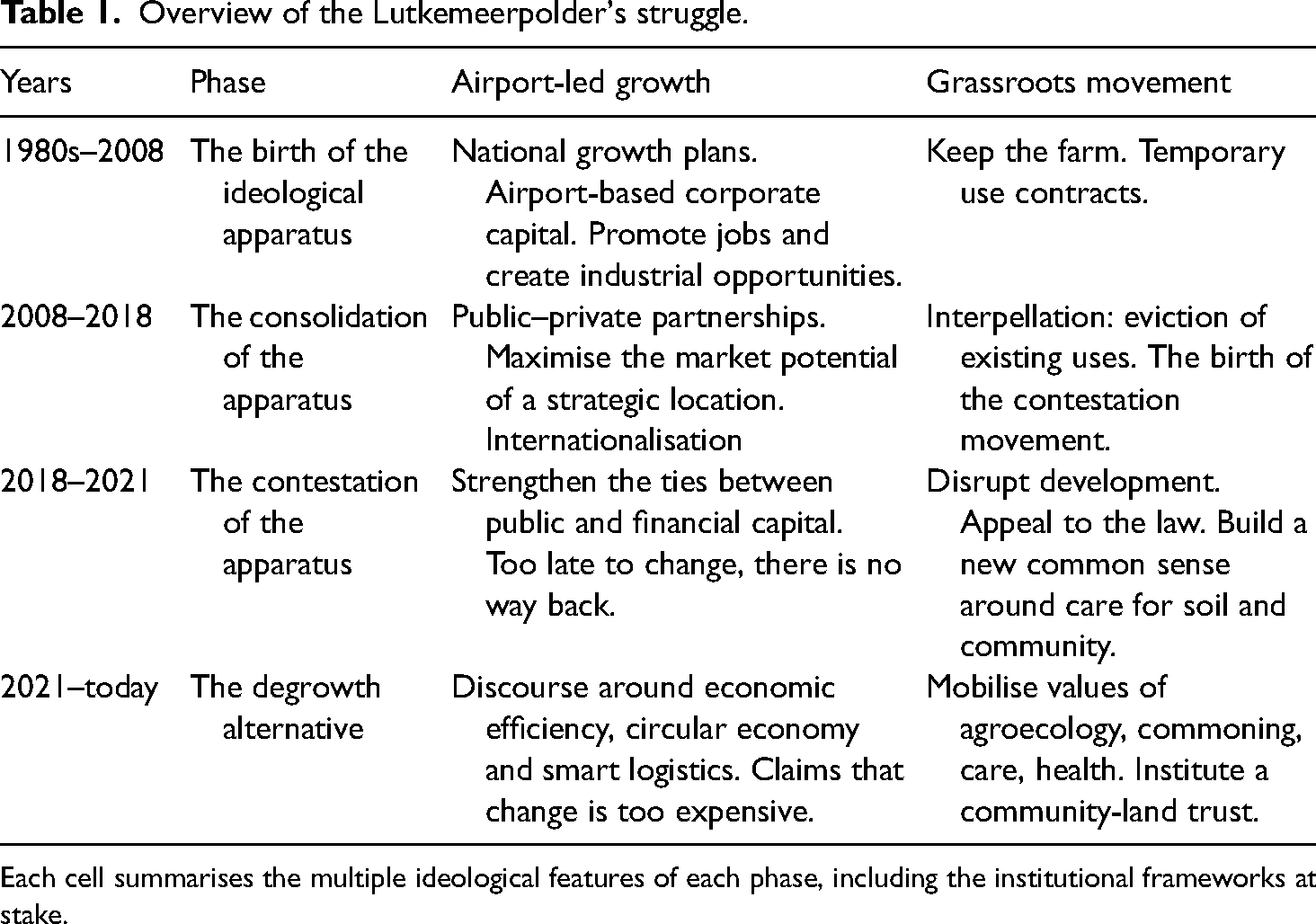
Each cell summarises the multiple ideological features of each phase, including the institutional frameworks at stake.
1980s–2008: the birth of the (airport-related) ideological apparatus
Amsterdam bought the polder's land in the 1950s when it became clear that the site would undergo development for both outward residential projects and the emerging airport industry. In 1987, the SADC was founded (through the Schipholconvenant) by the national government and its other shareholders (see above). This was a response to projections of a 300% increase in flights by 2000 9 and the growth expectations of airport-related logistics. The SADC's creation was justified on the grounds that it would secure cooperation among different public and private parties involved in implementing future business development, as well as ensure future compliance of the municipal authorities responsible for land use planning. The SADC materialised the Dutch government's ideal of the Netherlands as a ‘distribution country’ (distributieland) as expressed in the so-called ‘main port policy’ (Mainportbeleid) and formalised in the fourth national spatial planning framework (see Van Wijk et al., 2014).
These ideals triggered a series of institutional reforms to incentivise land markets in the polder. In 2002, to prepare the site for development, the Municipality of Amsterdam recategorised the polder from agricultural to industrial use. The common belief was that, by developing the polder, it was possible to secure the ‘industrial potential of the areas linked to Schiphol’ and increase ‘employment’ in the Nieuw-West, a poor area. 10 In 2003, the SADC approved the first vision for a business park (Programma van Eisen Deelgebied 3). In this document, the polder is praised for its nature, deemed favourable to future employees’ recreational activities, and ‘business atmosphere’. 11 Between 2003 and 2008, the SADC continued acquiring land in the area, prompting other private investors to buy plots. In this period, the SADC enlarged via a direct transfer of land from the shareholders, despite volatile trends in airport-related activities. 12 These decisions were meant to upscale, extend and lengthen the SADC's profile, despite that economic uncertainty.
In these early years, the institutional tie between local politics and the SADC became stronger, and it progressively locked together public and private interests. The 1990s growth ideology materialised into a regulatory edifice of holdings, contracts, agreements and partnerships that trapped the land's future in a dependence on growth. Yet, these regulations did not yet triggered eviction of existing uses. The Boterbloem, the last farm in the area at the time, obtained a temporary use agreement (bruikleenovereenkomst) that ended upon the start of development. This contract was reportedly secured through a legal escamotage: it was made clear that if it were not signed, any appeal that the farm made to retain its agricultural land would result in its biological shop and workshop being closed too. 13 By ensuring the obligation to vacate the area, the contract secured future compliance with redevelopment. As I now show, this became a matter of legal contention.
2008–2018: the consolidation of the apparatus
The SADC's response to the 2008 Global Financial Crisis emulated the neoliberal approach of most large Western European cities: secure development through contracts and inject public assets (Peck, 2012). To tackle the risk of land asserts being stranded due to declining revenues, the SADC adopted a more proactive approach. Amsterdam's government further tied its interests to the SADC, increasing its shares to 25%, injecting 20 million euros, and transferring responsibility for development and profit claims to the SADC itself. 14 This decision involved the parties making several agreements of cooperation, which further entrenched the growth imperative and exacerbated the repressiveness of the apparatus faced by contesting voices.
A cooperation agreement was signed between the city, SADC and two private landowners in the area (SEKU BV and Slough Estates Mainland BV). 15 This agreement established a new governing body: the GEM Lutkemeer Deelgebied 3, a public-public partnership between the municipality and SADC to manage the land development. The contract also specified that the GEM was obliged to transfer 33% of its future revenues to SEKU BV in return for the latter's land assets. In 2011, the SADC – originally founded to serve airport-related activities – reframed its mission, adopting an ‘international orientation’ toward business parks and enlarging its scope of operations. 16 In practice, it thus became a regular developer. These changes further reinforced the growth imperative within both public governments and private developers. In the years that followed, this made it increasingly difficult for grassroots organisations to challenge the legitimacy of the plans. In effect, it also institutionalised the common belief that proper development of this strategic location must prioritise international markets.
Following these institutional reforms, in September 2008 the Boterbloem received its first eviction notice. Although the use contract that the farm had been made to sign earlier stipulated that this would occur, it was only when the eviction was enacted that interpellation created the political subjects who would eventually coalesce into a movement contesting the entire development.
In 2009, the farm's owner, two journalists and local supporters created the Action Committee Boterbloem (Actiecomite’ Red de Boterbloem). The organisation, which campaigned to maintain 12 hectares of agricultural land, collected 14,000 signatures. That same year, a formal advocacy association (Vrienden van Boterbloem) was formed to attract attention among the local populace. Thanks to these interventions, the Boterbloem managed to extend its use contract for 10 years, until 19 July 2017, when the city of Amsterdam issued a new eviction notice. Until then, this contestation had been locally organised and concerned to protect the farm. In the coming years, it developed into a broader counter-hegemonic bloc, which eventually led to the creation of the Voedselpark Amsterdam.
2018–2021: the contestation of the growth apparatus
In this period, the grassroots movement to protect the polder pursued two distinct strategies. One sought to popularise agroecological use in the area. The other contested the institutional apparatus governing the land, both legally and in the street. In other words, the movement engaged in an ideological struggle on the terrains of both institutions and common sense.
In 2018, activists, led by one inhabitant of the area, formed the association Keep Lutkemeer (Behoud Lutkemeer). Although it was intended to be a legally recognised representative for the whole polder, other parties would never recognise the association as such. In the words of its founder, it became increasingly clear that the specific struggle for Boterbloem Farm might have required compromise with developers ‘because they [the farmers] had too much to lose’, namely their livelihood.
17
Instead, a political struggle had to address the whole polder. Keep Lutkemeer led several public actions in 2018 and 2019. ASEED, a radical, grassroots food justice organisation linked to the squatters’ movement, organised a cycling protest. Organic farmers’ associations parked tractors before the municipal council in response to the threat of eviction. Although in March 2018 the city council debated a motion to retain the Boterbloem and its 12 hectares of farmland, the motion was not carried. In September 2018, grassroots organisations occupied the polder. They faced the ideological state apparatus by enacting disruption. This action (Action Camp Lutkemeer) involved more than 500 people and combined civil disobedience with theatrical shows, music and collective cooking. These activities boosted public dissent around development, as the organiser states: This was the biggest flywheel for the whole diversity of the movement because many came, like Moroccan people from the neighbourhood but also a kind of a hangout for a bit homeless people (sic), but also activists, also the neighbourhood came with their kids. And you know, I think everybody knows, like eating and gardening together is a really good tool to bring people together. And having a place where we could meet, and it was so diverse. From the beginning we started building from this diversity.
18
Six people were arrested during another occupation, mounted in 2019 to stop the eviction of the farm. In 2021, however, the movement won the farm another temporary contract of two years. Further, the movement started exercising institutional pressure within the relevant municipal and provincial councils. The SADC and its subagencies became a target. Between 2018 and 2021, the struggle mutated from a defense of a farm to an oppositional movement against the wider apparatus sustaining the city's economic growth.
In 2018, the Behoud Lutkemeer appealed a zoning plan revision intended to further increase building. The matter of contention was the decision's democratic accountability. The appeal was triggered by a court verdict indicating corruption in the SADC's governing body. 19 The SADC's transformation from a Schiphol-related agency into an internationally orientated developer, the verdict stated, was arranged for private gain by the governing board's chair. 20 After its appeal was rejected, Behoud Lutkemeer pursued an aggressive campaign against various city institutions (described at large in Behoud Lutkemeer, 2022). Its numerous complaints, requests and letters all argue that the zoning plan (from the 1990s) was outdated, did not reflect new knowledge about climate change and lacked democratic engagement. 21 Importantly, these complaints were rejected on institutional, not substantive grounds, with Amsterdam's council arguing that because Behoud Lutkemeer did not own the land, it was not a formal stakeholder in the decision-making process. These responses illustrate both the hold of the regulatory apparatus created since the 1980s and the power of institutional legitimacy, whether it serves or is used against counter-movements.
In 2018, it became evident that the movement was mobilising new ideals of the polder's future and trying to gain public support for them. They tried to garner legitimacy for their ideals in city politics. Its struggle became about institutional recognition rather than substantive plans. From 2018 to 2022, Amsterdam's city council featured a green-left progressive coalition, with an alderwoman (Marieke van Dornick) responsible for planning, land policy and sustainability. She invoked the concept of doughnut economics (Raworth, 2017) as part of an agenda of strengthening the social justice dimension of circular economies and sustainable development. 22 Her urban strategic plan (Omgevingsvisie 2050) further established that to protect green spaces and livability, the city must grow within limits.
Following this intervention, discourses of growth within limits, doughnut economics and circular economy have become the objects of ideological struggle between the different value blocs claiming legitimacy for their operations on the polder. The diffusion of these terms in the city's public debate made it clear to the different stakeholders that the struggle around the polder's future was ideological, not technical. The matter of concern was the definition of those new terminologies of sustainable development. The Behoud Luktemeer movement claimed that those visions clearly demanded a protection of the soil. The council frequently recognised this claim, praising the area's social and ecological values. Yet, the council also rejected their demands, arguing that the city's sustainability required ‘hard choices’ to densify Amsterdam and use its remaining open spaces for housing and economic activities. 23 In these years, the SADC also started invoking circular economies, regeneration and employment in justifying development (see above). The alderwoman eventually proposed a compromise, allowing Boterbloem Farm and CSAs organisations to continue some food production in just three hectares of the polder. At this stage, however, the struggle over the polder was no longer about saving the farm and a few hectares of agricultural land. As I now show, it had mutated into a city-wide conflict around the institutions and values that govern the area (and Amsterdam as a whole).
2021–today: the degrowth alternative
During the last 3 years, the movement against the apparatus governing the polder has developed a propositional trajectory with an agenda, clear institutions and plans. On one side, the movement continued attempting to interrupt the development legally. It kept ‘halting’ of the growth imperative (Chertkovskaya, 2022). They appealed, boycotted and campaigned against developers and their customers. 24 On another, the movement coalesced into Voedselpark Amsterdam, which produced an alternative plan for the polder (Voedselpark Amsterdam, 2023), started to seek consent around it and instituted an alternative institution to govern the land, a community land trust.
At this stage, the contestation increased in scope and focused on the area's overall values and identity. After 20 years of fruitless struggle, the movement began questioning the economic, social and ecological rationale of development more broadly. It accused the city government of wasting money on unnecessary industrial activities while causing increasing damage to human health, the climate, heritage and recreational space (Van Zoelen, 2022). The movement also commissioned a study – titled ‘The natural capital of the Lutkemeerpolder’ – from Wageningen University (Schut and Amelung, 2022) to quantify these shortcomings.
However, the political response once again demonstrated the persistent power of the institutional and regulatory edifices established previously. The municipality cited contracts, plans and agreements, arguing that it was impossible to undo these agreements and that retiring their developer would have ‘irresponsibly high’ financial and political costs (GEM). 25 Unpicking those regulations, the city argued, would reduce investors’ trust in the municipality. Furthermore, the city quantified the loss entailed in changing direction. Although the land is considered worth €4.3 million (€100 per square metre), the council forecast 98 million in losses, 73 million of which was just to ‘buy back’ the land from GEM, a company owned by the city itself. 26 In sum, it is the system of regulations and institutions built over 20 years that has de facto locked the development into a growth imperative.
The city's valuations drew further ideological critique from the movement: while the municipality stressed the monetary loss and need for trust, the movement demanded a revaluation of the polder in social and ecological terms. On 8 September 2023, the movement organised a public meeting to debate the polder's value with municipal officials, neighbours, farmers, activists and the wider public. 27 Given the broad participation, the city agreed to engage in a more systematic ‘joint fact-finding’ mission with the movement to establish and quantify the area's ‘real’ values. The session that took place in February 2023 reveals the struggle between the two sides’ ideologies and the constraining role of institutions. The negotiations indicated that both parties recognised the area's social, cultural, agroecological and economic potential, but interpreted the value of this potential in different ways. The municipality also admitted that the polder was not ideal for logistical industries but indicated that land use plans had already been approved and it was impossible to change these. 28
Overall, this contestation led to a more propositional narrative and the movement started to make this narrative common sense among the public. It organised tours, workshops and events for students, the neighbourhood, children and visitors, testing popular support for alternative values.
29
This narrative also materialised into new institutions. In 2022, an alliance of actors founded Voedselpark Amsterdam was founded (formalised in 2024 as a foundation). Its members were structured into seven working groups, which dealt with various legal, political, ecological and tactical issues. The organisation pays four members a basic income and its members do not live in the polder's direct vicinity.
30
As to its goals, one of the founders has said that: We need to have an alternative. And we need to create a larger coalition. We need to have a different image. Voedselpark must be something that nobody can object to because it's so nice and friendly and cuddly and, you know, totally different image.
31
As an emerging institution governing the land, Voedselpark embodies values of commoning and care. Its goal is political, rather than practical. It works to increase the public legitimacy of an alternative proposition. To that end, it has led several campaigns for healthy food, agroecology and land justice across the city. It frames this struggle as a battle between ‘David and Goliath’. 32 Building on the longstanding defence of Boterbloem Farm, the scope of their actions has significantly increased, such that they now advocate 60 hectares of CSAs in the city.
The first campaign was highly successful. It collected 8000 signatures and €500,000 in donations and gained public traction throughout Amsterdam. Voedselpark features city-wide cultural programs (Pakhuis de Zwijger), engages public intellectuals (including internationally known personalities like David Bollier and Kate Brown), 33 and promotes documentaries screened widely in the city and on national television. 34 In February 2024, the movement also organised an event titled ‘the post-growth city: the future of common-based agriculture and Foodpark Amsterdam’, which brought more than 50 people to the polder and featured speakers from Dutch universities and recognised institutions. Voedselpark will continue campaigning for green spaces across the city (the current campaign is titled Red ons Groen).
By today, then, an advocacy movement for a farm in the polder has mutated into a city-wide counter-hegemonic proposal rooted in various degrowth values. The movement states that: The struggle for the Lutkemeerpolder is not only about the last fertile clay soil of Amsterdam. It revolves around our vision of the future and questions if we are ready (and able) to transform our food system, economy, and society.
35
The proposal to institute a community land trust to run the polder became the expression of this new imaginary. The trust proposes to acquire land from the city at its current price of €100 thousand per hectare (€43 million in total), raising investments from the association's members, or renting it from the city for 50 years. According to the plans, the trust will manage the land and rent it to CSAs. As I have described, the proposal is grassroots-based; centred around democracy, food sovereignty, conviviality, sufficiency and soil care; and inclusive.
Conclusions
Although degrowth research (and practice) is rooted in a critique of capitalism's growth ideology, it does not question degrowth itself as an ideology in the making. Because of this, degrowth scholarship risks essentialising or idealising degrowth, which becomes either the basis of an ideal society alien to people's lives, a purely voluntary choice taken by a few (privileged) individuals, or a (scholarly) agenda without public legitimacy. This article has addressed this problem by tackling degrowth as a nascent ideology and explaining how degrowth values have emerged as part of a struggle for new social institutions.
Taking this perspective, the article contributed to the development of a comprehensive theory of social change in degrowth. Ideology is understood as a system of ideals and values that govern society, functioning as a social imaginary. The ideals and values materialise into institutions and reflect the common sense that renders these values widely perceived as natural. The ideological potential of degrowth stems from the fact that values, institutions, and common sense are never static or fully coherent. Ideology is a field of socio-political struggle.
Through this perspective on ideology, it becomes clearer how growth becomes hegemonic in our society, but also how degrowth emerges as a counter-hegemonic force. Ideology is a set of dominant values that materialises into apparatuses of regulations, plans, governing agencies and physical artifacts that both constrain and shape everyday life. It is through such apparatuses that growth's hegemony persists throughout history. However, ideology is continually contested by social practices that embody different values A degrowth agenda (may) become counter-hegemonic if it engenders a contestation of those institutional and regulatory apparatuses that today lock urban environments into the growth imperative. A social transition to degrowth will inevitably cultivate new values such as care, conviviality and commoning. Yet, these values must also materialise into new institutions and create the popular consent that sees them as legitimate.
The article argued that movements that mobilise degrowth values can gain public traction by challenging the existing institutional frameworks that lock society into the growth imperative. I built on Althusser's notion of ideological apparatuses to elaborate this argument. Institutions materialise ideological values and thus reproduce the growth ideology in contemporary capitalism. Therefore, degrowth values are born within these apparatuses but move against them. Degrowth's radical potential, however, materialises when its practices simultaneously contest growth institutions and propose alternative ones. Degrowth values are mobilised to justify struggles against growth-related institutions and thereby propose new institutions.
The 30-year-long struggle in and for Amsterdam's Lutkemeerpolder, which is still unfolding, traces the genealogy of a degrowth alternative. From resistance to the airport-related growth machine, a grassroots movement evolved into a counter-hegemonic alliance seeking popular legitimacy and mass support. The struggle was ideological because it revolved around definitions of the polder's value. Both of the opposing blocs appealed to the public's common sense (e.g. more jobs versus healthy soil). They both advanced claims regarding the area's economic, social and ecological potential. These were not purely discursive, but either challenged or maintained specific institutions, regulations, norms and procedures. All of this contestation manifested in contracts, business cases and/or funding, producing serried contrasts: community land trusts versus top-down public–private partnerships, alliances versus (public) corporations and commoning versus private property.
Much degrowth scholarship focuses on the socio-ecological potential of everyday practices that mobilise degrowth values. Many such practices align with a political agenda of reduction but within existing state institutions. Approaching degrowth as an emergent ideology reveals how degrowth garners public legitimacy for new institutions to shape socio-ecological practices. Ideology and institutions must be of central theoretical and empirical concern for degrowth scholars, making it possible to appreciate degrowth as a means of radical change, not merely a different lifestyle.
Footnotes
Acknowledgements
The author would like to thank Iana Nesterova and Ritika Dagar for the careful help with the submission, and the three anonymous reviewers for their useful comments. The empirical work for this paper was carried out with the help of Emma Griffith, Johanna Waldenberger and Mirte Jepma at the University of Amsterdam. A preliminary idea of this paper was conceived in conversation with Julien-François Gerber, from the Erasmus University Rotterdam. A special thanks to all the interviewees that took part in the study.
Declaration of conflicting interests
The author declared no potential conflicts of interest with respect to the research, authorship and/or publication of this article.
Funding
The author disclosed receipt of the following financial support for the research, authorship and/or publication of this article: This work was supported by the H2020 European Research Council (grant number DECYCLE, award number 101039545).
