




Abstract
Ours are Days of Decision and it's indispensable to transform our technics. For it, we must abandon the inherited conception of technics based on neutrality and autonomy. To this end, in this article we develop a socio-historical ontology for technics that argues: (a) To understand technics we have to take into consideration technical objects, handling, and the degree of guidance of the animal user. (b) Each technics is inseparable from its society. (c) The idea of a free use of technics is illusory. There are always unexpected impacts and various uses of a given technics. (d) Technologies of the Capitalocene are imperial. (e) Technologies have acquired a destructive inertia and we have the obligation to understand technological development as a political phenomenon. (f) In order to go beyond the Capitalocene and advance towards Degrowth, we have to move from imperial technologies to humble technics.
Introduction
Our world is undergoing a multidimensional crisis (ecology, economy, care, climate, politics, ethics, energy, etc.), a world that surely won’t be able to sustain business as usual for long (Dandy, 2021). To describe this new scenario of a general overshooting of planetary boundaries (Steffen et al., 2015), some have proposed adopting the notion of the Anthropocene (Steffen et al., 2011). However, in this text, we prefer to use, following Jason Moore, Capitalocene (Moore, 2015).
This concept is more accurate rather than Anthropocene because it emphasizes the connection between the current crisis and a particular economic system: capitalism. Moreover, it shows that the current breakdown of social and ecological systems is the result of the permanent search for economic growth based on domination—of nature and human beings, and particularly of the colonial periphery (the Global South), and women. The value of capitalist products is constructed through the “cheapening” of nature, bodies, and labor. The notion of the Capitalocene unifies both Brand and Wissen's critique of our mode of living, which they conceptualize as imperial (Brand and Wissen, 2021), and Hornborg's (2001) critique of technology, which we will analyze later on.
Although a more complete understanding of the current crisis would require the study of a multitude of elements, in this article, we will focus on one of them: technics. Some of the most important elements of the crisis of the Capitalocene are somehow related to technical change: the spread of computerization and its impact on the social and economic fabric, contemporary warfare, the current anxiety about securing access to the resources and energy, climate change and the use of fossil fuels, and so on.
However, despite the social centrality of technics, social reflection upon them remains insufficient. Commonly, in public debate phenomena are studied in a piecemeal fashion, a positive prejudice predominates in relation to any new technics; its unforeseen effects and social costs are overlooked and, more importantly, the links between capitalist domination, economic growth, ecological destruction, and technological development is obscured. None of these analytical failures is accidental. They flow from assumptions and prejudices that form an inherited conception of technics whose two main features are neutrality and autonomy.
One can speak of neutrality in social and/or moral terms. Authors such as Winner (2001: 4–7) and Mitcham (1994: 108) argue that historically, technics have been considered neutral, that is compatible with any kind of moral or political purpose. Technics have been therefore considered as a simple amplifier of the ends of other social institutions. One of the consequences, as Castoriadis (1998a: 248–249) has pointed out, is to assume the free use of technics. In short, is to see technics as neutral, as a collection of mere tools that a user can employ as he pleases and that “have no politics” (Winner, 2001: 19; Alonso and Arzoz, 2021).
The idea of political and ethical neutrality is deeply connected to an ontological neutrality. In the framework of Greek thought, techne was understood as a process of production in which product was the key. The logos only intervened in capturing the form; there was no logos of techne. The contemporary notion of technics inverts this structure. Today technics is commonly understood as a pure logos, as a procedure that can be applied indistinctly to any type of form or eidos (Mitcham, 1994: 128). From this ontological framework technics are a pure tool that implies no end in itself. And, again, what is important is the user and the ends that he or she imprints on it.
A third belief about technics still very popular in public discourse considers it an autonomous reality, independent of historical processes. According to this notion of technological determinism, social changes are nothing more than the reflection of technological changes, which are themselves socially autonomous (Marx and Smith, 1994). The most important version of this determinism is the myth of the linear and continuous progress of technology. According to this myth, all technological change is always positive. Moreover, such progress cannot be slowed down and has its own, automatic dynamic, to which society can only adapt (Winner, 1977; Winner, 2001).
In conclusion, we can identify four elements in the inherited conception of technics: (a) technics can be freely used; (b) technics is politically and ethically neutral in terms of usage; (c) users are the key element to study technics from a social perspective; and (d) there is a positive bias towards technical change that makes it very difficult to perform critical analysis around it.
Ours are “Days of Decision” (Spash, 2020). To come out of them with the least social and ecological damage our priority should be to set in motion a transformation of our societies and technics. And, from our point of view, this task requires abandoning the inherited conception of the neutrality/autonomy of technics, which inhibits our reflection and action.
The critique of this inherited conception is found in the genesis of multiple fields of work, including the philosophy of technology, science and technology studies, and much anthropological work on technology as well. In fact, the idea that it's important to resist a neutral/autonomous understanding of technology is central to many influential perspectives and authors that we will not consider here due to space constraints: critical theory of technology (Feenberg, 1999; Feenberg, 2017), actor-network theory (Latour, 1999; Latour, 2017), Borgmann (2006), postphenomenology (Ihde, 2009; Rosenberger and Verbeek, 2015), the social construction of technology (Bijker et al., 2012; Oudshoorn and Pinch, 2005), or feminist new materialism (Coole and Frost, 2010).
Without aiming to be exhaustive or absolutely original or being able to render the full richness of the debate that has emerged from the abandonment of the inherited conception, the humble aim of this article will be to present a socio-historical ontology of technics based on the work of some of the people who have argued that technics is neither neutral nor autonomous. The goal is to construct a framework of analysis for technics that can also be used for a critical account of Capitalocene's technics, that we propose to call technologies.
Towards a definition of technics
Since technics have been present in human societies at all times and places, it is indispensable to provide a general ontological overview of them, which could apply to other animals. We will not explicitly discuss this matter here except to say that a number of studies evidence that birds, fish, and non-human primates are perfectly capable of making and using tools (Shumaker et al., 2011).
There is an extensive background of research and insights on technics from a wide array of fields, including engineering, physics, anthropology, mythology, literature, paleontology, history, or philosophy. Such theoretical production has broadened the meaning and scope of technics.
In the first instance, it seems reasonable to associate the notion of technics with technical objects. In Technics and Civilization, Lewis Mumford (1934) defined technics as the whole range of elements and devices manufactured for a specific use. Within these technics, Mumford provided a categorization: utilities (roads or buildings), utensils (cooking pots or mortars), apparatus (brick kilns), tools (hammers or needles), and machines (bow drills or lathes). Tim Ingold (1987) broadened the scope of this definition by adding that technics are all instruments harnessed for the intentional project of an agent, whether a human or non-human animal.
This reduction of the notion of technics to technical devices or instruments has been, nevertheless, criticized by anthropologists, for example André Leroi-Gourhan (2014) and philosophers such as Gilbert Simondon (2016). Working from different contexts, these writers pointed out that technical objects cannot be detached from the handling, procedures, and practices related to the use thereof. Think of a bow. Without assimilating how to use it after a demanding training or practice, bows will be of no use. A proper way of handling is crucial for turning objects into technics.
The importance of use and handling underlies classic definitions of technique, for example Mauss's definition: “A technique is any set of movements or acts, usually and mostly manual, organized and traditional, combined to achieve a known physical, chemical or organic goal” (Mauss et al., 2012: 412–13). Mumford's categorizations are also use-oriented or purpose-driven: whereas apparatus and utensils are aimed at performing chemical transformations, tools and machines operate through physical and mechanical transformations.
A more extended and complex categorization of technics was proposed by Carl Mitcham is his book Thinking Through Technology (1994: 185), which offers a scale distinguishing between different kinds of technics regarding the form of the immediate source of guidance. For this purpose, he drew from Ivan Illich's (1980) distinction between hand tools and power tools.
At one end of his scale Mitcham located hand tools (e.g. a hammer) which, like premodern machines (e.g. sailboat), are guided by an individual human being. The first change arrives with modern machines (e.g. all mechanical machines based on steam). In these, the human body begins to be displaced as the sole guide and shifts to the role of operator or manipulator. Instead of direct experience and sensitive information derived from the use of the tool, modern machines require a mechanical science capable of offering a new basis for judgment and give birth to the engineer.
This dynamic of decentering the human is deepened but also complexified in the case of power tools. If in modern machines mechanical controls were introduced, now they are joined by electrical controls. The role of the engineer, who uses mathematics to shape these controls, becomes increasingly important. At this point, the partial automation of certain processes becomes possible, placing the human being in an even more subordinate position (perhaps reaching its apotheosis in the production line—say, the production line of Chaplin's Modern Times.) But, in cases such as electric appliances, the human being paradoxically recovers a centrality as a user that was impossible in steam-based machines. At the extreme end of the scale designed by Mitcham, we would find cybernetic devices, in which guidance now rests entirely on electronic controls. The human being is completely removed from operation, although still involved in design and maintenance.
If we recall that until modern times all existing technics were hand tools or premodern machines, both guided by individual human beings, it is perhaps easier to understand the central role assigned to the user in the inherited conception of technics. This shift in the role of human beings in guidance can also be interpreted in terms of a loss of autonomy (Berlan, 2021), a crucial element in order to think politically about both current technics and their possible transformation.
Mitcham complements the previous classification with an analysis of the immediate sources of energy that allow technics to function. Hand tools only require the energy of individual human beings, while premodern machines undergo a change of scale, functioning either with groups of human beings (as in the case of a large boat), or with one or more animals (e.g. oxen pulling a moldboard plow).
Many authors have identified one of the most crucial metabolic breaks (González de Molina and Toledo, 2011) in the human history with the appearance of modern machines (Mumford, 1934). They are inseparable from the birth of capitalism and coupled with its desire for economic growth (Musso, 2017). First, they were sustained by massive deforestation. But wood was soon complemented with machines capable of productively harnessing the force of inanimate nature (windmills or watermills).
However, the limitations of this “raw” use of natural forces proved insufficient for capitalist greed. Hence, nature began to be technologically controlled first via heat engines and, later, via electrical devices. This is the deep reason behind “the choice of fire” (Gras, 2007) that Western society made a century and a half ago—a choice that, to this day, we have not abandoned. Since coal was massively introduced we have not experienced a single energy transition, understood in terms of a global substitution of one energy source by another (Fressoz, 2021). To sustain the power tools that are spreading everywhere and the cybernetic devices (e.g. computers, robots or phones) omnipresent today, we have added more and more energy sources: oil, nuclear, natural gas, industrial renewables, hydroelectric… But none of them has ever been abandoned.
It is clear that from this choice of fire stems much of our current ecological and social crisis. On the other hand, the trajectory outlined above points to the tremendous challenge that going beyond the Capitalocene would imply: reverse an energy dynamic that has been in place for almost two centuries (Jarrige and Vrignon, 2020). And yet, it will be impossible to find a way in our Days of Decision without facing this challenge.
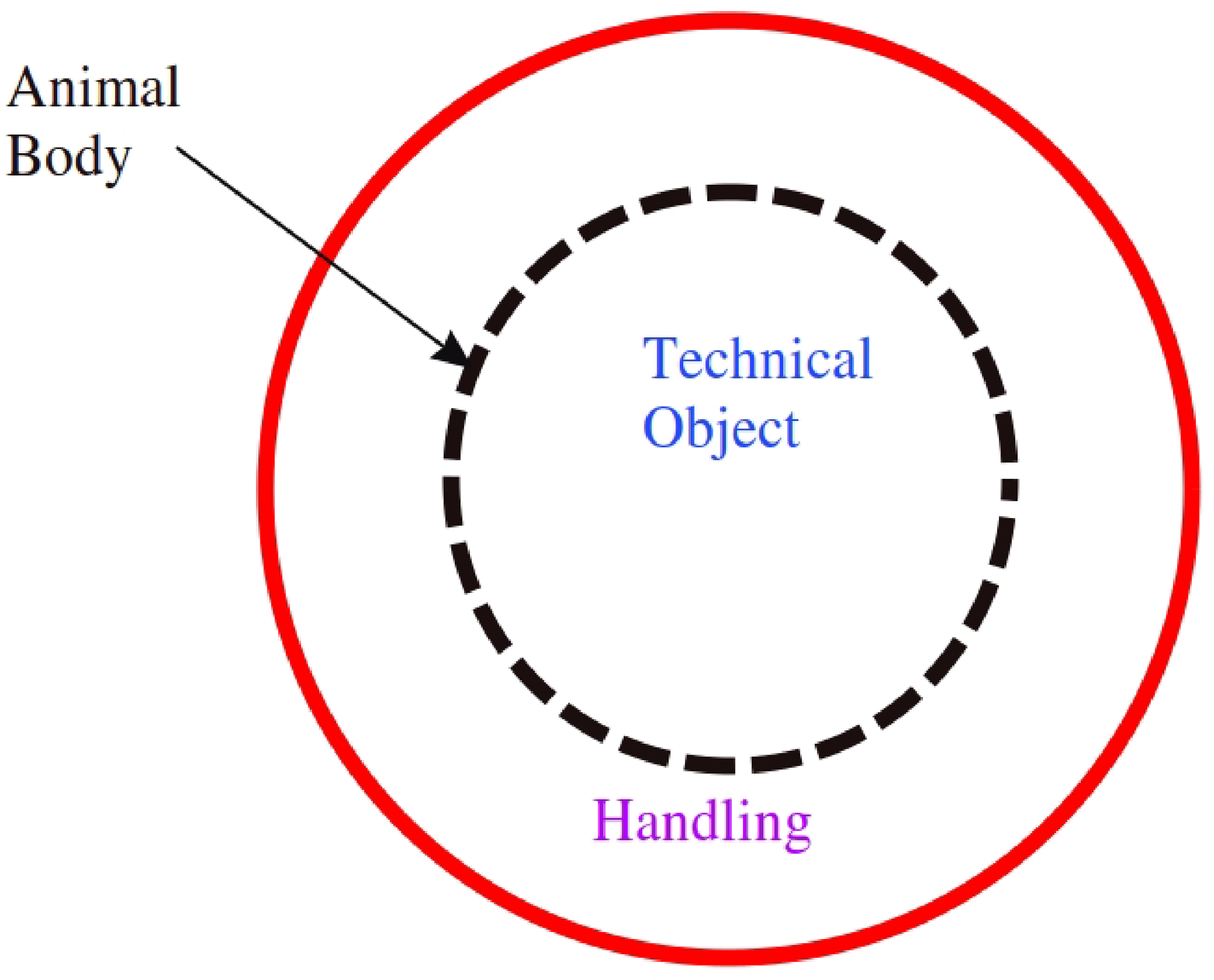
Diagram of technics' elements.
The technical sphere
Figure 1 tries to synthesize the basic elements of any technics as discussed above. It comprises the technical object or device itself, animal user, and the handling, material practices related to those objects. We could further break down the latter category into practices related to (a) production/manufacturing and (b) usage or handling. However, we will consider manufacturing as part of usage, since the manufacturing of technical objects ultimately entails using other devices for the manufacturing process.
Nevertheless, some precautions are in order. In this scheme, some borderline cases exist. We could think first of technics in which use is not very important or specialized, e.g. houses. Once built, a house requires no specific handling whatsoever, at least if compared with playing a musical instrument or handling a needle. However, even a house needs maintenance and care in order to be inhabited properly. And maintenance and care are far from being unskilled activities and are usually technically mediated.
Another borderline case would be what Mauss called techniques du corps. (Mauss et al., 2012: 365). According to these body technics, the body is not the agent acting on an external object. Rather, the body is the instrument itself. As exemplified by dancing or yoga, these techniques can be defined as sets of moves. Another way in which the animal body can be displaced is, as we have seen, to replace it with machines. These are able to “capture’ and “fix” the handling in mechanical or electronic controls at the cost of increasing the energy expenditure necessary to use the technique and becoming dependent on engineers and scientific knowledge.
In any case, it is necessary to go further. Going back to the bow, if we simply examine its shape or components, on the one hand, and the aiming and shooting technique, the way of carrying the bow and arrows, or the moves of professional archers, on the other, we would still know barely anything about what the bow actually is within its social context. Perhaps it would be necessary to extend our study to cover things like the relationship between the bow and the practice of hunting, which is some societies are associated with a privileged social status Moreover, the bow cannot be defined without considering other technics like the arrows or the instruments used to carve wood. This definition's shortcomings are even more noticeable regarding technics whose symbolism has more weight than their instrumental dimension or usability (e.g. jewels).
We are therefore forced to broaden the scope of our definition of technics introducing a new element: the “technical sphere.” There we will include economic, political, symbolic, and imaginary (Castoriadis, 1998b) relationships within society along with other technics tied to the relevant object's handling and manufacturing process. Accordingly, a given technics technical sphere should include a significant part of the social package surrounding it (Figure 2).
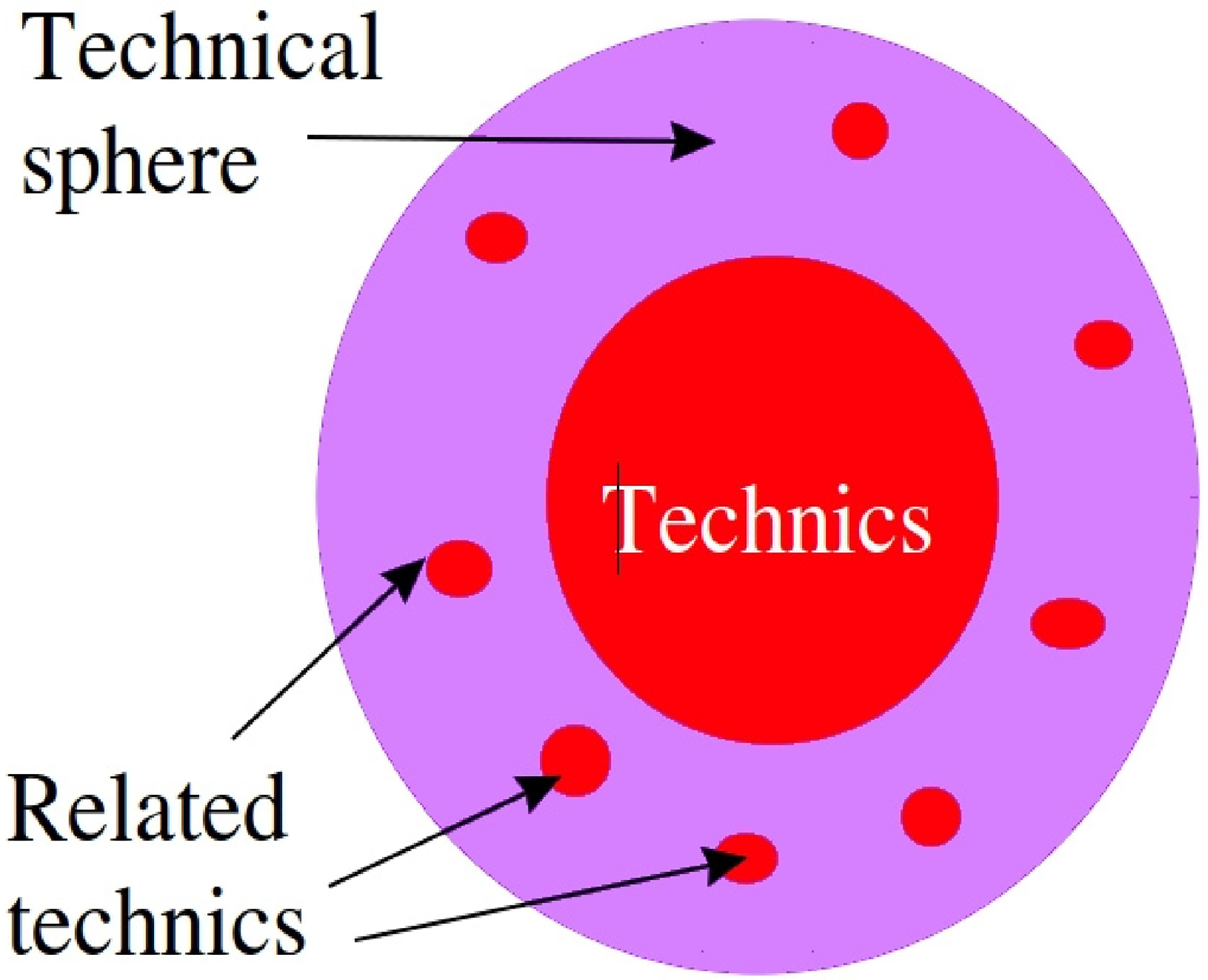
Technical sphere.
In fact, this is why we refer to a socio-historical ontology for technics. The essential nature of a technics, i.e. the core of its ontological definition, is society. Technics are an expression of ways to understand, embrace, and find a place in the world. Far from the idea of technics as simply material and inanimate objects (Jasanoff, 2002), they must be construed as pieces of matter comprising moves, actions and practices, but also wishes, beliefs, assessments, institutions, power relationships and struggles, as well as individual or social constructs and imaginaries (Alonso and Arzoz, 2002). These pieces of matter are tied to other pieces and fragments, including animal bodies, within the broad network provided by their respective technical spheres. It follows that the inherited conception of technics as neutral objects is misguided. Technics are most certainly not neutral (Winner, 1977).
Implications of a socio-historical ontology
The above insights have deep epistemological and practical implications. The bow in a community was a simple example. However, at a small scale, it showed that a genuinely social interpretation needs to take into account a significant part of that community's political, economic, and religious structure. What if we had to come up with a more complex socio-historical ontology like that of a smartphone?
First, we would go over the mining and extraction processes needed to obtain coltan, lithium, and other scarce materials to manufacture the phone (Merchant, 2017). Then, we would have to examine the quantity and distribution of minerals across the Earth's crust along with the social relationships in China and in many Latin American and African countries. In particular, we would have to think of (a) the asymmetry of power; (b) labor conditions; or (c) the extraction-oriented political framework in place (Gudynas, 2015).
Shortly after that, we would reflect on the globalized production processes. A meaningful analysis would require fully understanding (a) international transport and trade; (b) the speculative dynamics of funds and financial markets; (c) how workers in certain factories like Foxconn (Chan et al., 2020) are almost enslaved; or (d) the central role of fossil fuels in our metabolism (Heinberg, 2011). This reflection will most certainly not suffice if it fails to consider large software designing companies like Apple along with other aspects, including the role of these companies in political decision-making; how their very existence undermines democracy; the role of smart phones in the new global surveillance plans and big data analyses; and their major impact on institutional and personal relations (Zuboff, 2019).
On top of that, cell phones cannot be detached from many technical objects with their own impact and technical spheres: antennae, satellites, chargers/batteries, the grid, Internet servers, etc. Also, note that smartphones have a short lifespan by design. They soon become obsolete or even technological junk, which cannot be understood without really examining the actual context of geopolitical inequality, allowing toxic e-waste to end up in countries like Ghana (Chandrasekhar, 2022), polluting the air, water, soils, and those responsible for processing it.
Not even now can we claim that we have been comprehensive or thorough. We have barely touched on central aspects, like the major role of smartphones in social-identity building and its role in the attention economy, how they fuel social constructs like the idea of “progress,” or smartphones considerable impact on the world's computerization (Groupe Marcuse, 2019). However, the previous analysis clearly shows that the technical spheres of what we will call “technology” can be huge, covering ecosystems and societies across the world.
From the perspective of socio-historical ontology, thus, we have to abandon the first assumption of inherited conception of technics: free use doesn’t exist regarding technics. Since they are a constituent, inherent and non-removable element of society, they cannot be isolated and allocated to a completely different purpose (Castoriadis, 1998a: 306). Every technique individually, and, most certainly, the totality of all technics, will impose its technical sphere, including practices, skills, material requirements, infrastructures, training, constructs and imaginaries, and social purposes. The inseparability of technics and their associated spheres clearly demonstrates their non-neutrality, or in other words, the socio-historical nature of technics.
A socio-historical ontology of technics is also incompatible with the second assumption of inherited conception: technics cannot be consider politically and ethically neutral in terms of usage. Undoubtedly, evolutionary or morphological studies of technical objects are always instructive, but the socio-historical approach requires a shift in the focus of our research. The subject-matter of a socio-historical ontology of technics must cover all technics within a given society as well as that society as a whole.
The best way to understand how technics are subject to the relevant society's political an ethical purposes—these purposes being embodied in technics—is to focus on the ties between society, individuals, and technics. On the one hand, social individuals are the result of the intersection between a given psyche and a given society (Castoriadis, 1998b). Just like technics, individuals are social creations where society's institutions, values and constructs rest and reproduce. That's what Bourdieu (2019) tried to capture with his notion of habitus.
On the other hand, individuals create technics. However, it would be wrong to assume that just because individuals are the creators of technics they are entitled to determine, once and for all, the possible purposes and uses of such objects. First, because when individuals come up with a given technique, along with the purposes the individual embeds in the object, many other social values or purposes “slip in” involuntarily or even randomly. Indeed, this is one of society's basic silent reproduction mechanisms. Second, once built, technics could always (a) have an unexpected impact and (b) be subject to uses different from those for which they were conceived (Ellul, 1964).
Additionally, given that technics are deeply embedded in the social construction process of individuals and social needs, it is obviously delusive to treat them as mere means to ends different and independent from themselves. Individuals are part of many technics’ technical spheres. Individuals are not rational, autonomous and self-sufficient users who freely put technics to use. Rather, individuals are actually shaped by technics. When creating and using them, individuals are also creating and shaping themselves. The hunter-craftsperson creates a bow by building it and uses it in his/her daily life, but, simultaneously, the bow is shaping the hunter-craftsperson to the same or to a greater extent. The bow changes the way the hunter walks, gazes, conducts him/herself, and it also affects his/her outlook on the world, social awareness, clothing, eating habits, and many other aspects. Accordingly, what individuals and society as a whole consider a social need, beyond any physiological needs to survive, is always affected by society's technics (Castoriadis, 1998a: 304). For all these reasons, the third assumption of the inherited conception is also nullified. Society, and not the users, is the key element to study technics from a social perspective.
In fact, societies often set goals they can achieve with their available means or reasonably and steadily projecting those means into the future. This is still another way in which technics can’t be considered neutral: they play a crucial role in setting goals for a society and, therefore, also in preventing some processes of change from occurring when they are considered to be outside of what technics have made desirable or possible.
However, the close ties between technics and social and individual purposes should not be considered deterministic. Not all human beings carrying and using bows would be equal just for that reason. The construction process of individuals and social standards is a complex social process affected by a myriad of factors, including economic, political, and religious aspects. But there is no doubt that technics is one of these factors.
Lastly, the socio-historical nature of technics does not entail that technics cannot be passed on from one society to another. Every technics has a rational dimension allowing for his universalization (Castoriadis, 1998b). The logical sequences and rationales underlying all technics, e.g. the set of pieces to assemble an engine or the operating instructions of a lathe, can always be (a) understood beyond their cultural framework and (b) eventually reproduced.
This does not prevent that the appearance of a new technics always entails the qualitative transformation of the society receiving it. Neil Postman (1998) addressed this when noting that “[t]echnological change is not additive; it is ecological.” When a new technique makes its appearance in a given society, the result is not the old society plus a new device. Rather, we have a different society, just like a drop of red ink in a glass of water spreads throughout the water and results in colored water, not in the water plus the drop of ink. Similarly, as discussed above, an individual coming up with a new technique does not give rise to the same individual and the new technique, but to a transformed individual. Although the level of change associated with each technique is undoubtedly varied (a television set is more transformative than, e.g. a device for making ice cream at home), all technical change implies social change on a greater or lesser scale.
Capitalocene's technics: technology
Throughout the article we have been using the notion of technics and not that of technology. This is because we have preferred to reserve the latter term, as we have done in previous works (Almazán, 2021), to name the type of technics characteristic of our capitalist and industrial societies. In Mitcham's classification, technologies will comprise modern machines, power tools, and cybernetic devices. The proposed socio-historical ontology of technics could be used in order to analyze different technologies. But since we have neither the time nor the space to address the study of all the technologies in the same way as we have done in the case of the smartphone, we will focus in Alf Hornborg's analyses. He has identified elements shared by all technologies that should, therefore, be part of any socio-historical ontology that could be elaborate in the future.
In his analysis of the unfolding of the Capitalocene over the last two centuries, Hornborg shows that it is inseparable from the hegemonization of a set of technologies that are always and everywhere the product of an unequal distribution within the global society. In particular, the degree to which a technology is adopted is coupled to the distribution of money in the world-system, which implies that it can never be egalitarian under capitalist relationships. But what is more interesting: technology itself already implies an unequal exchange of resources between different segments of the global society. It assumes, in fact, an asymmetric flow of embedded human labor and natural space that is established between sectors for which these goods have different prices (Hornborg, 2014: 12).
From this point of view, the fourth element of the inherited conception, that conceived technological progress as always positive, is strongly disproved. If we follow Hornborg we should rather understand “technological progress” as an index of capital accumulation and unequal exchange. Moreover, if Capitalocene is inseparable from the institution of new imperial ways of life (Brand and Wissen, 2021), Hornborg allows us to note that technologies that have “structured” Capitalocene should be considered “imperial technologies”. They are inseparable from impoverishment, colonial domination, and the extension of extractivism (Gudynas, 2015) in the Global South.
Imperial technologies have thus institutionalized a destructive form of collective irresponsibility. As the reproduction and sustenance of life at all levels (food, housing, transportation, clothing, etc., but also parties, dreams, decision-making, conflict resolution, culture, etc.) have become coupled to them, our everyday life has become a stack of Promethean gaps (Anders, 2002). Perhaps the most substantive dimension of this irresponsibility has to do with the deep link between fossil fuels and current imperial technologies. By naturalizing, extending a whole set of machines which have become indispensable to our subsistence, such as power tools and cybernetic devices which rely on fossil fuels and produce changes in climate, we have displayed an imperialism that reaches even future generations (Jonas, 1984) and other species.
The massive displacement of humans by machines and the way these have shaped social needs have also made technologies to acquire an enormous inertia that increasingly limits what we can or cannot do as societies. Today there is an organic interconnection between all technologies. That means that, once a certain technology has been introduced into society, it is not so easy to simply do without it. Consider cars. Cars would be impossible without a multitude of other technologies, e.g. oil extraction and refining technologies. In addition, thousands of jobs all over the world depend on car technology. To make it even worse, a large part of our territory is designed for cars. Since the 1960s, the city has undergone an integral destructuration that has disfigured both its physiognomy and its functional organization. It is no longer organized to be walked in but rather to be driven through (Robert and Dupuy, 1976). Modern land use planning, which took the car as a technology destined to be eternal and as an unquestionable factum, organized the territory by segregating different spaces and assigning them to a single function (Harvey, 2005). Moreover, the car has become for many a substitute for their own motor skills, an extension of their own body (Illich, 1974).
In view of the above, it is impossible to simply state than from now on we will dispense with the use of cars. Although we are aware that greenhouse gas emissions put us on the brink of the civilizational abyss (Masson-Delmotte et al., 2019), the enormous organicity and inertia that a technology such as the car has acquired in recent decades makes doing without it a major challenge. The car clearly shows us that technologies are non-neutral and shape our lives and societies, even though not everyone uses them and regardless of how we use them.
This deep inertia and organicity, this social and historical nature, and the interconnection that exists between technological development and the economic and political interests of industrial capitalism is what should make it clear to us that by no means is there automatic, natural and always positive progress, as the fourth assumption of inherited conception assumes. The development and extension of a given technology is an absolutely political decision. Capitalist societies do not exist aside from their technologies and the foundations of a long-standing socialist claim, i.e. that communism would entail putting all capitalist technologies at the people's service, can no longer be sustained. Capitalist society is, inter alia, its technologies. These are an essential dimension of it, not just any means to any ends. Therefore, as examined below, if we want to build Degrowth (González Reyes and Almazán, 2023) societies and individual subjectivities that goes beyond capitalism, it is imperative to abandon our imperial technologies and replace them with new ones.
Conclusion: beyond technology, towards Degrowth
In this article, we have shown how, if we want to have any chance of making the right choices in the Days of Decision that we are living in, we have to move away from the inherited conception of technics, that can be summarized in four points: (a) technics can be freely used; (b) technics is politically and ethically neutral in terms of usage; (c) users are the key element to study technics from a social perspective; and (d) there is a positive bias towards technical change that makes it very difficult to perform critical analysis around it.
To this end, we have developed a proposal for a socio-historical ontology for technics which can be summarized thus:
To understand technics we have to take into consideration technical objects, their handling and the degree of guidance retained by the animal user. The latter is linked to the degree of energy consumption of different technics. Each technics is inseparable from other technics that are linked to it and, above all, from the set of economic, political, imaginary, etc. relations that characterize a society. We cannot consider society and its technics independently. To a large extent, technics are also the society in which they appear and exist. In the same way, they shape the needs, desires, and goals of its inhabitants. The idea of a free use of technology and, therefore, of its compatibility with a completely different social orders is illusory. When a society embraces a new technology, it is altered in a way that is not additive, but ecological. Moreover, there are always unexpected impacts and different uses of a given technology, so we cannot embrace the idea of a techno-scientific solution to all our socioecological problems. Technologies should be considered “imperial” since they are inseparable from an unequal exchange of time, energy and materials. Moreover, being composed of modern machines, power tools and cybernetic devices (in contrast to hand tools or premodern machines), they are inseparable from an abundant access to energy and, in particular, from fossil fuels. They are therefore imperial in a second sense: the natural destruction they create implies intergenerational and interspecies injustice. Technologies have acquired an enormous destructive inertia and, if we do not want to expose ourselves to the risk of great social and civilizational discontinuities, we must understand technological development as a political phenomenon. Social change beyond Capitalocene implies a move away from imperial technologies.
In addition, we have defined technologies as Capitalocene's technics. This has the following implications:
Taking all this into consideration we can conclude that in these Days of Decision, it would be unwise leave the solution to our problems in the hands of the New Prometheans (Keary, 2016) which reproduce the inherited conception of technics. A pervasive techno-optimistic vision (Alexander, 2014) promises to find a way out to Capitalocene simply through a set of technological transformations controlled from above and ridden by a narrow vision of efficiency. The current project of green and digital transition and, in general the partisans of growth's projects (Spash, 2021), are far from offering a real solution and risk deepening the destructive trajectories of Capitalocene.
It has been argued for several decades that one of the most promising ways to exit the delirium of capitalist economic growth and industrial domination of the Capitalocene and, at the same time, guarantee sustainability, global justice, equality, and autonomy is Degrowth (Kallis, 2018) (González Reyes and Almazán, 2023). Degrowth proposes to carry out very profound political transformations that move from the paradigm of efficiency to that of sufficiency (Alexander, 2014). Degrowth means equitably downscaling wealthy societies’ throughputs of materials and energy. It entails reorganizing the economy to meet people's needs regardless of what happens with GDP. It brings together diverse critiques of economic growth and its pursuit: growth is absurd, unnecessary, unsustainable, homogenizing, destructive, exploitative, and uneconomic. Scholars of degrowth call for collective self-limitation, through politics, to reduce resource use and avoid transgressing planetary thresholds beyond which lie an inhospitable Earth system. Such limits, they argue, can open space for diverse conceptions of the good life and how to pursue it (Bliss and Kallis, 2022).
As an indispensable part of these transformations, we need to reverse the current situation in which our capacity to influence the direction of technological development is basically nil. A direct conclusion from what has been developed so far is that there can be no Degrowth without going beyond imperial technologies and building new technics. We have addressed the characterization of this technics for Degrowth, that we propose to call “Humble Technics”, elsewhere (Almazán, 2023). Nevertheless, and as a closing remark, we can affirm that to think and build this Humble Technics we would at least have to:
Drastically reduce the huge amount of energy that technologies (modern machines, power tools and cybernetic devices) consume today and complete eliminate fossil fuels. In contrast, prioritize the direct use of Sun's energy in all its forms (sun, water, wind, etc.) over the technologies that use it to produce electricity (e.g. industrial windmills or solar panels). Reduce the number of technologies in our daily lives and stop the erosion of social and personal autonomy which the imply in our societies. In order to do this, small scale technics (Illich, 1980) should be promoted and the mechanical and electrical controls designed by engineers should lose their centrality in favor of human beings. We should also recover and design new hand tools and premodern machines (Atelier Paysan, 2021). Only these can be adapted to the metabolic requirements of Degrowth, go beyond the injustice of imperial technologies, allow the reconstruction of our autonomy (Berlan, 2021) and, moreover, interrupt and reverse the ecological destruction of the Capitalocene. Overcoming the current dominance of experts and the centrality of technological solutions in order to set in motion broad and democratic transformation processes which could change society in all its spheres.
Footnotes
Funding
This article was developed with funding from the following projects: European Union’s Horizon Europe research and innovation programme under the Marie Skłodowska-Curie grant agreement No 101086202 - Speak4Nature - HORIZON-MSCA-2021-SE-01; Energy humanities. Energy and socioculturalimaginaries between the industrial revolutions and the ecosocial crisis (ENERGEHUM) - PID2020-113272RA-I00/AEI/10.13039/501100011033 and Ecological Humanities and ecosocial transitions. Ethical, esthetic and pedagogical proposals for the Anthropocene, whose principal investigators are José Luis Albelda Raga and Paula Santiago (both from the Art and Environment Research Center of the UPV, Polytechnic University of Valencia). Reference: PID2019-107757RB-I00.